Creating a Sleep Sanctuary in Your Bedroom
You can significantly improve your sleep quality by transforming your bedroom into a sleep sanctuary. Learn to identify and fix environmental factors like light exposure that sabotage your already-limited sleep hours.
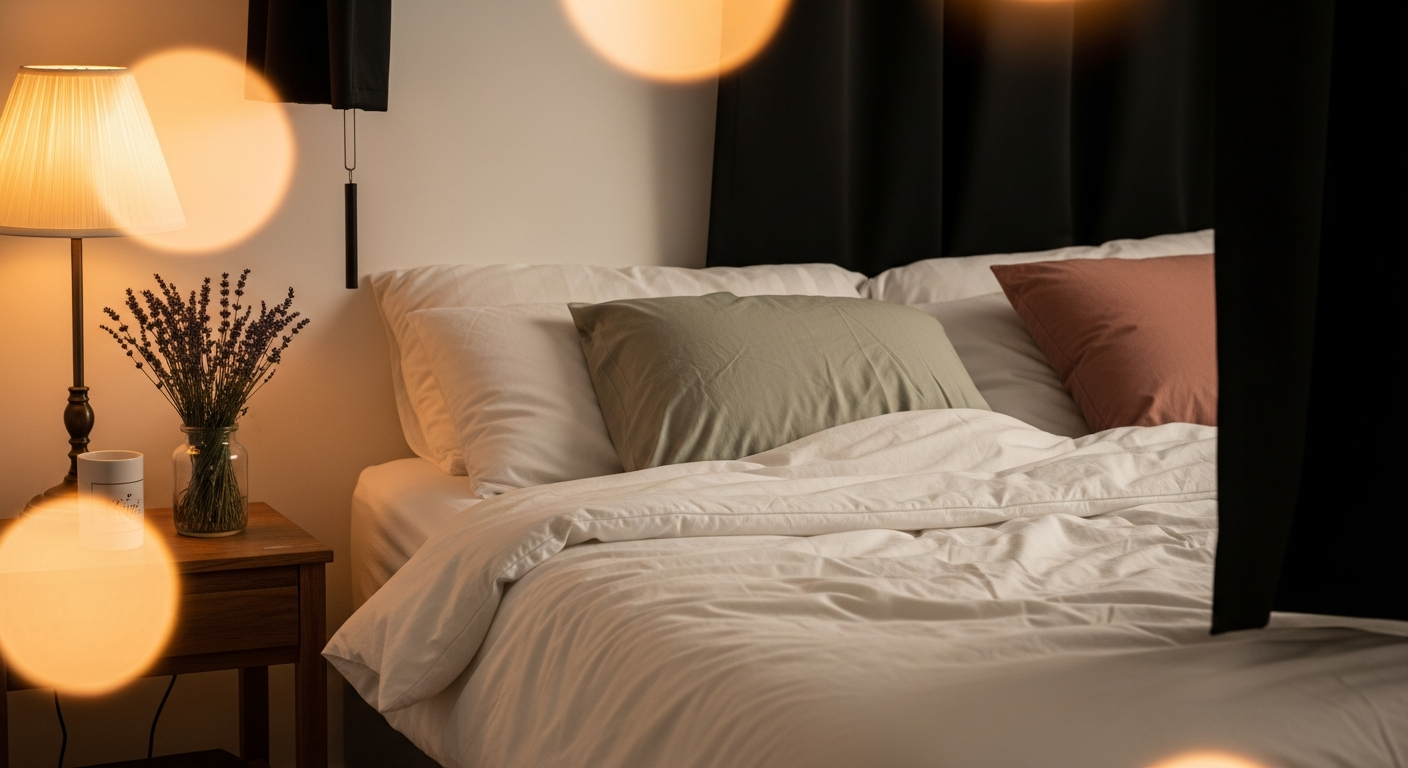
- Completely blackout your bedroom to maximize melatonin production and deep sleep.
- Switch to warm, dim lighting after 8 PM and use red/amber nightlights for nighttime feedings.
- Charge your phone outside the bedroom to avoid blue light and nighttime scrolling.
- Invest in blackout curtains and a simple alarm clock to reclaim your sleep from screens.
Your bedroom currently functions as a nursery annex, a laundry sorting station, a midnight snack depot, a work-from-home office, and occasionally, if you’re lucky, a place where you sleep. The bassinet is wedged between the bed and the wall. There’s a pile of clean laundry on the chair that’s been there so long it’s basically furniture. The nightstand is buried under burp cloths, nipple cream, a half-empty water bottle, your phone charger, and three pacifiers. The overhead light is either blazingly bright or completely dark, with no in-between. And you wonder why you can’t sleep.
Your bedroom environment directly controls your sleep quality in ways that are far more significant than most people realize. Sleep scientists call it “sleep hygiene,” but for moms it’s more like sleep triage: identifying the environmental factors that are sabotaging your already-limited sleep hours and systematically fixing them. You may not be able to control when your baby wakes you up, but you can control how quickly you fall back asleep, how deep your sleep is during those precious stretches, and how rested you feel when the alarm (or the baby) goes off. Transforming your bedroom into a sleep sanctuary isn’t a luxury project. It’s a survival strategy.
Light: The Most Powerful Sleep Signal You’re Ignoring
Light is the single most influential environmental factor in sleep quality. Your brain uses light cues to regulate melatonin production, which governs your entire sleep-wake cycle. Getting light wrong in your bedroom can steal hours of quality sleep without you ever realizing the cause.
Blackout your bedroom completely. Even small amounts of light, the glow from a power strip, the LED on a smoke detector, light leaking around curtains, suppress melatonin production and reduce sleep quality. A study published in the Proceedings of the National Academy of Sciences found that sleeping with even a dim light (equivalent to a nightlight) increased insulin resistance and heart rate compared to sleeping in total darkness. Blackout curtains ($25-60 for a good pair on Amazon) are the single best investment in this entire article. If your curtains have gaps at the edges, use magnetic curtain strips or painter’s tape along the edges. It looks messy. It works.
Handle the baby monitor glow. If you have a video monitor, the screen is likely one of the brightest light sources in your room. Turn the brightness to its lowest setting or turn the screen off entirely and rely on the audio alert. If you need to check visually, keep the monitor face-down and flip it only when needed. Some parents tape a small piece of red film (from a craft store) over the monitor screen, which provides enough visibility without the blue-spectrum light that disrupts melatonin.
Switch to warm lighting after 8 PM. Replace any bedroom overhead lights with warm-toned bulbs (2700K or lower). Better yet, stop using overhead lights entirely in the evening and use a bedside lamp with a warm bulb or a salt lamp ($15-25), which emits an amber glow that doesn’t interfere with melatonin. If you need to get up for nighttime feedings, use a motion-activated red or amber nightlight ($10) instead of flipping on the main light. Red and amber wavelengths don’t suppress melatonin the way blue and white light do.
Your phone is the worst offender. The screen on your phone emits significant blue light directly into your eyes at close range. If you scroll before bed (and most of us do), you’re delaying melatonin onset by 30-90 minutes. Night mode and blue-light filters help but don’t eliminate the problem. The real solution is charging your phone outside the bedroom, which also eliminates the temptation to check it during nighttime wake-ups. If you use your phone as an alarm, buy a simple alarm clock ($10-15) and reclaim your sleep from your screen.
Temperature: Your Body’s Sleep Switch
Your core body temperature needs to drop by about 2-3 degrees Fahrenheit to initiate sleep. If your bedroom is too warm, your body can’t execute this temperature drop, and you lie there feeling restless, kicking off covers, unable to settle.
The ideal bedroom temperature for sleep is 65-68 degrees Fahrenheit (18-20 Celsius). This feels cooler than most people expect. If your partner runs hot, this range is even more important. Running a fan or setting your thermostat to drop at bedtime creates a noticeable improvement in sleep onset and sleep depth.
Cooling bedding makes a real difference. If you can’t control your room temperature (apartment dwellers, shared spaces), cooling sheets and pillow cases can help. Look for percale cotton (it’s crisper and more breathable than sateen), bamboo viscose, or linen. Thread counts above 400 tend to trap heat. The Brooklinen Classic Percale sheets ($130-160) and the Ettitude Bamboo Lyocell sheets ($100-150) are both excellent, but even a $40 set of Target’s Threshold Performance percale sheets will outperform a hot, polyester set.
The warm bath trick. Counterintuitively, a warm bath or shower 60-90 minutes before bed helps you sleep better. The warm water brings blood to the surface of your skin, and when you get out, the rapid cooling triggers the core temperature drop that initiates sleepiness. A 10-minute warm shower an hour before bed is a simple, free way to hack this mechanism. Add Epsom salts with lavender if you’re doing a bath; the magnesium absorbs through your skin and has mild muscle-relaxing properties.
Socks in bed. Research from the Journal of Physiological Anthropology found that wearing socks to bed reduces sleep onset time by an average of 15 minutes. Warm feet dilate blood vessels, which allows heat to escape from your body core more efficiently, triggering the temperature drop needed for sleep. It sounds too simple to work. It works.
Sound: Protecting Your Sleep From a Noisy World
New parent sleep is already fragmented by nighttime wake-ups. Environmental noise (traffic, neighbors, a partner who snores, household sounds) further fragments the sleep you do get by causing micro-arousals, brief moments of wakefulness you don’t even remember that prevent you from reaching the deepest, most restorative sleep stages.
White noise or brown noise machines. A consistent sound backdrop masks sudden noises (a door closing, a car alarm, the dog barking) that would otherwise jolt you awake. Brown noise, which has a deeper, more rumbling quality than white noise, is often preferred for adult sleep. The Yogasleep Dohm Classic ($40) is a fan-based machine that produces natural, non-looping sound. The LectroFan ($48) offers multiple white and brown noise options. Both are significantly better than phone apps because they produce fuller sound and don’t have the notification risk.
Earplugs for partner snoring. If your partner snores and you’re a light sleeper (and sleep deprivation makes everyone a lighter sleeper), quality earplugs can be transformative. Mack’s Slim Fit Soft Foam Earplugs ($5 for 10 pairs) are comfortable for side sleepers. If you’re worried about not hearing the baby, use earplugs in one ear and keep the monitor on the nightstand on the open-ear side. The baby monitor will still wake you, but general household noise won’t.
Sound boundaries with your partner. If one of you is a night owl and the other crashes at 9 PM, establish sound agreements: headphones for any media after the early sleeper goes to bed, no phone calls in the bedroom after lights out, and if one partner comes to bed later, they use the amber nightlight rather than the overhead light. These small courtesies compound into significantly better sleep for both of you.
Creating Sensory Comfort: Bedding, Scent, and Touch
Your bed should feel like a place you want to be, not just a place you collapse. Investing in your bedding is one of the highest-return purchases you can make because you spend roughly a third of your life in that bed (or at least, you should).
Pillows matter more than you think. If your pillow is more than 2 years old, it’s likely lost its loft and support. Side sleepers (most common for moms, especially postpartum) need a firmer, thicker pillow to keep the neck aligned. The Coop Home Goods Original Pillow ($60) is adjustable (you add or remove fill) so you can customize the height perfectly. A body pillow or knee pillow ($15-25) between your legs reduces hip and lower back pain that disrupts sleep, and if you used one during pregnancy, keep using it. Your body still benefits from the alignment support.
Weighted blankets. A weighted blanket (typically 10-15% of your body weight) applies deep pressure stimulation that activates the parasympathetic nervous system, similar to being held. A study in the Journal of Clinical Sleep Medicine found that participants who used weighted blankets fell asleep faster, slept longer, and felt more refreshed in the morning. The YnM Weighted Blanket ($30-50 depending on weight) is a well-reviewed, affordable option. If you sleep hot, look for a cooling weighted blanket with glass bead filling and a breathable bamboo cover.
Aromatherapy that actually works. Lavender is the most studied scent for sleep, and the evidence is solid: a systematic review of 11 studies found that lavender aromatherapy significantly improved sleep quality. However, most commercial “lavender” products use synthetic fragrance, which doesn’t have the same effect. Use genuine lavender essential oil: a drop on your pillowcase, a few drops in a bedside diffuser that shuts off automatically, or a sachet of dried lavender under your pillow. Other evidence-supported sleep scents include cedarwood, bergamot (which also reduces cortisol), and chamomile.
Make the bed every morning. A National Sleep Foundation survey found that people who make their beds daily are 19% more likely to report getting a good night’s sleep than people who don’t. This isn’t because a made bed has magical properties. It’s because walking into a bedroom that looks and feels organized sends a signal of calm to your brain. When your bedroom is chaotic, your nervous system registers it as one more thing demanding your attention, even subconsciously. Thirty seconds of bed-making creates hours of ambient calm.
The Bedroom Detox: Removing What Doesn’t Belong
A sleep sanctuary isn’t just about what you add. It’s about what you remove. Your bedroom should serve two purposes: sleep and intimacy. Everything else is an intruder.
Remove the laundry pile. Clean or dirty, a visible pile of laundry is a visual to-do list. Move it to another room. If you must fold in the bedroom, do it during the day and put it away before evening. Your brain cannot relax in a room that reminds it of unfinished tasks.
Remove work materials. If you work from home and your desk is in your bedroom, your brain associates the bedroom with productivity and alertness. If you can’t move the desk, use a room divider, curtain, or even a bedsheet draped over the desk area to visually separate work space from sleep space. Close the laptop and cover it. Out of sight, out of mind.
Relocate the baby (when you’re ready). This is a personal decision with no universal right answer. The American Academy of Pediatrics recommends room-sharing for the first 6 months. After that, transitioning the baby to their own room often improves sleep for everyone. Studies show that babies who move to their own room after 6 months sleep longer and have fewer nighttime wake-ups, and mothers report significantly better sleep quality. When you’re ready, the transition can be gradual: start with naps in the nursery, then nighttime. Your bedroom goes from nursery annex back to your sanctuary.
Reduce clutter aggressively. A study from St. Lawrence University found that a cluttered sleep environment leads to longer sleep onset, more nighttime awakenings, and greater overall sleep disturbance. You don’t need a minimalist magazine bedroom. You need surfaces that are mostly clear, a floor you can walk across in the dark without stepping on something, and a general sense that this room exists for rest, not storage.
Your bedroom transformation doesn’t need to happen overnight or cost a fortune. Start with one change: blackout curtains, a cooler room temperature, or your phone charging in the hallway. Notice the difference after a week. Add another change. Within a month, you’ll have created a space that your brain recognizes as a place for deep rest, and every hour of sleep you get in that space will be more restorative than the sleep you were getting before. You deserve a room that feels like an exhale. Start building it tonight.
Mama in Chief
Mama in Chief is a wellness advocate and mother who learned the hard way that you can’t pour from an empty cup. After her own burnout journey, she now helps other moms prioritize their mental health, physical wellbeing, and personal identity alongside the beautiful chaos of motherhood.