Nap Strategies for Moms Who Can’t Sleep During the Day
You're not broken if you can't nap; postpartum hyperarousal makes daytime rest difficult. Learn why your body resists sleep and discover specific techniques like NSDR and the Military Sleep Method to help you achieve restorative rest.
- Understand postpartum hyperarousal makes daytime napping challenging for you.
- Align your nap attempts with your cortisol rhythm, aiming for after 1 PM.
- Build enough sleep pressure; try napping after 7-8 hours of wakefulness.
- Use NSDR (yoga nidra) for deep rest, even if you don't fully fall asleep.
- Practice the Military Sleep Method to train your body to fall asleep fast.
This post contains affiliate links. As an Amazon Associate I earn from qualifying purchases.
“Sleep when the baby sleeps,” they said, as if your body would just cooperate on command. As if you could lie down at 11:30 AM with a racing mind, a to-do list screaming from the kitchen, and a nervous system so wired from months of hypervigilance that the sound of a distant car door makes you bolt upright thinking the baby cried. You’re exhausted to your bones. You haven’t slept more than three consecutive hours in weeks. And somehow, when the baby finally goes down, you lie there staring at the ceiling with your heart pounding, completely unable to fall asleep.
You’re not broken. This is incredibly common and it has a name: postpartum hyperarousal. Your brain has been rewired to stay alert for your baby, which means your fight-or-flight system is stuck in the “on” position even when you’re safe and your baby is sleeping soundly. Daytime napping is a skill, and for many moms, it requires learning specific techniques to override a nervous system that’s convinced resting is dangerous. These strategies go beyond “close your eyes and relax” because if that worked, you wouldn’t be reading this.
In this article (5 sections)
Why Napping Feels Impossible (Even When You’re Exhausted)
Understanding the physiology behind your inability to nap is the first step toward working with your body instead of against it.
Cortisol timing. Your body produces cortisol (the alertness hormone) on a natural rhythm that peaks in the morning and gradually declines throughout the day. Trying to nap when cortisol is still high (typically before 1 PM for most people) is fighting biology. This is why the classic “morning nap when baby naps” feels impossible for many moms, but an afternoon attempt might go slightly better.
Sleep pressure hasn’t built enough. Sleep pressure (adenosine accumulation in the brain) builds from the moment you wake up. If you’ve only been awake for 3-4 hours, your brain simply hasn’t accumulated enough adenosine to overcome the cortisol and trigger sleepiness. This is why trying to nap at 10 AM after waking at 6 AM rarely works, but trying at 1 PM or 2 PM after 7-8 hours of wakefulness has much better odds.
Hypervigilance. Postpartum, your amygdala (the brain’s threat detection center) is literally enlarged and hyperactive. Studies using brain imaging show that new mothers have heightened amygdala responses to infant cries compared to non-mothers. Your brain is doing its job, keeping you alert to protect your baby. The problem is it doesn’t have an off switch, so even when the baby is safe and someone else is watching them, your brain keeps scanning for threats.
The anxiety spiral. You lie down, notice you’re not falling asleep, start worrying about not sleeping, check the time, calculate how many minutes of nap you have left, get more anxious, and now you’re further from sleep than when you started. Sleep anxiety creates a self-fulfilling prophecy that keeps you wide awake.
Nap Strategies That Work With Your Wired Brain
These techniques are drawn from sleep medicine, cognitive behavioral therapy for insomnia (CBT-I), and military sleep research. They’re designed for bodies and brains that resist rest.
The Non-Sleep Deep Rest (NSDR) Protocol. Popularized by neuroscientist Andrew Huberman, NSDR involves lying down and following a guided body scan or yoga nidra recording. You’re not trying to sleep. You’re resting deeply while technically remaining awake. Research shows that 20-30 minutes of NSDR restores brain function comparably to 2 hours of actual sleep. The key insight: by removing the pressure to fall asleep, many people actually do fall asleep. Even if you don’t, you get 80% of the benefit. Search for “yoga nidra 20 minutes” on YouTube or use the free Insight Timer app.
The Military Sleep Method. Developed by the U.S. Navy Pre-Flight School to help pilots fall asleep in 2 minutes under any conditions, this technique has a 96% success rate after 6 weeks of practice:
- Relax every muscle in your face, including your tongue, jaw, and the muscles around your eyes.
- Drop your shoulders as far as they’ll go. Then relax your upper arm, then forearm, then hands. One side at a time.
- Exhale and relax your chest, then your legs from thighs to calves to feet.
- Clear your mind for 10 seconds by imagining one of these three images: lying in a canoe on a calm lake with blue sky above you, lying in a black velvet hammock in a dark room, or simply repeating “don’t think, don’t think, don’t think” for 10 seconds.
This method works because it systematically releases the physical tension that keeps your nervous system in alert mode. Practice it every day, whether you fall asleep or not. The skill builds over 2-4 weeks.
The Coffee Nap. This sounds counterintuitive but it’s backed by research from multiple sleep labs. Drink a cup of coffee immediately before lying down for a 20-minute nap. Caffeine takes 20-25 minutes to reach your bloodstream, so you get the benefit of a short nap and wake up just as the caffeine kicks in, feeling dramatically more alert than either coffee or a nap alone. Set your alarm for exactly 20 minutes. Don’t exceed this or you’ll enter deep sleep and wake up groggy. This works best between 1-3 PM.
The 4-7-8 Breathing Technique. Developed by Dr. Andrew Weil, this acts as a natural tranquilizer for the nervous system. Inhale through your nose for 4 counts, hold your breath for 7 counts, exhale slowly through your mouth for 8 counts. Repeat 4 cycles. The extended exhale activates the parasympathetic nervous system and slows your heart rate. Many people report feeling drowsy by the third cycle. Use this while lying down at the start of your nap attempt.
Creating the Right Conditions for Daytime Rest
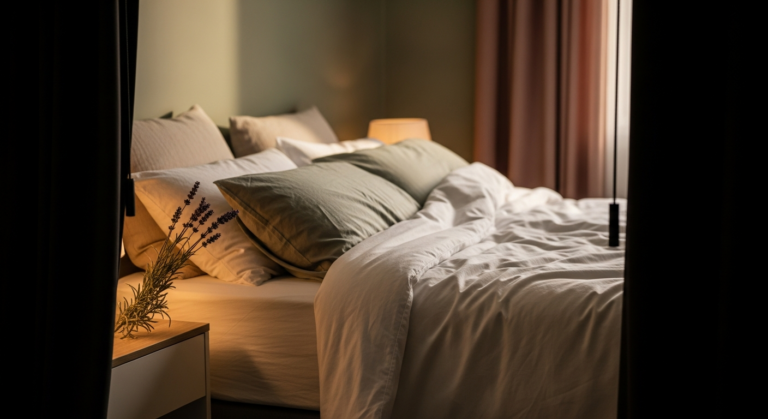
Your environment during daytime napping needs to be deliberately manipulated because everything about daytime (light, noise, activity, temperature) signals wakefulness to your brain.
Darkness is non-negotiable. Light enters your eyes and suppresses melatonin production, which is why napping in a bright room feels impossible. Invest in blackout curtains for your bedroom ($25-40 on Amazon) or, even cheaper, use a sleep mask. The Manta Sleep Mask ($35) is the gold standard: it blocks 100% of light and doesn’t press on your eyelids. A folded t-shirt over your eyes works in a pinch.
Temperature matters. Your core body temperature needs to drop slightly to initiate sleep. Keep the room cool (65-68 degrees Fahrenheit is optimal for sleep). If you can’t control the thermostat, a small fan provides both cooling and white noise. In summer, place a damp washcloth on your forehead or the back of your neck to help trigger the temperature drop.
White noise or brown noise. White noise masks household sounds that would otherwise jolt you awake. But for daytime napping, many people find brown noise (a deeper, more rumbling frequency) even more effective. It mimics the low-frequency sounds of wind or rain and is less harsh than white noise. Use a physical sound machine, or play a brown noise track from Spotify or YouTube on a speaker near your bed.
Phone management. Put your phone on Do Not Disturb with emergency bypass enabled for your partner or caregiver. Place it face down across the room so you can’t mindlessly check it. The blue light and mental stimulation from even a quick scroll can reset your wakefulness for another 20 minutes. If you use your phone as an alarm, switch to a dedicated alarm clock or ask a smart speaker to set a timer.
Create a nap ritual. Your brain responds to sleep cues. Create a mini ritual that signals nap time: close the curtains, put on your sleep mask, do 4 rounds of 4-7-8 breathing, start your NSDR track. After 1-2 weeks of consistent ritual, your brain begins to associate these cues with sleep, making it easier to fall asleep each time.
Alternatives When Sleep Truly Won’t Come
Some days, despite your best efforts, sleep won’t happen. That doesn’t mean rest is off the table. These alternatives provide genuine physiological recovery without actual sleep.
Legs Up the Wall (Viparita Karani). Lie on your back and extend your legs up a wall (your body forms an L-shape). Stay here for 10-20 minutes with your eyes closed. This inverted position improves blood return to your heart, reduces swelling in the legs and feet, activates the parasympathetic nervous system, and provides a level of circulatory and nervous system rest that approaches sleep. This is the single best thing you can do when napping fails.
The 20-minute eyes-closed rest. Lie down in your darkened room, close your eyes, and simply exist. Don’t try to sleep. Don’t meditate. Don’t listen to anything. Just lie there with your eyes closed. Research on quiet wakefulness shows that this state still allows your brain to consolidate memories, reduce stress hormones, and recover some cognitive function. It’s not as good as sleep, but it’s better than getting up and doing laundry.
Progressive muscle relaxation. Starting at your toes, tense each muscle group for 5 seconds, then release for 10 seconds. Work your way up: feet, calves, thighs, glutes, abdomen, hands, forearms, biceps, shoulders, neck, face. The systematic tension and release teaches your body what relaxation actually feels like, because many chronically stressed moms have forgotten. Even if you don’t sleep, you’ll get up feeling less physically tense.
Guided imagery. Close your eyes and mentally walk through a detailed, pleasant scenario: cooking your favorite meal, walking through a forest you remember from childhood, swimming in warm ocean water. Engage every sense. What do you see, hear, smell, feel, taste? This redirects your brain from the anxiety and vigilance that prevent rest. The Calm app and Insight Timer both have excellent guided imagery tracks under 15 minutes.
When Inability to Nap Signals Something Bigger
Sometimes the inability to sleep during the day, especially when combined with nighttime insomnia despite exhaustion, is a symptom of something that needs professional attention.
Postpartum insomnia is a recognized condition where new mothers cannot sleep even when their baby is sleeping and conditions are favorable. It affects up to 60% of postpartum women and is strongly associated with postpartum anxiety and depression. If you’ve been unable to nap or sleep at night for more than two weeks despite being physically exhausted, mention it to your OB or midwife at your next visit, or call them before then.
Postpartum anxiety often manifests as an inability to “turn off” your brain, intrusive thoughts about something bad happening to your baby, racing heartbeat, and a constant feeling of dread. The hypervigilance that prevents napping can be an early sign. Postpartum Support International (1-800-944-4773) has a free helpline and can connect you with local resources. You can also text them at 800-944-4773 or text “HELP” to 988.
Thyroid dysfunction is common postpartum and can cause both fatigue and insomnia simultaneously. If you’re exhausted but wired, losing hair, experiencing mood swings, or having heart palpitations, ask your doctor to check your TSH, free T3, and free T4 levels.
Being unable to nap doesn’t make you a bad napper. It makes you a mammal whose brain is doing exactly what evolution designed it to do: stay alert to protect your young. The strategies in this article work with that wiring rather than fighting it. Be patient with yourself. Try one technique at a time. And on the days when sleep simply won’t come, lie down anyway. Close your eyes. Let your body rest even if your brain won’t. That matters more than you think. And tomorrow, try again.
If you need support right now
Reaching out is not an overreaction. These lines are free and confidential.
- Emergency: if you are thinking about harming yourself or your baby, or you can’t keep yourself safe, call 911 or go to the nearest emergency room. This is a medical emergency, and it is treatable.
- 988 Suicide & Crisis Lifeline: call or text 988, 24/7, for anyone in crisis.
- National Maternal Mental Health Hotline: call or text 1-833-TLC-MAMA (1-833-852-6262), 24/7, in English and Spanish, for pregnancy and postpartum support.
- Postpartum Support International: call or text 1-800-944-4773 for help finding a provider who specializes in perinatal mental health. Not an emergency line.
US numbers. Elsewhere, ask your doctor, midwife or local crisis line. This article was written by a parent, not a clinician, and isn’t medical advice.
Mama in Chief
Mama in Chief is a wellness advocate and mother who learned the hard way that you can’t pour from an empty cup. After her own burnout journey, she now helps other moms prioritize their mental health, physical wellbeing, and personal identity alongside the beautiful chaos of motherhood.