Gentle Morning Stretches for Moms: A 10-Minute Routine to Undo the Damage of Motherhood
You'll learn a 10-minute gentle morning stretch routine designed to alleviate the common aches and stiffness in your neck, back, shoulders, and hips caused by the physical demands of motherhood. This routine targets specific postural issues to undo the daily 'damage' your body experiences.
- Your daily mom duties create unique physical strains like stiff neck, back, and shoulders.
- A 10-minute gentle morning stretch routine can undo this physical damage.
- Target specific issues like upper crossed syndrome and hip imbalances.
- Morning is the best time to stretch when your body is naturally stiffest.
- No gym or equipment needed; just 10 minutes in your pajamas.
You open your eyes. The baby monitor says 6:14 AM. You take a breath, start to sit up, and — oh.
There it is. The stiff neck that makes turning your head feel like you’re 87 years old. The lower back that seized up sometime around 3 AM. The shoulders that have apparently fused into a permanent hunch somewhere near your ears. The hips that creak and pop like a haunted staircase when you swing your legs over the side of the bed.
You are in your twenties. Or your thirties. Or your forties. You are, by any reasonable definition, young. And yet every morning, your body wakes up feeling like it went twelve rounds with a professional wrestler while you slept.
Welcome to the physical reality of motherhood.
The nursing posture that has your upper back curved like a question mark. The 25-pound toddler who lives on your left hip. The bending — dear God, the bending — to pick up toys, wipe faces, buckle car seats, and retrieve the sippy cup that was thrown on the floor for the nineteenth time. The co-sleeping pretzel positions. The tension you hold in your jaw and shoulders without even knowing it. The core that hasn’t quite worked the same since pregnancy.
Your body has been through something extraordinary. It grew a human being (or several). It feeds, carries, lifts, and comforts on a continuous loop. And it has been doing all of this on insufficient sleep, minimal exercise, and very little attention to its own needs.
It deserves ten minutes of your morning. That’s it. Ten minutes. Not an hour at the gym. Not a hot yoga class you’ll never make it to. Not a fitness program that requires equipment you don’t own and energy you don’t have.
Just ten stretches. One minute each. On your bedroom floor, in your pajamas, before the chaos begins.
This routine is designed specifically for the places where motherhood breaks your body down. Every stretch targets something that mothers uniquely struggle with — not generic “flexibility” goals, but the specific aches, tensions, and postural disasters that come from nursing, carrying, bending, and holding tiny humans all day long.
Let’s undo some of the damage.
Why Moms’ Bodies Need Morning Stretches (It’s Not Just About Flexibility)
Before we get to the routine, let’s talk about why your body feels the way it does in the morning — and why stretching, specifically, is the medicine it needs.
The Postural Catastrophe of Modern Motherhood
Your body adapts to the positions you spend the most time in. This explains almost everything about why you feel terrible.
Nursing and bottle-feeding round your shoulders forward and drop your chin for 20 to 40 minutes at a time, multiple times a day. Over months, your chest muscles shorten, your upper back weakens, and your neck develops a forward-head posture that researchers call “upper crossed syndrome” — the default posture of every breastfeeding mom.
Carrying children on the hip creates asymmetrical loading that pulls your spine into lateral curves and compresses the carrying-side hip. If you always carry on the same side (you do), you’re developing muscular imbalances that manifest as hip pain, SI joint dysfunction, and lower back tightness.
Bending and lifting — picking up from the floor, loading strollers, bending over the crib — chronically loads the lower back and tightens the hip flexors, especially since most moms bend from the waist rather than the hips.
Co-sleeping and side-lying nursing lock you in twisted, asymmetrical positions for hours. You wake up stiff not because your pillow is wrong, but because you spent four hours curled around a tiny human in a position that would make a chiropractor weep.
Phone use and baby holding keep your wrists in sustained flexion and your thumbs in repetitive motion, contributing to carpal tunnel symptoms and de Quervain’s tenosynovitis — so common in new moms it’s nicknamed “mommy thumb.”
Why Morning Is the Best Time to Stretch
Your body is at its stiffest in the morning. This isn’t just a feeling — it’s physiology. During sleep, your intervertebral discs absorb fluid and expand (which is why you’re actually taller in the morning), your muscles cool and contract, and your fascia — the connective tissue that wraps everything — becomes less pliable.
Gentle morning stretching reverses all of this. It warms the muscles, mobilizes the joints, increases blood flow to tight areas, and signals to your nervous system that it’s time to transition from the stillness of sleep to the movement of the day.
For moms specifically, morning stretching also serves a psychological function: it’s a physical declaration that your body matters. Before the first diaper change, before the first demand, before you start giving — you take ten minutes to care for the body that carries everything else. It’s not selfish. It’s structural maintenance. And it sets a physical and mental tone for the entire day.
The Nervous System Connection
Morning stretching isn’t just musculoskeletal — it’s neurological. Gentle, sustained stretching activates the parasympathetic nervous system, lowering cortisol and heart rate. For moms who wake up in anticipatory stress, ten minutes of stretching can shift your nervous system out of fight-or-flight before the day pushes you into it. Research in the Journal of Physical Therapy Science has shown that regular morning stretching reduces perceived stress, improves mood, and decreases pain within four weeks.
The 10-Minute Morning Stretch Routine for Moms
Here’s your routine. Ten stretches, roughly one minute each. You’ll need nothing except a floor and your body. A yoga mat is nice but absolutely not necessary — a carpet, a rug, or even a folded blanket works fine.
Go slowly. Breathe deeply. Don’t force anything. These are gentle stretches, not performance exercises. If something hurts (sharp pain, not the good-stretch-burn), back off. Your body is not your enemy — you’re learning to listen to it again.
Stretch 1: Neck Rolls and Tilts (The Nursing Neck Fix)
What it targets: The cervical spine, upper trapezius, and sternocleidomastoid muscles — everything that gets wrecked by looking down at a baby during nursing, bottle-feeding, and phone use.
Why moms need it: If you’ve spent any significant time nursing or bottle-feeding, your neck has been in sustained forward flexion for hours per day. This shortens the muscles at the front and sides of the neck while straining the muscles at the back. The result: stiffness, headaches, and that crunchy sound when you turn your head.
How to do it:
- Sit comfortably (on the edge of your bed or cross-legged on the floor). Let your shoulders drop away from your ears.
- Gentle neck rolls: Drop your chin toward your chest. Slowly roll your head to the right, bringing your right ear toward your right shoulder. Continue rolling your head back (gently — don’t crank your neck backward), then to the left, and back to center. Do three slow rolls in each direction. Let gravity do the work — don’t force the range of motion.
- Side tilts: Tilt your right ear toward your right shoulder. Place your right hand gently on the left side of your head — don’t pull, just let the weight of your hand deepen the stretch. Hold for 15 seconds. Repeat on the left side.
- Chin tucks: Pull your chin straight back (like you’re giving yourself a double chin). Hold for 5 seconds. Release. Repeat 5 times. This counteracts the forward-head posture from nursing.
Pregnancy/postpartum modification: Avoid full head circles if you experience dizziness (common in early postpartum due to blood pressure fluctuations). Stick with gentle side-to-side tilts and chin tucks instead.
Stretch 2: Shoulder Rolls and Chest Opener (The Carrying Posture Reset)
What it targets: The pectoralis muscles (chest), anterior deltoids (front of shoulders), upper trapezius, and rhomboids (upper back between shoulder blades) — the entire anterior-posterior chain that gets distorted by carrying, nursing, and hunching.
Why moms need it: The rounded-shoulder posture of motherhood shortens your chest muscles and overstretches your upper back. This doesn’t just cause pain — it restricts your breathing capacity. Tight chest muscles physically prevent full ribcage expansion, keeping you in shallow-breath stress response mode all day.
How to do it:
- Shoulder rolls: Sitting or standing, roll your shoulders forward in big, slow circles — up toward your ears, forward, down, and back. Do 5 rolls forward, then 5 rolls backward. Make them as big and slow as possible.
- Chest opener: Interlace your fingers behind your back. If your hands don’t meet easily, hold a dish towel or sock between them. Straighten your arms and gently lift your hands away from your body, squeezing your shoulder blades together. Lift your chest toward the ceiling. Hold for 20 to 30 seconds, breathing deeply into the stretch across your chest and the fronts of your shoulders.
- Doorway stretch (optional upgrade): Stand in a doorway. Place your forearms on the door frame at shoulder height, elbows bent at 90 degrees. Step one foot forward through the doorway until you feel a deep stretch across your chest and shoulders. Hold 20 seconds.
Pregnancy/postpartum modification: In late pregnancy or early postpartum, skip the hands-behind-back version if it’s uncomfortable on your shoulders. The doorway stretch is a great alternative that lets you control the intensity easily.
Stretch 3: Cat-Cow (Spine Mobility Wake-Up)
What it targets: The entire spine — cervical, thoracic, and lumbar — plus the abdominal muscles and back extensors. This is the single best mobility exercise for a spine that’s been through pregnancy and the daily grind of parenting.
Why moms need it: Motherhood locks your spine in flexion (hunched forward) for hours at a time. Cat-cow gently takes it through its full range of flexion and extension, waking up stabilizing muscles, lubricating facet joints, and restoring the natural curves that get flattened by poor posture.
How to do it:
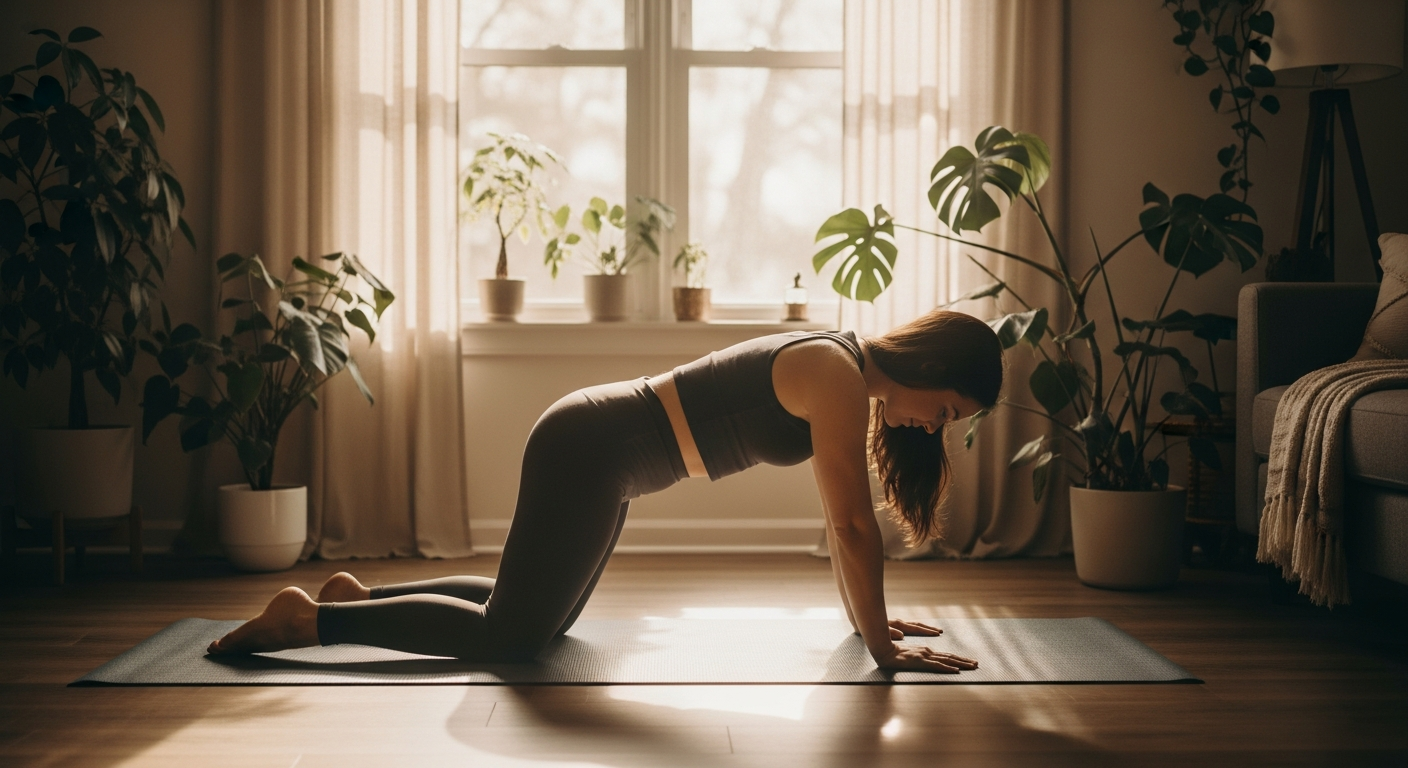
- Start on hands and knees (tabletop position). Wrists under shoulders, knees under hips. Spread your fingers wide and press evenly through your palms.
- Cow pose: On an inhale, drop your belly toward the floor. Lift your tailbone and chest toward the ceiling. Look slightly upward. Let your spine form a gentle U-shape.
- Cat pose: On an exhale, round your spine toward the ceiling. Tuck your tailbone under. Drop your head and look toward your navel. Push the floor away with your hands to deepen the rounding through your upper back.
- Flow between cow and cat slowly, syncing the movement with your breath. One full cycle (cow + cat) per breath. Continue for 8 to 10 breath cycles (about one minute).
Pregnancy/postpartum modification: This is one of the safest exercises during pregnancy and is commonly recommended by physical therapists throughout all trimesters. In the postpartum period, if you have diastasis recti (abdominal separation), go gently with the cow portion — don’t let your belly hang heavily toward the floor. Focus more on the cat portion, which engages the transverse abdominis and supports abdominal healing.
Stretch 4: Child’s Pose with Side Reach (Back and Lat Release)
What it targets: The latissimus dorsi (the large muscles on the sides of your back), the lower back, the shoulders, and the hips. The side reach variation gets into the intercostal muscles between your ribs and the quadratus lumborum — a deep low-back muscle that’s almost always tight in moms.
Why moms need it: Your lats and QL get chronically tight from carrying kids (especially on one side) and from the bracing patterns your core adopts to compensate for weakened abdominal muscles postpartum. This shows up as low-back pain, restricted shoulder mobility, and that “I can’t take a full breath” feeling.
How to do it:
- From tabletop, push your hips back toward your heels. Extend your arms forward on the floor, forehead resting on the ground (or on a pillow if your forehead doesn’t comfortably reach). This is basic child’s pose. Hold for a few breaths to let your lower back release.
- Side reach (right): Walk both hands to the right side of your mat, keeping your hips pressing back toward your heels. You’ll feel a deep stretch along the left side of your body — from your hip through your ribs to your armpit. Hold for 20 seconds, breathing into the left side of your ribcage.
- Side reach (left): Walk both hands to the left side. Hold for 20 seconds, breathing into the right side.
- Return to center child’s pose for a few final breaths.
Pregnancy/postpartum modification: In later pregnancy, widen your knees to make room for your belly. You can also place a pillow between your heels and your hips for support, or a bolster under your torso. If the forehead-down position causes dizziness or nasal congestion, rest your forehead on stacked fists instead.
Stretch 5: Hip Flexor Stretch (The Kid-on-Hip Corrector)
What it targets: The iliopsoas (the deep hip flexor that connects your spine to your femur), the rectus femoris (the quadriceps muscle that also crosses the hip), and the anterior hip capsule. These are the muscles that get brutally tight from sitting, carrying kids on your hip, and the general demands of constantly bending forward.
Why moms need it: Tight hip flexors are the silent epidemic of motherhood — tight from sitting during nursing and feeding, from carrying kids on your hip, and from pregnancy’s anterior pelvic tilt. They pull your pelvis forward, compress your lower back, and contribute to that aching, stiff morning feeling.
How to do it:
- From kneeling, step your right foot forward into a lunge position. Right knee directly over right ankle, left knee on the floor (place a folded towel or pillow under the left knee for padding if needed).
- Tuck your pelvis slightly under — imagine pulling your belt buckle up toward your chin. This is crucial. Without the pelvic tuck, you’ll arch your lower back instead of stretching your hip flexor.
- Gently shift your weight forward until you feel a stretch in the front of your left hip and upper thigh. Keep your torso upright. Don’t lean forward.
- For a deeper stretch, raise your left arm overhead and lean slightly to the right. This adds a stretch along the entire left side of your body.
- Hold for 30 seconds. Switch sides. Hold for 30 seconds.
Pregnancy/postpartum modification: In pregnancy, use a chair or wall for balance. Reduce the range of motion — you don’t need to go deep to get the benefit. In early postpartum, be gentle and avoid forcing the stretch. If you had a cesarean section, wait until you have clearance from your provider before doing lunging stretches, and start very gently.
Stretch 6: Figure-Four Stretch (Tight Glutes and Piriformis Release)
What it targets: The piriformis (a deep hip rotator that runs from your sacrum to your femur), the gluteus medius and minimus, and the outer hip. When the piriformis is tight, it can compress the sciatic nerve, causing that shooting pain or tingling that runs from your glute down the back of your leg.
Why moms need it: Carrying kids on the hip, sitting cross-legged on the floor (approximately 400 times per day as a parent), and pelvic changes from pregnancy create the perfect storm for tight piriformis muscles. If you’ve ever felt a deep glute ache that won’t release no matter how much you massage it, this is likely the culprit.
How to do it:
- Lie on your back with both knees bent, feet flat on the floor.
- Cross your right ankle over your left knee, creating a figure-four shape. Your right knee will fall open to the side.
- Reach your hands through the triangle created by your legs and clasp them behind your left thigh (or on top of your left shin, wherever you can comfortably reach).
- Gently pull your left knee toward your chest. You’ll feel a deep stretch in your right outer hip and glute. Keep your right foot flexed (pull your toes toward your shin) to protect the knee.
- Hold for 30 seconds. Breathe into the stretch. Switch sides.
Pregnancy/postpartum modification: In later pregnancy or if lying on your back causes dizziness, do this seated: sit in a chair, cross one ankle over the opposite knee, and gently lean forward. Same stretch, upright position.
Stretch 7: Seated Forward Fold (Hamstring Release)
What it targets: The hamstrings (back of the thighs), the lower back, and the calves. Tight hamstrings are one of the most common causes of lower back pain, because they pull the pelvis into a posterior tilt that flattens the natural lumbar curve.
Why moms need it: Constant bending forward and hours spent sitting leave your hamstrings chronically shortened or strained. The morning is when this shows up most acutely — you try to touch your toes and your fingers barely reach your knees.
How to do it:
- Sit on the floor with both legs extended straight in front of you. If your hamstrings are very tight, sit on a folded towel or pillow to elevate your hips slightly.
- Flex your feet (pull your toes toward your shins).
- On an inhale, reach your arms overhead and lengthen your spine.
- On an exhale, hinge forward from your hips (not your waist — there’s a difference). Lead with your chest, not your head. Reach your hands toward your feet, ankles, or shins — wherever they naturally land. Don’t round your back to go deeper. A flat back with less range of motion is better than a rounded back with more.
- Hold for 30 to 45 seconds, breathing deeply. With each exhale, see if you can release a fraction deeper without forcing.
Pregnancy/postpartum modification: In pregnancy, separate your legs into a wide V for your belly and use a strap or towel around your feet. Post-C-section, this may feel uncomfortable on the incision site in the first few weeks; wait until you’re ready.
Stretch 8: Supine Spinal Twist (Digestion and Back Release)
What it targets: The thoracic and lumbar spine, the obliques, the intercostal muscles, the glutes, and the IT band. Spinal twists are also known for stimulating digestion by gently compressing and then releasing the abdominal organs — a bonus for moms dealing with postpartum digestive sluggishness.
Why moms need it: Your spine almost never twists during daily parenting — you bend forward, hunch, and carry, but rarely rotate. The muscles supporting spinal rotation get stiff and neglected. A gentle twist restores rotational mobility, relieves lower back compression, and releases deep tension along the spine.
How to do it:
- Lie on your back with both knees bent, feet flat on the floor, arms extended out to your sides in a T-shape.
- On an exhale, drop both knees to the right side, keeping them stacked. Let them fall as far as they comfortably go — they don’t need to touch the floor.
- Turn your head to the left (opposite direction from your knees).
- Keep both shoulders pressing gently toward the floor. You’ll feel a stretch through your left side, low back, and possibly your outer left hip.
- Hold for 30 seconds, breathing deeply and letting gravity deepen the twist with each exhale.
- On an inhale, use your core to bring your knees back to center. Repeat on the left side, turning your head to the right.
Pregnancy/postpartum modification: In pregnancy, keep the twist gentle — relaxin has already loosened your ligaments. Place a pillow between your knees. Postpartum, if you have diastasis recti, bring knees to center using your hands rather than your abs.
Stretch 9: Wrist and Hand Stretches (The Phone/Baby-Holding Fix)
What it targets: The wrist flexors and extensors, the tendons of the fingers and thumb, the carpal tunnel, and the forearm muscles. These tiny muscles and tendons do an extraordinary amount of work that gets completely overlooked in most stretching routines.
Why moms need it: Holding a wiggly baby for hours, repetitive phone scrolling, gripping car seats and grocery bags, and constant hand-washing leave your wrists and forearms working overtime. De Quervain’s tenosynovitis is so common in new moms it’s nicknamed “mommy thumb.” Carpal tunnel symptoms from pregnancy can persist or worsen postpartum due to sustained baby-care hand positions.
How to do it:
- Wrist flexor stretch: Extend your right arm in front of you, palm facing up. Use your left hand to gently pull the fingers of your right hand down and back toward you. Hold for 15 seconds. Switch hands.
- Wrist extensor stretch: Extend your right arm in front of you, palm facing down. Use your left hand to gently press the back of your right hand down, so your fingers point toward the floor. Hold for 15 seconds. Switch hands.
- Wrist circles: Make fists with both hands and slowly circle your wrists — 5 times in each direction.
- Finger spreads: Spread all ten fingers as wide as you can, hold for 3 seconds, then make tight fists. Repeat 5 times. This helps counteract the sustained grip position of baby holding.
- Thumb stretch: Gently pull your thumb away from your hand and hold for 10 seconds. Then cross your thumb across your palm and wrap your fingers over it, gently bending your wrist toward the pinky side. Hold for 10 seconds each hand. This specifically targets the tendons affected by de Quervain’s.
Pregnancy/postpartum modification: If you have active carpal tunnel symptoms, be gentle with the flexor stretch. Wrist circles and finger spreads are safe throughout pregnancy and postpartum. If you have de Quervain’s, go slowly with the thumb stretch and stop if it causes sharp pain.
Stretch 10: Standing Full-Body Stretch (Wake Everything Up)
What it targets: Everything. This final stretch is a full-body wake-up call — reaching from your fingertips to your toes, extending the spine, opening the chest, activating the core, and grounding through the feet.
Why moms need it: After nine floor-based stretches, you need to stand up and remind your body what it feels like to be tall, open, and expansive. Motherhood makes us small — hunched, compressed, folded in on ourselves. This final stretch reclaims your full height. It’s a physical reset that says: I am here. I take up space. I am ready.
How to do it:
- Stand with your feet hip-width apart. Feel all four corners of each foot grounding into the floor.
- On an inhale, sweep your arms out to the sides and overhead, interlacing your fingers and pressing your palms toward the ceiling. Reach up as high as you can. Feel your entire spine lengthen.
- Keep reaching up and gently lean to the right, creating a crescent moon shape with your body. Feel the stretch along your left side. Hold for 10 seconds.
- Come back to center, still reaching. Lean to the left. Hold for 10 seconds.
- Come back to center. On an exhale, release your arms and roll down toward the floor — let your head, neck, shoulders, and upper back peel off your spine one vertebra at a time until you’re in a standing forward fold, knees slightly bent. Let your head hang heavy. Let your arms dangle. Hold for 10 seconds, gently shaking your head “yes” and “no” to release neck tension.
- On an inhale, slowly roll back up to standing, stacking one vertebra at a time until you’re upright.
- Take one final deep breath — the biggest inhale of your morning. Hold it at the top for a beat. Exhale completely.
Pregnancy/postpartum modification: In later pregnancy, widen your stance and don’t fold as deeply. In early postpartum, go slowly with the roll-down — the weight shift can cause dizziness. If you had a C-section, skip the overhead lean until comfortable.
How to Actually Do This Routine With Kids Climbing on You
If you have kids under five, a peaceful stretch session is laughable. The moment you get on the floor, you become a jungle gym. Here’s the good news: this is not a problem. It’s an opportunity.
- Cat-cow becomes a game. Say “mooooo” in cow, hiss in cat. Your toddler will join in — congratulations, you’ve just gotten your child doing spinal mobility.
- Child’s pose becomes a ride. A toddler on your back actually deepens the hip and back stretch. Let them sit there.
- Figure-four becomes peek-a-boo. The triangle your legs make is irresistible. Let the baby peek through while you hold the stretch.
- Standing full-body stretch becomes “how tall can you be.” Kids will reach for the ceiling too. Everyone stretches. Everyone wins.
Don’t wait for perfect conditions. They don’t exist. Do your stretches in the chaos. The routine might take fifteen or twenty minutes with interruptions. That’s still infinitely better than skipping it.
And on the mornings when you truly cannot do all ten? Do three. Cat-cow, hip flexor stretch, and the standing full-body stretch. Three minutes. Even on the worst morning, you have three minutes.
Building the Habit: How to Make This Stick
Knowing the stretches is the easy part. Actually doing them every morning — that’s where it gets real. Here are the evidence-based strategies for making this a habit that sticks.
Anchor It to Something You Already Do
The most effective way to build a new habit is to attach it to an existing one — “habit stacking.” Pick an anchor you do every morning without thinking:
- “After I go to the bathroom, I stretch.”
- “After I put the coffee on, I stretch.”
- “After I take the baby out of the crib, I stretch (on the nursery floor, with the baby).”
The anchor doesn’t matter. The consistency does. Same trigger, same response, every morning.
Start Smaller Than You Think
If ten minutes feels too ambitious, start with three minutes and the three essential stretches. Do those for a week. Add one more stretch when they feel automatic. The goal for the first two weeks isn’t the full routine — it’s building the identity of “I’m someone who stretches in the morning.”
Make It Visible
Put your yoga mat (or towel) out the night before, on the floor next to your bed. Visual cues are one of the most powerful habit triggers. If you see it, you’ll do it. If you have to get it out of the closet, you probably won’t.
Track It Simply
A physical calendar with a big X on each day you stretch is more effective than any app. The visual chain of Xs leverages loss aversion — the discomfort of breaking a streak is often stronger than the motivation to start one.
Give Yourself Grace
You will miss mornings. Missing one day does not break the habit. Missing two days in a row makes it significantly harder to restart. If you miss a morning, make it your priority to do even three minutes the next day. Protect the streak, but hold it loosely.
When to See a Professional: Signs Something Needs More Than Stretching
This stretching routine is wonderful for the general aches and stiffness of motherhood. But some postpartum physical issues need professional attention. Please see a pelvic floor physical therapist, orthopedic specialist, or your healthcare provider if you experience any of the following:
- Diastasis recti that isn’t improving. If you can fit two or more fingers in the gap between your abdominal muscles, or notice visible “doming” along your midline when engaging your core, you may benefit from guided rehabilitation.
- Pelvic floor dysfunction. Leaking urine when you cough, sneeze, or laugh. Difficulty controlling gas. Heaviness in your pelvis. Pain during intercourse. These are incredibly common postpartum, but they are not normal and they are treatable.
- Persistent pain that doesn’t respond to stretching. If you’ve been consistent for four to six weeks and a specific area still hurts, something else may be going on — labral issues, disc problems, or tendinitis that needs medical intervention.
- Numbness or tingling. In your hands (carpal tunnel) or shooting down your leg (sciatic nerve involvement). These are nerve-related issues that benefit from professional evaluation.
- Joint instability. Joints that feel like they’re “slipping” or “giving way” may indicate ligamentous laxity (common postpartum) that needs targeted strengthening, not just stretching.
Seeing a professional is not an admission of weakness. You would take your car to a mechanic for a persistent rattle. Your body deserves at least the same consideration.
Mama in Chief
Mama in Chief is a wellness advocate and mother who learned the hard way that you can’t pour from an empty cup. After her own burnout journey, she now helps other moms prioritize their mental health, physical wellbeing, and personal identity alongside the beautiful chaos of motherhood.
Frequently Asked Questions
I’m still pregnant. Can I do this routine?
Yes, with the modifications noted for each stretch. Key adjustments: widen your stance and knees to accommodate your belly, avoid deep twists and prolonged supine positions after about 20 weeks, and be gentle because relaxin is already loosening your ligaments. If anything feels wrong, stop. Always check with your prenatal care provider before starting any new exercise routine.
How soon after giving birth can I start?
For vaginal births, most providers clear gentle stretching within the first week. Start with bed-based stretches (neck rolls, shoulder rolls) before progressing to floor work. For cesarean births, wait until your incision is healing well (usually two to four weeks) before midsection stretches. Standing and neck stretches can begin as soon as you’re up and moving. Always follow your provider’s specific guidance.
I have diastasis recti. Are these stretches safe?
Most are safe with modification. Cat-cow is beneficial when done gently — focus on the cat portion (rounding up) rather than cow (belly dropping). Avoid any stretch causing visible doming along your midline. Forward fold, hip flexor, and figure-four stretches are all safe. Do spinal twists gently. If your gap is more than two finger-widths, work with a pelvic floor physical therapist alongside this routine.
What if I only have three minutes?
Do the three essential stretches: cat-cow (Stretch 3) for one minute, hip flexor stretch (Stretch 5) for one minute (30 seconds each side), and the standing full-body stretch (Stretch 10) for one minute. These three cover the spine, the hips, and the full body — the three areas where moms carry the most tension. Three minutes of these three stretches will make a noticeable difference in how your body feels for the rest of the day.
Should I stretch before or after coffee?
There’s no wrong answer here. Some moms prefer to stretch first thing, before their feet even leave the bedroom, because the momentum of the morning can sweep you away if you don’t catch it early. Others prefer to start the coffee maker, stretch while it brews, and then sit down with coffee feeling loose and open. Experiment with both and see what sticks. The only wrong time to stretch is never.
Can I do this routine at night instead of morning?
You can, and many of these stretches are wonderful before bed. However, the morning version specifically counteracts the stiffness from sleep and prepares your body for the day’s physical demands. If you can only do it once, morning is ideal. A shortened version at both times is even better.
I’ve been doing this for a week and I’m actually MORE sore. Is that normal?
It can be, especially if your muscles have been chronically tight. Mobilizing tissues that haven’t been properly moved in months can cause initial protest. This should be mild, muscular soreness — not sharp or joint pain. It typically resolves within two weeks. If it’s sharp, localized, or worsening, scale back and consider consulting a physical therapist.
Your Body Has Been Carrying Everything. It’s Time to Carry It.
Your body is not your enemy. It’s not betraying you. It’s sending you messages. The tight neck says I’ve been looking down for too long. The aching back says I need support. The creaky hips say I need to move in ways I haven’t been moved.
These aren’t complaints. They’re requests. And for ten minutes every morning, you can answer them.
You don’t need to be flexible, graceful, or have matching workout clothes. You need a floor, a body, and the willingness to treat that body with the same gentleness you give to the tiny humans in your care.
Your children need you to be able to get on the floor and play. To carry them when they’re hurt. To chase them, lift them, hold them for years to come. But more than that — you deserve to feel good in your body. Not because of what it can do for others. Because it’s yours. Because the feeling-87-years-old-at-34 is not an inevitable part of motherhood. It’s a solvable problem.
Ten minutes. Ten stretches. Every morning. Just start.
Your body has been waiting.