
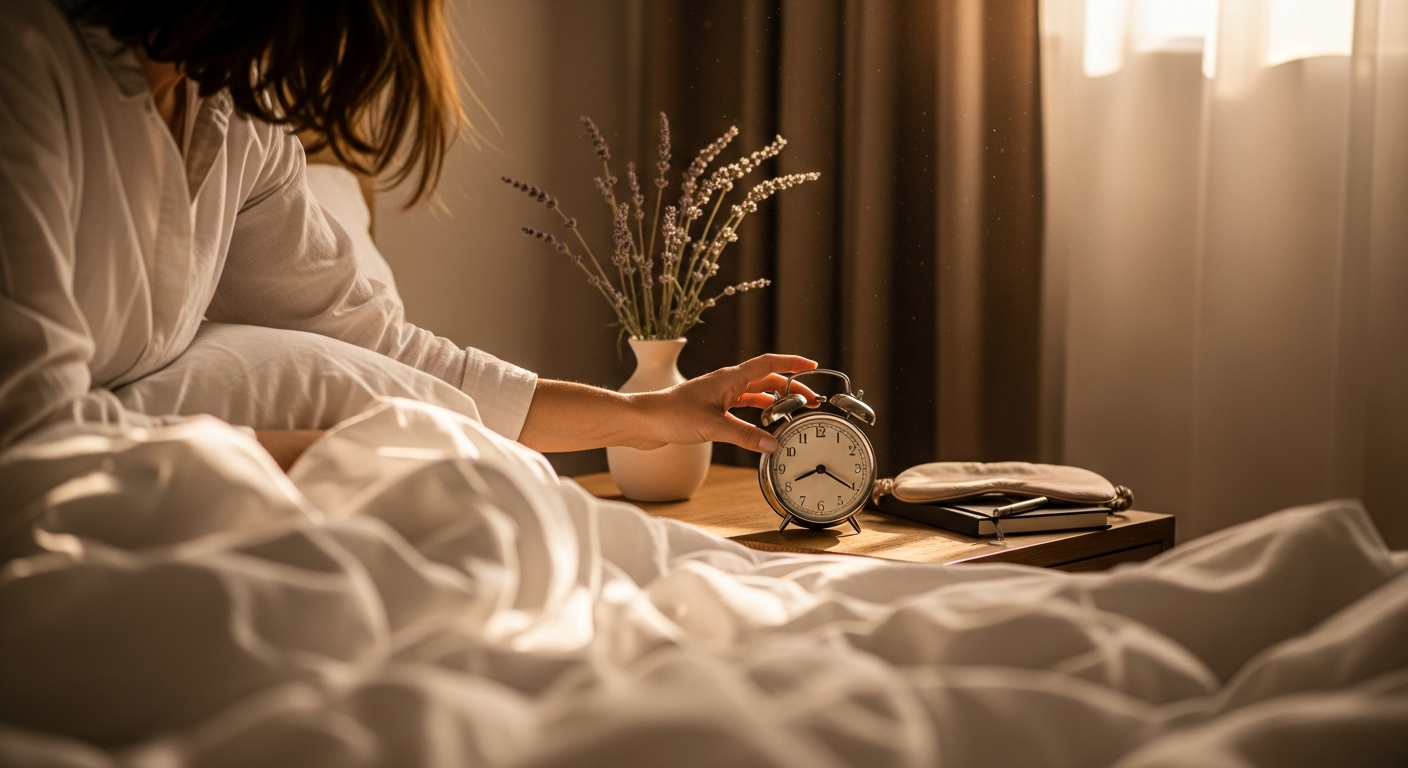
The Daylight Saving Time Hangover: How to Reset Your Sleep and Energy as a Mom
You're not imagining it: Daylight Saving Time hits moms harder due to existing sleep deprivation and children's disrupted routines. This article explains why you feel worse and how to reset your sleep and energy.
- DST is harder for you because you start from a baseline of insufficient, fragmented sleep.
- Your children's disrupted internal clocks add to the challenge, making them irritable.
- Existing sleep deprivation impairs your body's ability to adapt, worsening mood and impulse control.
- Understand the science behind circadian disruption to aid your recovery.
It’s Monday morning. The clock says 7:00 AM, but your body knows — it knows — that it’s 6:00 AM. Your alarm went off a full hour before your nervous system was ready to receive it. You peel yourself out of bed, slightly nauseous from the too-early wake-up, shuffle to the coffee maker, and immediately hear it: the sound of a child who is also decidedly not ready to be awake. Except they don’t know why they feel awful. They just know they’re furious, and you’re the nearest target.
By 9:00 AM, someone has already cried three times, including you, in the bathroom, where you stood in the dark for thirty seconds just to experience silence. By noon, your toddler has fallen apart over a cracker that broke in half. By 3:00 PM, you are running on caffeine, cortisol, and sheer maternal spite. And every single adult around you is talking about how “nice it is that it’s light out later now,” which you have decided is an objectively hostile thing to say.
Welcome to Daylight Saving Time as a mom. The rest of the world loses an hour of sleep. You lose an hour of sleep on top of the sleep you were already not getting, plus every child in your house turns into a sleep-disrupted gremlin, plus your carefully assembled routine — the one you spent three weeks getting to actually work — is now running sixty minutes off. You are not being dramatic. This is genuinely harder for you than for other people. And this article is going to tell you exactly why, what’s happening in your body, and how to recover — step by step, day by day.
Why Daylight Saving Time Hits Moms So Much Harder
Here’s the thing about sleep science: the research on DST disruption is almost entirely conducted on adults with normal sleep baselines. The average adult in a sleep study gets around 7 hours a night. They lose one hour. Their circadian rhythm adjusts in 3 to 7 days.
You are not that person.
According to the CDC, more than 70% of mothers of young children report insufficient sleep, defined as fewer than 7 hours per night. A 2023 study published in Sleep Health found that mothers of children under 6 average just 6.1 hours of sleep per night — and that’s not even accounting for the fragmentation. Six hours of interrupted sleep is physiologically nothing like six hours of consolidated sleep. It’s less restorative. It’s more disruptive to hormones. And it leaves you with essentially no buffer.
So when the clocks spring forward and everyone loses an hour, the person who was getting 8 hours becomes a 7-hour sleeper for a few days. Uncomfortable, manageable. The person who was getting 6.1 hours of fragmented sleep becomes a 5-hour sleeper, or less, while simultaneously managing children whose internal clocks are also now off — children who cannot articulate “I’m overtired and physiologically dysregulated,” but can absolutely express it at maximum volume.
This is why you feel like you’ve been hit by a bus on DST Monday when your childless colleague just seems vaguely tired. You are both experiencing the same one-hour shift. You are experiencing it from entirely different starting points.
And there’s more. The sleep deprivation that most moms are already carrying doesn’t just make you tired — it actively impairs your body’s ability to adapt to circadian disruption. Well-rested people adjust faster. Sleep-deprived people adjust slower, feel worse during the transition, and are more vulnerable to the downstream effects: impaired mood regulation, increased cortisol, reduced impulse control (hello, snapping at your kids over the cracker), suppressed immune function, and increased anxiety.
The deck is stacked. But it is not unshuffleable. Let’s talk about how to reset it.
The Science of Circadian Disruption (Made Actually Useful)
Your body runs on a 24-hour internal clock called the circadian rhythm. It controls nearly everything: when you feel sleepy and when you feel awake, when your body temperature peaks and dips, when cortisol rises to wake you up and melatonin rises to wind you down, when your digestion is most active, even when your immune system does its best repair work.
The master clock for all of this lives in a tiny part of your brain called the suprachiasmatic nucleus (SCN), which sits in your hypothalamus and receives direct input from your eyes. Specifically, it responds to light. Morning light tells your SCN “it’s day — fire up cortisol, suppress melatonin, raise body temperature.” Evening darkness tells it “it’s night — start the melatonin cascade, lower body temperature, prepare for sleep.”
Here’s what happens when the clocks change: your SCN doesn’t. Your SCN doesn’t know that humans decided to move the clock forward. It still thinks sunrise is when sunrise was yesterday. It still starts your melatonin production at the time it always has. But now your schedule — your alarm, your kids’ school start, your morning — is happening a full hour before your biology is prepared for it.
It’s as if you flew from New York to Chicago overnight, but your body is still on New York time. Except you can’t call this jet lag because there are no social points for it, no one asks how your flight was, and you still have to get everyone to school.
The average adult needs 3 to 7 days to adjust to DST. Some research suggests it can take up to two weeks for full circadian re-synchronization. For sleep-deprived moms, the timeline is on the longer end — and without intentional support, many people don’t fully adjust before they’re deep into allergy season and just chalking it up to “spring fatigue.”
The Two Levers You Can Actually Control
While you can’t force your circadian rhythm to reset overnight, you do have significant influence over two things that talk directly to your SCN:
Light exposure. Morning light is the most powerful circadian signal that exists. Bright light exposure in the first 30-60 minutes after waking suppresses residual melatonin, triggers a precisely timed cortisol pulse, and tells your SCN “this is morning — reset your clock to now.” Evening light, particularly blue-spectrum light, does the opposite: it delays melatonin production and tells your clock “it’s not time to sleep yet.”
Sleep and wake timing. Your SCN uses your consistent sleep and wake schedule as a secondary anchor. The more consistent your wake time, the more precisely your circadian rhythm calibrates. This is why sleep experts almost universally say that wake time matters more than bedtime for resetting circadian disruption.
These are your two most powerful tools for the next five days. Everything else — the melatonin, the sleepy tea, the magnesium (though that has its own value) — is supporting cast. Light and timing are the stars.
| Signal | Effect on Circadian Clock | Best Timing |
|---|---|---|
| Bright outdoor light | Advances clock, suppresses melatonin | Within 30-60 min of waking |
| Dim, warm artificial light | Minimal disruption | Evening, 2+ hrs before bed |
| Blue light (screens) | Delays melatonin, pushes clock back | Avoid in 90 min before bed |
| Consistent wake time | Anchors circadian rhythm | Same time daily, including weekends |
| Darkness in bedroom | Supports melatonin production | During entire sleep window |
The 5-Day DST Recovery Plan for Moms
This isn’t a rigid schedule. It’s a framework — day by day, with specific actions that are actually doable when you have children and a life. Think of it as meeting your circadian rhythm where it is and gently walking it forward.
5-Day Overview
| Day | Priority | Key Action | Kids’ Component |
|---|---|---|---|
| Day 1 (Sunday/Monday) | Survive and stabilize | Morning light ASAP, no naps past 3 PM | Outdoor time in the morning |
| Day 2 | Anchor wake time | Same wake time as Day 1, outside within 30 min | Maintain pre-DST meal times |
| Day 3 | Start pushing bedtime | Move bedtime 15 min earlier, no screens after 8 PM | Earlier bath/bed routine |
| Day 4 | Support the shift | Magnesium + calming wind-down; light dinner earlier | Dim lights in whole house by 7 PM |
| Day 5 | Consolidate | Full new sleep schedule in place; short outdoor walk after dinner | Celebrate: “We did it” energy |
Day 1: Survive With Intention
You are not going to feel good today. That’s not failure — that’s physics. The goal on Day 1 is not to fix anything. It’s to put two anchors in place that will make every subsequent day easier.
Action 1: Get outside within 30 minutes of waking. Even if it’s cloudy. Even if it’s cold. Even if you’re in your pajamas and a coat and you look feral. Stand in outdoor light for 10 minutes. If you can do it with your kids — better. Call it “morning air” time. You don’t have to be enthusiastic about it. Your eyes just need to register bright light, which signals your SCN that this is now morning.
Action 2: No naps after 3:00 PM. This is the hardest one. You will want to nap. You will feel like you physically cannot continue without napping. If you must nap, keep it before 2:00 PM and under 20 minutes. Napping later than this delays your sleep pressure (the adenosine buildup that makes you tired) and makes it harder to fall asleep at the new, already-shifted bedtime.
Action 3: Dim everything after 7:00 PM. Your body wants to start producing melatonin, and artificial bright light, especially from overhead LEDs and screens, is telling it not to. Dim the overhead lights. Turn on lamps. If you can, switch to warm-toned bulbs. Put on blue-light glasses if you use your phone in the evening (which, let’s be honest, you do). This won’t undo the time change, but it stops making it worse.
For the kids: Keep morning timing as close to yesterday as possible. If they usually eat breakfast at 7:30, do 7:30 even if they aren’t hungry yet (their bodies are on 6:30). Routine is an anchor for children’s circadian rhythms too.
Day 2: Anchor Your Wake Time
You survived Day 1. The key move today is holding your wake time even if you went to bed late or slept poorly. I know. It sounds backwards. But the consistency of your morning anchor — the same wake time, the same light exposure — is what starts re-training your SCN.
Action 1: Same wake time as yesterday. Set the alarm. Get up. Hate it. Get outside within 30 minutes. Repeat.
Action 2: Move your evening meal 15 minutes earlier. Meal timing is a secondary circadian signal. Your digestive system has its own clock, and eating earlier in the evening supports an earlier natural melatonin onset. You don’t need to eat at 4:00 PM — just shift dinner 15 to 20 minutes earlier than your usual DST-disrupted time.
Action 3: Begin winding down your children earlier. The goal is eventually to have them in bed at the time that, according to their bodies, feels right — which is still running about an hour behind the clock. Start nudging bedtime routines 15-20 minutes earlier than your normal pre-DST time.
A note on coffee: It’s tempting to double-dose today. Be thoughtful. Caffeine has a half-life of about 5-7 hours, meaning half of what you drink at noon is still in your system at 5-7 PM. If you’re reaching for coffee after 1:00 PM, you may be trading afternoon relief for a harder time falling asleep tonight. Herbal alternatives in the afternoon — even just peppermint tea, which provides an alertness boost without caffeine — can help bridge the gap.
Day 3: Start Shifting Bedtime
By Day 3, your circadian rhythm has absorbed two days of the new morning anchor. Your SCN is starting to recalibrate. Today, you add the other end of the equation: bedtime.
Action 1: Move your bedtime 15-20 minutes earlier than yesterday. Not the full hour — small, incremental shifts are more sustainable and less likely to result in lying in bed unable to fall asleep (which just creates anxiety around sleep, making everything worse). If last night you turned off the light at 11:00 PM, tonight aim for 10:40 or 10:45.
Action 2: A no-screens-after-8-PM experiment. Just try it. Tonight. You’ve probably read that screens before bed are bad for sleep approximately one thousand times, and you’ve also probably ignored it because your evening screen time is the only time that’s yours. I hear you completely. But on Day 3 of a circadian reset, screens after 8 PM are actively working against the recovery you’re trying to achieve. For just this one night: phone goes in another room at 8 PM. Replace it with anything else — a podcast through a speaker, a book, mindless TV with blue-light glasses, a bath, a conversation with your partner, staring at the ceiling. Anything that keeps the screens out of your direct eyeline.
Action 3: Low-dose melatonin, correctly timed. If you want pharmacological support, melatonin can help during a circadian reset — but only if you take it correctly. The research supports a low dose (0.5-1 mg, not the 10 mg gummies sold everywhere) taken approximately 90 minutes before your target bedtime. Higher doses don’t work better; they just make you groggy. Check with your healthcare provider, especially if you’re breastfeeding.
For kids on Day 3: Move their full bedtime routine (bath, books, lights out) 20-30 minutes earlier than pre-DST normal. Their bodies are ready to sleep earlier, clock be damned. Working with that, instead of against it, means fewer bedtime battles.
Day 4: Support the Shift
By Day 4, most moms start to feel a tentative easing. Not good, exactly, but less terrible. The body is recalibrating. Today is about supporting that process with a few specific additions.
Action 1: Magnesium glycinate in the evening. Magnesium is involved in hundreds of enzymatic processes in the body, including the production of GABA — the neurotransmitter that quiets your nervous system for sleep. Many people (and especially moms who eat erratically and are under chronic stress) are deficient. Magnesium glycinate is the best-absorbed form for sleep support. Take 200-400 mg about an hour before bed. Again, check with your provider, especially if you’re pregnant or nursing.
Action 2: A structured wind-down. Not elaborate. Not a spa ritual. Just a consistent sequence of 4-5 things that tell your nervous system: we are done now. The sequence matters more than the content. It might be: dim the lights, make a non-caffeinated drink, wash your face, do 5 minutes of gentle stretching or the legs-up-the-wall pose from our nervous system regulation guide, read until you’re drowsy. The routine becomes a conditioned cue for sleep onset. Your brain learns: after these things, we sleep.
Action 3: Assess your sleep environment. Just a quick scan: Is your room as dark as it could be? (Even small amounts of light from chargers, streetlights, or hallway light under the door can suppress melatonin.) Is your room cool enough? Sleep quality drops when bedroom temperature is above about 68°F. Is there noise from a partner, pet, or child that’s disrupting your light sleep stages? These aren’t luxuries. They’re leverage.
Day 5: Consolidate and Protect
Day 5 is about solidifying the new schedule and — crucially — not sabotaging it over the weekend.
Action 1: Walk outside in the late afternoon. The evening light in March is glorious and underutilized. A 20-minute walk after dinner, when the light is golden and lower in the sky, reinforces your new sleep timing without disrupting it the way morning light would. It also gives you a micro-dose of the mental reset that outdoor movement provides. (This is, by the way, a practice worth keeping permanently — more on that in the evening light section below.)
Action 2: Resist the weekend sleep-in. This is the hardest one. You made it through five hard days and now it’s Saturday and every cell in your body wants to sleep until 9:00 AM. If you sleep in more than one hour past your weekday wake time, you reset your circadian rhythm back by nearly the full five days of work you just did. This is called “social jet lag” and it’s why so many people never fully adjust to DST — they recover during the week and undo it every weekend. The compromise: sleep in no more than 30-45 minutes. Your circadian rhythm can absorb that without resetting.
Action 3: Notice and name what’s better. Seriously. Your brain has a negativity bias — it will naturally file this week under “it was terrible” unless you consciously register the improvement. You got through it. Your kids got through it. Your sleep is re-anchoring. That’s not nothing. That’s actually everything.
Managing Your Kids’ Sleep Adjustment at the Same Time
Here’s the cruel irony of DST for moms: you’re dealing with your own circadian disruption while simultaneously managing tiny people who don’t understand why they feel terrible and express that exclusively through behavior.
What’s Happening in Kids’ Bodies
Children’s circadian rhythms are actually more robust than adults’ — they respond powerfully to light cues — but they’re also less flexible in their timing. Young children especially tend to have an earlier chronotype (natural sleep/wake timing), which means DST can make an early riser wake up at what now feels like 4:30 AM rather than 5:30 AM, and fight bedtime because their body clock says it’s only 7:00 PM when the clock says 8:00 PM.
What looks like behavioral problems during DST week is almost always sleep dysregulation. The meltdowns, the hyperactivity, the refusal to eat at mealtimes, the 45-minute bedtime battle that usually takes 15 minutes — all of it. Sleep-disrupted children do not present as sleepy. They present as overtired, dysregulated, and completely unreasonable. Sound familiar?
The Gradual Shift Method
For children under 8 or so, the most effective approach is the same gradual shift method you’re using for yourself, but applied to their schedule:
- Wake them at the new time (or as close to it as they’ll tolerate) rather than letting them sleep in. Their light exposure in the morning is just as important as yours.
- Move meals 15-20 minutes earlier each day. Meal timing is a powerful circadian anchor for young children.
- Start the bedtime routine 15-20 minutes earlier than their pre-DST normal each night for 3-4 nights.
- Maximize outdoor time in the morning. For kids especially, morning light resets circadian rhythms faster than almost anything else. Outdoor play after breakfast isn’t just nice — it’s a genuine sleep intervention.
- Dim the house in the evening. Whole-house light dimming an hour before kids’ bedtime helps every person in the household. It’s not just for the adults.
When Your Kid Wakes Up an Hour Earlier Than the New Time
This is the especially brutal scenario: it’s 5:00 AM by the clock (which is really 4:00 AM by everyone’s internal clock), and a small person is now completely awake in your room. In the short term, use your judgment — there is no perfect answer here, and sometimes survival means another 45 minutes in your bed watching something on a tablet while you lay next to them with your eyes closed. In the medium term, the gradual shift in their bedtime (a bit earlier each night) will eventually push the early wakeup later.
The one thing not to do: keep them up later hoping they’ll sleep in. This almost never works and usually results in an overtired child who wakes even earlier because the cortisol from overtiredness kicks in around 4 AM.
Using the Extra Evening Light Intentionally
Here is the one genuinely good gift inside Daylight Saving Time: those first few weeks of extended evening light are extraordinary, and most of us are too depleted to notice them.
By late March and into April, sunset moves to somewhere around 7:30-8:00 PM depending on your location. That’s an entire extra hour of golden-hour light after dinner. An hour that, before DST, was darkness and early bedtimes and feeling like the evening was already over before it started.
This light is available to you. And the way you use it has real consequences for your wellbeing — not in a vague “fresh air is good” way, but in a measurable, circadian, neurological way.
What Evening Light Actually Does
Afternoon and early evening light in the lower, golden spectrum supports several things worth knowing about:
Serotonin production. Serotonin is your daytime mood stabilizer and also the precursor to melatonin. Light exposure supports serotonin synthesis. The particular quality of late-afternoon sunlight — lower on the horizon, warmer in tone — is associated with serotonin activity without the sleep-disrupting effects of direct overhead sun.
Vitamin D. In late winter and early spring, vitamin D synthesis from sunlight is limited (especially at higher latitudes), but it increases as the days lengthen. Even 15-20 minutes of skin exposure a few times a week starts to matter in March.
Circadian anchoring without disruption. Unlike morning light, which advances your clock (helping you wake earlier), evening light has a gentler, reinforcing effect on your overall circadian rhythm. A walk in the late afternoon light is one of the best things you can do for your sleep quality.
The thing you actually need most: a reason to be outside, moving, in something resembling daylight, that is not performance or productivity. The evening walk after dinner is one of the oldest human practices and one of the simplest forms of self-care that doesn’t require you to carve out special time — it happens after a thing you were already doing (eating dinner), requires nothing but shoes, and is immediately available.
Making the Evening Light Ritual Stick
The key to using the new evening light intentionally is deciding now — before the DST chaos fully settles and life fills the new hour with other things — that this hour is non-negotiable.
Not a spa evening. Not a workout. Not productivity. Just: after dinner, we go outside for 20 minutes. You, kids, partner, stroller, dog, whoever. The walk does not have to be brisk. The kids can scooter. You can walk at toddler pace, which is approximately 0.3 miles per hour with sixteen stops to examine rocks. It still counts. The light still reaches your eyes. The movement still matters. And the ritual of it — the predictable, daily experience of this is what we do after dinner now — becomes a circadian anchor for your whole family.
The Bigger Picture: Sleep as Foundational Self-Care
We need to have a direct conversation about something.
Sleep is not on the self-care menu alongside face masks and yoga. Sleep is not a bonus. Sleep is the substrate. It is the biological foundation on which every other form of wellbeing is built, and its chronic disruption in motherhood is one of the most serious, most under-addressed health issues that women face.
Research from 2023 published in Sleep Medicine found that mothers of young children experience some of the most severe sleep deprivation measured in any population — more acute, in many cases, than surgical residents. The same study found that this sleep deprivation predicts elevated rates of postpartum anxiety, depression, immune dysfunction, and metabolic disruption.
And yet. We celebrate how little sleep we get. We perform toughness with it. “The baby is up every 45 minutes” gets a knowing nod and a “that’s motherhood.” There’s no systemic support. There’s barely cultural acknowledgment that it’s a health crisis. Just tired moms running on caffeine and willpower, wondering why they snap, why they can’t lose weight, why they feel anxious, why they can’t access joy.
The snapping, the inability to regulate, the anxiety, the weight, the joylessness — a significant proportion of this is sleep. Not your character. Not your mental health (though they’re related). Sleep.
This matters because it means that working on your sleep — taking DST recovery seriously, building a wind-down routine, protecting your sleep environment — is not indulgent. It is medical. It is foundational. It is the kind of self-care that actually changes things. Not a nice addition to your day when you have bandwidth, but a structural priority, fought for and protected like the health intervention it actually is.
If you haven’t already, consider reading about how your nervous system connects to your sleep quality. The connection is direct: a dysregulated nervous system makes sleep harder, and poor sleep dysregulates your nervous system further. The two are in a loop, and you can enter that loop at either point.
Building a Lasting Sleep Routine Beyond DST
Let’s say you do the five-day recovery plan. You get through DST Monday, through the kids’ sleep disruption, through the first brutal week. And then you find yourself, somewhere around Day 8 or 9, sleeping a little better and staying a little more regulated. What do you do with that?
You build on it.
Because here’s the truth: the sleep habits that help you survive DST are the exact same sleep habits that would transform your daily life if you kept them year-round. The light exposure in the morning, the consistent wake time, the no-screens-after-8 experiment, the gradual wind-down — these aren’t tricks for a one-week recovery. They’re the architecture of a sustainable sleep practice.
The Sleep Hygiene Checklist — DST Recovery and Beyond
| Habit | DST Recovery Priority | Year-Round Value |
|---|---|---|
| Consistent wake time (within 30 min daily) | Critical | Highest |
| Morning outdoor light within 60 min of waking | Critical | Highest |
| No caffeine after 1:00 PM | High | High |
| Regular outdoor time in afternoon | High | High |
| Dinner at consistent, earlier time | Medium | High |
| Dim lights 2 hrs before bed | High | High |
| No screens 90 min before bed | High (experiment) | High |
| Bedroom cool (below 68°F), dark, quiet | High | High |
| Consistent wind-down routine (same sequence nightly) | Medium | Highest |
| Magnesium glycinate before bed | Optional support | Worth trying |
| No alcohol within 3 hrs of bed | Optional | High |
The Minimum Viable Sleep Routine
If the full checklist feels overwhelming — and it might, because you’re reading this exhausted during DST week — here is the pared-down version that gives you the most return on the least investment:
One thing in the morning: Get outside within 30-60 minutes of waking, even for 5-10 minutes. This single habit does more for your circadian rhythm, mood, and energy than almost anything else you can do.
One thing in the evening: Choose a consistent wind-down signal — something you do every night that marks the end of “on” time. It can be as simple as making a specific tea and washing your face. Keep your phone in another room after this signal. That’s it.
One thing in your bedroom: Make it darker. Blackout curtains if you can. A sleep mask if you can’t. Blue light from even a small charging cable has been shown to suppress melatonin. Darkness is free and it works.
The morning stretches routine is a perfect complement to this — gentle movement in the morning, ideally near a window or outside, stacks two circadian signals (movement and light) into one short practice.
When Better Sleep Habits Reveal Other Issues
Sometimes, as moms start to actually prioritize sleep, they discover that even when the conditions are right, they’re struggling to fall or stay asleep in ways that go beyond circadian disruption. If you’re doing the wind-down routine, limiting screens, keeping the room cool and dark, getting morning light, and still lying awake anxious most nights — that’s worth naming and exploring. Cognitive Behavioral Therapy for Insomnia (CBT-I) is the gold-standard treatment for chronic insomnia and has strong evidence for effectiveness in postpartum women. Your doctor or a sleep specialist can help.
Similarly, if you’re sleeping what should be adequate hours and still waking exhausted every morning, it’s worth asking about sleep apnea. Maternal sleep apnea is dramatically underdiagnosed — partly because women present with different symptoms than men (not the classic loud snoring, but more often waking with headaches, excessive daytime fatigue, and mood disturbance). A sleep study is worth requesting if this resonates.
Your sleep problems deserve real attention. Doom-scrolling your way through the night is a common sleep disruptor that compounds all of the above — if you recognize yourself there, that piece might be worth reading alongside this one.
Mama in Chief
Mama in Chief is a wellness advocate and mother who learned the hard way that you can’t pour from an empty cup. After her own burnout journey, she now helps other moms prioritize their mental health, physical wellbeing, and personal identity alongside the beautiful chaos of motherhood.
Frequently Asked Questions
How long does it actually take to adjust to Daylight Saving Time?
For most adults, circadian adjustment to a one-hour shift takes 3-7 days with intentional support (consistent wake time, morning light). Without intentional support — meaning without changing sleep or light exposure habits — research suggests full adjustment can take up to two weeks, and sleep-deprived moms tend toward the longer end. The five-day plan in this article is designed to compress that timeline using the two most powerful tools available: light timing and consistent wake time.
Should I try to start adjusting my kids’ sleep schedule before DST happens?
Yes, and this is one of the most effective strategies available to you. Starting 3-4 days before the clocks change, move bedtime and wake time 15 minutes earlier each day. By the time DST arrives, you’ve already shifted their schedule 45-60 minutes, and the clock change lands them close to their biological normal. It requires knowing DST is coming (second Sunday in March in the US) and being willing to put kids to bed earlier than usual during the preceding week, which is logistically annoying but physiologically brilliant.
Why do I feel so anxious and emotionally raw during DST week?
Sleep disruption directly impairs the prefrontal cortex — the part of your brain responsible for impulse control, emotional regulation, and rational thinking. Even one night of reduced sleep measurably increases amygdala reactivity (the brain’s alarm center) and decreases the prefrontal cortex’s ability to moderate it. After several days of disrupted sleep on top of an already depleted baseline, your nervous system is running in a state that closely resembles anxious hyperarousal. The anxiety and emotional rawness are real, they are physiological, and they will ease as your sleep stabilizes. You are not falling apart. You are running on a depleted operating system.
Is melatonin safe and effective for DST adjustment?
Low-dose melatonin (0.5-1 mg, not the 5-10 mg common in US supplements) taken 90 minutes before your target bedtime is well-supported by research for circadian phase-shifting. The key words are low-dose and correctly timed. High-dose melatonin doesn’t shift your clock faster — it just increases grogginess the next day. Always confirm with your healthcare provider if you’re pregnant, breastfeeding, or taking other medications.
My baby’s schedule is completely off after DST. What’s the fastest way to fix it?
Consistent morning light and meal timing are your fastest levers. Wake your baby as close to the new target wake time as possible (even if they’re cranky — gentle, bright morning light and a feeding will help), feed them at the new target meal times, and begin the bedtime routine 15-20 minutes earlier than you usually would for 3-4 nights in a row. Outdoor time in the morning — even 15-20 minutes in the stroller — is remarkably effective for resetting infant circadian rhythms. Be patient: most babies adjust within 5-7 days with consistent application.
Why do I feel so much worse during the spring DST than the fall one?
Two reasons. First, spring DST is a phase advance — your body is being asked to move forward, which is harder than moving back. Going to bed an hour later in fall (phase delay) is more aligned with the natural drift of the circadian rhythm. Going to bed an hour earlier in spring (effectively, because your body thinks it’s earlier) is against the clock’s natural tendency to run slightly longer than 24 hours. Second, you’re losing an hour of sleep in spring rather than gaining one. That asymmetry matters a great deal when you’re already at a sleep deficit.
Can the extra evening light actually help with postpartum mood, or is that just a nice idea?
Light therapy has genuine research support for seasonal and non-seasonal depression, and the mechanism is real: light exposure regulates serotonin synthesis, cortisol timing, and melatonin production — all of which are relevant to mood. Postpartum depression and the lower-grade postpartum mood dysregulation many moms experience are complex, but light exposure is one legitimate, evidence-supported lever. The best evidence is for morning light therapy (consistent bright light within 30 minutes of waking), but afternoon and evening outdoor light provides serotonin and mood benefits that are meaningful, especially as winter gives way to spring. It’s not a cure, but it’s real biology — not just a nice idea.
You Deserved the Hour They Took From You
Here’s the honest truth: Daylight Saving Time is a policy that was never designed with parents of young children in mind. It was designed for an era before we understood circadian biology, before we had research showing that this arbitrary one-hour shift measurably increases car accidents, heart attacks, and mental health crises in the days following the spring change. Multiple sleep medicine organizations have formally recommended abolishing the practice. Until that happens, you’re left navigating a system that isn’t built for you.
And you’re doing it while already running on empty. While managing tiny humans whose sleep disruption shows up as behavior that looks like defiance and feels like chaos. While performing all the functions of your life — the job, the meals, the appointments, the emotional labor — on a nervous system running on fumes.
The fact that you’ve made it to the end of this article, looking for ways to do this better, is not a small thing. It means you’re taking your sleep seriously. You’re treating your body as worth the effort of rebuilding. You’re refusing to just grit through it and tell yourself that this is just how it goes.
It doesn’t have to be how it goes. Circadian rhythms reset. Sleep debt can be partially paid down. Kids adjust. Mornings get easier. The evening light comes, and it stays a little longer every day.
That extra hour of evening light is yours. Go outside and find it.