How to Actually Get ‘Me Time’ When You Have No Village
If you lack a support system, this guide helps you redefine "me time" as any attention belonging to you, offering tiered strategies from micro-breaks to real breaks, and practical steps to build your own mini-village.
- Redefine 'me time' as any attention belonging to you, not just alone time or productivity.
- Start with 2-10 minute 'micro-breaks' and build to 15-45 minute 'pocket breaks'.
- Understand your struggle isn't poor time management; you're doing the work of several people.
- Use scripts to ask for help and strategies to build your own mini-village from scratch.
- Ensure your 'me time' leaves you feeling restored, not more drained or behind.
This post contains affiliate links. As an Amazon Associate I earn from qualifying purchases.
Last month a friend sent me an “easy ways to get me time” list. Ask your mom. Trade off with a sister. Hire a sitter you trust.
My mom lives eleven hours away. My sister and I text on holidays. The sitter I trust went back to campus in August.
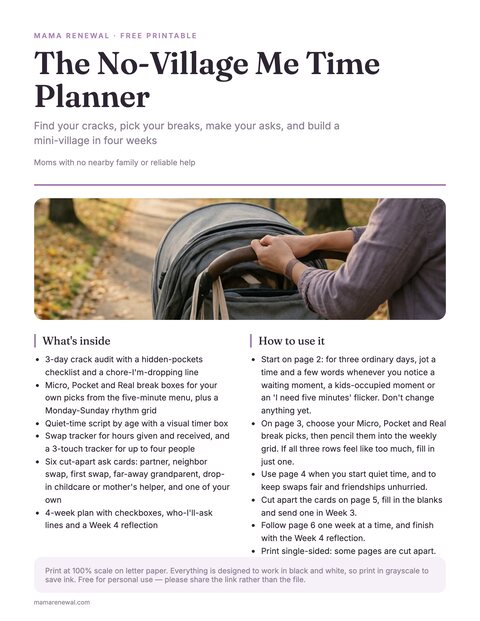
Free printable · 6 pages
The No-Village Me Time Planner
A 3-day crack audit with hidden-pockets checklist, a three-tier menu with weekly grid, an age-based quiet-time script with visual timer box, cut-out ask cards with swap and 3-touch trackers, and a 4-week plan with reflection.
Free. Your download link appears right here. You'll also join the Mama Reset. Unsubscribe anytime. Privacy
That list wasn’t written for us. This guide is for getting me time with no help or family nearby. It covers what me time really means, where to find hidden time, scripts for asking, and how to build a mini-village from scratch.
Short on time? Jump to the copy-and-paste scripts or the four-week plan.
In this article (15 sections)
- What “Me Time” Actually Means (And What It Doesn’t)
- Why It’s Harder Without a Village (and Why That’s Not Your Fault)
- Step One: Find the Time You Already Have
- Micro Me Time: What You Can Do With Zero Help
- Asking for Help When You’re a Mom With No Family Nearby
- What to Say When You Ask for Help (Scripts for Partners, Neighbors and Friends)
- Building a Mini-Village From Scratch
- A Four-Week Plan to Build Your “No Village” Me Time
- Self-Care Without Support
- Weekly Me Time Schedule for Busy Moms
- How to Handle Mom Guilt About Taking Me Time
- When Me Time Plans Keep Falling Apart
- Warning Signs That Need More Than Rest
- Frequently Asked Questions
- Me Time Without a Village: The Short Version
What “Me Time” Actually Means (And What It Doesn’t)
The tidy definition of me time is time alone, doing something you enjoy. For a mom with no help, that’s too narrow. The one I use instead: me time is any stretch of attention that belongs to you instead of to someone else’s needs.
Notice what that leaves out:
- It doesn’t need an hour or an empty house. Ten minutes counts, and being alone helps but isn’t required.
- It doesn’t have to be “productive,” “healthy,” or Instagram-worthy.
- It isn’t errands alone. A kid-free grocery run can feel like a vacation, but it’s logistics with a quieter soundtrack, not rest.
- It isn’t doomscrolling in the bathroom. That’s an understandable coping mechanism, but it rarely leaves you restored. (The piece on breaking the late-night phone habit gets into why.)
- It isn’t self-improvement you resent. A workout you dread or a course you “should” take is one more job.
The simplest test I know: after this, do I feel a little more like myself? If yes, it counts. If you feel more drained or more behind, it doesn’t.
Three kinds of me time
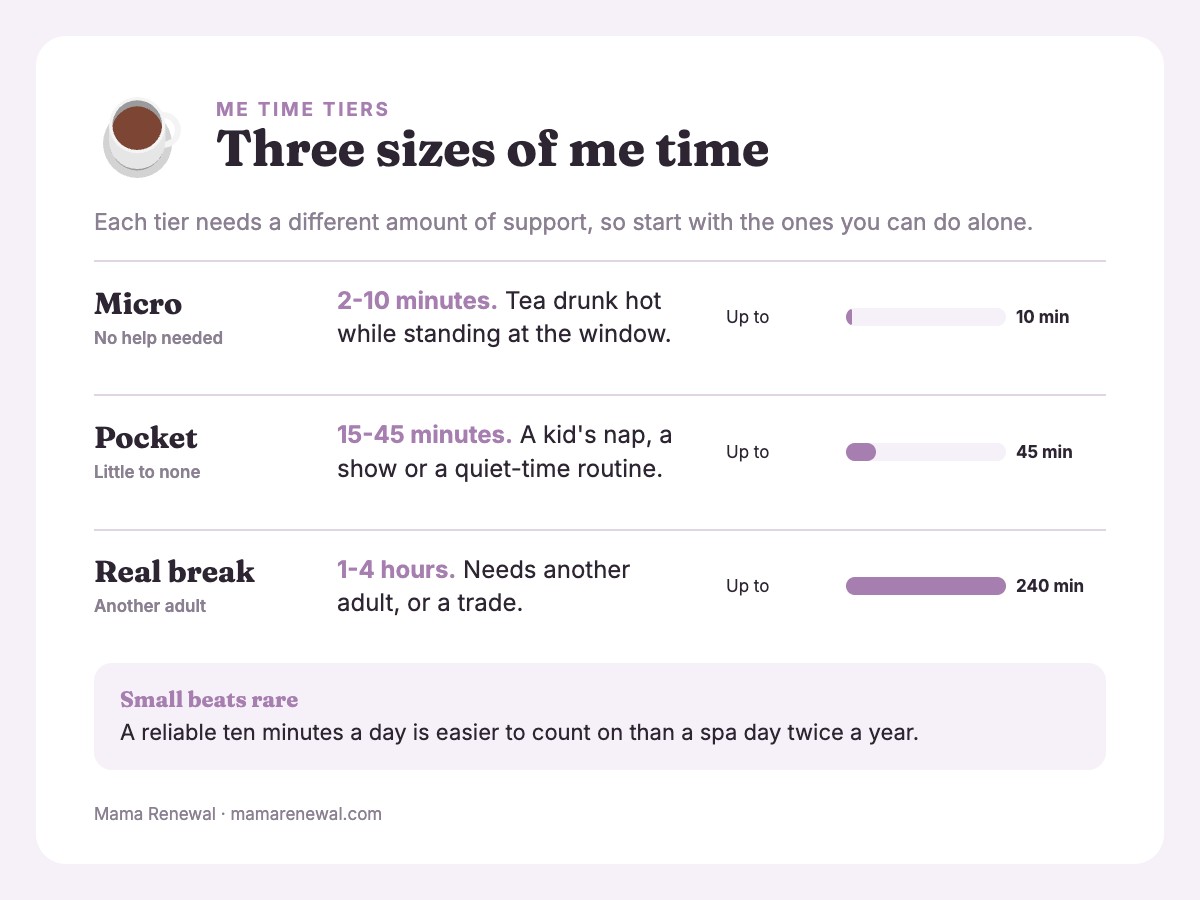
With no help, think in three tiers. Each needs a different amount of support.
| Tier | Length | Support needed | Example |
|---|---|---|---|
| Micro | 2-10 minutes | None | Tea drunk hot while standing at the window. |
| 15-45 minutes | Little to none (a kid’s nap, a show, a quiet-time routine) | A walk with a podcast in one ear while the stroller does the work. | |
| Real break | 1-4 hours | Another adult, or a trade | A solo coffee shop afternoon, a swim, or a nap with the door closed. Another trusted adult is actively in charge of the kids the whole time. |
Most advice jumps straight to tier three. With no village, you’ll live mostly in the first two and build toward the third on purpose. That’s not second best. A reliable ten minutes a day is easier to count on than a spa day twice a year.
Why It’s Harder Without a Village (and Why That’s Not Your Fault)
Struggling to find alone time without help is not a time management problem. For a long time I thought I just needed a better schedule. What I needed was another pair of hands.
One or two adults handling everything, often with one also working, is a hard setup. So when you feel stretched past what seems reasonable, that’s not weakness. You’re doing the work of several people.
If you’ve been wondering why everyone else seems to cope while you’re drowning, read about the mental load. The invisible part of the job is usually what keeps your brain from ever clocking out.
A few things make the no-village version especially tough:
- There’s no “off-ramp” when you hit your limit. There’s no one to say “give me the baby, go lie down.”
- Everything takes more planning. Even a haircut becomes a logistics project.
- The asking itself is costly. If you’ve been turned down or let down, it gets harder to ask next time.
- Guilt gets louder. When you’re the only one there, taking time away can feel like abandonment, even when it’s thirty minutes.
None of this means you should give up on rest. It means you need strategies built for your actual life, not the one on the listicle.
If you’re feeling the early signs of being truly run down, read the breakdown of the three signs of mom burnout. It’s a useful gut-check on whether this is “tired” or something more. Burnout isn’t a formal diagnosis, so if you’re worried, talk to a doctor.
Step One: Find the Time You Already Have
Before asking anyone for anything, do a quick, honest audit. Not a color-coded planner. Just a look at where your day has cracks.
The 3-day crack audit
For three ordinary days, keep a note on your phone. Every time you notice one of these, jot a time and a few words:
- A moment you were waiting (pickup line, microwave, bath running).
- A moment kids were occupied and content, and you filled it with chores or your phone.
- A moment you felt a flicker of “I just need five minutes.”
Don’t change anything yet. Just collect. You’ll probably find more time than you expected, but it’s fragmented and usually eaten by something other than rest. These are the common hidden pockets.
| Hidden pocket | Why it’s usually wasted | A better use |
|---|---|---|
| Nap or quiet time (30-90 min) | Used for dishes, work or catching up. | Pick one nap a day (or three a week) that’s for you. |
| First 15 minutes after kids wake | You jump straight into their needs. | Wake before them, even 10 minutes. |
| After bedtime, 8:00-9:30 PM | Scrolling, dishes, collapsing. | Protect 30 minutes before “must-do” tasks. |
| Car-line waiting | Phone triage. | Audiobook, music, or silence. |
| Kids’ independent play | You do chores nearby. | Sit down and do nothing next to them. |
| Weekend morning | Everyone’s up at once. | One adult up, one sleeps. Solo: kids under 6 play in a safe space while you sit nearby, awake and watching. Kids 6 and up play independently within earshot. |
The “chore swap” rule
Say you only have one nap window and a mountain of chores. My rule: the house can be 80% okay while you rest. Pick one thing in that pocket of time that is for you, do the minimum viable version of one chore, and leave the rest.
You’ve probably said, “I’ll just fold this basket and then I’ll rest,” and then the baby woke up. Rest first, then chores, knowing some chores may not happen. The basket can wait.
Micro Me Time: What You Can Do With Zero Help
This is for the days you’re alone with the kids from dawn to bedtime, and no one is coming. These don’t replace real breaks. They keep you from going a full week with no part of the day that is yours.
The five-minute menu
Pick one that appeals, and ignore the ones that don’t. Be honest about which ones you’d actually do. Mine is the hot drink.
- The hot drink, finished. Make it, sit down, and drink the whole thing without doing anything else. Use a lidded mug, and park it where you can see it but little hands can’t reach.
- The doorway reset. Stand at an open door or window with the kids in view, and take ten slow breaths looking at something far away. Save stepping out to the porch for when they’re asleep or another adult is watching them. (If you nurse or rock a baby most of the day, breathing you can do while holding a baby is built for exactly this.)
- The bathroom timeout. You’re going to be in there anyway. Give yourself five unhurried minutes with a face mask or lotion, and no screen. Close the door only when another adult is physically there and in charge. Otherwise leave it open enough to see and hear the kids, or bring the baby in and settle them in a safe spot on the floor, within arm’s reach. If your child is asleep in their crib or bed, keep the door ajar and a monitor on.
- The music hit. One song, with one earbud in and the other ear free, so you can still see and hear the kids. Dance if you’re feeling brave. Save headphones-on, eyes-closed for when they’re asleep or another adult is watching.
- The window stretch. Reach up, fold forward, roll your neck. You’ll hold less tension than you think, and you can do it while the toddler watches.
- A line in a notebook. Write three sentences about the day: no editing, no audience.
Safety firstA spilled hot drink can badly scald a baby or toddler. Never hold one while holding a baby. Use a lidded mug, keep it well back from table and counter edges, and keep it out of reach of crawling and toddling kids. During any micro break, babies and toddlers stay where you can see them, unless they’re asleep in a safe sleep space or another adult is watching.
For longer ideas that fit the “I have twenty minutes and nowhere to go” gap, there’s a whole list in solo time ideas for moms who get 20 minutes. And if bubble baths have never been your thing, try the roundup on self-care for moms who hate bubble-bath self-care. It will save you from forcing yourself into someone else’s idea of rest.
Make your kids part of the plan (without making them the plan)
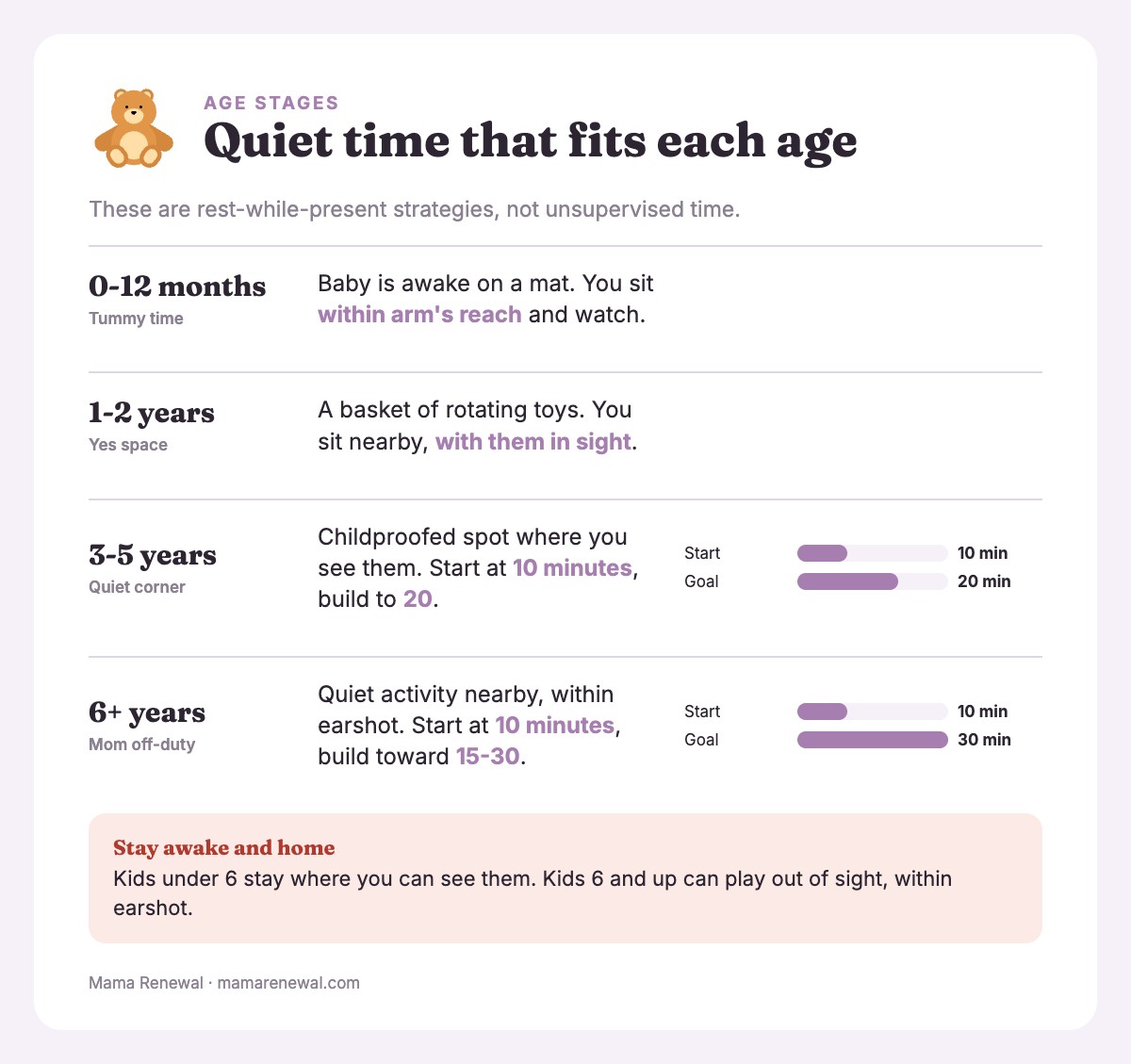
When you have no backup, the thing to build is independent-play stamina. What that looks like depends on your children’s ages. This isn’t about ignoring kids. It’s about teaching them that you have needs too, and that boredom is survivable.
| Age | What can work |
|---|---|
| 0-12 months | Tummy time on a mat while baby is awake. You sit within arm’s reach and watch. |
| 1-2 years | A “yes space” with a basket of rotating toys. You sit nearby, with them in sight. Your tea is in a lidded mug, out of their reach. |
| 3-5 years | Quiet time in a childproofed corner of the room you’re in, or a spot where you can see them the whole time. Stock it with books, large-piece puzzles, audio stories and a visual timer. Start at 10 minutes and build to 20. |
| 6+ years | A “mom is off-duty” window, depending on the child’s maturity. Start with 10 minutes and a quiet activity, like books or drawing, and build toward 15-30. Kids play on their own nearby, and you’re in the house, awake and within earshot. Minor squabbles wait until the timer goes off. You step in for injuries, fighting that turns physical, and anything unsafe. |
Safety firstThese are rest-while-present strategies, not unsupervised time for young children. At every age, you stay awake and in the home. Kids under 6 stay where you can see them. Kids 6 and up can play out of sight, within earshot. Sitting near an awake baby is low-effort rest, not a break from supervision.
- Babies: awake, watched, and within your arm’s reach the whole time.
- Clear the mat area of cords, small objects and loose blankets.
- Hot drinks: use a lidded mug, keep it out of reach, and never hold one while holding a baby.
- A baby who gets drowsy goes on their back on a firm, flat sleep surface, such as a crib or bassinet, with no loose bedding, per AAP safe sleep guidance. Not on the play mat or sofa.
- Ages 3-5: stay in the same room, or where you can see them. Skip small puzzle pieces, which are a choking risk under 4.
- Ages 6 and up: readiness varies by child, so start with short windows. An adult stays in the house, awake and within earshot. Check in more often on the younger kids in this range.
- Childproof any quiet-time space first: anchor furniture, no blind cords, no button batteries or magnets.
Five ways to make quiet time stick
- Start tiny. Ten minutes at first, then build toward twenty. Kids need practice.
- Fill their cup first. Ten minutes of undivided attention right before your break makes it much easier for them to let go.
- Use a visual timer. A sand timer or a countdown on a tablet turns “when is mom done?” into something they can check themselves.
- Offer a script. “I’m taking my quiet time now. When the timer goes off, I’m all yours.” Say it the same way every time.
- Expect pushback for a week. The first few days are usually the loudest. Consistency is what actually changes it.
Good to knowThey will interrupt sometimes. An interrupted ten minutes still counts, and it’s ten more than you had before.
Asking for Help When You’re a Mom With No Family Nearby
For years I believed asking was a kind of failure. It isn’t. What changed things for me was getting specific: a vague ask is hard to answer, and a small, clear one is easy to say yes to.
“Let me know if you need anything” is kind, but it hands the other person a puzzle. What could I do? Is it too much? So they do nothing.
At the other end, “Can you watch the kids Saturday?” is a big ask with no easy out. That makes it hard to say yes to.
The sweet spot is a low-ask: specific, time-limited, easy to decline, and easy to say yes to. If you’ve ever felt guilty even thinking about asking, read the piece on asking for help without the mom guilt. It goes deeper into why that guilt shows up and how to work with it.
Why low-asks work
A good low-ask has four parts:
- What exactly you need. Not “help,” but “twenty minutes.”
- When. Name a specific window.
- A built-in exit. “No worries if not!”
- A reason that’s about time, not crisis. “I’d love to take a walk alone.”
You are allowed to ask for something that isn’t an emergency. Rest isn’t a luxury you earn by collapsing first.
Safety firstBefore leaving your kids with anyone, run through this list.
- I’ve met them with my child present.
- I’ve checked references for any regular sitter or helper.
- The first visits are short, and I’m home and awake.
- We’ve agreed on kids per adult, allergies and water rules.
- They have my number and a second emergency contact.
What to Say When You Ask for Help (Scripts for Partners, Neighbors and Friends)
This is the part to screenshot. Below are scripts for different people in your life, with notes on why each one works. Change the words to sound like you. They’re a starting point, not a performance.
Asking a partner (or co-parent)
If you have a partner, even a busy or tired one, you may be assuming they know you need a break. Knowing it in the abstract isn’t the same as having a plan. These scripts turn it into one.
| Situation | Script | Why it works |
|---|---|---|
| Vague resentment building | “I’m running on empty and I’d like to fix it with you, not at you. Can we talk for ten minutes after the kids are down?” | Frames it as teamwork and gives a time. |
| Wanting a regular break | “Can I have Saturday 9-10 AM as mine, every week? You’re on duty, and I’ll do the same for you Sunday.” | Specific, recurring, reciprocal. |
| Needing a break right now | “I need fifteen minutes alone in the bedroom. Can you take over until I come out?” | Specific and short. |
| Unequal mental load | “Can you own bedtime this week, start to finish, including the stuff I usually remember?” | Asks for ownership, not just help. |
| Partner says “just tell me what to do” | “I don’t want to manage you. I’d like you to look at the situation and decide. Can we start with dinner this week?” | Names the mental-load issue without blame. |
| Partner works late or travels | “On the nights you’re home, can you do the 6-8 PM shift so I can step out for a walk?” | Uses the time they do have. |
If your partner’s reflex is “I’m tired too,” that can be true and your need can still be real. You aren’t competing for who is more exhausted.
Asking a neighbor
Neighbors are easy to overlook when you have no village. They’re physically close, and some would welcome the company too.
| Situation | Script | Why it works |
|---|---|---|
| Never really spoken | “Hi, I’m [name] from [house]. We’ve got a toddler and we’re new here. Would you want to swap numbers in case of anything?” | Starts the relationship before any ask. |
| First tiny favor | “Could you bring in my package if it arrives while we’re out? No worries if not.” | Small, specific, low-risk. |
| Trading time with a neighbor mom | “Want to trade? I’ll take your kids Tuesday 3-5, you take mine Thursday 3-5. We each get two free hours.” | Equal, scheduled, no cost. |
| An older neighbor who seems friendly | “Would you want to come sit on our porch with us on Wednesday afternoons? The kids love company.” | Gives them company, with you present. |
| Not ready for the big ask | “I’m going to try to take a ten-minute walk every day at 4. If you ever want company, join us.” | An open invitation with no pressure. |
Safety firstOn porch visits with a neighbor, you stay with the kids. Once you know the person well, you might rest inside with the door open, awake and within earshot.
If your neighbors are mostly strangers, the first step isn’t an ask at all. It’s a hello. Wave, learn names, say something small. A favor is much easier to ask once you’ve traded a few sentences.
Trading childcare with other moms (the “swap”)
A childcare swap is the closest thing to a village you can build from scratch. It’s reciprocal, free, and sustainable if structured well. You don’t need a close friend. You need another parent who is also stretched and willing to try.
| Situation | Script | Why it works |
|---|---|---|
| Proposing the first swap | “Would you want to try a trade? I take yours for two hours on Saturday, you take mine the next week. We both get a break.” | Clear structure and an easy yes. |
| Making it low-stakes | “Let’s try it once and see how it goes. If it’s a mess, no hard feelings.” | Removes pressure. |
| Mixed ages | “Mine are 3 and 6, yours are 4 and 7. I think they’d play well together. Want to try a Saturday morning?” | Shows you’ve thought about it. |
| Concern about safety | “Can we keep our first few swaps at one of our houses, with the other parent nearby? Then we can decide how comfortable we are.” | Builds trust gradually. |
| You’ve been asked and can’t | “I’d love to, but I can’t take on a regular swap right now. Can I do a one-off in two weeks instead?” | Honest, flexible, kind. |
| Keeping it fair | “Should we track hours so it stays even? I don’t want either of us to feel like we’re owing.” | Prevents resentment. |
TipPut swaps on the calendar as recurring. “We should do this sometime” almost never happens. “Tuesdays at 3” does.
Safety firstKeep ratios manageable, with fewer kids per adult when any are under 3. Agree on allergies, car-seat rules and water rules ahead of time. Never leave a child alone in a car, not even for a minute. Stay within arm’s reach of children near pools, tubs or ponds.
Asking a friend or family member who’s far away
Distance doesn’t mean zero help. It means you need creative asks.
| Situation | Script | Why it works |
|---|---|---|
| Grandparent far away | “Could you do a video call with the kids at 4 PM on Wednesdays? It’d give me a half hour to sit down nearby and breathe.” | Uses what they can do, while you rest in the same room. |
| Friend in another state | “Would you be up for a phone call during my walk on Thursday? I’d love company, and you’d be helping me stay sane.” | Companionship as help. |
| A family member who offers vaguely | “You mentioned you’d love to help. The most useful thing would be [specific]. Is that something you could do?” | Turns a vague offer into a real one. |
| Funding a break | “For my birthday, what I’d love most is a gift card toward a sitter or a drop-in childcare session.” | Redirects gifts to what you need. |
| Visiting family | “While you’re here, could you take the kids for the first hour after breakfast? I’d love a real shower and a quiet coffee.” | Visits are the best time to get real breaks. |
Safety firstA video call is company for the kids, not supervision. A grandparent on a screen can’t step in if something goes wrong. With kids under 6 (babies, toddlers and preschoolers), stay in the room and rest where you can see them. For kids 6 and up, you can be elsewhere in the house, awake and within earshot. Save the shower or closed-door time for when another adult is physically there.
Asking for help when you don’t have anyone close
If there’s truly nobody right now, start with options that don’t depend on a favor.
- A drop-in childcare session at a gym, library program, or community center. Many offer short sessions, often an hour or two, for a fee. Check their age limits and staff ratios.
- A mother’s helper. A responsible preteen or teen from your street plays with the kids while you stay home. The ground rules:
- There’s no single right age. Many families start around 12 or 13 and up, so check your local guidance. Judge the individual helper’s maturity, not just their age.
- A babysitting or first-aid/CPR course is a plus. The Red Cross offers them, so check the course’s age range.
- You stay home and awake. Keep kids under 6 where you can see them, and stay within earshot of older kids.
- The helper plays only with kids old enough to play on their own, about age 3 and up.
- You handle any baby yourself. The helper never holds or feeds an infant.
- No bath time, no bottles, and no sole charge of any child.
- Meet the helper’s parents first.
- Storytime or kids’ classes, where you’re present but not on duty.
- A paid hour of sitting. Yes, it costs money. Rates vary a lot by area, so call two or three places and ask for the hourly drop-in rate and any sign-up fee. Ask about age limits, staff ratios and maximum stay too. If you can find even one affordable hour a month, it’s worth it.
A one-line message that works for many of these: “Hi! I’m looking for a regular two-hour window for my [age]-year-old on [day]. Do you have openings?” That’s it. No emotional labor required.
Building a Mini-Village From Scratch
If you’ve thought, “I need a village, not a script,” you’re right. Scripts get you through right now. A village makes things sustainable, and you don’t need a big one. A mini-village is two or three people who occasionally help, and whom you occasionally help.
Where to find your people
Making friends as an adult is hard, and it’s okay to say so. The post on making mom friends as an adult explains why it feels so awkward and gives a gentler approach.
The places below tend to work best. They offer repeated contact, which is what builds friendship.
| Where | Why it works | Effort level |
|---|---|---|
| Library storytime | Same faces every week. | Low |
| Preschool or school pickup | Built-in daily proximity. | Low |
| Parks (same time, same park) | Regulars emerge quickly. | Low |
| Local parent groups online | Easy first contact, then meet in person. | Medium |
| Neighborhood groups | Hyper-local, often supportive. | Low |
| Faith communities, if relevant | Often have childcare and a built-in support culture. | Medium |
| Classes (swim, music, gymnastics) | Shared activity makes small talk easier. | Medium |
| Parent-child fitness or stroller groups | You get movement and company. | Medium |
The 3-touch rule
Friendship rarely happens in one meeting. A rule that helps: aim for three touches with the same person before deciding whether to continue.
- Touch one: small talk at the park. (“How old is yours?”)
- Touch two: a mild follow-up. (“Hey, nice to see you again! Do you come here often?”)
- Touch three: a low-key invitation. (“We’re at the park Thursday around 10 again if you want to meet up.”)
If it clicks, great. If it doesn’t, you’ve lost nothing. This takes the pressure off any single interaction.
Start by being a little bit useful
My favorite way in is to offer something small first. Not because you “owe” anyone, but because small generosity makes the later ask easier. The relationship already has a little warmth in it.
- Offer a hand-me-down box of kids’ clothes.
- Share a recipe or a recommendation.
- Drop a meal or snack on someone’s porch after a rough week.
- Message a mom you met: “Saw this and thought of you.”
Be honest about what you need
It’s tempting to hide how hard this is. But someone has to go first, and it can be you. A sentence like “I’m kind of drowning this week, are you?” can do more than months of polite chat.
A Four-Week Plan to Build Your “No Village” Me Time
If you like structure, use this as a gentle ramp. Each week adds one thing, so don’t skip ahead. Keep what works and drop what doesn’t. The free No-Village Me Time Planner near the top of this page walks you through it week by week.
- Week 1: Notice and protect. Do the 3-day crack audit. Pick one daily micro-break and do it at the same time every day. Choose one chore to drop for the month.
- Week 2: Build independent play. Start a 10-minute quiet time with a visual timer and a consistent script. Try one pocket of time strictly for you, three days this week.
- Week 3: Make one ask. Choose one person from the scripts tables: partner, neighbor, or swap partner. Send the message, using the exact script if it helps. If they say no, thank them and try someone else. A “no” is information, not rejection.
- Week 4: Add a recurring anchor. Put a recurring break on the calendar: a swap, a weekly partner shift, or a drop-in session. Tell one person your plan for accountability. Then reflect on what worked, what didn’t, and what you want more of.
By the end of the month, you won’t have a village. You’ll have a few routines, one or two people who’ve said yes, and proof that you can build rest into a hard season. That’s a real start.
Self-Care Without Support
Some seasons, no amount of friendly outreach changes the reality: you’re on your own most of the time. Maybe you’re single parenting, your partner is deployed or traveling, you’re in a new city, or the baby won’t take a bottle. In those seasons, “self care without support” has to mean something realistic.
Redefine “break”
When you can’t leave the room, a break may need to look like a change of state, not a change of location:
- From doing to being. Sit with the kids and just watch, instead of managing.
- From noise to quiet. One earbud at low volume during independent play, with the other ear free and young kids in sight. Save both-ears headphones for when they’re asleep or another adult is watching.
If you suspect your body is stuck in a constant “on” state, try the guide to nervous system regulation for moms. It has quick techniques you can do in a few minutes with no equipment.
Lower the bar on everything else
Sometimes the most effective self-care is removing something, not adding it. When you have no help, every obligation you drop frees time for rest. Look for what you do out of habit that nobody would miss, what could be “good enough” for the next month, and what you can buy, simplify, or skip.
The swaps I’d start with:
- Rotating the same five dinners instead of cooking something new every night.
- Grocery pickup instead of walking the store.
- Paper plates on the hardest days.
- Saying “no” without a long explanation. The scripts to protect self-care time are handy here.
Protect your sleep like it’s your job
When help is scarce, sleep is the closest thing you have to a reset button. It’s also the first thing to go. If you can only protect one thing, protect that.
A consistent wind-down, a phone that charges outside the bedroom, and a fixed “kitchen is closed” time all help. If you’re still exhausted even when the kids sleep, mom sleep debt explains why.
If tired is sliding into something heavier, read the warning signs that need more than rest.
Weekly Me Time Schedule for Busy Moms

This is what a week can look like once the four-week plan is in place. It assumes no regular help and one nap or quiet-time window per day. Swap, skip, and adapt.
| How often | What it looks like |
|---|---|
| Every day | A micro break: one pick from the five-minute menu, at the same time each day. |
| Three days a week | A pocket of time: a nap or quiet-time window for rest, a walk with a podcast, or a hobby. Not chores. |
| Once a week | A real break: a neighbor swap, partner shift or drop-in session, if you have one. |
Good to knowSome days you’ll skip it all, and that’s normal. The goal is a rhythm, not a streak. If all three rows look like too much, pick just one.
How to Handle Mom Guilt About Taking Me Time
You can have a perfect plan, a willing neighbor and a kind partner. You can still feel like a bad mother for taking twenty minutes. I still feel it some days, and it doesn’t mean you’re doing something wrong.
The first few times are the loudest. It tends to get quieter with practice.
Three ways to talk back to it:
- “A rested mom is a better mom.” There’s truth in it, but you don’t have to earn rest by being a better mom afterward. You deserve it regardless.
- “My kids are learning something.” They’re learning that adults have needs, that rest is normal, and that people take care of themselves.
- “This is maintenance, not indulgence.” You wouldn’t feel guilty about charging your phone.
If you’re also carrying the weight of everyone else’s expectations, the guide on saying no to the PTA and everything else is worth a read. Often the thing standing between you and rest is an overcommitted calendar, not a lack of time.
What to do with the time once you have it
It’s easy to get thirty minutes and spend them on indecision. Pick one of these before your window starts:
- Do nothing on purpose. Lie down. Stare at the ceiling. This is allowed.
- Make something. Draw, knit, bake, journal.
- Sleep, when another adult is watching the kids or they are asleep. There is no shame in this.
If you’re not sure what feels restorative for you, the self-care style quiz can help you figure out what actually works instead of what’s trendy.
When Me Time Plans Keep Falling Apart
Some seasons are just brutal. A newborn. A sick child. A move. A job loss. If you’ve tried and it’s not working, hold on to these three things:
- Survival mode is okay. Lower the target, not your worth. If five minutes is all you get, that’s enough for now.
- Ask a professional. A therapist, doctor, or postpartum support group can offer more help than you might expect. The guide to finding a therapist as a busy mom is a place to start.
- Look for programs. Many communities have parent support groups, free or sliding-scale childcare, home visiting programs, or library resources. A quick call to your local family resource center can open doors you didn’t know about.
You’re not the only one. Somewhere near you, another mom is sitting in her kitchen thinking the same thing. The village often begins when one person says, “Me too.”
Warning Signs That Need More Than Rest
Being alone with a lot of responsibility can slide from tired into something heavier. Tell a doctor or therapist if any of these last more than two weeks:
- Persistent sadness, numbness, or hopelessness.
- Constant anxiety, panic, or scary intrusive thoughts.
- Intense anger or irritability that feels out of control.
- Trouble sleeping even when you have the chance.
- Loss of interest in things you used to love.
Safety firstSome signs should not wait two weeks. Get help right away if you have thoughts of harming yourself, thoughts of harming your baby or fear for your baby, or a feeling that your family would be better off without you. In the US, call or text 988, or call 911 for immediate danger. The National Maternal Mental Health Hotline is 1-833-852-6262 (call or text, 24/7), and Postpartum Support International’s helpline is 1-800-944-4773. Outside the US, call your local emergency number.
You don’t have to wait until it’s “bad enough” to ask. Asking a professional for support is not a failure. It’s a form of self-care.
If you need support right now
Reaching out is not an overreaction. These lines are free and confidential.
- Emergency: if you are thinking about harming yourself or your baby, or you can’t keep yourself safe, call 911 or go to the nearest emergency room. This is a medical emergency, and it is treatable.
- 988 Suicide & Crisis Lifeline: call or text 988, 24/7, for anyone in crisis.
- National Maternal Mental Health Hotline: call or text 1-833-TLC-MAMA (1-833-852-6262), 24/7, in English and Spanish, for pregnancy and postpartum support.
- Postpartum Support International: call or text 1-800-944-4773 for help finding a provider who specializes in perinatal mental health. Not an emergency line.
US numbers. Elsewhere, ask your doctor, midwife or local crisis line. This article was written by a parent, not a clinician, and isn’t medical advice.
Frequently Asked Questions
How do I get me time as a mom when I have no help at all?
Start with micro and pocket time, which don’t require anyone else. Use a nap or quiet-time window for yourself instead of chores, and build short independent-play routines with a visual timer. Carve out five minutes a day that’s strictly yours, like a hot drink in a lidded mug or a few slow breaths at an open door with the kids in view.
Once that rhythm exists, add one low-ask: a swap with another parent, a paid drop-in hour, or a regular window with a partner. Small and consistent beats big and rare.
What does “me time” actually mean?
Me time is any stretch of attention that belongs to you instead of someone else’s needs. It doesn’t have to be an hour, a spa day, or even solitary. It can be ten quiet minutes, a walk with a podcast in one ear, or sitting with a book while your kids play nearby. The simplest test is whether you feel a little more like yourself afterward. If you do, it counts.
How do I find my village if I’m new to an area or don’t have family nearby?
Go where repeated contact happens: library storytime, the same park at the same time each week, preschool or school pickup, kids’ classes, and local parent or neighborhood groups. Friendship tends to form after several low-pressure meetings, so aim for about three touches with the same person before deciding whether it’s a fit. Offering something small first, like a hand-me-down box or a text that says “thought of you,” also warms things up. Expect it to take months rather than weeks.
How can I do self care without support from a partner or family?
Redefine a break as a change of state rather than a change of location. That can be a few slow breaths, one earbud of music during independent play, ten minutes outside with the kids, or a gentle stretch. Lower the bar elsewhere so rest has room to exist: simplify meals, use grocery pickup, and drop obligations nobody would miss. Protect sleep above all else. If you’re feeling persistently low, anxious, or angry, please also talk to a doctor or therapist. That is a valid and important form of support.
How do I ask my partner for alone time without starting a fight?
Be specific, pick a calm moment, and frame it as teamwork. “Can I have Saturday 9-10 AM as mine, every week? You’re on duty, and I’ll do the same for you Sunday” works better than “You never help.” Offering a reciprocal trade makes it easier to accept. Asking for ownership of a task (like bedtime) instead of “help” reduces the mental load. If conversations keep stalling, a calm check-in at a set time each week can keep resentment from building.
Is a childcare swap with another mom safe and realistic?
It can be, if you build trust gradually. Start with a short swap at one of your houses with both parents nearby, and choose kids who are close in age. Agree on allergies, screen rules and emergency contacts. Keep ratios low, and stay within arm’s reach of children near pools, tubs or ponds.
Track hours loosely so neither of you feels like you’re owing, and make it a recurring slot so it happens. If anything feels off, it’s fine to pause. A kind “this isn’t working for us right now” is all the explanation you owe.
I feel guilty taking time for myself. Is that normal?
Very. It’s common, especially when you’re the only adult in the house. It tends to fade with practice, as you see that your kids are fine.
It can help to think of rest as maintenance, like charging a phone, rather than an indulgence. If guilt is stopping you from taking any time at all, or you feel constantly overwhelmed, it’s worth talking to a professional.
Me Time Without a Village: The Short Version
If you take one thing from this, let it be this: you don’t have to wait for a village to start taking care of yourself. Begin with a hot drink, five unhurried minutes in the bathroom, or a ten-minute quiet time.
Then ask one person for one specific thing. Wave at the mom at the park again next week. Trade two hours with a neighbor. Villages don’t appear overnight, but they do get built, one small, awkward, brave ask at a time.
And in the meantime, please be as kind to yourself as you would be to a friend in your shoes. You’re doing hard work, mostly unseen, and you’re allowed to rest while you do it.