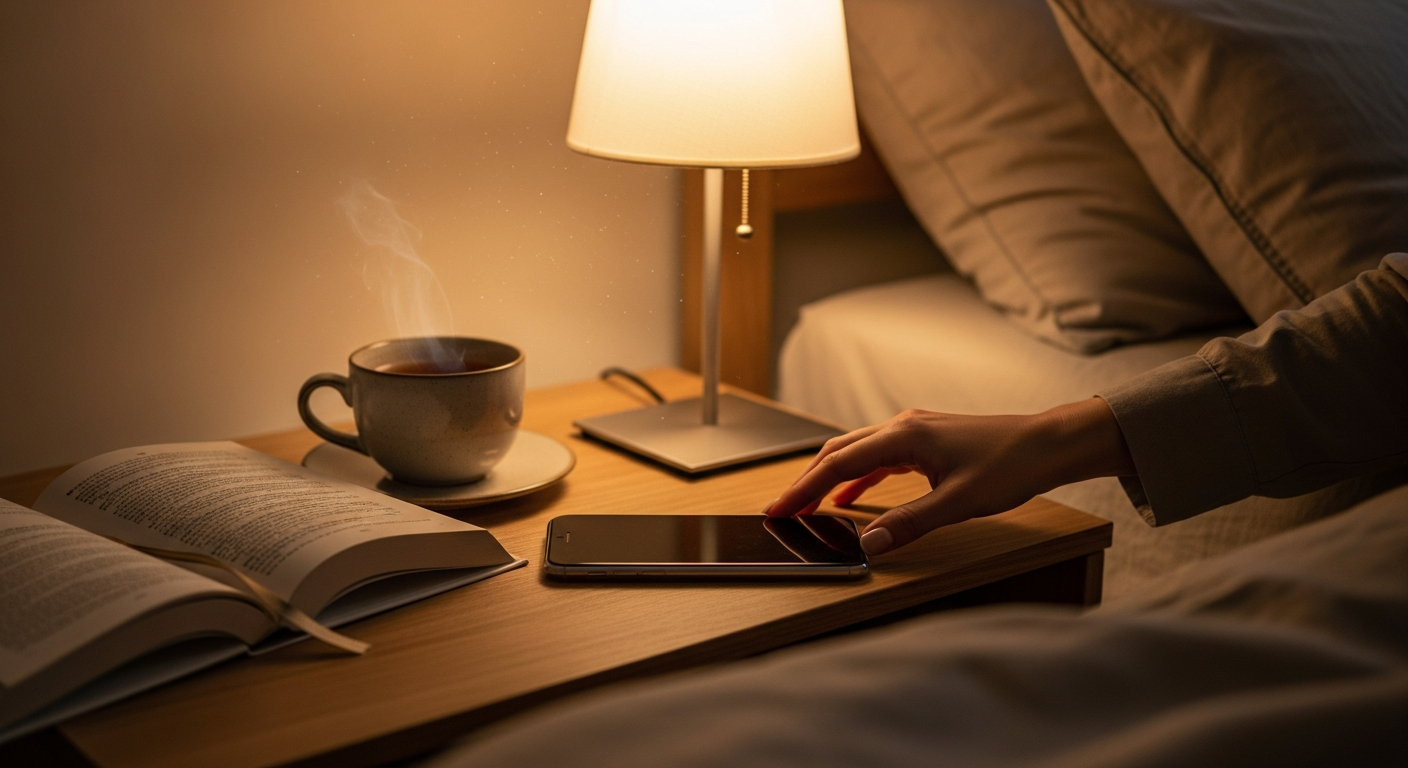
How to Stop Doom Scrolling: A Mom’s Guide to Breaking the Late-Night Phone Habit
Understand why your late-night doom scrolling habit is so hard to break, learning it's driven by your brain's dopamine and novelty responses, not a lack of willpower. You'll discover how to replace this costly habit.
- Recognize your late-night scrolling isn't a willpower failure, but a neurological response.
- Understand doom scrolling encompasses any compulsive, mindless app use, not just negative news.
- Your brain's dopamine loop and novelty bias drive the addictive "just one more scroll" urge.
- Identify your specific scrolling patterns to understand what you're truly seeking.
- Be aware that algorithms are designed to keep your thumb moving, making it hard to stop.
It’s 11:14 PM. The house is finally quiet.
The baby is asleep. The toddler stopped requesting water seventeen minutes ago. The dishes are… still in the sink, but that’s a problem for tomorrow-you. Your partner is already snoring. The day is done. You did it. You survived another one.
And now — finally — it’s your time.
You pick up your phone. Just to check one thing. Maybe a quick scroll through Instagram. Or a peek at the news. Or that one Reddit thread someone mentioned. You’ll just look for five minutes and then go to sleep.
You deserve this, right? After everything you gave today?
Except five minutes becomes fifteen. Fifteen becomes forty-five. And somewhere around 1:17 AM, you’re watching a stranger on TikTok organize her pantry while simultaneously reading a news article about something terrible happening somewhere far away, and your thumb is still moving, and you can’t stop, and you know you need to sleep because that baby is going to be up in four hours, but you just… can’t… put it… down.
Sound familiar?
If you’re reading this with bleary eyes and a shame hangover from last night’s scroll session, take a breath. You’re not weak. You’re not addicted. You’re not a bad mom for wanting something that’s just yours at the end of a relentless day.
But what you’re doing is costing you more than you realize. And the beautiful thing is, once you understand why you’re doing it, you can replace the habit with something that actually gives you what you’re looking for — rest, stimulation, connection, escape — without the 1 AM regret spiral.
Let’s break this down.
What Exactly Is Doom Scrolling (And Why Does It Feel So Good)?
Doom scrolling — sometimes spelled “doomscrolling” — refers to the compulsive habit of endlessly scrolling through negative, distressing, or simply mindless content on your phone, usually on social media or news apps. The term gained popularity during the early 2020s pandemic era, but the behavior has been around as long as smartphones have had infinite scroll features.
But here’s the thing: doom scrolling doesn’t always look like reading depressing news. For moms, it often looks like:
- Mindlessly watching Reels or TikToks for an hour without remembering a single one
- Scrolling Instagram and comparing yourself to every organized, put-together mom on your feed
- Reading parenting forums and spiraling about whether you’re doing everything wrong
- Falling down a rabbit hole of product reviews for something you don’t even need
- Checking the news and then reading every comment section
- Toggling between three apps in an endless loop — Instagram, check. TikTok, check. Email, check. Back to Instagram.
The common thread isn’t necessarily negative content. It’s the compulsive, mindless, can’t-stop quality of the scrolling itself. You’re not choosing to engage. You’re being pulled along by an algorithm designed by some of the smartest engineers on the planet whose entire job is to keep your thumb moving.
And it works. Devastatingly well.
The Neuroscience of Why You Can’t Put Your Phone Down
Here’s what’s happening in your brain during a doom scroll session, and it’s not willpower failure — it’s neuroscience:
The dopamine loop. Every time you scroll, your brain gets a tiny hit of dopamine — the neurotransmitter associated with anticipation and reward. But here’s the key: dopamine isn’t about satisfaction. It’s about the promise of satisfaction. It’s the neurochemical of “maybe the next post will be the good one.” This is the exact same mechanism that makes slot machines so addictive. You’re not getting rewarded consistently. You’re getting rewarded intermittently — and that variable reinforcement schedule is the most powerful behavioral conditioning pattern known to psychology.
The novelty bias. Your brain is hardwired to pay attention to new information. Every new post, every new video, every new headline triggers your brain’s novelty-seeking circuitry. In an ancestral environment, this helped you notice new threats or opportunities. In 2026, it helps TikTok keep you watching a stranger make a salad at midnight.
The completion compulsion. Infinite scroll is psychologically diabolical because there’s no natural stopping point. A book has a chapter end. A TV show has credits. But your Instagram feed just… keeps going. Your brain doesn’t get the “finished” signal it needs to disengage. You’re always in the middle of something, so it always feels too soon to stop.
The cortisol-curiosity cycle. When you encounter distressing content — scary news, judgmental parenting posts, comparison-inducing content — your body releases cortisol (the stress hormone). Counterintuitively, this doesn’t make you put the phone down. It makes you scroll more, because your brain seeks resolution to the threat. “Maybe if I read one more article, I’ll feel less anxious.” You won’t. But your brain keeps trying.
Blue light disruption. The blue wavelength light emitted by your phone screen suppresses melatonin production — the hormone that tells your body it’s time to sleep. Research published in the Proceedings of the National Academy of Sciences has shown that evening screen exposure can delay your circadian rhythm by up to 90 minutes. So not only are you staying up scrolling, but your body’s sleep architecture is being disrupted even after you finally put the phone down.
This is not a fair fight. You are bringing willpower to a neuroscience battle. And willpower always loses.
Why Moms Are Especially Susceptible to Doom Scrolling
You might be wondering: lots of people doom scroll. Why does this feel like such a particular trap for moms?
Because it is. And here’s why.
It’s the Only “Me Time” You Get
Let’s be honest about what bedtime represents for most moms. It’s not just “the kids are asleep.” It’s the first moment in 14 to 16 hours where nobody is touching you, needing you, talking to you, or requiring your immediate decision about anything. It is, for many mothers, the only unstructured, uninterrupted time in the entire day.
And your phone is right there. It requires zero setup, zero energy, and zero coordination with another human being. You don’t need a babysitter. You don’t need to leave the house. You don’t even need to sit up.
Of course you reach for it. It’s the lowest-friction source of stimulation available. And when you’re running on fumes, friction is everything.
Your Nervous System Is Seeking Stimulation After Shutdown
Here’s something most articles about doom scrolling don’t mention: many moms scroll not because they’re bored, but because their nervous systems are stuck.
After a full day of sensory overload — the noise, the touching, the constant vigilance — your nervous system often crashes into a freeze-like state by evening. You feel simultaneously exhausted and wired. Too tired to do anything productive but too activated to actually sleep.
Scrolling your phone hits a neurological sweet spot in this state. It provides just enough stimulation to keep you from feeling the discomfort of that wired-tired limbo, but not so much that it demands anything of you. It’s the neurological equivalent of treading water. You’re not swimming anywhere, but you’re not sinking either.
The Comparison Trap Is Uniquely Potent for Mothers
Social media comparison affects everyone. But for moms, the comparison game has a particularly vicious edge, because it’s not just about comparing your life — it’s about comparing your parenting. And parenting is one of the most emotionally loaded, identity-entangled things a human being can do.
When you scroll past the mom whose house is spotless, whose kids are in matching outfits, whose meal prep looks like a magazine shoot — your brain doesn’t just think “her life looks nice.” It thinks “I’m failing my children.” The stakes feel existential in a way that comparing careers or vacations or outfits never quite does.
You’re Starving for Adult Interaction
Many moms, especially those with young children, are profoundly under-stimulated intellectually and socially during the day. You’ve spent hours discussing which Paw Patrol character is the best, arbitrating disputes about whose turn it is, and narrating your actions to a baby who can’t respond.
By evening, your brain is desperate for adult-level content. News, opinion pieces, social media discourse — even the toxic stuff — at least engages the parts of your brain that have been dormant all day. You’re not doom scrolling because you lack discipline. You’re doom scrolling because your brain is starving.
The Guilt Cycle Keeps You Stuck
Here’s the cruelest part: doom scrolling makes you feel guilty, and guilt makes you doom scroll more. You stay up too late. You’re exhausted the next day. You’re more reactive with your kids. You feel terrible about being reactive. You need an escape from the terrible feeling. You reach for your phone.
The shame doesn’t motivate you to stop. It fuels the cycle. This is why the “just put your phone down” advice is so laughably unhelpful. It’s like telling someone in a whirlpool to “just swim.”
How Doom Scrolling Is Specifically Hurting You (The Honest Truth)
I’m not going to sugarcoat this section, because you deserve the truth — and because understanding the real cost is part of what makes change possible.
Your Sleep Quality Is Suffering (Even When You Get “Enough” Hours)
It’s not just about the hours of sleep you’re losing by staying up until 1 AM. The quality of the sleep you do get is being degraded in measurable ways:
- Suppressed melatonin from blue light exposure means it takes longer to fall asleep after you put the phone down, and your sleep is lighter and less restorative
- Elevated cortisol from distressing content means your body enters sleep in a stress state, reducing the amount of deep, restorative slow-wave sleep you get
- Cognitive arousal from rapid-fire content consumption means your brain takes longer to transition into sleep mode — it’s still processing, still scrolling, even after the screen is off
Research from the National Sleep Foundation consistently shows that screen use within one hour of bedtime is associated with significantly worse sleep quality, regardless of total sleep duration. You might be “in bed” for eight hours, but if you scrolled for the first ninety minutes, your body may only be getting the restorative equivalent of five or six.
For a mom who is already sleep-deprived, this isn’t trivial. It’s the difference between functioning and barely surviving.
Your Next-Day Patience Has a Direct Line to Last Night’s Screen Time
This is the connection that changed everything for me when I first learned about it: your emotional regulation capacity is directly proportional to your sleep quality. Not just sleep quantity — quality.
When you get poor-quality sleep (thanks, doom scrolling), the prefrontal cortex — the part of your brain responsible for patience, impulse control, emotional regulation, and rational decision-making — goes partially offline. Meanwhile, the amygdala — the part of your brain responsible for threat detection and emotional reactivity — becomes hyperactive.
In practical terms: after a night of doom scrolling, you have less patience, more reactivity, a shorter fuse, and less capacity for the creative problem-solving that parenting demands. That morning meltdown from your toddler? You might have handled it with grace on a good night’s sleep. After a doom scroll session? You’re white-knuckling it by 8 AM.
And then the guilt about being short-tempered drives you right back to the phone that night. The cycle continues.
The Comparison Trap Is Eroding Your Confidence
Multiple studies, including a 2024 meta-analysis published in Clinical Psychology Review, have linked higher social media use to increased parenting self-doubt, lower parenting self-efficacy, and higher rates of maternal anxiety and depression.
Every time you scroll past curated perfection, your brain files it under “evidence that I’m not enough.” It doesn’t matter that you know it’s filtered. It doesn’t matter that you know it’s performative. The emotional brain doesn’t operate on logic. It operates on exposure, repetition, and emotional resonance.
If you’re marinating in comparison content every night for an hour, you are systematically eroding your confidence as a mother. Not because you’re weak, but because that’s exactly what repeated exposure to curated perfection does to a human brain.
Your Anxiety Is Getting Fed, Not Soothed
If your doom scrolling tends toward news, health content, or parenting safety content, here’s what you need to know: consuming anxiety-provoking content does not reduce anxiety. It amplifies it.
Your brain doesn’t distinguish between real, present threats and hypothetical, distant ones when it comes to the physiological stress response. Reading about a child abduction three states away activates the same stress hormones as if it were happening on your street. Your body doesn’t know the difference.
Over time, chronic consumption of distressing content rewires your threat-detection circuitry to be more sensitive, not less. You become hypervigilant. The world starts feeling more dangerous. Your parenting becomes more fear-driven. Doom scrolling doesn’t prepare you for threats. It trains your brain to see threats everywhere.
The Core Strategy: Replacement, Not Removal
Here’s where most “how to stop doom scrolling” articles get it wrong. They tell you to just stop. Delete the apps. Use willpower. Go cold turkey.
This fails for moms almost universally, and here’s why: you’re not just trying to stop a bad habit. You’re trying to eliminate the only thing meeting several legitimate needs at once.
Your late-night scroll is simultaneously providing:
- Stimulation for an under-stimulated brain
- A sense of connection (even parasocial connection)
- An escape from the discomfort of the wired-tired state
- A feeling of autonomy and personal choice (“this is MY time”)
- A distraction from worries, to-do lists, and emotional pain
If you just remove the scrolling without addressing those needs, one of two things will happen: you’ll either go right back to scrolling within days, or you’ll feel a deep, restless emptiness that makes you resent the advice and whoever gave it to you.
The strategy that works is replacement, not removal. You need to find other ways to meet those needs — ways that don’t sabotage your sleep, your patience, and your mental health.
Let’s get into the specifics.
8 Practical Strategies to Break the Doom Scroll Cycle
Strategy 1: Give Your Phone a Bedtime (And a Bedroom That Isn’t Yours)
This is the single most effective change you can make, and it’s also the one that will feel the most impossible at first.
Starting tonight, charge your phone outside your bedroom.
The kitchen counter. The hallway. The bathroom. Anywhere that requires you to physically get out of bed to reach it. Buy a cheap alarm clock if your phone is your alarm — they’re $10 at any store, and they’ll pay for themselves in sleep quality within a week.
Here’s why this works: doom scrolling is largely a behavior of convenience. You reach for the phone because it’s within arm’s reach. Introducing even a small amount of friction — having to leave the warm bed, walk down the hall, and pick it up — is often enough to break the automaticity of the habit.
The first three nights will feel terrible. You’ll feel restless. You’ll feel like something is missing. You might even feel anxious without the phone nearby. This is normal. It’s the discomfort of changing a deeply entrenched pattern. It is not evidence that you need the phone. It’s evidence that this change is important.
By night four or five, most moms report something remarkable: they start falling asleep faster than they have in months. Sometimes years.
Strategy 2: The 10-Minute Wind-Down Swap
You don’t need to replace your entire scroll hour with something productive. Start with just ten minutes. For the first ten minutes after you get into bed, do one of these instead:
- A body scan meditation. Lie on your back and slowly bring attention to each body part, from toes to head. Notice tension and consciously release it. No app needed.
- Three-page journaling. Write three pages of whatever comes out — no structure, no grammar, no purpose. It gives your brain a place to dump everything it’s been holding, which is often what the scrolling is trying to do.
- A specific gratitude inventory. Not the generic variety. The sensory kind: “I’m grateful for the way my daughter’s hair smelled after her bath tonight.” Specificity activates the same reward circuitry that scrolling does, minus the cortisol spike.
- Breathing exercises. The 4-7-8 technique (inhale for 4 counts, hold for 7, exhale for 8) is particularly effective for transitioning from activation to rest. Three rounds will visibly lower your heart rate.
The key is gentle stimulation without the activating properties of screen content.
Strategy 3: App Timers That Actually Work
You’ve probably tried screen time limits before and blown right past them. The standard “You’ve reached your limit” notification with an “Ignore” button is a speed bump on a highway. Here’s what works better:
- Use a third-party app like One Sec or Opal that forces a breathing pause before opening social media apps. This interrupts autopilot and gives your prefrontal cortex time to make a conscious choice.
- Set a “wind-down” schedule on your phone (built into both iPhone and Android) that activates grayscale, limits notifications, and dims the screen 30 to 60 minutes before your target bedtime.
- Remove social media apps from your home screen. Move them into a folder, inside another folder, on the last page of your phone. Adding three taps of friction reduces mindless opening by up to 50% according to behavioral design research.
- Log out of your accounts. Having to re-enter your password creates just enough friction to interrupt the autopilot. Most doom scrolling happens because your thumb opened the app before your brain caught up.
Strategy 4: The One-Screen Rule
This one is simple but powerful: after the kids are in bed, you get one screen. Phone OR television. Not both.
The two-screen habit — scrolling your phone while “watching” a show — is particularly devastating because neither activity is satisfying. You’re half-watching something you can’t follow and half-scrolling through content you won’t remember. You end up consuming two hours of media and feeling like you did nothing.
Choose one. If you want to watch a show, put the phone in another room and actually watch it. Let yourself get absorbed. Let the story do what stories are supposed to do — transport you, move you, give you a complete narrative arc with a beginning, middle, and end.
If you want to be on your phone, turn off the TV and sit with it intentionally. But honestly? Once you remove the phone from the equation, many moms find that a good show is far more satisfying than the scroll — and they naturally get tired and fall asleep at a reasonable hour because they’re not being kept artificially awake by the phone’s stimulation.
Strategy 5: Curate a Healthier Feed (If You ARE Going to Scroll)
You’re probably not going to stop scrolling entirely. That’s fine. The goal isn’t zero screen time. The goal is intentional screen time.
- Ruthlessly unfollow or mute any account that makes you feel worse after viewing it. You can mute without unfollowing — they’ll never know.
- Actively follow accounts that leave you feeling lighter. Funny moms. Realistic parenting content. Hobby accounts. Art. Nature. Comedy.
- Unfollow news accounts and consume news intentionally. Set a specific time to read the news (morning coffee, not bedtime) from a reputable source, not social media aggregation. The algorithm prioritizes outrage, not accuracy.
- Use the “not interested” feature aggressively. You’re training your algorithm like a puppy. Consistency matters, and within a few weeks, your feed can look dramatically different.
Strategy 6: The Physical Book Strategy
This is going to sound almost insultingly simple, but hear me out: put a physical book on your nightstand.
Not a Kindle (that’s still a screen). Not an audiobook on your phone (that’s still your phone). A physical, paper book with pages you turn by hand.
Here’s why this works so brilliantly for breaking the doom scroll habit:
- It provides the stimulation your brain craves (narrative, imagination, intellectual engagement) without the blue light, dopamine loops, or infinite scroll
- It has natural stopping points (end of a chapter, your eyes getting heavy) that signal to your brain “we’re done now”
- It creates a physical boundary between you and your phone — your hands are occupied
- It activates the parasympathetic nervous system. Reading (especially fiction) lowers heart rate, reduces muscle tension, and promotes the transition to sleep. A University of Sussex study found that reading for just six minutes reduced stress levels by 68% — more than listening to music, drinking tea, or going for a walk
The genre matters. Choose something absorbing enough to hold your attention but not so thrilling that you can’t put it down. Cozy mysteries, literary fiction, memoir, essay collections — these tend to hit the sweet spot. Save the intense thrillers for daytime reading.
And if you’re thinking “I’m too tired to read” — try it for three nights before you decide. Most moms who swap scrolling for reading report that they actually feel more energized for reading than they expected, because the wired-tired state that makes scrolling feel like the only option is itself partially caused by the scrolling.
Strategy 7: The Grayscale Mode Trick
This is wildly underrated. Color is one of the primary mechanisms by which your phone captures attention. Red notification badges, vibrant photos, colorful buttons — these aren’t aesthetic choices. They’re attention-capture mechanisms your visual cortex is wired to prioritize.
Switch your phone to grayscale mode and everything looks boring. Instagram in black and white is dramatically less compelling. TikTok without color is surprisingly easy to put down. The visual dopamine hit simply disappears.
How to set it up:
- On iPhone: Settings > Accessibility > Display & Text Size > Color Filters > Grayscale. Set it as an accessibility shortcut so triple-clicking the side button toggles it.
- On Android: Settings > Digital Wellbeing > Bedtime Mode (includes grayscale), or Settings > Accessibility > Color Correction > Grayscale.
Set it to activate automatically during your wind-down time. You can still use your phone for functional things, but the recreational pull is dramatically reduced.
Strategy 8: Build a Post-Bedtime Routine That Actually Satisfies You
This is the most important strategy because it addresses the root of the problem: you need something to look forward to after the kids go to bed. Right now, your phone is the thing by default, not by design. You fall into it because nothing else is set up and effortless.
Design a post-bedtime pleasure routine — not productivity, not self-improvement. Something that makes you think “I can’t wait for bedtime” because something good is waiting.
Ideas that work for real moms with real energy levels:
- The bath and book combo. Epsom salts, a physical book, 20 minutes. Sensory experience, relaxation, and mental stimulation all at once.
- The creative ten. Ten minutes of adult coloring, sketching, knitting, puzzles, or doodling. Creative activities activate the brain’s default mode network — deeply restorative in a way consuming content never is.
- The connection call. Call or text a friend. A five-minute voice memo exchange meets the need for connection far more effectively than an hour of social media.
- The gentle movement option. Restorative yoga, stretching, or slow dancing alone in your kitchen with headphones. Movement metabolizes the day’s stress hormones.
- The intentional indulgence. Herbal tea in your favorite mug. A square of dark chocolate eaten slowly. A skincare routine that feels luxurious. The key is intentionality — being fully present for a specific pleasure.
Pick one or two. Set them up in advance. Make it feel like a gift, not a prescription.
What Doom Scrolling Is Really Telling You (And How to Address the Root Cause)
If you don’t address what’s driving the behavior, the strategies above will eventually feel like band-aids. Your doom scrolling is a symptom, not the disease. It’s telling you something important about what you need.
You Need Stimulation
After a day of repetitive tasks and operating at a cognitive level far below your capacity, your brain is desperate for something complex and engaging. The phone provides this — but so does a compelling book, a fascinating podcast, a challenging puzzle, or a creative project.
The fix: Get intellectual engagement during the day in small doses. A podcast during chores. An audiobook during the commute. When your brain gets some of what it needs during daylight hours, the desperate grab for the phone at night becomes less intense.
You Need Connection
You’re surrounded by tiny humans all day, but you’re starving for adult connection and the feeling of being seen as a person. Social media offers a facsimile of connection — but it’s connection without reciprocity, without the nourishing quality of being truly known.
The fix: Invest in one or two real friendships. A weekly voice memo exchange, a monthly coffee date, a text thread where you share what’s real. Quality over quantity.
You Need Escape
The desire to mentally check out is a healthy response to unsustainable demand. The phone provides dissociation-lite — it lets you leave your responsibilities for a while. But it doesn’t actually restore you. It’s like eating cardboard when you’re hungry — the motion is there, but the nourishment isn’t.
The fix: Build micro-escapes into your day. Five minutes alone in the car before you go inside. A ten-minute walk after dinner. A locked bathroom door for the duration of one song. These pressure-release valves reduce the buildup that leads to the binge.
You Need Autonomy
After a day of being demanded upon and responsible for everything, your phone represents the one space where you get to choose. This need is real. The problem is that the phone is a poor vehicle for it.
The fix: Reclaim choices during the day. Say no to one thing. Delegate one task. Do one thing purely because you want to. When you have more agency in your waking hours, you need less compensatory agency from the phone.
Your Quick-Start Plan (Starting Tonight)
Please don’t use this article as another reason to beat yourself up. The research on habit change is clear: shame makes change harder, not easier. So be gentle with yourself. Progress, not perfection.
Here’s your minimum viable plan:
- Tonight: Put your phone in another room to charge. Put a book or journal on your nightstand instead.
- Tomorrow: Move your social media apps off your home screen into a nested folder.
- This week: Set up grayscale mode on an automatic schedule one hour before your desired bedtime.
- This month: Experiment with two or three post-bedtime routine elements until you find what genuinely satisfies.
Four changes, spread across a month. No dramatic overhauls. Just a gradual, compassionate shift toward giving yourself what you actually need.
Frequently Asked Questions
How long does it take to break the doom scrolling habit?
Research suggests it takes an average of 66 days to establish a new behavioral pattern, though it varies widely (18 to 254 days). Most moms report the first three to five nights are hardest. By the end of week one, the acute pull diminishes significantly. Within a month, the evening routine feels natural. Expect discomfort in the first week — that’s not evidence the change isn’t working. It’s evidence that it is.
What if my phone is my baby monitor?
Completely valid concern. Options: Use a dedicated baby monitor instead of a phone app. If you must use a phone-based monitor, put the phone face-down across the room with Do Not Disturb on (exceptions only for the monitor app). Some moms keep an old phone with no social media apps solely as a monitor device. The goal is separating the monitoring function from the scrolling function.
Is it really that bad if I just scroll for 15 to 20 minutes? Does it have to be zero screen time before bed?
No, it doesn’t have to be zero. Absolute rules tend to backfire because they trigger the all-or-nothing mindset (“I already checked my phone, so I might as well scroll for an hour”). A short, intentional phone session — checking messages, looking at a few specific things, then putting it away — is very different from an open-ended, mindless scroll. The key distinction is intentionality. Going in with a purpose and a time limit is fine. Picking up the phone “just to check” with no plan and no stopping point is where the trouble starts. If you can do 15 minutes intentionally and then put it away, you’re doing great.
I’ve tried everything and I still can’t stop. Does that mean I’m addicted?
The term “phone addiction” is debated among researchers, but problematic phone use shares many features with behavioral addictions — the compulsive quality, the tolerance, and continued use despite negative consequences. If you genuinely feel unable to control your phone use despite repeated attempts, consider speaking with a therapist who specializes in behavioral patterns. Cognitive behavioral therapy (CBT) has strong evidence for addressing problematic phone use. There’s no shame in professional support — it means you’re taking your well-being seriously.
My partner also doom scrolls. How do we change this together?
Changing a shared habit is easier than changing one solo. Try: a shared “phone bedtime” where both phones go on the charger at a set time, a no-phones-in-bedroom rule, or a shared evening activity (a show without phones, a card game, a conversation prompt jar). Approach it as teammates solving a shared problem, not one person policing the other. If your partner isn’t interested in changing, you can still make changes for yourself.
What do I do when I wake up in the middle of the night and can’t fall back asleep?
If your phone is already outside the bedroom (Strategy 1), you’ve eliminated the primary temptation. For the wakeup itself: try a body scan meditation, progressive muscle relaxation, counting slow breaths, or a sleep story from a dedicated device (not your phone). The most important thing is avoiding light exposure — light tells your brain it’s morning. Staying in the dark, even awake, preserves your body’s readiness to fall back asleep.
Will this make me a better mom?
It won’t make you a better mom. You’re already a good mom — that’s not what this is about. What it will do is give you more of the resources you need to be the mom you already are on your best days. More patience. More presence. More energy. More emotional bandwidth. More capacity to repair after the inevitable moments when you lose it. Doom scrolling doesn’t make you a bad mom. But breaking the habit gives the good mom you already are more room to show up. And that’s worth the discomfort of change.
The Night Is Yours. Spend It Wisely.
Here’s the truth that nobody tells you about the post-bedtime hours: they are some of the most precious hours of your day. Not because you should be productive during them. Not because you should be optimizing or self-improving or catching up on the mental load.
They’re precious because they’re yours.
After a day of giving — your attention, your patience, your body, your energy, your decisions, your emotional bandwidth — to everyone else, those quiet hours are the only time you have to give something to yourself.
And you’ve been spending them on something that takes from you instead.
Your phone will always be there. The algorithm will always be waiting. The content will keep refreshing, endlessly, forever. It will never be done, and it will never be enough.
But you — the woman underneath the doom scroll, the one who’s too tired and too wired and too touched out and too everything — you deserve more than the blue glow of a screen in a dark room at 1 AM.
You deserve rest that actually restores you. Pleasure that actually satisfies you. Connection that actually nourishes you.
Put the phone down, mama. Not because you’re bad for picking it up. But because what’s waiting on the other side — real rest, real presence, real you — is so much better than anything you’ll find on that screen.
Tonight, try it. Just tonight. See how it feels to close your eyes without the scroll.
You might be surprised by what you find in the quiet.