
Cycle Syncing for Moms: How to Plan Your Energy, Meals, and Self-Care Around Your Cycle
Learn to cycle sync your energy, meals, and self-care around your menstrual cycle's four phases to reduce self-blame and adapt to hormonal shifts as a mom. This guide helps you work with your body's natural rhythms.
- Understand your cycle's four phases to align your energy, meals, and self-care.
- Recognize that hormonal shifts, not character, often cause energy dips and mood changes.
- Adapt your schedule and expectations during different cycle phases to reduce stress.
- Use self-knowledge to practice self-compassion, especially when demands are high.
- Track your own patterns to personalize cycle syncing, as individual experiences vary.
This post contains affiliate links. As an Amazon Associate I earn from qualifying purchases.
It’s 4 PM on a Tuesday. The kids are playing, nothing has gone wrong, and you want to crawl under the table and cry. Sometimes that is your cycle, not your character.
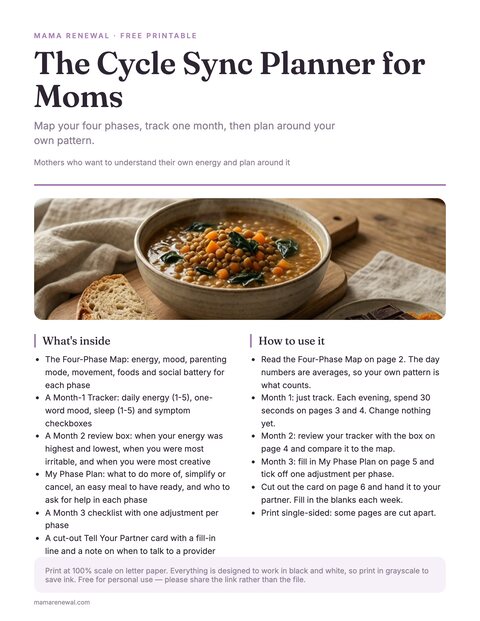
Free printable · 6 pages
The Cycle Sync Planner for Moms
A four-phase at-a-glance chart, a fill-in Month 1 energy and symptom tracker with a Month 2 review, a My Phase Plan with easy meals and the Month 3 one-adjustment checklist, and a cut-out card to tell your partner what you need.
Free. Your download link appears right here. You'll also join the Mama Reset. Unsubscribe anytime. Privacy
Cycle syncing means planning food, movement, schedule, and self-care around the four phases of your menstrual cycle. This guide covers the four phases, meals, exercise, tracking, and what changes on birth control or postpartum. I wrote it for the mother who can’t cancel Tuesday, so you can adjust what you can and drop the self-blame for the rest.
Hormone changes are well documented. Research on how much they shape your day is mixed, and it varies a lot between people. Treat this as a way to notice your own patterns, not a proven protocol.
In this article (12 sections)
- What Is Cycle Syncing?
- The 4 Phases of the Menstrual Cycle
- The Four Phases at a Glance
- Cycle Syncing Your Parenting
- Cycle Syncing Food by Phase
- Cycle Syncing Workouts by Phase
- Cycle Syncing Your Self-Care and Social Calendar
- How to Track Your Cycle
- Cycle Syncing on Birth Control, Postpartum, or with Irregular Cycles
- The Realistic Version: When Life Doesn’t Care About Your Cycle
- How to Start Cycle Syncing as a Busy Mom
- Frequently Asked Questions
What Is Cycle Syncing?
Jump to your phase: Menstrual (days 1-5), Follicular (days 6-13), Ovulatory (days 14-16), or Luteal (days 17-28). The parenting, food, workout, and self-care sections below all use these same four phase headings, so you can skip straight to yours in each one.
The Basics
Your menstrual cycle isn’t one event (your period) followed by a bunch of identical days until the next one. Hormones shift the whole way through, and cycle syncing groups those shifts into four phases. Typical adult cycles run about 21-35 days, with an average around 28.
Each phase has its own hormonal profile. Many women notice it in some of these areas.
- Energy levels
- Mood and emotional processing
- Cognitive strengths (verbal, analytical, creative)
- Pain tolerance
- Libido
- Appetite and cravings
- Sleep quality
- Stress resilience
- Social desire (wanting connection vs. wanting solitude)
Cycle syncing means working with these natural fluctuations instead of against them. You stop expecting the same output from yourself every day. You learn which weeks are for sprinting and which are for resting, and you plan accordingly.
Why This Matters Specifically for Mothers
Here’s why cycle awareness can matter for mothers:
You have almost no margin for error. When you’re already running on low reserves from the baseline demands of motherhood, the hormonal dips in your cycle hit harder. A non-mom in her luteal phase might feel a little tired and crave chocolate. A mom in her luteal phase might feel like she’s losing her grip on reality, because the energy deficit compounds what’s already a deficit.
You blame yourself for what’s biological. Without understanding your cycle, the energy crash of late luteal phase can feel like personal failure. You wonder why you had patience on Monday and none on Thursday.
You’re not the problem. Your body runs on a monthly rhythm.
You can’t opt out, but you can adapt. You can’t tell a toddler that you’re in your menstrual phase and need three days of solitude. But you can move the playdate to next week and order pizza instead of cooking from scratch.
You can wear the noise-canceling earbuds during the witching hour. You can also lower your standard for “good enough” during the weeks your body needs more rest.
Cycle syncing for moms isn’t about perfection. It’s about self-knowledge that leads to self-compassion. And when so much is demanded of mothers, self-compassion helps.
The 4 Phases of the Menstrual Cycle
Let’s walk through each phase. The day numbers are approximate and describe an idealized 28-day cycle, so your own timing may differ.
Good to knowMedically, the cycle has two main phases: follicular (day 1 of your period up to ovulation) and luteal (after ovulation until your next period). Your period is technically the start of the follicular phase, and the luteal phase begins right after ovulation, around day 15 in a 28-day cycle. Cycle syncing splits these into four windows for planning. This guide groups the days around ovulation (about days 14-16) into their own window, so the luteal section here starts at about day 17.
Ovulation usually falls about 12-14 days before your next period, so the follicular phase is the one that stretches or shrinks. Experiences vary widely. Read the “how you feel” notes as what many women report, not what everyone feels.
Phase 1: Menstrual Phase (Days 1-5)
What’s happening hormonally: Estrogen and progesterone are low. Your uterine lining is shedding.
How you feel: Low energy, inward, reflective, possibly crampy and tired. Many women describe this phase as “wanting to be left alone,” which is hard to come by with children. Some notice lower pain tolerance and a smaller social battery, and some feel emotionally raw.
Your superpower this phase: Some women report feeling more reflective in this phase, which can be a good time to check in on what’s working in your life.
What your body needs:
- Comfort. Warm foods, baths, or blankets can feel good, especially with cramps.
- Iron-rich foods. Menstrual blood loss uses up iron, so foods like lentils, beans, leafy greens, and meat help.
Safety firstIf your periods are heavy or you’re exhausted all the time, ask your provider to check your iron/ferritin and thyroid before assuming it’s your cycle. Fatigue can also be anemia, thyroid disease, or depression.
Phase 2: Follicular Phase (Days 6-13)
What’s happening hormonally: Estrogen begins rising steadily. Follicle-stimulating hormone (FSH) triggers your ovaries to prepare an egg. Testosterone begins a gradual increase.
How you feel: Many women notice energy building and a lighter mood, with more interest in socializing and trying new things. This can be the phase where you wake up and think, “I’ve got this.”
Your superpower this phase: Many women feel more creative and ready to plan. If that’s you, this can be a good time for brainstorming, starting projects, or tackling something you’ve been avoiding.
What your body needs:
- Fresh, lighter foods. Resting energy use may be slightly lower, though the difference is small and varies. Many women simply prefer lighter meals now: salads, fermented foods, lean proteins, and bright vegetables.
- Movement that challenges you. Many women have more energy now, so this can be a good time to try something more challenging if you feel like it.
Phase 3: Ovulatory Phase (Days 14-16)
What’s happening hormonally: Estrogen peaks just before ovulation. Luteinizing hormone (LH) surges, triggering ovulation. Testosterone has a small mid-cycle rise.
How you feel: Many women report their highest energy and confidence around ovulation, along with a higher libido and a sense of clarity. Not everyone does, and that’s normal.
Your superpower this phase: Communication, connection, and high-output tasks. If you feel at your best, this may suit the parent-teacher conference, a meal prep session, a difficult phone call, or a day trip with the kids.
What your body needs:
- Channel the energy. Don’t waste this phase on tasks you could do anytime. Use it for the high-energy, high-stakes stuff.
- Connection. Plan the playdate, the date night, the friend lunch. You’ll actually enjoy them.
Phase 4: Luteal Phase (Days 17-28)
What’s happening hormonally: Progesterone rises and becomes the dominant hormone of this phase. Estrogen dips after ovulation, then has a smaller second rise mid-luteal. If the egg isn’t fertilized, both hormones fall in the final days (roughly days 24-28 of a 28-day cycle). That drop is when PMS symptoms tend to show up, and then your period starts.
What many women report: The luteal phase has two halves. Early luteal (about days 17-21) often feels fairly steady.
In late luteal (about days 22-28), many women notice lower energy and patience, stronger cravings, and more intense emotions. The mental load that felt manageable last week can feel heavy. Irritability, tearfulness, and anxiety are common.
Safety firstIf you feel hopeless or have thoughts of harming yourself, get help right away (in the US, call or text 988). Persistent low mood, rage, or anxiety, especially postpartum, deserves a professional’s attention.
Your superpower this phase: Detail-oriented work and completion. Some women find they have more focus for finishing projects, organizing, and tying up loose ends, and early luteal can suit nesting tasks.
What your body needs:
- Magnesium. Some studies suggest lower magnesium may be associated with PMS symptoms, but the evidence is mixed. Dark chocolate, almonds, spinach, and pumpkin seeds are good food sources. Ask your provider or pharmacist before supplementing, especially if you have kidney disease, are pregnant or breastfeeding, or take medications. For a complete guide on nutrition as self-care, we cover how to nourish yourself without complicated meal plans.
- More sleep. Some women sleep worse in the luteal phase, so protecting your sleep can help.
- Self-compassion. The emotional intensity of late luteal is hormonal, not character. Knowing this won’t make it painless, but it can prevent the self-blame spiral.
The Four Phases at a Glance
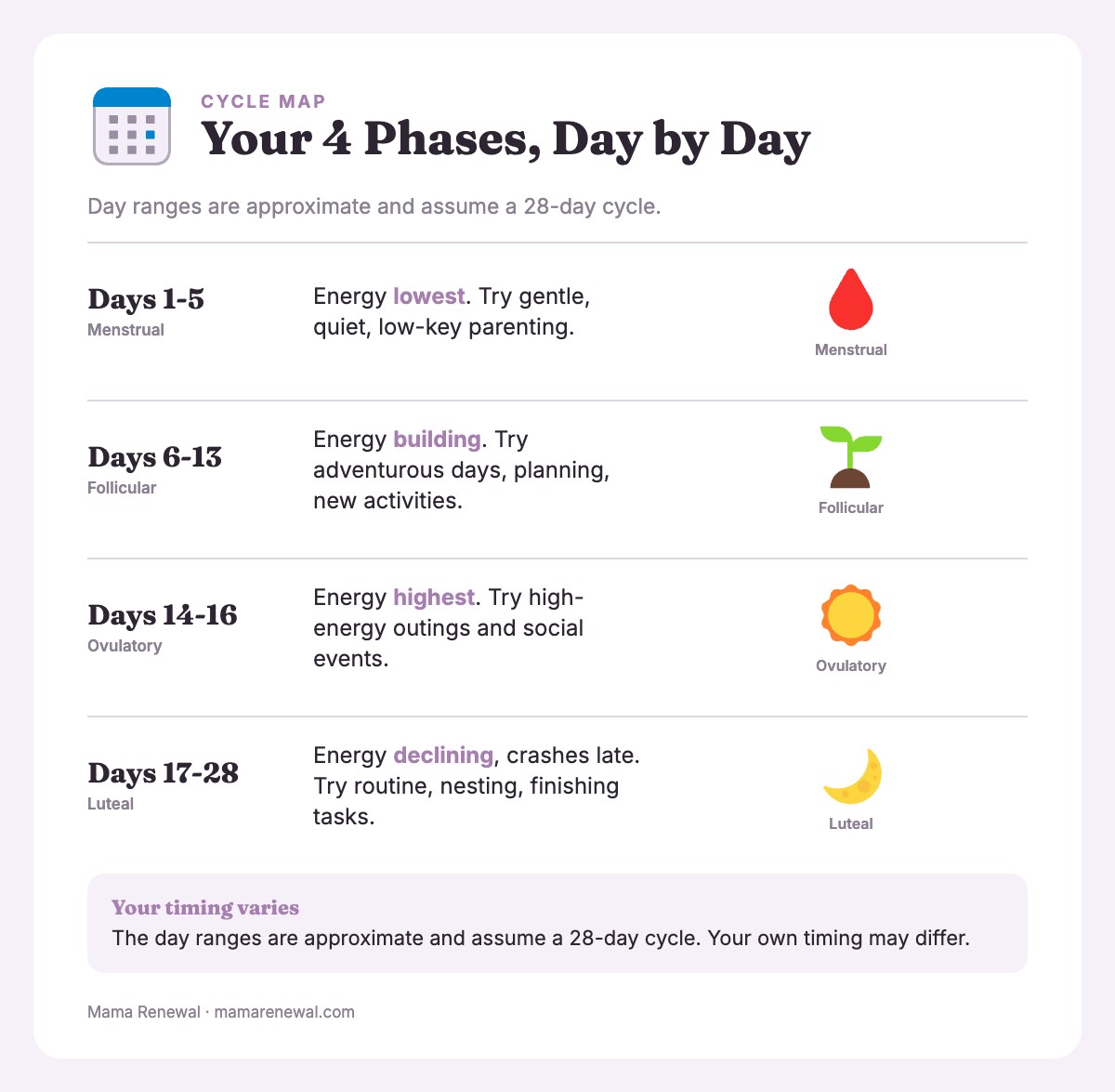
The day ranges below are approximate and assume a 28-day cycle. Your own timing may differ.
When to see a providerTalk to your provider about very heavy periods, severe pain, bleeding between periods, cycles shorter than 21 or longer than 35 days, or mood changes that interfere with daily life.
| Menstrual (Days 1-5) | Follicular (Days 6-13) | Ovulatory (Days 14-16) | Luteal (Days 17-28) | |
|---|---|---|---|---|
| Dominant Hormone | Estrogen and progesterone low | Rising estrogen | Estrogen peaks; LH surges | Progesterone dominant |
| Energy | Lowest | Building | Highest | Declining (crashes late) |
| Mood | Reflective, raw | Optimistic, creative | Confident, social | Early: calm. Late: irritable, emotional |
| Parenting approaches to try | Gentle, quiet, low-key | Adventurous, planning, new activities | High-energy outings, social events | Routine, nesting, finishing tasks |
| Many women prefer (exercise) | Rest, gentle yoga, walks | Running, dance, strength training | HIIT, challenging workouts | Early: moderate. Late: gentle |
| Foods to try | Warm, iron-rich, comforting | Light, fresh, fermented | Fiber-rich vegetables, hydrating foods | Complex carbs, magnesium-rich |
| Social Battery | Low — recharge | Building — connect selectively | Full — connect freely | Declining — protect |
Cycle Syncing Your Parenting
This is where cycle syncing gets real for mothers. You can’t always choose your schedule, but you can make strategic decisions that work with your biology instead of against it.
Menstrual Phase Parenting
- Schedule low-key days. Movie afternoons, audiobook time, quiet crafts. Avoid scheduling playdates or outings that require high social energy from you.
- Lean on screens without guilt. An extra episode of Bluey during your period is not going to damage your children. It might save your sanity.
- Accept that your patience is thinner. Name it for yourself: “My body is doing hard work right now, and I have less capacity. That’s okay.” If you notice rage bubbling up, our piece on nervous system regulation has techniques you can use in the moment.
- Delegate or simplify meals. Cereal for dinner is fine. So is asking your partner to cook tonight.
- Wear comfortable everything. This seems small but it matters. Don’t fight your body.
Follicular Phase Parenting
- Schedule the fun stuff. Zoo trip, playground with the energetic friend group, the messy art project you’ve been putting off. Your energy matches theirs.
- Plan the week ahead. Many women feel more optimistic about logistics in this phase. Use this phase to meal plan, organize the calendar, and set up systems.
- Tackle the hard parenting tasks. The behavior conversation with your preschooler. The boundary-setting with your tween. You may have more patience now.
- Start the new routine. Want to implement a morning stretching practice? Start it in your follicular phase when many women have more energy for new habits.
Ovulatory Phase Parenting
- Be the “yes” parent. “Can we go to the splash pad and the library?” Sure. You’ve got the energy.
- Schedule playdates and social events. Your social battery is full, and your kids benefit from seeing you connect with other adults.
- Have the important conversations. With your partner about redistribution of labor. With the school about your child’s needs. You may feel at your most articulate.
- Batch the errands. Grocery shopping with three kids feels survivable during ovulation. Schedule it.
Luteal Phase Parenting
- Simplify ruthlessly. Reduce commitments. Cancel what you can. Lower the bar.
- Increase routine and predictability. Many kids find routines grounding too. Same bedtime, same meals, same quiet rhythm.
- Give yourself permission to be “boring.” You don’t have to be the fun parent every day. Steady and present is enough.
- Outsource your triggers. If bath time always sets you off during PMS, ask your partner to take it. If the after-school witching hour is unbearable, schedule a walk with earbuds during that time while your partner or older child covers.
- Name what’s happening. Telling your partner or older children “I’m in a phase where I need extra quiet and patience” is not weakness. It’s modeling self-awareness.
Cycle Syncing Food by Phase
Your appetite and energy may shift across your cycle, and no special diet is required. Here’s a practical, mom-friendly approach.
Safety firstFood first. Ask your provider or pharmacist before taking magnesium or B6 supplements, especially if you have kidney disease, are pregnant or breastfeeding, or take medications. Don’t take high-dose B6 supplements without medical advice.
Menstrual Phase Meals
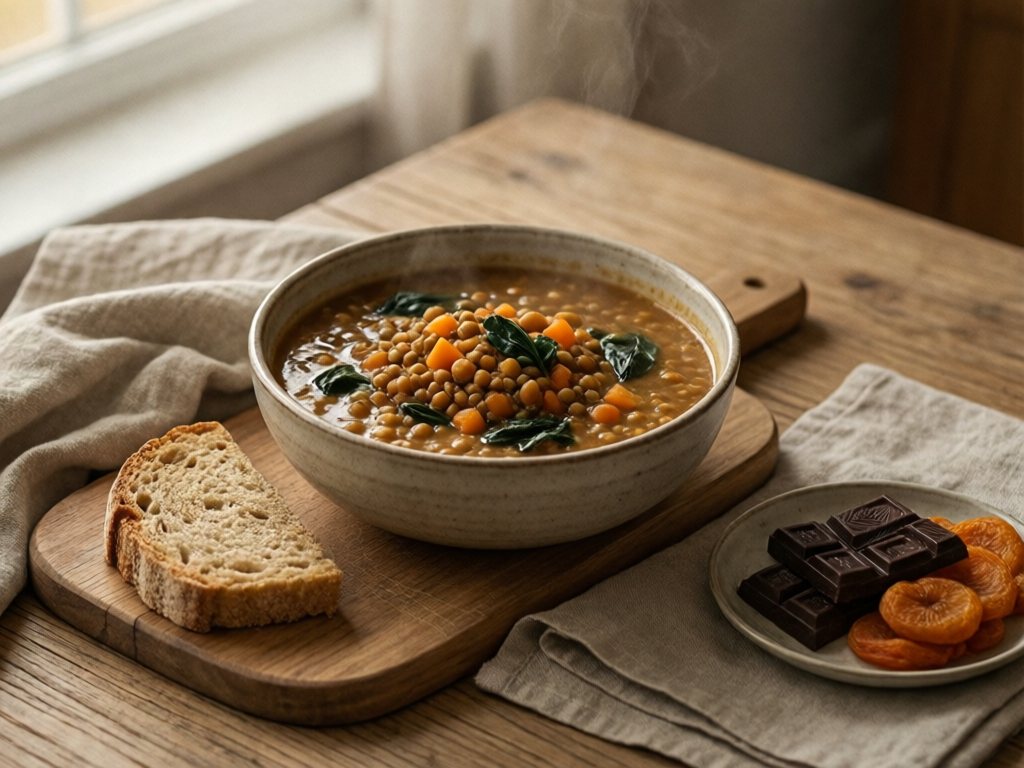
Your body is losing blood and needs replenishment. Focus on:
- Iron-rich foods: Slow-cooker beef stew, lentil soup, spinach and chickpea curry, dark leafy green salads with pumpkin seeds
- Vitamin C (enhances iron absorption): Citrus, bell peppers, strawberries — pair with iron-rich meals
- Healthy fats: Salmon, avocado, olive oil, walnuts
- Warm, comforting preparations: Soups, stews, roasted vegetables, herbal teas (ginger for cramps, chamomile for calm)
- Adequate calories: Eat enough; this isn’t the time to restrict.
Quick meal ideas for menstrual phase:
- Breakfast: Oatmeal with walnuts, banana, and a drizzle of honey (warm and comforting; no honey for babies under 12 months if you’re sharing)
- Lunch: Lentil soup with crusty bread
- Dinner: Slow-cooker pot roast with root vegetables (cook it in follicular phase, freeze, reheat now)
- Snack: Dark chocolate and dried apricots (iron + satisfaction)
Follicular Phase Meals
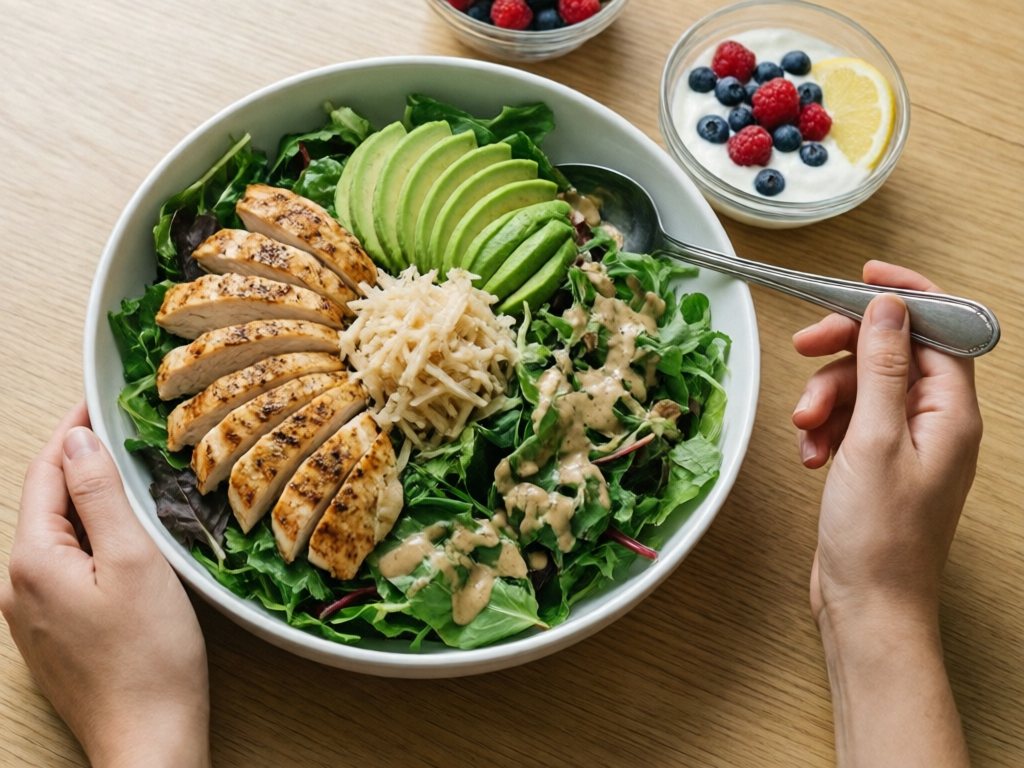
Many women prefer lighter, fresher foods in this phase.
- Fermented foods: Sauerkraut, kimchi, yogurt, kefir — support gut health
- Fresh and raw foods: Salads, fresh vegetables, lighter grains, and sprouts (cooked, not raw, if you’re pregnant or immunocompromised)
- Lean proteins: Chicken, fish, eggs, tofu
- Cruciferous vegetables: Broccoli, cauliflower, Brussels sprouts — fiber-rich vegetables are good any time
Safety firstRaw sprouts (alfalfa, bean, clover) can carry bacteria that cause food poisoning. Cook them thoroughly if you’re pregnant or have a weakened immune system, or skip them.
Quick meal ideas for follicular phase:
- Breakfast: Greek yogurt with berries, granola, and a squeeze of lemon
- Lunch: Big salad with grilled chicken, avocado, sauerkraut, and tahini dressing
- Dinner: Stir-fry with tofu, broccoli, snap peas, and brown rice
- Snack: Hummus with raw vegetables
Ovulatory Phase Meals
Many women feel more social now, which makes this a good time for shared meals.
- High-fiber foods: Good for digestion and fullness (vegetables, whole grains, flaxseed)
- Lighter proteins: Fish, shellfish, plant-based proteins
- Raw vegetables and fruits: Easy to prepare when you want something fresh
- Hydrating foods: Cucumber, watermelon, celery — a simple way to stay hydrated
Quick meal ideas for ovulatory phase:
- Breakfast: Smoothie bowl with spinach, mango, flaxseed, and coconut
- Lunch: Grain bowl with salmon, cucumber, edamame, and ginger dressing
- Dinner: Grilled fish tacos with cabbage slaw and lime
- Snack: Fresh fruit with nut butter
Luteal Phase Meals

Resting energy use may rise slightly (on average by roughly 100-200 calories), and many women feel hungrier. Eating enough, including carbohydrates and magnesium-rich foods, is a reasonable approach.
Our guide to nutrition as self-care covers how to nourish yourself without complicated meal plans.
- Complex carbohydrates: Sweet potatoes, brown rice, quinoa, oats, root vegetables
- Magnesium-rich foods: Dark chocolate, almonds, pumpkin seeds, spinach, bananas (some studies suggest lower magnesium may be associated with PMS symptoms, but the evidence is mixed)
- B6-rich foods: Turkey, chickpeas, potatoes, bananas — B6 may help some PMS symptoms; get it from food, and don’t take high-dose B6 supplements without medical advice
- Healthy fats: Avocado, olive oil, nuts, seeds (good general nutrition any time)
- Eat enough: Many women feel hungrier in this phase. Cravings are not weakness.
Quick meal ideas for luteal phase:
- Breakfast: Sweet potato hash with eggs and avocado
- Lunch: Turkey and roasted vegetable wrap with hummus
- Dinner: One-pot chicken and rice with roasted root vegetables
- Snack: Dark chocolate almond butter cups (homemade: melt dark chocolate, spoon into muffin tin, freeze with a dollop of almond butter)
Cycle Syncing Workouts by Phase
Some women notice differences in energy and performance across the cycle. Research shows small, inconsistent effects, so follow how you feel. The lists below are options, not prescriptions. For a quick daily movement practice that adapts to any phase, our morning stretches for moms guide is a great starting point.
Movement by Phase
Menstrual Phase:
- Gentle yoga (restorative, yin)
- Walking (slow, ideally outdoors)
- Light stretching
- Rest days are part of any program
- If you feel good and want to move more, trust your body. But don’t force it.
Follicular Phase:
- Running, cycling, swimming
- Dance or movement classes
- Strength training
- Trying new forms of movement (your brain is open to novelty)
- Building intensity gradually throughout the phase
Ovulatory Phase:
- HIIT, boot camp, challenging group classes
- Peak performance training
- Competitive activities if that’s your thing
- Social exercise (buddy workouts, group classes)
- Your heaviest lifts or fastest runs, if you feel up to them
Luteal Phase (early):
- Moderate strength training
- Pilates
- Moderate cardio (steady-state, not intervals)
- Swimming (cooling and supportive)
Luteal Phase (late):
- Walking
- Gentle yoga
- Stretching
- Low-intensity movement that doesn’t stress your system further
- Rest if you need it.
The Mom Reality Check
TipThink in two modes: gentle and challenging. When your energy is low (often around your period and late luteal), walk or stretch. When it’s high (often follicular and ovulation), do the workouts you enjoy. Let how you feel decide.
Cycle Syncing Your Self-Care and Social Calendar
Menstrual Phase Self-Care
- Cancel or reschedule non-essential social commitments
- Take a bath or long shower (warmth can be comforting)
- Journal, if you feel more reflective
- Spend time alone if possible (even 20 minutes)
- Create a calming evening routine that signals rest to your body
- Say no to anything that doesn’t feel necessary
Follicular Phase Self-Care
- Schedule coffee dates, mom meetups, or friend dinners
- Start a creative project or revisit an abandoned one
- Plan your month while your energy is up
- Try something new — a class, a recipe, a park you’ve never visited
- Make the appointment you’ve been putting off (dentist, therapist, doctor)
Ovulatory Phase Self-Care
- Date night, if you feel confident and up for it
- Social events where you want to show up energetically
- Advocacy and difficult conversations
- Document moments (photos, journaling) — you’ll want to remember how capable you felt
- Mentoring or volunteering, if you have energy to share
Luteal Phase Self-Care

- Nesting activities: organizing, cleaning, creating cozy spaces (many women feel like creating order)
- Reduce screen time and social media (emotional sensitivity makes comparison more painful during this phase)
- Comfort media: rewatching beloved shows, reading familiar books
- Batch cooking and meal prep (early luteal, while you still have energy) for late luteal when cooking feels impossible
- Ask for help before you’re desperate; early support often makes the hard days easier.
How to Track Your Cycle
You can’t sync to something you don’t know. Tracking is the foundation of cycle syncing, and it doesn’t have to be complicated.
Digital Tracking Apps
| App | Best For | Cost | Notes |
|---|---|---|---|
| Flo | Beginners; comprehensive symptom logging | Free (premium available) | Period and ovulation predictions; symptom logging |
| Clue | Science-based, no-frills tracking | Free (premium available) | Simple, clean interface |
| Stardust | Community + cycle tracking | Free | Social features |
| Natural Cycles | Fertility awareness (preventing pregnancy or trying to conceive) | Subscription | FDA-cleared as birth control, but with typical use it is less effective than an IUD or implant. Uses basal body temperature. |
| Apple Health | Already-in-your-phone simplicity | Free | Built into iPhone; basic but functional cycle tracking |
Good to knowCycle data is reproductive health data. Review each app’s privacy policy before you log anything. If you want to use an app as birth control, ask your provider whether it’s a good fit for you.
Paper Tracking
Some women prefer a physical tracker — especially moms who are trying to reduce screen time. A simple approach:
- Get a calendar. A blank monthly calendar works.
- Mark Day 1. Circle the first day of your period.
- Note each day. Energy (1-5), mood (one word), and any symptoms.
- Look for patterns. After 2-3 cycles, your own pattern may start to show.
What to Track
At minimum, track:
- Day 1 of your period (first day of full flow, not spotting)
- Energy level (scale of 1-5)
- Mood (one word: calm, anxious, irritable, energized, flat, etc.)
- Sleep quality
- Notable symptoms (cramps, headache, bloating, breast tenderness, cravings)
After 2-3 months, you’ll have your own record, which is more useful than any generic chart. You’ll see when your energy tends to dip and when your patience runs thin.
Cycle Syncing on Birth Control, Postpartum, or with Irregular Cycles
Safety firstCycle syncing is not a reason to stop birth control, and breastfeeding is not dependable birth control unless you meet specific criteria. Call your provider for bleeding that soaks a pad or tampon every hour, large clots, severe pain, bleeding between periods or after menopause, or low mood or anxiety that persists.
Hormonal Birth Control
If you’re on hormonal birth control (the pill, hormonal IUD, implant, patch, ring), you may not have a natural hormonal cycle, because the synthetic hormones suppress or change your body’s natural fluctuations. This doesn’t mean cycle syncing is irrelevant, but it does change the approach.
Combined oral contraceptive pill: Many packs are 21 active plus 7 placebo pills, though others differ, and the bleed is a withdrawal bleed, not a true period. Some women notice energy and mood shifts that loosely follow the pack. You can track your symptoms and sync to the pattern you observe, even if it’s not a “natural” hormonal cycle.
Hormonal IUD (Mirena, Kyleena, etc.): These deliver a progestin (levonorgestrel). Many users continue to ovulate, so some have natural cycles; ask your provider. If you still have periods, you can track energy and mood alongside them. If you don’t, a simple four-week calendar of energy and mood can still show your own patterns. Copper IUDs are non-hormonal and don’t stop ovulation, though they can make periods heavier or more painful.
Cycle syncing is not a reason to stop birth control. If you’re considering stopping for other reasons, discuss it with your doctor or other healthcare provider.
Postpartum and Breastfeeding
Your period may not return for months while you breastfeed, but you can ovulate before your first postpartum period. Breastfeeding is not dependable birth control unless you meet specific criteria, so talk to your provider about contraception. In the meantime:
- Track your energy and mood anyway. Even without a menstrual cycle, your body may develop observable patterns on a roughly monthly rhythm.
- When your cycle returns, it may be irregular for several months. Track it patiently. Don’t expect 28-day clockwork immediately.
- Your first few postpartum cycles may be heavier, more painful, or more emotionally intense than your pre-pregnancy cycles. This is common and often settles over several cycles. Contact your provider if you soak through a pad or tampon every hour, pass large clots, have severe pain, or have low mood or anxiety that persists.
- Be extra gentle with yourself. Postpartum is already a state of depletion for many mothers. Layer cycle awareness on gently — as information, not another standard to meet.
Irregular Cycles
If your cycles are irregular (fewer than 21 days, more than 35 days, or highly variable), cycle syncing is harder but not impossible.
- Track symptoms rather than calendar days. Cervical mucus changes, basal body temperature, and energy patterns may help you guess which phase you’re in. These signs are less reliable when cycles are irregular, so don’t rely on them to avoid pregnancy.
- Talk to your provider. Irregular cycles can indicate PCOS, thyroid issues, perimenopause, stress-related amenorrhea, or other conditions that deserve investigation.
- Use the principles loosely. Even without precise phase identification, the core wisdom of cycle syncing applies: some weeks you’ll have more energy than others, and that’s biology, not failure.
The Realistic Version: When Life Doesn’t Care About Your Cycle
Let me be honest with you: you will not be able to schedule your life around your hormones.
Your toddler will have a meltdown during your menstrual phase. You will need to host a birthday party during your late luteal. The stomach bug will rip through your household precisely when your energy is lowest. The school event that requires your A-game will land on Day 2 of your period. The colicky baby does not check your Flo app.
This is not a failure of cycle syncing. This is life.
The value of cycle syncing for mothers is not in perfectly controlling your schedule. It’s in the four things below.
Understanding Why You Feel the Way You Feel
When you know you’re in your late luteal phase, you can read the rage over spilled juice differently. Instead of “What is wrong with me?” you can tell yourself, “My hormones are shifting and my patience may be lower this week. This is temporary. I am not a bad mother.”
That reframe can be a real relief.
Making Strategic Choices Where You Can
You can’t cancel the school play, but you can:
- Choose takeout instead of cooking
- Ask your partner to handle bedtime
- Skip the post-event socializing
- Go to bed at 8:30 PM without guilt
- Wear the comfortable clothes
- Leave the laundry for tomorrow
Giving Yourself Permission
Knowing your cycle gives you a concrete reason to expect different capacity on different days. You can use it in three places.
- With your partner: “I’m in a low-energy phase this week. I need you to step up on dinners.”
- With yourself: “I’m going to lower my expectations for the next three days, and that’s not laziness.”
- With your inner critic: The one that insists you should be doing more.
Building a Long-Term Rhythm
Over months of tracking and adapting, something shifts. You stop being surprised by the dips. You stop scheduling the hardest tasks during the weeks you know will be hard. You batch-cook during follicular phase so luteal-phase-you has easy meals. You say no to the commitment that lands during your period. Slowly, gently, your life begins to have a rhythm that works with your body instead of punishing it for having one.
How to Start Cycle Syncing as a Busy Mom
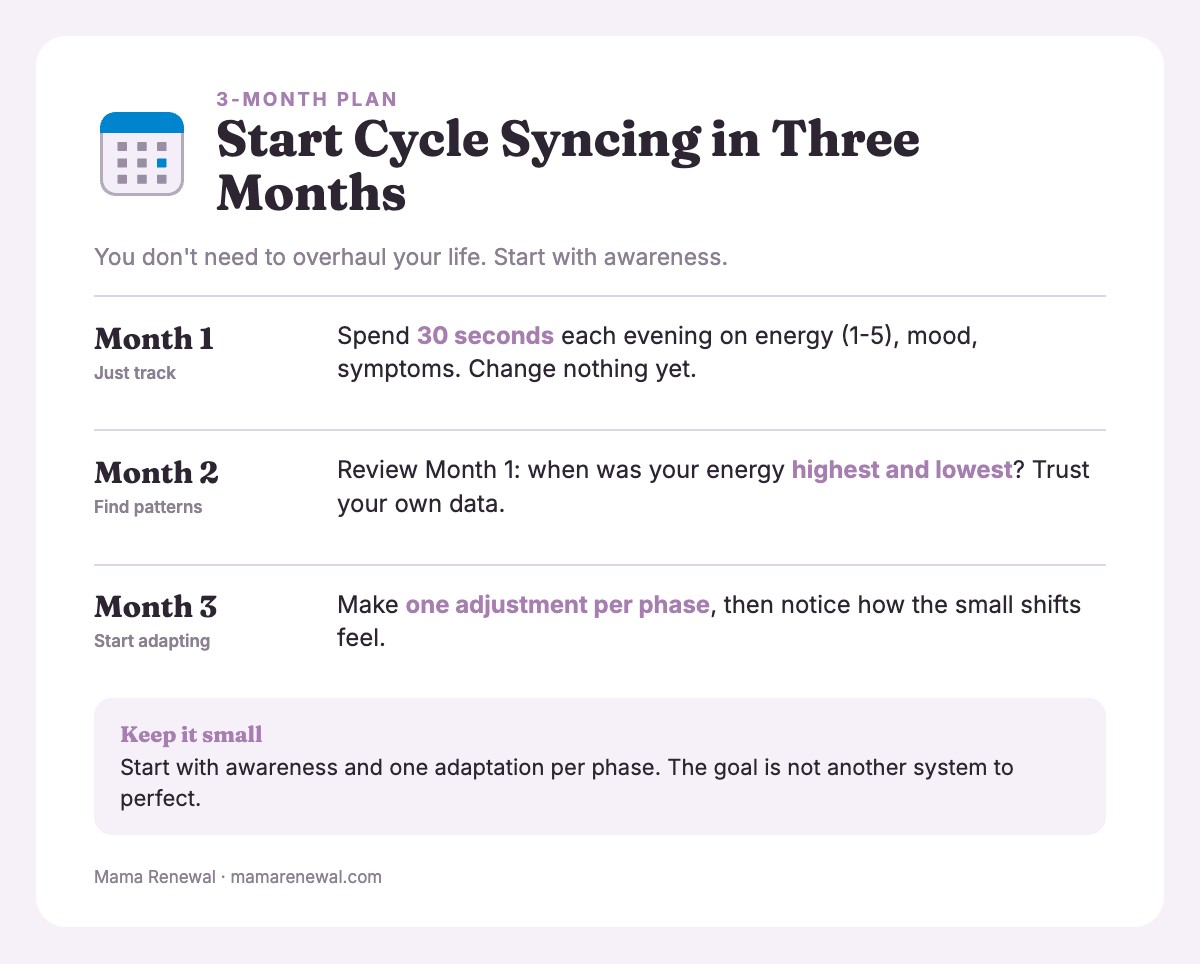
You don’t need to overhaul your life. Start with awareness.
Month 1: Just Track
- Pick a tracker. Download an app or start a paper tracker.
- Mark Day 1. Note the first day of your period.
- Note each evening. Spend 30 seconds on energy (1-5), mood (one word), and any symptoms.
- Change nothing yet. Just observe.
Month 2: Identify Your Patterns
- Review Month 1. When was your energy highest and lowest? When were you most irritable or most creative?
- Compare. Do your patterns line up with the phase descriptions above?
- Trust your data. If your energy dips earlier or later than the textbook says, your pattern is what matters.
Month 3: Start Adapting
Make one adjustment per phase, then notice how the small shifts feel and build from there.
| Phase | One adjustment to try |
|---|---|
| Menstrual | Plan one easier dinner (freezer meal, takeout, cereal) |
| Follicular | Schedule one social or high-energy activity |
| Ovulatory | Tackle one thing you’ve been avoiding |
| Luteal | Cancel or simplify one commitment |
Ongoing: Expand Gradually
Over time, you can layer in nutritional changes, exercise adjustments, and more strategic scheduling. But start with awareness and one adaptation per phase. The goal is not another system to perfect. The goal is a kinder relationship with your own body.
Your energy changes across the month, and motherhood asks for the same output every day. You’ll still have hard days that land in the wrong phase, and months when you forget to track. That’s fine. Start with one note a day, and let what you learn make you a little easier on yourself.
Frequently Asked Questions
How long does it take for cycle syncing to make a noticeable difference?
Some women notice a difference within 2-3 cycles of tracking, though experiences vary. The first month is for observing your patterns. In months two and three, small adjustments may mean fewer “blindsided by PMS” moments and more self-compassion in low-energy phases. The biggest shift is often the relief of understanding why you feel the way you feel.
Can I cycle sync if I don’t have a regular 28-day cycle?
Yes, with caveats. Cycles of 21-35 days are considered normal, and most of the variation comes from the follicular phase. Track symptoms rather than calendar days. Cervical mucus, basal body temperature, or ovulation test strips may help you estimate your phase.
Ovulation tests and temperature tracking can be unreliable with PCOS or perimenopause, and with irregular cycles none of these methods should be relied on to avoid pregnancy. If your cycles are highly variable, or consistently shorter than 21 days or longer than 35, talk to your provider.
Is there scientific evidence that cycle syncing works?
Research on how the cycle affects mood, cognition, and performance is mixed, and individual variation is large. Hormone changes across the cycle are well documented; how much they change your day-to-day varies. Cycle syncing as a packaged approach has not been tested in large clinical trials. Treat it as a way to notice your own patterns, not a proven protocol.
My partner doesn’t understand why I’m so different week to week. How do I explain this?
Keep it short and concrete. Try: “My hormones follow a monthly rhythm that can affect my energy and mood. Some weeks I have more capacity, and some weeks I need more support. Knowing that helps us work as a team.”
Then share the phase chart from this article so your partner can see the pattern.
Can cycle syncing help with PMS?
Some women find that diet, sleep, exercise, and stress management help with PMS. Evidence for cycle syncing itself is limited, and treatments exist, so ask your provider. If your PMS is severe or interferes with daily function, talk to your provider about PMDD (premenstrual dysphoric disorder), a clinical condition that responds to targeted treatment.
Safety firstIf you feel hopeless or have thoughts of harming yourself, get help right away (in the US, call or text 988). Persistent low mood, rage, or anxiety, especially postpartum, deserves a professional’s attention.
I’m perimenopausal and my cycles are all over the place. Can I still cycle sync?
Yes, but sync to how you feel today rather than a predicted phase. Perimenopause (the transition to menopause, which can last 4-10 years) makes hormone patterns less predictable, so track your symptoms daily.
Treat a low-energy, withdrawn day like menstrual phase, whether or not you’re bleeding. Treat a high-energy, clear-headed day like ovulatory phase.
Heavy or prolonged bleeding, bleeding between periods, or any bleeding after menopause should be checked by a provider. Pregnancy is still possible in perimenopause.
Will cycle syncing make me a better mom?
Cycle syncing won’t make you a “better” mom in the performative sense — you won’t suddenly become a Pinterest-perfect parent who never loses her temper. What it can do is help you understand why your patience, energy, and emotional capacity fluctuate, which makes planning easier.
Understanding your body and giving yourself grace in low-energy phases may help some mothers feel less self-blame and more present. That beats white-knuckling every day at the same impossible standard.
What if I can’t afford organic food or supplements for each phase?
Cycle syncing your meals does not require organic food, expensive supplements, or a Whole Foods budget. The core idea is simple: eat enough, include iron-rich foods around your period, and favor fiber-rich, filling foods the rest of the month.
A bag of dried lentils, a bunch of bananas, a bag of frozen spinach, a can of chickpeas, and a bar of dark chocolate cover most of those bases for a few dollars.
Supplements aren’t required, so go food first and ask your provider or pharmacist before starting any. The most useful thing here is free: understanding your body’s needs and giving yourself permission to rest.