Beyond the Gym: 10 Ways to Move Your Body Outside This Spring (Even with Kids in Tow)
Discover how ditching gym guilt and moving your body outside this spring, even with kids, offers unique physical and mental benefits beyond indoor workouts. You'll learn how sunlight, nature, and cortisol reduction make outdoor movement a game-changer for moms.
- Ditch gym guilt; move your body outside for unique benefits.
- Boost mood, serotonin, and Vitamin D with outdoor sunlight exposure.
- Reduce stress and cortisol levels more effectively through outdoor exercise.
- Improve focus and reduce rumination by exercising in green spaces.
- Integrate movement easily by exercising outdoors, even with kids in tow.
I have a gym membership. I’ve had it for fourteen months. I have been to the gym eleven times. That’s not a typo — eleven times in fourteen months, which works out to roughly $47 per visit, which means I could have hired a personal trainer to come to my house and I still would have saved money.
The gym isn’t the problem. The gym is fine. The problem is that getting to the gym requires: childcare (arranged in advance, not spontaneous), a packed gym bag (that I remembered to wash the sports bra in), driving there (fifteen minutes), working out (forty-five minutes), showering (because I’m not getting back in the car drenched), driving home (another fifteen minutes), and somehow all of this has to happen during a window when no child needs me, no appointment is scheduled, and I have the mental energy to actually go.
That’s a two-hour commitment for forty-five minutes of movement. And in the economy of motherhood, two uninterrupted hours might as well be two million dollars.
Meanwhile, my front door is right there. The sidewalk is free. The park is a five-minute walk. The backyard exists. Spring is doing that thing where the air smells like possibility and the sunlight is warm enough to make you want to be outside.
So this spring, I gave up the gym guilt. Not exercise — the guilt about not exercising the “right” way, in the “right” place, wearing the “right” outfit. I started moving my body outside, in whatever time I had, in whatever condition I was in, often with a toddler on my hip or a preschooler on a scooter beside me.
And something shifted. Not just physically — though yes, I’m stronger and sleeping better — but mentally, emotionally, almost spiritually. Outdoor movement changed the game for me this spring, and I think it can change it for you too.
Why Outdoor Movement Hits Different for Moms
This isn’t just anecdotal. The science on outdoor exercise versus indoor exercise is compelling, and for moms specifically, the benefits compound in ways that a treadmill simply can’t replicate.
The Sunlight Factor
Sunlight exposure — especially morning sunlight — sets your circadian rhythm, boosts serotonin production, and triggers vitamin D synthesis. A 2023 study in the Journal of Affective Disorders found that women who exercised outdoors reported 23% greater improvement in mood compared to those who did the same exercise indoors.
For moms running on disrupted sleep, elevated cortisol, and depleted serotonin, morning outdoor movement addresses all three simultaneously. The sunlight tells your body “it’s daytime, be alert now” which helps you sleep better that night. The movement metabolizes stress hormones. The serotonin boost stabilizes your mood.
The Nature Bonus
Movement in green spaces — parks, trails, even a tree-lined neighborhood — activates additional benefits beyond the exercise itself. Researchers call it “green exercise,” and it’s been shown to reduce rumination (the repetitive negative thinking that fuels anxiety and depression), lower blood pressure, and improve attention and focus.
For the mom brain that runs seventeen mental tabs simultaneously, an outdoor walk in nature is like closing all the browser windows and rebooting.
The Cortisol Connection
A 2024 meta-analysis published in Psychoneuroendocrinology found that outdoor exercise reduced cortisol levels significantly more than equivalent indoor exercise. Cortisol — the stress hormone — is the one most moms are swimming in. If you’ve been dealing with the wired-but-tired feeling, the belly weight that won’t budge, the irritability that seems disproportionate to the trigger, elevated cortisol is likely a factor.
Moving your body outside isn’t just exercise. It’s a cortisol intervention. And if you’re interested in how movement connects to your overall nervous system regulation, that’s a rabbit hole worth exploring.
Vitamin D: The Maternal Deficiency
Approximately 40% of American adults are vitamin D deficient, and rates are higher among women, especially postpartum and breastfeeding mothers. Vitamin D deficiency is linked to fatigue, mood disturbances, weakened immunity, and — in a cruel twist — reduced motivation to exercise. Twenty minutes of outdoor movement in spring sunlight can provide a meaningful vitamin D dose while simultaneously improving the mood and energy levels that deficiency was undermining.
Before You Start: Redefining “Exercise” for This Season of Life
Before I give you the list of outdoor movement ideas, I need to say something important: we need to talk about what “exercise” means right now, in this chapter of your life.
Movement Is Not Punishment
If your relationship with exercise is tangled up with guilt, punishment, “earning” food, or making your body smaller, I need you to hear this: that framework will sabotage any movement practice you try to build.
Exercise that comes from self-hatred doesn’t stick. It burns bright for two weeks and then crashes when motivation fades, because punishment is not a sustainable motivator. The moms I know who move consistently do it because movement feels good, not because they’re trying to fix something that’s wrong with them.
Your body carried, birthed, and is raising human beings. It doesn’t need to be punished. It needs to be moved, stretched, strengthened, and cared for — the way you’d care for any tool that’s done extraordinary work.
If you’re navigating complicated feelings about your postpartum body, please be gentle with yourself as you explore movement this spring. The goal is joy and function, not aesthetics.
What “Counts” as Exercise
Everything. A ten-minute walk counts. Chasing your toddler around the yard counts. Dancing in the driveway counts. Stretching on the porch counts. Gardening counts. Carrying a thirty-pound child up a hill counts (and is, frankly, an elite-level weighted carry).
The fitness industry has convinced us that exercise only “counts” if it’s structured, intense, and at least thirty minutes long. That’s gatekeeping, and it’s especially harmful to mothers who can rarely meet those criteria. The research is clear: movement accumulated throughout the day in shorter bouts is just as beneficial as one continuous session.
So throw away the “it doesn’t count” filter. If your body moved more than it would have on the couch, it counts.
Joyful Movement as the Standard
I want you to choose movement based on one criterion this spring: does it bring you any amount of joy? Not “is it the most efficient calorie burn?” Not “will this get me back to my pre-baby body?” Not “is this what the fitness influencers are doing?”
Does it feel good? Does it make you smile, or breathe deeper, or feel more like yourself? Then it’s the right movement for you right now.
10 Outdoor Movement Ideas for Spring
1. The Power Walk (With or Without Stroller)
Time required: 20-60 minutes
Equipment needed: Supportive shoes, stroller (optional)
Kid-inclusion strategy: Stroller for babies/toddlers, bike or scooter for older kids, or solo during partner/childcare time
Fitness level modifications: Slow and flat for beginners; add hills, speed intervals, or a weighted vest for more challenge
Walking is the most underrated exercise in existence. It’s low-impact, requires no equipment beyond shoes, can be done at any fitness level, and provides nearly all the cardiovascular benefits of running with a fraction of the injury risk.
But I’m not talking about a casual stroll where you stop every forty-five seconds because your three-year-old found another interesting rock. I’m talking about an intentional walk — one where you set a pace that elevates your heart rate and breathe a little harder than normal.
How to make it work:
- Route planning matters. Find a route that minimizes stop-and-go (fewer street crossings, longer stretches). Loops work better than out-and-back because you can’t quit at the halfway point.
- Pace yourself for conversation, not comfort. You should be able to talk but not sing. If you’re pushing a stroller, this is harder than it sounds — stroller walking engages your core and upper body in ways that make even moderate speeds challenging.
- Invest in a podcast or playlist. The right audio transforms a walk from “exercise I should do” to “the thirty minutes of my day I actually look forward to.” I have a walking playlist that makes me feel like I’m in a movie montage, and I’m not embarrassed about it.
- Try walk intervals. Two minutes at your normal pace, one minute as fast as you can go. Repeat. This is surprisingly effective cardiovascular training disguised as a walk.
A daily power walk — even twenty minutes — will do more for your physical and mental health this spring than a gym membership you use twice a month. I promise.
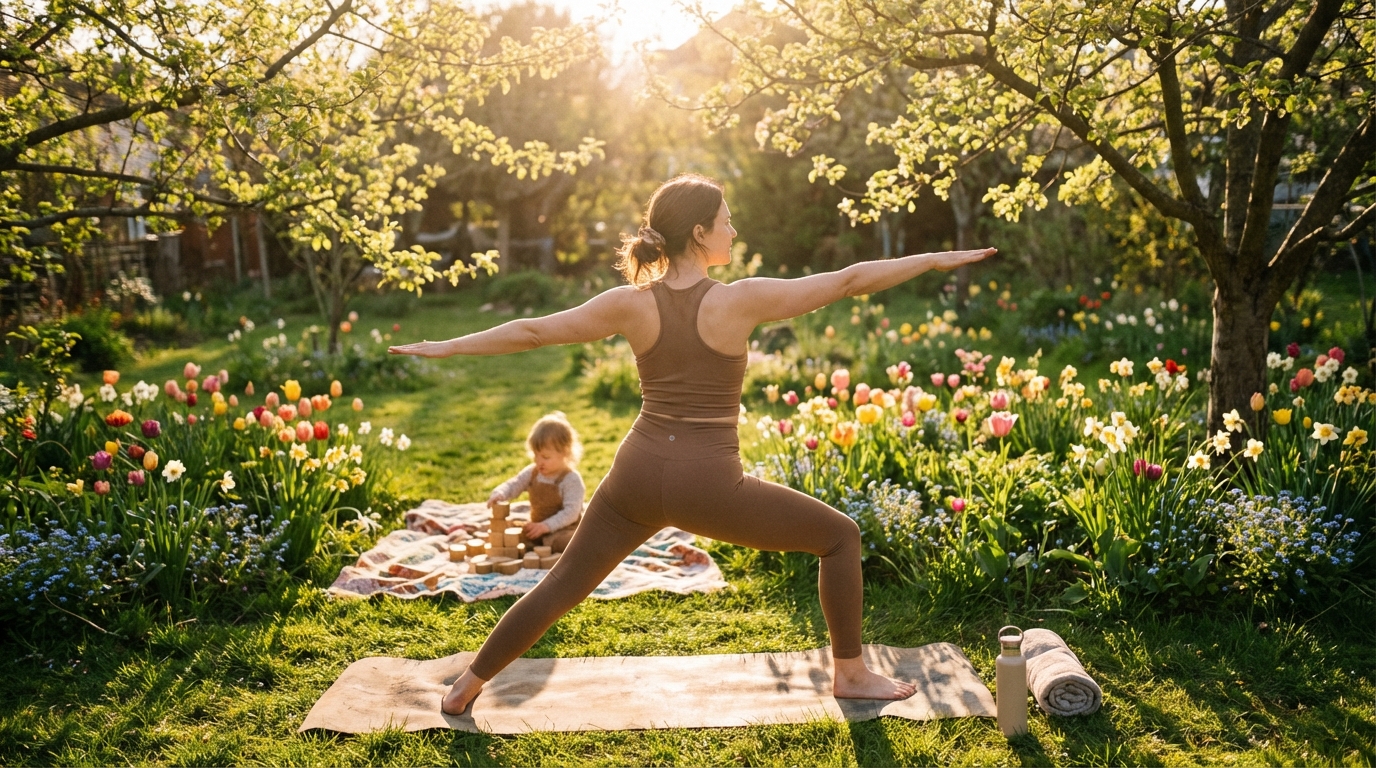
2. Backyard Yoga Flow
Time required: 15-30 minutes
Equipment needed: A yoga mat or towel (grass works too)
Kid-inclusion strategy: Let young kids climb on you (it adds resistance!), give older kids their own mat, or practice during rest time/screen time
Fitness level modifications: Start with gentle stretching and basic poses; progress to vinyasa flows as you build strength
There is something about doing yoga outside that transforms it from exercise into something closer to meditation. The uneven ground engages your stabilizer muscles. The breeze on your skin grounds you in your body. The sounds of birds and wind replace the studio playlist, and somehow it’s better.
You don’t need a class. You don’t need to be flexible. You don’t need an hour.
A 15-minute backyard flow to start with:
- Child’s pose (2 minutes) — knees wide, arms extended, forehead on the ground. Breathe.
- Cat-cow (1 minute) — on all fours, alternate arching and rounding your spine.
- Downward dog (hold for 5 breaths) — pedal your feet, let your head hang heavy.
- Low lunge, each side (1 minute each) — deep hip opener, which every mom desperately needs.
- Warrior II, each side (30 seconds each) — strength and stability.
- Tree pose, each side (30 seconds each) — balance. Will be hilariously difficult at first. That’s fine.
- Forward fold (1 minute) — let everything hang. Shake your head yes and no.
- Seated twist, each side (1 minute each) — ring out the tension in your spine.
- Savasana (3 minutes) — lie flat on your back on the grass. Feel the earth holding you up. This is the most important part. Don’t skip it.
The kid interruption reality: Kids will climb on you. They will try to go under your downward dog. They will ask for snacks during savasana. Two options: roll with it (a toddler on your back during plank is genuinely challenging core work), or set them up with an activity first and accept that you’ll get about twelve of your fifteen planned minutes. Both are fine.
For more detailed sequences, the morning stretches routine on our site is designed specifically for the mom body — tight hips, sore shoulders, clenched jaw, all of it.
3. Playground Workout
Time required: 20-45 minutes
Equipment needed: A playground (your kids are the reason you’re there anyway)
Kid-inclusion strategy: Built in — you exercise while they play
Fitness level modifications: Start with basic moves and fewer reps; advance by adding sets, speed, or complexity
This is the one that changed everything for me, because it eliminated the biggest barrier: childcare. You’re already at the playground. You’re already standing there watching your kids. Why not use that time and that equipment?
Playground exercises that actually work:
- Step-ups on the bench — step up, step down, alternate legs. 10 each side. This is a serious glute and quad workout.
- Incline push-ups on the bench or low wall — hands on the bench, body in a straight line, lower your chest to the bench. Start with 5, work up to 15.
- Tricep dips on the bench — hands on the edge, lower your body, push back up. Your arms will be shaking by rep 8. That’s normal.
- Monkey bar hang — just hang. As long as you can. This decompresses your spine, builds grip strength, and stretches your shoulders. If you can’t hang for 10 seconds at first, that’s your starting point.
- Walking lunges across the grass — long steps, back knee hovering above the ground. 10 each side.
- Swing plank — hands on the swing seat, body in plank position. The instability makes your core work overtime.
- Swinging — yes, actually swinging. On a swing. It’s a core workout, it’s joyful, and your kids will think you’re the coolest mom at the park.
The social dynamics: You might feel self-conscious doing push-ups at the playground. I did, the first time. Then I noticed every other mom was staring at her phone, and I was the one smiling and sweating, and I stopped caring. Within two weeks, another mom asked what I was doing and joined me.
4. Family Bike Rides
Time required: 30-60 minutes
Equipment needed: Bikes (adult and kid-sized), helmets, bike trailer or child seat for younger kids
Kid-inclusion strategy: Fully integrated — this is a family activity
Fitness level modifications: Flat routes and short distances for beginners; hills and longer routes for more challenge
Biking is one of the few family exercises that genuinely works for all ages once kids can ride (or ride along in a trailer). The wind in your face, the speed, the freedom — it scratches the adventure itch that motherhood often suppresses.
Making it work with different ages:
- Babies and young toddlers (6 months-2 years): Bike trailer or rear-mounted child seat. The motion often puts them to sleep (bonus).
- Toddlers and preschoolers (2-5 years): Trail-a-bike attachment or continued trailer use.
- School-age kids (5+): Their own bikes. Start short and flat; kids can go farther than you think with snack breaks.
Practical tips:
- Start with a route that has a bailout option — a shorter loop you can take if kids hit a wall.
- Bring more water and snacks than you think you’ll need.
- Destination rides (to the ice cream shop, to the park, to a friend’s house) motivate kids better than “let’s just ride.”
Cycling is low-impact, builds leg strength and cardiovascular endurance, and at a moderate pace, burns 400-600 calories per hour. And unlike a treadmill, you actually go somewhere.
5. Garden Fitness
Time required: 20-90 minutes
Equipment needed: Basic gardening tools, a patch of dirt
Kid-inclusion strategy: Kids can dig, plant, water, and find worms (which is apparently very thrilling)
Fitness level modifications: Self-pacing — go as hard or gentle as your body wants
I used to feel guilty that gardening was my exercise because it didn’t seem “real.” Then I wore a fitness tracker while doing yard work and realized I’d burned more calories than a gym session.
The actual physical demands: Digging engages arms, shoulders, core, and legs. Weeding is constant squatting and lunging. Raking is rotational core work. Carrying bags of soil or mulch is a loaded carry — one of the most functional strength exercises there is.
A 150-pound person burns approximately 250-350 calories per hour gardening — the same range as moderate cycling. But gardening offers something most exercise doesn’t: a tangible result. You moved your body AND now there are tomato plants.
The gut health connection: Exposure to soil microbiomes is genuinely good for your immune system and gut health. If you’re working on your gut health as a mom, gardening with bare hands in the dirt is a surprisingly evidence-based intervention.
Kids in the garden: Give them their own patch. A small section where they can plant, dig, and water with complete autonomy. They will overwater everything and plant seeds too close together and it will be perfect. Gardening with kids isn’t efficient, but it’s one of the most naturally joyful outdoor activities for families.
6. Dance Party in the Driveway
Time required: 10-30 minutes
Equipment needed: A speaker (phone speaker works), a driveway or patio
Kid-inclusion strategy: This IS a kid activity — they’ll be all in
Fitness level modifications: You control the intensity — sway gently or go full out
I’m going to be honest: this one felt ridiculous to me until I tried it. And then I tried it and I was laughing and sweating and my four-year-old was spinning in circles beside me and I realized I hadn’t felt that alive in months.
How to make it a thing:
- Pick 4-5 songs. That’s 15-20 minutes. That’s enough.
- Mix YOUR music with the kids’ music. “Bohemian Rhapsody” into the Encanto soundtrack into that one song that makes you feel twenty-two again.
- Don’t choreograph. Just move however your body wants to. Jump. Spin. Shimmy. Your kids don’t care if you look cool — they care that you’re present.
- Do it consistently. Make it a weekly ritual. Your kids will start requesting it, which means you have a built-in accountability system.
The fitness benefits are real: cardiovascular conditioning, balance, coordination, and multi-plane functional strength. But the real benefit is the neurological reset. Dancing releases endorphins, reduces cortisol, and activates the playful part of your brain that caregiving often suppresses.
7. Walk-and-Talk with Another Mom
Time required: 30-60 minutes
Equipment needed: A friend, shoes
Kid-inclusion strategy: Strollers, or kid-free if childcare allows
Fitness level modifications: Walk at whatever pace allows conversation
This is the one I recommend most to moms who are struggling with both fitness and isolation, because it addresses both at once.
In the era of text-based friendship and canceled plans, the intentional walk-and-talk deserves a comeback.
Why it works so well for moms:
- No scheduling a “place.” Just pick a time and a meeting point. No reservations, no spending money.
- Side-by-side conversation. Research shows that walking side-by-side reduces social anxiety and makes it easier to discuss difficult things. The most honest conversations happen on walks.
- Movement regulates emotion. If the conversation turns hard, the physical movement helps your body process the emotion rather than getting stuck in it.
- Built-in time limit. You walk a loop. When the loop is done, the conversation naturally wraps.
How to start: Text one mom friend today. “Want to walk together on Thursday morning?” That’s it. No elaborate planning. Just shoes and showing up. If you don’t have a local mom friend for this, neighborhood walks at consistent times naturally lead to meeting regulars. It takes one brave invitation.
8. Outdoor Stretching Routine
Time required: 10-15 minutes
Equipment needed: A porch, patio, or grassy spot
Kid-inclusion strategy: Do it while kids eat breakfast, during morning outdoor play, or as a family before the day starts
Fitness level modifications: Entirely self-paced — go only as deep as feels comfortable
If full workouts feel like too much right now — if you’re in early postpartum, chronically exhausted, managing pain, or just in a season where “exercise” sounds like a burden — stretching outside is your entry point.
Not stretching as a warmup for something else. Stretching as the whole thing.
A 10-minute outdoor morning routine:
- Standing, face the sun. Close your eyes. Take five deep breaths. Feel the warmth on your face.
- Neck rolls. Slow circles, each direction. Let the weight of your head do the work.
- Shoulder shrugs and rolls. Up, back, down. Reverse. Repeat until your shoulders drop from their default position by your ears.
- Standing side stretch. Reach one arm overhead and lean to the opposite side. Hold for 30 seconds each side. Breathe into the stretch.
- Forward fold. Feet hip-width apart, fold forward and let your arms hang. Shake your head gently. Hold for one minute.
- Hip circles. Hands on hips, make big slow circles. This mobilizes the pelvis and lower back — the regions most mothers carry tension.
- Deep squat hold. Feet wider than hip-width, lower into a deep squat and hold for 30 seconds (or as long as comfortable). Hold onto a porch railing for balance if needed.
- Seated spinal twist. Sit on the ground, twist to each side, holding for 30 seconds.
- Legs up the wall (use the side of the house or a fence). Five minutes. This is restorative magic for tired legs and a racing mind.
Do this every morning on the porch and within two weeks you’ll notice: less stiffness, better posture, calmer mornings. It pairs perfectly with the full morning stretches routine for moms when you want to expand it.
9. Swimming and Water Play
Time required: 30-60 minutes
Equipment needed: Access to a pool, lake, or splash pad; swimsuit; sunscreen
Kid-inclusion strategy: Fully integrated — kids in the water with you, or baby in a float while you move
Fitness level modifications: From gentle water walking to lap swimming — water accommodates all levels
Swimming is the exercise I recommend most to postpartum moms and moms recovering from injury or dealing with joint pain, because water removes the impact while adding resistance. Everything is gentler in the water, and yet everything is harder in the water. It’s a beautiful paradox.
Spring swimming options:
- Community pool: Many open for the season in April or May. Lap swimming while your partner watches the kids in the shallow end.
- Lake or river: Even wading and water walking is excellent exercise. The uneven bottom engages stabilizer muscles, and water resistance works your muscles harder than equivalent movements on land.
- Splash pad: Chasing your toddler through a splash pad for thirty minutes is more cardio than you’d think.
- Backyard pool or inflatable: Water walking, leg lifts holding the edge, and treading water are all legitimate workouts.
The sensory reset: Water has a unique calming effect on the nervous system. The hydrostatic pressure, the muffled sound, and the temperature change all signal safety to your brain. For the touched-out mom, water can be an almost paradoxical comfort. It holds you without needing anything from you.
10. Trail Walking with Kids
Time required: 45-90 minutes
Equipment needed: Sturdy shoes, water, snacks, a carrier or hiking backpack for little ones, basic first aid kit
Kid-inclusion strategy: Fully integrated — the trail is the adventure
Fitness level modifications: Choose trail length and elevation appropriate to your level; paved greenway trails for easy, dirt trails with hills for challenge
Trail walking takes you away from cars and sidewalks and screens and into the kind of environment humans are biologically designed for — uneven terrain, green canopy, natural sounds.
Making trails work with different ages:
- Babies (in a carrier): You’re doing the walking, they’re doing the vibes. This is basically a weighted hike and an excellent workout.
- Toddlers (1-3): Expect approximately 0.3 miles per hour. Every stick is a treasure. Every puddle requires investigation. Reframe the goal from “distance” to “time outside.”
- Preschoolers (3-5): Can walk 1-2 miles on flat, easy trails. Give them a mission — find five different leaves, spot a bird, collect three interesting rocks.
- School-age (5+): Can handle 2-4 miles depending on terrain. Old enough for real trail conversations, making this a connection opportunity too.
What to bring: Double the water you’d bring for yourself, non-meltable snacks, sunscreen and bug spray, a change of clothes (if your kid is the mud-puddle type — mine is), and a carrier for the child who will inevitably declare their legs “don’t work anymore” at the farthest point from the car.
Trail finding: AllTrails (app) has a “kid-friendly” filter that’s genuinely useful. Local nature centers and state parks often have short loop trails designed for families. Start with paved greenways; work up to dirt trails and elevation as your family builds stamina.
Building an Outdoor Movement Habit That Sticks
Knowing ten ideas is useless if none of them become habits. Here’s how to actually build a sustainable outdoor movement practice.
Habit Stacking
Don’t create a new “exercise time” in your schedule. Attach movement to something you’re already doing:
- Already going to the playground? Do the playground workout.
- Already walking to school drop-off? Add ten minutes and make it a power walk loop on the way home.
- Already doing morning coffee on the porch? Add the 10-minute stretching routine before or after.
- Already taking the kids to the park on Saturday? Make Saturday park day = family bike ride to the park.
The most sustainable habits are the ones that don’t require new schedule slots — they upgrade existing ones.
The Minimum Viable Movement
On the days when everything falls apart — the kids are sick, you’re exhausted, the weather is terrible, motivation is at zero — your goal is not the full workout. Your goal is the minimum viable movement: the smallest amount that still counts as “I did it.”
For me, that’s a five-minute walk to the end of the block and back. That’s it. Some days, five minutes turns into twenty. Some days, five minutes is five minutes and then I’m done. Both maintain the habit. Both beat zero.
Set your minimum viable movement before you need it. When the hard day comes (and it will), you already know what “good enough” looks like.
Tracking Without Obsessing
If tracking motivates you, track. If it triggers obsessive tendencies, don’t. Know yourself.
Helpful tracking: a simple checkmark on the calendar each day you moved outside. Seeing the chain of checkmarks builds momentum.
Unhelpful tracking: obsessing over step counts, calorie burns, pace times, or comparing your numbers to pre-kid benchmarks. That way lies misery.
The goal is consistency over intensity. Five days of fifteen-minute walks beats one day of an intense workout followed by six days of nothing.
If you’re the type who benefits from aligning exercise with your energy cycles, understanding cycle syncing can help you plan higher-intensity outdoor days during your follicular and ovulatory phases and gentler movement during luteal and menstrual phases. It’s not about doing less — it’s about doing what works with your body instead of against it.
What to Wear and Bring
I’m not going to recommend expensive athleisure brands. I’m going to tell you what actually matters for outdoor movement as a mom.
Shoes
This is the one thing worth investing in. Good supportive shoes make the difference between a walk that feels great and one that leaves you with knee pain. If you’re doing more than casual walking, visit a running store for a proper fitting (most offer free gait analysis). One good pair outlasts and outperforms five cheap ones.
Clothes
Wear whatever you’re comfortable moving in. The fitness industry wants you to believe you need matching sets and moisture-wicking fabrics to walk around the block. You don’t. The one functional recommendation: a good sports bra, especially if you’re postpartum or breastfeeding.
The Mom Outdoor Kit
Keep a bag by the door with: sunscreen, filled water bottles, snack bars, a hat, sunglasses, hand wipes, a plastic bag (for collected treasures and emergency diapers), and a light layer. Having the bag ready removes the “getting ready” barrier that kills spontaneous outdoor time. When a window opens, you grab the bag and go.
When Movement Feels Impossible
I would be a terrible guide if I wrote all of the above without acknowledging that for some moms, in some seasons, movement feels genuinely impossible. Not lazy-impossible — physiologically, emotionally, or circumstantially impossible.
If You’re in Postpartum Recovery
Your body just did the most physically demanding thing a human body can do. You don’t owe anyone a “bounce back.” Walking is usually the first green-lit activity, and outdoor walking with a newborn in a carrier is a beautiful gentle re-entry. But if walking to the mailbox feels like a marathon right now, that IS your exercise, and it IS enough.
If You’re Dealing with Chronic Fatigue or Illness
The advice to “just get moving and you’ll feel better” can be genuinely harmful for mothers dealing with autoimmune conditions, chronic fatigue, thyroid disorders, or depleted mother syndrome. If your body is sending distress signals, listen to them before overriding them with exercise. Gentle outdoor stretching, slow walking, and simply sitting outside in the sunlight are all valid movement for a depleted body.
If You’re Touched Out
Some days, the idea of one more physical experience is too much. Your body has been climbed on, nursed on, clung to, and grabbed at all day. On those days, the movement is rest. Lying on the grass while the kids play. Sitting on the porch. Being outside without doing anything. Your body needs to experience existing without being needed.
The Permission to Rest
If you’re in a season where rest is what your body needs most, take the rest. The trails and playgrounds and bike paths will still be there. Your body is not on a deadline.
Start where you can. Start small. Start outside.
Frequently Asked Questions
Is outdoor exercise safe for new postpartum moms?
Generally, walking is safe for most postpartum moms within days of an uncomplicated vaginal delivery and within a few weeks of a cesarean — but always follow your healthcare provider’s guidance. Start with short, flat walks and build gradually. Avoid high-impact activity until cleared (typically 6-8 weeks postpartum). If you experience pain, bleeding, or pelvic floor heaviness, stop and talk to your provider.
How do I exercise outside when I have no one to watch my kids?
Most of the ideas in this article are designed for exactly this situation — playground workouts, family bike rides, trail walking, backyard yoga, and driveway dance parties all include your kids by design. For solo activities, options include: exercising during nap time, swapping childcare with another mom, waking 30 minutes before your kids, or using the window after bedtime. You don’t need kid-free time to move outside.
What if it rains? Do I need to skip outdoor exercise?
Light rain is actually a wonderful time to be outside — the air is cleaner, the parks are empty, and kids are fascinated by puddles. Dress in layers that can get wet, skip cotton (which stays cold when damp), and embrace it. Porch stretching and covered-patio yoga work in rain too. The only weather worth truly skipping for is lightning, extreme wind, or extreme temperatures. If you find yourself using weather as a frequent excuse, you might be dealing with motivation issues rather than actual weather barriers — and the minimum viable movement (five minutes, even in drizzle) can break through that.
How much outdoor exercise do moms actually need per week?
The general recommendation is 150 minutes of moderate activity per week — about 20-25 minutes per day. But any movement is better than none. Research shows even 11 minutes per day is associated with significant health benefits. Don’t let “150 minutes” become a barrier — it’s an aspiration, not a minimum requirement for your movement to “count.”
Can I get a good enough workout just from walking?
Absolutely. Brisk walking (3-4 mph) provides cardiovascular conditioning, supports bone density, reduces disease risk, and improves mental health. A 2023 meta-analysis found regular walkers had 30-40% lower cardiovascular disease risk. Adding hills, speed intervals, or a weighted vest increases the challenge further. Walking is not a consolation prize — it IS real exercise, and one of the most sustainable forms.
My body looks different postpartum. How do I exercise outside without feeling self-conscious?
This is so real. A few things that helped me: wearing clothes that feel comfortable (not ones I’m constantly adjusting), choosing less crowded times at first, wearing sunglasses (they create a psychological barrier that reduces self-consciousness — this is research-backed), and focusing on how movement FEELS rather than how it looks. For deeper work on this, our article on postpartum body image goes into the emotional and psychological dimensions.
What time of day is best for outdoor exercise as a mom?
The “best” time is the time that actually happens. That said, morning outdoor exercise has specific advantages: sunlight exposure regulates your circadian rhythm, cortisol is naturally higher (giving you energy for movement), and exercising before the day’s chaos begins means it’s less likely to get canceled. If mornings don’t work, the post-nap or post-school window is a natural time for outdoor play that can incorporate movement.