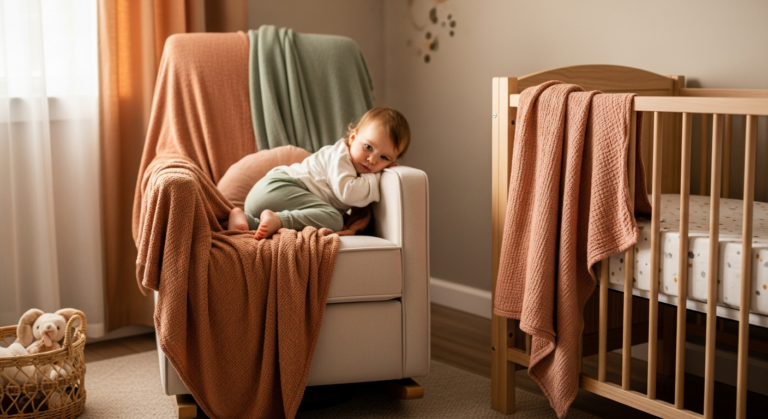
Touched Out: What It Means When You Can’t Stand to Be Touched Anymore
If you're a mom who recoils from touch after a long day, you might be 'touched out.' This article explains what this physiological response means, why it's common for mothers, and what you can do to manage it.
- Understand 'touched out' as a real, physiological sensory overload, not a character flaw.
- Recognize it's common for moms due to constant physical contact with children all day.
- Know that even loving touch can trigger this response when your nervous system is saturated.
- Discover actionable ways to manage 'touched out' feelings without guilt or family disruption.
It’s 8:47 PM and your toddler is finally asleep, sweaty head heavy on the pillow, one hand still fisted in your shirt from the last fifteen minutes of rocking. You peel her fingers off one at a time, the way you’ve done every night for two years, and you tiptoe out of the room like you’re defusing a bomb. Your partner is on the couch. He reaches out and puts a hand on your knee — not asking for anything, just a hand, just contact — and something in you recoils so hard you almost gasp out loud. You don’t mean to flinch. You love him. You’re not touched-starved in your marriage; if anything you’re the opposite. But your whole body just said no more before your brain even caught up, and now you feel like a monster sitting three inches farther away on the couch than you were a second ago, arms crossed over your own body like you’re guarding it from something.
If that scene lands a little too close to home, you already know the feeling I’m talking about, even if you’ve never had a name for it. It’s not that you don’t love your family. It’s not that you don’t want affection. It’s that your body has been in near-constant physical contact with other humans since roughly 6:15 AM — nursing or snuggling, a toddler climbing into your lap mid-breakfast, a preschooler hanging off your leg in the kitchen, a baby on your hip through three loads of laundry, a six-year-old who still needs to be carried “just for a little bit,” bath time hands and hair-brushing and buckling car seats and wiping faces and holding hands crossing the parking lot — and by the time evening rolls around, your nervous system has quietly filed a complaint. It wants out. Not out of your life. Just out of contact. For a minute. An hour. A night.
This feeling has a name, and it’s more common than the silence around it would suggest: touched out. It’s real, it’s physiological, it’s not a character flaw, and — this is the important part — it’s something you can actually do something about, without needing to blow up your family life or feel guilty for the rest of the week. Let’s talk about what’s actually happening in your body, why it happens more to moms than almost anyone else on earth, and what to do the next time you feel your own skin start to scream.
What “Touched Out” Actually Means
“Touched out” is the term moms use — because it was moms who needed it first — to describe a state of sensory saturation from too much physical contact. It’s most often talked about among breastfeeding mothers, because nursing is uniquely relentless: a body attached to your body for what can add up to eight or more hours a day, with no real off switch. But it doesn’t end when weaning does. Any mom who spends her day as a human jungle gym, comfort object, napping surface, and emotional-regulation tool for small people can hit this wall, whether her youngest is four months or fourteen years old.
Clinically, this overlaps with what researchers call sensory overload or touch saturation — a nervous system response, not a mood or a preference. Your skin has an enormous number of touch receptors, and your brain is constantly processing signals from all of them. Under normal circumstances, that processing happens in the background. But when the volume of touch input crosses a threshold — and for moms of young kids, it crosses that threshold routinely, every single day — your brain starts treating additional touch, even gentle, loving touch, the way it might treat a persistent, irritating noise. Not because the touch itself is bad. Because there’s simply been too much of it, for too long, without a break.
Here’s what makes this genuinely confusing for a lot of moms: the touch that finally tips you over is often the touch you’d normally want most. A hug from your partner. Your older kid crawling into bed with you on a Saturday morning. It’s not about who is touching you or how much you love them. It’s about total sensory load, and your nervous system doesn’t sort incoming touch by “wanted” versus “unwanted” once it’s maxed out — it just registers “more” and pushes back.
A few things touched-out is not:
- It’s not a sign you don’t love your kids or partner.
- It’s not the same as touch aversion from trauma (though the two can coexist and are worth untangling with a therapist if you suspect that’s part of it).
- It’s not permanent — it ebbs and flows with how depleted your nervous system is on any given day.
- It’s not something that only “sensitive” or “introverted” moms experience — extroverted, physically affectionate moms report it too, often with more confusion because it doesn’t match how they see themselves.
Why It Happens: The Science Behind the Overwhelm
Your nervous system operates a bit like a bank account for stimulation. Every sensory input — touch, sound, light, demands on your attention — is a withdrawal. Rest, quiet, and time alone are deposits. Most moms of young kids are running a serious overdraft by 3 PM most days, and touch is one of the biggest line items on the ledger because it’s constant, physical, and largely outside your control (you can’t exactly tell a two-year-old to schedule their clinginess for a more convenient time).
A few physiological pieces are worth understanding:
Cortisol and the “on” switch that never flips off. When you’re responsible for small humans’ safety, comfort, and needs all day, your body runs on a low simmer of vigilance — a baseline stress-hormone level that’s always slightly elevated, even during “calm” moments, because some part of your brain is always scanning for the next need. Touch that would feel soothing at baseline can feel like static on top of static when cortisol is already running high.
Oxytocin’s double edge. Oxytocin, the so-called “bonding hormone,” floods your system during nursing, skin-to-skin contact, and physical affection with your kids. It’s genuinely wonderful — and also metabolically demanding. Big oxytocin days (lots of cuddling, lots of nursing, lots of physical comfort-giving) can leave you feeling paradoxically both bonded and drained, because your body has been working hard the whole time, even though it didn’t look like “work” from the outside.
Sensory processing fatigue. Your brain filters and prioritizes sensory input constantly — this is called sensory gating. Under chronic overload, that filtering system gets worn down, similar to a muscle that’s been asked to do too many reps. By evening, incoming touch that would normally register as neutral or pleasant gets misfiled as an alarm.
Depletion compounds it. If you’re running on interrupted sleep, skipped meals, and zero alone time — which, if we’re honest, describes most seasons of early motherhood — your baseline capacity to tolerate any additional input drops. Touch is just often the input that finally cracks the dam because it’s the most physically inescapable one. If this pattern of running on empty sounds familiar well beyond just touch, it’s worth reading about Depleted Mother Syndrome, which covers the broader picture of chronic maternal depletion and how to start climbing out of it.
The upshot: being touched out isn’t a personality problem, it’s a resource problem. Your nervous system has a finite capacity for processing physical contact, and modern intensive parenting — especially in the early years, especially for primary caregivers — routinely exceeds it.
It’s Not Just Moms of Babies: Touched Out at Every Stage
There’s a persistent myth that touch-out is a breastfeeding-specific phenomenon that resolves once you wean. It’s true that nursing is one of the most concentrated forms of physical demand a body can experience, and a lot of moms first encounter this feeling in the newborn or infant stage. But the sensation doesn’t have an expiration date tied to weaning — it just changes shape.
| Stage | What the touch load looks like | Why it can still overwhelm |
|---|---|---|
| Newborn/infant | Near-constant holding, nursing/feeding, skin-to-skin, babywearing | Physical contact is almost continuous with little predictable break |
| Toddler | Climbing, clinging during meltdowns, “carry me,” co-sleeping migration | Unpredictable, often forceful contact combined with tantrums and resistance |
| Preschool | Hanging on your leg, sitting on your lap uninvited, face-grabbing for attention | Contact often demands your full attention simultaneously (touch + talking + needing something) |
| School-age | Piling onto you on the couch, hair-touching, still needing help with baths/hygiene | Bigger bodies mean more physical weight and pressure; less “cute,” more genuinely tiring |
| Tween/teen | Sporadic but intense — a long hug after a hard day, wanting to be physically close when upset | Less frequent but higher emotional stakes, which can make it harder to say “not right now” |
Multiple kids compound this in ways that aren’t simply additive — it’s not “twice the touch,” it’s touch from more than one direction at once, often while you’re also touching a third thing (dishes, a phone, dinner) or fielding a fourth person’s questions. A mom of three under six isn’t managing triple the sensory load of a mom of one; she’s often managing simultaneous, competing, physically demanding touch requests with zero buffer time between them.
It’s also worth naming: partners and pets count too. A dog who wants to be petted, a partner who wants a hug hello, an aging parent who needs help with mobility — all of it draws from the same finite well. If you find yourself touched out even on days when the kids were relatively easy, look at the whole picture of who and what needed your hands and body that day, not just the obvious culprits.
The Guilt Spiral: Why Wanting Space Doesn’t Make You a Bad Mom
Here’s where it gets emotionally messy for a lot of moms, and where I want to be very direct: needing physical space from the people you love is not a betrayal of them. It’s a biological signal, and biological signals exist to be listened to, not shamed into silence.
But the guilt is real, and it’s worth naming exactly where it comes from, because understanding the source makes it easier to talk back to it.
The cultural script says physical affection equals good mothering. We’re saturated with images of motherhood defined by constant closeness — babywearing, co-sleeping, extended nursing, “touch is love.” These aren’t bad practices; plenty of them are wonderful, evidence-supported choices. But somewhere along the way, “touch is love” quietly mutated into “the absence of wanting touch means the absence of love,” which is simply false. You can deeply love your child and also need your own skin back for twenty minutes.
Flinching feels like rejecting the person, when it’s really about the sensation. When you pull away from your partner’s hand on your knee, it can feel — to both of you — like you’re rejecting him. But your nervous system isn’t evaluating him. It’s registering total touch volume for the day and hitting a ceiling. Naming this out loud, to your partner and to yourself, does a lot of work to defuse the guilt: “I’m not touched out because of you. I’m touched out because I’ve been touched, held, and climbed on for twelve straight hours and my body needs a minute.”
Identity loss makes it worse. A lot of moms describe touch-out as one more piece of evidence that they’ve disappeared into the role — that their body isn’t fully theirs anymore, that even their own reactions feel like they belong to “mom” instead of to them as a person. If that resonates, it’s worth reading this letter to the mom who lost herself — the sense that your body, time, and needs have been quietly absorbed into everyone else’s is one of the most common and least talked-about threads in early motherhood, and touch-out is often just where it shows up first and most physically.
The reframe that helps most moms: wanting space from touch is a maintenance need, the same category as needing to eat, sleep, or use the bathroom without an audience. You wouldn’t feel guilty for needing to eat. Treat the need for physical space the same way — a biological requirement to keep functioning well, not a referendum on how much you love your family.
How to Tell the Difference: Touched Out vs. Something Bigger
Most of the time, touch-out is a normal, expected response to a high-contact day, and it resolves with rest and some intentional space. But it’s worth knowing when the feeling is pointing at something that deserves more attention.
Likely just touch-out if:
- It builds over the course of the day and peaks in the evening
- It improves noticeably after even a short break (a shower alone, ten minutes on the porch, a solo errand)
- You still want connection with your partner and kids — just not physical contact in that exact moment
- It doesn’t come with a broader sense of dread, numbness, or disconnection from your life
Worth a closer look, possibly with a therapist or your doctor, if:
- The aversion to touch is constant, not just evening-specific or day-specific
- It’s accompanied by irritability, rage, numbness, or intrusive thoughts that feel out of character
- You feel touch-averse even after real rest and time alone
- It’s tangled up with feelings of resentment toward your kids or partner that don’t lift
- You notice it alongside symptoms of postpartum depression or anxiety, or a general sense of running in survival mode most of the day
That last point matters — chronic touch aversion can sometimes be a symptom sitting on top of a nervous system that’s stuck in fight-or-flight far more broadly than just around physical contact. If a lot of your days feel like you’re bracing rather than living, it’s worth reading about nervous system regulation techniques for moms — touch sensitivity is often one of the clearest external signs that your baseline stress state needs active downregulation, not just willpower.
There’s no shame in either category. Most moms live in the first one most of the time, with occasional dips into the second during particularly hard seasons (a new baby, a job change, a health scare, a partner traveling more). The point of the distinction isn’t to diagnose yourself — it’s to know when “I need a shower alone tonight” is enough, versus when it’s worth a conversation with a professional.
Concrete Strategies to Reclaim Physical Space (Without the Guilt)
This is the part that actually changes your evenings. None of these require a total life overhaul — they require small, specific, repeatable boundaries that give your nervous system real recovery time.
Build in a decompression buffer
The single highest-leverage change most moms report is inserting even ten to fifteen minutes of zero physical contact between “on duty” and “affectionate partner/parent mode.” This isn’t about avoiding your family — it’s about giving your nervous system a chance to reset so the contact that follows actually feels good instead of like one more demand.
Ways to build the buffer:
- Shower alone, door locked, the second bedtime is done — before you sit on the couch, before anyone can touch you
- Ten minutes in the car in the driveway after work before walking in the door
- A “hands-off half hour” after bedtime that you name out loud to your partner: “I need twenty minutes of no touching, then I’m all yours”
- Stepping outside — even just the porch or the backyard — for a few minutes of air with your arms free
Use words, not just withdrawal
Silently pulling away reads as rejection. A short, specific verbal flag reframes it as information instead of a slight:
- “I’m touched out from the day, not from you — can I get twenty minutes and then come find you?”
- To a clingy toddler: “Mama’s hands need a break. Let’s sit next to each other instead of on top of each other.”
- To an older kid: “I love snuggling with you, and right now my body needs a little space. Can we do it after dinner instead?”
Redirect touch instead of eliminating it
Total touch elimination usually isn’t realistic (or even desirable) with young kids. Redirecting the type of contact often solves the problem without anyone feeling shut out:
| Instead of | Try |
|---|---|
| Kid climbing directly onto your lap | Sitting next to each other, shoulders touching |
| Being nursed/held for comfort during a meltdown | A hand on their back while they’re on the floor, not in your arms |
| Carrying a “big kid” who wants to be held | Piggyback for a short distance, then walking hand-in-hand |
| Partner hugging you the second you walk in | Asking for a hug in ten minutes instead of a hard no |
Protect one non-negotiable touch-free zone
Pick one recurring window and defend it consistently — not as a punishment to anyone, but as maintenance. For a lot of moms this is the first twenty minutes after the last kid is asleep, or the first ten minutes after walking in the door from work. Consistency matters more than duration; a reliable ten minutes does more for your nervous system than an occasional random hour.
Get physical relief for your own body, separately
A lot of moms find that touch they choose, on their own terms, actually helps reset their tolerance rather than adding to the load — because the nervous system responds very differently to touch you initiate and control versus touch that’s imposed on you. A hot bath, a solo walk swinging your own arms freely, stretching it out with something like gentle morning stretches, or even just lying flat on the floor with nothing touching you but the ground can genuinely lower the static before the evening touch-load hits.
Track your pattern, not just the feeling
If you notice touch-out hits harder at certain points, it may not be random. Many moms find their tolerance for physical contact shifts across their menstrual cycle — often dropping noticeably in the luteal phase, alongside lower patience and higher sensory sensitivity generally. If that rings true, cycle syncing your energy and self-care can help you anticipate the harder days and build in extra buffer time proactively instead of being blindsided by it.
Talking to Your Partner About Touch Needs
This is often the trickiest conversation, because a partner’s hand on your shoulder can trigger the exact same “no more” response as a toddler climbing on you — and partners can take that personally in a way toddlers, mercifully, don’t.
A few things that help:
Explain the mechanism, not just the reaction. Most partners respond well to “my nervous system is overloaded from touch, and that includes yours, even though I love your touch” far better than a wordless flinch. Frame it as a full-day sensory tally, not a comment on your relationship.
Give a timeline, not just a no. “Not right now” without a follow-up can feel like an indefinite rejection. “Not right now, but I’ll come find you in twenty minutes” gives your partner something concrete to hold onto, and gives you a deadline that makes the “no” feel less absolute and easier to actually enforce.
Ask for non-touch forms of connection on hard days. Sitting near each other without contact, talking while doing separate tasks in the same room, or a check-in conversation can maintain closeness without adding to the sensory tally. A lot of couples find that verbal affection (“tell me about your day,” genuine eye contact, a shared laugh) fills the connection gap on nights when physical touch just isn’t available.
Watch for the resentment trap on both sides. If touch-out becomes a recurring, unaddressed pattern, partners can start to feel chronically rejected, and moms can start to feel chronically guilty or, conversely, chronically resentful of being expected to have anything left to give. Naming the pattern out loud — “this has been happening most weeknights, let’s figure out a rhythm that works” — heads off both spirals before they calcify into something harder to repair.
Talking to Your Kids About Personal Space
Kids, especially younger ones, don’t automatically understand that a body that’s usually available for climbing and cuddling sometimes needs a break — and they shouldn’t be expected to intuit it. Teaching it explicitly is a genuinely useful skill for them, not just relief for you.
Name it simply and without shame. “Mama’s body needs a little space right now, just like your body sometimes needs space when you’re upset and don’t want to be hugged.” Most kids have had at least one moment of not wanting to be touched themselves, which gives them a reference point.
Offer an alternative, not just a rejection. “I can’t hold you right now, but I can sit right here next to you” gives a young child something to say yes to instead of just experiencing a no.
Use a consistent phrase or signal. Some families use a simple phrase (“gentle hands” or “Mama needs bubble space”) consistently enough that kids learn to recognize and eventually anticipate it, which reduces the number of times you have to explain it from scratch mid-meltdown.
Reassure explicitly that it’s not about them. Especially with sensitive kids, add the connective tissue: “This isn’t because I’m mad at you or don’t want to be near you. My body just needs a break sometimes, and then I’ll have lots of hugs again.” Kids as young as three or four can understand and hold onto this distinction with enough repetition.
Model recovery, not avoidance. Let them see you take the break and come back. “I took a few minutes and now I have room for a hug” teaches kids that needing space is a normal, temporary, resolvable thing — a genuinely valuable lesson for their own future relationships, not just a convenience for you tonight.
Rebuilding Your Relationship With Touch Over Time
If touch-out has been a near-daily reality for a while, it’s common to start dreading physical affection generally, even outside the specific overload moments — a kind of low-grade bracing that colors the whole day. Rebuilding a more relaxed relationship with touch is possible, and it usually comes down to restoring your sense of choice around it.
A few things that help over the longer term:
- Reclaim touch you control. Massage, a hot bath, weighted blankets, or self-massage tools give your body positive touch input entirely on your own terms, which helps recalibrate your overall tolerance rather than just managing the deficit.
- Rebuild margin elsewhere so touch isn’t the only overloaded system. Sensory overload rarely shows up in just one channel. If noise, mess, and demands on your attention are also maxed out most days, touch tolerance drops even further because your total capacity is shared across all of it. Broader nervous system regulation practices — even five minutes of intentional downregulation before pickup or after work — genuinely move the needle on how much touch you can absorb later without hitting the wall.
- Notice the seasons. Touch-out is often worse during high-demand seasons — a new sibling, sleep regressions, illness, big transitions — and eases up during more stable stretches. Recognizing “this is a hard season, not a permanent state” helps you extend yourself some patience instead of assuming this is just who you are now.
- Give yourself full permission for physical solitude as a real need, not an indulgence. A short solo walk, ten minutes with a hobby that’s genuinely yours, or simply sitting in a room alone with the door shut isn’t selfish time carved from your family — it’s the maintenance that lets you show up for physical closeness with them without gritting your teeth through it.
The goal isn’t to never feel touched out again — with young kids in the house, some level of it is close to inevitable. The goal is to catch it earlier, name it without shame, and build in enough real recovery time that it doesn’t quietly curdle into resentment or a fear of being touched at all.
Frequently Asked Questions
Is being “touched out” a real medical or psychological term?
It’s not a formal clinical diagnosis, but it describes a well-recognized and physiologically real phenomenon: sensory overload from cumulative physical contact. It overlaps with concepts like touch saturation and sensory gating fatigue that are studied in sensory processing research, and it’s widely recognized among lactation consultants, therapists, and pediatric providers as a common experience for caregivers, especially breastfeeding mothers and parents of multiple young children.
Why do I feel touched out even by my partner, when I actually want affection from him?
Your nervous system tracks total touch volume across the whole day, not who the touch is coming from. If you’ve already absorbed hours of contact from kids, pets, or caregiving tasks, your capacity for additional touch can be maxed out regardless of how much you love or want closeness with your partner. It’s about sensory load, not a judgment on the relationship — naming that distinction out loud to your partner usually helps a lot.
Does being touched out mean something is wrong with my relationship with my child?
No. Wanting physical space is a normal biological response to a high-contact day and doesn’t reflect the strength or quality of your bond. Kids who are securely attached and deeply loved still sometimes get told “not right now” for a hug, and learning that boundaries exist even within loving relationships is a healthy thing for them to witness and absorb.
How do I stop feeling touched out every single evening?
Total elimination usually isn’t realistic during high-contact parenting seasons, but frequency and intensity can improve significantly with a consistent decompression buffer (even ten to fifteen minutes of zero contact after the “on duty” part of your day ends), redirecting touch types rather than eliminating touch altogether, and addressing broader depletion — sleep, food, and alone time — that lowers your overall tolerance.
Is touch-out connected to my menstrual cycle?
For many moms, yes. Touch sensitivity, patience, and general sensory tolerance often dip noticeably in the days before a period, alongside other premenstrual symptoms. Tracking your cycle and anticipating harder days can help you build in extra buffer time proactively rather than being caught off guard by a rougher evening.
When should I talk to a doctor or therapist about this instead of just managing it myself?
If touch aversion feels constant rather than tied to specific high-contact days, doesn’t improve with rest, or comes with numbness, rage, resentment, or a broader sense of dread and disconnection, it’s worth bringing up with your doctor or a therapist. It can sometimes be one visible symptom of a nervous system stuck in chronic overload, or, in some cases, connected to postpartum mood or anxiety symptoms that deserve their own support.
How do I explain this to my kids without making them feel rejected?
Keep the explanation simple, consistent, and reassuring: your body needs a short break sometimes, it’s not because of anything they did, and it’s temporary. Offering an alternative in the moment (“I can’t hold you right now, but I can sit right next to you”) and following through on reconnecting afterward helps kids experience it as a normal, resolvable part of family life rather than a rejection.
You’re Allowed to Want Your Body Back, Even for Just an Hour
If you’ve spent today being climbed on, nursed, carried, hair-pulled, and hugged, and you’re sitting here at the end of it with your arms crossed and your skin feeling like it’s had enough — that’s not a sign you’re failing at motherhood. It’s a sign you’ve been giving generously all day, in one of the most physically demanding and least acknowledged ways love gets expressed. Naming it, asking for the buffer, and letting yourself take the space isn’t pulling away from your family. It’s exactly what lets you come back to them — hands, arms, and all — with something left to give.