
Mom Mental Health 101: The Ups, Downs, and When to Get Help
This article helps you understand the common ups and downs of mom mental health, so you can recognize when you're overwhelmed and know when to seek professional support.
- Learn to recognize the signs of overwhelm in your daily life.
- Distinguish between a tough week and a more serious mental health concern.
- Understand when your feelings warrant seeking professional mental health support.
- Utilize tools like a mental health check-in to track your well-being.
It was 9:40 on a Tuesday night when I found myself sitting on the bathroom floor with the fan running, eating shredded cheese out of the bag, and crying about a permission slip. Not the permission slip itself. The permission slip was fine. It was the fourth piece of paper that day that needed something from me, and somewhere between the lunchbox and the “wear red tomorrow” email, a small, quiet voice said: I don’t think I can keep doing this.
I wasn’t in danger, and no stranger would have noticed anything. But I couldn’t tell whether this was a hard week or something I should take seriously.
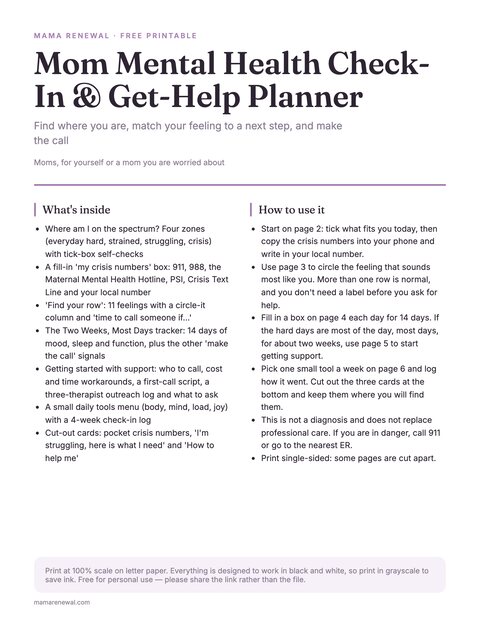
Free printable · 6 pages
Mom Mental Health Check-In & Get-Help Planner
A spectrum self-check with a fill-in crisis numbers box, an 11-feeling decision table, a two-week mood, sleep and function tracker, a first-call planner with script and outreach log, a small daily tools menu with a 4-week check-in, and cut-out cards for your pocket, your partner and your friends.
Free. Your download link appears right here. You'll also join the Mama Reset. Unsubscribe anytime. Privacy
If you’ve ever been on that floor, this page is for you. It’s a map of the common ups and downs of motherhood, a table that matches what you’re feeling to a next step, and clear signs it’s time to get professional help. If you need help right now, the crisis numbers are in the “If You Need Help Right Now” section just below, before anything else.
I’m a mom writing for moms, not a clinician. Nothing here is a diagnosis or a replacement for care.
In this article (19 sections)
- If You Need Help Right Now
- Why Mom Mental Health Deserves Its Own Conversation
- The Spectrum: From Hard Days to Real Support Needs
- The Decision Guide: What You’re Feeling, What It Might Be, and When to Get Help
- The “Two Weeks, Most Days” Rule of Thumb
- Anxiety: The Mom Brain That Won’t Switch Off
- Burnout: When Tired Becomes Something Deeper
- Rage: The Feeling Nobody Warns You About
- Loneliness: Surrounded and Still Alone
- Identity: “Who Am I Now?”
- Therapy: What It Is, Who It’s For, and How to Actually Start
- Journaling: The Low-Barrier Support You Can Start Tonight
- Postpartum and Beyond: Perinatal Mood and Anxiety Disorders
- Everyday Tools for the In-Between Days
- Seasonal Mental Health: Why Fall and Winter Can Hit Hard
- How to Support a Mom You’re Worried About
- A Gentle Plan for This Week
- Frequently Asked Questions
- You Don’t Have to Earn Your Way to Support
If You Need Help Right Now
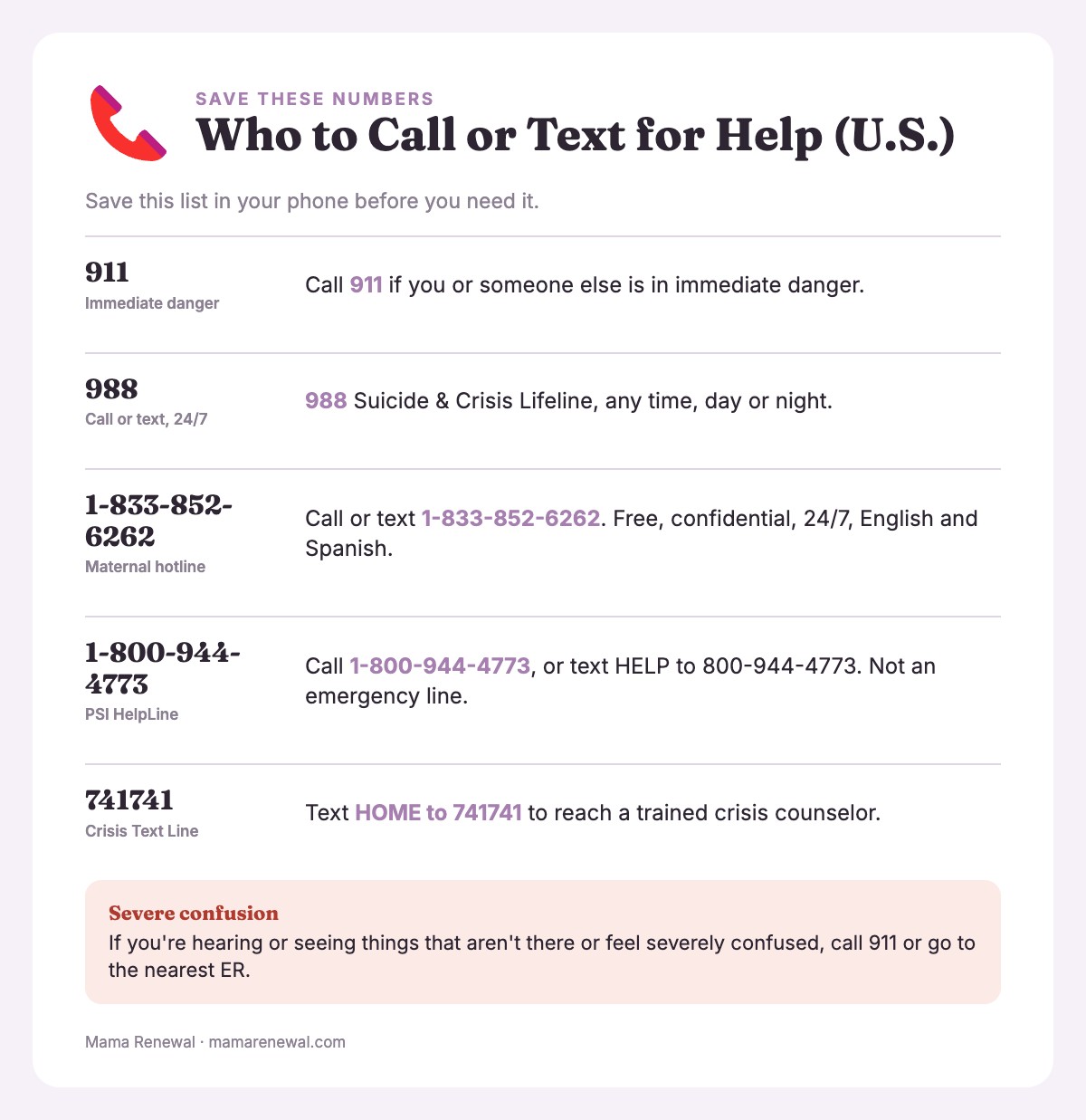
Safety firstIf you are in crisis, thinking about harming yourself or your baby, or feel unsafe, please don’t scroll further. Call 911 or go to the nearest ER if you’re in immediate danger, or if you’re hearing or seeing things that aren’t there or feel severely confused. Otherwise, reach out using the list below.
In the United States:
- Emergency: call 911 if you or someone else is in immediate danger.
- 988 Suicide & Crisis Lifeline: call or text 988, any time, day or night. You don’t have to be “suicidal enough” to call. If you are overwhelmed and can’t see a way through, that’s enough.
- National Maternal Mental Health Hotline: call or text 1-833-852-6262 (1-833-TLC-MAMA). Free, confidential, 24/7, available in English and Spanish, and staffed by people who understand pregnancy, postpartum, and parenting.
- Postpartum Support International (PSI) HelpLine: call 1-800-944-4773 (English and Spanish) or text HELP to 800-944-4773 (English) or text AYUDA to 971-203-7773 (Spanish). The HelpLine is not an emergency line, but a trained volunteer will return your message, listen without judgment, and connect you with local resources, support groups, and providers. PSI also runs free online peer support groups for moms.
- Crisis Text Line: text HOME to 741741 to reach a trained crisis counselor by text.
Outside the U.S.: search “crisis line” plus your country, or contact your local emergency number. Many countries have dedicated perinatal and parental mental health lines. Your doctor, midwife, or health visitor can also point you to one.
Please screenshot this list or save it in your phone’s notes. The best time to find a crisis number is before you need it.
You deserve support whether or not you ever need a crisis line. The rest of this page is about everything in between.
Why Mom Mental Health Deserves Its Own Conversation
We talk about baby sleep, picky eating, and screen time in endless detail. We talk much less about the person doing all of it. Yet your mental health is the load-bearing wall of your household. When it’s cracked, everything else gets harder: patience, decisions, connection, even the simple stuff like remembering whether you ate lunch.
Some honest context about why motherhood is so tough on mental health:
- The workload is enormous and mostly invisible. Tracking, planning, anticipating, remembering. Researchers call it cognitive labor, and it never clocks out.
- Your sleep gets fragmented for years. Not just the newborn months. Nightmares, potty trips, growth spurts, and school-night anxiety keep it going.
- Your identity shifts. You’re becoming someone new, and nobody throws a party for that part.
- Your support system often shrinks. Friends scatter into their own schedules, and the village is a lovely idea that rarely shows up with a casserole.
- Your hormones, body, and brain are all in flux. This is true during pregnancy and postpartum, but also during weaning, cycle changes, and perimenopause.
- The standard is impossible. Social media shows polished highlights, and we compare our messy middle to everyone else’s best moment.
None of that is a personal failing. It’s a recipe for struggle that any reasonable person would find hard. Understanding that is the first piece of relief: you are not broken, you are overloaded.
And still, sometimes it goes past overload into something that needs care. Knowing the difference is the whole point of this page.
The Spectrum: From Hard Days to Real Support Needs
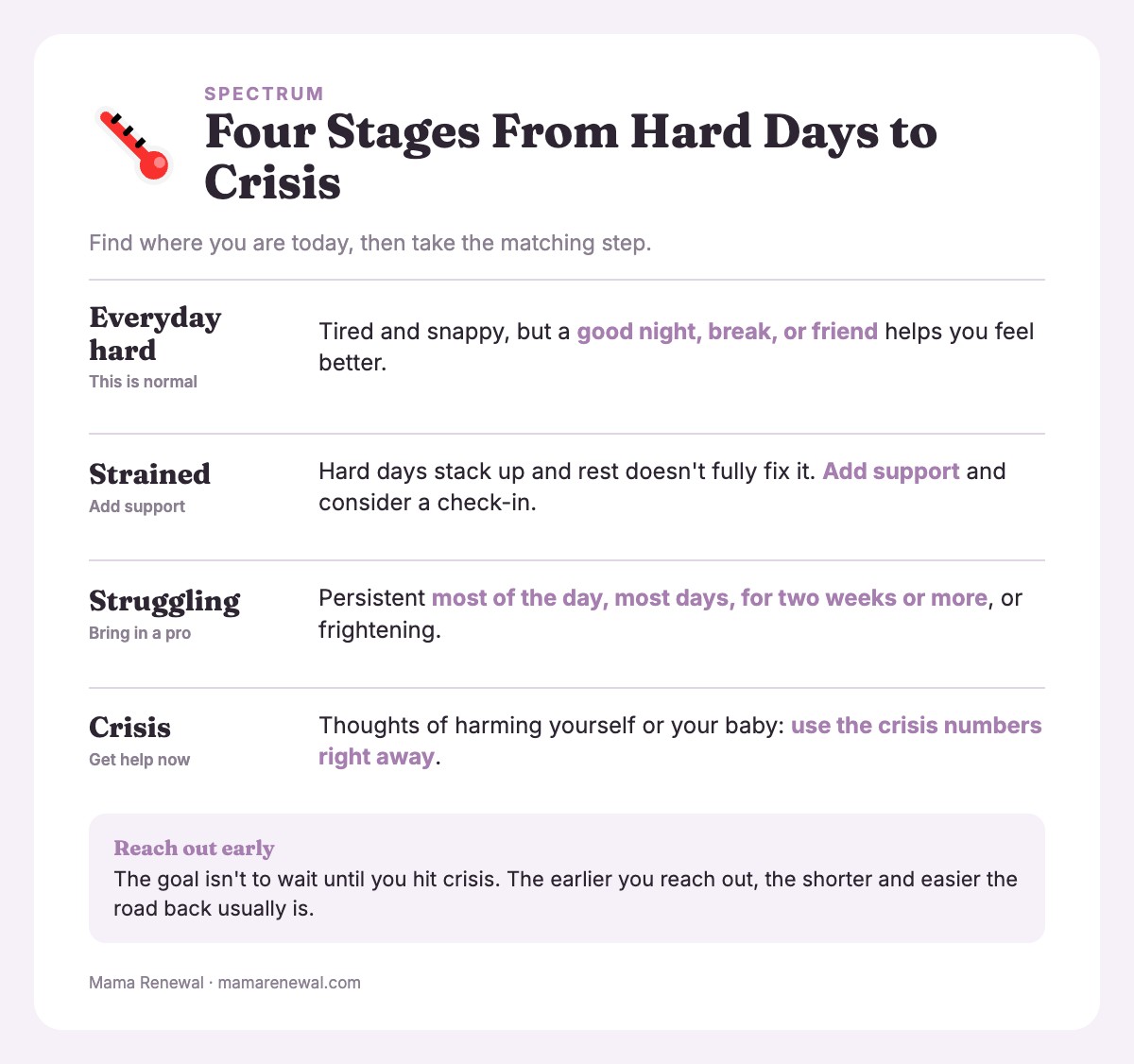
Mental health isn’t a switch between “fine” and “not fine.” It’s more like weather, and it moves along a spectrum. Here’s a simple way to picture it.
Everyday hard (this is normal)
You’re tired, snappy, a little teary at a commercial, short on patience by 4 p.m. You can still laugh at things. After a decent night of sleep, a break, or a good talk with a friend, you feel noticeably better. The hard feelings come and go, and they have an obvious trigger: a rough week, a sick kid, a deadline, a time change.
Strained (pay attention and add support)
The hard days are stacking up. You’re more irritable than you’d like, you dread certain parts of the day, and rest doesn’t fully fix it. You’re getting by, but it costs a lot. This is the zone where self-care, boundaries, and asking for help from your partner or family can really turn things around. It’s also a good time to consider a check-in with a professional, even if nothing feels like an emergency.
Struggling (time to bring in a professional)
Feelings are persistent (most of the day, most days, for two weeks or more), they’re interfering with daily life, or they’re frightening. You can’t sleep even when the baby sleeps, you can’t stop worrying, you feel numb or hopeless, or you’re having rage you can’t control. Self-care tips alone aren’t going to be enough here. You deserve real treatment, and it works.
Crisis (get help now)
Thoughts of harming yourself or your baby, feeling like your family would be better off without you, hearing or seeing things that aren’t there, severe confusion, or being unable to care for yourself or your child. Use the numbers at the top of this page right away. If you’re hearing or seeing things or severely confused, call 911 or go to the nearest ER.
The goal isn’t to wait until you hit crisis. It’s to notice early and respond early. The earlier you reach out, the shorter and easier the road back usually is.
The Decision Guide: What You’re Feeling, What It Might Be, and When to Get Help
This is the heart of the page. Find the feeling that sounds most like you, see the likely everyday cause, follow the link or topic for support, and check the last column to see when it’s time to bring in a professional.
| What you’re feeling | Likely everyday cause | What to read next | Time to seek professional support if… |
|---|---|---|---|
| Constant low-grade worry, racing thoughts at night | Sleep loss, a big transition, a busy season, caffeine, hormone shifts | Anxiety in Motherhood | Worry is nearly constant for two weeks or more, you have panic attacks, intrusive scary thoughts, or you can’t function or sleep even when you could |
| Exhausted in a way that sleep doesn’t fix, dreading the day | Long-term overload, no recovery time, the invisible workload | Mom Burnout Recovery and Toddler Mom Burnout | You feel hopeless, numb, or detached from your kids, or you’re thinking of escaping your life entirely |
| Snapping, yelling, feeling rage that shocks you | Depletion, sensory overload, unmet needs, too many demands at once | Dealing with Mom Rage and Anger Management for Moms | Rage feels out of control, you’ve hurt or are afraid you’ll hurt someone, or it comes with a sense of dread or intrusive images |
| Sad, flat, or tearful for days at a time | A rough patch, seasonal shifts, grief about a change | Fall journal prompts for moms | Sadness lasts two weeks or more, you’ve lost interest in things you used to enjoy, or you have thoughts of self-harm |
| Lonely even when surrounded by people | Few mom friends, a move, a baby-stage friendship gap | Making Mom Friends as an Adult | Loneliness is deepening into hopelessness, or you’re withdrawing from everyone |
| “I don’t know who I am anymore” | Matrescence, the identity shift of becoming a mother | Matrescence and the Identity Shift of Motherhood | You feel like you’ve disappeared, can’t feel anything, or the shift comes with persistent despair |
| Touched out, wanting to be left completely alone | Sensory overload from constant physical contact | Touched Out: What It Means | You feel disgusted by or disconnected from your child, or it’s affecting your relationships in a way you can’t repair |
| Replaying your birth experience, jumpy or tearful when reminded | Processing a hard or surprising delivery | 20 Journal Prompts for Processing Your Birth Story | Flashbacks, nightmares, avoiding anything related to the birth, or feeling constantly on edge (these can signal birth trauma or postpartum PTSD) |
| Not sleeping even when the baby does | Hypervigilance, a busy brain, a new-parent adjustment | Anxiety in Motherhood | You can’t sleep for several nights in a row, feel wired but exhausted, or notice racing thoughts and unusual energy |
| Overwhelmed by decisions, forgetful, scattered | The mental load, stress, sleep debt | The Mental Load for Exhausted Moms | Brain fog is severe, comes with sadness or hopelessness, or doesn’t improve with rest (it’s also worth a check on thyroid and iron with your doctor) |
| Guilty all the time, convinced you’re failing | Social comparison, perfectionism, impossible standards | Comparison and Social Media for Moms | Guilt is crushing, tied to feeling like a burden, or comes with thoughts that your family would be better off without you |
If more than one row sounds like you, that’s normal. These things overlap constantly, and a good professional will help you untangle them. You don’t need to figure out the label before you ask for help.
The “Two Weeks, Most Days” Rule of Thumb
If you remember only one thing from this page, make it this one. It’s a gentle, non-clinical rule that many providers echo:
If a difficult feeling lasts most of the day, most days, for about two weeks, or if it’s getting in the way of caring for yourself or your family, it’s time to talk to someone.
That doesn’t mean something is “wrong” with you. It means the feeling has outlasted its usual explanations, and you deserve more support than willpower and a bubble bath can provide.
A few other signals that mean “make the call”:
- You’ve stopped doing things you used to love, and you don’t miss them.
- You’re having trouble eating or you’re eating much more than usual.
- You’re sleeping far too much or far too little, apart from what the baby is causing.
- You’re drinking more than you’d like to cope, or you’re relying on other substances to get through the day.
- You feel like you can’t bond with your child, or you feel nothing.
- You’re afraid of your own thoughts.
- People who know you well have said they’re worried.
And one that matters: trust your gut. If something feels off, it’s okay to say so, even if you can’t name it and even if everyone else says you seem fine. Moms are experts at hiding it. “You seem great” is not a clinical assessment.
Anxiety: The Mom Brain That Won’t Switch Off
Anxiety is one of the most common mental health struggles moms face, and it rarely looks like what we picture. Often it’s not a dramatic panic attack. It’s the background hum: running through worst-case scenarios, checking the baby monitor six times, mentally rehearsing a conversation for the fifteenth time, and feeling a tight knot in your chest by midmorning.
Everyday worry is part of caring about a small person. It becomes a problem when it takes over. Signs worth noting:
- Worry that feels impossible to turn off, even when you know it’s out of proportion
- Physical symptoms: racing heart, shallow breathing, stomach trouble, tension headaches, trembling
- Intrusive thoughts, such as sudden vivid images of something bad happening to your baby. These are very common and are not a sign you want harm to happen. They’re a sign your protective brain is in overdrive. Still, if they’re frequent or distressing, tell a professional.
- Avoiding things (driving, leaving the house, being alone with the baby) because of fear
- Irritability and trouble concentrating
If this sounds familiar, our full guide to anxiety in motherhood walks through what’s going on in your body, grounding tools you can use in the moment, and what treatment can look like. The short version: anxiety is highly treatable, and you don’t have to white-knuckle it.
Burnout: When Tired Becomes Something Deeper
Burnout and ordinary tiredness are not the same thing. Tired is “I need a nap.” Burnout is “I need a different life, and I don’t know how to get one.”
Mom burnout tends to show up as:
- Emotional exhaustion that sleep doesn’t touch
- Cynicism or detachment (“whatever, I don’t care anymore”)
- A sense that nothing you do is enough
- Resentment toward the people you love most, followed immediately by guilt
- Physical symptoms: frequent illness, headaches, aches, a constant feeling of running on fumes
It can hit at any stage. Toddler years bring relentless physical demand, the school years bring the logistics and emotional management, and the baby stage brings the sleep deprivation. If you’re in the toddler trenches, Toddler Mom Burnout explains why those years can feel so relentless and what actually helps. And if you’re ready to start climbing out, the mom burnout recovery guide lays out a realistic, step-by-step path that doesn’t require you to quit your life.
Burnout isn’t a clinical diagnosis on its own, but it can sit right alongside depression and anxiety, and it can tip into them. If burnout comes with hopelessness, thoughts of escape, or numbness, treat that as a signal to call a professional, not as a character flaw.
Rage: The Feeling Nobody Warns You About
Let’s talk about the one that carries the most shame. Many moms are startled by how angry they get. The yelling that comes out of nowhere. The surge of fury over spilled milk. The urge to throw something or leave the room (or the house) immediately.
Here’s what’s helpful to know:
- Rage is often a sign of depletion, not of being a bad mother. When your tank is empty, the smallest thing becomes the last straw.
- It can be a symptom of other things. Anxiety, depression, hormonal shifts (including postpartum and perimenopause), ADHD, and unprocessed trauma can all show up as anger rather than sadness. For some women, postpartum depression shows up mainly as irritability or anger rather than tears.
- It’s workable. You can learn to notice the early warning signs, interrupt the escalation, and repair afterward.
Some things that help in the moment: first make sure your child is somewhere safe (crib, playpen, or with another adult), then step away for sixty seconds to breathe. Run cold water over your hands or drink a glass. Lower your voice rather than raising it, and name it out loud (“I’m feeling really angry; I need a minute”). If you feel you might hurt your child, put them down safely in a crib or playpen, step away, and call someone: a partner, a friend, the 988 line, or the PSI HelpLine. If you feel you might act on it, call 911.
Some things that help longer term: regular sleep (as much as you can), regular meals, moving your body, reducing the invisible load, and getting support.
When to get professional help for rage: if it feels out of control, or if it’s your main emotion most days. Also reach out if it comes with dread or intrusive images. The same goes if you’ve been physically rough with your child or partner, or you’re scared you might be.
Please reach out. This is common and it’s treatable.
Most therapists respond with support, not judgment, and having rage or scary thoughts is not, by itself, a reason to lose your children. If you’re worried, ask about confidentiality limits before you share details. Our guides on dealing with mom rage and anger management for moms go deeper on both the in-the-moment tools and the longer-term picture.
Loneliness: Surrounded and Still Alone
Motherhood can be one of the loneliest seasons of life, precisely because you’re never physically alone. You can spend a whole day with people who need you and not have one adult conversation. You can be in a room full of parents at a playground and feel invisible.
Loneliness matters for mental health. Long-term isolation is linked with higher rates of depression and anxiety, and it makes everything else feel heavier. A few ways to chip away at it without needing to become a social butterfly:
- Lower the bar. A friendship doesn’t have to start with a coffee date. It can start with a text after a playgroup: “Fun chatting today. Want to meet at the park Thursday?”
- Repeat exposure. Friends are usually made through the same people, same place, same time, again and again. Pick one recurring thing (library story time, a Saturday class) and keep showing up.
- Try online and then offline. Local mom groups, PSI’s free online support groups, and neighborhood apps are good starting points. The goal is to move from scrolling to saying hi in person.
- Rekindle old friends. Voice memos are a great tool when you can’t coordinate schedules. You can send one while the dinner cooks.
- Say the real thing. “I’m having a rough month” opens more doors than “I’m good, busy!”
Our guide to making mom friends as an adult breaks down why it’s so hard and offers scripts that don’t feel awkward.
If loneliness has settled into persistent sadness or hopelessness, or if you notice yourself pulling away from the people you do have, that’s a good moment to bring in a therapist. They can help with the loneliness and with what’s making connection feel impossible.
Identity: “Who Am I Now?”
There’s a name for the identity upheaval of becoming a mother: matrescence. Like adolescence, it’s a developmental transition with big physical, emotional, social, and hormonal changes. Unlike adolescence, nobody prepares you for it or acknowledges it.
You might notice:
- Grief for your old life, even though you love your child
- Feeling like a stranger in your own body, mind, or marriage
- Losing touch with what you like, what you want, or what you’re good at
- Ambivalence about work, whether you’re going back, staying home, or somewhere in between
- Feeling both deeply in love and deeply unrecognizable
This is a normal part of becoming a mother, and it doesn’t mean you’re ungrateful. Giving it words helps. So does small, regular contact with the person you were before and are becoming: a hobby, a solo walk, a friend who knew you before kids, a creative project, an old playlist.
If the identity shift is accompanied by numbness, persistent despair, or a feeling that you’ve vanished, bring that to a professional. Therapy can be an excellent place to meet the new version of yourself with support. Our guide to matrescence is a good place to start if you’re in this one.
Therapy: What It Is, Who It’s For, and How to Actually Start
Therapy isn’t only for crisis. It’s for anyone who wants support working through something, and moms are among the people who benefit most, because we spend so much time giving and so little time being tended to.
Common objections, answered kindly:
- “I don’t have time.” Many therapists offer telehealth, evening, and weekend hours. A 50-minute session from your parked car or the bedroom with the door locked still counts.
- “I can’t afford it.” Options include sliding-scale therapists, community mental health centers, university training clinics, employee assistance programs (EAPs) that offer free sessions, and PSI’s free support groups. Ask about all of them.
- “Other people have it worse.” Pain isn’t a competition. You can be grateful and struggling at the same time.
- “I don’t even know what I’d say.” “I’m exhausted and I don’t feel like myself” is a perfectly good opening line.
- “Will they judge me or take my kids?” Therapists are there to support you. Having hard feelings, even scary ones, is not by itself grounds for losing your children (see the confidentiality note below). Telling someone about intrusive thoughts is a sign of insight, not danger.
Good to knowWhat you share with a therapist is generally private. The limits are suspected child abuse or neglect and imminent danger to yourself or someone else, where providers must act. Their first aim is usually to connect families with support. Ask up front, “How do you handle confidentiality?”
Types of support to know about
| Who | What they do | Good first stop when |
|---|---|---|
| Therapist or counselor (LCSW, LPC, LMFT, psychologist) | Talk therapy such as CBT (cognitive behavioral therapy) or interpersonal therapy, both well studied for anxiety and depression, including postpartum | You want regular support working through feelings |
| Psychiatrist or psychiatric nurse practitioner | Evaluates and can prescribe medication when it’s appropriate | You want a medication conversation |
| Primary care provider or OB/midwife | Screens for postpartum depression and anxiety, checks for physical contributors like thyroid issues or anemia, and refers you onward | You don’t know where to start |
| Perinatal mental health specialist | Has extra training in pregnancy and postpartum; PSI’s directory can help you find one | Symptoms began in pregnancy or after birth |
| Support group | Peer-led or professionally facilitated; many moms say it helps them feel normal for the first time in months | You feel isolated or can’t start therapy yet |
About medication: it’s one tool, not a moral choice. For many moms it makes the difference between surviving and living, and there are options that are compatible with breastfeeding. That’s a conversation to have with a prescriber who knows your situation. Never start or stop a medication on your own.
If you want the practical nuts and bolts, our guide to finding a therapist as a busy mom walks you through it step by step. It covers how to search, what to ask on the first call, and how to fit it into an overbooked life.
A script for your first call or message
If staring at a blank email is the barrier, copy this:
“Hi, I’m a mom of [ages] and I’ve been feeling [anxious / overwhelmed / really low / angry] for the past [few weeks]. It’s starting to affect my daily life. I’m looking for support and wanted to ask if you’re accepting new clients, what your availability looks like, and whether you offer telehealth. I’d also love to know your fees or whether you take [insurance]. Thank you.”
Send it to three therapists at once. Not everyone will have openings, and that’s normal. It isn’t a reflection on you.
Journaling: The Low-Barrier Support You Can Start Tonight

Journaling is not a substitute for therapy, but it’s a lovely companion to it, and it’s a good option when you’re in the “strained” zone and want something you can do for free in five minutes.
Why it helps: putting swirling thoughts on paper gives them edges. It makes the unnamed nameable, helps you notice patterns (every Sunday evening you spiral, every time your mother-in-law visits you feel small), and gives you a private place to say the true thing.
You don’t need to be a writer, and you don’t need a beautiful notebook. Try:
- A three-line check-in: How am I, really? What’s one thing weighing on me? What’s one small kindness I can offer myself today?
- A brain dump: set a timer for five minutes and write everything, unedited, then close the notebook.
- A prompt list. If a blank page feels intimidating, prompts are a gift. Our 30 fall journal prompts for moms are gentle, season-aware starting points. And if your heart is still carrying a hard delivery, 20 journal prompts for processing your birth story can help you work through it at your own pace.
A caution: if journaling stirs up overwhelming memories or emotions, or you find yourself ruminating without relief, take it to a therapist. Writing is meant to help you process, not to leave you stuck in the worst of it.
Postpartum and Beyond: Perinatal Mood and Anxiety Disorders
Many people think “postpartum depression” is the only postpartum mental health condition, and that it only shows up in the first weeks. In reality, there’s a whole family of perinatal mood and anxiety disorders (PMADs), and they can begin during pregnancy or any time in the first year or longer after birth.
They include:
- Depression: persistent sadness, emptiness, hopelessness, guilt, changes in appetite and sleep, loss of interest, trouble bonding.
- Anxiety: constant worry, restlessness, panic attacks, physical tension.
- OCD (obsessive-compulsive disorder): intrusive, upsetting thoughts and repetitive behaviors meant to reduce them (like checking or cleaning). The thoughts are unwanted, and moms with perinatal OCD are typically horrified by them and very unlikely to act on them.
- PTSD: following a traumatic birth or event, with flashbacks, nightmares, and avoidance.
- Bipolar mood disorders: including episodes of unusually elevated mood, decreased need for sleep, racing thoughts, and impulsive behavior.
- Postpartum psychosis: rare but serious. Symptoms include confusion, hallucinations, delusions, extreme agitation, and severely disrupted sleep, usually in the first days or weeks after birth. It’s a medical emergency. Call 911 or go to the nearest emergency room.
Important to know: dads and non-birthing partners can experience perinatal mood disorders too. Adoptive parents and parents who’ve experienced pregnancy loss are also at risk. If you’re reading this for someone else, the same guidance applies.
Treatment works. Most moms improve with treatment, though it can take time and sometimes more than one approach. The most important step is the first one, which is telling someone.
Everyday Tools for the In-Between Days

Not every difficult day needs a professional, and not every one will. For the “everyday hard” and “strained” zones, small and repeatable beats big and heroic. Here’s a menu. Pick one, not all of them.
Body basics (the unglamorous foundation)
- Sleep: protect it where you can. Trade nights with a partner, go to bed thirty minutes earlier, and cut the late-night phone spiral if you can. (Doom scrolling is a real sleep thief; see our guide to stopping doom scrolling.)
- Food: regular meals help keep your energy steady. Our protein guide for moms covers easy ways to get enough.
- Light and movement: ten minutes of outdoor daylight and a short walk can shift mood. In the darker months, seasonal dips are real, so talk to your doctor about vitamin D if you’re feeling the fall slump.
- Gut and hormones: physical health and mood are linked. If you’ve felt “off” for a while, ask your provider about thyroid, iron, B12, and vitamin D.
Mind basics
- Name it to tame it. Saying “this is anxiety” or “this is exhaustion talking” creates a little distance.
- Box breathing: inhale for four, hold for four, exhale for four, hold for four. Repeat four times.
- Five-four-three-two-one grounding: name five things you see, four you can touch, three you hear, two you smell, one you taste.
- The “good enough” rule: if a task is 80% done and the world won’t end, it’s done.
Load basics
Much of mom mental health trouble is actually a workload problem wearing an emotional costume. Look at what’s on your plate:
- Do a quick audit of the invisible work. Writing it all down is eye-opening, especially to share with a partner. Our invisible labor checklist and mental load guide can help.
- Practice saying no. Scripts for saying no can make it easier.
- Hand off something this week, even if they do it “wrong.”
Joy basics
Mental health isn’t only about reducing the bad. It’s also about letting in the good.
- If bubble-bath self-care makes you roll your eyes, you’re in good company. There are plenty of self-care ideas beyond bubble baths.
- Use naptime for something that fills you up rather than only chores. (Our guide to self-care during naptime can help you decide what that looks like.)
- Habit stack: attach a small kindness to something you already do, like stretching while the coffee brews. See our guide on habit stacking for moms.
- Take the self-care style quiz to find what actually works for you instead of what Instagram says should.
None of these are cures. They’re ways of making each day a little more livable while you figure out the bigger things.
Seasonal Mental Health: Why Fall and Winter Can Hit Hard
As the days shorten each fall, many of us feel the shift. Shorter days, the clocks changing, school routines in full swing, and the holiday calendar looming can all weigh on mood and energy.
Things that tend to help this time of year:
- Get light early. Even a gray-day walk outside in the morning helps your body clock.
- Lower holiday expectations before they build. Decide now what you’ll skip, what you’ll keep, and what you’ll say no to. If grandparents tend to go overboard on gifts, or you’re facing a first Christmas with a newborn, planning your boundaries ahead of time saves you from resentment later.
- Reset your sleep after the time change. The week after clocks shift is rough for babies, toddlers, and moms alike. Be extra gentle with yourself.
- Keep one small ritual. A warm drink, a nightly two-minute journal, a short stretch. Rituals are anchors when everything else is moving.
If you notice a pattern of low mood every fall or winter, with oversleeping, cravings, and withdrawal, let your provider know. Seasonal affective disorder is real and treatable. Options include light therapy, talk therapy, and medication, so ask your provider what fits.
How to Support a Mom You’re Worried About
Maybe you’re not reading this for yourself. Maybe you’re a partner, friend, sister, or mother watching someone you love struggle. Here’s how to help:
- Lead with love, not diagnosis. “I’ve noticed you seem exhausted lately, and I’m here for you” lands better than “I think you have PPD.”
- Ask open questions and listen. “How are you really doing?” and then wait.
- Offer specific help. “I’ll take the baby for two hours Saturday morning” beats “let me know if you need anything.”
- Offer to make the call or sit with her while she does. Booking the first appointment is often the biggest hurdle.
- Take every mention of self-harm seriously. Stay with her, remove access to means if you can, and call 988 or 911.
- Look after yourself too. Supporting someone through a hard time is draining.
A Gentle Plan for This Week
If you’ve read this far and aren’t sure what to do next, here’s a simple plan. It’s meant to be small enough to actually happen.
- Save the crisis numbers from the top of this page in your phone.
- Find your row in the decision guide and read the linked post.
- Do the two-week check: has this been most of the day, most days, for two weeks or more? If yes, book an appointment with your doctor or a therapist. If you’re not sure, text a friend and ask what they’ve noticed.
- Pick one tiny daily practice: a three-line journal, a ten-minute walk, a regular breakfast.
- Ask for one concrete piece of help from someone in your life.
- Tell one person the truth about how you’re doing.
That’s it. You don’t have to fix everything this week. You only have to take the next small, kind step.
Frequently Asked Questions
How do I know if my feelings are “normal” mom stress or something more serious?
A helpful rule of thumb: if a difficult feeling lasts most of the day, most days, for about two weeks, it’s time to talk to a professional. The same goes if it’s interfering with your ability to function, care for yourself, or enjoy your life. Other flags include thoughts of harming yourself or your baby, panic attacks, severe trouble sleeping when you have the chance, feeling numb or hopeless, or being scared of your own thoughts. When in doubt, reach out. A professional can help you sort it out, and no one will think you’re overreacting for asking.
Is it normal to have scary or intrusive thoughts about my baby getting hurt?
Yes, it’s very common. Research suggests intrusive thoughts are very common among new parents, such as images of dropping the baby or something terrible happening. These thoughts are usually a sign of an anxious, protective brain in overdrive, not a sign that you want harm to happen. Still, if they’re frequent, distressing, or make you avoid caring for your child, tell your provider or call the PSI HelpLine at 1-800-944-4773. They are treatable, and you will not be judged. If you ever feel like you might act on thoughts of harming yourself or your child, call 988 or 911 right away.
Do I have to be postpartum to get help from Postpartum Support International?
PSI focuses on pregnancy and postpartum mental health, but their resources are broader than many people realize. The HelpLine (1-800-944-4773) offers listening, information, and referrals, and their free online support groups serve parents in many circumstances. Postpartum can last well beyond the first few months, and many moms reach out a year or more after birth. If you’re not sure whether you “qualify,” call or text anyway. The worst case is that they point you to a better-fit resource. You can also call or text the National Maternal Mental Health Hotline at 1-833-852-6262.
Will a therapist or doctor take my children away if I tell them how bad things are?
This is one of the most common fears, and it keeps many moms silent. Having depression, anxiety, rage, or even scary thoughts is not, by itself, grounds for losing your children, and reaching out for help is a sign of being a responsible parent. Confidentiality does have limits: providers must act if they suspect child abuse or neglect, or if someone is in imminent danger. Their first aim is usually to connect families with support, and most moms who disclose depression, anxiety, rage, or intrusive thoughts are not separated from their children. Ask up front, “Can you tell me how you handle confidentiality?” A good provider will answer plainly.
I can’t afford therapy and have no time. What are my options?
You have more options than you might think. Look into sliding-scale therapists, community mental health centers, university training clinics (supervised graduate students, often low cost), and your employer’s Employee Assistance Program, which often includes several free sessions.
Telehealth can cut down on travel and childcare needs. Free peer support groups, including PSI’s online groups, can be a lifeline in the meantime.
Your OB or midwife can also be a low-cost starting point, since screening for postpartum depression and anxiety is often part of a routine visit. They know local resources too. Our guide to finding a therapist as a busy mom walks through budget and schedule workarounds in detail.
Can mom burnout and depression exist at the same time?
Yes. Burnout is typically tied to prolonged overload and shows up as exhaustion, detachment, and feeling ineffective. Depression is a mood condition that can include persistent sadness, loss of interest, changes in sleep and appetite, and hopelessness. They overlap a lot, and long-term burnout can tip into depression. The difference matters because the solutions differ: burnout often needs a lighter load and more recovery, while depression often benefits from professional treatment. If you’re not sure which one you’re dealing with, a provider can help you sort it out, and it’s okay if it turns out to be a bit of both.
What if I’m not in the U.S.? Where do I turn?
Many countries have their own crisis lines and perinatal mental health services. Search for “crisis line” plus your country, or call your local emergency number if you’re in immediate danger. Your doctor, midwife, health visitor, or local public health service can usually point you to specialized perinatal support. Postpartum Support International lists some international resources and runs online groups, so check their website for what’s available near you.
You Don’t Have to Earn Your Way to Support
If there’s one thing I wish someone had said to me on that bathroom floor, it’s this: you don’t have to wait until it’s bad enough. You don’t have to be falling apart to deserve help, and you don’t have to prove your exhaustion to anyone. Needing support is not a verdict on your mothering. It’s evidence that you’ve been carrying a lot, for a long time, mostly alone.
Start small. Find your row in the table, read the one post that fits, text one person the truth, and save the numbers at the top of this page. If the weight doesn’t lift, make the call. You are worth the care you give so freely to everyone else.