
Toddler Mom Burnout: Why These Years Feel So Relentless
Understand why toddler years are relentless and lead to burnout, not personal flaws. This article helps you identify signs and triggers, offering tools for coping and recovery.
- Recognize that toddler mom burnout is real and not your fault.
- Learn to identify the specific signs and triggers of your burnout.
- Access tools like a self-check and trigger table for recovery.
- Explore a recovery planner with coping actions and a 4-layer plan.
It was 4:47 on a Tuesday when I found myself in the pantry, door pulled almost shut, eating dry cereal out of the box. Not because I was hungry. Because it was the only place in the house where nobody was asking me for anything.
On the other side of the door, my two-year-old was screaming that his banana was broken. (It had simply been peeled the wrong way, which is a far more serious crime.)
I stood there in the dark with a Cheerio stuck to my thumb and thought: I love these people more than my own life, and I cannot do this for one more minute.
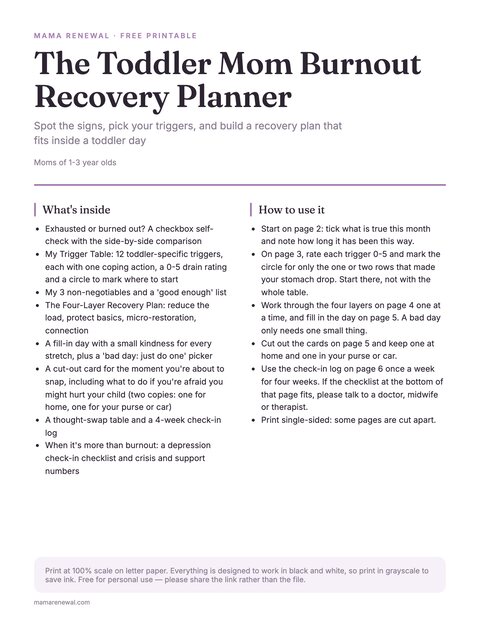
Free printable · 6 pages
The Toddler Mom Burnout Recovery Planner
A self-check for exhausted vs. burned out, a 12-trigger table with one coping action each, a four-layer recovery plan, a day that includes you, an anger-in-the-moment cut-out card, a thought-swap table, a 4-week check-in log, and a when-to-get-help checklist with 988 and Postpartum Support International numbers.
Free. Your download link appears right here. You'll also join the Mama Reset. Unsubscribe anytime. Privacy
Toddler mom burnout is real, and it comes mostly from the stage, not from some flaw in you. Here’s why these years exhaust moms, the signs, 12 triggers with one fix each, a recovery plan, and when to talk to a doctor.
In this article (11 sections)
- Why the Toddler Years Feel So Relentless
- What Toddler Mom Burnout Actually Looks Like
- Toddler-Specific Burnout Triggers (and One Thing You Can Do About Each)
- How to Protect Your Sleep With a Toddler
- When Burnout Feels Like Anger
- Burnout, Depression, or Both? A Gentle Check-In
- How to Recover From Toddler Mom Burnout
- A Sample Day That Includes You
- The Mindset Shift That Makes It Lighter
- Frequently Asked Questions
- You’re Not Failing, You’re Fully Occupied
Why the Toddler Years Feel So Relentless
Newborn exhaustion has a clear story: you’re up at night, your body is recovering, everyone expects you to be wrecked. People bring casseroles. The toddler years have no such story. You’re supposed to be “past the hard part.” You’re sleeping (sometimes). The baby is walking and talking and, honestly, adorable. So when you’re more depleted than you were in the newborn haze, it feels like a personal failing.
It isn’t. Here is what is actually happening.
Toddlers combine three things that rarely come together
- Constant physical vigilance. A newborn needs you, but a newborn stays where you put them. A toddler climbs, runs toward parking lots, eats things off the floor, and discovers the stairs. Your nervous system is on low-grade lookout duty from wake-up to bedtime, and that kind of sustained alertness is tiring in itself, even when nothing goes wrong.
- Nonstop emotional demand. Toddlers have enormous feelings and almost no ability to regulate them. You are the regulation. Every meltdown asks you to stay calm while someone else is falling apart, and you do that dozens of times a day.
- Zero predictability. Naps shift. Appetite vanishes. Potty training starts and stalls. Just when you learn the rhythm, the rhythm changes. You never get to coast.
The work is invisible and endless
Nothing you do in a toddler day produces a finished product. You make lunch; it is eaten, or thrown, and then you make another. You tidy the living room; it is undone in ninety seconds. Occupational psychologists call this kind of mismatch effort-reward imbalance, and many parents will recognize it. The effort is enormous, the feedback is a person who says “NO” and lies down on the grocery store floor.
You are rarely off, even when you’re “off”
Even during nap time or after bedtime, part of your brain is still listening for a cough, planning tomorrow’s snacks, or remembering that the library books are due. This is the mental load, and it doesn’t clock out. If that sounds familiar, The Mental Load: Why Moms Feel Exhausted Even When Everyone ‘Helps’ goes deep on why.
What Toddler Mom Burnout Actually Looks Like

Burnout rarely arrives as one dramatic collapse. It shows up as a slow narrowing. You can usually spot it in four areas.
Physical signs
- Tired in a way sleep doesn’t fix
- Headaches, tight shoulders, a clenched jaw
- Getting sick more often
- Craving sugar and caffeine just to function
Emotional signs
- Snapping at small things, then feeling awful
- Numbness, or feeling like you’re going through the motions
- Dreading the hours between 4 and 7 p.m.
- Crying in the car, the shower, or the pantry
Mental signs
- Forgetting words, appointments, why you walked into the room
- Difficulty making even tiny decisions (what’s for dinner becomes unbearable)
- Feeling like you’re failing at everything at once
Relational signs
- Resenting your partner, or your friends who “get to” do things
- Pulling away from people because talking takes too much energy
- Feeling touched out and wanting to be left alone, which then brings guilt
That last one is so common it deserves its own conversation. If your skin crawls when one more small hand grabs you, Touched Out: What It Means When You Can’t Stand to Be Touched Anymore is worth a read.
Exhausted toddler mom vs. burnt-out toddler mom
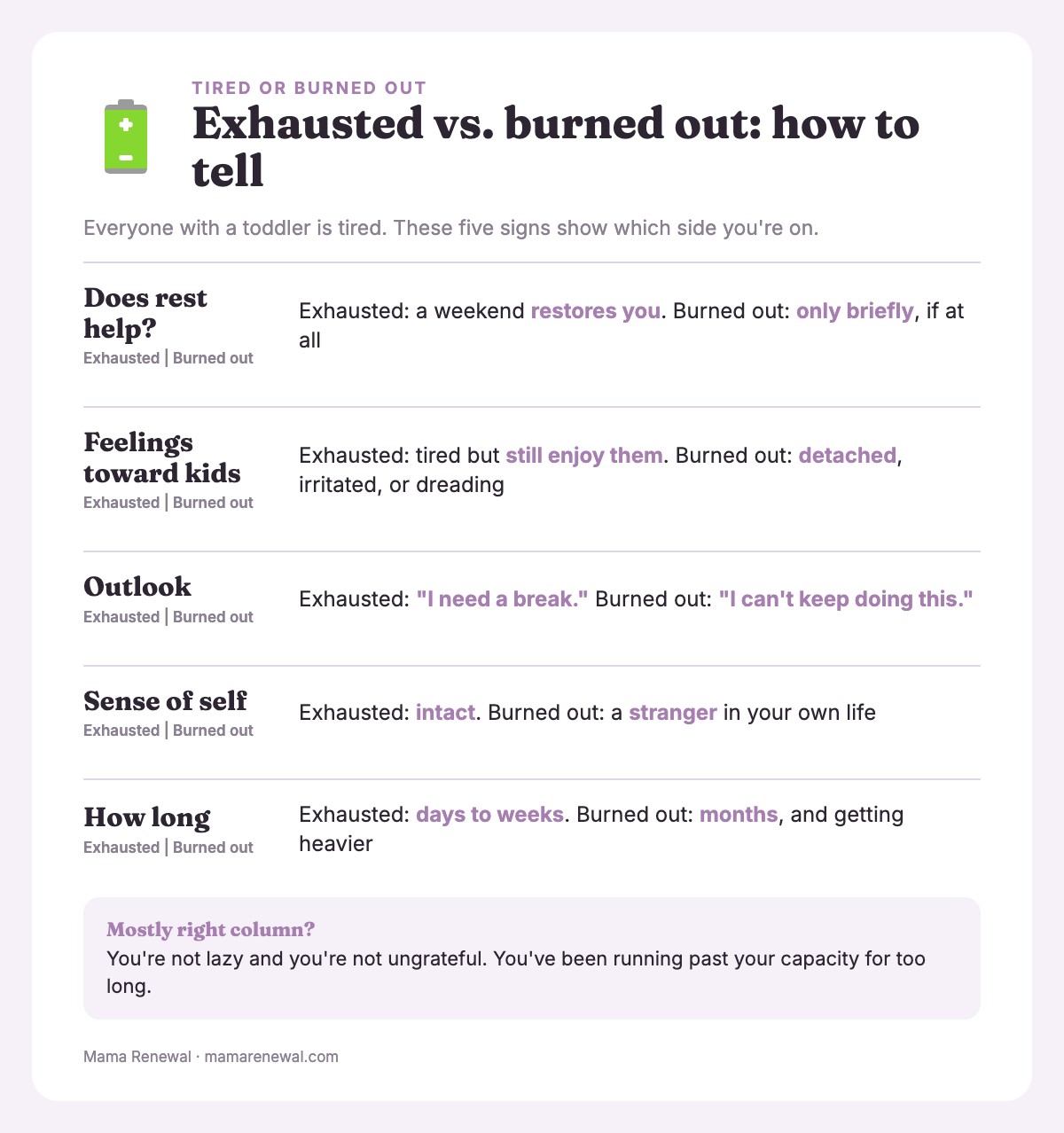
Everyone with a toddler is tired. So what’s the difference?
| Exhausted | Burned out | |
|---|---|---|
| Rest helps | Yes, a good weekend or a few nights of sleep restores you | Only briefly, if at all |
| Feelings toward kids | Tired, but still enjoy them | Detached, irritated, or dreading them |
| Outlook | “I need a break” | “I can’t keep doing this” |
| Sense of self | Intact | Feeling like a stranger in your own life |
| Duration | Days to weeks | Months, and getting heavier |
If you’re mostly in the right-hand column, you’re not lazy and you’re not ungrateful. You’ve been running past your capacity for too long.
Toddler-Specific Burnout Triggers (and One Thing You Can Do About Each)
Generic advice like “practice self-care” falls flat because it ignores what is actually draining you. Here are common triggers, each paired with one small, realistic coping action.
| Burnout trigger | Why it drains you | One coping action |
|---|---|---|
| Broken or fragmented sleep | Night wakings, early risers, and 5 a.m. wake-ups chip away at your reserves nightly | Aim for at least two nights a week where your partner or a support person handles all night wakings, so you get a protected block of sleep (ideally 6-8 hours). If you’re nursing at night or parenting solo, see the FAQ on having no partner nearby |
| Meltdowns and tantrums | You absorb big emotions all day while staying regulated | Use a one-line script (“I’m here. I won’t leave.”) and take three slow breaths before responding, so you aren’t reacting from adrenaline |
| Picky eating and food refusal | Every meal becomes a negotiation you can’t win | Serve at least one food your toddler reliably accepts at every meal and drop the pressure to get them to eat. Your job is to offer, theirs is to eat |
| Constant touch and noise | Sensory overload leaves you touched out by midday | Build a 5-minute sensory reset: step outside, face a wall or window, and let your body have no input |
| No uninterrupted thought | Being interrupted dozens of times an hour makes concentration impossible | Keep one “parking lot” note on your phone for half-formed thoughts so your brain stops trying to hold them |
| The 4-7 p.m. witching hour | Everyone is hungry, tired, and fried, including you | Simplify dinner to a default menu of three meals on rotation, and stop expecting yourself to cook creatively |
| Potty training and regression | Constant monitoring, laundry, and the feeling of going backward | Set a “good enough” date to pause and revisit in a month if it isn’t clicking. Stopping is allowed |
| Isolation | Days with no adult conversation | Schedule one recurring thing, a weekly park meetup or a standing phone call, so it doesn’t depend on your energy |
| Loss of identity | You’re “Mom” to everyone and nobody asks about you | Spend 10 minutes a day on something that was yours before kids, even badly |
| Unequal household load | You are the default parent, the one who knows where everything is | Hand over one entire task (not a piece of it) to your partner or a family member, including the planning and remembering. For example, all of dinner: deciding, shopping, and cooking |
| Guilt about screens, snacks, and “not enough” | Self-judgment stacks on top of the workload | Write down your three non-negotiables as a parent and let everything else be “good enough” |
| Seasonal and schedule disruptions | Time changes, holidays, and weather wreck routines | Before a time change or holiday, pick one routine to protect (like bedtime), let the rest slide, and tell your partner now |
TipDon’t try to fix the whole table. Choose the one or two rows that made your stomach drop when you read them, and start there. The free Toddler Mom Burnout Recovery Planner below walks you through it.
How to Protect Your Sleep With a Toddler
Sleep deprivation amplifies every other burnout trigger. Your patience, memory, mood, and ability to handle frustration all take a hit. And toddler sleep is notoriously unreliable: night terrors, separation anxiety, dropped naps, early wake-ups, and the occasional stomach bug.
You may not be able to fix your toddler’s sleep this month. But you can protect your own.
- Trade nights. If you have a partner, split the night shift so you each get at least two nights a week with all night wakings handled by someone else. If you’re nursing at night or parenting solo, see the FAQ below on having no partner nearby.
- Move your bedtime earlier than feels reasonable. The “revenge bedtime procrastination” pull, staying up for a sliver of me-time, is understandable, but a tired mom trading sleep for scrolling often pays for it the next afternoon. If late-night scrolling is your thing, How to Stop Doom Scrolling: A Mom’s Guide to Breaking the Late-Night Phone Habit has practical ways to loosen its grip.
- Plan for clock changes. The fall time change hits toddler households hard. The Daylight Saving Time Sleep Schedule Chart for Moms and Toddlers walks through how to ease everyone into it.
- Lower the bar on weekends. A nap on the couch while a show plays is not a failure. It’s maintenance.
When Burnout Feels Like Anger
Many mothers describe the scariest part of burnout as the temper, not the tiredness. The shout that comes out of nowhere. The slammed cabinet. The moment you look at your small, wide-eyed child and feel ashamed of how big your voice just got.
This is extremely common, and it’s a signal, not a character flaw. When you’re depleted, patience and self-control get harder to reach. You have less buffer, so ordinary toddler behavior lands like an attack.
A few things that help in the moment:
- Name it out loud. “I’m feeling really frustrated. I need a minute.” Younger toddlers may not follow every word, but they absorb your tone and the pattern.
- Make your child safe and step away. A toddler-proofed room or a playpen for 60 seconds is a legitimate reset.
- Cold water or a long exhale. Splash your wrists or breathe out slower than you breathe in. It nudges your body out of fight-or-flight.
- Repair afterward. “I yelled, and that wasn’t okay. I’m sorry. I love you.” Repair teaches more than perfection ever could.
Safety firstIf you are ever afraid you might hurt your child, put them down in a safe place and step out of reach. Then call someone right away: a partner, a friend, the Childhelp National Child Abuse Hotline (1-800-422-4453), or 988. If anyone is in immediate danger, call 911.
If rage is a regular visitor, read dealing with mom rage and Mom Rage: What It Really Means When Motherhood Makes You Snap for a closer look at what’s underneath it.
Burnout, Depression, or Both? A Gentle Check-In
I’m not a clinician, and nothing here replaces one. But there’s something important to say plainly, because so many mothers miss it.
Good to knowConstant irritability or a sense of dread during the toddler years can be burnout, and it can also be depression. The two overlap a lot, and from the inside they can feel nearly identical. Both can look like exhaustion, short temper, numbness, and loss of joy. Depression and anxiety don’t only show up in the newborn months. They can arrive or linger well into toddlerhood.
Consider checking in with a doctor, midwife, or therapist if:
- Irritability, sadness, or dread has lasted more than a couple of weeks and isn’t lifting
- You’ve lost interest in things you used to enjoy
- You feel worthless, hopeless, or like your family would be better off without you
- You’re having trouble eating, sleeping when you have the chance, or getting through basic tasks
- You feel constantly on edge, or have racing thoughts or panic
- The feelings are getting in the way of how you take care of yourself or your kids
Safety firstIf you ever have thoughts of harming yourself or feel like you can’t keep yourself safe, please reach out right away. For immediate danger, call 911. For crisis support, call or text 988. For non-emergency support and referrals, Postpartum Support International’s HelpLine (1-800-944-4773, call or text) can connect you to help.
Reaching out is not an admission that you’re failing. It’s the same thing you’d tell a friend to do. And if it turns out to be “just” burnout, you’ll still have gotten support, and that’s never wasted.
How to Recover From Toddler Mom Burnout
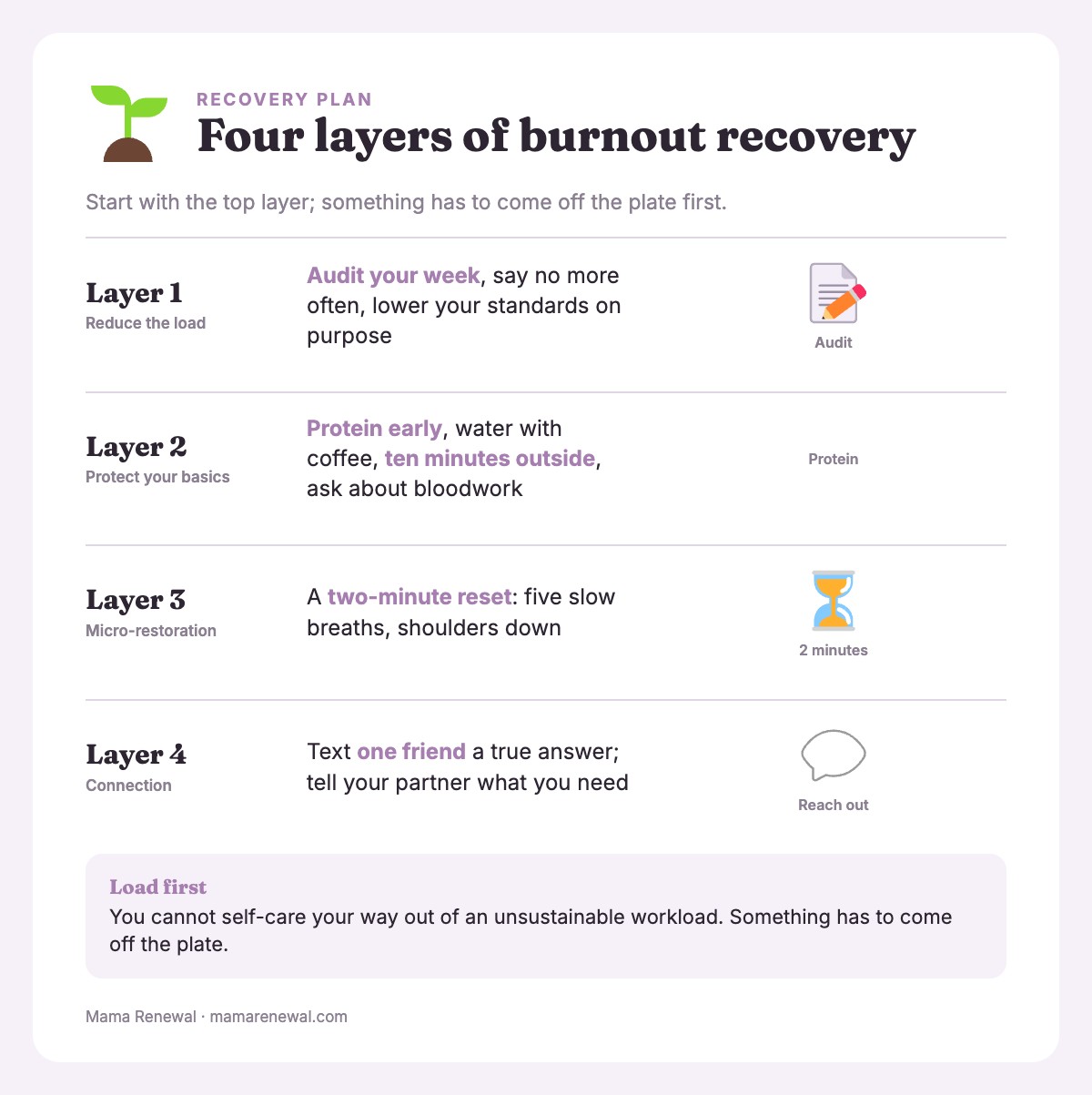
You can’t quit motherhood for a month and go to a retreat. Recovery from toddler mom burnout has to fit inside a life that still contains toddlers. The good news is that it works in layers, and small changes compound.
Layer 1: Reduce the load
You cannot self-care your way out of an unsustainable workload. Something has to come off the plate.
- Audit your week. Write down every recurring obligation. Circle the ones that are genuinely required and cross out the ones you do out of habit or guilt.
- Say no more often. Commitments that felt fine before kids can quietly sink you now. How to Say No: Printable Scripts to Protect Self-Care Time has exact wording so you’re not improvising while guilty.
- Lower your standards on purpose. Frozen vegetables are vegetables. Paper plates are plates. A house that’s lived in is a house that’s loved.
- Make the invisible visible. Sit down with your partner (or whoever shares your life) and list everything that keeps the household running. The Invisible Labor Checklist makes this conversation much easier.
Layer 2: Protect your basics
When you’re running on empty, the fundamentals matter more, not less.
- Eat something with protein early in the day. Blood sugar crashes make everything feel worse. Protein for Moms: Why You’re Not Eating Enough and How to Fix It has easy ideas.
- Drink water before coffee, or at least alongside it.
- Get outside for ten minutes. Daylight and movement, even a lap around the block with the stroller, reset your mood and your body clock.
- Ask your provider about bloodwork. Low iron, low vitamin D, and thyroid issues can mimic or worsen burnout. Vitamin D dips are more common in fall and winter.
Layer 3: Micro-restoration

Forget the two-hour bubble bath. You need tiny doses of restoration scattered through your day, which is the only kind a toddler schedule allows.
- The two-minute reset. Stand somewhere quiet, drop your shoulders, and take five slow breaths.
- Habit stack it. Attach a small kindness to something you already do: stretch while the coffee brews, listen to a song you love while you buckle the car seat. Habit Stacking for Moms: Sneak Self-Care Into What You Already Do shows how.
- Use naptime for you. At least some days, skip the chores. How to Use Naptime for Self-Care (Not Just Chores) can help you decide what’s worth doing.
- Find what actually restores you. If bath bombs and face masks leave you cold, you’re not doing it wrong. You may just need a different style of rest.
Layer 4: Connection
Burnout feeds on isolation. Even when you’re tired and would rather hide, a little connection goes a long way.
- Text one friend a true answer to “how are you?”
- Join a toddler playgroup, a library story time, or a moms’ group where you can sit and talk while kids play
- Tell your partner what you need, specifically, rather than waiting for them to notice
Making friends as an adult is genuinely hard, especially when you’re depleted. Making Mom Friends as an Adult: Why It’s So Hard and How to Actually Do It is a gentle place to start.
A Sample Day That Includes You
Here’s what a realistic toddler-mom day can look like when you build in tiny pockets of care. This isn’t a schedule to follow perfectly. It’s a menu.
| Time | What happens | The small kindness |
|---|---|---|
| Morning | Wake-up chaos, breakfast, getting dressed | Eat something with protein before the kids’ leftovers |
| Mid-morning | Park, errands, or play | Ten minutes of daylight, phone in your pocket |
| Naptime | Quiet house (if you’re lucky) | Rest first, chores second. Even 15 minutes counts |
| Afternoon slump | Snack, screen time, or outdoor play | A glass of water and a stretch on the floor while they play |
| 4-7 p.m. | Dinner, baths, the hard stretch | Default meal, lowered expectations, a song you like |
| After bedtime | The house goes still | Ten minutes of something just for you, then bed, not the phone |
On the days nothing goes to plan (and there will be many), you can drop the whole thing and just do one: eat the protein, or drink the water, or take the five breaths. One is enough.
The Mindset Shift That Makes It Lighter
A lot of burnout is held in place by quiet beliefs we never examined. Try swapping a few.
- “I should be able to handle this.” becomes “This is genuinely hard, and handling it takes support.”
- “Other moms make it look easy.” becomes “I’m only seeing their highlight reel.” (If comparison is a problem, Mom Comparison and Social Media can help.)
- “Rest is a reward I have to earn.” becomes “Rest is what keeps me functioning.”
- “I’m failing my child if I’m not enjoying this.” becomes “I can love my child and still find this stage exhausting.”
- “This will never end.” becomes “This stage is intense and temporary.”
That last one matters. Toddlerhood does shift. The constant physical vigilance eases. Language arrives, and with it, the ability to negotiate and reason a little. Sleep usually improves. You will not feel this wrung out forever, even though right now the end feels very far away.
If you need support right now
Reaching out is not an overreaction. These lines are free and confidential.
- Emergency: if you are thinking about harming yourself or your baby, or you can’t keep yourself safe, call 911 or go to the nearest emergency room. This is a medical emergency, and it is treatable.
- 988 Suicide & Crisis Lifeline: call or text 988, 24/7, for anyone in crisis.
- National Maternal Mental Health Hotline: call or text 1-833-TLC-MAMA (1-833-852-6262), 24/7, in English and Spanish, for pregnancy and postpartum support.
- Postpartum Support International: call or text 1-800-944-4773 for help finding a provider who specializes in perinatal mental health. Not an emergency line.
US numbers. Elsewhere, ask your doctor, midwife or local crisis line. This article was written by a parent, not a clinician, and isn’t medical advice.
Frequently Asked Questions
Is toddler mom burnout different from regular parental burnout?
The core experience is the same, but the causes are stage-specific. Toddlers add constant supervision, intense emotions, and unpredictable sleep all at once, which is why many mothers find this stage more draining than the newborn months.
How do I know if I’m an exhausted toddler mom or actually burned out?
Exhaustion improves with rest. Burnout doesn’t, or only barely. If a good night’s sleep or a weekend off restores you, you’re likely just tired. If you feel detached from your kids, dread the days, or feel like you can’t keep going even after rest, that points toward burnout. Persistent irritability or dread can also signal depression, so it’s worth mentioning to your doctor or a therapist if it lasts.
Can toddler mom burnout be a sign of depression?
It can be. Burnout and depression share many symptoms, including fatigue, irritability, numbness, and loss of enjoyment, and they can occur together. If these feelings persist for more than a couple of weeks, are getting worse, or include hopelessness or thoughts of self-harm, please check in with a healthcare provider. This isn’t a diagnosis, just a nudge to get an expert opinion, which is always worthwhile.
How long does it take to recover from burnout as a toddler mom?
There’s no single timeline. Small improvements can show up within a couple of weeks of reducing your load and protecting sleep, while deeper recovery often takes months. Think of it as rebuilding reserves, not flipping a switch. If you want a structured path, see our guide to mom burnout recovery.
What if I don’t have a partner or family nearby to help?
Many mothers carry this stage mostly alone, and it makes burnout more likely. Focus on what you control: lower your standards without apology, build one dependable point of connection (a weekly call, a library story time, an online group), and protect whatever sleep you can. Some mothers find trading childcare with another parent easier to arrange than paid care.
Is it normal to feel angry at my toddler?
Feeling frustrated with a toddler is extremely normal, because the behavior is developmentally typical but wearing. Anger that feels frequent, explosive, or frightening can be a sign that your reserves are depleted. Stepping away briefly, repairing afterward, and addressing the underlying exhaustion all help. If it keeps happening or scares you, talk to a provider or therapist. You’re not a bad mother for needing support.
What is the single most helpful thing I can do this week?
Pick the one trigger from the table above that hits hardest and do its one coping action. For most mothers, that means either protecting a block of sleep or handing off one full task. Small, targeted changes beat sweeping overhauls when you have no energy to spare.
You’re Not Failing, You’re Fully Occupied
If you’ve read this far, you’re probably tired, and you probably spent some of your reading time being interrupted. Here’s what I most want you to hear: the toddler years are genuinely relentless, and the fact that you feel it doesn’t mean you’re doing anything wrong. It means you’re paying close attention to a job that demands everything.
Start small. Pick one row from the table, one layer from the recovery list, one tiny kindness for today. And if the heaviness doesn’t lift, please let someone, a provider, a friend, or a therapist, help you carry it. You were never meant to do this part alone, and this stage, as endless as it feels, will not last forever.