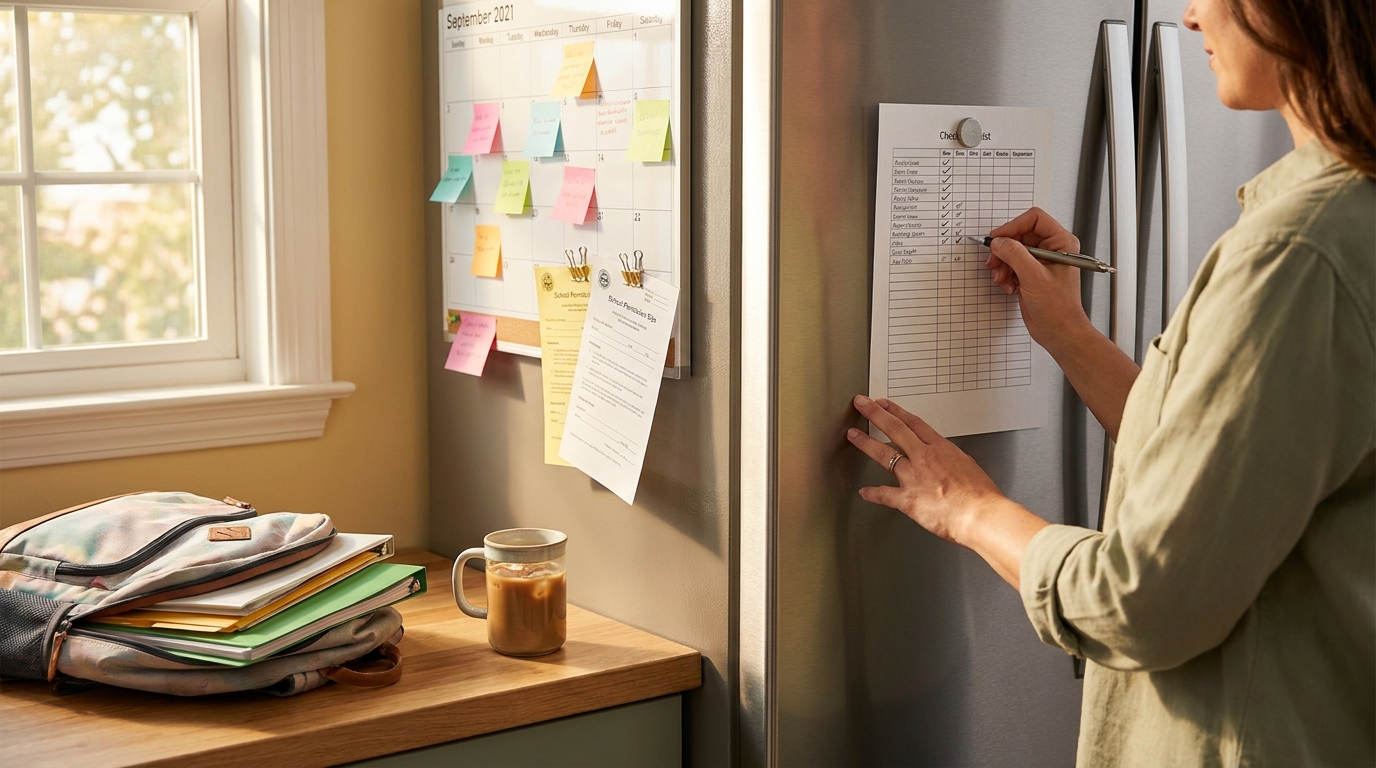
School-Age Mom Burnout: The Invisible Load of Logistics
You're experiencing school-age mom burnout, a unique cognitive load of tracking endless logistics, not just physical tasks. This article helps you name this invisible burden and offers a tool to manage your mental load.
- Recognize your exhaustion as a cognitive load from tracking school logistics, not just physical tasks.
- Understand how school adds a new, constant layer of mental burden beyond household responsibilities.
- Distinguish between performing physical tasks and the never-ending mental surveillance of logistics.
- Utilize a shared system, like a checklist with a delegate column, to offload tracking from your brain.
It’s 9:47 PM on a Tuesday and you’re standing in the kitchen with your phone in one hand and a permission slip in the other, trying to remember if the $12 field trip fee is due tomorrow or Thursday, whether you signed the reading log, whether soccer cleats are clean for practice, and whether you responded to the class parent’s text about Friday’s snack rotation. You haven’t sat down since 6 AM. Nobody made you do any of this. Nobody’s “in charge” of it but you. And somewhere between the permission slip and the snack text, you realize you’re not tired the way you were tired last spring — you’re tired in a different, heavier way, like your brain has a hundred tabs open and none of them will close.
That’s not you being disorganized. That’s not “just September.” That’s school-age mom burnout, and it has a specific shape that’s different from newborn exhaustion or toddler chaos — it’s not physical labor, it’s tracking labor. It’s the invisible load of logistics, and if you’ve felt like something shifted the moment the school year started, you’re reading the right thing.
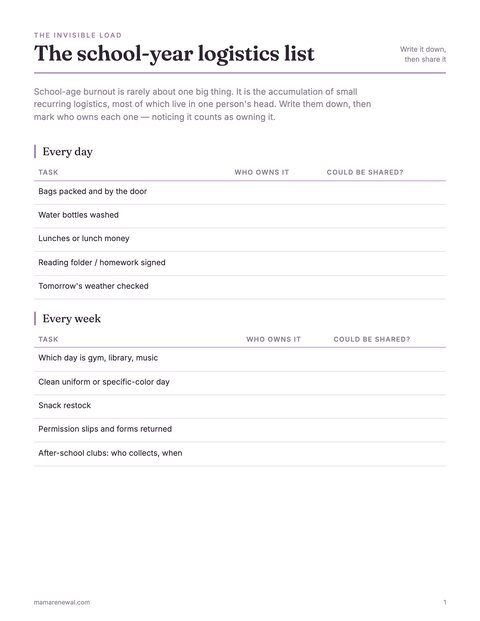
Free printable · 2 pages
School-Year Logistics Checklist
Every recurring school-year task written down, with a column for who actually notices it.
Free. Your download link appears right here. You'll also join the Mama Reset. Unsubscribe anytime. Privacy
This article names what’s actually happening, why the school calendar makes it worse than almost any other season of motherhood, and gives you a real tool — a printable checklist with a delegate column — to start moving some of that tracking off your one brain and onto a shared system.
In this article (13 sections)
- What Makes School-Age Burnout Different From Other Kinds of Mom Burnout
- The School Logistics Mental Load: What You’re Actually Carrying
- Why Back-to-School Season Hits Different Than the Rest of the Year
- The Symptoms: How to Tell School Logistics Have Tipped Into Burnout
- The Printable School-Year Logistics Checklist (With a Delegate Column)
- How to Actually Get the Delegate Column to Work
- What Happens Once the Routines “Settle” (And What It Means If They Don’t)
- A Realistic Weekly Rhythm for Managing School Logistics
- Protecting Something for Yourself in the Margins
- When the Load Feels Bigger Than Logistics Alone
- The Bottom Line
- Frequently Asked Questions
- You’re Not Failing at This
What Makes School-Age Burnout Different From Other Kinds of Mom Burnout
Most conversations about mom burnout picture a specific image: a mom drowning in physical caregiving, sleep-deprived with a baby on her hip. That’s real, but it’s not what’s happening to moms of school-age kids, and the mismatch is part of why this particular burnout is so hard to name.
School-age burnout isn’t primarily physical. Your kids can dress themselves, mostly feed themselves, and don’t need to be carried anywhere. On paper, this should be the “easier” season. But what replaced the physical load is a cognitive load that never fully switches off: the tracking, remembering, anticipating, and coordinating of dozens of moving parts across multiple kids, multiple schools, multiple apps, and multiple deadlines — all running simultaneously in the background of your mind, whether you’re at work, in the shower, or trying to fall asleep.
This is the same territory covered in The Mental Load: Why Moms Feel Exhausted Even When Everyone “Helps” — the idea that exhaustion isn’t only about doing tasks, it’s about being the one who has to think of the tasks in the first place. School adds a whole new category of mental load on top of the household one, with its own calendar, its own apps, its own deadlines, and its own social obligations (class parties, fundraisers, volunteer sign-ups) that didn’t exist before your kids were in school.
Here’s the distinction that matters:
| Physical Load | Cognitive/Logistics Load |
|---|---|
| Making lunch | Remembering he has a peanut allergy classmate so no PB&J on shared-snack day |
| Driving to practice | Knowing practice moved to Wednesdays this month and telling three other people |
| Signing the form | Knowing the form exists, when it’s due, and where it went in the backpack |
| Buying the costume | Remembering the parade is Friday, not the following Friday, and it’s “orange and black” not a full costume |
| Doing the laundry | Knowing the uniform has to be washed by Thursday night for Friday’s game |
Physical tasks have a clear finish line. Logistics tasks don’t — they live in your head as an ongoing surveillance system, and that surveillance never clocks out. That’s the burnout.
The School Logistics Mental Load: What You’re Actually Carrying
If you tried to write down everything you’re currently tracking for the school year, most moms are shocked by the length of the list once it’s actually visible. Here’s what tends to be in there, even for families with just one kid in elementary school:
- Daily: backpack check, signed folders, homework completion, snack, water bottle, weather-appropriate clothing, any forgotten item drama
- Weekly: reading logs, spelling lists, lunch account balance, upcoming week’s schedule changes, laundry rotation for uniforms/gear
- Recurring but irregular: permission slips, field trip payments, early dismissal days, picture day, book fair, fundraiser deadlines
- Seasonal: parent-teacher conferences, holiday parties, costume days, standardized testing schedules, report card follow-ups
- Ongoing background tracking: which app has which information (Seesaw for one kid, ParentSquare for the school, a group text for the team, email for the PTA), which teacher prefers which communication method, which other parents you need to coordinate carpool or playdates with
None of these tasks is hard on its own. A permission slip takes ninety seconds to sign. The burnout isn’t in the doing — it’s in the remembering that it exists, at the right time, among fifteen other things also demanding to be remembered. That’s the part that doesn’t show up on any to-do list, because it’s not a task, it’s a state of vigilance.
Why This Load Is So Hard to Delegate
One reason this load lands so heavily on moms specifically is that it’s mostly invisible to anyone not doing it. A partner can see dishes in the sink. A partner cannot see “I have been quietly tracking that book fair money is due Thursday since Monday.” The tasks themselves are small and often genuinely fast to do — which makes them easy for someone helpful to grab in the moment (“I’ll drop off the form!”) while the actual cognitive work of knowing the form existed, needed a signature, and had a deadline stays entirely with you.
This is why “he’s actually really helpful” and “I’m still burned out” can both be true at the same time. Help with execution doesn’t relieve the mental load of tracking — and tracking is the exhausting part.
Why Back-to-School Season Hits Different Than the Rest of the Year
If you feel like this specific stretch — September through early November — is uniquely draining compared to, say, February or June, you’re not imagining it. A few things stack up specifically during back-to-school season:
The system resets all at once. New teacher, new classroom, new schedule, new supply list, new communication app login, new carpool arrangement, new after-school activities — all launching in the same two-to-three-week window, with almost no onboarding. You’re expected to just know how the new system works by week two.
You’re grieving the old rhythm while building a new one. Summer had its own chaos, but it also had slack in it — fewer hard deadlines, more flexibility. The compression back into a school schedule is its own adjustment, and for a lot of moms it comes with real, unacknowledged grief about the end of unstructured togetherness. If mornings feel quieter than you expected and it doesn’t feel like relief, that’s worth sitting with rather than pushing past — The First Quiet Morning: Why Back-to-School Feels Like Grief, Not Relief goes deeper into that specific ache.
Everyone else’s logistics become your logistics. Fall is peak season for group coordination — sports team schedules, PTA fundraisers, class party sign-ups, carpool chains. Each of these is a small task on its own, but they all funnel through you as the “default parent” who fields the group texts, replies to the sign-up sheets, and remembers what everyone else agreed to.
There’s no natural end point. Unlike a big one-time event (a birthday party, a move, a trip), school logistics don’t resolve — they just keep generating new instances of themselves every single week, for nine months. That’s what makes it burnout and not just a busy stretch: busy stretches end, and your brain knows that; this doesn’t feel like it has an end date, so there’s no light at the end of the tunnel to pace yourself toward.
The Symptoms: How to Tell School Logistics Have Tipped Into Burnout
A busy September is normal. Burnout is when the busyness stops resolving even after the initial adjustment period. Here’s how to tell the difference:
| Just Adjusting (Normal) | Tipping Into Burnout |
|---|---|
| Forgetting one form here and there | Consistently forgetting things you’d never have forgotten before |
| Feeling tired by Friday | Feeling tired by Monday, every week |
| Occasional snapping at kids over the morning rush | Snapping becomes your default tone, and you feel guilty but can’t seem to stop |
| Looking forward to weekends as a break | Weekends feel just as logistics-heavy as weekdays (games, makeup practices, birthday parties) |
| Mild anxiety checking the school app | Dread or avoidance of checking the school app, followed by a scramble when you finally do |
| Occasional overwhelm you can name a cause for | A low hum of dread that doesn’t attach to any one specific thing |
| Sleep is a little lighter during busy weeks | You’re lying awake mentally running through tomorrow’s logistics, or waking at 3 AM already tracking |
If you’re consistently landing in the right-hand column by October — not just during the first hectic week of school, but as your new normal — that’s a sign the load has outpaced your capacity, not a sign you need a better planner. The nervous system regulation piece matters here too: chronic low-grade vigilance keeps your body in a mild stress response for months at a time, and that has physical costs, not just emotional ones. If you notice yourself feeling wired-but-exhausted, jumpy, or unable to fully relax even when you finally sit down, Nervous System Regulation for Moms: 12 Simple Techniques to Stop Living in Survival Mode has concrete tools for interrupting that pattern, not just naming it.
The Printable School-Year Logistics Checklist (With a Delegate Column)
Here’s the tool. The point of this checklist isn’t to make you more organized at doing everything — it’s to make the invisible load visible, so it can actually be divided instead of just described. Most delegation attempts fail not because a partner or co-parent won’t help, but because the task was never written down anywhere both people could see it. “I told him about the field trip” isn’t a system. This is.
Print this, stick it on the fridge or inside a kitchen cabinet, and actually fill in the “Delegate To” column with a name — not “we’ll figure it out,” an actual person. Review it once a month as the season shifts (fall sports end, winter concerts start, etc.).
| Recurring Task | How Often | Currently Tracked By | Delegate To |
|---|---|---|---|
| Check backpack for forms/notices | Daily | ||
| Sign and return permission slips | As needed | ||
| Pack/replace school supplies | Weekly check | ||
| Check school app (Seesaw, ParentSquare, ClassDojo, etc.) | Daily | ||
| Reading log / homework folder sign-off | Daily/weekly | ||
| Lunch account balance | Weekly | ||
| Laundry for uniforms/sports gear | Weekly | ||
| Field trip payment & forms | As needed | ||
| Class party sign-ups / snack rotation | Per event | ||
| Fundraiser tracking (money, forms, deadlines) | Per event | ||
| Picture day prep (outfit, order form) | 1–2x/year | ||
| Book fair (money, wish list) | 1–2x/year | ||
| Costume/spirit day prep | Per event | ||
| Parent-teacher conference scheduling | 1–3x/year | ||
| After-school activity registration | Seasonal | ||
| Sports/activity payment deadlines | Seasonal | ||
| Carpool coordination | Weekly/seasonal | ||
| Sick day / absence notes | As needed | ||
| Early dismissal / no-school day childcare | Per calendar | ||
| Yearbook / class photo orders | 1x/year | ||
| Holiday party or gift coordination | Seasonal | ||
| Immunization / physical form updates | Annual |
A few notes on using this well:
- You don’t have to delegate every row. The goal is that every row has an owner — even if that owner is you, on purpose, because it genuinely makes sense for you to handle it. The problem was never that you did things; it was that everything defaulted to you by default, not by decision.
- “Delegate To” can include the kid. Reading logs, backpack checks, and lunch account reminders are all reasonable to hand to a school-age kid with some scaffolding — it’s logistics practice for them, and it’s one less thing tracked in your head.
- Put dates on the app-check row. “Check the app daily” sounds fine until you realize checking isn’t the hard part — remembering to check consistently is. Attach it to an existing habit (after coffee, during the school drop-off drive) instead of leaving it floating.
- Revisit this monthly, not once. School logistics change with the seasons — fall sports hand off to winter activities, fundraisers cluster around certain months. A checklist filled out once in September and never touched again just becomes one more thing to feel guilty about.
How to Actually Get the Delegate Column to Work
Writing a name in a column is the easy part. Getting the handoff to stick is where most delegation attempts quietly fail — usually within two to three weeks, when the “helper” forgets or drops the task and it silently boomerangs back to mom, often with an added layer of resentment on both sides.
A few things that make delegation actually hold:
Hand off the whole task, not just the execution step. If your partner agrees to “handle sports,” that has to include knowing when registration opens, when payment is due, and when practice schedules change — not just showing up to drive when you tell him where to go. Partial delegation (you still track it, he still just executes on your instructions) doesn’t reduce your mental load at all; it just adds a middleman.
Give the delegate direct access to the source. If the school app, the team group text, or the fundraiser email only goes to your phone, you are still the bottleneck no matter who’s “responsible.” Add your partner to the school app, the class parent group text, the team communication thread — directly, not relayed through you.
Expect an adjustment period, not instant competence. The first month of a new delegation often goes worse before it goes better — a missed deadline, a scramble, a “why didn’t you tell me” moment. That’s not proof delegation doesn’t work; it’s proof the other person hasn’t built the vigilance habit yet, because you’ve been doing it for them without meaning to. Let a few things be imperfect rather than swooping back in to fix it yourself, which teaches everyone (including you) that it was never really delegated at all.
If you’re parenting solo or your co-parent genuinely can’t take more on, delegate to systems instead of people. A shared digital calendar with automatic reminders, recurring calendar entries for weekly deadlines, or a standing “logistics hour” on Sunday nights can absorb some of what a partner would otherwise hold. It’s not the same as a second adult, but it does take some of the load off pure memory, which is often where the exhaustion lives.
And if the resistance to asking for help isn’t logistical but emotional — if some part of you feels like you’re supposed to be the one who holds it all, or that asking means you’ve failed — that’s worth sitting with honestly rather than white-knuckling through. How to Say No to the PTA (and Everything Else) Without the Mom Guilt tackles that guilt directly, particularly around the volunteer and social obligations that tend to pile on top of the core logistics load during the school year.
What Happens Once the Routines “Settle” (And What It Means If They Don’t)
Most families do eventually find a rhythm. By mid-to-late October, the new teacher’s communication style is familiar, the carpool lineup has stabilized, the initial wave of first-of-the-year paperwork has cleared, and the household finds something closer to a groove. If that’s happening for you, good — that’s the expected adjustment curve, and it’s worth naming out loud so you can actually feel the relief instead of staying braced for the next thing.
But for a meaningful number of moms, the overwhelm doesn’t ease once the routines settle. The forms slow down, the schedule stabilizes, and the dread, the snapping, the 3 AM logistics-brain, the sense of being perpetually behind — none of it lifts. If that’s you, that’s an important signal, and it’s worth taking seriously rather than assuming you just need to try harder at the checklist.
This is the piece worth saying plainly and without alarm: if the overwhelm you’re feeling right now doesn’t ease once the school-year routines settle in — if weeks pass, the initial chaos calms down, and you still feel like you’re drowning — that ongoing pattern is worth mentioning to a therapist. Not because something is wrong with you, and not because you’ve failed at managing your life. Burnout that persists past the point where the external circumstances have stabilized is often telling you something beyond “the calendar is full” — it can be a sign of underlying anxiety, depression, or a nervous system that’s been in survival mode for long enough that it’s stopped resetting on its own. A therapist can help you sort out what’s situational (genuinely too much on the plate, needs real redistribution) from what’s become a deeper pattern that logistics fixes alone won’t touch. That’s not a bigger, scarier version of what’s covered here — it’s just the next right step if the tools in this article don’t move the needle.
If you’re not sure whether what you’re feeling has crossed that line, Depleted Mother Syndrome: What It Is and How to Start Recovering walks through the fuller picture of chronic maternal depletion, and can help you figure out whether you’re in a hard season or something that’s asking for more support than a checklist can give.
A Realistic Weekly Rhythm for Managing School Logistics
Rather than trying to hold everything in your head continuously (the exact habit that’s burning you out), building one or two small, protected windows into the week for logistics can shrink the “always on” feeling significantly. This isn’t about doing more — it’s about containing the load to specific times instead of letting it bleed into every hour of the day.
A simple version that works for a lot of families:
- Sunday, 15–20 minutes: Glance at the week ahead — check the school app for any new notices, confirm which days need special items (gym clothes, snack duty, early dismissal), and flag anything that needs a form or payment before Wednesday.
- Wednesday, 5–10 minutes: A quick midweek check — this is when last-minute additions (a forgotten permission slip, a rescheduled practice) tend to surface, and catching them mid-week instead of the night before prevents the 9:47 PM scramble.
- First of the month, 20 minutes: Zoom out — check upcoming fundraisers, picture day, early releases, and any seasonal transitions (sports ending, new activities starting) so they don’t ambush you with 48 hours’ notice.
The goal of a rhythm like this isn’t perfection — you’ll still miss things sometimes, and that’s fine. The goal is giving your brain permission to actually stop scanning for logistics threats outside of those windows, instead of running a low-grade background check on “did I forget something” constantly, which is where a huge amount of the exhaustion actually lives.
Protecting Something for Yourself in the Margins
It can feel almost indulgent to think about self-care in the middle of a season this logistically dense, but the two aren’t in competition — a mom who’s running on empty has less capacity to hold logistics well, not more. You don’t need a spa day to make a dent here; you need small, repeatable things that don’t depend on a clear calendar, because your calendar isn’t going to clear itself for the next several months.
A few low-lift options that fit into genuinely small windows:
- A ten-minute stretch after drop-off, before the workday or the next task takes over — Gentle Morning Stretches for Moms is built for exactly this kind of window.
- Protecting even twenty unstructured minutes that belong only to you, not to logistics, not to kids — see Solo Time Ideas for Moms Who Get 20 Minutes and Nowhere to Go for ways to actually use that time to recharge instead of just collapsing into your phone.
- Paying attention to what you’re actually eating during the scramble — logistics-heavy days are exactly when nutrition quietly falls apart, and under-eating protein in particular tends to make everything, including your capacity to track fifteen things at once, feel harder. Protein for Moms: Why You’re Not Eating Enough and How to Fix It is worth a look if lunch has become “whatever the kids didn’t finish.”
None of these fix the logistics load. But a body that’s rested, fed, and occasionally given a break from vigilance mode has more room to absorb a hard season without it turning into full burnout.
When the Load Feels Bigger Than Logistics Alone
Sometimes what looks like pure school logistics overwhelm is tangled up with something else running underneath it — grief about a season of life ending, identity questions about who you are outside of “the parent who tracks everything,” or a body and nervous system that were already depleted before September even started. If back-to-school season is stirring up more than just scheduling stress — a sense of loss, a feeling of having disappeared into the logistics of everyone else’s life — that’s worth naming too, not just powering through. Matrescence: Understanding the Identity Shift Every Mom Goes Through and International Women’s Day: A Letter to the Mom Who Lost Herself (And Is Finding Her Way Back) both speak to that deeper layer, if this season has you feeling like more than just “busy.”
The Bottom Line
School-age mom burnout isn’t a character flaw, a time-management failure, or something a better app will fix. It’s the predictable result of one brain being asked to hold dozens of small, recurring, unassigned tasks with real deadlines, for nine straight months, mostly invisibly. Naming it as logistics burnout — rather than just “feeling tired” or “feeling behind” — is the first step to actually addressing it, because it points you toward the real fix: not doing more, but making the load visible enough to actually share it.
Print the checklist. Fill in real names in the delegate column, not “we’ll see.” Build in small windows to contain the tracking instead of letting it run all day. And if the overwhelm doesn’t ease once the season settles, take that seriously enough to say it out loud to someone who can help — a therapist, not just a to-do list app.
If you need support right now
Reaching out is not an overreaction. These lines are free and confidential.
- Emergency: if you are thinking about harming yourself or your baby, or you can’t keep yourself safe, call 911 or go to the nearest emergency room. This is a medical emergency, and it is treatable.
- 988 Suicide & Crisis Lifeline: call or text 988, 24/7, for anyone in crisis.
- National Maternal Mental Health Hotline: call or text 1-833-TLC-MAMA (1-833-852-6262), 24/7, in English and Spanish, for pregnancy and postpartum support.
- Postpartum Support International: call or text 1-800-944-4773 for help finding a provider who specializes in perinatal mental health. Not an emergency line.
US numbers. Elsewhere, ask your doctor, midwife or local crisis line. This article was written by a parent, not a clinician, and isn’t medical advice.
Frequently Asked Questions
What is school-age mom burnout, exactly?
School-age mom burnout is chronic exhaustion driven primarily by the mental and logistical load of managing a school-age child’s (or children’s) schedule, paperwork, communication, and recurring obligations — as opposed to the physical caregiving load associated with burnout in earlier parenting stages. It shows up as constant background vigilance (tracking forms, deadlines, apps, schedules) rather than physical fatigue alone, and it tends to intensify specifically during the school year, especially at transition points like the start of fall.
Why does back-to-school season feel more overwhelming than the rest of the year?
Back-to-school season compresses a huge number of new systems — new teacher, new classroom routines, new apps, new schedules, new social obligations like fundraisers and class parties — into a very short window, usually with no onboarding period. On top of that, many moms are also adjusting emotionally to the end of a looser summer rhythm, which adds a layer of transition stress on top of the pure logistics load.
How is school logistics mental load different from general mental load?
General mental load covers the ongoing tracking of household needs — meals, appointments, supplies. School logistics mental load is a specific, seasonal subset layered on top of that: it has its own calendar, its own apps and communication channels, its own recurring deadlines (forms, fundraisers, conferences), and its own social obligations tied to the school community. It tends to spike sharply at the start of the school year and again around holidays, rather than staying flat year-round like general household mental load.
How can I actually get my partner to take on more of the school logistics, not just help with tasks?
Give them direct access to the source of information (the school app, the team group text, the class email list) rather than relaying it yourself, and hand off entire tasks — including the remembering and deadline-tracking, not just the execution step. A written system, like a shared checklist with clear ownership per task, makes this concrete instead of relying on verbal reminders, which tend to quietly default back to whoever was already tracking things.
What if my overwhelm doesn’t get better once the school routines settle down?
Most families see logistics stress ease somewhat once the new school-year systems become familiar, usually by mid-to-late fall. If that doesn’t happen for you — if the dread, exhaustion, or feeling of being constantly behind persists even after the schedule stabilizes — that ongoing pattern is worth mentioning to a therapist. It doesn’t necessarily mean something is “wrong,” but persistent overwhelm that outlasts the circumstances that caused it is a signal worth taking seriously rather than pushing through alone.
Can kids help with school logistics, or is this really an adult-only task?
Many school-age kids can take on real pieces of this load with some scaffolding — checking their own backpack for forms, signing their own reading log, tracking their own lunch balance reminder, packing their own bag the night before. Handing these off does double duty: it teaches genuine independence, and it removes real items from a parent’s mental tracking list rather than just reassigning the doing while the remembering stays with mom.
Is it normal to feel more burned out in September than during the busier summer months?
Yes — many moms report exactly this, and it often surprises them because summer can look objectively busier on paper (more activities, less structure). The difference is that summer chaos is usually flexible and low-stakes, while school-year logistics come with hard deadlines, external accountability (teachers, other parents, coaches), and a rigid calendar that doesn’t bend around a bad day. That combination — real deadlines plus low flexibility — is a strong driver of burnout even when the total hours of “work” are similar or less than in summer.
You’re Not Failing at This
If September left you feeling like you’d lost a step you never actually lost — like you were suddenly the kind of mom who forgets things — that wasn’t a personal failing showing up out of nowhere. It was a system overload, and systems get fixed by redesigning them, not by trying to run the same overloaded one harder. Print the checklist, put real names in the delegate column, and give yourself permission to let some things be imperfect while the load actually gets shared. You were never meant to hold all of this alone.