Protein for Moms: Why You’re Not Eating Enough and How to Fix It
You're likely under-eating protein, contributing to exhaustion, brain fog, and other postpartum issues. This article explains why mainstream advice misses moms and how to fix your protein deficit without adding to your busy schedule.
- Your exhaustion, brain fog, and mood crashes may stem from a protein deficit.
- Mainstream protein advice often ignores the unique challenges of motherhood.
- Protein is crucial for postpartum healing, rebuilding tissue, and restoring blood volume.
- Learn how to increase your protein intake without adding to your busy schedule.
Last Tuesday I ate dinner standing over the sink, straight off my three-year-old’s plate. Three cold chicken nuggets, four bites of mac and cheese, the crusts off a sandwich nobody wanted. I wasn’t even hungry-hungry when I did it — I was just there, and the food was there, and sitting down to make myself an actual plate felt like one task too many at the end of a day that had already asked for everything I had. I didn’t think about it again until 9 p.m., when I hit that specific wall of shaky, foggy, irrationally close to tears exhaustion that used to make me think I just needed more sleep. I didn’t need more sleep. I needed about 25 more grams of protein and I hadn’t eaten a real source of it since a splash of milk in my coffee that morning.
If that sounds familiar, you’re not imagining things, and you’re not weak. You’re almost certainly under-eating protein, and it’s probably been happening for years without you clocking it as the reason you feel the way you feel. Protein has become the trendiest nutrient on the internet right now — cottage cheese ice cream, 30-grams-per-meal challenges, protein-coffee TikToks — but almost none of that conversation is written for a body that grew a human, is recovering from that, is maybe still feeding that human with its own tissue, and is trying to do all of that on the leftover bites of someone else’s chicken nuggets. This is the protein conversation for that body. Let’s talk about why you’re under-fueled, what it’s actually costing you, and how to fix it without adding a single new thing to your to-do list.
The Protein Conversation Everyone’s Having (And Why Moms Got Left Out of It)
Open any wellness feed right now and you’ll see it: influencers hitting 150 grams of protein a day, recipe accounts turning yogurt into “protein ice cream,” fitness coaches insisting you need “a palm-sized portion at every meal.” The research behind the trend is real — most adults, and especially most women, eat meaningfully less protein than their bodies actually need to function well, not just to build muscle at the gym.
But scroll through that content for more than a few minutes and you’ll notice something: almost none of it is talking to you. It’s talking to someone with forty-five uninterrupted minutes to meal prep on Sunday, someone whose biggest obstacle is “remembering” to eat enough protein, someone who has never once eaten a child’s abandoned quesadilla crust as an entire meal because sitting down felt impossible.
Moms have a protein problem that’s different in both cause and consequence from the one the wellness internet is describing. It’s not about optimizing an already-adequate diet for muscle gain. For a lot of us, it’s about closing a real deficit that’s been quietly driving the exhaustion, the brain fog, the hair loss, the mood crashes, and the “why can’t I lose this weight no matter what I do” frustration that gets written off as just what motherhood does to a body. Some of what motherhood does to a body is real and unavoidable. But some of it is a fixable nutrition gap that nobody flagged for you because the protein conversation was built around gym-goers, not the woman who hasn’t sat down for a meal since 2022.
What Protein Actually Does for a Postpartum Body
Pregnancy and birth are, biologically speaking, an enormous construction project. Your body built an entire organ (the placenta) from scratch, grew a baby’s worth of muscle, bone, skin, and brain tissue, expanded your blood volume by nearly 50%, and then — however you delivered — went through a major physical event that leaves tissue to repair: a surgical incision, a perineal tear, or simply the significant work your uterus, abdominal muscles, and pelvic floor did to get that baby out.
Protein is the raw material for every part of that repair. It’s not optional scaffolding — it’s the literal building block your body pulls from to:
- Rebuild uterine and abdominal muscle tissue
- Heal incision or tearing sites
- Restore blood volume and red blood cell production (especially important if you lost blood during delivery)
- Support your immune system during one of its most taxed periods
- Produce breast milk, if you’re nursing — milk production alone increases your protein needs by roughly 25 grams a day above your pre-pregnancy baseline
- Stabilize mood, since amino acids from protein are precursors for neurotransmitters like serotonin and dopamine
Most postpartum nutrition advice fixates on iron and calcium, which matter, but protein is the nutrient that’s most commonly under-consumed and most directly tied to how depleted you feel. If you’re still walking around a year or two postpartum feeling like your body never quite “came back” — not in a shape or size sense, but in a strength and energy sense — insufficient protein during the recovery window is one of the most overlooked reasons why. Repair happens whether you feed it or not; if you don’t give it enough raw material, your body borrows from muscle you already have, which is part of why so many moms feel weaker at eight months postpartum than they did at eight days.
If any of this is tangled up with how you feel about your body more broadly, it’s worth reading Postpartum Body Image: Finding Peace With Your Changed Body alongside this — because fueling your body well and making peace with how it looks are two different, both-important things, and neither has to wait for the other.
The 3pm Crash Isn’t a Caffeine Problem — It’s a Protein Problem
Here’s a pattern I’d bet a lot of you recognize: breakfast is coffee and maybe half a piece of toast standing at the counter while you pack lunches. Lunch is whatever’s fastest — crackers, a handful of your kid’s goldfish, string cheese eaten in the car. By 3 p.m. you’re reaching for a second (third?) coffee and something sweet, not because you’re weak-willed, but because your blood sugar has been on a rollercoaster all day with nothing to flatten the curve.
Protein slows the absorption of glucose into your bloodstream, which is what keeps you from spiking and crashing every time you eat. A carb-heavy, protein-light day — toast, crackers, cereal, fruit snacks eaten standing over the pantry — produces exactly the blood sugar pattern that causes that specific 3 p.m. wall: a fast rise, a fast fall, and a brain that’s now flooded with cortisol and adrenaline trying to compensate, which is why the crash so often comes with irritability and shakiness, not just tiredness.
More caffeine doesn’t fix this. It masks it for about ninety minutes and then makes the eventual crash worse. What actually fixes it is protein at the start of your day and protein at regular intervals through it, because amino acids don’t spike blood sugar the way refined carbohydrates do — they provide steady, slow-burning fuel instead.
This is one of the clearest, fastest wins in this whole article: if you eat one thing differently tomorrow, make it a protein-forward breakfast. Even 20-25 grams — two eggs plus a serving of Greek yogurt, or a protein shake with a banana — measurably changes how stable your energy and mood feel by mid-afternoon. It won’t fix a genuinely under-slept week, but it removes one of the variables that’s currently stacked against you every single day. For more on what stable, sustainable eating actually looks like day to day (not a diet, just a foundation), Nutrition as Self-Care: Simple Eating Habits That Help Moms Thrive is a good next read.
You’re Losing Muscle Right Now, and Nobody Told You
This is the part of the protein conversation that almost never makes it into mom-focused content, and it should, because it’s happening to you whether or not anyone mentions it.
Starting in your 30s, women lose an average of 3-8% of their muscle mass per decade — a process called sarcopenia — and that rate accelerates significantly through perimenopause and menopause as declining estrogen changes how efficiently your body builds and maintains muscle tissue. If you’re in your late 20s through 40s right now, you are very likely in the early, invisible stretch of this process: you can’t see it yet, you probably don’t feel it as anything specific, but it is quietly reshaping your metabolism, your bone density, your injury risk, and your baseline energy level.
Muscle isn’t just about how your arms look in a tank top. It’s your body’s primary site for glucose disposal (which is why declining muscle mass is linked to rising blood sugar issues with age), it’s what keeps your metabolism from slowing more than it has to, and it’s directly tied to functional strength — the ability to carry a car seat, chase a toddler through a parking lot, and get up off the floor without it being an event.
Two things drive muscle loss or muscle maintenance more than almost anything else: resistance-type movement, and protein intake. You can’t out-supplement a completely sedentary lifestyle, but you also can’t build or preserve muscle on inadequate protein no matter how much you move. And critically — this is the part that surprises most people — protein needs go up with age, not down, because of something researchers call “anabolic resistance.” An aging body needs more protein per meal to trigger the same amount of muscle repair that a younger body could accomplish with less. The 20-year-old you were in college could get by on erratic, protein-light eating in a way your current body genuinely cannot.
If this is landing as one more depleting thing on a list of already-depleting things, it might be worth reading Depleted Mother Syndrome: What It Is and How to Start Recovering — because chronic under-fueling and chronic muscle loss are often part of the same larger pattern, and neither one is something you’re doing wrong so much as something nobody set you up to notice.
So How Much Protein Do You Actually Need?
The old-school RDA of 0.36 grams per pound of body weight (0.8g/kg) is a bare minimum designed to prevent outright deficiency in a sedentary adult — it is not a target for feeling good, recovering from birth, breastfeeding, or maintaining muscle through your 30s and beyond. Most nutrition researchers now agree that range is too low for the vast majority of women, and especially too low for postpartum, breastfeeding, or perimenopausal bodies.
Here’s a more realistic breakdown:
| Your situation | Target range | Example: 150 lb / 68 kg mom |
|---|---|---|
| General baseline (not pregnant/nursing, sedentary) | 0.55–0.65 g/lb (1.2–1.4 g/kg) | 83–98g/day |
| Active, trying to maintain or build muscle | 0.7–0.8 g/lb (1.6–1.8 g/kg) | 105–120g/day |
| Postpartum recovery (first 3-6 months) | 0.7–0.9 g/lb (1.5–2.0 g/kg) | 105–135g/day |
| Breastfeeding | Baseline + 25g/day minimum | 130–160g/day |
| Perimenopause / 40+ maintaining muscle | 0.7–0.9 g/lb (1.6–2.0 g/kg) | 105–135g/day |
A few things worth knowing as you look at that table:
- These numbers are higher than what most women actually eat. Studies consistently find the average American woman eats somewhere around 60-70 grams of protein a day — well under even the “general baseline” range above, let alone the postpartum or breastfeeding ranges.
- Distribution matters as much as total. Getting 100g of protein all in one big dinner is far less effective for muscle repair and blood sugar stability than spreading it across 3-4 meals of 25-30g each. Your body can only use so much protein for muscle protein synthesis at one sitting — the rest gets used for energy or stored, which is part of why “protein at every meal” beats “protein at one meal.”
- You don’t need to hit these numbers with surgical precision every single day. This isn’t a diet plan, it’s a target range to aim toward. Getting within 15-20 grams of your number most days will move the needle enormously compared to where most moms are starting from.
The Real Reason You’re Under-Eating Protein (It’s Not Laziness)
Before we get to fixes, it’s worth naming why this happens, because “just eat more protein” is useless advice if you don’t understand what’s actually blocking it. In my experience talking to moms about this, it’s rarely about not knowing protein matters. It’s almost always one of these:
- You feed everyone else first, and by the time it’s your turn, you’re too depleted to cook something real. Eating standing up, off other people’s plates, or not at all becomes the default because sitting down to make yourself a proper meal requires energy you don’t have left.
- Protein takes more active preparation than carbs do. A bowl of cereal, a piece of toast, or a handful of crackers requires zero cooking. Chicken, eggs, or fish generally require at least some. When you’re exhausted, the path of least resistance wins, and the path of least resistance is almost never protein.
- There’s guilt wired into spending time or money on food just for you. A lot of moms will grocery shop, meal plan, and cook elaborate meals for their kids while genuinely not believing their own meal is worth the same effort. This isn’t a character flaw — it’s a socialized pattern, and it’s worth noticing if it’s true for you.
- Snacking has replaced sitting down to eat. Grazing on kid snacks throughout the day — the goldfish, the fruit snacks, the crusts — fills you up just enough that you never feel hungry enough to make a real meal, even though almost none of it contains meaningful protein.
- You genuinely don’t know how much you need, so there’s no target pulling you toward better choices. It’s hard to hit a number you’ve never seen.
None of these are solved by willpower. They’re solved by making the protein-rich option require less effort than the alternative — which is exactly what the next section is for.
How to Hit Your Protein Target Without Adding a Single Meal-Prep Session
This is the part that actually matters: not the theory, but the specific, low-effort ways to close the gap on a day that already has no room in it. None of these require a Sunday meal-prep ritual, though if you already do one, great — layer it in. These are built for the mom who has five minutes, not fifty.
Make the “protein first” rule your only rule. Whatever you’re eating, eat the protein portion of it before anything else on the plate. This does two things: it means you get the protein in even if you get interrupted (extremely likely) and don’t finish the rest of the meal, and it naturally curbs how much lower-value filler food you eat afterward, since protein is the most satiating macronutrient.
Cook double portions of protein whenever you’re already cooking for your kids, and eat that instead of their leftovers. If you’re making chicken nuggets or grilled chicken for dinner, throw an extra chicken breast in the pan for yourself. This is the single highest-leverage habit change available to you, because it uses effort you’re already spending rather than asking for new effort.
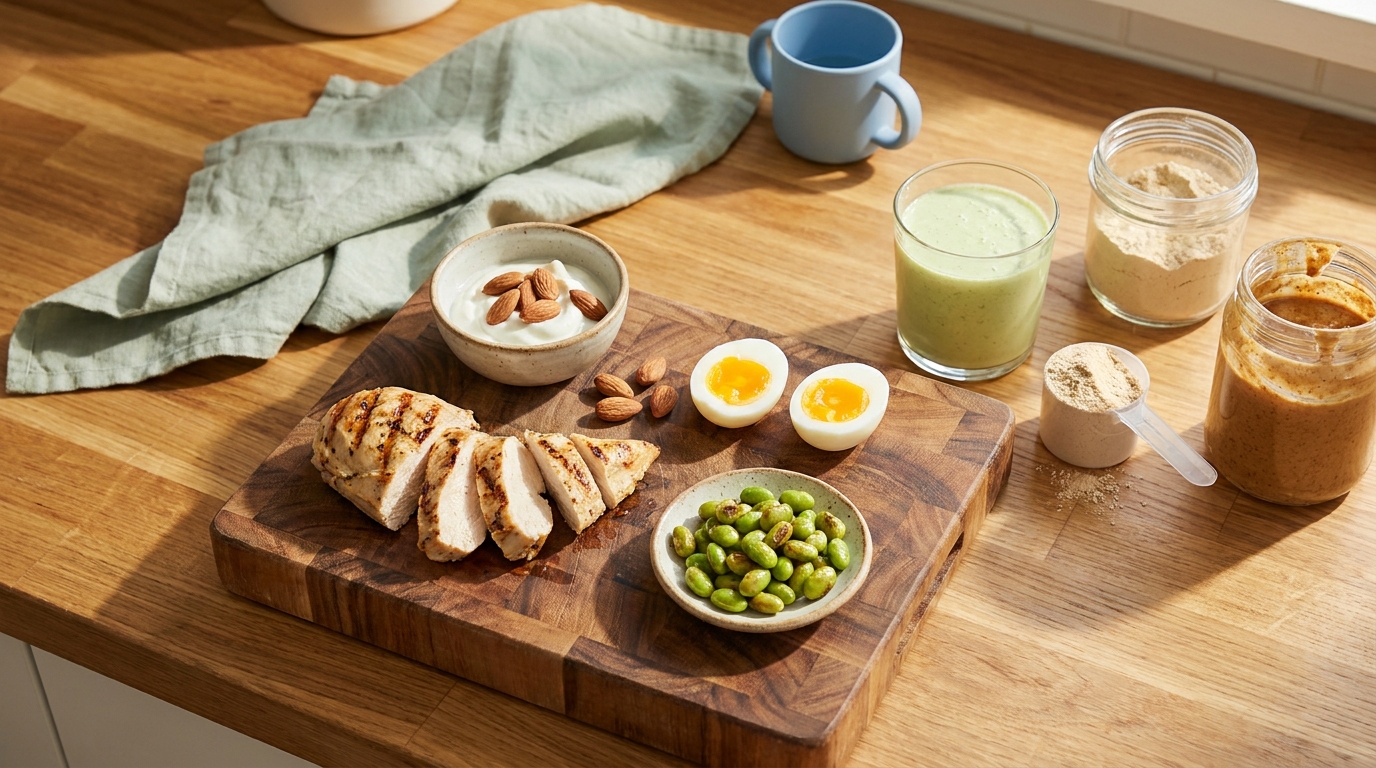
Keep a “protein grab-and-go” shelf stocked at all times, specifically in the spots you already stand — the counter, the fridge door, the diaper bag, the car console. Things that need zero prep:
- Hard-boiled eggs (the precooked, peeled kind from Costco or Trader Joe’s are worth every penny for how much friction they remove)
- Individual Greek yogurt cups or squeeze pouches
- String cheese or Babybel
- Canned tuna or salmon pouches (no draining, no dishes)
- Beef or turkey jerky
- Roasted edamame
- Cottage cheese cups
- A quality protein bar (check the label — some are basically candy bars; look for 15g+ protein and under 10g sugar)
Put protein powder in things you’re already drinking, not a new shake you have to remember to make. A scoop stirred into your morning coffee (unflavored or vanilla works fine, especially in a latte), blended into a smoothie you’re already making for your kids, or mixed into oatmeal adds 20-25 grams with zero additional steps.
Batch-cook one protein, once, and repurpose it three ways. A rotisserie chicken or a pound of ground turkey cooked on a Sunday (or honestly, any day you happen to have ten spare minutes) becomes chicken salad for lunch, chicken tossed into pasta for dinner, and shredded chicken in eggs for breakfast. One cooking session, three meals covered.
Lean on convenience without guilt. A rotisserie chicken from the grocery store, pre-cooked shrimp, canned beans, or a bag of frozen, pre-grilled chicken strips are not “cheating.” They’re the exact tool that makes this sustainable on the days you have nothing left. The goal is protein in your body, not a specific level of effort in getting it there.
If you’re trying to build any of this into a broader rhythm rather than one-off fixes, Back-to-School Meal Prep for Moms: Easy Nutrition Habits That Actually Stick has more on building routines that survive contact with an actual school-year schedule.
A Realistic Day of Protein for a Busy Mom
Here’s what closing the gap actually looks like on a normal, chaotic day — not a wellness-influencer day with an empty house and a green smoothie bar. This example lands around 115-125 grams, solidly in range for most active or breastfeeding moms.
| Meal/Snack | What it is | Protein |
|---|---|---|
| Breakfast (eaten in under 5 min, probably standing) | 2 scrambled eggs + a cheese stick | ~19g |
| Coffee | Splash of milk + unflavored protein powder stirred in | ~20g |
| Mid-morning | Greek yogurt cup with a handful of almonds | ~17g |
| Lunch | Leftover rotisserie chicken over pre-washed salad greens | ~28g |
| Afternoon (the 3pm danger zone) | String cheese + turkey jerky | ~16g |
| Dinner | Double portion of the ground turkey you cooked for taco night | ~25g |
| Total | ~125g |
Nothing on that list requires a recipe. Nothing requires more than five minutes of active prep at any single point. And notice that the highest-protein moments of the day — the coffee, the leftovers, the double-cooked dinner portion — are all things layered onto stuff you were already doing, not extra tasks bolted on top of an already-full day.
The Protein Pantry: What to Always Have on Hand
Having the right things in the house removes the decision fatigue that sinks most good intentions by 4 p.m. This is the shopping list version of everything above — keep these stocked and the “what am I going to eat” question mostly answers itself.
Fridge:
- Eggs (always, in bulk)
- Greek yogurt (plain or vanilla, full-fat if you tolerate dairy well — it’s more satiating)
- Cottage cheese
- Rotisserie chicken or pre-cooked chicken strips
- String cheese / Babybel
- Hummus (pairs protein with fiber for extra staying power)
- Milk or a high-protein milk alternative
Freezer:
- Ground turkey or beef, portioned
- Frozen shrimp (thaws in cold water in 10 minutes)
- Frozen pre-grilled chicken strips
- Edamame
Pantry:
- Canned tuna, salmon, and chicken (single-serve pouches for zero-dish grabbing)
- Canned beans and lentils
- Nut butter
- Protein powder (whey or a plant-based blend, unflavored is most versatile)
- Jerky
- Protein bars with a clean-ish label (15g+ protein, minimal sugar)
You don’t need all of this at once. Pick five or six items from this list, keep them stocked without fail, and let that be your baseline — you can expand from there once it’s habit.
When to Consider a Protein Supplement (and When You Don’t Need One)
Protein powder gets treated as either a magic bullet or an unnecessary gimmick, and the truth is more boring than both: it’s a convenience tool, not a requirement. If you can consistently hit your target through whole foods, you don’t need it. If your day genuinely doesn’t allow for three sit-down meals — which, if you’re a mom, is most days — a scoop of protein powder in your coffee or a quick shake is often the single fastest way to close a 20-25 gram gap without needing a stove.
A few practical notes if you go this route:
- Whey protein is well-absorbed and generally safe during breastfeeding, but check with your provider if you have any dairy sensitivity concerns for you or your baby.
- Plant-based blends (pea, rice, hemp combos) are a solid option if you’re dairy-free — just check that it’s a blend, since single plant sources often lack a complete amino acid profile on their own.
- Look for third-party testing (NSF Certified for Sport or USP verified) especially if you’re pregnant or nursing, since supplement regulation is looser than most people realize and heavy-metal contamination has been an issue in some tested brands.
- Watch added sugar. Some “protein” products are closer to dessert — check that sugar is in the single digits per serving, not 15-20 grams.
The goal isn’t to become a person who drinks protein shakes for fun. It’s to have one more tool in the box for the days when a real meal genuinely isn’t happening — which, again, for a mom, is a lot of days.
Frequently Asked Questions
Is it safe to eat a high-protein diet while breastfeeding?
Yes — breastfeeding actually increases your protein needs by roughly 25 grams a day above your normal baseline, so “high protein” relative to typical intake is appropriate, not risky. The exception is if you have an underlying kidney condition, in which case any major dietary shift should go through your provider first. For the average healthy breastfeeding mom, adequate protein supports both milk supply and your own tissue recovery.
How much protein do I need if I’m trying to lose the baby weight?
More than you’d think, and definitely more than a low-calorie, low-effort diet naturally provides. Protein is the most satiating macronutrient and it’s what preserves muscle mass while you’re in any kind of calorie deficit — without enough of it, weight loss pulls from muscle as well as fat, which tanks your metabolism and leaves you softer and weaker even at a lower number on the scale. Aim for the higher end of the postpartum range in this article (0.8-0.9 g/lb) rather than cutting calories aggressively.
Can I get enough protein without eating meat?
Absolutely, though it takes slightly more intention. Eggs, Greek yogurt, cottage cheese, tofu, tempeh, lentils, beans, edamame, and a quality plant-based protein powder can all get you there. The main difference is that most single plant protein sources aren’t “complete” (they’re missing one or more essential amino acids), so variety across the day — beans plus rice, for example — matters more than it does with animal protein.
Will eating more protein make me bulky?
No. Building visible muscle mass requires a sustained calorie surplus, a structured resistance training program, and — for most women — significantly more time and effort than simply eating adequate protein. Increasing your protein intake without a dedicated strength program will support a leaner, more toned appearance and better energy, not bulk. This fear keeps a lot of women under-fueled for no real benefit.
What’s the best time of day to eat protein?
Spread throughout the day beats loading it all at dinner. Aim for 25-30 grams at each meal rather than 10 grams at breakfast and 70 at dinner — your body can only use so much at once for muscle repair, and even distribution also does the most for stabilizing blood sugar and energy across the day, especially at breakfast, which sets the tone for how your afternoon feels.
Do protein powders count toward my daily total?
Yes, completely — a scoop of quality protein powder is just as valid toward your target as protein from a chicken breast. The main things to watch are added sugar content and, if you’re pregnant or nursing, choosing a third-party tested brand for purity.
How do I know if I’m not eating enough protein — what are the symptoms?
Common signs include persistent fatigue that sleep doesn’t fully fix, feeling “hangry” or shaky between meals, hair thinning or slower hair growth, brain fog, cravings for sugar or refined carbs (your body seeking quick energy since it’s not getting steady fuel from protein), and feeling weaker or less recovered from normal daily activity than you’d expect. None of these are proof on their own — they overlap with a lot of postpartum and sleep-deprivation symptoms — but if several are present alongside a diet that’s genuinely low in protein sources, it’s worth treating as a real lead, not a coincidence.
You Don’t Have to Overhaul Everything Tonight
You don’t need a meal plan, a macro-tracking app, or a Sunday prep ritual to start closing this gap. You need one protein-forward breakfast tomorrow, a doubled portion the next time you cook chicken for your kids, and a stocked shelf of grab-and-go options so the exhausted version of you at 3 p.m. has something better than crackers within reach. Small, boring, repeatable changes are what actually move the needle here — not perfection, just more protein, more often, than you’re getting now. Your body has been asking for this for a while. This is just the first time someone told you what it was actually asking for.