Halloween Overwhelm: A Low-Effort Survival Plan for Tired Moms
Feeling overwhelmed by Halloween logistics? This guide helps you manage the evening's demands, from timing and candy limits to protecting your energy, so you can survive the night with your humor intact.
- Recognize that Halloween stress stems from invisible logistical demands.
- Lower demands and protect your energy to avoid burnout on Halloween.
- Utilize a realistic hour-by-hour timeline for evening logistics.
- Implement a candy limit plan that avoids making you the villain.
- Aim for a Halloween you survive with humor, not a perfect one.
This post contains affiliate links. As an Amazon Associate I earn from qualifying purchases.
Last October, at 5:42 on Halloween evening, I was standing in my kitchen holding one cheetah-print boot while my five-year-old screamed that the other boot “felt like bees.” My eight-year-old had announced that he was now a “very specific character from a game” and needed a belt we did not own. The dinner I had planned to make was still three ingredients away from existing. And somewhere under the pile of coats, the flashlight I had bought on sale in September was doing a very good impression of a missing person.
Nobody had warned me that Halloween, the holiday that is supposedly about fun, would turn into the most logistically demanding three hours of my October.
If you have ever felt your stomach tighten when someone says “Are you ready for Halloween?”, you’re not being dramatic. Halloween stress for moms is real, and it almost never has anything to do with the costumes. The pumpkins and the craft ideas are not what make the evening hard. The pressure comes from the timing, the candy negotiations, the sensory chaos, the dinner that doesn’t happen, the meltdown that always arrives right when you are most tired, and the quiet expectation that you will make it all feel magical.
This guide skips the costume ideas and the Pinterest crafts. Instead, it handles the stuff that actually drains you: the evening logistics. You’ll get a realistic hour-by-hour timeline you can copy right from this page, a plan for candy limits that doesn’t turn you into the villain, an honest look at sugar crashes, and a few ways to protect your own energy so you can still enjoy at least ten minutes of the night.
Take what works and leave the rest. The goal is not a perfect Halloween. It’s a Halloween you survive with your sense of humor mostly intact.
In this article (13 sections)
- Why Halloween Feels So Overwhelming (Even When Nothing Is “Wrong”)
- Step One: Decide Your “Halloween Floor”
- Step Two: The Hour-by-Hour Halloween Evening Timeline
- Step Three: Feed Everyone Before the Candy (Without Cooking a Big Meal)
- Step Four: Candy Limits That Don’t Make You the Bad Guy
- Step Five: Understanding the “Sugar Crash” (and What Actually Causes It)
- Step Six: Getting Out the Door Without Losing Your Mind
- Step Seven: Protect Your Own Energy During the Evening
- Step Eight: The Wind-Down and the Morning After
- Quick-Reference Checklist: “Halloween Without the Meltdown”
- When It’s More Than One Hard Evening
- Frequently Asked Questions
- Closing: You Only Have to Get Through One Evening
Why Halloween Feels So Overwhelming (Even When Nothing Is “Wrong”)
Before we fix anything, let’s name what is actually happening. When a mom says she is stressed out about Halloween, she is usually not stressed about the holiday itself. She’s reacting to a pile of small demands stacked on top of an already full life.
Here is what tends to land on one person’s plate:
| The hidden demand | What it actually asks of you |
|---|---|
| Costume logistics | Buying, borrowing, or making something; fixing it when it fails at 4 p.m. |
| School and class events | Party contributions, parade timing, forms, and “wear your costume” days that sneak up on you |
| Dinner | Feeding everyone before the candy, at a time when no one is hungry or home |
| The evening schedule | Coordinating pickup, dinner, dressing, and trick-or-treating around sunset |
| Candy rules | Deciding, announcing, and enforcing limits while children are at peak excitement |
| Emotional management | Soothing the overtired, the overstimulated, and the disappointed, sometimes all in one child |
| The “magic” expectation | The feeling that you should be capturing photos, smiling, and making memories |
| Cleanup and recovery | Candy wrappers, a wrecked bedtime, and the next-day fallout |
Notice that almost all of these are invisible tasks. Nobody sees you tracking the sunset time, remembering that one kid won’t wear anything itchy, and calculating how late is too late for the candy. That’s the same mental load that makes ordinary weeks exhausting. Halloween just compresses it into a few hours with an audience.
It’s a “Peak Demand, Low Reserves” Problem
October is also not a neutral month. School routines have usually worn thin by now. The days are getting shorter, the weather is turning, and many of us are running on less sleep and less daylight than we had in summer. When your reserves are already low, a holiday that asks for extra output can tip you over faster than you expect.
So if you feel snappy, weepy, or flat-out dreading October 31st, that doesn’t mean you’re bad at being a mom or at holidays. It means the demand is high and your tank is not full. The fix isn’t to push harder. It’s to lower the demand and protect the tank.
Step One: Decide Your “Halloween Floor”
The single most useful thing you can do is decide, ahead of time, what the minimum version of a good Halloween looks like. I call this your floor.
Your floor is the version of the evening where, if everything else falls apart, you still consider it a success. Write it down. Seriously, write it on the back of an envelope.
Examples of a Halloween floor:
- “Everyone eats a real dinner, gets a costume on, and walks the block once.”
- “We hand out candy from the porch and the kids watch from the doorway in costume.”
- “We go to the one neighborhood party, stay 45 minutes, and are home by 7:30.”
- “Kids trick-or-treat with their dad while I get one hour of quiet and then do the candy sorting with them.”
Anything above the floor is a bonus. The pumpkin carving, the themed dinner, the matching family costumes, the perfect photo: all bonuses. When you treat them as bonuses instead of requirements, you stop feeling like you’re failing at things nobody required in the first place.
Do a 10-Minute “Cut List” This Week
Take a piece of paper and list everything you think Halloween “should” include. Then cross off anything that:
- Costs you money you don’t want to spend
- Needs more than 15 minutes of prep from you
- Only exists because you saw someone else do it
- Your kids haven’t actually asked for
What’s left is your real Halloween. Most moms find the list shrinks by more than half. The kids almost never miss the crossed-out items. They want to dress up, stay up a little late, and come home with a bucket of candy. Everything else is for the adults, and often for the adults’ imagined audience.
Step Two: The Hour-by-Hour Halloween Evening Timeline
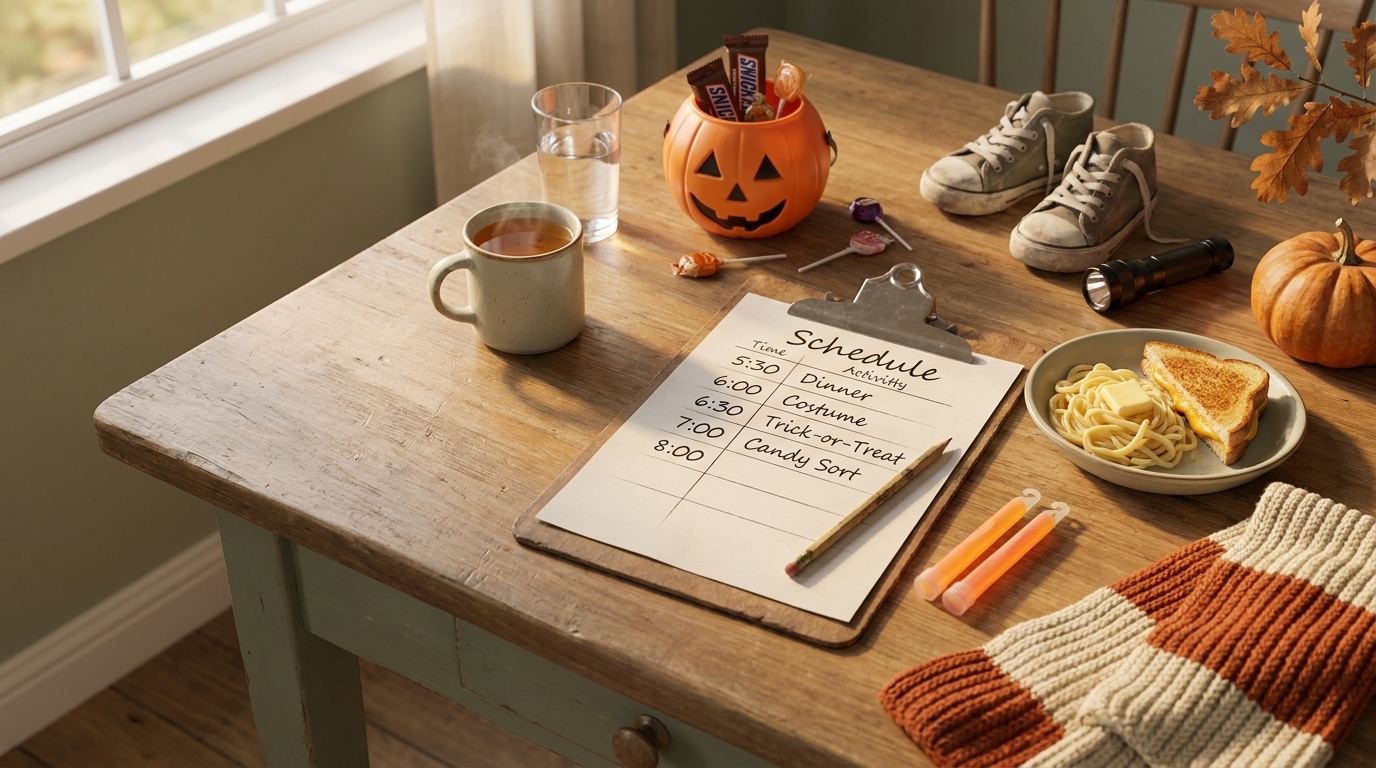
This is the heart of the plan. Below is a simple timeline for a typical school-night Halloween, assuming trick-or-treating begins around sunset, which in many places is roughly 5:30 to 6:30 p.m. at the end of October. Adjust every time to fit your own sunset, your neighborhood’s hours, and your kids’ bedtimes.
You can copy this table, paste it into your notes app, or print this page and tape it to the fridge. Cross things off as you go.
The Evening Timeline (Trick-or-Treating Out)
| Time | What’s happening | Your one job | Done? |
|---|---|---|---|
| 3:00 p.m. | School pickup or end of day | Pack a protein-rich snack (cheese, nuts, yogurt, a sandwich half). Keep it low-effort, but do not skip it. | ☐ |
| 3:30 p.m. | Home, decompression | Quiet time, 20 to 30 minutes. No screens-as-punishment, no questions. Let everyone land. | ☐ |
| 4:00 p.m. | Lay out the gear | Costumes, shoes, coats, flashlights, bags or buckets, and a spare bag for you. Check the shoes for “bees.” | ☐ |
| 4:30 p.m. | Early dinner starts | Serve a real, filling, easy meal (see the dinner section below). Eat before candy, every time. | ☐ |
| 5:15 p.m. | Dinner done, clean up only the minimum | Leave the dishes. Everyone uses the bathroom. Seriously, everyone. | ☐ |
| 5:30 p.m. | Costumes on | Add layers underneath, not on top. Do a quick fix for anything itchy or loose. | ☐ |
| 5:45 p.m. | Reflective gear and phone | Glow sticks on wrists, flashlight in hand, phone charged, your own jacket and comfortable shoes. | ☐ |
| 6:00 p.m. | Out the door | State the rules at the door, not on the sidewalk (see the candy section). | ☐ |
| 6:00 to 7:15 p.m. | Trick-or-treating | Set a time limit or a house limit. Bring water. Know your turnaround point. | ☐ |
| 7:15 p.m. | Head home | Give a 10-minute warning, then a 5-minute warning. End on a high note, not a meltdown. | ☐ |
| 7:30 p.m. | Candy dump and sort | Quick sort, limited choice, one or two pieces tonight (or your family’s rule). | ☐ |
| 7:50 p.m. | Bath or wash-up | Face, hands, and teeth. Costume off, pajamas on. Skip the full bath if you need to. | ☐ |
| 8:15 p.m. | Wind-down | Dim lights, quiet book or calm show, water to drink, no more candy. | ☐ |
| 8:45 p.m. | Bedtime | Expect it to take longer than usual. Stay boring and calm. | ☐ |
| 9:15 p.m. | Your time | Candy hidden, door closed, one thing that is only for you. | ☐ |
The Evening Timeline (Staying Home to Hand Out Candy)
Not every family goes out, and plenty of moms are secretly relieved to stay home. If you are on candy-door duty, here is the lighter version:
| Time | What’s happening | Your one job | Done? |
|---|---|---|---|
| 4:30 p.m. | Early dinner | Same rule: real food first. | ☐ |
| 5:15 p.m. | Set up the porch | Light on, bowl out, chair set, and a “take one” plan in mind. | ☐ |
| 5:30 p.m. | Costumes on | Kids can answer the door with you or take turns. | ☐ |
| 6:00 to 7:30 p.m. | Door duty | Rotate who answers. Keep the bowl by the door so no one is running back and forth. | ☐ |
| 7:30 p.m. | Lights off | Turn off the porch light, bring the bowl in, and call it. | ☐ |
| 7:45 p.m. | Candy sort | Same limited-choice routine as above. | ☐ |
| 8:15 p.m. | Wind-down | Quiet, dim, boring. | ☐ |
| 9:00 p.m. | Your time | Hide the bowl. Sit down. | ☐ |
Why This Timeline Works
A few of the choices in that schedule are doing quiet work:
- A real snack at 3:00 and an early dinner at 4:30 mean your kids start trick-or-treating with food in their bodies. Hungry, overexcited children are far more likely to melt down than children who have eaten.
- The “land” period at 3:30 keeps the post-school crash from colliding with Halloween excitement.
- The gear check at 4:00 moves all the frantic searching to a time when nobody is already upset.
- A fixed end time keeps the night from stretching until everyone is wrecked.
- The final “Your time” line is not a luxury. It’s part of the plan. A plan that ends with you collapsed and resentful isn’t a good plan.
If you want to print this section, use your browser’s print function and choose the “selection” option, or just copy the tables into a note and edit them to fit your family.
Step Three: Feed Everyone Before the Candy (Without Cooking a Big Meal)
Of everything on that timeline, the pre-candy dinner is the most important and the most skipped. It’s easy to understand why: you’re busy, the kids are wired, and the idea of cooking anything feels impossible.
So here is the permission slip: dinner does not need to be good. It just needs to be dinner.
The goal is protein, fat, and some fiber or complex carbs, enough that candy is a treat on top of a full stomach instead of a meal replacement. A full stomach slows the whole evening down. Kids who have eaten tend to ask for less candy, tolerate waiting better, and recover faster from disappointment.
Low-Effort Halloween Dinner Ideas
| Option | Effort | Why it works |
|---|---|---|
| Breakfast for dinner (scrambled eggs, toast, fruit) | Very low | Protein plus carbs, ready in 10 minutes |
| Quesadillas with beans or chicken | Low | Everyone eats them, and you can make them in batches |
| Slow cooker chili or soup, started at noon | Low (set and forget) | Hot, filling, and ready when you walk in |
| Sheet pan sausage and veggies | Low | One pan, minimal cleanup |
| Sandwich “snack plate” with cheese, crackers, fruit, and cut veggies | Very low | No cooking, easy to customize for picky eaters |
| Pasta with butter or sauce, plus a side | Low | Reliable comfort food |
| Takeout or a frozen pizza | Lowest | Perfectly fine. Add a fruit or veggie if you want, or don’t. |
If you want to lean into the theme, you can call the spaghetti “worms” or the string cheese “mummy fingers,” but that’s optional. A spooky name costs you nothing. A spooky project costs you plenty. Choose the name, skip the project.
The “Dinner First” Rule Sets Itself Up
Here’s a small trick: announce the rule early and in a neutral, boring way. “On Halloween we always eat dinner first, and then we go out.” Say it the way you’d say “we always wear shoes outside.” Treated as a fact instead of a negotiation, it draws far less pushback.
If someone refuses to eat, you can calmly offer a simple backup like a banana, a cheese stick, or a piece of toast. You are not required to win this battle. A few bites of anything with protein is a win.
Step Four: Candy Limits That Don’t Make You the Bad Guy
If candy is where most of your Halloween stress lives, you’re in good company. It’s the topic that produces the most guilt, the most arguments, and the most second-guessing. Let’s simplify it.
Pick One System and Stick With It
There’s no single “right” way to handle Halloween candy. Pediatric and nutrition experts are generally fine with a range of approaches, as long as the approach is calm and consistent rather than anxious and punitive. The key is picking one and announcing it ahead of time so you aren’t improvising at 8 p.m. with a screaming audience.
Here are the most common systems, with an honest look at what each costs you:
| System | How it works | Pros | Watch out for |
|---|---|---|---|
| Pick-your-pieces | Kids choose a set number of pieces to keep (say 10) and the rest go away | Gives kids real control and a clear endpoint | Needs a plan for “the rest” |
| The Switch Witch / Great Pumpkin | Kids leave candy out overnight and wake to a small toy or book in exchange | Ends the evening on a fun note | You have to remember to do the swap |
| Daily allowance | One or two pieces a day, with dessert or after a snack | Spreads candy out and builds habits | Requires you to monitor it for weeks |
| Candy night, then done | Kids eat as much as they want on Halloween, then the stash is gone or limited | Takes away the “forbidden fruit” feeling | Can mean a rough night and a rough morning |
| Trade-in | Kids trade candy for coins, a small outing, or a privilege | Rewards them for letting go | Needs a believable “payout” |
My honest suggestion for a tired mom: choose the system that requires the least ongoing enforcement from you. For many families, that’s either the Switch Witch (one decision, one swap, done) or “pick your 10 pieces, rest goes in the freezer or the donation bag.” Anything that needs you to police candy for three weeks is going to wear you down.
Say the Rule Before You Leave the House
Rules announced mid-sidewalk are rules that get argued. Rules announced calmly at the door, before anyone is thrilled and overstimulated, tend to stick. A quick script:
> “Here’s the plan. We’re going to trick-or-treat until about 7:15. When we get home, we’ll sort candy and each pick [your number] to keep. Tonight you can eat [one or two] pieces. The rest will go in the cupboard. Got it?”
Then ask your child to repeat it back. It sounds a little silly, but it takes ten seconds and saves twenty minutes of arguing.
Scripts for the Moments That Actually Happen
Here are a few lines for the exact moments where candy conversations go sideways.
When they ask for candy before dinner:
“Candy is for after dinner. I’ll put your bucket right here so you know it’s safe.”
When they ask for “just one more” at bedtime:
“I hear you. You really want more. Tonight is done, and your candy will be right here tomorrow.”
When they melt down about the limit:
“It’s hard to stop when something tastes good. I’m not changing the rule, but I’m right here.”
Notice that none of these are lectures about nutrition. You’re allowed to hold the boundary and let your kid be upset about it. A child’s disappointment about a candy limit is not an emergency, and it’s not evidence that you’re a mean mom.
What About “Good” and “Bad” Food Language?
Many dietitians who work with children recommend avoiding moral labels like “good food” and “bad food,” and sticking with neutral language such as “sometimes food” and “everyday food.” You don’t need to be perfect about it. Even a small shift away from guilt-laden language can make candy feel less loaded, and that tends to reduce the intensity of the begging. If you’re curious about how your own eating patterns fit into the picture, the habits behind everyday nutrition for moms are worth a look. You deserve a dinner that isn’t a handful of mini chocolates eaten over the sink.
The Candy You Don’t Want in the House
Here’s a quiet truth: plenty of moms find themselves eating the Halloween candy at 9 p.m. out of sheer exhaustion. That’s not a moral failing. It’s what happens when you’re depleted and the candy is within reach.
If that’s you, you can make a plan for it too. Either choose your favorite pieces on purpose and enjoy them sitting down, or send the extras to the freezer, a coworker, a neighborhood donation bin, or a dentist’s candy buy-back program if one is nearby. You’re allowed to protect your own sugar habits as well.
Step Five: Understanding the “Sugar Crash” (and What Actually Causes It)
“Sugar crash Halloween kids” is one of the most-searched phrases this time of year, and it’s worth talking about honestly, because the story most of us grew up with is more complicated than it sounds.
What the Research Actually Says
Controlled studies over several decades have generally not found that sugar causes hyperactivity in children. In blind tests, where neither the parents nor the kids knew who got sugar, parents’ perceptions of hyperactivity often followed what they expected rather than what the child actually ate.
That does not mean you’re imagining things. Kids really do act wild on Halloween night. It just means sugar is probably not the only (or even the main) cause. Consider everything else going on:
- Excitement and anticipation that have been building for days
- A disrupted routine, including later dinner, later bedtime, and different clothing
- Costume discomfort from itchy fabric, tight masks, or the wrong shoes
- Crowds, darkness, and noise that overstimulate small nervous systems
- Skipped meals or snacks leading to genuinely low energy
- Tiredness, especially after a full school day
- Social buzz from being with friends and other kids in costume
Put all that together with a pile of candy and you get what looks like a sugar high. In reality, it’s a perfectly ordinary overstimulated, overtired child.
Why the Crash Feels So Real
The “crash” after Halloween is real too, even if the cause is more than sugar. After a burst of excitement and activity, kids often drop hard. You may see:
- Sudden tears over something tiny
- Clinginess, whining, or defiance
- Refusing to go to bed, then falling asleep instantly
- A rough, grumpy morning the next day
Large amounts of sugar can also affect some kids’ tummies, energy, and sleep. Some children get stomachaches, headaches, or a restless night after a lot of candy, and that’s worth taking seriously. The takeaway is not “sugar is innocent.” It’s “sugar is rarely working alone.”
How to Soften the Crash
You can’t eliminate a post-Halloween wobble, but you can make it much gentler.
| What helps | Why |
|---|---|
| Real food before candy | Steadies energy and slows sugar absorption |
| Water on the trick-or-treat route | Hydration helps with headaches and crankiness |
| Candy in a limited window | Keeps the sugar from stretching across the whole evening |
| A protein-rich snack if they’re still hungry | A cheese stick beats a fourth fun-size chocolate |
| A boring, dim wind-down | Gives their bodies a chance to come down |
| An earlier bedtime the next night | Pays back the sleep debt before it snowballs |
| Lower expectations the next day | Plan for a slow, cozy morning rather than a packed schedule |
If you have a day-after-Halloween commitment you can move or shorten, do it. The grumpiness of November 1st has ended more than one “perfect” parenting plan.
Step Six: Getting Out the Door Without Losing Your Mind
The ten minutes before leaving the house are some of the most stressful of the whole night. Everyone needs to pee, one kid has lost a shoe, and someone has decided the costume is now unacceptable. Here’s how to make that window smaller.
Do the “Costume Test Run” a Few Days Early
A costume that looks great on the hanger can fall apart the second it meets a real child. Have your kids wear it for 15 minutes this week, preferably with the shoes and layers they’ll actually use. You’ll learn about:
- Itchy tags and scratchy fabric
- Masks that block vision or breathing (these are also a safety issue after dark)
- Capes and long hems that trip a child on stairs
- Whether anything can actually be worn over a winter coat
Fixing a problem on a Sunday afternoon is a minor annoyance. Fixing it at 5:50 on Halloween is a crisis.
Build in the Weather
In many places, late October is cold, damp, or both. Costumes that look adorable but offer no warmth lead to kids who want to turn around after four houses.
- Put warm layers under the costume, such as leggings, a long-sleeve shirt, or thermal base layers.
- Choose face paint or makeup over bulky masks when possible.
- Pack hats, gloves, or a cozy jacket in a bag you can carry.
- Bring a rain plan, even if it’s just a clear poncho.
A cold, wet kid is a cranky kid, and a cranky kid is a short trick-or-treat.
The “Launch Pad” by the Door
Set up one spot by the door, even if it’s just a laundry basket, and put everything there at 4:00:
- Shoes and costume pieces
- Flashlights or glow sticks
- Buckets or pillowcases
- Your own jacket, comfortable shoes, and phone charger or backup battery
- Wipes and a plastic bag for any messes
- Water bottles
When it’s time to leave, there’s one place to look. This is the same logic that makes school mornings work, and it applies perfectly here.
The Bathroom Rule
Everybody goes to the bathroom before leaving. Everyone. Even the child who swears they don’t need to. You will thank yourself about eleven minutes after you step off the porch.
Choose Your Out-the-Door Time and Protect It
Decide when you’ll walk out and set an alarm on your phone for 15 minutes before. When the alarm goes off, everyone starts wrapping up. The trick is treating the alarm as the authority, not you. “The timer says it’s time” is far easier on everyone than “because I said so.”
Know Your Turnaround Point
Before you leave, decide how far you’ll go. A short loop of one or two streets can be a delightful evening for a small child. Longer routes tend to end with an exhausted kid you have to carry back. Choose a landmark, such as “we’ll turn around at the red mailbox,” and treat it as part of the plan, not a disappointment.
Step Seven: Protect Your Own Energy During the Evening
Most Halloween advice is about the kids. But the plan only works if you are functioning, so let’s talk about you.
Lower Your Own Bar for “Magic”
Many moms feel an invisible pressure to be the fun, patient, glowing hero of the night. You are allowed to be a tired, pragmatic, mostly-okay mom who walks the sidewalk with a coffee in her hand. Your kids will remember the dressing up, the glow sticks, and the bucket of candy. They will not remember whether you matched your outfit to theirs or hand-made the treat bags.
Decide What You Will Not Do
It’s just as useful to make a “not doing” list as a to-do list. For example:
- I’m not making a themed dinner.
- I’m not hosting a party.
- I’m not decorating beyond one pumpkin.
- I’m not attending the optional event I secretly dread.
- I’m not volunteering for one more class contribution.
If the word “no” feels hard to say out loud, it can help to practice with a few ready-made phrases. The scripts in this guide on saying no to protect your self-care time are written for exactly these moments.
Add Small Pockets of Regulation
You don’t need an hour of meditation to stay steadier during a chaotic evening. Even tiny resets help:
- Take a slow exhale before you walk back into the noise. A long, slow breath out can help settle your body.
- Drink water and eat something real, not just the candy you swiped from the bucket.
- Step onto the porch alone for 60 seconds while someone else watches the door.
- Relax your jaw and drop your shoulders while you wait for dinner to finish. Most of us are clenching without noticing.
- Say one honest sentence in your head: “This is loud, and it will be over by nine.”
If you find your stress ramping up quickly and staying there, it may help to explore broader tools, like the ideas in this piece on managing parenting stress. The same basics, like noticing your body’s signals and taking small breaks, carry over from ordinary days to holiday evenings.
Share the Load Out Loud
If you have a partner, a co-parent, a friend, or a family member nearby, assign jobs before the night, not during it. Don’t assume anyone will “just help.” Say, “You’re on dinner and dishes. I’m on costumes and the door. You’re taking the kids out while I handle the candy sorting.” Specific beats vague every time.
If you’re parenting solo, aim to cut the evening down even more and ask one friend or neighbor to share a stretch of the route. Walking with another family often makes the trip easier. Two adults, even if the kids are different ages, mean one of you can handle the toddler and one the older child.
Build In Your “After” Before You Start
Plan what you’ll do at 9:15, not at 9:30 when you’re too tired to think. Maybe it’s tea and a show, a long shower, or lying on the floor with your phone on silent. If you’re stumped, the routine ideas in this self-care routine for busy moms can help you pick something realistic that doesn’t require another hour you don’t have.
Step Eight: The Wind-Down and the Morning After
You’ve made it home. The bucket is full, the shoes are by the door, and you’re running on fumes. This is the part where many Halloween evenings quietly unravel, because everyone is overstimulated and sugar is within reach. Here’s how to land the plane.
The 30-Minute Landing Routine
- Costumes off, pajamas on. Do it right away, before anyone sits down.
- Quick candy sort. Use your chosen system. Keep it short, and let them keep one or two pieces for tonight.
- Wash up. Hands, face, and teeth. A full bath is optional.
- Water and a calm snack if needed. A banana, toast, or yogurt will do.
- Dim the lights. Lower the noise and the screens.
- One quiet activity. A short book, soft music, or a cuddle.
- Boring bedtime. Keep your voice low and your tone neutral.
A calm landing doesn’t need to be elaborate. It needs to be predictable. If your evenings in general tend to unravel at bedtime, the steps in this guide to a calming evening routine for moms work just as well on Halloween as they do on any other school night.
Expect a Slower Bedtime
Most kids will take longer to settle after Halloween. That’s normal. They’ve had a big night. If you plan for a 45-minute bedtime instead of a 20-minute one, you’re less likely to lose your patience when it takes a while.
If someone is clearly too wired to sleep, try:
- A warm, dim room and a slow-paced story
- A few minutes of quiet back-rubbing or deep pressure hugs
- A small cup of water, with no sugary drinks
- Reassurance that they don’t have to fall asleep right away, only rest
The Morning After
Aim to make November 1st small. Whenever possible:
- Keep breakfast simple and include protein.
- Skip anything that needs your child to behave perfectly.
- Allow extra time to get out the door.
- Expect some big feelings and respond with kindness instead of correction.
- Put the candy somewhere out of sight, so it stays a decision you control rather than an all-morning negotiation.
If you do the Switch Witch or a trade-in, this is also when the “payoff” happens. A small book, a sticker pack, or a trip to the park is plenty. The point is closure, not a second holiday.
Quick-Reference Checklist: “Halloween Without the Meltdown”
Copy this list into your phone or print the page and tape it somewhere you’ll see it.
This week
- ☐ Decide my “Halloween floor” (the minimum that counts as a good night)
- ☐ Do a 15-minute costume test run with shoes and layers
- ☐ Pick one candy system and tell the family
- ☐ Choose a dinner that requires almost no effort
- ☐ Find the flashlights, buckets, and glow sticks
- ☐ Say no to one optional thing
Halloween afternoon
- ☐ Protein-rich snack at 3:00
- ☐ 20 to 30 minutes of quiet decompression
- ☐ Set up the “launch pad” by the door
- ☐ Early dinner before any candy
- ☐ Everyone uses the bathroom
Out the door
- ☐ State the candy rule before leaving
- ☐ Layers under the costume, water in the bag
- ☐ Know the turnaround point and the end time
- ☐ Give 10-minute and 5-minute warnings
After
- ☐ Costumes off, quick candy sort, wash up
- ☐ Dim, quiet wind-down and boring bedtime
- ☐ Candy out of sight
- ☐ Something that is only for me
- ☐ A slow, low-expectation morning tomorrow
When It’s More Than One Hard Evening
Here’s something worth saying plainly. A rough Halloween is normal. Being tired, irritable, and ready for the holiday to be over is part of being a parent with a full life.
But if the overwhelm you’re feeling isn’t limited to one evening, it deserves a closer look. Pay attention if you notice that:
- The dread started weeks ago and doesn’t lift between holidays
- Holiday-season stress feels constant rather than a one-off hard night
- You’re having trouble sleeping, eating, or concentrating
- You feel numb, hopeless, or unusually irritable most days
- You’re snapping at your kids more than you want to and can’t seem to stop
- Everyday tasks feel impossibly heavy
- Your worry or sadness is getting in the way of work, relationships, or daily life
None of that makes you weak or broken, and none of it means you’re failing your family. It simply means that pushing through on willpower isn’t the right tool anymore. If this sounds familiar, it’s worth mentioning to your doctor or a therapist rather than just pushing through. They can help you work out what’s going on and what kind of support would help, whether that’s talking things through, adjusting your routines, checking for physical contributors like thyroid or iron issues, or something else.
If you’re ever in crisis, or thinking about harming yourself or feeling like your family would be better off without you, please reach out right away to a local emergency number or a crisis line in your country. In the United States, you can call or text 988 at any hour. You deserve support, and asking for it is a strong, practical thing to do.
If you need support right now
Reaching out is not an overreaction. These lines are free and confidential.
- Emergency: if you are thinking about harming yourself or your baby, or you can’t keep yourself safe, call 911 or go to the nearest emergency room. This is a medical emergency, and it is treatable.
- 988 Suicide & Crisis Lifeline: call or text 988, 24/7, for anyone in crisis.
- National Maternal Mental Health Hotline: call or text 1-833-TLC-MAMA (1-833-852-6262), 24/7, in English and Spanish, for pregnancy and postpartum support.
- Postpartum Support International: call or text 1-800-944-4773 for help finding a provider who specializes in perinatal mental health. Not an emergency line.
US numbers. Elsewhere, ask your doctor, midwife or local crisis line. This article was written by a parent, not a clinician, and isn’t medical advice.
Frequently Asked Questions
Why do I feel so stressed about Halloween as a mom?
Halloween packs a lot of invisible work into a short window: costumes, early dinner, timing around sunset, candy rules, crowds, and managing everyone’s big feelings, often on top of a regular school day. It also comes with a quiet pressure to make the night feel magical. That combination of high demand and low reserves is why so many moms feel stressed out about Halloween, even when nothing has actually gone wrong. Setting a simple “floor” for the evening and cutting optional extras can lower the pressure a lot.
How can I avoid a sugar crash on Halloween night?
Feed everyone a protein-rich snack in the afternoon and a real dinner before any candy. Bring water on the trick-or-treat route, set a clear limit on how much candy is eaten that night, and keep the wind-down dim and quiet. Research generally suggests that sugar alone isn’t the main cause of hyper behavior, since excitement, a disrupted routine, tiredness, and skipped meals all play a role. Still, a lot of candy can cause stomachaches or restless sleep for some kids, so a limit and a full stomach help. Plan for an earlier bedtime the following night to make up for any lost sleep.
How much Halloween candy should my kids be allowed to eat?
There’s no single correct number. Many families find it works to allow one or two pieces on Halloween night, then a small daily amount with a meal or snack, or to let kids keep a set number of favorites and trade or donate the rest. Choose a system that is calm, consistent, and doesn’t require you to monitor candy for weeks. Announcing the rule before you leave the house, in a neutral tone, tends to prevent most of the arguments.
What are some truly low-effort Halloween ideas for exhausted moms?
Keep it small: wear costumes you already own, serve breakfast-for-dinner or takeout before candy, walk one short loop of the neighborhood, or hand out candy from the porch. Skip themed meals, elaborate decorations, and hosting. A good rule is to cross off anything that costs money you don’t want to spend, takes more than 15 minutes of prep, only exists because you saw someone else do it, or hasn’t actually been requested by your kids. Most families discover their kids care far more about dressing up and getting candy than about the extras.
My child melts down when I enforce the candy limit. What should I do?
Hold the limit calmly and let the feeling happen. You can say something like, “I know it’s hard to stop when something tastes good. I’m not changing the rule, and I’m right here.” Disappointment is not an emergency, and a meltdown does not mean you made the wrong call. Giving advance notice of the rule, offering a small choice within it (like which two pieces to eat tonight), and keeping the candy out of sight after bedtime can all reduce the intensity.
What if I’m a single mom or my partner isn’t helping on Halloween?
Shrink the plan and borrow help. Choose the simplest version of the evening, such as a short route, takeout for dinner, and a firm end time, and ask a friend or neighbor to share part of the trick-or-treat loop so there are two adults for the kids. If you do have a partner, assign specific jobs ahead of time instead of hoping they’ll notice what needs doing. Something like “You handle dinner and the door, I’ll handle costumes and the candy sort” works much better than a vague request for help.
When should I talk to a doctor or therapist about holiday stress?
If the overwhelm isn’t limited to one hard evening and instead feels constant, or if it’s affecting your sleep, appetite, mood, or ability to get through the day, it’s worth mentioning to your doctor or a therapist rather than just pushing through. Persistent dread, numbness, hopelessness, or irritability you can’t shake are all good reasons to reach out. If you ever feel unsafe or in crisis, contact local emergency services or a crisis line right away, such as 988 in the United States.
Closing: You Only Have to Get Through One Evening
Halloween will come, the candy will get eaten (some of it by you), and by Saturday morning most of it will have faded into a pile of wrappers and a slightly sticky memory. You don’t need a perfect costume, a homemade dinner, or a flawless sidewalk performance to give your kids a good night.
You need a floor, a plan for dinner, a clear candy rule, a launch pad by the door, and a few minutes at the end that are yours. Do those things, forgive the rest, and let the evening be exactly as messy and good-enough as it is. You are doing far more than you realize, and tonight, “good enough” is more than enough.