The Ultimate Self-Care Checklist for Moms (Free Printable)
This article provides a free printable self-care checklist for moms, offering 20 small, actionable tasks sorted by the time you have (5, 10, or 15 minutes) to help you prioritize your well-being.
- Download a free printable self-care checklist for moms.
- Find self-care tasks sorted by the time you actually have (5, 10, 15 min).
- Choose from 20 tasks that don't need a babysitter, gym, or clean house.
- Use it as a tool, not a to-do list; any checkmark is a win.
- Customize the checklist by adding your own self-care items.
This post contains affiliate links. As an Amazon Associate I earn from qualifying purchases.
Most of us have made a tea at 3 p.m. and found it cold at 9:40 p.m. Then someone says, “Do something nice for yourself,” and you can’t think of a single thing.
That’s because deciding what to do is one more task, and by mid-afternoon there are no decisions left. So this self-care checklist for moms is sorted by the time you actually have.
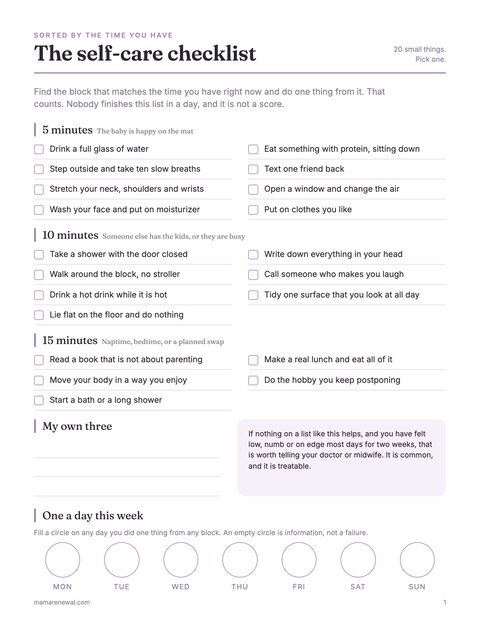
Free printable · 1 pages
Self-Care Checklist for Moms
A one-page checklist of 20 small things sorted into 5, 10 and 15-minute blocks, with space for your own three and a one-a-day week strip.
Free. Your download link appears right here. You'll also join the Mama Reset. Unsubscribe anytime. Privacy
It’s one page with 20 items in three columns: 5, 10 or 15 minutes. No item needs a babysitter, a gym membership or a clean house.
Jump to the checklist and PDF card. Below it: how it works, a note on each item, and a weekly routine.
In this article (10 sections)
- Free Printable Self-Care Checklist for Moms (PDF)
- How This Self-Care Checklist Works
- The 5-Minute Items: Self-Care for the Days You Have Nothing
- The 10-Minute Items: Maintenance That Keeps You From Hitting the Wall
- The 15-Minute Items: Refills That Actually Restore You
- How to Use the Checklist Each Week
- Self-Care Ideas for Busy Moms: Swap by Style and Stage
- When a Self-Care Checklist Feels Like One More Thing (and When to Get Help)
- Frequently Asked Questions
- Start Your Self-Care Checklist With One Thing Today
Free Printable Self-Care Checklist for Moms (PDF)
The easiest way to print this is the PDF download card above. The version below is a backup you can read on screen or print from your browser. Each box is something you can tick with a pen.
✿ Mama Renewal Self-Care Checklist ✿
Find your time. Pick one. Tick it. That’s the whole system.
Week of: ______________
🕐 When You Have 5 Minutes
- 1. Drink a full glass of water before you pick up your phone
- 2. Stand outside in daylight, no screen
- 3. Take five slow breaths with a long exhale
- 4. Eat something with protein, just for you
- 5. Text one person one honest sentence
- 6. Stretch your neck, shoulders, and hips on the floor
- 7. Sit in a quiet spot (bathroom if another adult has the kids) for five full minutes
🕑 When You Have 10 Minutes
- 8. Walk around the block (stroller or not)
- 9. Wash your face or shower with something that smells good
- 10. Do a brain dump: everything in your head onto paper
- 11. Make a hot drink and drink it while it’s still hot
- 12. Reset one surface that’s been stressing you out
- 13. Put in earbuds and listen to something that isn’t about kids
- 14. Set up one thing for tomorrow morning
🕒 When You Have 15 Minutes
- 15. Call a friend (voice, not text)
- 16. Do a gentle movement video or yoga flow
- 17. Read a paper book or magazine
- 18. Spend time on a small hobby or creative thing
- 19. Sit down at a table and eat a real snack or meal
- 20. Start an early, phone-free wind-down
My Own Additions
☐ ______________________________
☐ ______________________________
This week I ticked: ______ / 20 Anything above zero is a win.
How This Self-Care Checklist Works
It’s a tool, not a to-do list. Five rules keep it that way.
- Sorted by time, not category. Most self-care checklists group things into “physical, emotional, social, spiritual.” Your day doesn’t look like that. It looks like I have six minutes while the pasta boils: scattered pockets of 3 to 15 minutes while dinner heats up, in the car line, or during a nap or a show. So the columns are 5, 10 and 15 minutes, and the choice is already made when you’re depleted.
- Don’t try to check everything off. You’re not meant to do all 20 in a day, or even in a week. A good week might be 5 to 8 checkmarks. A hard week might be two. Both count.
- A checkmark means you did it. It doesn’t have to be perfectly enjoyed. If you drank the water while answering a toddler’s questions about why the moon follows the car, it counts.
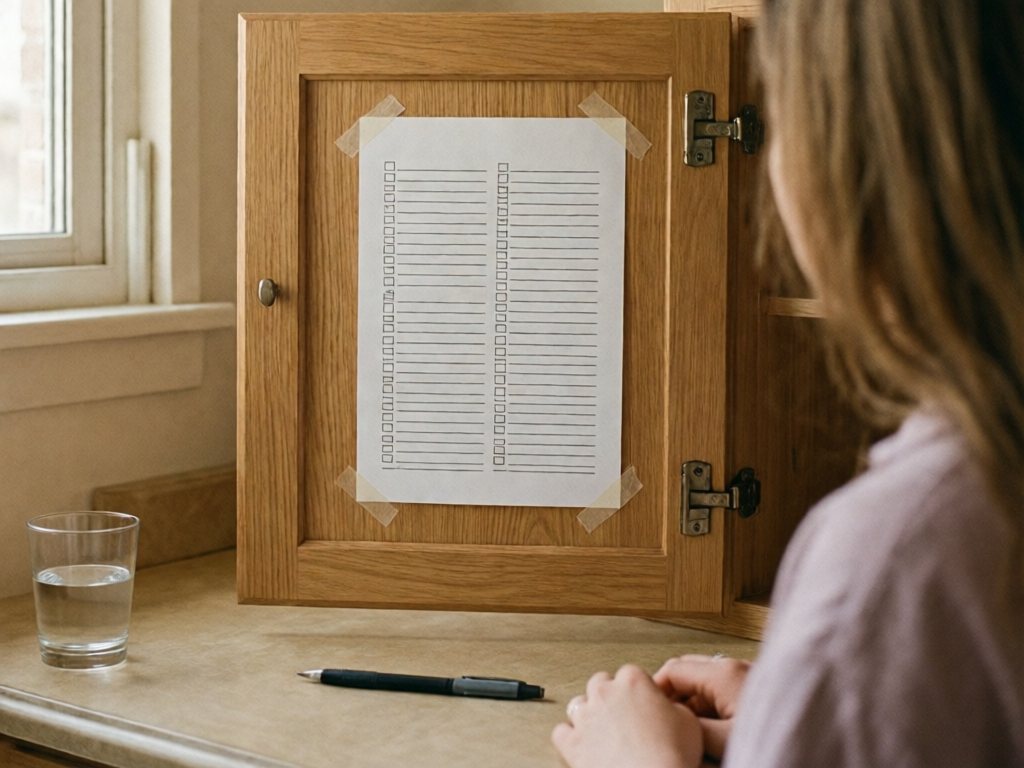
- Print it and put it where you’ll see it. Try the inside of a cabinet door, the bathroom mirror, the fridge or a clipboard by the couch, wherever you already stand at 6 a.m.
- Cross out and replace freely. If “read a real book” makes you feel guilty because you haven’t finished one in two years, cross it out and write your own item. The blank lines at the bottom of the printable are there for exactly that.
If choosing still feels hard because you’re running on no sleep, Mom Sleep Debt is worth a read. You don’t need to solve your exhaustion before you start with one 5-minute item.
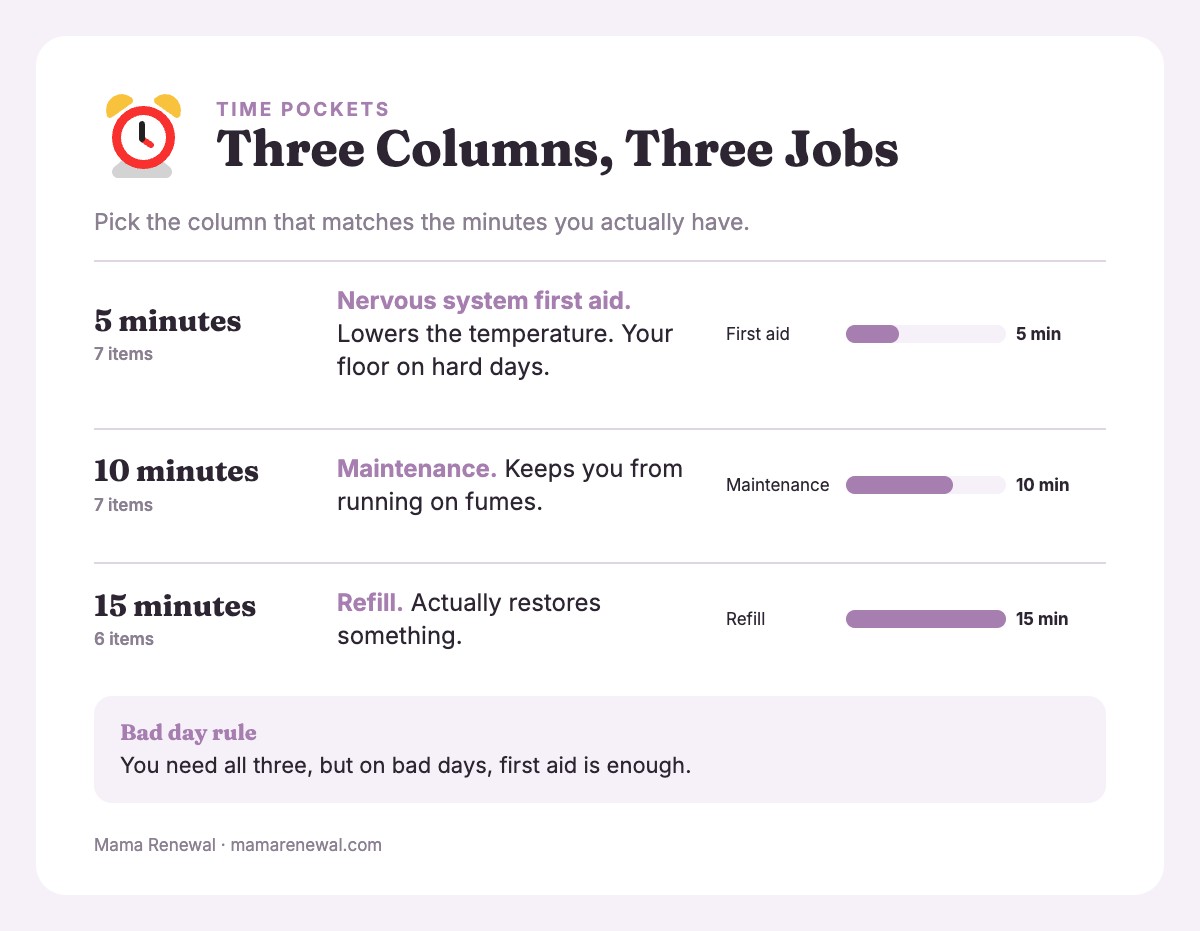
What Each Time Pocket Is For
| Time pocket | What it’s for | Typical real-life moment |
|---|---|---|
| 5 minutes | Nervous system first aid. Lowers the temperature. | Waiting for the microwave, dinner in the oven, kids watching a show |
| 10 minutes | Maintenance. Keeps you from running on fumes. | Naptime start, kids playing independently, car line |
| 15 minutes | Refill. Actually restores something. | Quiet time, partner takes over, early bedtime for kids |
You need all three, but on bad days, first aid is enough.
The 5-Minute Items: Self-Care for the Days You Have Nothing
These seven are your floor. When someone is sick, work is wild, or you slept four hours, reach for these. None needs a babysitter, special equipment, or money.
Safety firstOnly step out of the room when another adult is watching the children. Babies and young toddlers need to stay in your sight. Never leave a child alone in or near water. Otherwise, do the breathing, stretching, and glass of water with the kids in the room. Put a baby down in a safe spot first, such as a crib or play yard, and stay within sight.
1. Drink a Full Glass of Water Before You Touch Your Phone
Mild dehydration may contribute to fatigue, headaches, irritability, and trouble concentrating. That’s also a decent description of the average mom at 2 p.m. It’s easy to go hours with only coffee and whatever is left in a kid’s cup. If fatigue or headaches stick around, mention them to your doctor.
The “before your phone” part matters, because the phone is the first thing that pulls you into everyone else’s needs. One glass of water first is a tiny way of saying I count too. Put a full glass next to your bed the night before and drink it before you sit up.
2. Stand Outside in Daylight, No Screen
Morning light helps set your body clock, which affects sleep, mood, and energy later. You don’t need a hike. Five minutes on the porch, the balcony, or the front steps counts. Leave the phone inside, and take your first hot drink with you in a lidded mug, out of little hands.
In fall and winter this one matters even more, because daylight hours shrink and a lot of us slide into a flat, low-energy feeling without understanding why. If that’s you, the post on Vitamin D and the Fall Slump goes into more detail on beating seasonal low energy early.
3. Take Five Slow Breaths With a Long Exhale
This is the least glamorous item and probably the most useful. When your body is stuck in “go go go,” a long exhale (longer than your inhale) signals your nervous system that it can downshift. Try breathing in for a count of four and out for a count of six or seven. Five rounds takes about a minute.
You can do it at a red light, in the pantry, or while the kids argue over a toy. You don’t have to close your eyes or sit cross-legged. Drop your shoulders, unclench your jaw, and exhale like you’re fogging up a mirror.
TipPick one trigger, such as every time you wait for a door to open or a screen to load, and breathe then.
4. Eat Something With Protein, Just for You
Not the crusts off a sandwich, but something you chose and ate on purpose: a hard-boiled egg, Greek yogurt, a handful of nuts and a cheese stick, a spoonful of peanut butter on an apple.
Safety firstWhole nuts, chunks of raw apple and uncut string cheese can be choking hazards for young children (whole nuts for children under 4). Don’t share them, and keep your plate out of reach of little hands. Eat sitting down, and put leftovers away when you’re done.
Skipping real food and then running on caffeine is one of the fastest ways to feel shaky, short-tempered, and weepy by afternoon. Protein may help steady blood sugar and keep you full longer. If this one hits home, the guide on protein for moms explains why so many of us aren’t eating enough and how to fix it without meal-prepping your whole Sunday.
TipKeep a “mom shelf” in the fridge with things that only you eat: boiled eggs, hummus, cheese, yogurt. Make it a high shelf, and store whole nuts up high in the pantry, so small children can’t help themselves.
5. Text One Person One Honest Sentence
Skip “we should catch up soon” and send something true, like Today was rough and I just wanted to tell someone. Loneliness is one of the quiet drivers of mom burnout. It doesn’t take a long conversation to chip away at it. One real line sent to one real person counts.
TipKeep a short list in your notes app of two or three people who are safe to be honest with. Pick from it so you don’t have to think.
6. Stretch Your Neck, Shoulders, and Hips on the Floor
You carry, bend, lift, hunch over nursing or phones, and hold tension in your shoulders without noticing. Five minutes on the floor, with your back against the couch or lying flat, can undo a surprising amount of it. Roll your neck slowly. Pull one knee to your chest, then the other. Do a gentle twist.
If you want a more structured version, gentle morning stretches for moms lays out a 10-minute routine you can trim down to five.
7. Sit in a Quiet Spot for Five Full Minutes
This one feels silly until you try it. The bathroom is the spot most moms can claim without anyone questioning it. Only close that door when another adult is watching the children.
If you’re the only adult home, skip the bathroom and pick a quiet spot in the room the kids are in: a corner of the couch, the floor beside the play yard, a chair by the window. Keep babies and young toddlers in your sight the whole time. It still counts.
The goal is to sit, breathe, and let your brain be quiet, so don’t scroll. A small basket with hand lotion or a lip balm makes it nicer. There’s a whole post on this, Bathroom Self-Care: What to Do With Your 5 Minutes of Hiding, because for many moms this is the only place with any privacy. It’s not sad. It’s resourceful, as long as another adult is with the kids.
The 10-Minute Items: Maintenance That Keeps You From Hitting the Wall
If the 5-minute list is first aid, these seven are maintenance. Ten minutes is enough to keep a hard week from wearing you all the way down.
8. Walk Around the Block
Ten minutes is about a third to half a mile at a relaxed pace, less with a toddler who stops at every rock. A brief walk can lift your energy and ease stress for many people, and with a stroller or a rock-collecting toddler, it still counts. Near roads and driveways, keep earbuds out or low and hold your toddler’s hand.
If you can leave the kids with a partner or another trusted adult, go solo. If you can’t, bring them along and let the walk be yours in spirit: no agenda, no destination, and ideally no phone in your hand.
9. Wash Your Face or Shower With Something That Smells Good
This is a sensory reset, not vanity. A warm washcloth, a cleanser you actually like, a body wash that smells like something other than baby wipes: these tell your brain the day has a boundary. Ten minutes of warm water can make you feel more human.
You don’t need a ten-step routine. Buy one thing that smells amazing, keep it only in your shower, and don’t let it become the “family” soap.
Safety firstShower only when another adult is watching the children. If you’re alone with a baby or toddler, wash your face at a sink where you can see them, or use a warm washcloth in the room with them. Never leave a young child alone in or near water, including the bathtub.
10. Do a Brain Dump: Everything in Your Head, Onto Paper
Set a timer for ten minutes and write down everything that’s rattling around: appointments, worries, half-ideas, reminders, gripes. Don’t organize or edit. Use one dedicated notebook, not scrap paper, so you can find it later.
This is a good one to repeat weekly. Once it’s on paper, your brain stops spending energy trying to remember it. Afterward, circle the two things that actually need to happen this week. If you’re exhausted even when everyone “helps,” the Invisible Labor Checklist is a good companion.
11. Make a Hot Drink and Drink It While It’s Still Hot

The mom joke about reheating the same coffee four times is funny because it’s true. This item is a small act of rebellion: make tea, coffee, or cocoa, sit down, and drink it at the temperature it was intended to be drunk.
Use a mug you like, not the chipped one with the cartoon on it. An insulated one with a lid means you aren’t racing the clock. Sit somewhere that isn’t the kitchen counter, ideally with a window view.
Safety firstHot drinks scald little ones fast. Keep your mug out of reach, and never hold one while a baby or toddler is on your lap or climbing on you. A lidded insulated mug is safest.
12. Reset One Surface That’s Been Stressing You Out
Not the whole house. One surface: the kitchen counter, the entry table, your nightstand. Pick the one you see first when you walk in the door or wake up. A cluttered visual field adds low-level stress that you may not notice until it’s gone.
Set a timer and clear just that one spot. When it rings, stop, even if you aren’t finished. For a bigger, more structured version this season, Fall Reset Checklist for Moms breaks it into a 7-day room-by-room plan.
13. Put in Earbuds and Listen to Something That Isn’t About Kids
A podcast about something you’re curious about, an album from before you had children, an audiobook, a comedy set. Ten minutes where your brain is being entertained, not asked for something.
This works best paired with something low-effort: folding laundry, a walk, or just lying on the floor. Use one earbud or keep the volume low when little ones are around, and keep it low near roads.
14. Set Up One Thing for Tomorrow Morning
This one is a gift to your future self. Fill the coffee maker, lay out your clothes, or pack one lunch. Pick the single thing that removes the most friction from tomorrow’s first 20 minutes. Pair it with something you already do every night, like brushing your teeth.
It counts as self-care because a calmer start leaves you more patience for everything after.
The 15-Minute Items: Refills That Actually Restore You
Fifteen minutes is long enough to decompress. These six items can feel indulgent, but they’re maintenance too.
15. Call a Friend (Voice, Not Text)
Texting is great, but a call often feels more connecting than a text thread, and more restoring than scrolling. Text first to ask “Got 15 minutes?” so the call lands at a good time, and if they don’t pick up, leave a short voice message anyway. No one free? A voice memo to a friend to play later works too.
If your village is thin right now, you’re not alone. How to Actually Get “Me Time” When You Have No Village covers how to build in time when there’s no grandma down the street.
TipSchedule a standing call with one friend, say Thursdays during the kids’ quiet time, so nobody has to coordinate.
16. Do a Gentle Movement Video or Yoga Flow
Fifteen minutes of low-impact movement is plenty. You don’t need to sweat. Search for “gentle yoga,” “mobility,” or “stretch for tired people” and pick a free 15-minute video. Roll out a mat, or skip the mat and use a towel. If kids join in, great. If they climb on you, also great.
The goal here is to feel better in your body than you did before, not to burn calories or hit a goal. If your body has changed and that’s tender territory, Postpartum Body Image: Finding Peace With Your Changed Body is a kind place to start.
17. Read a Paper Book or Magazine
Even ten pages counts, and a library hold costs nothing. If you used to love reading and haven’t touched a book in a year, choose something easy: a light novel, a memoir, a magazine you can dip in and out of. This is not the time for the “important” book you feel you should read.
Keep it somewhere visible: the couch, your bedside, or the bathroom basket. You’ll be surprised how often a physical book wins over the phone when it’s within arm’s reach.
18. Spend Time on a Small Hobby or Creative Thing
Knitting, sketching, journaling, baking something just for fun, a puzzle, a garden bed, a playlist of songs you love. Anything that is yours and has nothing to do with productivity. A $5 sketchbook and a pencil is enough to start. Fifteen minutes can be enough to get absorbed, the state people call flow.
It’s common to feel you don’t have hobbies anymore. Often it’s because the time disappeared, not the interest. If you’re starting from zero, Hobbies for Busy Moms can help you find something that fits your real schedule.
TipKeep your supplies in one visible bin, ready to grab, so setup takes 30 seconds.
19. Sit Down at a Table and Eat a Real Snack or Meal
Not standing at the counter. Not in the car. Sit, use a plate, and eat slowly enough to taste it. This is surprisingly rare for moms, and it makes a big difference to how nourished you feel.
You don’t need an elaborate plate. Crackers, cheese, fruit, and some nuts at the table can feel like a small luxury. A placemat or cloth napkin signals that this is a “real” meal. If a child under 4 is at the table with you, keep the whole nuts and other choking hazards on your side and don’t share them. To build more of this into your week without heavy planning, Nutrition as Self-Care offers simple habits.
20. Start an Early, Phone-Free Wind-Down
Put your phone on its charger in another room 15 minutes before you want to be asleep. Dim the lights, wash your face, put on something comfortable, and let your brain slow down.
Late-night scrolling can quietly eat into sleep, and it often feels like the only “me time” we have. If that’s your situation, you aren’t doing anything wrong, but there are gentler ways to reclaim it. How to Stop Doom Scrolling walks through breaking the late-night phone habit without shaming yourself.
TipBuy a cheap alarm clock so your phone doesn’t need to be your bedside companion.
How to Use the Checklist Each Week
A checklist only helps if it survives contact with a real week. Here’s how to make it stick.
- Print two copies. Put one where you spend your mornings and one where you spend evenings or hard moments, often the fridge and the bathroom.
- Do a 60-second setup. Read all 20 items once. Star the three that sound easiest right now, cross out anything that makes you cringe, and write two of your own at the bottom.
- Match your time to a column. When a pocket of time appears, check the clock before your phone. Ask How many minutes do I have? Then pick the first item in that column that doesn’t feel like work.
- Tick it immediately. Use a pen. Ticking is its own tiny reward, and it’s proof on the days your brain insists you did nothing for yourself.
Good to knowIf you never get to the 15-minute column, the problem isn’t willpower. Your week has no 15-minute gaps, and that’s worth addressing.
If you like a more structured weekly ritual, the Printable Sunday Self-Care Planner pairs well with this page and helps you plan which pockets of time to protect.
An Example Week (Made Up, but Typical)
This week is invented, to show the scale to aim for.
| Day | What happened | Items ticked |
|---|---|---|
| Monday | Chaotic morning, work deadline | #1 (water) |
| Tuesday | Normal day | #2 (daylight), #11 (hot tea) |
| Wednesday | Sick kid, no time | #3 (breaths) |
| Thursday | Nap day, quiet afternoon | #10 (brain dump) |
| Friday | Partner home early | #8 (walk) |
| Saturday | Family stuff, busy | #5 (text a friend) |
| Sunday | Slow evening | #20 (wind-down) |
This example adds up to 8 ticks, and most days got just one. Real self-care for moms tends to look like that: uneven, interrupted, and still worth it.
Self-Care Ideas for Busy Moms: Swap by Style and Stage
The 20 items above suit most moms, but swap freely until the page fits your life.
Know Your Self-Care Style
Some people recharge through quiet, others through connection, movement or creativity. If a lot of items on this list feel wrong, the free Self-Care Style Quiz helps you find your style, so you can replace items with ones that fit.
Swap Ideas by Style
| If you recharge through… | Try swapping in… |
|---|---|
| Quiet and solitude | Sit in the parked car at home, engine off, while another adult is inside with the kids. Never leave a child alone in a car. Or wear noise-canceling headphones with silence. |
| Movement | Dance to one loud song in the kitchen. Run up and down the stairs. Take a short walk with a podcast. |
| Connection | Send a voice memo to a friend. Sit with your partner for 10 minutes with no screens. |
| Creativity | Doodle in a sketchbook. Rearrange a shelf. Write three lines of a poem. |
| Order and tidiness | Make your bed. Clear the car. Organize one drawer. |
| Sensory comfort | Use hand lotion with a scent you love. Get under a weighted blanket. Light a candle, out of reach of little hands. |
Adjust for Your Season of Motherhood
This checklist is meant for all stages, but what’s possible shifts a lot.
| Stage | Best column | What fits |
|---|---|---|
| Newborn and postpartum | 5 minutes | Water, protein, daylight, and one honest text are plenty, and breathing exercises while nursing are often the easiest to fit in. Rest when the baby sleeps if you can, and say yes to offers of meals. Follow your provider’s guidance on movement after birth, and if your mood or recovery isn’t improving, tell them at your postpartum visit. |
| Toddlers | 5 and 10 minutes, side by side | Stretching on the floor, a walk with the stroller, and a hot drink once they’re settled and the mug is out of reach. |
| School age | 10 minutes, during the school day | Brain dumps, walks, and setting up tomorrow. For the invisible load of school logistics, School-Age Mom Burnout is a good read. |
| Teens | 15 minutes | The emotional load is heavier, so friend calls and hobbies matter more. Try a 15-minute call while they’re at practice. |
| Mixed ages | 5 minutes, plus one longer item on calm days | The easiest 5-minute item on hard days, and a 10- or 15-minute one when the house is calmer. |
Adjust for the Calendar
Your needs shift with the seasons and with your own body. Fall often means a lower-energy, higher-logistics stretch. If you want a seasonal boost, 27 Cozy Fall Self-Care Ideas for Moms Running on Empty is a good source of ideas to add to your own lines. And if you notice your energy and mood changing across the month, cycle syncing for moms can help you match the checklist to what your body needs.
When a Self-Care Checklist Feels Like One More Thing (and When to Get Help)
For some moms, a self-care checklist can backfire. If looking at 20 items makes you feel more behind, more guilty, or more pressured, that’s a signal worth listening to.
Signs the Checklist Is Becoming a Burden
- You feel bad about the unticked boxes.
- You’re doing items out of obligation, not need.
- You’re comparing your week to an imaginary “perfect” week.
- You’ve started using it as proof of what you’re doing wrong.
What to Do Instead
Shrink it. Pick just three items and cover the rest of the page with a sticky note. Three is a perfectly good list.
Reframe it. The checklist is a menu, not an assignment. You wouldn’t feel guilty for not ordering every dish at a restaurant.
Protect the time first. Sometimes the real issue isn’t the list, it’s that you can’t say no to anything. If that’s you, How to Say No: Printable Scripts to Protect Self-Care Time gives you actual words to use.
When It’s More Than Tiredness
Self-care can’t fix everything. Please take it seriously if you notice:
- You feel hopeless, numb, or like you can’t cope most days.
- You’re snapping or raging in ways that scare you.
- You’re having trouble sleeping even when you have the chance.
- You’ve lost interest in things you used to love.
- You have thoughts of harming yourself, or feel like your family would be better off without you.
- You have frightening, unwanted thoughts you can’t shake, including thoughts of harm coming to your baby or children.
These can be signs of depression, anxiety, postpartum mood disorders, or burnout. They deserve real support, not just a checklist. Talk to your doctor or a therapist soon, and tell a trusted person today. If you’ve recently had a baby, the signs of postpartum depression are worth reading too.
About scary thoughts. Unwanted, frightening thoughts are common in motherhood, and they are treatable. Telling a doctor or therapist about them is safe, and it’s how you get help. If you feel you might act on a thought of harming yourself or your child, call 988 or 911 now.
Safety firstSeeing or hearing things others don’t, or severe confusion, can be postpartum psychosis. That is a medical emergency. Call 911 or go to the ER now, and don’t wait for an appointment.
Safety firstIf you or anyone is in immediate danger, call 911. In the U.S., you can call or text 988 anytime if you are in crisis. You can also call or text the National Maternal Mental Health Hotline (1-833-852-6262) at any hour, during pregnancy and after birth. The Postpartum Support International helpline (1-800-944-4773) is there for parents struggling after birth.
“Depleted mother syndrome” is a popular term, not a medical diagnosis. If you recognize yourself in the exhaustion and emptiness described in Depleted Mother Syndrome, persistent symptoms deserve a professional evaluation, and you don’t have to do it alone.
If you need support right now
Reaching out is not an overreaction. These lines are free and confidential.
- Emergency: if you are thinking about harming yourself or your baby, or you can’t keep yourself safe, call 911 or go to the nearest emergency room. This is a medical emergency, and it is treatable.
- 988 Suicide & Crisis Lifeline: call or text 988, 24/7, for anyone in crisis.
- National Maternal Mental Health Hotline: call or text 1-833-TLC-MAMA (1-833-852-6262), 24/7, in English and Spanish, for pregnancy and postpartum support.
- Postpartum Support International: call or text 1-800-944-4773 for help finding a provider who specializes in perinatal mental health. Not an emergency line.
US numbers. Elsewhere, ask your doctor, midwife or local crisis line. This article was written by a parent, not a clinician, and isn’t medical advice.
Frequently Asked Questions
How often should I do self-care as a busy mom?
Aim for a little most days rather than a lot once in a while. One 5-minute item is enough on hard days, and you can add a 10- or 15-minute one when the day allows. A few checkmarks a week still counts, especially if you’re coming from zero.
What’s the best way to print this self-care checklist?
Use the PDF download card in the checklist section, which prints cleanly on one page. Print two copies, one for the kitchen and one for the bathroom or bedroom, so you’re more likely to use it.
I feel guilty taking time for myself. Is that normal?
Very normal. Guilt doesn’t mean you’re doing something wrong; it often means you’re doing something unfamiliar. Start with the smallest items, like water or a few slow breaths, and the guilt tends to soften as they become ordinary.
What are quick self-care ideas for moms with no time?
Start with the 5-minute column: a full glass of water, two minutes of daylight, or a stretch on the floor. None of them needs a babysitter or any gear.
What if I never get even 5 minutes alone?
Use the “with kids” versions: breathing, stretching on the floor, drinking water, eating protein, and stepping outside all work with children nearby. Keep whole nuts and other choking hazards out of reach of children under 4. If you truly have no support, How to Actually Get “Me Time” When You Have No Village has practical ideas for exactly that.
Is a self-care checklist different from a self-care routine?
Yes. A routine is a fixed sequence you repeat on a schedule, while a checklist is a menu you pick from based on the time and energy you have. If you want a routine as well, Self-Care Routine for Busy Moms walks you through building one.
What counts as self-care if I can’t afford spa days or classes?
Almost everything on this list is free. Water, daylight, breathing, a walk, a brain dump, a call with a friend, and a library book cost nothing. If you do want to spend a little, pick one small thing you love, like a good tea or a lotion you enjoy.
Can my partner or older kids use this checklist too?
Yes. The time-based structure works for anyone, and older kids and teens can use a version with items like stretching, a walk, or music. Sharing the page can also open a conversation about protecting each other’s small pockets of rest.
Start Your Self-Care Checklist With One Thing Today
You don’t need a calmer season, a free weekend or a spotless house to take care of yourself. Five minutes, the water in your kitchen and the daylight outside your door are enough to start.
Print the checklist and tape it up. Even one box a week is something kind for the person your family depends on most, so tick one today.