
How to Do a Fall Reset as a Mom Without Overhauling Your Life
Reset your fall without overhauling your life by making small, actionable adjustments to your kitchen, calendar, wardrobe, and mindset. Learn to create systems that work for you this season.
- Embrace a gentle reset: Make small adjustments, aiming for "good enough," not perfection.
- Address four key areas: Reset your kitchen, calendar, wardrobe, and mindset in manageable steps.
- Dedicate short bursts of time: Each reset step takes only 15-60 minutes to complete.
- Streamline your kitchen: Clear unused items and establish fall default meals to reduce decisions.
- Follow a logical order: Start with your kitchen, then calendar, wardrobe, and finally mindset.
This post contains affiliate links. As an Amazon Associate I earn from qualifying purchases.
Picture standing in your kitchen at 6:40 a.m. holding one lunchbox lid and no lunchbox. Three seasons of shoes are piled by the door. Your first thought probably isn’t “I should reset my fall.” It’s “I am clearly bad at this.”
That second thought is the real problem. The season changed and the systems you built in August no longer fit, so you need a few small adjustments, not a color-coded binder or a 5 a.m. routine.
A fall reset can be twenty minutes editing the fridge calendar, one basket by the door, or deciding Thursday is soup night. It isn’t a deep clean or a weekend project that has to be finished to “count.” Fall is a gentler reset point than January, because by mid-October you can see what’s working. Shorter days can also affect energy and mood for some people, and the post on vitamin D and the fall slump covers the energy side.
Below are four small fall-reset steps for your kitchen, calendar, wardrobe, and mindset. Each one has a time estimate, and a free planner follows the same four steps. Have a baby or toddler? Start with what a fall reset looks like at different stages.
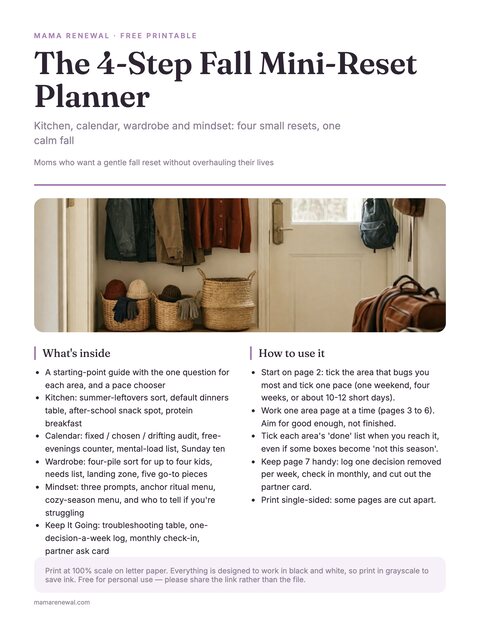
Free printable · 7 pages
The 4-Step Fall Mini-Reset Planner
A writable planner with a pick-your-pace guide, then a kitchen sort and default-dinner table, a calendar audit and free-evenings counter, a kids' clothes sorter and needs list, three reflection prompts and an anchor-ritual menu, plus a troubleshooting table, a four-week log and a cut-out partner ask card.
Free. Your download link appears right here. You'll also join the Mama Reset. Unsubscribe anytime. Privacy
In this article (12 sections)
- The 4-Step Fall Reset Routine for Moms
- Step 1: The Kitchen Reset (Feed People Without Losing Your Mind)
- Step 2: The Calendar Reset (Protect Your Time Before It’s Gone)
- Step 3: The Wardrobe Reset (Fewer Decisions, Warmer Kids)
- Step 4: The Mindset Reset (The One That Makes the Others Stick)
- What a Fall Reset Looks Like at Different Stages
- A Sample Fall Routine for Moms: Reset Timeline
- What to Do When the Reset Falls Apart
- Small Habits That Make the Whole Thing Stick
- The Seasons Ahead: Halloween, Holidays, and the Dark Months
- Frequently Asked Questions
- You Don’t Have to Fix Everything
The 4-Step Fall Reset Routine for Moms
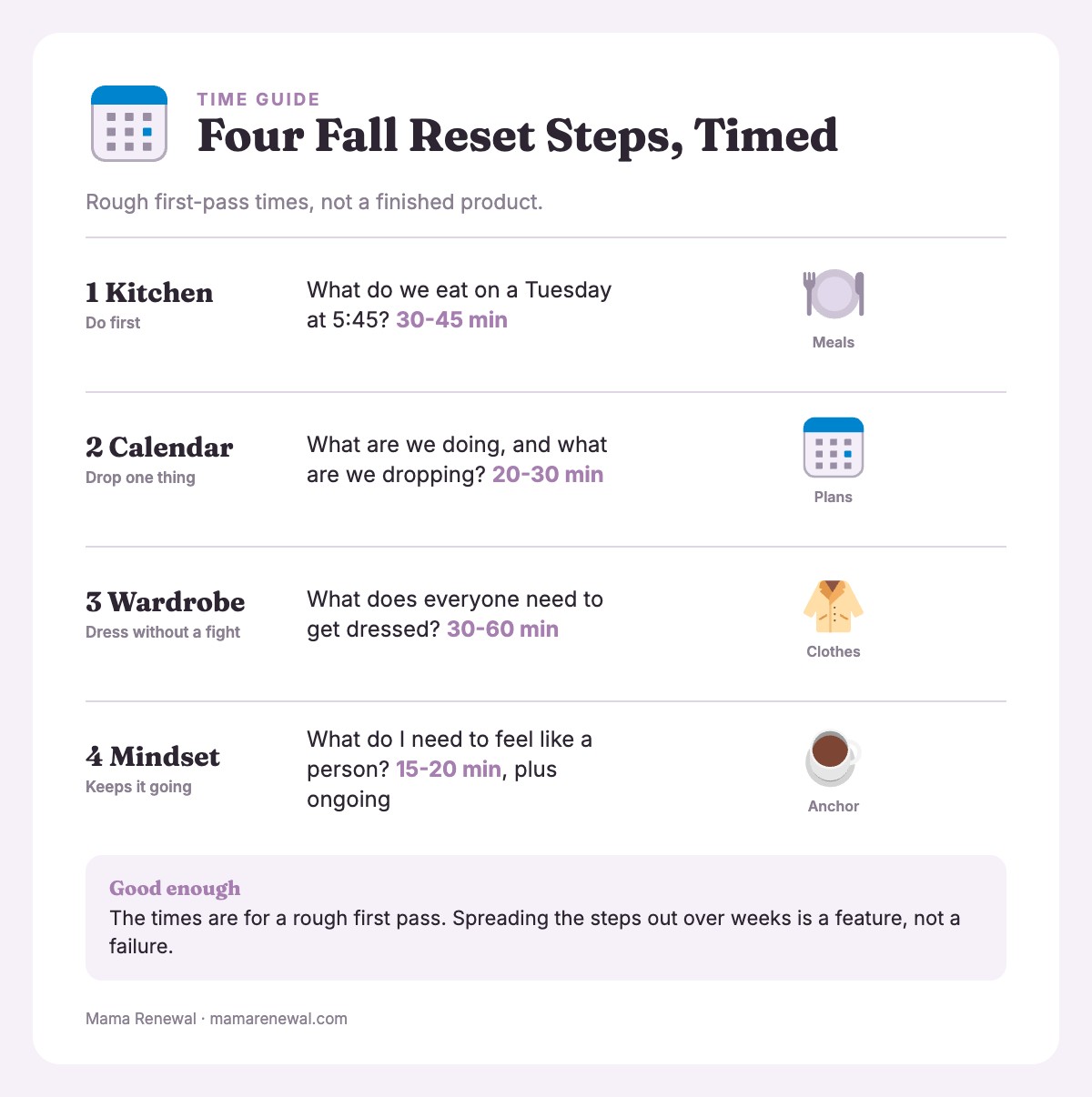
Here’s the map: kitchen, calendar, wardrobe, and mindset. Each of the four areas is small enough to finish in one sitting, and each links to a deeper resource. The free 4-Step Fall Mini-Reset Planner follows the same four steps.
| Step | Area | The one question | Time to a “good enough” reset | Go deeper |
|---|---|---|---|---|
| 1 | Kitchen | What do we actually eat on a Tuesday at 5:45 p.m.? | 30-45 minutes | Fall Reset Checklist for Moms |
| 2 | Calendar | What are we doing, and what are we quietly dropping? | 20-30 minutes | How to Say No: Printable Scripts |
| 3 | Wardrobe | What does everyone need to get dressed without a fight? | 30-60 minutes | Morning Routine for Moms |
| 4 | Mindset | What do I need to feel like a person this season? | 15-20 minutes, plus ongoing | Calming Evening Routine for Moms |
A few notes on how to use this:
- Order matters, loosely. Kitchen comes first, because food is the thing that breaks everyone’s mood. Calendar is second, because it decides how much time and energy you have. Wardrobe is third, because it’s the most visible and satisfying. Mindset is last, but don’t skip it. It keeps the other three from becoming another to-do list.
- You can do one step this week and the next one in two weeks. Spreading it out is a feature.
- “Good enough” is the target. The times in the table are for a rough first pass, not a finished product.
Step 1: The Kitchen Reset (Feed People Without Losing Your Mind)
The kitchen is first because it’s where the daily pressure lands. Three meals a day, plus snacks, plus lunchboxes, plus the dreaded 5 p.m. question, add up to a lot of decisions. A fall kitchen reset is mostly about removing decisions.
Clear the summer leftovers
Open the pantry, the fridge door, and the one drawer where things go to hide. You’re looking for three categories:
- Expired or stale. Toss it.
- Summer-only. Popsicle molds, the pool snacks, the sunscreen that lives in the wrong place. Move it to a bin and put the bin somewhere out of sight.
- Things nobody eats. The cereal someone wanted for exactly one week. Donate it or finish it, and don’t re-buy it.
This takes ten to fifteen minutes with a trash bag. You are not deep cleaning. You’re making room for what you’ll actually use this season.
Pick your fall “default meals”
The most useful kitchen idea is a short list of default meals you can make on autopilot. It isn’t a meal plan, just five to seven dinners your household reliably eats and that you can make without a recipe.
Write them down. Tape the list inside a cabinet. When someone asks “what’s for dinner,” you look at the list instead of reinventing the wheel.
TipStart with the three dinners your family already eats most often, then add from there.
A sample fall default list might look like this:
| Night | Default | Why it works |
|---|---|---|
| Monday | Sheet-pan sausage and roasted veggies | One pan, almost no cleanup |
| Tuesday | Tacos or taco bowls | Everyone builds their own plate |
| Wednesday | Soup and grilled cheese | Cozy, forgiving, freezer-friendly |
| Thursday | Pasta with whatever sauce and a bagged salad | Zero-thought backup |
| Friday | Pizza night (homemade, frozen, or delivered) | Rewards the end of the week |
| Weekend | Slow-cooker meal or breakfast-for-dinner | Flexible around plans |
Your list will look different. The point is that it exists. If your family has dietary needs, picky eaters, or a partner who works late, build around that. A list that fits your real life beats a prettier one that doesn’t.
Stock the “after-school window”
The hour after school or after nap is when kids are hungriest and everyone is most fragile. Set up a spot, a low shelf in the pantry or a bin in the fridge, with three or four grab-and-go options. Cheese sticks, fruit, crackers, hummus cups, whatever works.
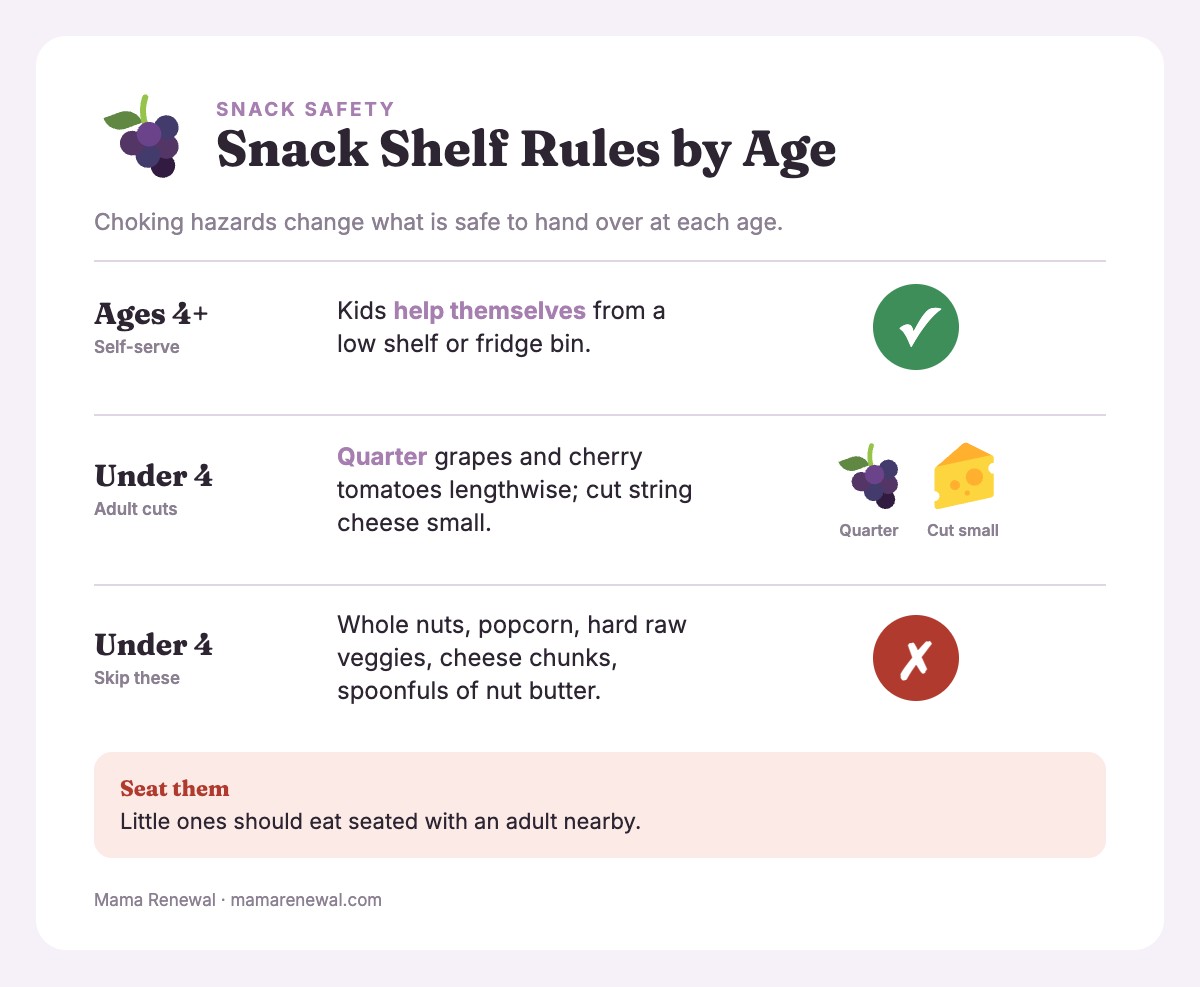
The self-serve shelf is for kids 4 and older. When they can help themselves, you get ten minutes back at the worst moment of the day. For kids under 4, an adult should cut the food up and serve it. That includes cutting cheese sticks and fruit into small pieces.
Safety firstChoking hazards for kids under 4:
- Quarter lengthwise, then cut small: grapes, cherry tomatoes, sausage.
- Cut string cheese into small pieces.
- Skip: whole nuts, popcorn, hard raw vegetables, large cheese chunks, and spoonfuls of nut butter.
- Steam hard vegetables like carrots until soft, or grate them.
Have little ones eat seated with an adult nearby. Self-serve shelves are for kids 4 and older.
Protein basics (lightly)
Fall is a good time to nudge your own eating without a full diet overhaul. It’s easy to skip protein early in the day and lean on caffeine and snacks by mid-afternoon. If you want a simple place to start, the posts on protein for moms and nutrition as self-care are practical and short on judgment. The reset-level move is tiny: pick one breakfast you can eat with one hand that has real protein in it, like a Greek yogurt cup or hard-boiled eggs, and stock it.
Kitchen reset: the “done” checklist
- Pantry, fridge, and the junk drawer cleared of expired and summer-only items.
- A list of 5-7 default dinners where you’ll see it.
- One snack spot kids 4 and older can reach (an adult cuts and serves for under-4s).
- One protein-forward breakfast you can eat in the car if needed.
- Lunchbox pieces all in one place (yes, including the lids).
If you want a room-by-room walk-through that goes beyond the kitchen, the Fall Reset Checklist for Moms breaks the whole house into a 7-day plan.
Step 2: The Calendar Reset (Protect Your Time Before It’s Gone)
Nobody decides to overbook the fall. It happens one “sure, that sounds fun” at a time. Then you look up and every weeknight has a place to be.
Do a calendar audit
Pull up everything: the school calendar, the activity schedules, and the family group chat. Add whatever lives in your head. Put it all in one place. A single wall calendar or one shared digital calendar works. The goal is a single source of truth.
Then look at it as a whole. The fall looks different when you can see it in one view.
Run the audit with three questions:
- What’s fixed? School hours, work, medical appointments, anything non-negotiable.
- What’s chosen? Sports, clubs, playdates, volunteering, social plans.
- What’s drifting? Things you said yes to that nobody is really tracking.
Count your “free evenings”
Count the weeknights in a typical week that have nothing scheduled. If the answer is zero or one, you don’t have a time-management problem. You have an overbooking problem, and no planner can fix that.
TipAim for at least two protected weeknights where nobody has to be anywhere. If you have zero or one today, pick one recurring night and block it on the calendar first.
Decide what you’re quietly dropping
Pick one thing to let go of this season. It might be:
- A committee you joined out of guilt.
- A weekly activity that stresses everyone out.
- A standing social obligation that feels like work.
- A “should” that nobody else even remembers.
Dropping something makes the remaining things possible. If saying no is the hard part, the printable no-scripts give you the exact words. The post on saying no to the PTA and everything else covers the guilt that tends to show up afterward.
Make the invisible visible
Put the mental load on the page. Write down the things that currently live only in your head, such as permission slips, library books, the pediatrician follow-up, and the birthday gift for Saturday’s party.
If you’re the person who tracks all of it, spend five minutes writing every open loop on sticky notes, then give each one an owner and a date on the calendar. That shares the load with your partner or older kids and gets it out of your own head.
If this feels familiar, you may be carrying more than you realize. The school-age mom burnout post and the invisible labor checklist are good companions to this step.
A tiny weekly rhythm
Once the calendar is honest, add one small recurring slot: a ten-minute weekly check-in. Sunday evening works for many families. You look at the coming week, spot the collisions, and decide who’s doing pickup on Wednesday. If you want a structure for it, the printable Sunday self-care planner pairs the logistics with a little something for you.
Calendar reset: the “done” checklist
- Everything in one calendar.
- At least two protected weeknights (or a plan to get there).
- One commitment dropped or scheduled to end.
- Mental-load items written down, not just remembered.
- A weekly ten-minute check-in on the calendar itself.
Step 3: The Wardrobe Reset (Fewer Decisions, Warmer Kids)
The wardrobe step is the most tangible, and for a lot of moms, the most oddly emotional. Clothes hold memories and sometimes a little grief, so go at your own pace. But they also create daily friction, and mornings fall apart when nobody can find a sweatshirt.
Do the kids’ clothes first
Kids outgrow things faster than seems fair, and the switch from summer to fall is the moment it all shows up. Here’s an efficient approach:
- Pull everything out for one kid at a time. Don’t try to do the whole house at once.
- Sort into four piles. Keeps, too small, too summery, and damaged or stained beyond use. A keep fits now and suits the season.
- Try things on only when you have to. For borderline items, ask the kid to put them on while you’re standing right there. Thirty seconds each.
- Make a short “needs” list. Count what’s missing, such as pants, a warm layer, pajamas, or rain boots. Buy those and stop.
You’re aiming for a small, workable rotation, not a closet full of options. Five to seven outfits that mix and match beat thirty pieces that don’t.
Create a landing zone

A pile of shoes by the door usually needs a basket and a hook, not more discipline. A fall landing zone might hold:
- One bin per kid for hats, gloves, and scarves.
- A hook at kid height for jackets.
- A shoe tray with only the current season’s shoes.
- A “grab and go” spot for backpacks and lunch gear.
Put everything else away. If the summer sandals aren’t visible, nobody will fight about them.
Your own closet (the small version)

It’s easy to skip your own clothes entirely, but mornings are hard enough without a closet that fights you. Here’s a quick pass:
- Pull the five things you reach for most. Those are your uniform. Notice what they have in common.
- Find the clothes that make you feel uncomfortable or annoyed. The pants that pinch, the top that rides up. Put them in a bag. You don’t have to donate them today, just get them out of the daily line of sight.
- Add one cozy thing that feels like you. A soft cardigan, good socks, a sweater you actually like. Fall dressing is an easy place to practice choosing yourself.
If your body has changed since having kids, this step can sting. Be kind to yourself about it. The post on postpartum body image addresses the emotional side. The practical rule is simple: clothes should fit the body you have now, not the one you’re waiting to have again.
Tie it to mornings
Three free tweaks that save time on school mornings:
- Set out the next day’s clothes the night before (for kids, and for you).
- Keep a “no-negotiation” outfit option for hard mornings.
- Pair socks in advance, or give up and buy one style and color.
For the rest of the first hour, see the morning routine guide.
Wardrobe reset: the “done” checklist
- Kids’ clothes sorted, outgrown items bagged.
- A short, honest “needs” list (and nothing extra bought).
- A landing zone by the door for fall gear.
- Five go-to pieces for you, easy to find.
- Tomorrow’s clothes chosen before bedtime (when possible).
Step 4: The Mindset Reset (The One That Makes the Others Stick)
You can clear every cabinet and still be running on fumes. This step makes sure you have a place in your own fall plan.
Name what you’re carrying into the season
Take ten minutes with a notebook or your phone’s notes app and answer three prompts:
- What drained me most this summer?
- What’s one thing that actually helped, even a little?
- What do I want to feel more of this fall?
Keep your answers short. “Rushed” and “calm” are valid responses.
If your answers lean toward dread, irritability, or feeling numb, take that seriously. Some of what moms call “just being tired” has deeper roots. The posts on depleted mother syndrome and anger management for moms are gentle starting points. If things feel heavy, please talk to a doctor or therapist. Reaching out is good maintenance, not overreacting.
Safety firstGet help sooner if symptoms are severe or you’re in the first year after birth. If you or your baby may be in immediate danger, call 911 (or your local emergency number) or go to the nearest emergency room. If you feel hopeless or have thoughts of harming yourself or your baby, get help right away.
In the US, call or text 988 any time. You can also call or text the US National Maternal Mental Health Hotline at 1-833-852-6262, 24/7. Postpartum Support International (1-800-944-4773) is a US-based support and referral line, not a crisis line. If you are outside the US, call your local emergency number or crisis line.
Choose one anchor ritual
Choose a single anchor ritual: a small, repeatable thing that signals to your body that you’re allowed to be a person. It should take ten minutes or less and require almost nothing.
Some options that fit real fall life:
- A hot drink you drink while it’s still hot, at the same time each day.
- Five minutes outside with your shoes on, even if it’s just the porch.
- A short stretch when you wake up, before your phone.
- A bathroom door that locks for exactly five minutes. The bathroom self-care post is for you.
- Lighting a candle at the kitchen table after dinner cleanup, or switching on a flameless LED one.
Safety firstTake the locked-door five minutes only when another adult is with the kids, or when older kids are safely occupied within earshot. Never leave a baby or toddler alone. Use a lock you can open from outside.
Keep candles out of kids’ reach, never leave one unattended, and blow it out before bed.
If bubble baths and face masks make you roll your eyes, you’re in good company. The post on self-care ideas for moms who hate bubble-bath self-care is built for you. If you’re not sure what kind of rest actually works for you, the self-care style quiz can help you narrow it down.
Cozy Fall Routine for Moms That Costs Nothing
Fall already comes with cheap rituals, and a cozy routine doesn’t need to be Instagram-worthy. Pick from this list:
| Cozy move | What it takes | When it fits |
|---|---|---|
| Blanket and a show after bedtime | A blanket you already own | Weeknight evenings |
| Soup in the slow cooker on a cold day | Ten minutes of chopping | Sunday afternoons |
| A walk to see the leaves | Shoes and a jacket | After school or on weekends |
| Hot tea on the porch | A kettle and a mug | Any quiet five minutes |
| Pumpkin-anything with the kids | A baking sheet | A Saturday morning |
| Lamps or LED candles instead of overhead light | Bulbs you already have | Evenings |
For a longer menu of ideas, 27 cozy fall self-care ideas has plenty of options at different effort levels. You’re not supposed to do them all. Pick two.
Protect your evenings
If you’re going to guard one part of the day, make it the end of it. Evenings are where moms either recover or keep running. A calmer evening often makes mornings feel easier, and a regular wind-down is a common sleep-hygiene suggestion.
The calming evening routine guide walks through how to wind down when you’re still picking up toys at 8:30. And if your nights tend to dissolve into your phone, the post on breaking the late-night scrolling habit is a kind, practical read.
Mindset reset: the “done” checklist
- Ten minutes of honest reflection on summer and what you want from fall.
- One anchor ritual, scheduled.
- Two cozy-season things chosen (not twelve).
- One evening wind-down habit you’ll protect.
- A plan for who you’ll tell if you’re struggling.
What a Fall Reset Looks Like at Different Stages
“All stages” is a big range. A fall reset looks different with a newborn than with a middle schooler. Here is how to scale it.
| Stage | Best starting step | What to skip | A realistic win |
|---|---|---|---|
| Baby / newborn | Mindset (rest and food) | Wardrobe overhaul, big calendar changes | A stocked snack drawer for you and one cozy ritual |
| Toddler / preschool | Kitchen (simple default meals) | Anything requiring a long uninterrupted stretch | A landing zone by the door and a nap-time reset |
| Elementary | Calendar (activities and logistics) | Perfect lunch planning | One protected weeknight and a Sunday check-in |
| Tween / teen | Calendar and mindset | Micromanaging their wardrobe | Shared calendar and a clear “who does what” list |
| Mixed ages | Kitchen and calendar | Doing everything for everyone | Defaults for meals and a single source of truth for plans |
If you have a baby or toddler, the nap window can be a good moment for the mindset step. The post on using naptime for self-care is a reminder that not every quiet hour has to go to chores.
A Sample Fall Routine for Moms: Reset Timeline
Different families need different speeds. Here are three ways to do the same work.
The one-weekend version
- Saturday morning: Kitchen reset (45 minutes), then the default meal list.
- Saturday afternoon: Wardrobe pass for kids (about an hour), landing zone set up.
- Sunday afternoon: Calendar audit (30 minutes) and one thing dropped.
- Sunday evening: Mindset prompts and picking your anchor ritual.
The four-week version
- Week 1: Kitchen.
- Week 2: Calendar.
- Week 3: Wardrobe.
- Week 4: Mindset, plus a review of what’s working.
The “I only have 15 minutes a day” version
- Day 1-3: Kitchen, one shelf or drawer per day.
- Day 4-5: Calendar. Gather everything, then decide what to drop.
- Day 6-9: Wardrobe, one kid per session (two sessions each if needed).
- Day 10-11: Mindset prompts and anchor ritual.
All three versions get you to the same place. Pick the one that matches your actual energy.
What to Do When the Reset Falls Apart
A kid gets sick, a work deadline hits, the schedule you carefully built meets a school holiday you forgot about. That’s normal and doesn’t mean the reset didn’t work.
The same goes for a past reset that fizzled. Routines built in a burst of energy often fade within a few weeks. The spring reset guide walks through why rebuilding is a normal cycle rather than a failure. You’re tuning what’s already there, not starting from zero.
Here is a short troubleshooting guide.
| What happened | What it usually means | What to try |
|---|---|---|
| The default meal list isn’t being used | The meals are too ambitious | Swap in simpler options; add one “nothing” night |
| The calendar is full again by November | New yeses crept in | Do a five-minute audit; drop one more thing |
| The landing zone is a mess | The system is too complicated | Cut it to one bin per kid |
| You skipped your anchor ritual for a week | It was too big or too rigid | Shrink it to two minutes and restart |
| You feel worse, not better | You’re depleted, not disorganized | Pause the logistics; focus on rest, food, and support |
Sometimes the reset reveals that the problem isn’t your systems, it’s your reserves. If you’ve cleaned and organized and still feel flat, anxious, or angry, that’s information, not failure. The nervous system regulation guide and the piece on mom sleep debt address what’s going on under the surface.
Small Habits That Make the Whole Thing Stick
A few tiny habits do most of the work.
- The five-minute evening sweep. Before bed, return the obvious things to the landing zone and kitchen counters. It prevents the morning pile-up.
- The Sunday ten. Ten minutes on Sunday to look at the week ahead.
- One decision removed per week. Each week, notice a decision you made repeatedly and make it permanent. Thursday is soup night. Library books go in the blue bin.
- A monthly “what’s not working” check. Once a month, ask what’s creating friction and fix one thing.
- Ask for help in specific terms. “Can you handle Tuesday and Thursday pickup?” works better than “I need more help.” If you don’t have a partner or village to ask, the guide to getting me-time when you have no village offers realistic workarounds.
The Seasons Ahead: Halloween, Holidays, and the Dark Months
A fall reset isn’t only about October. It sets you up for what’s coming. Halloween, Thanksgiving, and the December rush all land on top of whatever you’ve built. If your reset is solid, those events feel like events instead of emergencies.
Two things to do now, while it’s calm:
- Pick your holiday boundaries early. Decide what you’re doing and not doing before the invitations pile up. The less you decide in the moment, the less you’ll overcommit.
- Lower the bar on purpose. For Halloween, for instance, a simple plan beats an elaborate one. The Halloween overwhelm survival plan is a good model for how to do “enough” without the guilt.
And keep an eye on your energy as the days shorten. If you notice yourself dragging, sleeping badly, or feeling low, bring it up with your doctor. Go sooner if it feels severe (see the safety note in Step 4). Seasonal changes in mood and energy are common, and there’s no award for toughing it out silently.
Frequently Asked Questions
What is a fall reset for moms, in simple terms?
A fall reset is a short, deliberate set of adjustments to your home, schedule, and mindset as the season changes. It’s about reducing daily friction, not achieving a perfect house.
How do I do a fall reset when I only have a few minutes a day?
Break it into tiny pieces. Spend ten to fifteen minutes a day on one small task, such as one kitchen shelf, one kid’s clothes, or one calendar review. About ten to twelve short sessions of fifteen minutes gets you a rough first pass at all four. Wardrobe may need two sessions per kid.
What should I do first if I feel overwhelmed by everything?
Start with whichever area causes you the most daily stress. If you’re not sure, pick the kitchen and write a short list of default dinners. It’s quick and removes a daily decision.
Is a fall reset different from a spring reset?
The idea is the same, but the focus shifts. Fall resets tend to center on routines, logistics, and getting cozy and grounded as the days get shorter and the school-year rhythm kicks in. Spring resets often focus on rebuilding energy and routines after a rough winter. If you want to compare, the spring reset guide covers the other half of the cycle.
What does a cozy season routine for moms actually look like?
It’s usually small and cheap. Think a hot drink while it’s still hot, a blanket and a show after bedtime, or soup in the slow cooker on a cold afternoon. Pick two or three that fit your life; the goal is comfort, not more chores.
What if I do the reset and still feel exhausted or low?
If you’ve done the practical steps and still feel flat, anxious, irritable, or hopeless for more than a couple of weeks, talk to your doctor or a mental health professional. Go sooner if symptoms are severe or you’re in the first year after birth. Needing more support doesn’t mean you did the reset wrong.
How often should I redo my fall reset?
You don’t need to redo it from scratch. Do a quick check-in once a month to see what’s creating friction and adjust one thing. Save a larger refresh for the start of each season.
You Don’t Have to Fix Everything
The point of a fall reset is not to become a different mom. It’s to make the next few months a little easier for the mom you already are.
You don’t have to do all four areas this week. Pick the area that’s bugging you most, do the smallest useful version of it, and let that be enough for today. The lunchbox will turn up eventually. If it doesn’t, you’ll at least know where the next lid goes.
Go find a warm drink, and take it somewhere quiet for five minutes. That counts as step one too.