How to Use Naptime for Self-Care (Not Just Chores)
This article helps you prioritize self-care during your baby's naptime instead of just doing chores. You'll learn how to use a decision tree and nap length guidance to intentionally spend your limited free time.
- Prioritize self-care during naptime over chores to prevent exhaustion.
- Utilize the Naptime Decision Tree to align your rest with your tiredness level.
- Recognize realistic nap windows and budget your limited free time deliberately.
- Understand why you're drawn to visible chores over unseen rest during naps.
- Always ensure your baby is in a safe sleep space before stepping away.
This post contains affiliate links. As an Amazon Associate I earn from qualifying purchases.
The baby goes down at 1:12. By 1:50 the bottles, the dishes and half the laundry are done, and you haven’t sat down, eaten, or breathed on purpose once. The monitor crackles at 1:51, and you’re more tired than when you started.
This post is about self-care during naptime in the postpartum year. You’ll get a ten-second decision tree that matches your nap to how tired you are. You’ll also get sample splits by nap length and a note on when exhaustion needs a professional. Short on time? Jump to the Naptime Decision Tree.
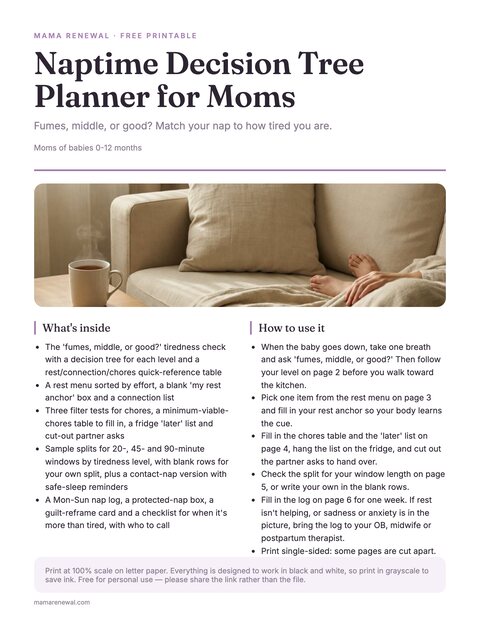
Free printable · 6 pages
The Naptime Decision Tree Planner
A tiredness check and decision tree, a rest and connection menu, chores that earn their place, sample splits for 20-, 45- and 90-minute naps, and a one-week nap log with a when-it's-more-than-tired checklist.
Free. Your download link appears right here. You'll also join the Mama Reset. Unsubscribe anytime. Privacy
In this article (13 sections)
- Why You Do Chores at Naptime Instead of Resting
- How Long Are Baby Naps? What You Can Actually Use
- The Naptime Decision Tree
- What to Do During Baby’s Nap: What Counts as Rest
- Naptime Self-Care Ideas for Connection
- Naptime Chores Worth Doing
- Sample Naptime Splits by Window Length
- How to Stop Feeling Guilty About Resting
- When Exhaustion Is More Than “Just Tired”
- Building a Naptime Routine That Sticks
- A Quick Naptime Cheat Sheet
- Frequently Asked Questions
- Try a Naptime Self-Care Plan This Week
Why You Do Chores at Naptime Instead of Resting
Spending every nap on chores isn’t a character flaw. Three things pull you toward the sink the second the monitor goes quiet.
- Chores are visible, and rest is not. A clean bottle rack is proof. Rest leaves nothing behind, so after weeks of unseen caregiving your brain reaches for work that shows.
- The mess feels like a verdict. A full sink can start to feel like a report card on how you’re doing, so clearing it comes first.
- Naps feel like a limited-time offer. You never know how long this one will last, so you rush to be productive before it ends.
Sometimes there really is no one else to do the dishes. But spending every nap on chores tends to backfire. You use the only energy you had on the lowest-stakes tasks, then walk into the next stretch of baby care with nothing in the tank.
How Long Are Baby Naps? What You Can Actually Use
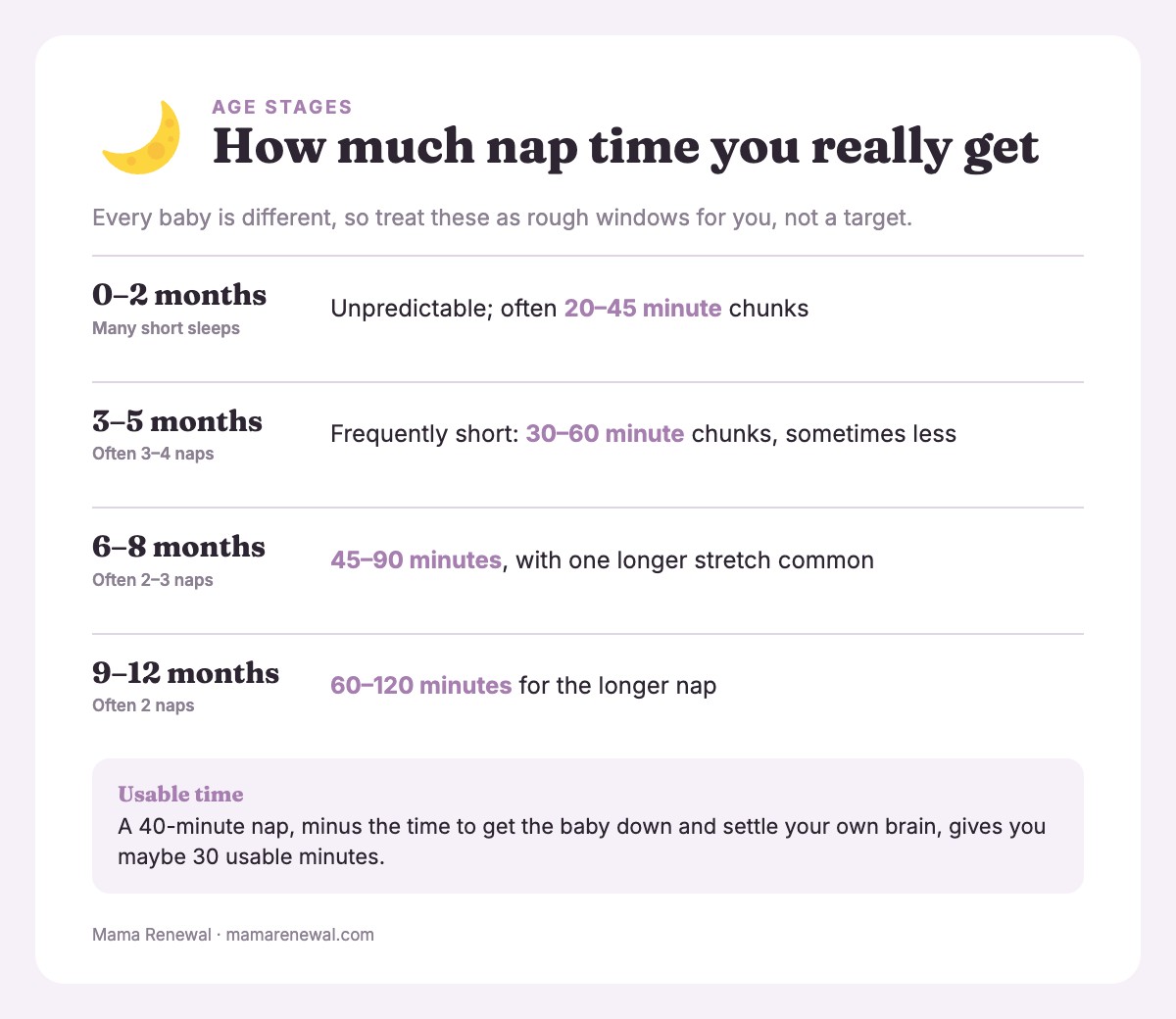
Newborns often sleep in short bursts spread across the day and night. By a few months, naps tend to consolidate. By the end of the first year, many babies are down to one or two longer naps. Every baby is different, and yours may not follow any of this, so treat the table below as rough orientation, not a standard to measure yourself against.
| Baby’s age | Typical nap pattern (varies a lot) | Realistic window for you |
|---|---|---|
| 0–2 months | Many short sleeps, 30 minutes to a few hours, around the clock | Unpredictable; often 20–45 minute chunks |
| 3–5 months | Often 3–4 naps, frequently short | 30–60 minute chunks, sometimes less |
| 6–8 months | Often 2–3 naps | 45–90 minutes, with one longer stretch common |
| 9–12 months | Often 2 naps, sometimes shifting to 1 | 60–120 minutes for the longer nap |
The windows are small. A 40-minute nap, minus the time to get the baby down and your own brain settled, gives you maybe 30 usable minutes. And “usable” is not the same as “productive.” Thirty minutes can hold a lot of rest, or a little bit of everything.
Treat the nap window as a small budget and spend it deliberately. Most days, a split works better than going all-in on anything.
Safe sleep first: before you step away
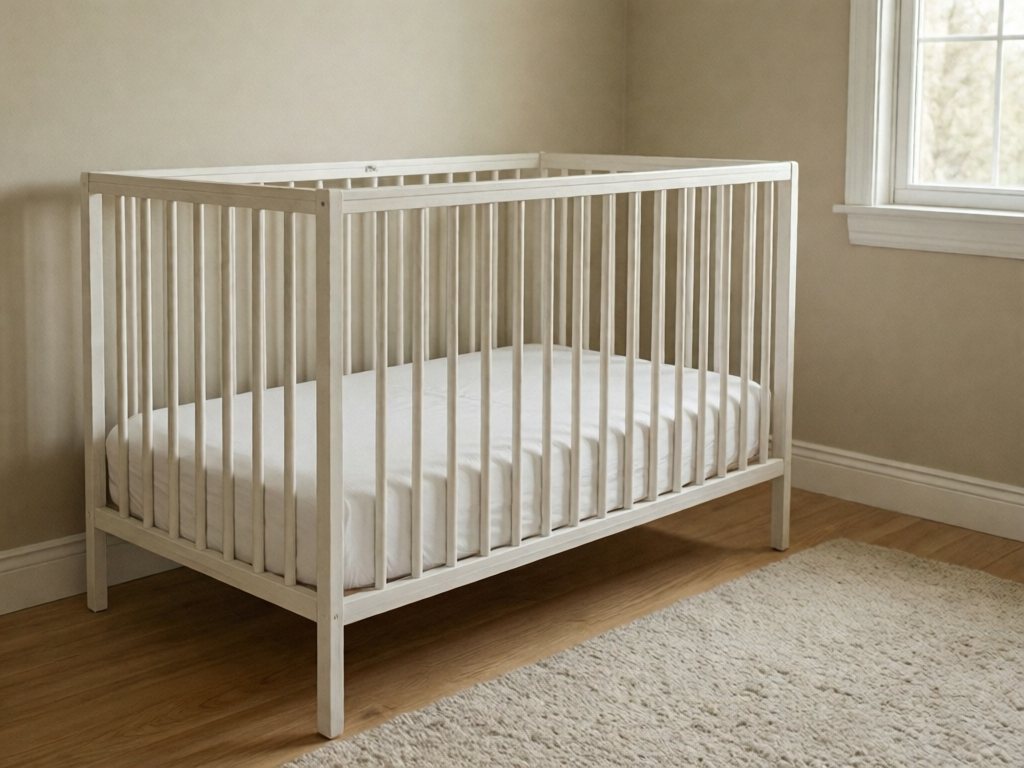
Safety firstYou can step away and use nap time when your baby is asleep in a safe sleep space.
- Baby sleeps on their back, on a flat, firm surface, in a crib or bassinet.
- Keep the crib bare: no pillows, blankets, bumpers or soft toys.
- Share a room, not a bed. The American Academy of Pediatrics recommends room-sharing without bed-sharing. Bed-sharing raises the risk of SIDS and suffocation, especially in the first months.
- Never fall asleep holding or wearing your baby. That goes for a sofa, armchair, recliner or adult bed.
- Feeling drowsy while holding the baby? Move them to the crib or bassinet first, or hand them to another awake adult.
- In a carrier: stay awake the whole time. Babywearing is for when you’re up and alert, not for your own nap.
- Follow the carrier maker’s age and weight limits and its newborn positioning instructions. Run the T.I.C.K.S. checks: tight, in view at all times, close enough to kiss, keep chin off the chest, supported back.
- Too exhausted to stay awake? Ask a partner or support person to take a shift.
- Taken anything that makes you very drowsy, such as sedating medication or alcohol? Have another awake adult in charge of the baby before you lie down.
The Naptime Decision Tree
Here is the tool the whole article is built around. It takes about ten seconds to run, and you can do it standing in the nursery doorway.
The idea is that your tiredness level decides the category, not the size of the to-do list. The list is always long, and it will never be the thing that tells you to stop.
Step 1: Rate your tiredness right now
Pick the closest match, honestly. Nobody is grading this.
- Level 1 — Running on fumes. You’re foggy, snappy, or close to tears. Your eyes burn. Reading a sentence twice is normal today.
- Level 2 — Tired but functional. You’re worn down but can think. You could do a task, but you’d feel it.
- Level 3 — Okay, even a little restored. You slept a decent stretch, or it’s one of those good days. You have some energy to spare.
The tree at a glance
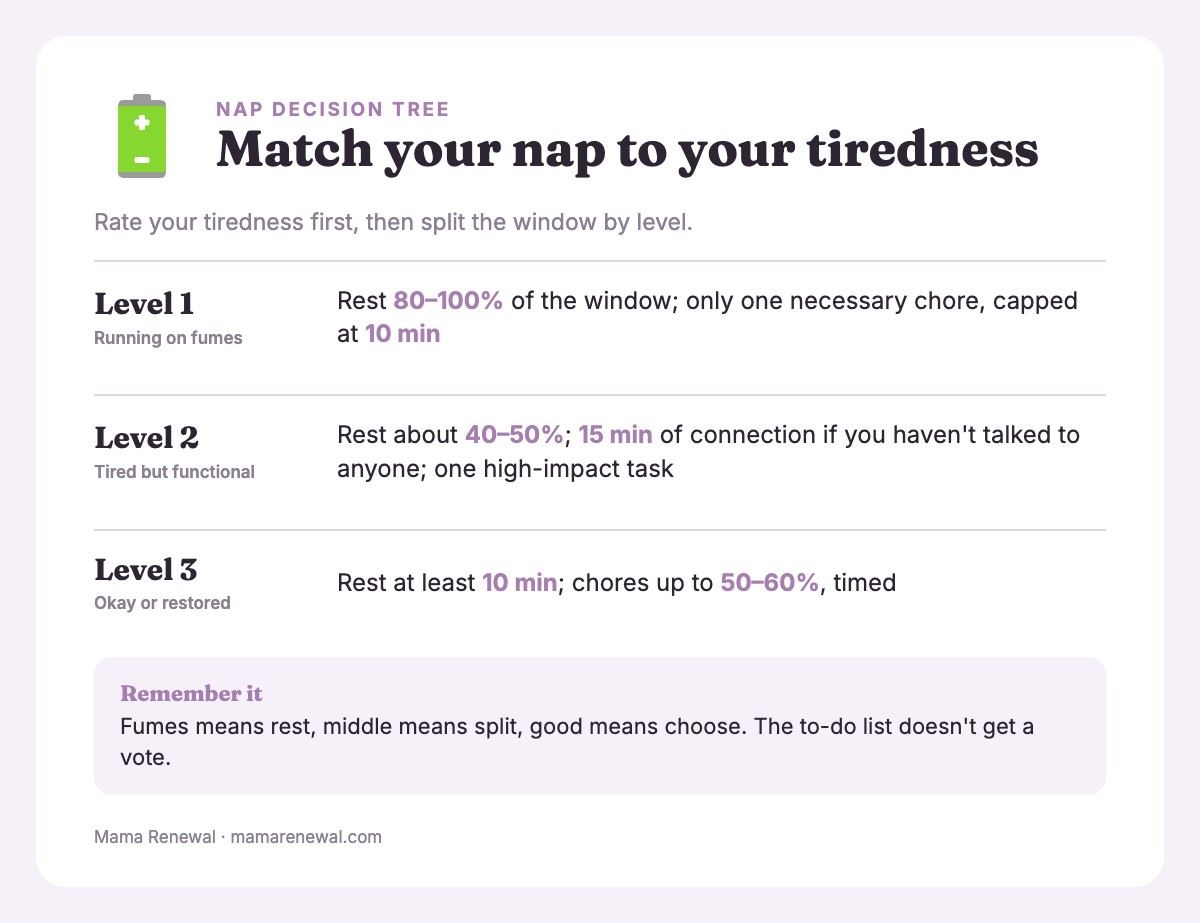
| Your tiredness | Rest | Connection | Chores |
|---|---|---|---|
| Level 1: fumes | 80–100% of the window | Only if it’s soothing (a low-effort text) | Only the one truly necessary thing, capped at 10 min |
| Level 2: tired but functional | About 40–50% | 15 min if you haven’t talked to anyone | One high-impact task, not a full list |
| Level 3: okay or restored | At least 10 min | Optional, as it feels good | Up to 50–60%, timed |
Step 2: Follow your level
Level 1 (running on fumes)
- Is your baby asleep in a safe sleep space, or with another awake adult?
- Yes: lie down, set a timer for a few minutes before the baby usually wakes, and close your eyes even if you don’t sleep.
- No: put the baby in a crib or bassinet, then lie down.
- Can’t put them down: hand the baby to another awake adult, then lie down.
- Nobody available: try the crib or bassinet once more. If your baby won’t settle, sit upright in a straight-backed chair with your eyes open and a short repeating alarm on your phone. That quiet, awake rest is the most you can safely do today. Stay off sofas, armchairs, recliners and adult beds.
- Then: ask a helper to cover one nap this week.
- Would skipping one chore cause real harm? Think bottle prep for tonight, medication, or something time-sensitive. Yes: do only that, capped at 10 minutes, then rest. No: skip chores today.
Level 2 (tired but functional)
- Have you had real adult contact today? No: spend the first 10–15 minutes on a call, a voice memo, or a real conversation with your partner, then rest or do one small chore. Yes: split the window, roughly half rest and half chores.
- Is there one chore that would make the next few hours easier? Clearing the bottle area or starting a meal counts. Yes: do that one thing, not five. No: give the whole window to rest or something that feels like yours.
Level 3 (okay, even restored)
- Is a chore quietly stressing you out? Yes: knock it out now with a timer so it doesn’t swallow the nap. No: choose something that fills you up, like a hobby, a phone call with a friend, a slow meal, or a shower you enjoy. Want a walk-and-talk? Go only if another adult is home with the baby, or bring the baby along in a stroller or carrier.
- Have you reserved 10 minutes for something that isn’t a task? Do it even on a good day.
What the tree is not
Good to knowThe tree is not a rule. If you rest and the dishes still need doing, you’re allowed to feel that tension. The tree doesn’t clean the house. It stops the automatic default, so “chores” becomes a choice you make on purpose, not a reflex you obey.
What to Do During Baby’s Nap: What Counts as Rest
A lot of postpartum advice says “sleep when the baby sleeps,” and for many of us that is not possible, or not productive.
Your brain won’t switch off, you’re too wired from the morning, or the baby naps for exactly thirty-one minutes. Rest covers a lot more than sleep.
Here’s a menu, sorted by how much energy it takes to start.
Zero-effort rest (for Level 1 days)

Do these once your baby is asleep in a safe sleep space or with another awake adult.
- Lying flat with your eyes closed, no phone, for as much of the window as you have (20 minutes is plenty). Sleep is a bonus, not the goal.
- Sitting in a dim room with a warm drink you don’t have to think about.
- Putting a hand on your chest and belly and taking slow breaths. Longer exhales than inhales can help some people settle.
- A warm shower with the water running longer than necessary.
- Listening to an audiobook, a podcast, or soft music with your eyes closed.
Low-effort rest (for Level 1–2 days)
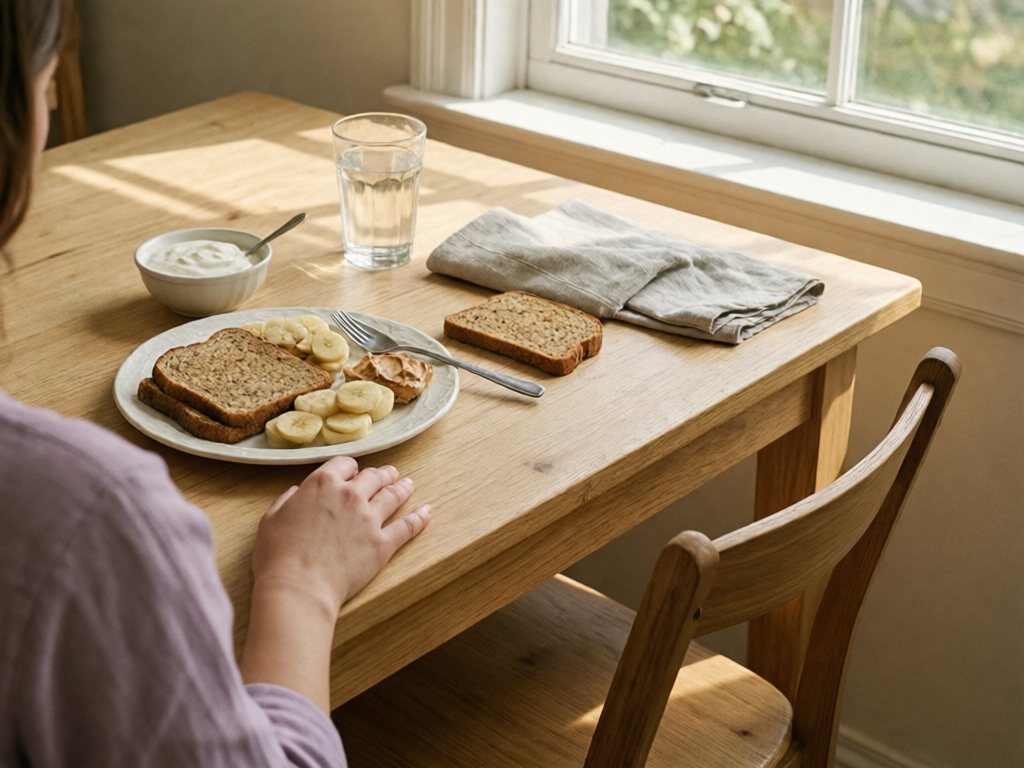
- Eating something real, sitting down, with no screen. (Postpartum bodies burn a lot of fuel, and skipped meals make exhaustion worse.)
- Stretching on the floor for a few minutes.
- Ten minutes of air and daylight at an open window or door. Step outside only if another adult is home with the baby.
- Reading something you actually want to read, not something you “should.”
- A face mask, lotion on your hands and feet, or any small physical comfort.
Restorative-but-active (for Level 2–3 days)
- A short, easy walk if your body is cleared for it and you feel up to it. Go only if another adult is home with the baby, or bring the baby along in a stroller or carrier. Check with your provider about when exercise is right for you after birth.
- Journaling a page of whatever’s in your head.
- A hobby you used to love, even for 15 minutes.
- Slow, simple cooking for pleasure, not for survival.
Safety firstNever leave a baby alone in the home, even asleep and even for a few minutes. If you head out for a walk, another adult stays with the baby or the baby comes with you.
If you want ideas for tiny windows, the post on 5-minute self-care for busy moms is a good companion, since many of those ideas fit the “first ten minutes of a nap” slot perfectly.
The phone trap
Scrolling is the most common thing we do with a nap window, and I’m not going to pretend I’m above it. The problem is that scrolling often feels like rest without delivering it. You come out of a 30-minute scroll with a full brain and an empty tank, and sometimes with a small hit of comparison or dread on top.
That doesn’t mean never touch your phone. A funny video or a voice note from a friend can be lovely. The trick is to decide first: “I’m going to use this window for X,” and let the phone be part of X, not the default fallback. If the scroll follows you into bed at night, my guide to stopping doom scrolling covers that version.
Naptime Self-Care Ideas for Connection
When we talk about naptime, it’s almost always chores versus rest. But there’s a third thing the postpartum year quietly strips away: connection with other adults.
Newborn life can be isolating in a way that sneaks up on you. You may go whole days where the only person you talk to is someone who can’t talk back. Isolation compounds exhaustion. A tired mom who has also had zero adult conversation tends to feel heavier than a tired mom who got ten minutes of laughing with a friend.
That’s why the decision tree gives connection its own column. A short list of ways to do it in a nap window:
- Send a voice memo to a friend or sibling instead of typing. Talking out loud feels more like company.
- Call someone while you do something easy, like folding laundry or sitting by an open window. Phone calls are a natural bridge between “chore” and “connection.”
- Text one person something specific. Try: “I’m having a rough day. Can you send me a funny story?” A small ask is easier than a big one.
- Have a real conversation with your partner (if you have one) in the first few minutes of a nap, before the day’s logistics swallow it. Ask a question that isn’t about the baby.
- Reach out to another new mom. Mom friendships in the postpartum stage often start with a text like “are you also awake right now?”
If your village feels thin or nonexistent, you’re not alone, and it’s not a personal failing. The article on how to get “me time” when you have no village is written for exactly that situation, and it pairs well with using nap windows for connection.
When connection feels like too much
Good to knowLevel 1 days: skip connection. It’s an option, not an obligation. Sometimes people are draining, especially when you’re touched-out or overstimulated. Meet the need you actually have, not the one on a checklist.
Naptime Chores Worth Doing
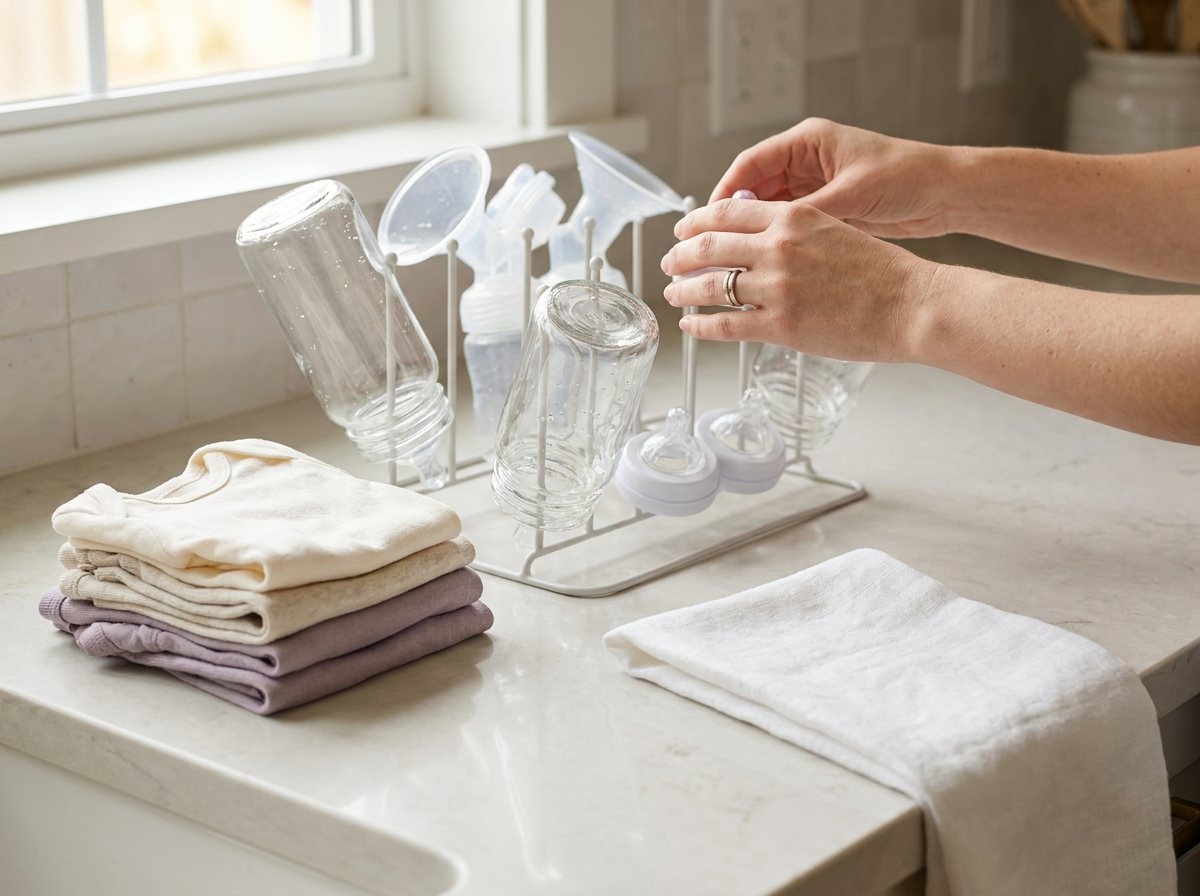
I’m not anti-chore. A clean bottle at 3 a.m. is a gift to future you. The point is to be choosy, so the chores you do during naptime are the ones that earn their spot.
Use these filters before you commit nap minutes to a task.
- Does it save me time or stress later? A slow-cooker meal, pump parts, or tomorrow’s clothes do. A baseboard does not.
- Can only I do it, and only now? If it can wait, be shared, or be done with an awake, content baby, it’s not a nap task.
- Would I regret skipping it? Tonight’s bottle prep, medication, or a bill due today, yes. A sock drawer, no.
A “minimum viable chores” list
On days when you need to protect rest, shrink the list to the essentials:
| Category | Minimum viable version |
|---|---|
| Feeding | Wash what you need for the next feed or two. Follow your pediatrician’s guidance on cleaning and sanitizing, especially if your baby is under 3 months, premature or immunocompromised. |
| Laundry | Only what the baby (or you) will need to wear tomorrow |
| Dishes | Enough to eat and prepare with; the rest can soak |
| Tidying | One surface, one room, five minutes |
| Meals | Something that takes under 10 minutes or is already prepped |
| Mail/admin | Only what has a deadline this week |
Everything else goes in a “later” bucket. If a “later” list makes you anxious, write it down in one place so your brain stops carrying it. Writing it down is more restful than rehearsing it.
Sharing the load
If you have a partner or helper, naptime chores are a great place to renegotiate. A few lines that tend to work:
- “I’m using the nap to rest today. Can you handle the dishes tonight?”
- “Can you do bottles in the evening so I can skip them during the nap?”
- “I need the first 20 minutes of the nap for myself. After that I can help with whatever’s left.”
If you’ve been quietly carrying more than your share, the invisible labor checklist can help you see the full picture and start the conversation with specifics instead of general frustration.
Sample Naptime Splits by Window Length
Here’s what the decision tree can look like in practice. These are examples, not prescriptions. Setup time (getting the baby down, settling your own brain) shortens every window, so start your timer once you’re actually sitting or lying down.
A 20-minute window (common in the early weeks)
| Tiredness | Plan |
|---|---|
| Level 1 | 20 minutes lying down, eyes closed, phone away |
| Level 2 | 5 minutes eating a snack sitting down, 10 minutes eyes closed, 5 minutes one tiny task |
| Level 3 | 10 minutes of something you enjoy, 10 minutes of a timed chore |
For Level 3, the 10 minutes of something you enjoy is your rest.
A 45-minute window
| Tiredness | Plan |
|---|---|
| Level 1 | 35–40 minutes of rest; 5-minute essential task only if truly needed |
| Level 2 | 10 minutes of connection (a call or voice memo), 20 minutes of rest, 15 minutes of one high-impact chore |
| Level 3 | 15 minutes of chores, 10 minutes of connection, 20 minutes of something that fills you up |
A 90-minute window
| Tiredness | Plan |
|---|---|
| Level 1 | 60+ minutes of rest, a real meal, a few minutes of fresh air at an open window |
| Level 2 | 15 minutes of connection, 35 minutes of rest, 30 minutes of chores, 10 minutes of a snack or tea |
| Level 3 | 30 minutes of chores, 15 minutes of connection, 35 minutes of a hobby or movement, 10 minutes to breathe before the baby wakes |
The “baby only naps on me” version
If your baby contact naps, your window isn’t hands-free, but it’s still yours. The one firm rule is that you stay awake and alert while you hold a sleeping baby, and that still leaves room for an audiobook, a quiet phone call, reading, or simply sitting still without guilt.
Safety firstContact naps are awake time for you. Sit upright, not reclined or lying down, and keep your eyes open. Have a plan for drowsiness before you settle in: a short repeating alarm on your phone, or another awake adult nearby. If you feel yourself fading, move the baby to the crib or bassinet, or hand them over, before you rest.
It won’t look like the nursery-door version of rest, but it counts. If it’s wearing you down, ask a support person to take the baby for one nap a week so you can lie flat on your own.
How to Stop Feeling Guilty About Resting
You can run the whole decision tree, choose rest, and still feel a pang of “I should be doing something.”
Guilt is not evidence you’re doing it wrong. It’s often just the old habit protesting. When you stop doing something you’ve always done, the brain objects for a while. That doesn’t make the new choice wrong.
A few reframes that I find helpful:
- “Rest is part of the job.” Caring for a baby is physically and mentally demanding work. Recovery is part of doing that job sustainably, not a reward for finishing it.
- “Future me gets a better afternoon.” The 30 minutes of rest you take now may show up as a less frayed 4 p.m. later.
- “The mess is temporary; the depletion compounds.” Dishes can be done in ten minutes tomorrow. Chronic exhaustion takes much longer to undo.
If guilt is loud, try a small ritual. Before you start your rest, say out loud (or in your head): “This time is for me, and the dishes will be there later.” It sounds silly, and it often helps.
If the voice that says you don’t deserve rest is constant, or you can’t relax even when you have time, two articles might resonate. Try nervous system regulation for moms and depleted mother syndrome.
When Exhaustion Is More Than “Just Tired”
Being tired in the postpartum year is expected. Broken sleep, healing, hormonal shifts, and round-the-clock care add up, and the piece on mom sleep debt explains why that tiredness can feel so stubborn. But there’s a difference between the tiredness that eases when you get some rest and a heaviness that doesn’t.
It’s worth mentioning to your OB, midwife, or a postpartum therapist if:
- You rest, even properly, and still feel exhausted in a way that doesn’t lift. Persistent exhaustion can also have physical causes such as anemia or thyroid problems, so mention it at your postpartum checkup.
- You feel persistently sad, empty, or hopeless, most days, for more than a couple of weeks.
- You feel anxious a lot of the time, with racing thoughts, constant worry, or a sense of dread that’s hard to switch off.
- You have trouble sleeping even when the baby is asleep and you have the chance.
- You feel numb or disconnected from your baby or from things you used to enjoy.
- You’re finding it hard to function day to day: eating, getting dressed, getting through the basics.
- You have unwanted, intrusive thoughts that frighten you. These are common in new parents, and a provider can help you make sense of them, so bring them up soon. Thoughts of harming yourself or your baby need urgent help. See the box below.
None of this means you’re failing, and none of it is your fault. Postpartum depression and anxiety are common and treatable. They can start during pregnancy or at any point in the year after birth, and they sometimes last or show up later than that. Baby blues usually ease within about two weeks, so a low mood that lasts longer, or feels severe, is worth a visit. Telling a provider is not overreacting. It’s the same as mentioning a symptom that won’t go away. This article can’t diagnose anything, and it isn’t a substitute for professional care.
Safety firstCall your local emergency number right away if you feel confused, see or hear things that aren’t there, or feel severely agitated. Do the same if you have thoughts of harming yourself or your baby, or feel unable to keep yourself or your baby safe. You can also go to the nearest emergency room. In the U.S., call or text 988 for the Suicide & Crisis Lifeline. The National Maternal Mental Health Hotline (1-833-852-6262) offers free, confidential support around the clock. You deserve support, and it’s available.
A small practice for noticing
If you’re not sure whether what you’re feeling is “normal tired,” try this for a week. At the end of each nap, jot down two words: how tired you felt before, and how you felt after. If you notice that rest helps, even a little, that’s a good sign your body is responding. If nothing seems to touch it, or the sadness or anxiety is showing up regardless, you’ll have a concrete record to bring to your appointment. Bring the log and tell them how long the symptoms have lasted.
Building a Naptime Routine That Sticks

The decision tree is a tool, but tools work better when they live somewhere you’ll see them. A few ways to make this stick.
- Make the first minute automatic. When the baby goes down, take a single breath, ask “fumes, middle, or good?” and pick your branch. Don’t start walking toward the kitchen first.
- Set a “rest anchor.” Choose one small thing that signals “this nap is mine”: a specific blanket, a particular mug, a playlist, a corner of the couch. Cues help your body downshift faster.
- Keep a “later” list on the fridge. A single page where chores wait their turn. It keeps your brain from rehearsing them.
- Prep the night before. Lay out what you’ll need for the next day’s nap: a snack, water, the book, the headphones. Removing decisions in the moment makes rest easier to start.
- Plan one protected nap a week. If you can’t rest at every nap, pick one and defend it. Tell your partner, “Tuesday afternoon nap is mine.”
- Check in weekly. Once a week, look at how you’ve been spending your nap windows. If it’s all chores again, just notice and adjust. The Sunday self-care planner is a handy spot to plan your protected window for the week ahead.
For ideas on getting your own rest outside the baby’s nap, see nap strategies for moms.
A Quick Naptime Cheat Sheet
- Check your tiredness (fumes, middle, good) and match the nap to it: fumes means rest, middle means split, good means choose.
- Use a timer so no category eats the whole window.
- Skip the phone default unless you’ve chosen it.
- If rest doesn’t help, or sadness or anxiety is in the picture, tell your OB or a postpartum therapist.
If you need support right now
Reaching out is not an overreaction. These lines are free and confidential.
- Emergency: if you are thinking about harming yourself or your baby, or you can’t keep yourself safe, call 911 or go to the nearest emergency room. This is a medical emergency, and it is treatable.
- 988 Suicide & Crisis Lifeline: call or text 988, 24/7, for anyone in crisis.
- National Maternal Mental Health Hotline: call or text 1-833-TLC-MAMA (1-833-852-6262), 24/7, in English and Spanish, for pregnancy and postpartum support.
- Postpartum Support International: call or text 1-800-944-4773 for help finding a provider who specializes in perinatal mental health. Not an emergency line.
US numbers. Elsewhere, ask your doctor, midwife or local crisis line. This article was written by a parent, not a clinician, and isn’t medical advice.
Frequently Asked Questions
What should I do during my baby’s nap if I only get 20–30 minutes?
Pick one category and keep it simple. On a tired day, lie down with your eyes closed for the full window. On a middle day, spend 5 minutes eating something, 15 minutes resting, and 5 minutes on one small task. On a good day, do a single timed chore and save a few minutes for something you enjoy. Short windows are best used for one or two things, not a long list.
Is it okay to skip chores completely during naptime?
Yes, especially on days when you’re running on empty. Chores can often be shared, shrunk, or done later, while exhaustion tends to build if it’s ignored. If a task is truly essential, like prepping a bottle you’ll need tonight, do just that and protect the rest of the window. The house being imperfect for a day is a much smaller problem than being depleted for weeks.
What are some good naptime self-care ideas for new moms?
Good options include lying down with your eyes closed, eating a real snack sitting down, and taking a warm shower. You could also get some fresh air at an open window, call or voice-message a friend, or stretch gently. Reading a few pages or writing a quick journal entry works too. Choose based on your energy: the more tired you are, the lower the effort should be.
Should I really “sleep when the baby sleeps”?
Sometimes, and it can be a great use of a nap, particularly in the early weeks when your body is recovering. But it’s not always realistic. Your mind may not switch off, or the nap may be too short. Rest counts even if you don’t fall asleep: lying quietly, breathing slowly, or sitting somewhere comfortable can help. If you’re sleeping when the baby sleeps and still feel exhausted, that’s worth mentioning to your provider.
How do I stop feeling guilty about resting instead of cleaning?
Guilt often shows up because you’re changing a long-standing habit, not because you’re doing something wrong. It can help to remember that rest is part of caring for a baby sustainably. The dishes will still be there, but your energy won’t refill by itself. This is one nap, not a forever rule. A small ritual helps some people, such as saying “this time is for me” before you start. If the guilt feels constant or overwhelming, it’s worth talking about with a therapist.
How do I know if my exhaustion is normal or something I should mention to a doctor?
Tiredness that eases with rest is common in the postpartum year. It’s worth mentioning to your OB, midwife, or a postpartum therapist if exhaustion feels impossible to shake even when you do rest. The same goes if it comes with persistent sadness, anxiety, numbness, trouble sleeping when you have the chance, or difficulty getting through the day. You don’t need to wait until things feel unmanageable. If you ever have thoughts of harming yourself or your baby, seek help immediately through your local emergency number, a crisis line, or an emergency room.
What if my baby only contact naps and I can’t put them down?
You can still use the time, within safe sleep guidelines from your pediatrician. Audiobooks, podcasts, quiet phone calls, reading, or simply letting yourself sit still all count as rest or connection. Stay awake and alert the whole time you’re holding or wearing a sleeping baby. Never fall asleep with your baby on a sofa, armchair, recliner or adult bed. If you feel yourself drifting off, put the baby in a crib or bassinet or hand them to another awake adult. If contact naps are wearing you out, ask a partner or support person to take over for one nap a week so you can lie down properly.
Try a Naptime Self-Care Plan This Week
You don’t have to overhaul your day or stop caring about the laundry. Try one nap this week where you ask “How tired am I?” before you ask “What needs doing?”
That nap might be twenty minutes lying down with your eyes closed, a call with someone who makes you laugh, or a warm meal eaten sitting down. It might be one timed chore and then a long exhale. Pick one, notice how the rest of your afternoon feels, and adjust from there.