Grandparents Buying Too Many Christmas Gifts? What to Say
If grandparents buy too many gifts, you'll learn why it bothers you and how to set boundaries effectively. Get word-for-word scripts and strategies to ask for fewer, more meaningful gifts.
- Understand why grandparents overbuy (often to show love) to frame your requests.
- Before talking, decide on a specific number (e.g., 3 gifts) and preferred categories.
- Use provided scripts to communicate your wishes before shopping starts, ideally in late Oct/early Nov.
- Address your discomfort (clutter, overstimulation, mental load) to validate your feelings.
This post contains affiliate links. As an Amazon Associate I earn from qualifying purchases.
Last December, my friend Dana stood in her living room at 8:40 on Christmas morning holding gift number fourteen, a toddler-sized plastic kitchen. Her two-year-old had opened four, fixated on a wooden spoon, and wandered off to stack couch cushions.
If grandparents buying too many gifts leaves you annoyed, then guilty for being annoyed, you’re not ungrateful. This page gives you word-for-word scripts for before the shopping starts, on Christmas Day, and afterward, a script table you can screenshot, and gift ideas to ask for instead.
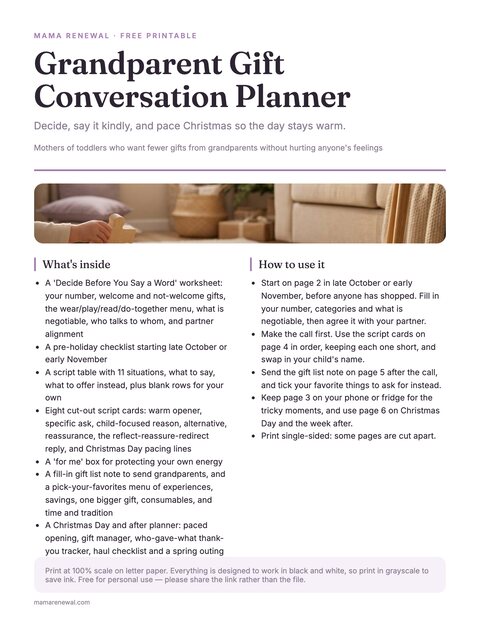
Free printable · 6 pages
Grandparent Gift Conversation Planner
A decide-first worksheet, an 11-row script table, cut-out script cards, a fill-in gift list note with a menu of things to ask for instead, a Christmas Day and after planner, and a pre-holiday checklist with a 'for me' box.
Free. Your download link appears right here. You'll also join the Mama Reset. Unsubscribe anytime. Privacy
In this article (13 sections)
- Why Grandparents Go Overboard (It’s Usually Not About the Stuff)
- Step One: Decide What You Actually Want Before You Say a Word
- Step Two: What to Say to Grandparents Before Christmas Shopping Starts
- The Script Table: Situation, What to Say, What to Offer Instead
- The In-the-Moment Version: What to Say on Christmas Day
- The Follow-Up That Keeps the Relationship Warm
- Things to Ask For Instead (Ideas That Feel Generous to the Giver)
- Special Situations (Because Families Are Complicated)
- Taking Care of Yourself Through the Holiday Season
- Quick Reference: Your Pre-Holiday Checklist
- One-gift ideas to suggest, from our sister brands
- Frequently Asked Questions
- You’re Allowed to Want a Gentler Christmas
Why Grandparents Go Overboard (It’s Usually Not About the Stuff)
Short on time? Skip ahead to the script table. If you have a minute, it helps to know what’s driving the buying, because a request that speaks to the motive lands instead of stings.
- Gifts are how many grandparents say “I love you.” A mountain of presents can be a mountain of “I’m thinking about you.”
- The shopping is part of the fun. Browsing for a toddler is a real joy once your own kids are grown, so the count creeps up without any bad intention.
- They remember a different kind of Christmas. Some grew up with very little, and others raised kids on a tight budget and finally have room to spoil.
- They want to matter. When they hear “please buy less,” they may hear “please matter less,” so answer that in the same breath.
- The toddler can’t tell them to stop. An older child says “I already have that,” but a two-year-old just says “ball!” and the buying gets reinforced.
None of this means you have to accept the pile. Start by honoring the love, then adjust the format. Gift conversations are rarely only about gifts, so boundaries with in-laws is a useful companion read.
Why it bothers you (and why you’re not being ungrateful)
The discomfort has a name: Christmas gift guilt. You feel crowded, then bad about feeling crowded. Any one of these reasons is enough to speak up:
- Space. Fourteen new toys have to live somewhere, usually your floor, your closet, or your head.
- Overstimulation. Past a certain number of presents, you may see your toddler stop delighting in each one and turn glassy-eyed, whiny, and short-fused.
- The mental load. Unboxing, assembling, finding batteries and tracking who gave what usually lands on you, and it’s a quiet part of the mental load.
- Values. A haul works against raising a kid who plays deeply and doesn’t expect a pile.
- Money, sometimes. Big gifts can create pressure to reciprocate, which has its own script in the table below.
- Fairness. When one side buys twelve gifts and the other buys two, you don’t want your toddler or the other grandparents to feel that imbalance.
Step One: Decide What You Actually Want Before You Say a Word
The most common reason these conversations go sideways is that the parent only knows what they don’t want. “Less stuff” is vague, and vague requests invite negotiation. Grandma hears “less” and decides eleven is less than fourteen.
Spend ten minutes getting specific. Ask yourself:
- What number feels right? Not “fewer,” but an actual number, such as about three gifts from each set of grandparents. That’s the number the scripts below use, so swap in yours if it’s different.
- What categories are welcome and which aren’t? Maybe books are always good, but anything with batteries and a screen isn’t. Maybe clothes are a yes if they’re one size up. Maybe big plastic items are a no because of storage.
- What would you love to receive instead? An experience, a contribution to savings, one bigger shared gift. Having a positive alternative ready makes your request feel like a redirect instead of a rejection.
- What’s negotiable and what’s not? Maybe the number is flexible but the no-large-plastic-things rule isn’t. Know which hill you’re on.
- Who is the right person to talk to? Usually it’s your own parent, and your partner talks to theirs. Grandparents tend to hear boundary requests more easily from their own child.
If you have a partner, get aligned first. Five minutes of “here’s what we’re going to say” prevents the grandparent from playing the two of you against each other, and it keeps you from fighting about it on December 24th. If you’re feeling hesitant about holding the line in general, boundaries for moms goes deeper on how to stay steady when the guilt kicks in.
A simple starting framework
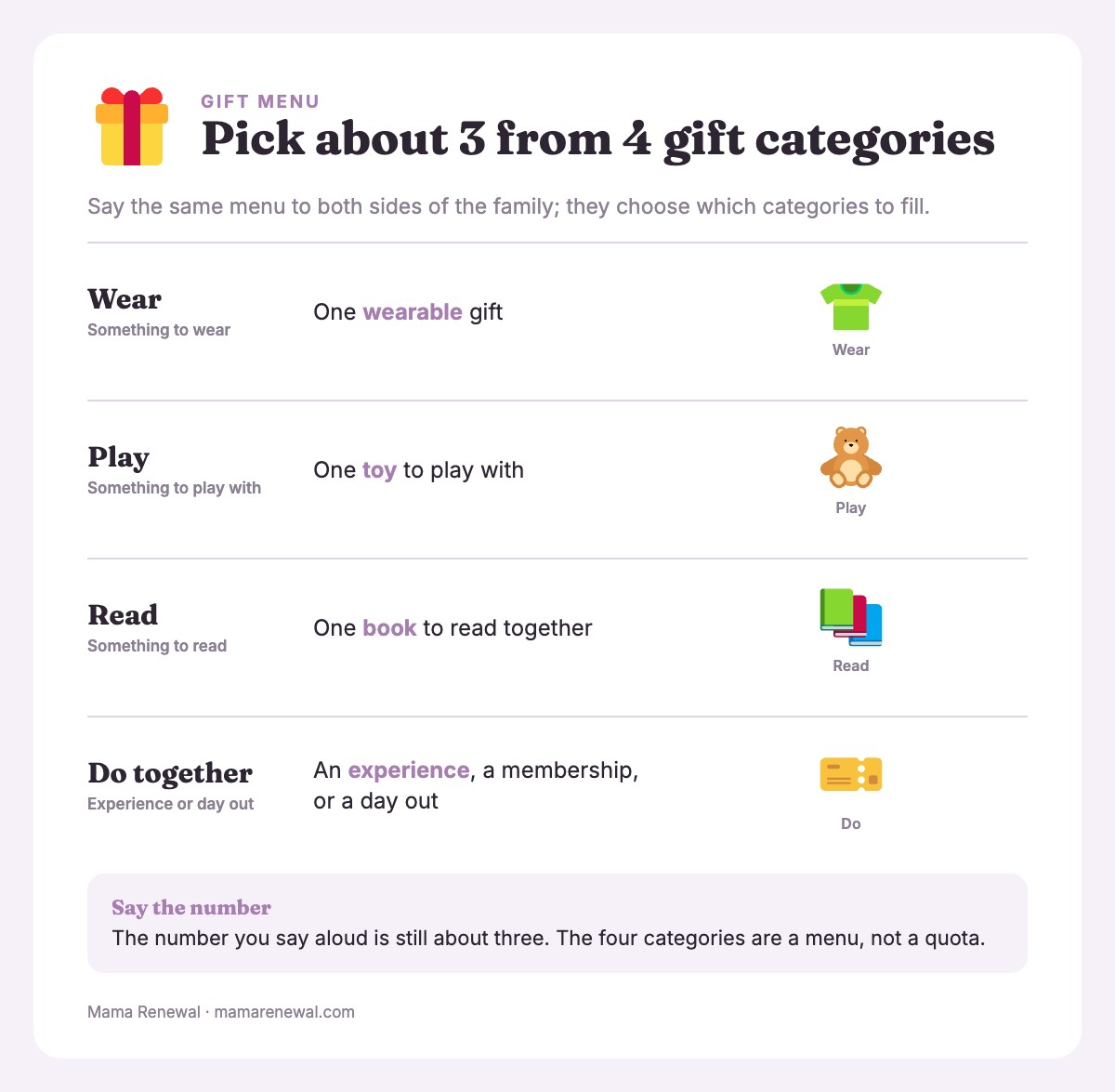
If you’re stuck on what those three gifts should be, here’s a simple menu that’s easy to say out loud:
- Something to wear
- Something to play with
- Something to read
- Something to do together (an experience, a membership, a day out)
Treat the four categories as a menu, not a quota. The number you say aloud is still about three, and grandparents choose which categories to fill. They still get the joy of choosing, you get a manageable number, and you can say it the same way to both sides of the family.
Step Two: What to Say to Grandparents Before Christmas Shopping Starts
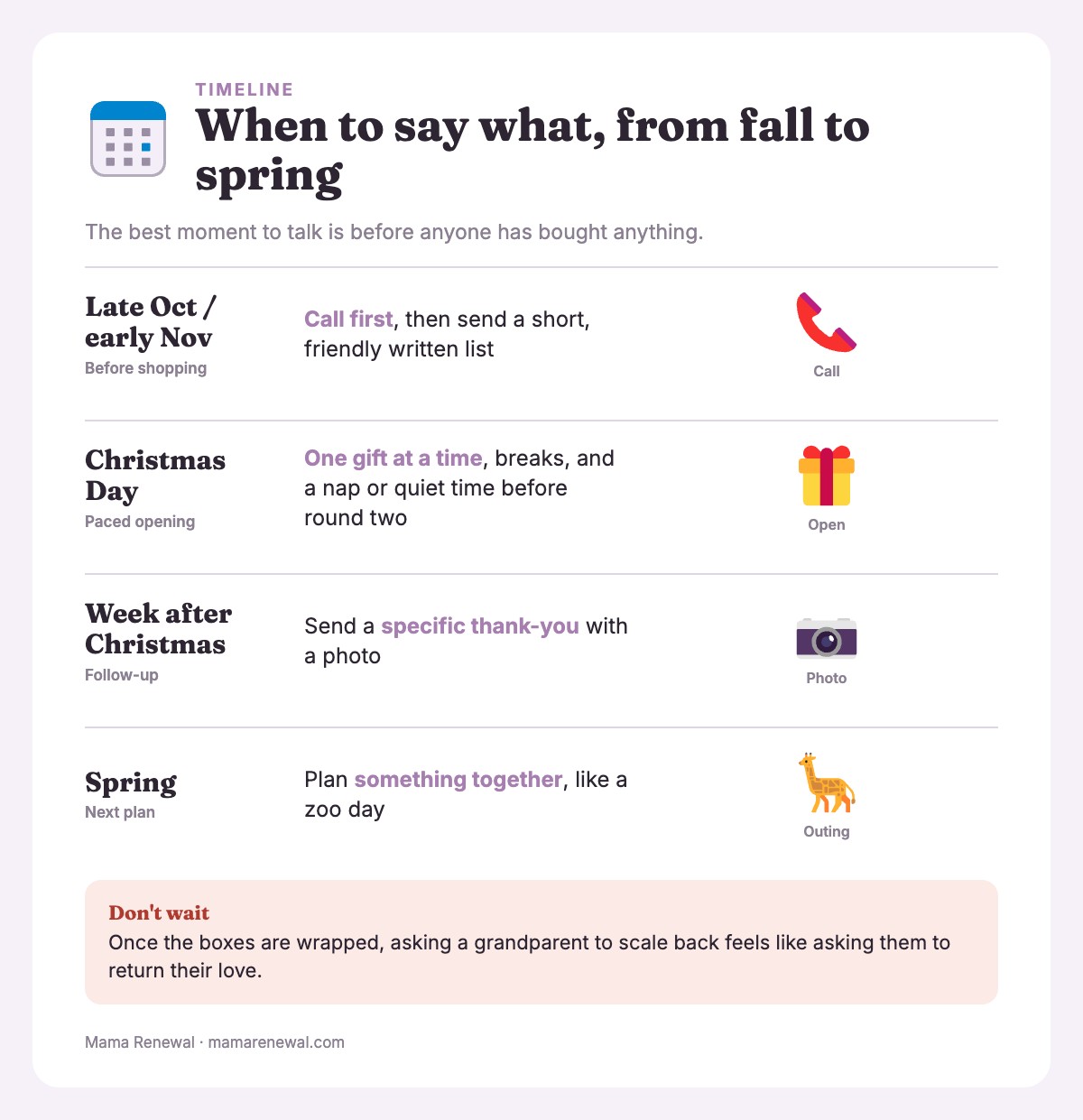
Timing matters more than wording. The best moment for this talk is late October or early November, before anyone has bought anything. Once the boxes are wrapped, asking a grandparent to scale back feels like asking them to return their love.
Pick the right way to say it
- A phone call or in-person chat beats a text. Tone gets lost in writing, and a text can read as a rule being handed down. Have the call first, then follow it with a short, friendly written list.
- Choose a calm moment. Not at pickup with a toddler shrieking, not during a holiday dinner.
- Start with appreciation, specific and real. Not a throwaway “thanks, but.” Something true.
- Lead with the toddler’s experience, not the grandparent’s behavior. “Here’s what helps her” lands better than “here’s what you’re doing wrong.”
- Offer the alternative in the same breath. A request without an alternative leaves a gap that feels like loss.
The core scripts
Say these in order and keep each one short. Maya is a sample name; swap in your child’s name.
- The warm opener. “Before the holidays get busy, I wanted to talk about gifts for Maya. You two are so good to her, and she lights up when she sees you. I wanted to share what’s working for us this year so you can have the most fun with it.”
- The specific ask. “We’re keeping things smaller this year because she gets overwhelmed with a lot at once. We’re asking everyone to pick about three things. It makes it easier for her to actually play with each one.”
- The reason (short and about your child). Use something you’ve actually noticed in your own child, for example: “At this age she can get stuck on one thing while the rest doesn’t really register. We’ve noticed she plays longer and happier when there’s less.”
- The alternative that keeps their joy. “What would be really special is if you could do something with her. We’d love for you to take her to the zoo in the spring, or you could start a little savings account for her if you want to give something that lasts.”
- The reassurance. “This isn’t about you buying less love. You’re one of her favorite people, and what she’ll remember is you, not the pile. We just want the gifts to land well.”
If you want to put the gift list in writing
Many grandparents actually love having a list, because it removes the guessing. You can send something like:
“Hi both! Here’s what Maya is into this year, in case it’s helpful. We’re keeping it small, about three gifts each. Her favorites right now are: board books about animals, anything for pretend cooking, chunky puzzles, and dress-up clothes. We’d love to do an outing together instead of more toys if you’re up for it. Thank you for being so thoughtful with her!”
It reads as helpful, not controlling.
Safety firstIf dress-up clothes are on the list, ask for toddler-sized pieces with no cords, drawstrings or long ties, no small accessories like costume jewelry, beads or clip-ons, and no battery-powered light-up parts. Keep costumes and dress-up clothes away from candles, fireplaces and other open flames; a flame-resistant label does not make fabric fireproof. Check age labels on puzzles and blocks too, and skip anything with small parts for children under 3.
When the grandparent is hurt or defensive
Some grandparents will bristle even with the gentlest framing. If you hear “I can’t buy my own grandchild a present?” try not to defend or over-explain. Reflect, reassure, redirect.
Reflect: “I hear you. It’s really important to you to give.”
Reassure: “And she’s so lucky to have you. That’s exactly why I want to make it good.”
Redirect: “Can we pick the three things together? I’d love your help choosing the best ones.”
Giving them a role in choosing turns a limit into a collaboration, which often softens things.
The Script Table: Situation, What to Say, What to Offer Instead
Screenshot it, print it, or save it on your phone. The Grandparent Gift Conversation Planner (the printable above) has room to fill these in for your own family. Each row is a situation you’re likely to meet, the words that work, and a real alternative so the grandparent still has an outlet for their generosity.
| Situation | What to say | What to offer instead |
|---|---|---|
| Before shopping starts: you want a smaller number | “We’re keeping gifts small this year. About three each works for us. We’ve noticed she seems to play longer with fewer things.” | One bigger gift: “If you want to splurge, one special thing she can grow into, like a play kitchen or a balance bike, would be perfect.” |
| A grandparent always buys a huge haul | “You’re so generous, and she loves you for it. What we’d love is to channel that into something that lasts rather than lots of small things.” | Savings: “A contribution to a savings or education account would mean so much to us.” |
| Grandma buys too many gifts every holiday, not just Christmas | “I’ve noticed the visits come with lots of presents. The best present is you. Could we make the visits themselves the event?” | An experience: a recurring outing, like a monthly library trip or a Saturday pancake breakfast just for them. |
| Long-distance grandparent who ships boxes | “Boxes are so exciting for her! Could we do one special package and a video call to open it together?” | Time: a scheduled video call, reading a book over video, or a shared online story time. |
| You’re short on space | “We’re tight on space, so we’re asking for things that don’t take up room, like books, art supplies, or experiences.” | Consumables or experiences: art supplies, a museum membership, a class pass. |
| The gifts are noisy, battery-powered, or screen-based | “We’re trying to keep her toys open-ended and low-stimulation. Wooden toys, books, and things she can build with are our favorites.” | Open-ended alternatives: blocks (age-labeled for under 3), a ride-on toy, a dress-up trunk with no cords, long ties or small accessories. See the dress-up safety note above the table. |
| Gifts you don’t want in your home (toy weapons, candy, small parts) | “Thank you so much for thinking of her. This one isn’t a fit for our house, so we’ll set it aside. Next time, books or art supplies are always a hit.” | A category list: send the short written list of welcome categories, and keep the unwanted item out of sight rather than making a scene. |
| Other grandparents give far less, and you worry about imbalance | “We’re asking both sets of grandparents to keep it to about the same, so it feels fair for everyone.” | A shared idea: agree on a number or a budget range for each side. |
| Gifts create financial pressure or the expectation to reciprocate | “Please don’t spend too much on us. The best gift is time together. We’d love to keep things simple.” | A shared tradition: a family dinner, a cookie-baking afternoon, a holiday walk. |
| They’ll ignore the list no matter what | “I know you love to surprise her. If something extra comes, we may keep some for later in the year so she can enjoy them one at a time.” | A rotation plan: store the extras and bring them out a few at a time (more in “Manage the haul quietly” below). |
| Christmas morning: a mountain is already under the tree | “Let’s open a few and save the rest for after a nap or quiet time. She may enjoy them more.” | A paced opening: one gift at a time, one for each person, taking turns. |
| Someone comments “that’s all you’re letting her have?” | “She’s so happy with what she has. We’re focusing on enjoying each thing.” | A subject change: “Want to see what she’s been up to with the new puzzle?” |
| After the holiday: you want to follow up kindly | “Thank you for such a thoughtful Christmas. Her favorite was the book. She’s asked for it three times.” | A future plan: “Let’s plan the zoo day for spring.” |
TipAdapt the wording to your own voice. The structure matters more than the exact phrasing: appreciate, state the ask, give a short child-focused reason, offer the alternative. If a grandparent bristles, reflect, reassure, redirect.
The In-the-Moment Version: What to Say on Christmas Day
Even after a good conversation, there may still be more boxes than you planned for. Maybe a grandparent forgot, maybe they ignored the list, maybe an aunt joined in. The goal on Christmas Day is not to enforce a policy. It’s to protect your toddler’s experience and the day’s good mood.
The paced-opening approach
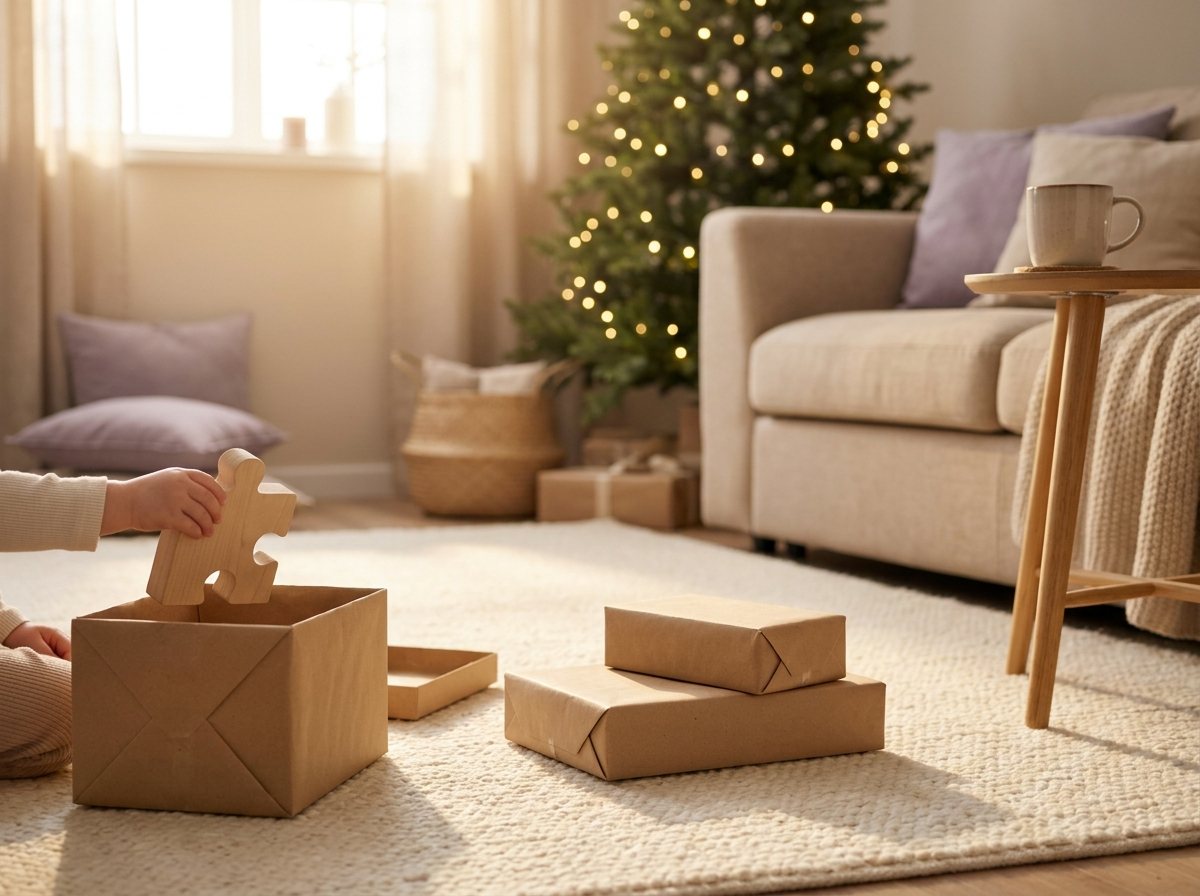
The easiest fix is to change how gifts are opened instead of arguing about how many exist. Toddlers don’t need to open everything at once, and many seem happier when they don’t.
Say, lightly and cheerfully:
- “Let’s take turns so we can all watch her open each one.”
- “Why don’t we do a few now and a few after lunch?”
- “She loves this one so much already. Let’s let her play before we open the next.”
Nobody hears a criticism in any of those lines. It just sounds like a nice way to enjoy the morning, and it quietly solves most of the overload problem.
Safety firstClear wrapping, plastic bags, ribbon and packaging as you go. Keep button or coin-cell batteries and battery-powered toys out of reach; if a battery is swallowed, call Poison Control or seek emergency care right away. Check gifts from other households for small parts, magnets and age labels before your toddler plays with them.
Scripts for specific moments
| The moment | What to say |
|---|---|
| A fourth gift arrives while the third is still half-unwrapped | “Oh, she’s still busy with that one! Let’s set this aside so it gets her full attention.” |
| Someone says “Oh, there are so many more in the car!” | “That’s so thoughtful. Let’s keep those for later today or even later this month so she can enjoy them one at a time.” |
| Your toddler gets glassy-eyed and cranky mid-pile | “I think she’s getting a little overloaded. Let’s have a snack at the table and come back to the rest.” |
| A grandparent seems disappointed that you’re pacing things | “This is so fun to watch. I just want her to really enjoy each thing you picked.” |
| A relative makes a snarky comment about your “rules” | Smile and say, “We’re doing it this way this year. Thanks for understanding!” Then change the subject. You don’t owe a defense on the holiday. |
Protecting your own energy
Christmas gift guilt hits hardest when you’re tired and hosting. A few ways to protect yourself in the moment:
- Assign a gift manager. Ask your partner to handle the tracking of who gave what so you aren’t the sole note-taker.
- Step out for two minutes. If you feel the irritation rising, take a breath in the kitchen or the bathroom. The point isn’t to hide, it’s to reset before responding.
- Decide the response in advance. If you’ve already chosen your line, you won’t have to scramble while a grandparent is looking at you expectantly.
If you notice big feelings come up quickly in these moments, nervous system regulation for moms has simple techniques that fit into small pockets of the day.
What if you just let it go for the day?
This is also a valid choice. If the day is going well and the grandparent is clearly delighted, you can decide the gifts are not worth a moment of tension. You can quietly manage the pile afterward. Choosing your battles isn’t giving up on your boundaries. It means you’re picking the right moment to talk about them, and Christmas morning with a grandparent beaming usually isn’t it. Save the conversation for a calmer time, which brings us to the follow-up.
The Follow-Up That Keeps the Relationship Warm
What you do in the week after Christmas often matters more than what you did before. It’s your chance to reinforce what worked, thank them sincerely, and gently set up next time without sounding like a performance review.
Send a real thank-you, with a specific detail
Skip the generic “thanks for everything.” Grandparents light up when you name something particular, because it tells them their choice mattered.
“Thank you for the wooden puzzle. She did it four times in a row on Tuesday, and she says ‘Gampa!’ every time she sees it.”
A photo or short video of your toddler playing with the gift helps. It reinforces the idea that thoughtful gifts get noticed, which is a quiet nudge toward quality over quantity.
Share what landed
When you’re warm and specific, you can gently steer next year’s choices:
“The thing she loved most was when you read to her. If you ever want to choose a gift, books and anything we can use together are such winners.”
Set up the next time
If the conversation about numbers didn’t go as planned, don’t litigate it in January. Instead, plant a seed:
“I loved how Christmas felt this year. For next time, I’d love to do something like an outing together. Do you want to think about what would be fun?”
If it went badly
Sometimes feelings get hurt. If a grandparent seemed upset, a short, sincere message can reset things:
“I’ve been thinking about Christmas. I know I asked for a smaller number and I hope it didn’t feel like I wasn’t grateful. You mean so much to her and to us. I’d love to figure out together what gives you the most joy in giving.”
You’re not retracting your request. You’re repairing the connection.
Manage the haul quietly
After the holiday, you’ll probably have more than you want to keep out. Here are low-conflict ways to handle it:
- Rotate. Put half the toys in a closet and swap them every few weeks. Toddlers may treat resurfaced toys like new ones.
- Save a few for birthday or “just because” moments. Spacing gifts out lets each one matter.
- Donate gently. If something truly doesn’t fit, pass it along. Many parents find it easier to do this out of sight and without making it a conversation.
- Keep the card or tag on things you want to remember to thank someone for, so your thank-you can be specific.
A caution: if a grandparent will be hurt to learn their gift was donated, you don’t need to announce it. You also don’t have to keep every item forever out of guilt. Use your judgment about your own family.
Things to Ask For Instead (Ideas That Feel Generous to the Giver)
The most successful redirect isn’t “stop buying.” It’s “here’s something even better.” Many grandparents love these ideas because they feel meaningful and they get to be part of something lasting.
Experiences
Experiences don’t clutter your home, and they build memories with the grandparent in them.
- A zoo, aquarium, or museum membership the family can use all year
- A recurring outing: a monthly library morning, a Saturday breakfast date, a seasonal trip to the pumpkin patch or the pond
- A toddler class pass: music, swim, or movement classes
- A “grandparent day”: one set day each month that’s theirs with the toddler
- A holiday outing: tickets to a lights display, a train ride, or a story hour
For a toddler, the experience itself is less important than the person. A grandparent pushing a stroller to feed ducks gives the child something that a toy can’t.
Savings or a long-term gift
For some families, this is the most welcome option.
- A contribution to a savings or education account. Many grandparents like knowing their gift is growing.
- An electronic savings bond through TreasuryDirect, or a small deposit into a child’s savings account.
- Starting a “college jar” tradition where each holiday adds a little.
Check the account’s contribution rules, or ask a financial advisor, before suggesting it, since gifts can have tax or financial-aid implications. A practical note: if you share an account link or details, make it easy. Say, “Here’s the link if you’d like to contribute any amount. Even a little means a lot.” That keeps it voluntary and warm.
One bigger, better gift
If the grandparent wants a big moment, direct it toward one meaningful item instead of many small ones.
- A balance bike or ride-on toy
- A play kitchen, a wooden train table, or a child-sized table and chairs
- A really good set of blocks
- A reading nook: a small bookcase plus a few special books
- A “grow-with-me” item like a step stool or a sturdy art easel
The trick is giving them the satisfaction of a big reveal, while keeping the total number small.
Safety firstUse a helmet on bikes and ride-ons. Anchor bookcases, tall furniture and play kitchens to the wall following the maker’s instructions, and choose stable, wide-based step stools. Check age labels: for children under 3, avoid small parts (anything under about 1.75 inches) and magnets, and set aside gifts meant for older kids until your child is ready.
Gifts that get used up
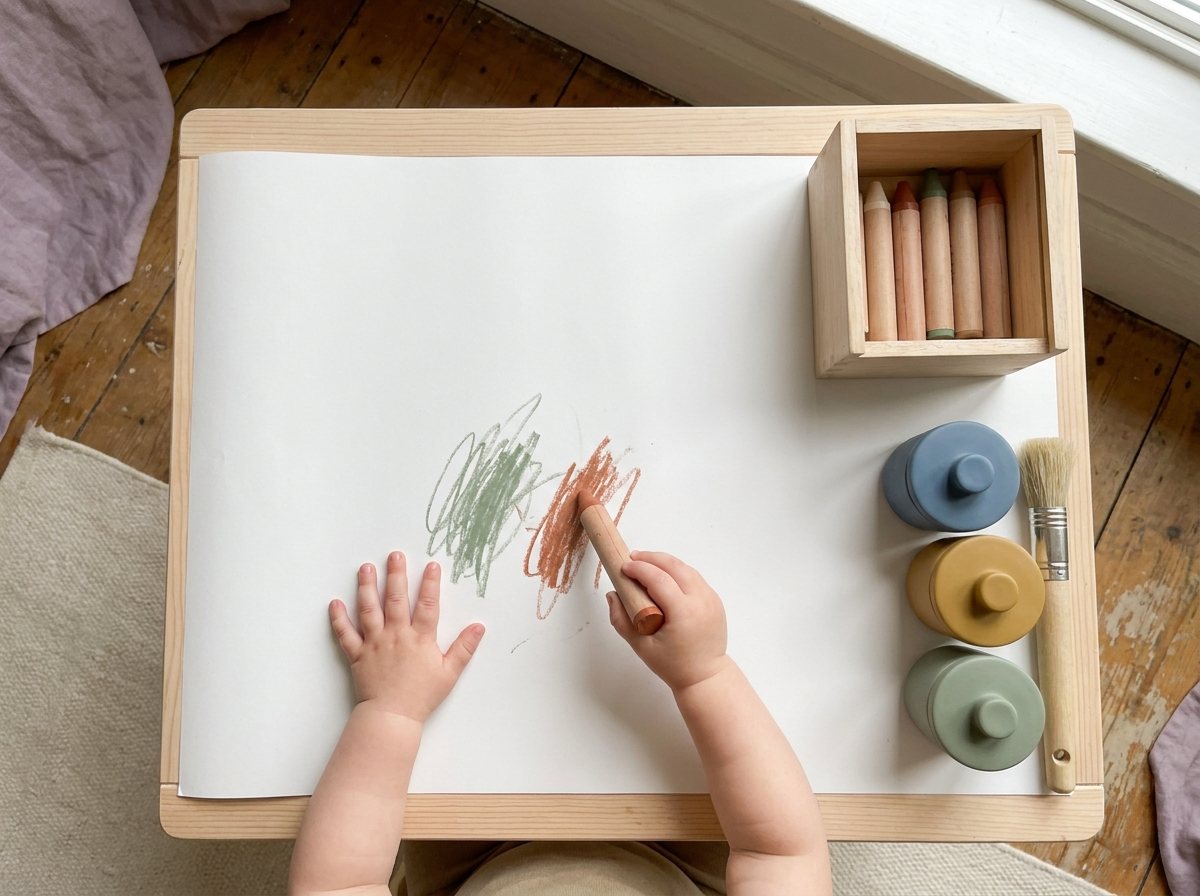
Safety firstChoose non-toxic art supplies labeled ASTM D-4236, go for jumbo-size crayons, and supervise. Stickers and broken crayon pieces are choking hazards, so keep them away from mouths. Bath items are for supervised bath time only; never leave a toddler alone in the tub.
- Art supplies: jumbo crayons, washable paint, paper, and stickers for supervised use
- Bath and sensory items: bubbles, sponges, bath crayons
- Books (still the classic win)
- Special snacks or a treat basket for the family
- Seasonal consumables: a cookie-making kit or a gingerbread-decorating set to do together
Time and tradition
- A recorded bedtime story: a grandparent reads a book on video the toddler can watch whenever they miss them
- A shared photo book or scrapbook the two of them add to
- A tradition: matching pajamas, a Christmas Eve walk, a cookie afternoon
- A “memory box”: each year, one small thing is added
These can be especially meaningful for long-distance grandparents, who may feel that the only way to be present is through shipping boxes.
Special Situations (Because Families Are Complicated)
When it’s your in-laws, not your own parents
Usually, the person who grew up with the grandparent should lead the conversation. A request from a daughter-in-law or son-in-law can be heard differently than the same words from their own child. If your partner is willing, let them make the call. If they won’t, or the relationship is strained, you might say, “I’d love your help. We want this to feel good for everyone.” For more on that dynamic, boundaries with in-laws goes into it in detail.
When one set of grandparents spends much more than the other
Fairness is worth addressing gently, for your toddler’s sake and for the other family’s feelings. You can suggest a rough shared guideline to both sides, like a number of gifts or a general range. If one side has fewer resources, an experience-based or time-based model lets everyone give at their level without comparison.
When money is a factor
If the generosity is making you uncomfortable because of expectations to reciprocate, it’s fine to say plainly: “We’d love to keep gifts simple on all sides this year. The best part is being together.” Many families agree on a price cap or a “no gifts between adults” rule and find it a relief.
When a grandparent has a history of boundary-pushing
If this isn’t new, and a grandparent routinely ignores requests, you may need firmer structure. That could mean:
- Telling them that extra gifts will be held for later in the year
- Opening the gifts at a different time or place
- Limiting how much comes into your home
- Having your partner take the lead on enforcing it
You’re allowed to protect your household. If it feels heavy, remember that holding a boundary doesn’t make you unkind. It makes you consistent.
When a grandparent is grieving or lonely
Sometimes the buying is tied to something deeper: loss, loneliness, a feeling of being left out. In those cases, more time together usually helps more than any script. Invite them to a regular dinner, ask them to teach your toddler something, or build a small ritual. The more they feel included, the less the gifts need to carry the weight.
When you feel like you’re the problem
If you’re caught in “Maybe I’m being too picky,” pause. Wanting a calmer, more intentional Christmas for your child is a reasonable thing. You can honor a grandparent’s love and your family’s needs at the same time. You don’t have to pick one. If you need more words for saying no kindly, scripts to say no has plenty.
Taking Care of Yourself Through the Holiday Season
It’s easy to treat this as a logistics problem, but it’s also an emotional load. Navigating family dynamics, managing expectations, and absorbing someone else’s disappointment is real work. A few gentle reminders:
- You’re allowed to feel conflicted. You can love your parents and be frustrated by the gifts. Both can sit together.
- Don’t over-explain. A short, warm request is easier to hear than a long defense.
- Protect your rest. Holiday overload is a recipe for a short fuse. Small pockets of calm matter, and so does sleep. If you’re running on fumes, mom sleep debt might explain more than you think.
- Remember it’s a season, not a verdict. One chaotic Christmas doesn’t define your family or your boundaries.
- Be as kind to yourself as you’re trying to be to them. You’re doing a hard job: balancing love, limits, and logistics.
- Get support if it lingers. If overwhelm or low mood lasts beyond the holidays, talk with your doctor or a therapist.
Quick Reference: Your Pre-Holiday Checklist
Print this, screenshot it, or fill it in on the Grandparent Gift Conversation Planner.
- Talk to your partner first. Agree on a number and a message.
- Pick a number and categories: about three gifts, chosen from something to wear, play with, read, or do together.
- Choose your timing: late October or early November, before shopping.
- Make the call or visit, and follow up with a friendly written list if it helps.
- Open with appreciation, state the ask, give a short child-focused reason, and offer an alternative.
- Suggest experiences, savings, or one bigger gift so there’s a joyful outlet.
- Plan Christmas Day pacing: one gift at a time, breaks, and a nap or quiet time before round two.
- Save your lines for the in-the-moment moments.
- Send a specific thank-you with a photo.
- Rotate or store extras quietly afterward.
- Plan something for spring so the relationship has something to look forward to.
From our sister brands
One-gift ideas to suggest, from our sister brands
If the conversation ends with "then what should we get?", it helps to have one specific answer ready. Each of these is a single keepsake.
Akoni Books and White Loft are sister brands of this site. When you buy through these links we may earn a portion of the revenue, at no additional cost to you.

Akoni Books
A Christmas storybook from Grandma or Grandpa
A grandparent can make it from one photo. The pictures are drawn to look like the child, and the book has a signed dedication page that says who it is from. You see the cover and first pages before paying. Order a printed copy by December 5 and most US orders arrive before Christmas.
Digital $9.99 · Softcover $29.99 · Hardcover $39.99, shipping included
First book? Code WELCOME5 takes $5 off at checkout.
Preview it free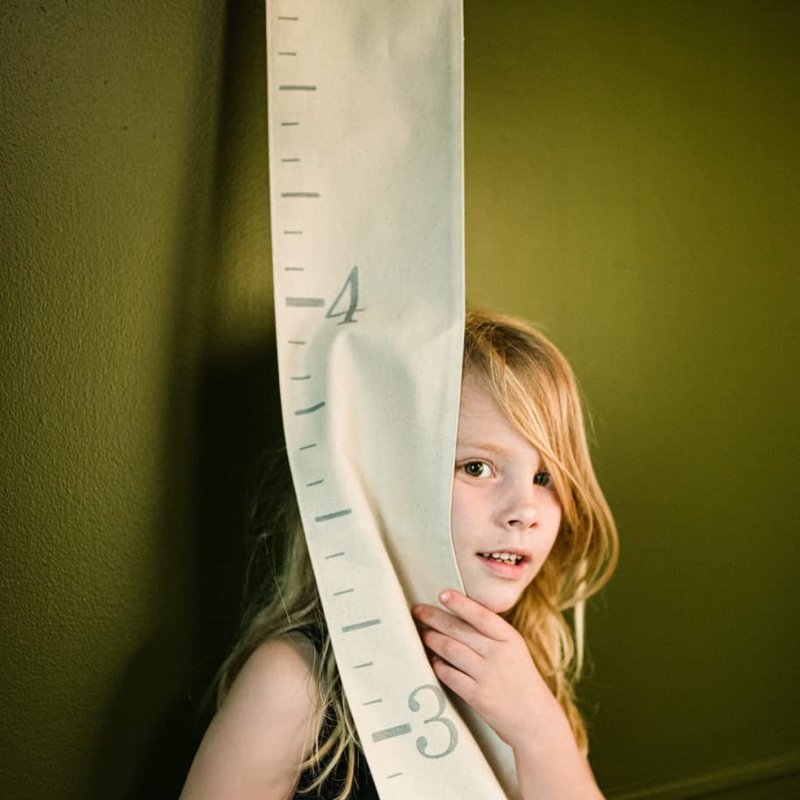
White Loft
One gift that lasts through years of visits. Grandparents can keep it at their house and measure at each visit, or give it for the child's room. Cream canvas with gray ruler numbers and a fabric pen.
$40.99 on Amazon
See it on Amazon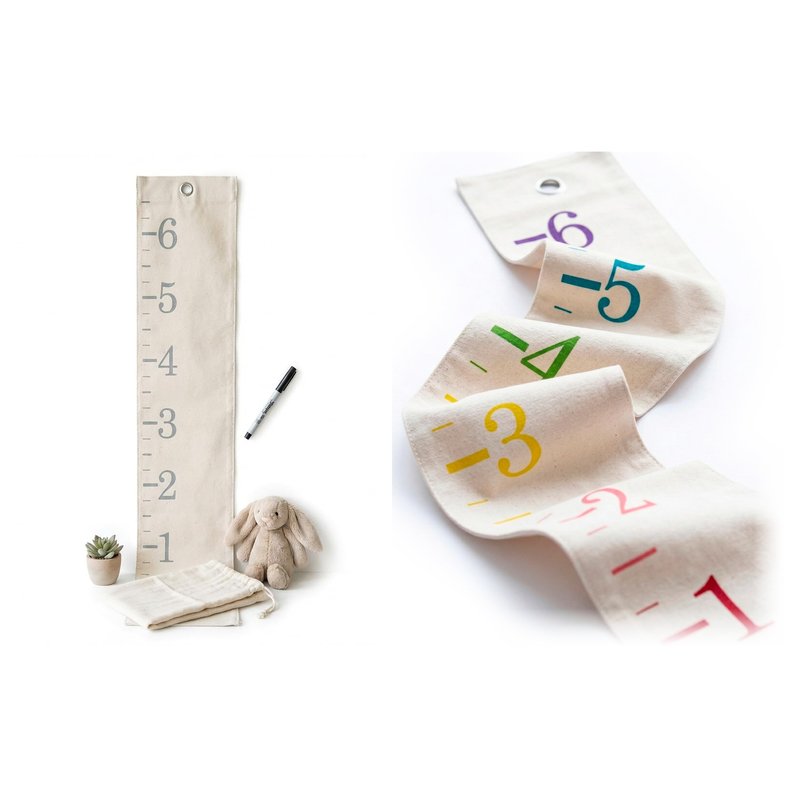
White Loft
For two grandchildren: the classic gray chart and the rainbow one, so each child gets one gift of their own. As a set it costs 15% less than the two bought separately.
$68.83 on Amazon
See it on AmazonPrices checked October 2026; they can change.
Frequently Asked Questions
How do I tell my mother-in-law she’s buying too many gifts without hurting her feelings?
Start with real appreciation, then make the request about what helps your toddler, not about what she’s doing wrong. You might say, “She loves everything you give her. We’ve noticed she plays longer with fewer things, so we’re asking everyone to keep it to about three.” That keeps the focus on your toddler. Pair it with an alternative she can say yes to, such as an outing, a savings contribution, or one special bigger gift. It also helps if your partner delivers the message, since grandparents often hear boundary requests more easily from their own child.
What if grandparents ignore my request and buy a huge pile anyway?
Shift from enforcing the number to managing the pace: open a few gifts at a time on Christmas Day and save the rest for later. Afterward, rotate the extras so only some are out at once. If it happens year after year, have a calm conversation outside the holiday, ideally with your partner leading.
Is it rude to ask for experiences or savings instead of toys?
Not at all, as long as you frame it warmly. Many grandparents find experiences and long-term gifts meaningful because they feel lasting and personal. Put it as an invitation, “We’d love it if you’d take her to the zoo this spring,” instead of a restriction, and make it clear it’s optional. Some grandparents will still want to wrap something, and a small gift alongside the experience is a nice compromise.
How many gifts is “too many” for a toddler?
There’s no official number, and it depends on your home, your values, and your child. Many families find that a handful of thoughtful gifts per household works well for toddlers, partly because a very young child can get overwhelmed and stop engaging after a certain point. The best test is your own toddler: if they get cranky, glassy-eyed, or stop noticing what they’re opening, the pile is probably past their limit. Pick the number that feels calm for your household and communicate it kindly.
How do I deal with Christmas gift guilt when I’m annoyed at a generous grandparent?
First, know that mixed feelings are normal. You can be thankful for someone’s love and still be overwhelmed by the amount of stuff. Separate the person from the pile: you can honor their generosity while adjusting the format. If the guilt creeps in, remind yourself that you’re protecting your child’s experience and your household’s peace, not rejecting the grandparent. A specific, sincere thank-you after the holiday often helps release some of the guilt too.
What if the grandparents live far away and just ship boxes?
For long-distance grandparents, gifts are often a stand-in for presence, so offering more of the real thing can help. Suggest a scheduled video call to open one special package together, a recorded bedtime story they can send, or a regular call time that your toddler can look forward to. You can also share photos and short videos of your toddler enjoying whatever they sent, so they feel seen without needing to keep sending more.
Should I tell the grandparents or let my partner do it?
Usually the person who grew up with the grandparent should lead. A parent’s request tends to feel less like criticism than the same words from an in-law. If your partner is hesitant, agree on the message together first so you’re united, and decide in advance who will say what. If you’re the one who needs to speak, keep it short, warm, and focused on your toddler, and offer an alternative so they’re not left with a gap.
You’re Allowed to Want a Gentler Christmas
If you take only one thing from this: you can love the people who love your child and still ask for a different way of showing it. You aren’t ungrateful, and you aren’t controlling. You’re a parent trying to make the holiday feel good for a very small person and a very tired adult.
Start the conversation early, keep it warm, and always bring an alternative along with the request. Then give yourself credit for doing something hard and kind at once. Chances are that, a few Christmases from now, what your family treasures won’t be a pile of boxes. It’ll be the zoo day, the cookie afternoon, or the grandparent who read the same book fifteen times in a row.