
Christmas With a Newborn: What to Skip, Keep and Say No To
Navigate Christmas with a newborn by learning what to skip, keep, and hand off, how to manage visitors, and when to prioritize your baby's health, ensuring a calm holiday for you and your family.
- Give yourself permission for a non-traditional Christmas; your baby needs a calm parent, not perfect traditions.
- Use the Skip/Keep/Hand-Off method to delegate tasks and simplify holiday jobs with your partner.
- Prioritize your newborn's health by setting boundaries with visitors and knowing when to call the pediatrician.
- Utilize word-for-word scripts to gently manage visitor expectations and protect your space and recovery.
This post contains affiliate links. As an Amazon Associate I earn from qualifying purchases.
It’s 2:40 a.m., you’re feeding a nine-day-old, and a relative texts: “Are we still doing matching pajamas on the 24th? Also, can we come the 22nd AND the 26th?” You put the phone face down. Below, you’ll find what to skip, keep, or hand off this Christmas, how to host or travel gently, word-for-word visitor scripts, and when to call your provider.
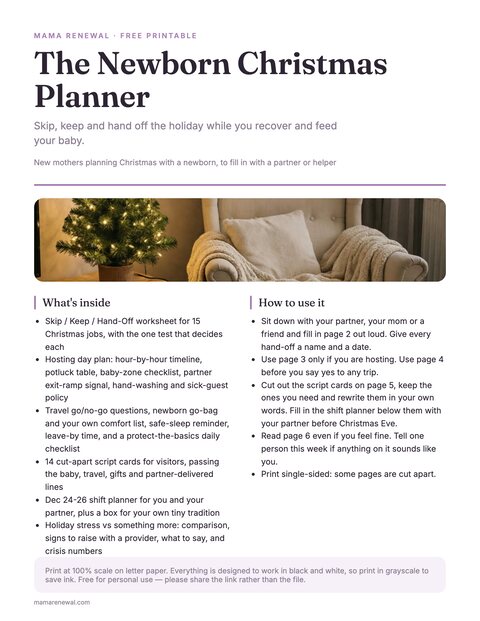
Free printable · 6 pages
The Newborn Christmas Planner
A Skip/Keep/Hand-Off worksheet for 15 Christmas jobs, a hosting day plan with baby zone and exit-ramp signal, a travel go/no-go and go-bag list with a protect-the-basics checklist, cut-out script cards, a Dec 24-26 shift planner, and a holiday stress vs something-more check-in with crisis numbers.
Free. Your download link appears right here. You'll also join the Mama Reset. Unsubscribe anytime. Privacy
This guide is for the mother, not the baby’s photo album. Your newborn will not remember this Christmas; they need milk, warmth, sleep, and a calm adult. You are recovering from a major physical event and running on fragments of sleep.
In this article (11 sections)
- Give Yourself the Permission Slip First
- The Skip / Keep / Hand-Off Table
- What the Newborn Weeks Look Like (and How to Plan Around Them)
- Hosting Christmas With a Newborn Without Losing Your Mind
- Visiting and Travel: Going Somewhere With a Newborn
- Newborn Christmas Visitor Rules and Scripts: What to Actually Say
- Christmas Activities With a Newborn That Are Actually Gentle
- Sleep, Feeding, and Splitting the Day With Your Partner
- When It’s More Than Holiday Stress
- Frequently Asked Questions
- You Don’t Have to Make This Christmas Magical
Give Yourself the Permission Slip First
This is not a normal Christmas, and it’s not supposed to be. In a regular December you’re the gift-buyer, card-sender, cookie-baker, and the person who remembers Aunt Linda’s walnut allergy. This year you’re also healing and feeding another human around the clock, and that job doesn’t fit one person. If guilt shows up, it’s because you’re measuring postpartum reality against a holiday-card fantasy, not because you’re doing it wrong.
The goal of Christmas with a newborn is a baby who is fed and safe, a mother who is healing, and a day you can look back on without wincing. Almost everything else is optional. Not “optional but you’d better do it anyway.” Actually optional.
The one thing that isn’t optional: protecting the baby from illness
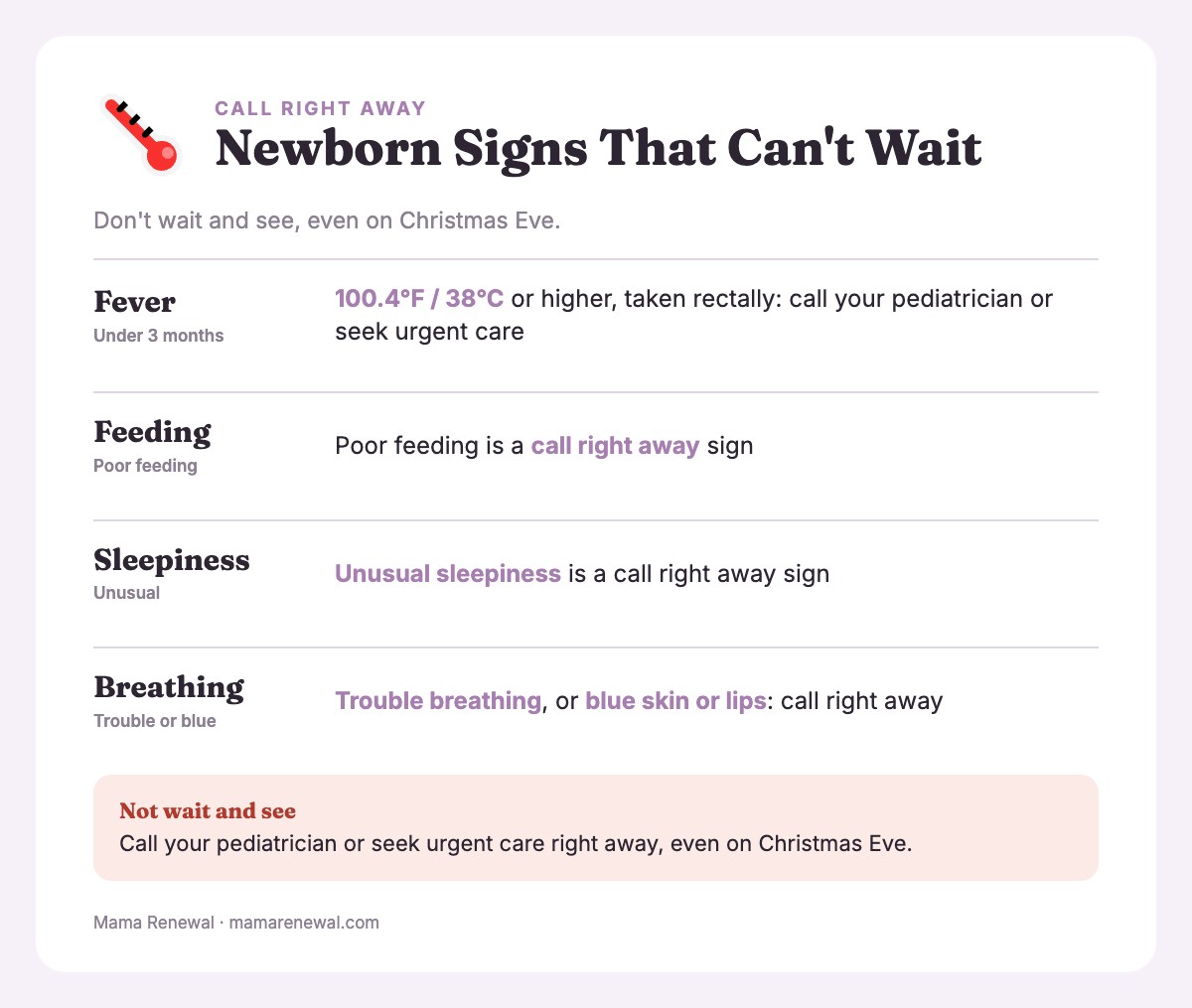
Very young babies are more vulnerable to illness than older children and adults, and the holidays fall right in cold, flu, RSV, and COVID season. Pediatric guidance generally advises limiting contact with sick people, asking visitors to wash their hands, and keeping newborns out of crowded indoor spaces when you can. That makes your boundaries medical, not just emotional.
When to call the pediatrician, and when to call 911Call your pediatrician right away, or seek urgent care, for a fever of 100.4°F (38°C) or higher, taken rectally, in a baby under three months old. Call right away, too, for poor feeding or unusual sleepiness. If the office is closed for the holiday, use the after-hours line. Call 911 for trouble breathing, blue or gray skin or lips, or a baby who is limp or hard to wake. None of these are “wait and see” situations, even on Christmas Eve.
Knowing all this isn’t about making you anxious. It’s about giving you solid ground to stand on when someone says “oh, it’s just a little cough.”
The Skip / Keep / Hand-Off Table
This is the heart of the page. Most of what makes a holiday feel heavy is a long list of jobs nobody has ever explicitly assigned, which means they quietly land on the mother. Go through this list with your partner (or your mom, or a friend) and decide, out loud, which bucket each job goes in.
Here’s my suggested starting point. Adjust it to your family. If you’d like a printable version to fill in together, The Newborn Christmas Planner is built for exactly this.
| Christmas job | Skip it | Keep it (simplified) | Hand it off |
|---|---|---|---|
| Full tree and decorations | Skip the elaborate theme, the garland on every surface, the second tree | Keep one small tree, or one string of lights you can see from the couch | Have your partner or a friend put it up and take it down |
| Christmas cards | Skip the custom photo card and the handwritten notes | Keep a text with one photo to the people you actually want to update | Ask a relative to design and send them if cards matter to your family |
| Gift shopping for everyone | Skip gifts for extended family and coworkers this year | Keep gifts for your partner, older kids, and maybe two or three close people | Online orders, gift cards, or a partner who owns the shopping list |
| Gift wrapping | Skip the bows, the coordinating paper, the tags | Keep gift bags, or one roll of paper and a stack of tape | Your partner, a teen relative, or a store gift-wrap counter |
| Baking and cookie swaps | Skip cookie exchanges and homemade gifts | Keep one easy family recipe, or buy the dough and bake it | A guest who brings dessert as their contribution |
| Hosting Christmas dinner | Skip being the host if you can | Keep a smaller, simpler meal if you do host (see below) | Someone else hosts, or everyone brings a dish |
| Christmas Eve service or big gathering | Skip the late-night event if it clashes with feeds | Keep a short daytime version or a livestream | Your partner attends with the family while you rest |
| Matching pajamas and photo shoot | Skip the staged photo session | Keep one casual photo, taken whenever the baby is calm | A relative takes candid shots while you do nothing |
| Travel to family | Skip long trips, overnight stays, and multi-stop itineraries | Keep one short visit with a firm end time | Ask family to come to you in small, scheduled windows |
| Santa visits and crowded events | Skip malls, lines, and indoor crowds | Keep a quiet at-home “first Christmas” moment | N/A, this one is just a skip |
| Thank-you notes | Skip them until January (or later) | Keep a quick text or voice note | Dictate to your partner, or send a group message |
| Remembering everyone’s dietary needs | Skip the complicated menu | Keep a short, flexible menu | Assign the allergy-aware guest to bring their own dish |
| Baby’s “first Christmas” keepsakes | Skip the elaborate milestone setup | Keep a footprint ornament, a letter to baby, or a single photo | A grandparent can take the lead on a keepsake they’d love |
| Clean house for guests | Skip deep cleaning | Keep a tidy “guest zone” (bathroom, entry, one room) | A hired cleaner as a gift, or a relative’s contribution |
| Managing everyone’s expectations | Skip the endless explaining | Keep one clear message, sent once | Your partner is the communicator for their side of the family |
A few notes on using this table.
Make the “skip” column genuinely skip. The trap is moving something from skip to “I’ll just do a quick version” until you’ve rebuilt the whole to-do list in miniature. If you’re not sure, ask: “If I didn’t do this, would the baby be less safe or less fed?” If not, it can go.
Say the hand-offs out loud. “Can you help with Christmas?” is too vague. “Can you own the gift wrapping start to finish by December 20th?” is a job someone can actually take.
Let the people who love you contribute. Many grandparents, aunts, and friends are desperate to help and don’t know how. A specific ask is a gift to them as much as to you.
If you want a broader look at why all this invisible work lands on mothers by default, the invisible labor checklist and the mental load piece go deeper. For this season, though, the table above is your working document. Screenshot it and send it to your partner.
What the Newborn Weeks Look Like (and How to Plan Around Them)
Most holiday advice treats a newborn like a small, quiet guest who sleeps through dinner. Real newborns set the schedule, so before you lock in plans, here’s what you’re planning around.
Feeds set the schedule
Breastfed newborns often feed eight to twelve times in 24 hours, and evening cluster feeding is common. Bottle-fed babies usually go a bit longer between feeds. Either way, a “two-hour visit” will include at least one feed, probably a diaper blowout, and some soothing in a quiet room while everyone else eats ham.
Your body is still healing
Whether you had a vaginal birth or a cesarean, you may be dealing with bleeding, stitches, swelling, afterpains, night sweats, engorgement, or incision pain. Long stretches of standing, heavy lifting, and repeated stairs can be harder than you expect. Follow your own provider’s guidance over any holiday timeline.
Sleep comes in pieces
Rest comes in short stretches, so any plan that needs you bright, social, and upright between 9 p.m. and 6 a.m. will cost you. These sleep tips for new moms can help you protect the rest you do get.
Hosting Christmas With a Newborn Without Losing Your Mind
If you can avoid hosting this year, avoid it. There’s no medal for hosting a newborn Christmas, and the people who love you would almost always rather have you rested than perfect.
But sometimes hosting is the best option. Maybe your house is where the baby’s stuff is, maybe travel is harder than hosting, maybe your family expects it and you’ve decided it’s worth it. If that’s you, here is how to host in a way that protects your recovery.
Redefine “hosting”
Hosting a newborn Christmas doesn’t mean cooking, cleaning, and entertaining. It means providing the location. Everything else can be delegated.
- Make it a potluck. Assign dishes by name: “Aunt Marie, you’ve got the green beans. Dad, rolls and butter. Sam, dessert.” Nobody’s guessing, nobody’s overloading you.
- Buy the main dish cooked. A pre-cooked spiral ham, a rotisserie chicken platter, a catered tray, or a restaurant takeout order is not cheating. It’s strategy.
- Disposable plates and cups. Yes, really. Cleanup is a recovery tax you don’t need to pay.
- Give a time window, not an open door. “Come at 1, plan to head out by 4” is kind and clear.
Build a baby zone and an exit ramp
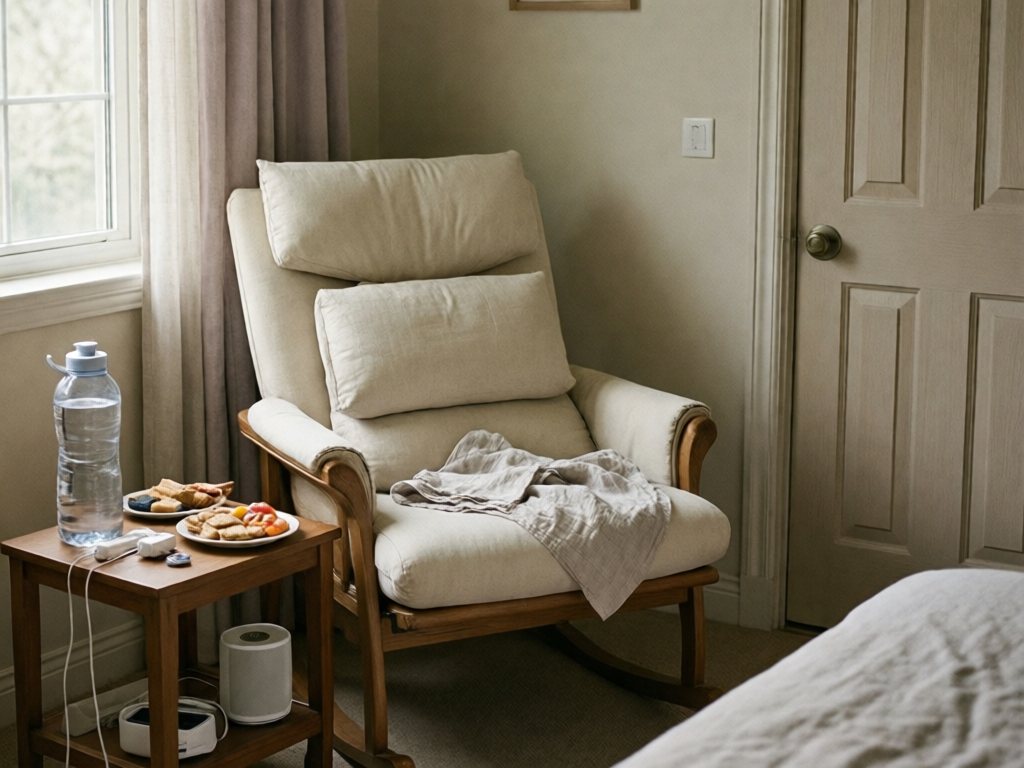
Designate one room as yours. A bedroom, the nursery, or a quiet office will do. Put a comfortable chair, water, snacks, a burp cloth, a charger, and a white noise machine in there. Tell your guests this room is off limits unless you invite them in. This is where you feed, where you retreat when the noise is too much, and where the baby naps away from the crowd.
Then decide on an exit ramp before anyone arrives. Agree with your partner on a signal that means “I’m done, please start wrapping this up.”
It can be as simple as “I think the baby needs a quiet moment” or a hand on your partner’s arm. Your partner’s job is then to move the party along.
A realistic hosting timeline
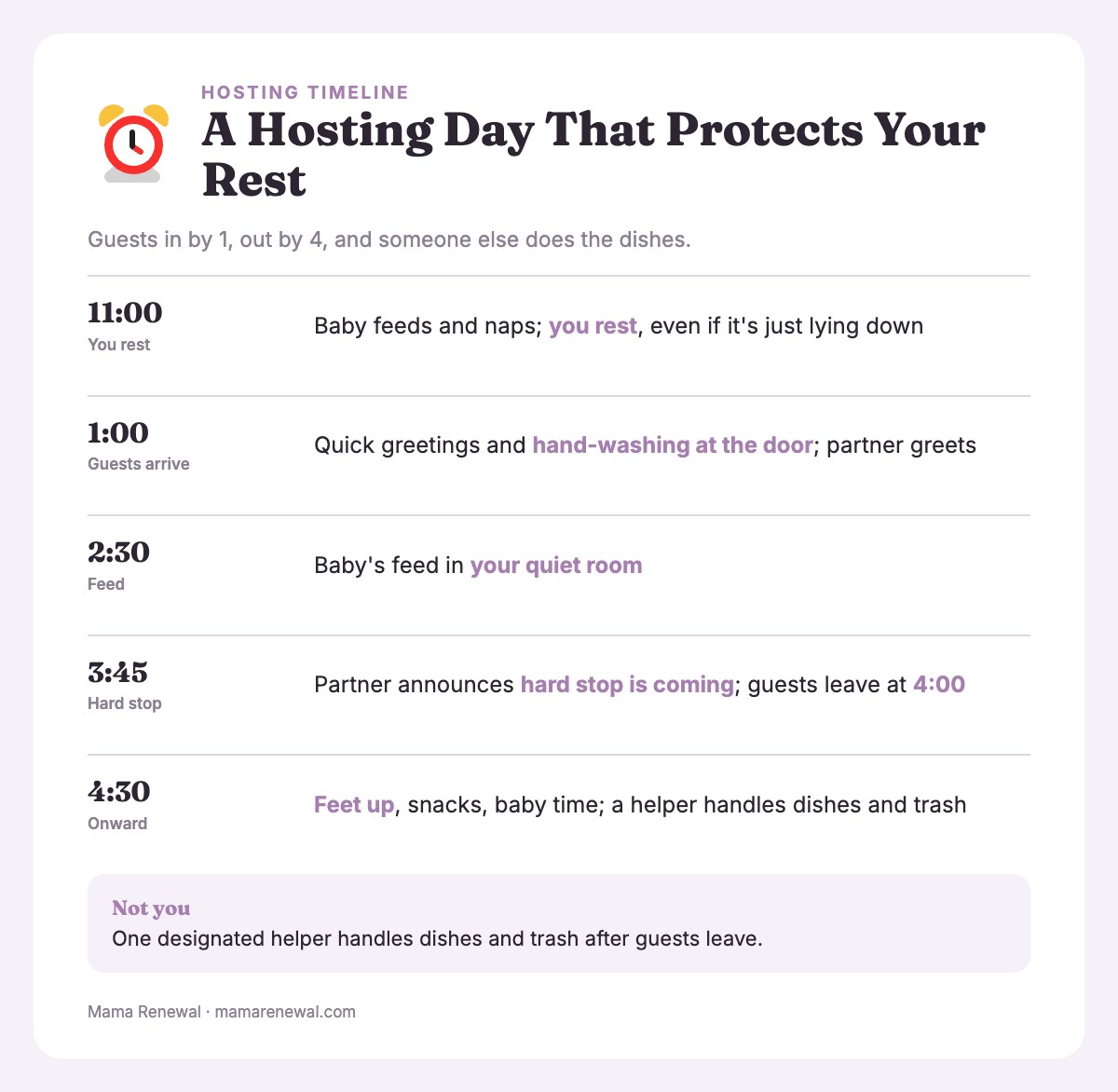
| Time | What’s happening | Who’s responsible |
|---|---|---|
| 11:00 | Baby feeds and naps; you rest, even if it’s just lying down | You |
| 12:00 | Food arrives or is reheated; drinks set out | Partner and early-arriving helper |
| 1:00 | Guests arrive; quick greetings, hand-washing at the door | Partner at the door |
| 1:30 | Eat; you can eat sitting down, with someone holding or settling the baby if needed | Everyone |
| 2:30 | Baby’s feed in your quiet room | You |
| 3:00 | Brief gift opening (just a few things) | Whoever’s in charge of the gift pile |
| 3:45 | “Hard stop is coming” announcement | Partner |
| 4:00 | Guests leave; one person handles dishes and trash | A designated helper, not you |
| 4:30 onward | Feet up, snacks, baby time | You |
A schedule like this feels almost too modest. That’s the point.
Food rules for the tired host
- Eat. This is not the day to skip meals. Many new mothers are hungry in an almost bottomless way, especially while feeding. If your energy is flagging, simple protein-forward snacks help. The protein for moms guide has easy ideas, and nutrition as self-care is a good reminder that feeding yourself is part of the job.
- Keep a pitcher of water and a snack plate in your feeding spot.
- If someone offers to bring food, say yes and say “no cooking needed, just bring it ready to eat.”
Safety notes for a house full of people
- Put a small “please wash or sanitize your hands before holding the baby” sign by the entry, or have your partner say it as people arrive.
- Ask anyone who is sick, even mildly, to stay home. Include “or reschedule” in your invitation so it doesn’t feel like a rejection.
- Many pediatric practices encourage up-to-date vaccines for people around newborns, including whooping cough (Tdap), flu, and COVID-19. Vaccines take about two weeks to work, so ask early. Frame it as a household policy: “We’re asking everyone around the baby to be current on their Tdap, flu, and COVID-19 shots this year.” Also ask your pediatrician about RSV protection (a maternal vaccine or an infant antibody).
- Ask visitors not to kiss the baby’s face, hands, or head. Kisses can pass on germs such as RSV and cold sores (herpes), which can be dangerous for newborns.
- No smoking anywhere near the baby, including on clothing. Avoid wood fires, keep candles well out of reach, and ventilate the room.
Visiting and Travel: Going Somewhere With a Newborn
Sometimes you can’t stay home. Maybe the family tradition is at someone else’s house, or your relatives live far away, or you’ve decided that being with family is worth the effort. Here’s how to go in a way that protects you.
Decide whether to travel at all
Ask yourself these questions honestly:
- Can we do a day trip instead of an overnight? Sleeping in your own space, with your own gear, makes feeds and rest much easier.
- How long is the drive or flight? Long drives mean more stops for feeding and diaper changes. Plan a break at least every 2 hours and take the baby out to rest flat. Never use the car seat as a bed outside the car, and don’t buckle the baby in a puffy coat; lay blankets over the harness instead. Ask your pediatrician what’s right for your baby’s age and health.
- How are you physically? If you had a cesarean, if you’re still bleeding heavily, if sitting is painful, this may not be the year.
- Will there be sick people or crowds? If the destination is a house with six small cousins in the cold-and-flu stage, your boundaries are medically sensible.
- Who will be your helper there? A host who will actually hold the baby while you nap is worth more than a beautiful guest room.
Flying with a newborn is a question for your baby’s doctor, especially for very young or premature babies. Many pediatricians suggest waiting until a baby is a little older if possible, so check with yours.
The travel-day setup
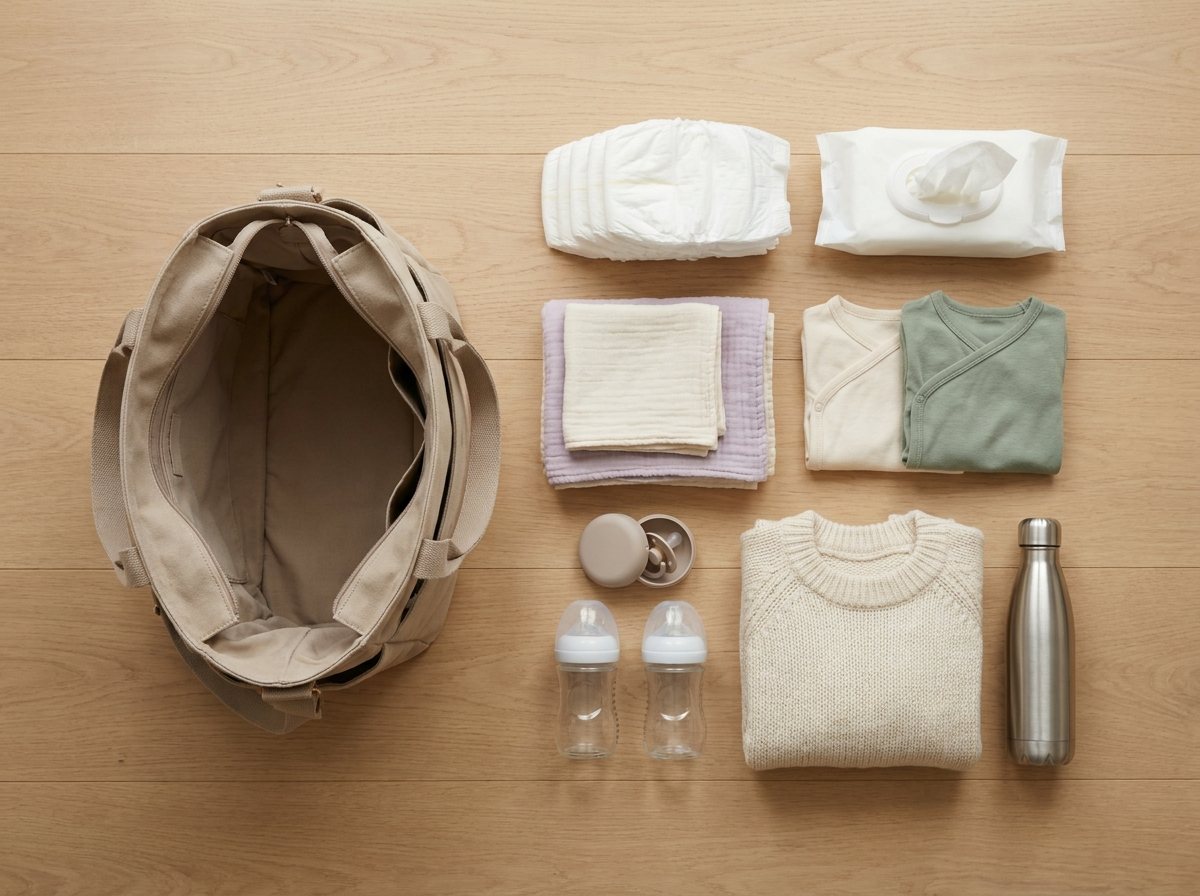
- Pack a “newborn go bag.” Diapers, wipes, two or three changes of baby clothes, burp cloths, a swaddle or blanket, a pacifier if you use one, bottles or nursing supplies, and a change of clothes for you. Spit-up and leaks are not polite about location.
- Bring your own sleep setup. A portable crib or bassinet that meets current safety standards, with a firm, flat surface and a fitted sheet, is a better bet than a borrowed couch or an adult bed. Safe sleep rules don’t take a holiday. Babies should sleep on their backs, on a flat surface, with nothing soft in the sleep space.
- Plan feeding stops. Look up rest areas or quiet cafes along the way. If you’re pumping, charge the pump and bring spare parts.
- Pack your own comfort. A water bottle, snacks, a cozy layer, headphones, and any medication or pain relief your provider has approved. A donut pillow if you need one. Look after the mother in the back seat, too.
At someone else’s house
Be explicit about where you’ll feed and rest. Ask your host in advance: “We’ll need a quiet room for feeds and naps. Is there somewhere that can be our base?”
Safe sleep away from homeThe AAP recommends the baby sleep on their own flat, firm surface in your room, never in an adult bed, on a couch, or in an armchair. Risk is highest when an adult is drowsy from alcohol, sedating medication, or exhaustion. Agree with your partner ahead of time on who is awake and sober for baby duty. If you feel yourself drifting while feeding, put the baby on their back in their own sleep space first, and never doze with them on a couch or chair.
Have an escape plan. Drive separately if you can, or at least agree that you can leave when you need to. “We’re heading out at 3” is a perfectly good plan that you set before you arrive.
Newborn Christmas Visitor Rules and Scripts: What to Actually Say
This is the section most mothers screenshot. Boundaries are easier when you don’t have to invent the words in a moment of exhaustion. Mix and match, adjust the tone to fit your family, and let your partner use them too.
If you’d like a larger bank of phrases to draw from, the How to Say No printable scripts are a good addition, and there’s more on the in-law dynamic in boundaries with in-laws.
Scripts for visitors who want to come over
The warm but firm limit:
“We’d love to see you! We’re keeping visits to about an hour this month so the baby and I can rest. Could you come Saturday between 2 and 3?”
When someone wants to stay for hours:
“Thank you so much for coming. We’re going to wrap up at 4 because it’s nap and feed time. We’ll let you know when we’re ready for another visit.”
When someone asks to stay overnight:
“We’re not hosting overnight guests this year while I’m recovering. We’d love for you to stay at a hotel nearby and come by during the day.”
When someone is sick or sniffly:
“We’re asking anyone who’s had symptoms in the last few days to wait until they’re feeling fully better. We’d love to see you next week instead. Hope you feel better soon!”
When a visitor shows up unannounced:
“We’re so glad you thought of us! Today isn’t a good day. Can we set up a time for later this week?”
When you want help rather than company:
“We’d love a visitor who comes with food and does a load of laundry. Could you do that instead of a regular visit? It’d be the most helpful gift.”
Scripts for passing the baby around
The “pass the baby” ritual is a classic of family gatherings. It can be sweet, and it can also leave you feeling anxious, touched-out, and one second away from snatching your child back from a cousin you barely know. If that feeling is familiar, the piece on being touched out might help it make sense.
To limit holding:
“We’re keeping the baby close to me for now. You can sit next to us and see them, though.”
To allow holding with conditions:
“Yes, you can hold the baby! Please wash your hands first, and keep them seated on the couch.”
When someone pushes back:
“I know it’s disappointing, and I appreciate how much you want to snuggle. This is what we’re doing right now. We’ll have more chances.”
When the baby needs a break:
“The baby’s getting fussy. I’m going to take them back for a feed.”
When you’re the one who is done:
“I’m going to take a quiet minute with the baby. Back in a bit.”
When someone wants to wake a sleeping baby:
“They just fell asleep, so we’re going to let them rest. You can see them when they wake up.”
When someone offers unsolicited advice:
“Thanks, we’re working it out with our pediatrician. We’ve got a plan that works for us.”
Scripts for travel invitations
Declining a trip:
“We won’t be traveling this year. We want to keep the baby’s routine steady and my recovery on track. We’d love to do a video call on Christmas morning.”
Setting a time limit:
“We can come for dinner, but we’ll need to leave by 5:30. That’s what works for the baby’s schedule.”
Asking for accommodations:
“If we come, we’ll need a quiet room for feeding and naps, and we’d appreciate a heads-up if anyone is sick.”
When family pushes for the full tradition:
“I understand this is a tradition that matters to you. We’re doing a smaller version this year, and we’ll revisit next year when the baby’s older.”
Scripts for gifts and “stuff”
The first Christmas can bring a flood of gifts for a baby who can’t hold a rattle yet. If you’d like help with that conversation, what to say when grandparents buy too many Christmas gifts has more.
Redirecting gifts:
“The baby has everything they need right now! If you’d like to give something, a contribution to their savings, a gift card for diapers, or a meal for us would be wonderful.”
Asking for experiences over objects:
“Instead of toys, we’d love a few hours of help one day in January. That would mean so much.”
Safety firstPolitely decline crib bumpers, pillows, sleep positioners, weighted sleep sacks, and toys with small parts or cords. Keep stuffed toys out of the sleep space.
Scripts for your partner to use
Here’s the idea that changes everything: you shouldn’t be the only one delivering the boundaries. Your partner can handle their own family and be your buffer.
- “We’ve talked, and we’re doing a smaller Christmas this year. We’ll share photos.”
- “She needs to rest, so I’ll be taking the baby for a bit.”
- “We appreciate you wanting to help. The best thing you can do is bring dinner and leave it on the porch.”
Having your partner say it prevents the family from treating the boundary as “just the new mom being sensitive.” It makes it the household’s decision.
Christmas Activities With a Newborn That Are Actually Gentle
You may be asking: if I skip all this, what’s left? A lot, actually. The things that are left are the ones that matter.
Here are some low-effort Christmas ideas for a newborn that won’t cost you a night’s sleep.
Quiet, small, and sweet

- Lights-off tree time. Turn off the overhead lights, sit with the baby and the tree lit up, and just be there for five minutes. Newborns see best at close range and respond to gentle contrast. Keep the tree and its cords well out of reach.
- Read a Christmas book aloud. Your baby doesn’t care about the plot. They care about your voice. Pick a short rhyming story, or read your favorite grown-up book out loud in a cozy tone.
- A pajama day. Everyone stays in soft clothes, with no outfit changes required.
- Christmas music on low. Gentle instrumental versions of carols can be soothing during a feed.
- A walk in the stroller or carrier, if you’re feeling up to it and your provider has cleared you for gentle activity, with the baby dressed in one more layer than you’d wear and not overheated. In a carrier, keep the baby’s face visible and chin off the chest (the T.I.C.K.S. rules). Fresh air can shift your mood, and daylight helps your body clock too. If winter makes you feel flat, vitamin D and seasonal low energy is worth a read.
First Christmas with baby: keepsakes that don’t take over your life
If you do want to mark the milestone, pick one thing and make it small.
| Keepsake idea | Effort level | Notes |
|---|---|---|
| A single photo in front of the tree | Very low | Take it when the baby is calm; no outfit changes needed |
| A footprint or handprint ornament | Low | Use an ink-free kit or take a footprint on paper. If you use salt dough, keep it away from the baby’s mouth and hang ornaments out of reach |
| A letter to your baby | Low | Write 5 sentences about this season: where you are, how you feel, what you hope |
| A “dated” ornament | Very low | Buy one with the year on it |
| A short voice memo | Very low | Record yourself telling the baby about their first Christmas |
| A journal entry about your birth story | Medium | If you want to process the birth, these 20 journal prompts may help |
If the baby is screaming in the photos, that’s the honest version of the first Christmas, and you’ll probably love it later.
Make a mother’s version of tradition

This is the piece most holiday guides leave out: you get to have your own tiny traditions, too. A few ideas:
- A hot drink in your favorite mug, in a quiet room, while the baby naps.
- A warm bath or shower with a good-smelling soap after the guests leave. If a bath isn’t comfortable yet, a long shower counts. The bathroom self-care piece has more on making the most of five minutes alone.
- A movie night in bed with a snack.
- A phone call with a friend who asks how you are, not how the baby is.
You are part of this first Christmas. You can design at least one moment of it for you.
Sleep, Feeding, and Splitting the Day With Your Partner
The holiday is a relay race. If one person runs the whole thing, that person will collapse. Here’s how to share the load.
Split the baby shifts
If you’re feeding at night, your partner can take the stretch of the day when you’re most depleted. Even one four-hour block of protected sleep can change how you feel. Agree on this before the holiday, not on Christmas Eve at 11 p.m.
Most newborns shouldn’t go more than about 3-4 hours between feeds in the early weeks unless your pediatrician says otherwise, so these blocks are about four hours. If the baby is breastfed, your partner gives a pumped bottle during your sleep block, or you wake for the feed.
A sample split for the 24th through the 26th:
| Block | You | Your partner |
|---|---|---|
| Christmas Eve, 7 to 11 p.m. | Sleep in earplugs | Baby on duty; gives a pumped or formula bottle if the baby wakes hungry |
| 11 p.m. to 3 a.m. | Baby on duty, including feeds | Sleep |
| 3 to 7 a.m. | Feed at the start of the block, then sleep | Baby on duty after the feed; bottle if needed |
| Christmas morning, 7 to 11 a.m. | Rest, shower, breakfast | Baby on duty, simple cooking |
| Afternoon | Event time, or a nap | Handle guests or family logistics |
If you’re exclusively breastfeeding, the baby will still need you for feeds. In that case, your partner can handle everything around the feed: diaper changes, burping, soothing afterward, getting you water and a snack, and putting the baby back to sleep so you can go back to bed. That’s a real contribution.
If you want more ideas for protecting your sleep, these new-mom sleep tips offer practical help for chopping rest into usable pieces.
Protect the basics
On days with a lot going on, remember the unglamorous essentials:
- Water. Keep a big bottle within reach at every feeding spot.
- Food. Eat something with protein at regular intervals.
- Pain relief. Take pain medication as your provider directed, including dose limits, and tell them if it makes you drowsy.
- Quiet breaks. Even ten minutes with the door closed can reset a frayed nerve.
- Dark and quiet. If you can, nap when the baby naps. If you can’t nap, lie down with your eyes closed.
The “no screens at 3 a.m.” question
Late-night feeds often come with a phone in hand, and the December scroll is a special kind of torment. Everyone else’s perfect trees, matching pajamas, and elaborate cookie spreads can make you feel behind.
If that’s happening, how to stop doom scrolling and the piece on mom comparison and social media are worth a look. Try a podcast, an audiobook, or a white-noise-and-dark-room approach instead. You don’t need a highlight reel at 3 a.m.
When It’s More Than Holiday Stress
This is the section I most want you to read, even if the rest of the page isn’t your situation.
In an emergencyIf you have thoughts of harming yourself or your baby, call or text 988, call the National Maternal Mental Health Hotline at 1-833-852-6262, or call 911.
Exhaustion, tears, overwhelm, and a rollercoaster of emotions are very common in the first days and weeks after birth. Many mothers experience the so-called “baby blues,” with mood swings, weepiness, and anxiety that tend to ease within about two weeks. The holidays can make all of it feel louder.
Don’t wait two weeks if symptoms are severe or you have thoughts of harming yourself or the baby. Get help right away.
But sometimes what looks like “just stress” is something more, and it deserves care. Perinatal mood and anxiety conditions are common, treatable, and not a sign of weakness or failure. They can start during pregnancy or any time in the first year after birth, not just in the first few weeks.
Signs worth raising with your doctor or midwife
You don’t need to meet some strict threshold. If any of these sound like you, and especially if they last more than a couple of weeks or are getting worse, please tell your doctor, midwife, or another healthcare provider:
- A low mood that doesn’t lift, or feeling sad, empty, hopeless, or numb most of the day, most days
- Anxiety that won’t switch off, including constant worry, racing thoughts, a pounding heart, or feeling on edge
- Intrusive thoughts, such as scary images or “what if” thoughts about harm coming to the baby, that you can’t shake
- Trouble sleeping even when the baby sleeps, or the opposite, sleeping far too much
- Loss of interest in things you usually enjoy, or feeling nothing when you look at the baby
- Feeling like you can’t cope, or that everyone would be better off without you
- Rage or irritability that feels out of proportion and frightens you. (If this is you, mom rage and anger management for moms may help you feel less alone.)
- Not eating, or eating far more than usual, with changes you can’t explain
- Panic attacks, or feeling detached from yourself or the world
- Withdrawing from people, avoiding the baby, or dreading every interaction
- Feeling like a failure as a mother in a way that doesn’t ease
Depletion can also be a part of it. If you’ve been running on empty for a long time, the article on depleted mother syndrome describes how exhaustion and overwhelm can build up.
What to say to your provider
You don’t need to have it figured out. You could say:
“I’ve been feeling really low since the baby came, and it’s not getting better. I want to talk about it.”
or
“I’m anxious all the time, and I can’t turn it off. I think I need some help.”
Your doctor or midwife has heard this many times. They’ll likely ask a few questions, and there are treatments and supports that can help, including talk therapy, support groups, and, for some people, medication. Many mothers say the hardest part was admitting it out loud.
If you’ve already had an appointment and you still feel bad, go back. Tell them again. It’s okay to ask for a second opinion or a referral.
When to get help right away
Some situations are urgent. Please seek help immediately if:
- You’re having thoughts of harming yourself or your baby
- You’re thinking you’d be better off dead, or that your family would be better off without you
- You’re seeing or hearing things that aren’t there, feeling confused, or having beliefs that others tell you aren’t real
- You’ve barely slept for days and feel agitated, “wired,” or out of touch with reality
- You feel you can’t keep yourself or the baby safe
These are emergencies. In the United States, you can:
- Call or text 988 (Suicide & Crisis Lifeline), available 24/7
- Call or text the National Maternal Mental Health Hotline at 1-833-852-6262 (1-833-TLC-MAMA), free, confidential, and available 24/7 in English and Spanish
- Call 911 or go to the nearest emergency room if you or your baby are in immediate danger
For support that isn’t a crisis line, Postpartum Support International (PSI) offers information and local resources at 1-800-944-4773. Text “HELP” to 800-944-4773 (English) or “Ayuda” to 971-203-7773 (Spanish).
If you’re outside the United States, please look up your local crisis line or emergency number, or ask your doctor, midwife, or health visitor for the right contact. Help exists in nearly every country, and you do not have to wait for the holidays to be over.
If you’re worried about a partner, sister, or friend, it’s okay to ask directly: “Are you having thoughts of hurting yourself?” Asking doesn’t plant the idea. It opens a door.
If the answer is yes, stay with them and call or text 988, or take them to the ER.
Holiday stress versus something more
If you’re not sure which one you’re facing, here’s a rough comparison. This isn’t a diagnosis, and it can’t replace a conversation with a professional.
| More like holiday overwhelm | Worth raising with a provider |
|---|---|
| Tired, teary, and fed up, but you have moments of calm or laughter | Persistent sadness or numbness that doesn’t lift |
| Worried about hosting, travel, or family drama | Worry that fills the day and won’t let you rest |
| Short on sleep, but you can nap when given the chance | Can’t sleep even when you have the chance |
| Irritable when people overstep | Rage or panic that scares you |
| Eases when you cancel or simplify plans | Stays the same or gets worse when pressure is removed |
| You enjoy small things, like a warm drink or a cuddle | Nothing feels good, or you feel disconnected from the baby |
One practical test: if you simplified everything, cut the guests, canceled the trip, and rested, and you still felt awful, that’s a signal. Not a failure. A signal.
Tell one person this week
If you’re worried about yourself, tell one person today: your partner, a friend, your mom, your doctor’s office, a PSI volunteer. Say, “I’m not okay and I need help getting through this.” Being specific about the request, like “Can you come over Thursday and sit with the baby while I nap?”, turns worry into action.
Making friends and finding support matters, too. If your village feels thin, making mom friends as an adult is a good place to start when you’re ready.
If you need support right now
Reaching out is not an overreaction. These lines are free and confidential.
- Emergency: if you are thinking about harming yourself or your baby, or you can’t keep yourself safe, call 911 or go to the nearest emergency room. This is a medical emergency, and it is treatable.
- 988 Suicide & Crisis Lifeline: call or text 988, 24/7, for anyone in crisis.
- National Maternal Mental Health Hotline: call or text 1-833-TLC-MAMA (1-833-852-6262), 24/7, in English and Spanish, for pregnancy and postpartum support.
- Postpartum Support International: call or text 1-800-944-4773 for help finding a provider who specializes in perinatal mental health. Not an emergency line.
US numbers. Elsewhere, ask your doctor, midwife or local crisis line. This article was written by a parent, not a clinician, and isn’t medical advice.
Frequently Asked Questions
Is it okay to skip Christmas entirely with a newborn?
Yes. There’s no rule that says you have to celebrate in any particular way. Some families do a full “pajamas, takeout, and a movie” Christmas. Others keep a very small gathering, and some mark the day only with a video call. Your baby won’t know or remember the difference, and you will. Choose what protects your recovery and your sanity, and treat the rest as optional.
How long should visitors stay when we have a newborn?
A visit of 45 minutes to an hour is a good starting point, especially in the first few weeks. Give a time window in advance (“come between 2 and 3”). Have your partner help signal when it’s time to wrap up. Let helpful visitors do a chore, such as bringing a meal or folding laundry, rather than only holding the baby. If a visitor stays longer than planned, it’s fine to say, “We’re going to rest now. Thank you so much for coming.”
Can I take my newborn to a big family Christmas gathering?
It depends on your baby’s age, health, and the setting, so it’s a good question for your pediatrician. In general, pediatric guidance leans toward limiting crowds and sick contacts during a newborn’s first weeks and months, because young babies are more vulnerable to infections. If you do go, consider a shorter visit, a quieter room, hand washing for anyone who holds the baby, and a firm “no kissing” rule. It’s also okay to decline, and to celebrate with a smaller group at home.
What do I say when relatives are upset that I won’t let them hold the baby?
Stay warm and short. Something like, “I know how much you want to snuggle. We’re keeping the baby close right now, and we’ll have more chances soon.” You don’t need to justify it with a medical lecture, and you don’t need to apologize. If hurt feelings come up, remember that feeling disappointed doesn’t mean you did something wrong. Many families also find it easier when the partner delivers the message to their own side of the family.
How do I handle breastfeeding or bottle-feeding around extended family?
Do what makes you comfortable. Some mothers feed in the main room, with or without a cover. Others prefer a quiet bedroom. You can tell your hosts in advance, “I’ll be feeding the baby in the back room, and I may be in and out.” If someone comments, a simple “This is what works for us” is enough. If you’re formula or combination feeding, you don’t owe anyone an explanation, either.
I feel sad and overwhelmed this Christmas. When should I talk to a doctor?
If your low mood, anxiety, or exhaustion lasts more than about two weeks or is getting worse, please reach out to your doctor or midwife. The same goes if it is getting in the way of eating, sleeping, or caring for yourself or the baby.
You should also reach out if you have scary intrusive thoughts, can’t feel connected to your baby, or feel hopeless. Mood and anxiety conditions after birth are common and treatable, and you can raise them at any point in the first year. If you’re having thoughts of harming yourself or your baby, or you feel unsafe, call or text 988, call the National Maternal Mental Health Hotline at 1-833-852-6262, or call 911 right away.
How do I stop feeling guilty about doing less this year?
Guilt often comes from comparing your real life to an idealized one. It can help to ask: “What does my baby actually need today?” and “What does my body need?” Write down two or three things that truly matter to you about the holiday, and let everything else go. Then talk with your partner about who will own the jobs you’re dropping or delegating. Over time, the guilt usually fades, and what you remember is how you felt, not how many cookies you baked.
You Don’t Have to Make This Christmas Magical
Here’s what I hope you take from all this: you are allowed to have a small, quiet, imperfect Christmas, and you are allowed to ask for help, say no, and rest. Your baby needs you fed, supported, and well, far more than they need a perfect tree or a picture-perfect gathering.
If something in the newborn weeks feels heavier than ordinary tiredness, tell someone. Call your doctor or midwife, reach out to a helpline, or ask a friend to sit with you. Needing support doesn’t make this first Christmas less special. It makes it survivable, and that’s the real gift.
Pick one thing from the skip column, one script from the list, and one tiny tradition that’s just for you. That’s enough. Merry, gentle, good-enough Christmas, mama.