Bathroom Self-Care: What to Do With Your 5 Minutes of Hiding
Discover how to reclaim brief moments of self-care in the bathroom, even when hiding from your toddler. Learn tiered strategies for 60-second, 2-3 minute, and 5-minute resets, with crucial safety guidelines for solo breaks versus when another adult is present.
- Prioritize safety: solo breaks are 60 seconds max, door ajar, child secured in a safe space.
- Utilize tiered resets: 60-second solo, longer 2-3 and 5-minute breaks require another adult.
- Manage expectations; even 5 minutes with help isn't quiet, solo breaks are very brief.
- Implement specific resets like box breathing (60s), stretching (2-3m), or hand cream (5m).
- Embrace bathroom breaks as a valid way to combat feeling "touched out" from constant demands.
This post contains affiliate links. As an Amazon Associate I earn from qualifying purchases.
Last Tuesday, with my toddler in the gated play area, I said I had to “go potty” and pulled the bathroom door almost shut, so I could still hear every sound. Less than a minute later a small voice asked, “Mama? Are you pooping?” I said yes. I was hiding, and I regret nothing.
Below: 60-second, 2–3 minute and 5-minute resets, sorted by how much interruption you get. The longer two need another adult on duty. If you’re the only adult home, stick to one 60-second reset, no longer, and read the safety note below first. They won’t fix chronic exhaustion. They just take the edge off.
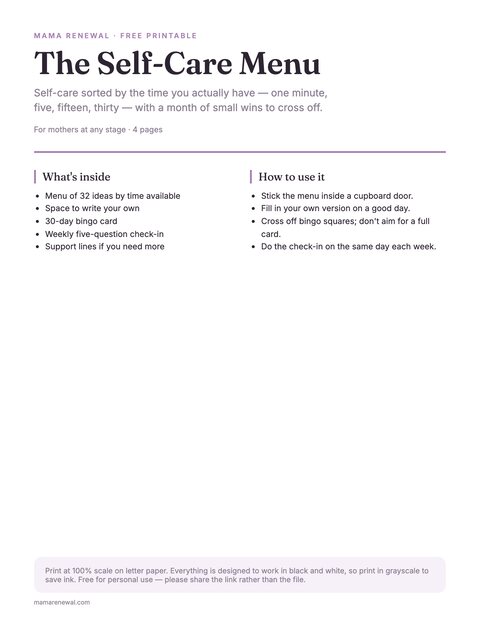
Free printable · 6 pages
The Self-Care Menu + 30-Day Bingo
Self-care sorted by the time you actually have — one minute, five, fifteen, thirty — with a month of small wins to cross off.
Free. Your download link appears right here. You'll also join the Mama Reset. Unsubscribe anytime. Privacy
In this article (10 sections)
- The Three Tiers: How Much Time Do You Have?
- Why Moms Hide in the Bathroom (and Why It’s Okay)
- What 5 Minutes Really Looks Like With a Toddler
- Tier 1: Quick Self-Care Ideas for Moms in the Bathroom (60 Seconds)
- Tier 2: 2–3 Minute Self-Care Ideas
- Tier 3: Self-Care When You Get 5+ Minutes
- Set Up Your Bathroom for Quick Resets
- How to Make Bathroom Self-Care a Habit
- When Hiding in the Bathroom Is a Warning Sign
- Frequently Asked Questions
The Three Tiers: How Much Time Do You Have?
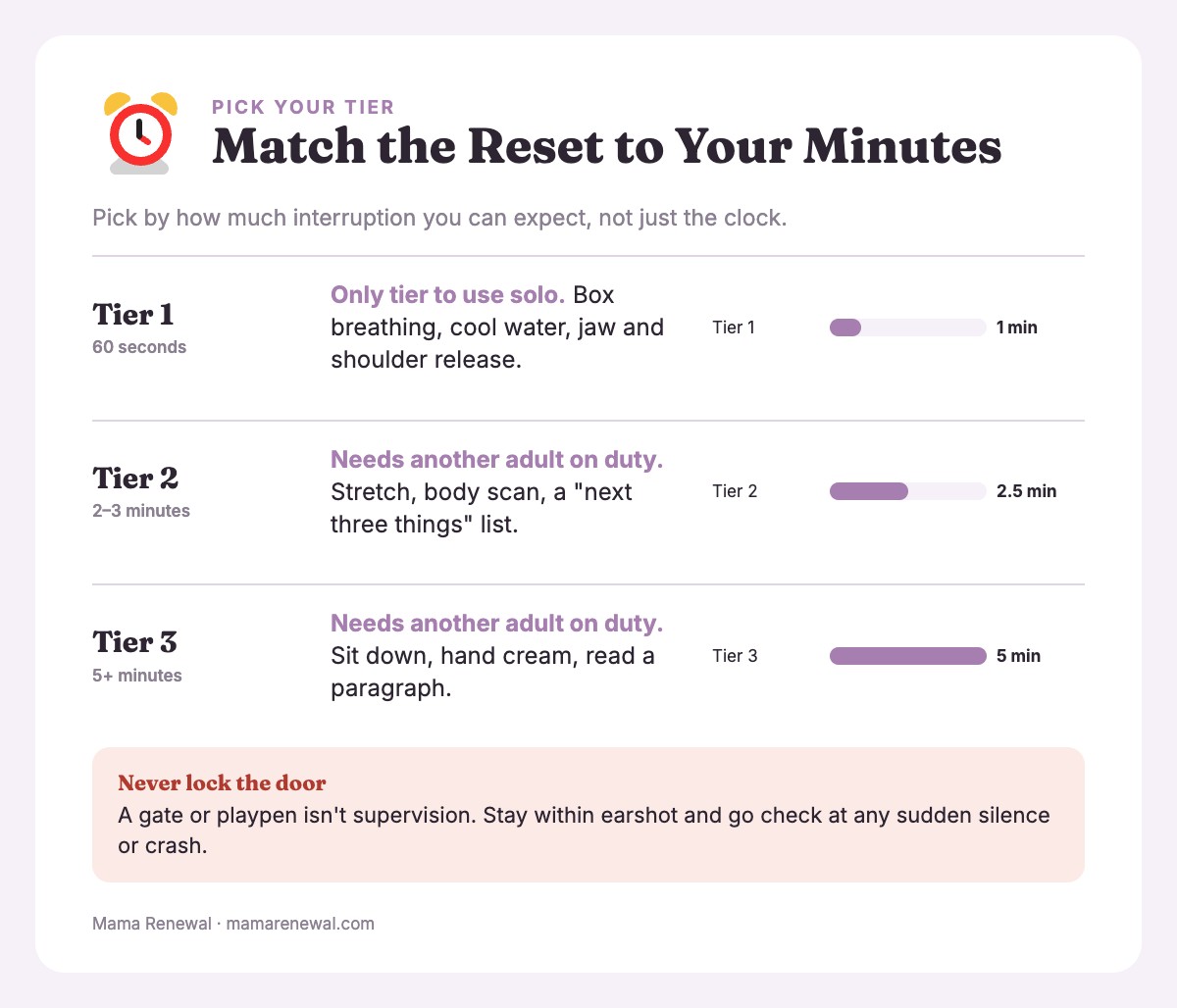
Safety firstAnother adult on duty is the safest setup. A gate or playpen isn’t supervision, and time alone is a risk to minimize, not a safe allowance. If you’re the only adult home, a solo break is a last resort: one minute or less, Tier 1 only, and only if your child can’t climb out of a gated, childproofed space. Stay within earshot and go check at any sudden silence or crash. Never lock the door. If your toddler is loose in the house, skip the break, or do a breathing reset in front of them.
| Tier | Time | Interruption tolerance | Best ideas |
|---|---|---|---|
| 1 | 60 seconds | High: works while someone narrates your location. The only tier to use solo | Box breathing, cool water, jaw and shoulder release. |
| 2 | 2–3 minutes | Medium: needs another adult on duty | Stretch, body scan, a “next three things” list. |
| 3 | 5+ minutes | Low: needs another adult on duty | Sit down, hand cream, read a paragraph. |
Why Moms Hide in the Bathroom (and Why It’s Okay)
In my house, and probably yours, my name gets called first. My lap gets climbed on, and my body is needed for touching, nursing and carrying at nearly all hours. The bathroom is often the one room with a door that closes.
Many moms call this feeling “touched out”: the overwhelm of being physically needed all day, every day. If you’ve read what touched out means, you know it’s not a character flaw. A closed door gives you a sliver of that space back, and a minute behind it is a reasonable, low-cost break.
Plenty of jobs build in breaks. Yours doesn’t.
What 5 Minutes Really Looks Like With a Toddler
Here’s the honest math of a toddler-era bathroom break. It is not five quiet minutes, and how long you get depends on who is watching your toddler.
With another adult on duty (up to 5 minutes)
This five-minute version only applies when another adult is supervising your toddler. It looks more like:
| Time | What’s happening |
|---|---|
| 0:00–0:15 | You close the door. Someone immediately notices you are missing. |
| 0:15–0:45 | Knock, knock, knock. “Mama?” |
| 0:45–1:30 | Brief silence. This is your actual window. |
| 1:30–2:30 | Calling through the door, or a small hand on the handle. Time to start wrapping up. |
| 2:30–4:00 | Full negotiation through the door about whether you’re almost done yet. |
| 4:00–5:00 | You emerge, having done one small thing, or nothing at all. |
If you’re the only adult home (1 minute, tops)
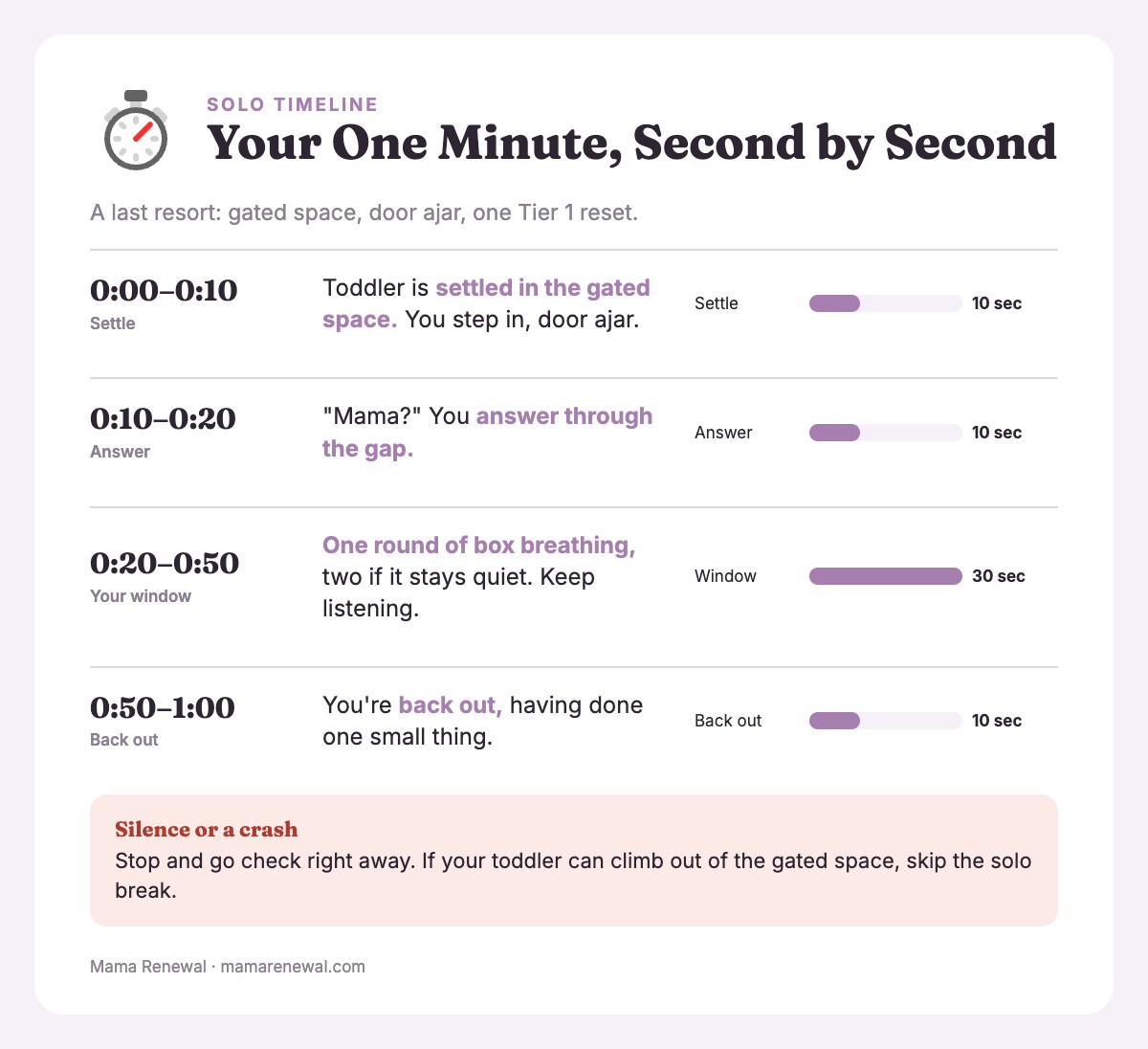
This is a last resort, not a routine. Your toddler is in a gated, childproofed space they can’t climb out of, and the door stays ajar so you can hear every sound. The bathroom is childproofed too: medications and cleaners locked away, toilet lid latched. The timeline is much shorter:
| Time | What’s happening |
|---|---|
| 0:00–0:10 | Your toddler is settled in the gated space. You step in and leave the door ajar. |
| 0:10–0:20 | “Mama?” You answer through the gap. |
| 0:20–0:50 | Brief quiet. This is your actual window, enough for one Tier 1 reset: one round of box breathing, two if it stays quiet. Keep listening the whole time. |
| 0:50–1:00 | You’re back out, having done one small thing. |
| Any time | Sudden silence or a crash means you stop and go check right away. |
Solo, that leaves about thirty usable seconds, with noise around the edges. Time without an adult watching is a risk to keep as small as possible, not a safe allowance. If your toddler can climb out of the gated space, skip the solo break and wait for another adult. That’s the actual constraint we’re designing for here.
This matters because a lot of “5 minute self care” content assumes you’ll get five quiet minutes. You won’t. So the ideas below are sorted by how much interruption-tolerance they require, not just how long they technically take.
Tier 1: Quick Self-Care Ideas for Moms in the Bathroom (60 Seconds)
Even for 60 seconds, another adult watching is the safest setup. If you’re solo, this is the only tier to use: one reset, a minute or less. Your toddler stays in a gated space they can’t climb out of, with the door ajar so you can hear them.
These work even while someone narrates your location to the whole house. Pick one.
- Box breathing, four counts each way. Slow breathing can help you feel calmer. One round takes about 16 seconds. If you’re solo, do one or two rounds and stop. Steps are just below, with more in nervous system regulation for moms.
- Cool water on your wrists, neck or face. Thirty seconds is plenty.
- Unclench your jaw and drop your shoulders, three times. Tension can sit there all day unnoticed. Letting go on purpose can ease it.
- Say one true thing out loud, quietly. “This is hard right now,” “I’m doing okay,” or just “ugh.” Naming it beats gritting through it.
- Look at yourself in the mirror. Not to critique. Just see your own face for a second, the way you’d look at someone you care about.
- Three slow sips of water. An easy, no-cost reset. Use a clean cup or bottle kept out of kids’ reach.
None of these need silence or props. The free Self-Care Menu has more ideas sorted by time.
Box breathing, step by step
- Breathe in. Count to 4.
- Hold. Count to 4.
- Breathe out. Count to 4.
- Hold. Count to 4. That’s one round, about 16 seconds.
- Repeat to fit your window. If you’re solo, do one or two rounds (16 to 32 seconds) and head back out by the 0:50 mark on the solo timeline, even mid-round. With another adult on duty, do three rounds, about 48 seconds.
TipIf holding your breath feels uncomfortable or makes you lightheaded, skip the holds and just breathe out slowly. If you get interrupted while another adult is on duty, restart. If you’re solo, don’t restart. Count what you got and head back out.
Tier 2: 2–3 Minute Self-Care Ideas
This tier needs another adult on duty. If you’re solo, stay with Tier 1. The only thing here that fits a solo minute is the five-second scent item at the end. Pick one of these, not all of them.
Stretch what’s actually tight
About 2 minutes. You don’t need a routine. Target the places that get wrecked by holding a toddler on one hip: your chest, lower back and neck. Three moves cover most of it.
- Doorframe chest stretch (30 seconds). Rest your forearm on the frame at shoulder height, elbow bent, and step through until you feel a stretch across your chest. Switch sides halfway.
- Standing forward fold (30 seconds). Feet hip-width apart, knees soft, let your head and arms hang heavy.
- Slow neck roll (5 each way). Drop one ear toward your shoulder and roll gently through the front. Skip the back of the neck.
TipSkip the forward fold if it makes you dizzy, and come up slowly. Only stretch when another adult is watching your toddler.
For a fuller version at a quieter moment, like before the kids wake up, try the gentle morning stretches for moms routine.
Do a 60-second “body scan” check-in
About 1 minute. Starting at your feet and moving up, notice where you’re holding tension, where you’re tired, and where something hurts. Aches are easy to ignore when there’s never a still moment. If pain is persistent, getting worse or severe, mention it to your doctor or a physical therapist.
Reset your mental “next three things”
About 1 minute. Instead of scrolling, name the next three things you actually need to do, in your head or in a phone note. Not the whole day, just three.
This shrinks an overwhelming list into something manageable. It’s a small antidote to the mental load, the invisible tracking and planning that runs in the background of a mom’s brain.
Apply something with actual scent
About 5 seconds. A dab of a favorite lotion, a swipe of lip balm you like, or a spritz of something that smells like you, not like the inside of a diaper bag. It’s one small thing in your day that’s only for you, and the one item in this tier that fits a solo minute. Read the safety note in the setup section below before you stock anything.
Tier 3: Self-Care When You Get 5+ Minutes
This tier needs another adult on duty, so wait until a partner or helper takes point. With five minutes, pick two or three of these and don’t rush. The times shown are minimums.
- Sit down (1–2 min). Not perch, not hover. You’re on your feet most of the day. Sitting all the way down is a real break.
- Use your hands for you (1 min). Apply hand cream, or braid a piece of your own hair. One small thing that isn’t for someone else.
- Journal three words (30 sec). Keep a tiny notebook, or a phone note called “bathroom brain dump,” for this. Write three words about how you’re doing, like “tired, snappy, okay,” and stop there. Over time you get a real record of your own patterns.
- Read one paragraph that’s just for you (1 min). Not the group chat, not the news, not your kid’s school app. A novel, a devotional, anything you chose because you wanted it.
- Repeat your favorite Tier 2 reset (1 min). The body scan or the “next three things” list both work well here.
Set Up Your Bathroom for Quick Resets
A few small changes make these minutes easier to use, and none of them cost much.
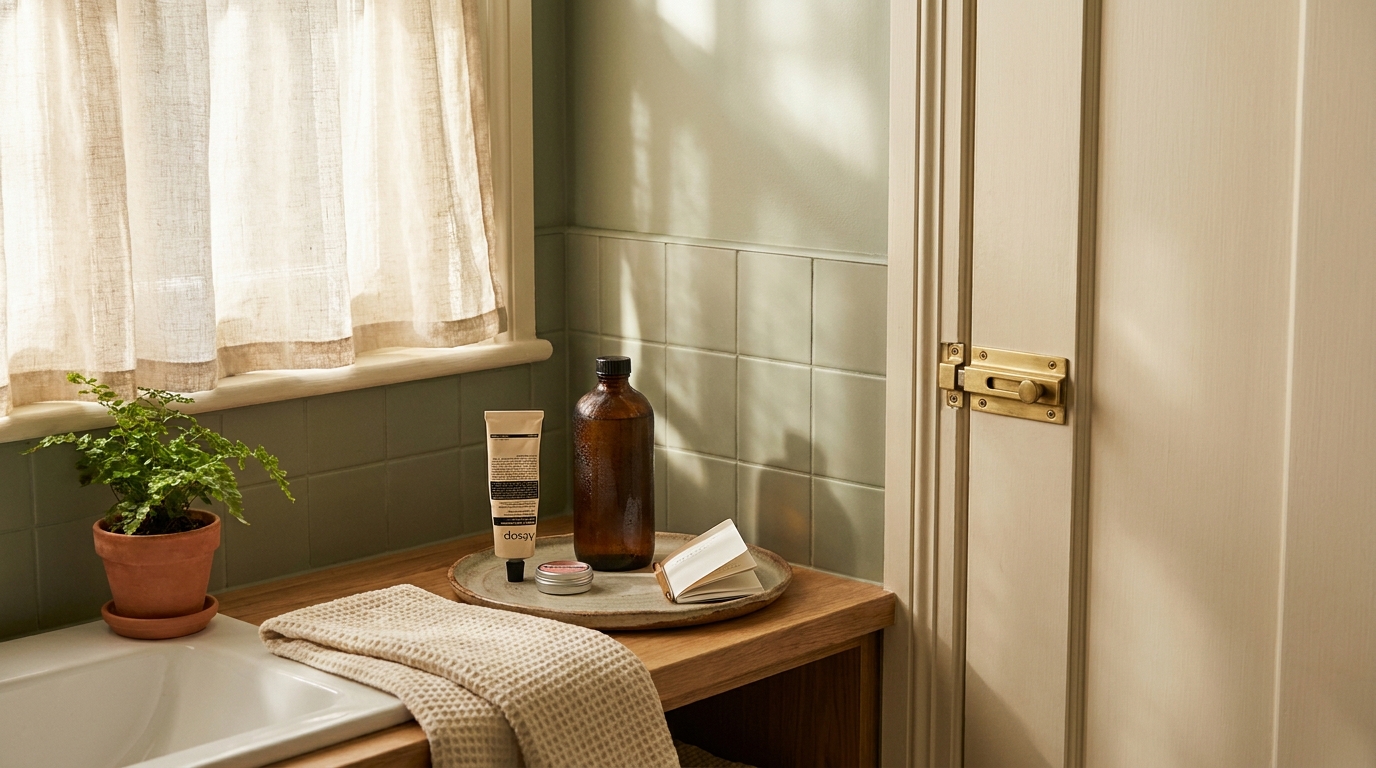
- A grab kit in a lockable box or on a high shelf. Lip balm you love, hand cream, and a tiny notebook with a pen. Staging it means you don’t spend your sixty seconds deciding.
- Something nice at eye level. A small print or a plant on the windowsill. Anything that isn’t a to-do list or a school calendar.
- Warm lighting, if you can. An inexpensive warm-white bulb can soften the room. Check the fixture’s maximum wattage and turn the power off before changing it.
- A door you never lock. Close it fully only when another adult is on duty. If you’re solo, leave it ajar so you can hear your toddler. Check that the lock releases from outside with a coin or flat tool, and keep that tool on a high ledge above the door frame, out of children’s reach.
- A childproofed room. Medications and cleaning products locked away, and a latch on the toilet lid.
Closing the door isn’t rude; it’s a boundary, and you don’t have to apologize for it. If that feels hard, start with boundaries for moms.
None of this needs to look like a Pinterest board. Keep it functional.
Safety firstHair ties, pens, nail files, lotions, lip balm and button batteries are choking, ingestion or sharp-object risks for children under 4. Keep them out of reach, and lock away medications and cleaning products. Skip essential oils and candles around little ones.
How to Make Bathroom Self-Care a Habit
The hard part isn’t knowing what to do with sixty seconds. It’s remembering to use them instead of doom-scrolling. A few ways to make it automatic:
- Attach it to something that already happens. Every time you use the bathroom, run cool water over your wrists. No decision required, which is why it sticks.
- Lower the bar on purpose. The goal is one small thing instead of zero. Some days that’s box breathing. Some days it’s just sitting down.
- Stop apologizing for it, out loud or in your head. You don’t need to justify a bathroom break beyond “mama needs a minute.” That sentence is a complete explanation.
- Notice you did it. If you took even one real sixty-second reset today, call it a win. That’s the idea behind micro self-care for busy moms: tiny, repeated moments add up.
Three sample days
Here are three sample days for a mom of a toddler. They’re not aspirational, just realistic:
| Day | What actually happened |
|---|---|
| Monday | Solo morning. Two rounds of box breathing, about thirty seconds, with running commentary from the play area the whole time. Still worth it. |
| Wednesday | Partner had the kids for five minutes. Sat down, ate a granola bar, read half a page. |
| Thursday | Forgot entirely. Stood in the bathroom scrolling, walked out feeling worse. Also a normal day. |
Thursday is in there on purpose. This isn’t a streak to protect. Some days the bathroom is just a bathroom.
Self-care guilt: why small resets count
If you’re thinking “it’s a little sad that a bathroom door is my main form of self-care,” I hear you. But the size of the reset doesn’t decide its value. A sixty-second breath isn’t a consolation prize for the spa day you’re not getting.
If you closed a door, breathed on purpose, and walked out slightly steadier, that was a real break. If the guilt hangs around anyway, how to stop mom guilt goes deeper.
When Hiding in the Bathroom Is a Warning Sign
Occasionally ducking into the bathroom for a breather is normal. But if you’re hiding constantly, or the bathroom is the only place you don’t feel dread or resentment, pay attention. You’re not doing something wrong. It might be a signal.
Some questions worth sitting with honestly:
- Am I hiding to get a break, or because I can’t be around my kids right now without snapping?
- Do I feel relief when I close the door, or something closer to panic or numbness?
- Is this happening a few times a week, or every time I’m alone with my kids?
If you’re leaning toward the second option in each pair, read about mom burnout. Depleted mother syndrome is a popular term, not a diagnosis, but it describes a similar pattern.
There’s also a difference between needing space and having mom rage, where your reactions feel disproportionate and scary even to you. Neither is shameful.
Only a professional can tell what’s going on. Burnout, numbness or intense anger are worth a conversation with a clinician, not just a longer break. If you don’t know where to start, here’s how to find a therapist as a busy mom.
Good to knowIf you feel panic, numbness, constant dread, or fear you might hurt yourself or your child, talk to your doctor or a mental health professional. In the US, call or text the National Maternal Mental Health Hotline at 1-833-852-6262 (24/7), or call or text 988 in a crisis.
For most of us, though, bathroom-hiding is just Tuesday. It’s a reasonable response to a job with no scheduled breaks, and it deserves a plan, not guilt.
If you want a slightly bigger version of this, with a few more minutes to work with, 5-minute self-care for busy moms is a good next stop.
If you need support right now
Reaching out is not an overreaction. These lines are free and confidential.
- Emergency: if you are thinking about harming yourself or your baby, or you can’t keep yourself safe, call 911 or go to the nearest emergency room. This is a medical emergency, and it is treatable.
- 988 Suicide & Crisis Lifeline: call or text 988, 24/7, for anyone in crisis.
- National Maternal Mental Health Hotline: call or text 1-833-TLC-MAMA (1-833-852-6262), 24/7, in English and Spanish, for pregnancy and postpartum support.
- Postpartum Support International: call or text 1-800-944-4773 for help finding a provider who specializes in perinatal mental health. Not an emergency line.
US numbers. Elsewhere, ask your doctor, midwife or local crisis line. This article was written by a parent, not a clinician, and isn’t medical advice.
Frequently Asked Questions
What are the best 5 minute self care ideas for moms with toddlers?
Good options for an interruptible five minutes don’t require silence or props. Try box breathing (four counts in, four hold, four out, four hold), cool water on your wrists or neck, a deliberate jaw-and-shoulder release, or a few slow sips of water. A full five minutes needs another adult on duty. If you’re the only adult home, do one of these for a minute or less. With another adult watching and a clearer window, a short stretch sequence or a three-word journal entry about how you’re actually doing adds more without needing much extra time.
Is it normal to hide in the bathroom to get away from your kids?
Yes, it’s very common, especially in the toddler years when kids are physically following, climbing on, and needing you almost constantly. The bathroom is often the one room with a door that closes, which makes it the default hiding spot for a lot of moms. Ducking in occasionally is a reasonable way to take a short break when another adult is watching your toddler. If you’re the only adult home, treat it as a last resort: a minute or less, with your toddler in a gated space they can’t climb out of and within earshot. It becomes a concern if you feel unable to be around your kids at all.
How do I do self care with kids around all the time?
Shift your definition of self-care from activities that need solitude to small resets you can do in front of your kids, or briefly away from them. A deep breath while your toddler plays nearby, a cold glass of water, a look in the mirror, or a sixty-second stretch all count. None require your kids to be elsewhere.
What can I do at home for self care that doesn’t cost money or take a long time?
Most of the best options are free and fast: breathing exercises, cool water, stretching tight muscles, drinking water, and a mental “next three things” reset. All take under two minutes and need nothing extra.
Why does a quick self care break actually help if it’s so short?
Slow breathing and cooling down can help your body settle, and a short pause can keep stress from piling up. The goal isn’t to erase your stress for the day. A sixty-second interruption can help keep it from compounding.
What if I don’t even get a full 5 minutes, more like 60-90 seconds?
With another adult on duty, 60 to 90 seconds is enough for a real reset. If you’re the only adult home, keep it to a minute or less, even with your toddler in a gated space they can’t climb out of. That means one or two rounds of box breathing, not three. Focus on the Tier 1 options in this article: box breathing, cool water, a jaw and shoulder release, or three sips of water. They work even with interruptions.
How do I stop feeling guilty about needing a break in the bathroom?
Reframe it: you’re not avoiding your kids. You’re managing a job with no built-in breaks by using the one room with a door that closes. A real sixty-second reset, used on purpose, is a legitimate tool, not a smaller, sadder version of self-care.