
Daylight Saving Time Sleep Schedule Chart for Moms and Toddlers
Prepare for Daylight Saving Time by using a 5-day gradual bedtime shift chart to help your toddler adjust. You'll learn how to manage early wake-ups and prioritize your self-care during the transition.
- Prepare for Daylight Saving Time by planning for clocks to fall back.
- Implement a 5-day gradual bedtime shift chart for your toddler.
- Discover effective fixes for early morning wake-ups.
- Utilize the mom self-care check-in to support yourself.
- Download the free printable sleep shift planner for comprehensive tools.
This post contains affiliate links. As an Amazon Associate I earn from qualifying purchases.
The first Sunday after the clocks fell back last year, my daughter stood at the end of my bed at what my phone swore was 5:12 a.m. Her body said 6:12. She was cheerful and ready to discuss the moon. I was running on a thimble of sleep.
That’s the catch with the “extra hour.” Your toddler gets an hour awake in the dark, and you get a morning that starts in the middle of your night.
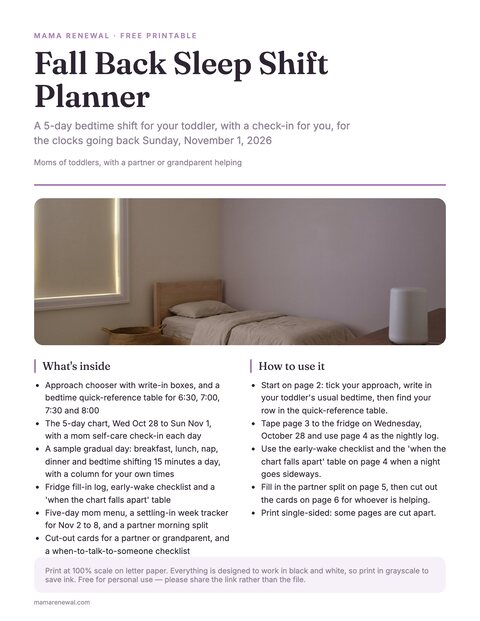
Free printable · 6 pages
Fall Back Sleep Shift Planner
A chooser for cold turkey, gradual or split-the-difference, a quick-reference bedtime table, the Wed Oct 28 to Sun Nov 1 chart with mom check-ins, a fridge log, an early-wake checklist, a mom menu, a settling-in week tracker, a partner split with cut-out cards, and a when-to-talk-to-someone checklist.
Free. Your download link appears right here. You'll also join the Mama Reset. Unsubscribe anytime. Privacy
The good news: you can see this one coming. Daylight saving time ends on Sunday, November 1, 2026, when clocks go back at 2 a.m. You have about a week and a half to plan, and the chart starts Wednesday, October 28.
Below you’ll find a 5-day gradual bedtime shift chart, a mom self-care check-in, and fixes for early wake-ups. The grown-up is going to be tired too, so she gets a column of her own.
For the broader “why do I feel so wrecked” conversation, see The Daylight Saving Time Hangover. This post is the practical, day-by-day companion, so you can stop doing time-zone math at 9 p.m.
In this article (13 sections)
- What Actually Happens to Toddlers When the Clocks Fall Back
- Pick Your Approach (and Stop Second-Guessing It)
- The 5-Day Gradual Bedtime Shift Chart
- Day-by-Day: What to Actually Do
- Light, Wake-Ups, and the Early-Morning Problem
- Naps, Meals, and Everything Else That Shifts
- When the Chart Falls Apart (Because It Will, a Little)
- The Mom Self-Care Check-In (the Column That Matters Most)
- A Gentle Plan for the Week After the Change
- When to Talk to Someone
- Make the Chart Easy to Use
- Frequently Asked Questions
- You Don’t Have to Do This Perfectly
What Actually Happens to Toddlers When the Clocks Fall Back
Let’s name the problem clearly so the plan makes sense.
Toddlers run on a pretty rigid internal schedule. Their sleepiness, hunger, and wake-ups are tied to light, routine, and body clock rhythms, not to the number on the microwave. When the clock suddenly shifts by an hour, their bodies keep following the old rhythm for a while.
In practical terms, “falling back” usually looks like this:
- Early wake-ups. A toddler who normally wakes at 6:30 a.m. wakes at what feels like 6:30 to her body, which is now 5:30 on the clock.
- Bedtime that arrives an hour late for her body. At the usual 7:30 on the new clock, her body still reads 8:30. She may be overtired, cranky, or get a second wind. That’s why the chart shifts bedtime later in small steps.
- Naps that fall apart. The nap that used to start at 12:30 now lands when her body thinks it’s 1:30. Some toddlers fight it, some crash early, some take a short nap and wreck the afternoon.
- Overtired evenings. Even when the schedule technically lines up, a few nights of choppy sleep can show up as meltdowns around 4 p.m.
- Night wakings. Some kids who normally sleep through will pop awake and want company.
Daylight saving time sleep disruption is usually temporary. For many families, kids re-sync within a week or so, sometimes a little longer. A gradual shift helps because you’re nudging their body clock a few minutes at a time instead of asking it to jump a whole hour overnight.
And what about the sleep effects on you? They’re real, too. Some adults feel groggy or off for a few days. If you are already running on a low sleep tank, a bad week of toddler sleep lands harder. (If that sounds like your baseline, Mom Sleep Debt: Why You’re Still Exhausted Even When Kids Sleep Through the Night is worth a read.)
Why “Fall Back” Isn’t Actually the Easy One
Moms love to say fall back is the “easy” time change, and in one narrow way it is: the clock change gives bedtime a free hour of leeway. Nobody is trying to get a toddler to sleep an hour earlier than her body wants, which is the harder spring-forward problem.
But early rising is its own special misery. A toddler who is up at 5 a.m. is not going to drift back to sleep because you ask nicely. And since the sun also comes up earlier on the new clock for a few weeks, her room may be getting light even sooner than usual.
The fix isn’t a mystery. It’s patience, light control, and a very small shift each day.
Pick Your Approach (and Stop Second-Guessing It)
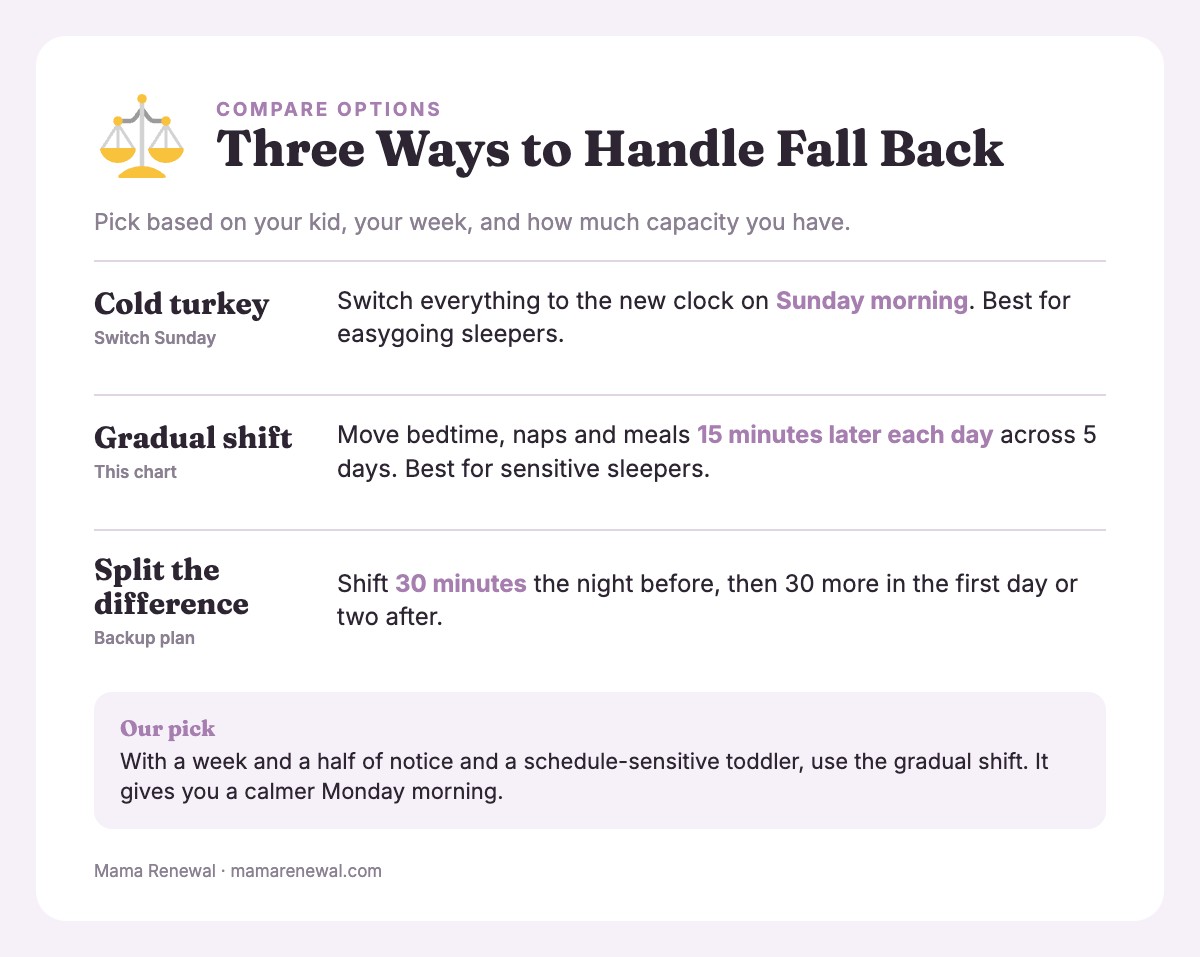
There are three common ways to handle the fall back time change with a toddler schedule. All three can work. The right one depends on your kid, your week, and honestly how much capacity you have.
| Approach | How it works | Best for | Watch out for |
|---|---|---|---|
| Cold turkey | Switch everything to the new clock on Sunday morning and ride it out | Easygoing sleepers, flexible schedules, families who can tolerate a rough few days | Very early wake-ups and a cranky first week |
| Gradual shift (this chart) | Move bedtime, naps, and meals 15 minutes later each day across 5 days so the new clock lines up on Sunday night | Sensitive sleepers, kids already prone to early waking, daycare schedules | Takes a little planning and some evening discipline |
| Split the difference | Shift 30 minutes the night before, then 30 minutes in the first day or two after | Families with a busy weekend (hello, Halloween) who can’t do a full 5 days | A bit less predictable, so expect some bumps |
My recommendation: if you have a week and a half of notice and a toddler who is even a little schedule-sensitive, use the gradual shift. It’s the one that gives you a calm Monday morning. Cold turkey is fine for easy sleepers. The split option is your backup if life gets chaotic.
You don’t have to commit forever. If the gradual plan falls apart on Day 3 because someone got sick or a grandparent came to dinner, you jump to the next step and keep going. The chart is a guide, not a test.
The 5-Day Gradual Bedtime Shift Chart
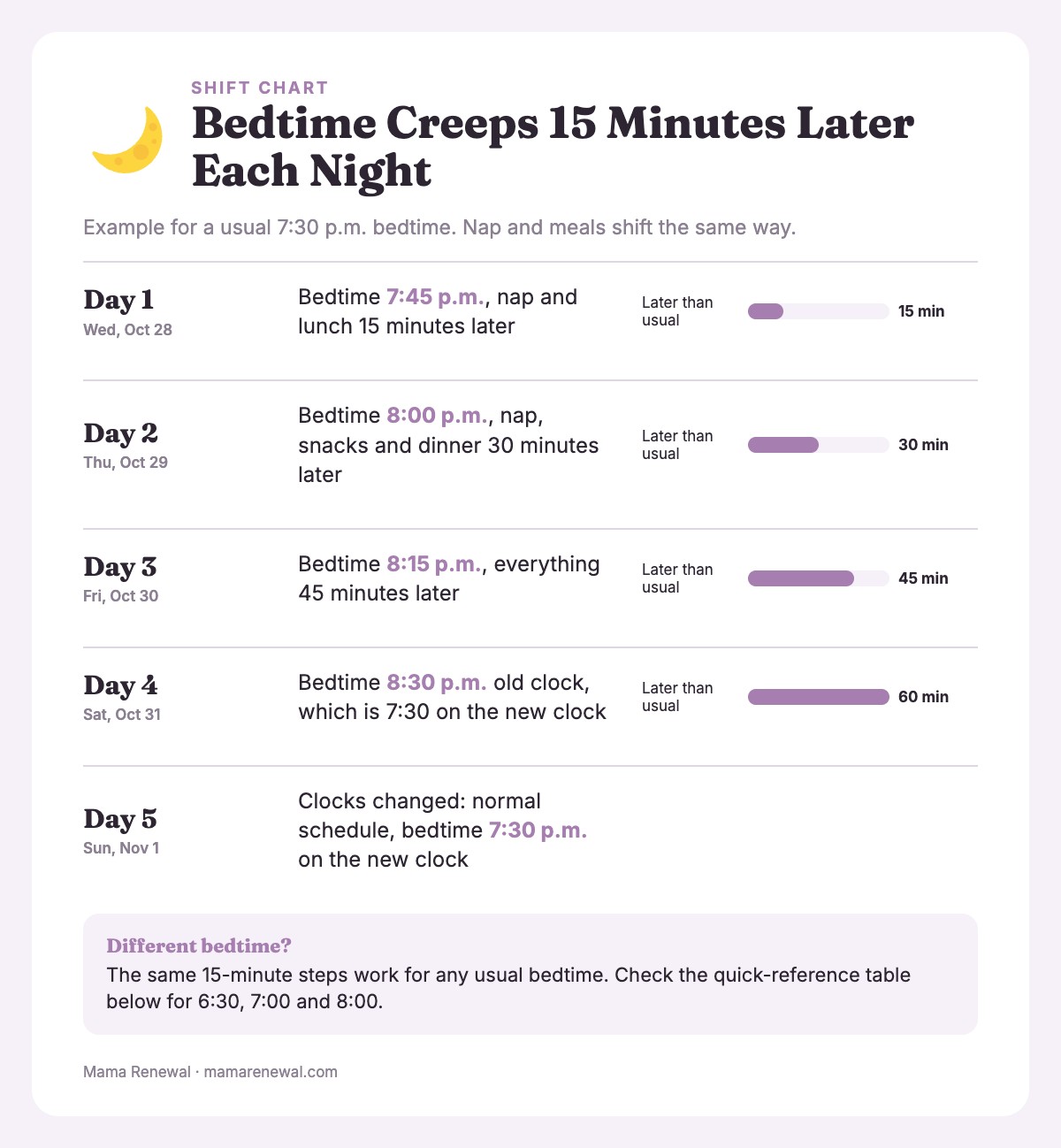
Here’s the plan. It starts Wednesday, October 28 and finishes on Sunday, November 1, the day the clocks change. Each day, you push bedtime (and nap and meal times) about 15 minutes later on the old clock. By Saturday night, your toddler is going to bed an hour later by the old clock, which is her usual bedtime by the new clock.
In the example below, the usual bedtime is 7:30 p.m. If your toddler’s bedtime is 7:00 or 8:00, scroll to the quick-reference table right after for your numbers.
The Chart (Example: Usual Bedtime 7:30 p.m.)
| Day | Toddler bedtime (clock time) | Nap and meals | Evening focus | Mom self-care check-in |
|---|---|---|---|---|
| Day 1: Wed, Oct 28 | 7:45 p.m. | Push nap and lunch 15 minutes later | Dim lights 30 minutes before bed | Tonight I will go to bed at ______ . One thing I’ll stop doing by 9 p.m.: ______ |
| Day 2: Thu, Oct 29 | 8:00 p.m. | Push nap, snacks, and dinner 30 minutes later | Same bedtime routine, same order, same words | Did I eat something with protein today? Y / N. Water by my bed? Y / N |
| Day 3: Fri, Oct 30 | 8:15 p.m. | Push everything 45 minutes later | Keep the room very dark and very boring | Who can take the first wake-up this weekend? Name: ______ |
| Day 4: Sat, Oct 31 (Halloween) | 8:30 p.m. (7:30 on the new clock) | Everything one hour later on the old clock | Costume off, quiet wind-down, no candy near bedtime | Treat I’m giving myself that is not candy: ______ |
| Day 5: Sun, Nov 1 (clocks changed) | 7:30 p.m. on the new clock | Normal schedule on the new clock | Get outside in morning light, normal routine tonight | Today I’m tired because of the clock, not because I’m failing. One kind sentence to myself: ______ |
A quick note on Day 4: because it falls on Halloween this year, the later bedtime lines up beautifully with a trick-or-treat evening. Your toddler will probably be up past her usual time anyway. Just try to keep the actual lights-out near 8:30 on the old clock if you can, and don’t stress if it drifts.
Quick Reference: If Your Usual Bedtime Is Different
| Usual bedtime | Day 1 (Wed) | Day 2 (Thu) | Day 3 (Fri) | Day 4 (Sat) | Day 5 (Sun, new clock) |
|---|---|---|---|---|---|
| 6:30 p.m. | 6:45 | 7:00 | 7:15 | 7:30 | 6:30 |
| 7:00 p.m. | 7:15 | 7:30 | 7:45 | 8:00 | 7:00 |
| 7:30 p.m. | 7:45 | 8:00 | 8:15 | 8:30 | 7:30 |
| 8:00 p.m. | 8:15 | 8:30 | 8:45 | 9:00 | 8:00 |
All times above are on the old clock until Sunday. After the clocks change, Day 5 runs on the new clock, and that’s your normal bedtime again.
Your Fill-In Version

Use the free Fall Back Sleep Shift Planner card on this page to log bedtime, wake-up, nap, and your own energy each night.
The energy rating isn’t there to grade you. It’s there so that in a week, when you’re wondering whether this was a bad stretch or a long stretch, you have something concrete to look back at.
Day-by-Day: What to Actually Do
The chart tells you the times. Here’s what each day looks like in real life.
Day 1 (Wednesday): The Smallest Shift
You are only moving bedtime 15 minutes. Most toddlers won’t even notice. Use this day to get the groundwork in place:
- Check the bedroom for light leaks. Blackout curtains or even a cheap temporary blackout liner tucked behind the curtains will matter more than anything else on this list once the sun starts coming up earlier.
- Decide who covers early mornings this weekend. Say it out loud. “You’ve got Saturday, I’ve got Sunday” is a complete plan. If you’re parenting solo, ask a friend or relative to cover one morning, or lower the bar for that day.
- Do the normal bedtime routine, just 15 minutes later. Bath, books, song, bed. Same order every night. Predictability is the whole point.
Mom check-in, Day 1Pick your own bedtime for the week and write it down. Not a fantasy bedtime. A real one, maybe 30 minutes earlier than usual. You’re about to have a few rough mornings, and your sleep matters too.
Day 2 (Thursday): Meals and Naps Follow
On Day 2 you push bedtime 30 minutes later than usual, and now the rest of the day needs to follow. Food and light are strong clock-setters, so don’t skip this step.
- Nudge lunch, snack, and dinner about 30 minutes later.
- Start nap about 30 minutes later (or, if she’s a short napper, keep the same nap length and let it land a bit later).
- If she starts to fall apart before the new nap time, move it earlier by 10 or 15 minutes. Don’t white-knuckle it.
Mom check-in, Day 2Eat something with protein before noon. A tired body leans on sugar and caffeine, and that’s how you end up shaky at 3 p.m. A boiled egg or yogurt is not glamorous, but it works.
Day 3 (Friday): The “It’s Getting Real” Day
By Friday, bedtime is 45 minutes later than normal. This is often the day a toddler starts to look a little off: cranky, clingy, or wired-and-tired at the end of the day.
- Keep the wind-down very low-key. Dim lights, quiet play, no screens for the last hour before bed.
- If she’s overtired and melting down, it’s okay to move bedtime 10 or 15 minutes earlier tonight and hold the shift there tomorrow. Think of the chart as a staircase. You can pause on a step.
- Make the bedroom pitch-dark. If she already uses a white noise machine, keep the volume low (about a soft shower), place it across the room and not in the crib, and keep the cord out of reach.
Mom check-in, Day 3Decide who takes the first wake-up this weekend, and write the name down. Having a plan is surprisingly calming. If you can, set tomorrow’s alarm for nothing. A sleep-in is a legitimate gift.
Day 4 (Saturday, Halloween): The Big Night
Saturday night is the last night on the old clock. Bedtime is 8:30 on the old clock, which equals 7:30 on the new one. Remember, at 2 a.m. the clock jumps back an hour, so she’ll go to bed at 8:30 and wake up when her body feels rested, which will now show up as a “normal” time on the new clock.
A few practical thoughts for Halloween:
- If you’re trick-or-treating, plan to be home with at least 30 to 45 minutes for a calm wind-down before lights-out.
- Candy and sleep are not friends. No candy once you’re home, and none in the hour before the 8:30 lights-out. Put the bucket out of sight.
- Let the costume come off early, and never let her sleep in it. Toddlers love a costume for exactly 40 minutes.
- Don’t change your clocks before bed if you’re someone who might forget. Many phones update automatically, but the stove, the car, and the oven usually don’t. Do those on Sunday morning.
Safety firstChildren under 4 should not have hard candy, gum, gummies, lollipops, nuts, or caramels, which are choking hazards. Check the bucket yourself. Skip masks that cover the face, and costumes with cords or drawstrings. Add reflective gear or a light for trick-or-treating.
Mom check-in, Day 4Choose a treat for yourself that isn’t the candy bowl. A hot tea, a face mask, ten minutes in the bathroom with the door locked. (I wrote about the bathroom hiding spot in Bathroom Self-Care: What to Do With Your 5 Minutes of Hiding, and I stand by every word.)
Day 5 (Sunday): The New Normal
Sunday morning, your toddler wakes up. If the plan worked, the clock says something reasonable. If it didn’t, you might still be looking at an early start. Both are okay.
Here’s how to handle Sunday:
- Morning light helps. Get outside within the first hour or two of the day if you can. A walk, a porch coffee, sitting by a bright window. Light tells the brain that this is the morning.
- Run the day on the new clock. Meals, naps, and bedtime all follow the new times. Don’t let her drift back to old-clock meals.
- Keep the nap. Even if it’s a little shorter or messier, protect it. Skipping naps usually causes a bad evening, which causes a bad bedtime.
- Bedtime tonight is the usual time on the new clock. In our example, 7:30. If she’s falling apart at 7:00, go ahead and start early.
Mom check-in, Day 5Offer yourself one kind sentence. Something like, “I’m tired because the clock moved, not because I’m doing this wrong.” Write it on your planner. Say it out loud. It sounds silly, and it helps.
Light, Wake-Ups, and the Early-Morning Problem
Early wakes are the number one complaint after fall back, so let’s give them their own section.
Make the Room Darker Than You Think It Needs to Be

Sunrise is going to be earlier by the clock for a few weeks. If your toddler’s room gets any light before 6, the sun will happily wake her up. Try:
- Blackout curtains or blackout liners
- Painter’s tape or removable window film on the edges where light sneaks through
- A cordless blackout shade, or a blackout liner or panel taped to the wall well out of reach
- Turning off or dimming bright lights. A small piece of electrical tape over a tiny LED is fine
Safety firstWindow coverings must be cordless or have cords well out of reach, and cribs and beds stay away from windows and cords. Never drape cloth over chargers, power strips, lamps, or night-lights, and never use pins. Keep white noise low and across the room, with the cord out of reach.
Try an “OK to Wake” Clock

For toddlers around 2.5 or 3 and up, a simple color-changing clock can help. The light stays one color until it’s okay to get up, then switches. For younger toddlers it may not click yet, but it can be introduced as a game.
A few tips if you try it:
- Set the “OK to wake” time at a realistic point, like 6:15 or 6:30, not wishful thinking.
- Practice during the day. “When the light turns green, we can get up!”
- Praise her when she stays in bed until the light changes, even if she’s just playing quietly.
Don’t Start the Day Too Early (Even If You’re Up)
Here’s a counterintuitive one. If she wakes at 5:15 and you bring her into the living room, turn on every light, and start breakfast, you may be teaching her body that 5:15 is the new morning.
Instead, treat the early hour like a night wake-up for a little while:
- Keep lights low.
- Keep your voice quiet and boring.
- Offer a calm cuddle or a book in her room.
- Wait until your target time (or as close as you can stand) to start the day with bright lights and breakfast.
I’ll be honest: some mornings this isn’t possible, and it’s okay to give up and make coffee at 5:30. Aim for “mostly consistent,” not perfect.
When the Early Wake-Up Won’t Budge
If you’re still seeing 5:30 wake-ups after a week, try this:
- Move bedtime a little later, by 10 to 15 minutes, for a few nights. (Sometimes a toddler who is slightly undertired at bedtime wakes early. Other times, an overtired toddler does. If you aren’t sure which is happening, a short experiment helps.)
- Check the nap. Too much daytime sleep can steal from night sleep. Too little can cause the opposite problem.
- Double check the room: light, noise, temperature.
- Give it a few more days. Body clocks are slow, and they eventually catch up.
Naps, Meals, and Everything Else That Shifts
A toddler’s day is a chain, and when one link moves, the others follow. The more you shift consistently, the easier the transition.
Sample Gradual Day (Usual Wake 6:30 a.m., Nap 12:30, Bedtime 7:30)
| Normal | Day 1 | Day 2 | Day 3 | Day 4 | Day 5 (new clock) | |
|---|---|---|---|---|---|---|
| Breakfast | 7:00 | 7:15 | 7:30 | 7:45 | 8:00 | 7:00 |
| Lunch | 11:45 | 12:00 | 12:15 | 12:30 | 12:45 | 11:45 |
| Nap start | 12:30 | 12:45 | 1:00 | 1:15 | 1:30 | 12:30 |
| Dinner | 5:15 | 5:30 | 5:45 | 6:00 | 6:15 | 5:15 |
| Bedtime | 7:30 | 7:45 | 8:00 | 8:15 | 8:30 | 7:30 |
All times are on the old clock until Day 5. Don’t worry about matching these to the minute. The idea is a gentle drift.
What If My Toddler Is in Daycare or Preschool?
If your child is at daycare, the schedule is partly out of your hands. The center will likely move to the new clock on Monday (or sometimes Sunday for weekend care). A few things you can do:
- Tell the teachers you’re shifting gradually and ask how naps usually go the week after the change.
- Expect that she might nap differently at school for a few days.
- Plan a quiet evening Monday with an early start to bedtime if she seems wiped.
Most centers have seen this a hundred times, and they’re usually pretty relaxed about it.
Daylight Saving Time and Babies
Although this post is aimed at toddlers, if you also have a baby in the house, the same ideas apply with some tweaks. Babies under about a year often have less rigid body clocks but are more affected by naps and feedings.
- Shift naps in 15-minute steps like the chart. Babies under about 4 to 6 months are fed when hungry, so don’t delay feeds. Only shift feeds that are already flexible, and check with your pediatrician about newborns.
- Expect early mornings to be the main issue.
- Keep night feedings low-key and dark.
- If your baby is on a flexible schedule, it may sort itself out in a few days with consistent light exposure.
Safety firstFeed young babies on demand and never delay a feed to match the chart. While darkening the room, keep to safe sleep: baby on their back, on a firm flat surface, with an empty crib.
And if you have a baby and a toddler, pick one schedule to build the day around (usually the toddler’s) and let the baby fit in.
When the Chart Falls Apart (Because It Will, a Little)
Let me save you some guilt. At least one night will go sideways. Maybe it’s an ear infection. Maybe it’s a birthday party. Maybe she just decided that 9:45 p.m. is a fantastic time to sing the alphabet.
Here’s how to recover without throwing the whole plan out.
| What happened | What to do |
|---|---|
| She refused to go to bed at the later time | Move bedtime back 10 to 15 minutes and hold that step for a night |
| She fell asleep early in the car | Gently move to the chart bedtime anyway if she wakes, or let her go down and resume the plan tomorrow |
| She woke at 4:45 a.m. | Keep lights low, keep it boring, and offer a cuddle. Don’t start the day yet if you can help it |
| She skipped her nap | Go for an earlier bedtime (even 30 minutes) that night and get back on the chart the next day |
| She got sick | Pause the plan. Sick-day sleep is its own thing. Resume when she’s feeling better, or just switch to the new clock |
| You got off track by two or three days | Skip to the new clock and use the first week after as your gradual shift |
The goal isn’t a perfect chart. The goal is a toddler who is more or less back on schedule within a week or so, and a mom who didn’t lose her mind getting there.
If Everyone Is Already Cranky
Sometimes the best thing you can do is simplify. Cut one activity. Order takeout. Let the screen time run a little longer in the afternoon. A reset doesn’t have to be a project.
The Mom Self-Care Check-In (the Column That Matters Most)
I put a mom column in the chart on purpose. I know that when a toddler’s schedule shifts, most of us put our own needs somewhere below “find the missing shoe.” But toddler sleep and mom sleep are tangled up together. When one of you is off, the other usually is, too.
You don’t need an elaborate routine. You need a handful of tiny, repeatable choices.
The Five-Day Mom Menu
Pick one or two of these each day. You don’t need to do all of them.
- Go to bed 30 minutes earlier than usual. Even if you can’t sleep right away, lying down in a dark room is better than scrolling in the living room.
- Put your phone across the room. If you’re like me, doom scrolling at 10:30 p.m. is the thing that steals your sleep. How to Stop Doom Scrolling: A Mom’s Guide to Breaking the Late-Night Phone Habit has a gentle plan if this is your struggle.
- Get morning light. Five to ten minutes outdoors in the first part of your day helps your own body clock, not just your toddler’s.
- Cut off caffeine earlier. If you have a mid-afternoon coffee habit, try moving it to before 1 p.m. for the week.
- Eat something real at breakfast. Protein, fat, some carbs. Not just coffee and the crusts off a sandwich.
- Say no to one thing. Make the week lighter, not heavier. Skip the optional playdate. Cancel the thing you were dreading.
- Ask for one concrete favor. “Can you do bedtime Thursday so I can lie down?” is easier to say yes to than “I need more help.”
- Do a two-minute reset. Hands on your belly, three slow breaths, drop your shoulders. It’s tiny, and it works better than you’d think.
How to Use the Check-In Column
In the chart, the mom column changes each day, but the idea is the same: ask yourself three things.
- When am I going to bed tonight? Pick a time, write it down.
- What’s one thing I need today? Food, quiet, movement, help.
- What’s one thing I can let go of? The dishes. The email. The expectation that the house will look a certain way.
If you hit all three, great. If you hit one, that’s a win. If you hit none and still survived the day, also a win. This isn’t a performance review.
Cheap Tricks for a Tired Week
- Keep a water bottle where you spend the most time.
- Keep a snack in your bag, your car, and your nightstand.
- Make dinner something that takes one pan. This is the week for pasta, sheet pans, and eggs.
- Take a 10-minute walk after lunch if you can. It helps energy more than you’d expect.
- Give yourself grace for being a little snappy. If you’ve noticed rage creeping in, Mom Rage: What It Really Means When Motherhood Makes You Snap might feel like a hug in article form.
A Note on Guilt
Sometimes in the middle of a sleep shift, a mom feels like she’s failing because her kid is crying or the schedule isn’t “working.”
I want you to hear this: a toddler who is having a rough week of sleep is not evidence that you did something wrong. She has a body clock that’s out of sync with a number on the wall. That’s biology, not a parenting grade.
A Gentle Plan for the Week After the Change
The five-day chart gets you through the weekend. Here’s what the next week might look like. Think of it as the “settling in” phase.
| Day | What to expect | What to do |
|---|---|---|
| Mon, Nov 2 | Probably tired, maybe a little off | Keep the day simple, get morning light, stick with the new schedule |
| Tue, Nov 3 | Early wakes may still show up | Keep lights low in the early morning, stay consistent with nap and bedtime |
| Wed, Nov 4 | Usually a bit better | Check in with your own sleep. Go to bed early tonight if you can |
| Thu, Nov 5 | Many toddlers are mostly back on track | If she’s still waking early, try a 10-15 minute bedtime adjustment |
| Fri, Nov 6 | Weekend is coming | Plan a quiet evening. Protect the nap |
| Sat–Sun, Nov 7-8 | Possible bumps from weekend activity | Keep wake-up, naps, and bedtime within about 30 minutes of normal |
If the hangover lingers for you personally, the tips in The Daylight Saving Time Hangover go deeper on energy, mood, and getting your own rhythm back. And if you’ve ever used the 15-minute-at-a-time approach for a different schedule shift, like school mornings, Resetting Your Kids’ Sleep Schedule Before School Starts uses the same idea and has extra routine ideas you can borrow.
When to Talk to Someone
I want to be straightforward about this part. Most DST sleep disruption fades on its own with patience and a consistent routine. But there are times when it’s worth bringing in a professional, and you don’t need to wait until things feel desperate.
For Your Toddler
Consider mentioning it to your child’s pediatrician if:
- Sleep disruption lasts more than two weeks after the time change, with no sign of improving
- Your child seems unusually sleepy during the day, or very hard to wake
- She snores loudly, gasps, or seems to struggle to breathe at night
- She has frequent night terrors, or the night wakings have changed suddenly in a way that worries you
- Something else is going on with her mood, appetite, or behavior that you can’t explain
A pediatrician can help sort out whether it’s just a stubborn adjustment or something else, like an ear infection, allergies, or a sleep issue that was brewing anyway.
For You
This is the part I hope you don’t skip. Poor sleep makes everything harder, including mood. A few off days are normal. But if you notice:
- New or worsening low mood that doesn’t lift
- New anxiety, racing thoughts, or constant dread
- Feeling numb, hopeless, or unlike yourself
- Trouble sleeping even when your child is sleeping
- Rage or tearfulness that feels out of proportion or scary
…please mention it to your own healthcare provider, whether that’s your OB, midwife, primary care doctor, or a therapist. This isn’t a sign you’re weak. It’s information, and you deserve support, not just endurance. If you ever feel like you might hurt yourself or can’t keep yourself safe, call or text 988 (the US Suicide & Crisis Lifeline) or call emergency services right away.
Good to knowPostpartum mood and anxiety conditions are common and treatable. You can reach the Postpartum Support International helpline at 1-800-944-4773.
None of this is meant to diagnose or alarm you. It’s a gentle nudge: if something feels off and keeps feeling off, tell someone. If you want to read more on the heavier end of exhaustion, Depleted Mother Syndrome: What It Is and How to Start Recovering is a place to start.
Make the Chart Easy to Use
Put the Fall Back Sleep Shift Planner card where anyone helping can see it, and set a gentle “start wind-down” alarm 30 minutes before each bedtime.
If the whole chart feels like too much this week, use only the first row and the last row: move bedtime a little later one night, and switch to the new clock on Sunday. Something is better than nothing.
If you need support right now
Reaching out is not an overreaction. These lines are free and confidential.
- Emergency: if you are thinking about harming yourself or your baby, or you can’t keep yourself safe, call 911 or go to the nearest emergency room. This is a medical emergency, and it is treatable.
- 988 Suicide & Crisis Lifeline: call or text 988, 24/7, for anyone in crisis.
- National Maternal Mental Health Hotline: call or text 1-833-TLC-MAMA (1-833-852-6262), 24/7, in English and Spanish, for pregnancy and postpartum support.
- Postpartum Support International: call or text 1-800-944-4773 for help finding a provider who specializes in perinatal mental health. Not an emergency line.
US numbers. Elsewhere, ask your doctor, midwife or local crisis line. This article was written by a parent, not a clinician, and isn’t medical advice.
Frequently Asked Questions
When does daylight saving time end in 2026, and what do I do first?
Daylight saving time ends on Sunday, November 1, 2026, when clocks go back one hour at 2 a.m. If you want to shift gradually, start on Wednesday, October 28 by moving your toddler’s bedtime about 15 minutes later, then keep adding 15 minutes each day. By Saturday night she’ll be going to bed an hour later on the old clock, which is her normal bedtime on the new clock. If that doesn’t fit your week, you can also just switch everything on Sunday morning and use the following days to settle in.
How long does it take a toddler to adjust to the fall back time change?
Many toddlers settle in within about a week, and some take closer to two. Sensitive sleepers or kids with a very rigid routine may take a bit longer. A gradual shift, morning light, a dark bedroom, and consistent naps usually speed things along. If your toddler is still struggling more than two weeks after the change, it’s reasonable to bring it up with your pediatrician to make sure nothing else is going on.
My toddler is waking up at 5 a.m. since the clocks changed. What should I do?
First, check the room for light and noise, since sunrise will be earlier by the clock for a while. Keep early wake-ups calm and dark, with low lights and quiet voices, instead of starting the day at full speed. You can also try moving bedtime 10 to 15 minutes later for a few nights, and make sure the nap isn’t too long or too short. An “OK to wake” clock can help older toddlers. Most early waking improves within a week or two as the body clock catches up.
Should I wake my toddler up from a nap during the time change week?
Generally, it’s fine to cap a very long nap if it’s pushing bedtime too late or stealing from night sleep, especially during the shift. A common guideline is to keep the nap from running much past the usual length. But don’t skip the nap entirely, because an overtired toddler tends to have a harder bedtime and more night wakings. If she’s been sleeping well and the nap is only a little longer than normal, there’s usually no need to stress.
Is the gradual shift really better than just changing the clocks and moving on?
Not necessarily better for every family. Easygoing sleepers often do fine switching all at once. A gradual shift tends to help kids who are sensitive to changes, who already wake early, or who have strict daycare schedules. It also gives you a gentler lead-in, so you aren’t facing a hard Sunday morning with no warning. If the gradual plan feels like too much work this year, switching on Sunday and giving yourselves a few easy days is a perfectly valid choice.
I’m exhausted and cranky every time the clocks change. Is that normal?
Yes, it’s very common. Some adults feel groggy or off for a few days, especially when they’re already short on sleep. Try going to bed a little earlier, getting morning light, eating real food, and lowering your expectations for the week. If your low mood or anxiety lingers, gets worse, or feels different from your normal, it’s worth mentioning to your own healthcare provider. You deserve support too.
What about babies and the daylight saving time change?
Babies can be affected too, mostly through early wake-ups and shifted feeding and nap times. Use the same idea of small steps: move naps about 15 minutes at a time, never delay a feed for a hungry young baby, keep the room dark, and keep night and early-morning care calm and quiet. Young babies’ body clocks are still developing, so they often adjust quickly, though early wake-ups are common and every baby is different. If you have both a baby and a toddler, build the day around the toddler’s schedule and let the baby fit around it.
You Don’t Have to Do This Perfectly
When the clocks change, it feels like the whole house is out of sync. Your toddler is wide awake in the dark, you’re running on fumes, and the clock on the stove is still wrong. It’s a small, silly, temporary problem that somehow feels enormous at 5 a.m.
Take it one step at a time. Move bedtime a little each day, protect the nap, keep the room dark, and give yourself a little care along the way. Fill in the chart, tape it up, and let it do some of the thinking for you.
In about a week, you’ll look at the clock and realize things feel normal again. And if they don’t, you’ll know who to ask for help. Until then, go to bed a little earlier. The laundry will keep.