A 4-Week Printable Self-Care Habit Tracker for Moms
Discover a realistic 4-week habit tracker built for moms, featuring floor versions and no-shame rules.
- Track one tiny habit over four weeks with zero guilt when you miss days.
- Create a fallback floor version of your habit for hard or chaotic days.
- Use family script cards and weekly reflection prompts to stay consistent.
This post contains affiliate links. As an Amazon Associate I earn from qualifying purchases.
Last January I bought a gorgeous habit tracker. Linen cover, gold foil, little circles for every day of the month. I filled in the first three days with a fancy pen and felt like a woman who had her life together. On day four my youngest woke up with a fever, on day five I was running on four hours of sleep, and by day nine the planner was under a pile of permission slips and one sock. I didn’t open it again until I was cleaning out the junk drawer in March.
This self care tracker is built for the mom who skips days. It follows one tiny habit for four weeks, gives you a floor version for bad days, and uses no-shame rules for missed ones.
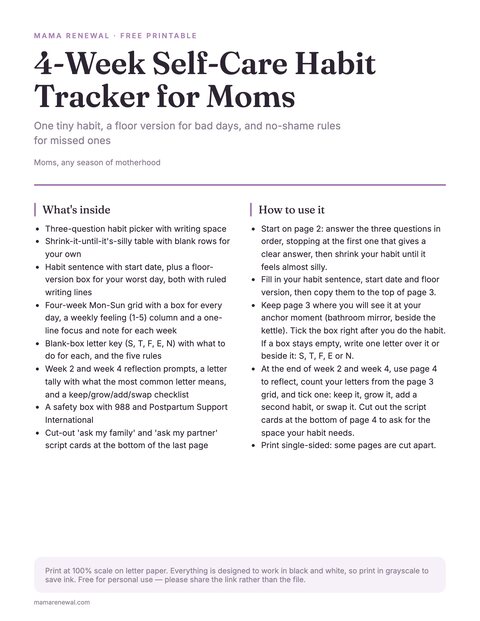
Free printable · 4 pages
4-Week Self-Care Habit Tracker for Moms
A writable habit picker, a shrink-it table, an After I / I will habit sentence, a floor-version box, a Mon-Sun four-week grid with a weekly feeling score, a blank-box letter key, the five rules, week 2 and week 4 reflection prompts, a letter tally, a keep/grow/add/swap checklist and cut-out family script cards.
Free. Your download link appears right here. You'll also join the Mama Reset. Unsubscribe anytime. Privacy
The printable card is in the section titled The Free Printable 4-Week Self-Care Habit Tracker, after you pick a habit and an anchor. If you just want the grid, skip straight there, or copy it by hand.
In this article (15 sections)
- Why Most Habit Trackers Quietly Fail Moms
- What Counts as a “Self-Care Habit” Here
- How to Pick One Self-Care Habit (Yes, Only One)
- Anchor Your Habit to a Daily Routine
- The Free Printable 4-Week Self-Care Habit Tracker
- Week-by-Week Guide to Your Self-Care Habit Tracker
- What to Do When You Miss a Day
- Gentle Self-Care Habit Ideas, Sorted by Energy Level
- Sample Tracker Setups for Different Seasons of Motherhood
- Where to Put Your Printable Habit Tracker
- How to Talk to Your Family About It
- Common Mistakes (and Simple Fixes)
- A Realistic Look at What Four Weeks Can (and Can’t) Do
- Frequently Asked Questions
- Start Small, Start Messy, Start Today
Why Most Habit Trackers Quietly Fail Moms
That planner was made for a version of me who doesn’t exist, one with a spare forty-five minutes and a stable sleep schedule. Every empty circle felt like a tiny report card, and the grade was always the same.
Standard habit-tracking advice assumes you control your own schedule: wake up at 5 a.m., stack your habits, never break the chain. Then a three-year-old wipes out your whole morning by deciding today is the day she will not wear pants.
| What the typical tracker assumes | What motherhood actually looks like |
|---|---|
| You can do the habit at the same time every day | Your day is set by nap windows, school pickup, and whoever is sick |
| Missing a day “breaks the chain” | Missing a day is guaranteed at least a few times a month |
| The tracker is a motivation tool | For many moms it becomes another source of guilt |
That last row matters most. If you’ve read about the mental load, you know the invisible work of remembering, planning and anticipating never actually clocks out. A tracker with fifteen rows of daily habits is just a new chunk of mental load wearing a cute outfit.
So we’re flipping the design. Instead of asking how much you can pile on, we ask how little you can do and still count it.
The popular “21 days to a habit” idea is a myth. In a small University College London study of 96 people, Phillippa Lally and colleagues found that new habits took a median of about 66 days to feel automatic. Individual times ranged from 18 to 254 days. Simpler actions tended to get there faster, and missing a single day didn’t derail the process. So the takeaway for a tired mom is simple: make it tiny, tie it to something you already do, and if you miss a day, pick it back up the next day.
What Counts as a “Self-Care Habit” Here
A self-care habit is not a bubble bath, a spa day, or anything you need to buy. If those work for you, wonderful. If they make you feel like you’ve been handed another assignment, you’re in good company, and self-care ideas for moms who hate bubble-bath self-care is a good place to find your own flavor.
For this tracker, a self-care habit is any small, repeatable action that does one of three things:
- Meets a physical need you usually postpone (water, food, movement, sleep, sunlight)
- Gives your mind a break from managing everyone (quiet, a single page of a book, a few slow breaths)
- Reconnects you to being a person, not just a service (a song you like, a text to a friend, a few minutes on something that’s only yours)
The test is simple. After you do it, do you feel even 2% more like yourself? If yes, it counts. If it makes you feel like you passed an exam, it probably belongs on someone else’s tracker.
How to Pick One Self-Care Habit (Yes, Only One)
This is the step people want to skip, and it’s the one that decides whether the tracker works. You are picking one habit for the full four weeks. Not three. Not a “morning routine.” One.
Here’s a quick way to choose. Answer these in order and stop at the first one that gives you a clear answer.
The three-question habit picker
- What do you skip first on a hard day? Water, eating lunch, stepping outside, going to bed on time, asking for help. The habit you drop first is often the one your body is quietly asking for.
- What would make tonight feel 5% better? Not your whole life, just tonight. Maybe it’s the lights off by 10:30, or five minutes alone before you pick up the baby monitor.
- What can you do in under five minutes with zero prep? If it needs a trip to the store, a babysitter or a special playlist, it’s not the right starter habit. Park it for later.
Shrink it until it feels almost silly
Once you have a habit in mind, make it smaller. Much smaller. Here’s what that looks like:
| Your big idea | The tracker-sized version |
|---|---|
| Work out every morning | Stretch your arms overhead and roll your shoulders for one minute |
| Journal nightly | Write one sentence about today |
| Drink more water | Drink one full glass before your first coffee |
| Meditate daily | Take five slow breaths in the car before walking inside |
| Read more | Read one page |
| Eat better | Add one protein to breakfast (a hard-boiled egg counts) |
| Go to bed earlier | Phone on the charger across the room by 10 p.m. |
| Spend time outside | Stand on the porch for two minutes, no phone |
If you read the tracker-sized version and thought, “That’s too easy to count,” good. That’s exactly the right size. The goal over four weeks isn’t impressive output. It’s proof that you can keep a small promise to yourself. If you want more ideas at this scale, micro self-care for busy moms has a long list of two-minute options.
Anchor Your Habit to a Daily Routine
A habit with no anchor floats around your day until it gets forgotten. An anchor is an existing routine that already happens reliably, even on chaotic days. The formula is:
The formulaAfter I [existing thing], I will [tiny habit].
This is habit stacking. To go deeper, habit stacking for moms walks through dozens of pairings built around real mom routines.
Here are some anchors that tend to hold up under pressure:
- After I pour my first cup of coffee or tea, I will drink a glass of water.
- After I start the dishwasher, I will stretch for one minute.
- After I buckle the kids into the car, I will take five slow breaths before I turn the key.
- After I brush my teeth at night, I will write one sentence in my notes app.
- After I put the baby down for her first nap, I will sit for three minutes before touching anything.
- After I plug in my phone at night, I will read one page of a book.
- After I hear the school pickup bell or see the line of cars, I will unclench my jaw and drop my shoulders.
Pick an anchor that happens daily, not “most days.” If your anchor only happens on weekdays, your habit will only happen on weekdays, and the weekend will feel like a failure when it isn’t one.
Write your habit sentence
Fill this in before you start the grid.
Your sentenceAfter I ______________________, I will ______________________.
Put the sentence at the top of your printed page. It’s the only instruction your tracker needs.
The Free Printable 4-Week Self-Care Habit Tracker
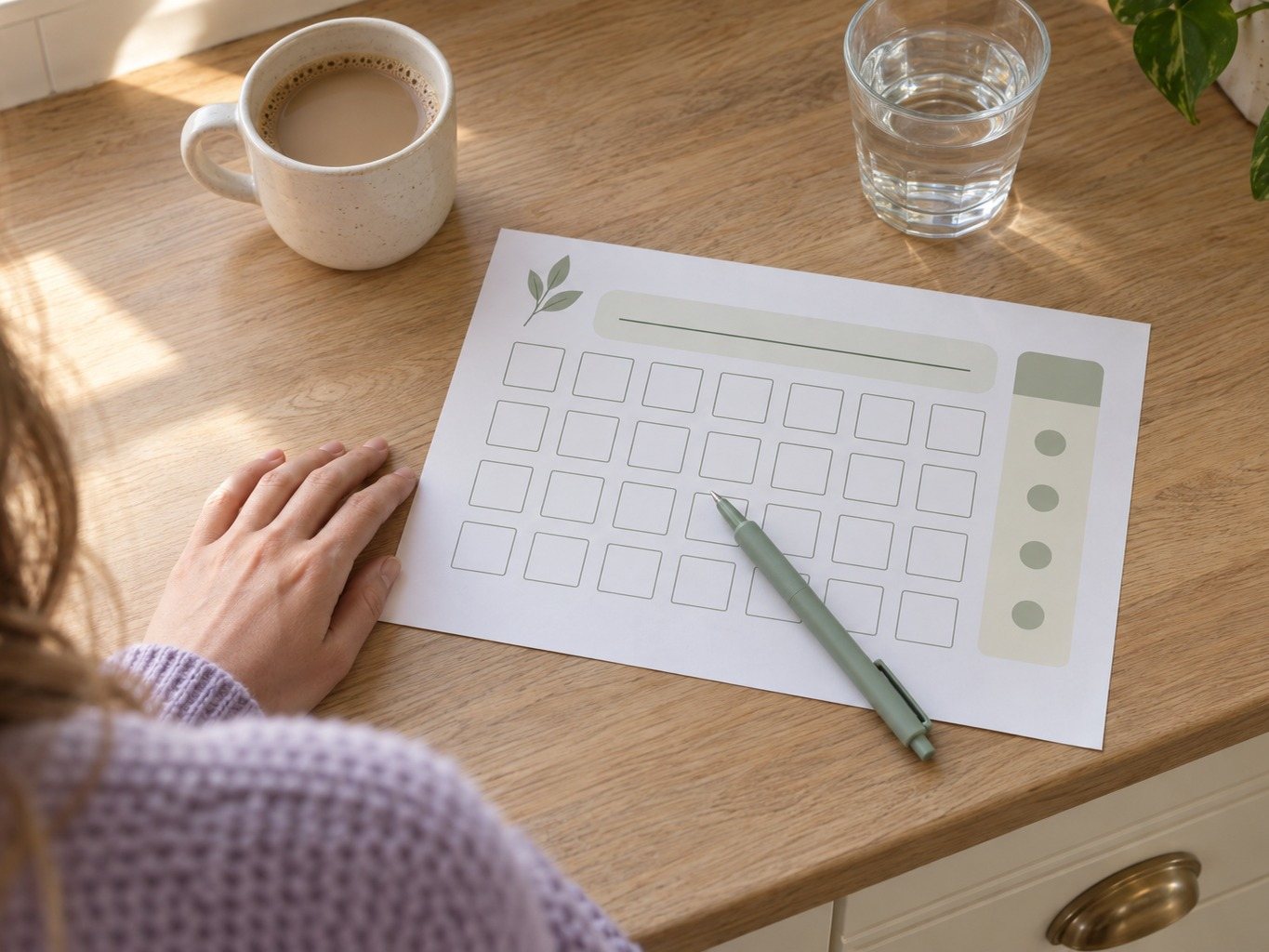
The printable card has the grid, the habit picker and space for weekly notes. You can also copy the table into a notes app or draw it by hand on any paper.
Add a start date next to your habit sentence. Each box is one day: check it off, color it in, or put a dot in it, whatever feels satisfying.
Your four-week grid
Here’s the whole month at a glance. Jot a line about how each week went in the weekly notes space on the card, or in the margin if you’re drawing it by hand:
| Mon | Tue | Wed | Thu | Fri | Sat | Sun | Weekly feeling (1-5) | |
|---|---|---|---|---|---|---|---|---|
| Week 1 | ☐ | ☐ | ☐ | ☐ | ☐ | ☐ | ☐ | ___ |
| Week 2 | ☐ | ☐ | ☐ | ☐ | ☐ | ☐ | ☐ | ___ |
| Week 3 | ☐ | ☐ | ☐ | ☐ | ☐ | ☐ | ☐ | ___ |
| Week 4 | ☐ | ☐ | ☐ | ☐ | ☐ | ☐ | ☐ | ___ |
The “weekly feeling” column is optional but I love it. Rate how you felt overall that week, from 1 (rough) to 5 (pretty good). It’s not tied to whether you did the habit. Over four weeks, you may spot patterns you’d never see in a single day.
What a filled-in month can look like
Here’s a made-up example, not a real person’s data. Habit: a glass of water after pouring coffee. Floor version: three sips. Yours will look different, and that’s fine.
| Week | Note to self | Feeling (1-5) |
|---|---|---|
| 1 | Forgot twice; moved the glass next to the kettle | 2 |
| 2 | Weekdays easy, Saturdays hard | 3 |
| 3 | Stomach bug: marked those boxes S for sick, did the floor version after | 3 |
| 4 | Keeping it; adding a second habit next month | 4 |
The five rules to keep with your tracker
Write these at the bottom of your page, printed or hand-drawn. They’re the part that makes this tracker different from the ones that made you feel bad:
- One habit only. Resist the urge to add a second.
- Done is done. The tiny version counts fully.
- Never miss twice, when you’re able. One missed day is life. After one, do the floor version next day if you can.
- A blank box is data, not failure. Write down what happened instead.
- Free passes. Sick, travel and newborn days don’t count against you. Draw a line through the box and move on.
Week-by-Week Guide to Your Self-Care Habit Tracker
The grid is simple on purpose. What changes across the four weeks is your focus. Think of it as a gentle progression, not a challenge you can lose.
| Week | Focus | One action |
|---|---|---|
| 1 | Show up, don’t perfect | Test whether your habit and anchor fit; swap the anchor if they don’t |
| 2 | Notice what makes it easier | Compare your checked days with your blanks |
| 3 | Protect it on hard days | Write down your floor version |
| 4 | Decide what’s next | Keep it, grow it, add a second habit, or swap it |
Week 1 guide: show up, don’t perfect
The only goal this week is to find out whether your habit and anchor actually fit your life. Some will. Some won’t. If the anchor you picked turns out to be unreliable (your “after breakfast” never happens because breakfast is a chaotic free-for-all), that’s useful information, not a failure. Swap the anchor mid-week if you need to.
Tips for week 1:
- Put the tracker where you’ll see it at the anchor moment. Taped to the bathroom mirror, tucked under the coffee maker, or as a phone wallpaper.
- Make the habit physically easy. Set the glass of water out the night before. Leave the book on your pillow.
- Check the box immediately after doing the habit, not at the end of the day. The check mark is part of the reward.
- Don’t judge how it feels yet. Week 1 is data collection.
Week 2 guide: notice what makes it easier
By now you should have a few days of evidence. Look at your checked boxes and your blanks, and ask: what do the good days have in common?
Maybe the habit works on weekdays when the routine is predictable, and falls apart on Saturdays. Maybe it works when you’ve slept at least six hours. Maybe it works better in the evening than the morning. None of that is a character flaw. It’s information about your life, and you’re allowed to design around it.
Questions to ask yourself this week:
- What time of day did I actually do it?
- Was there something I did right before that helped?
- On the days I skipped, what was happening? (Sick kid, no sleep, busy day, forgot, didn’t feel like it?)
- Does the habit still feel small enough?
If the habit feels like a chore by day ten, shrink it again. A one-minute stretch can become a thirty-second stretch. A page of reading can become a paragraph. Smaller is always allowed.
Week 3 guide: protect it on the hard days
Around week three, the novelty has worn off and real life has had time to throw something at you: a stomach bug, a school holiday, a work deadline, a hormonal dip. This is where most habits die, and it’s where your bare-minimum plan earns its keep.
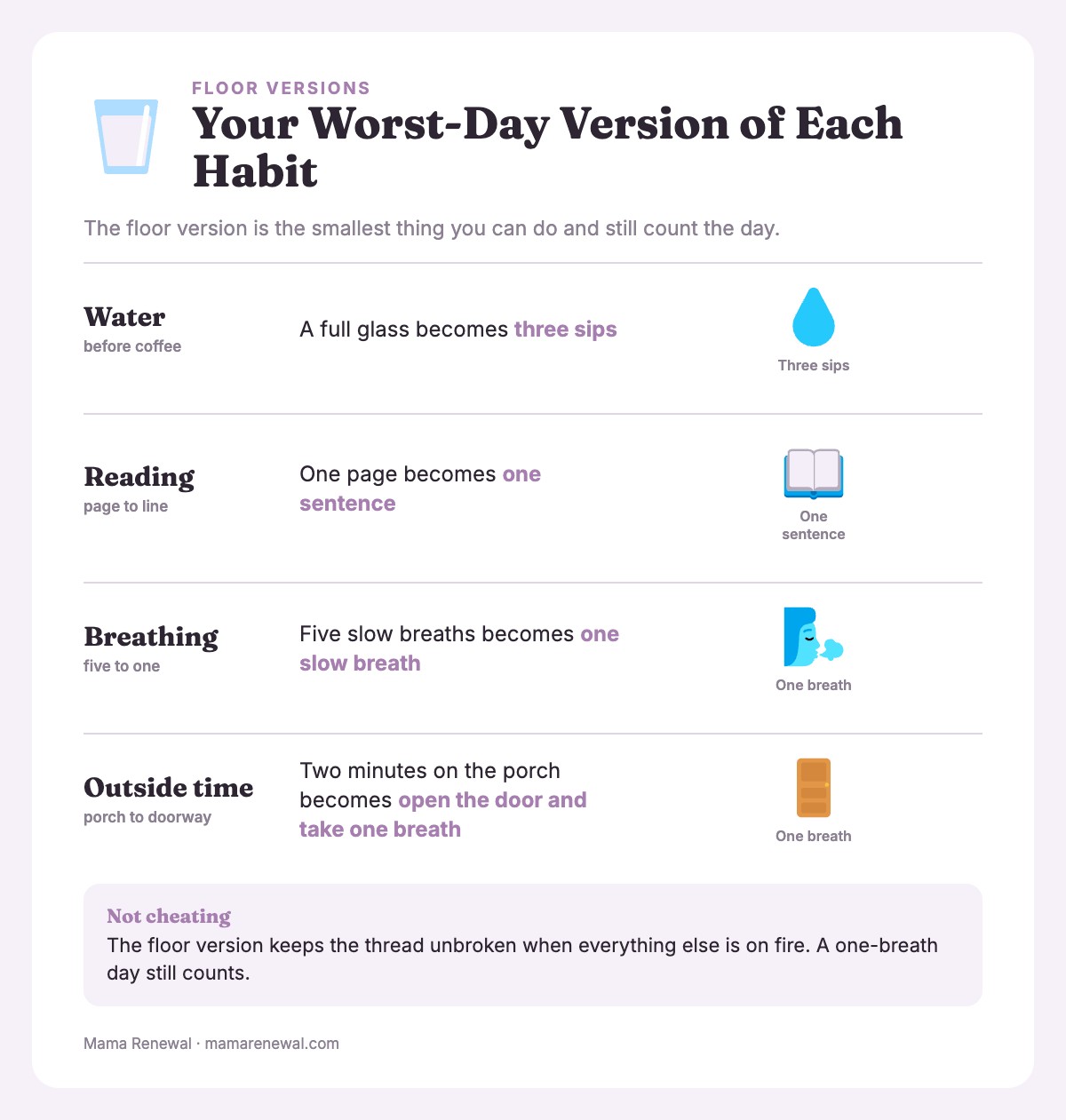
Write down your floor version, the absolute smallest thing you could do on your worst day and still count it. Examples:
| Habit | Normal version | Floor version |
|---|---|---|
| Stretching | One minute of shoulder and neck stretches | One slow shoulder roll |
| Water | A full glass before coffee | Three sips |
| Reading | One page | One sentence |
| Outside time | Two minutes on the porch | Open the door and take one breath |
| Journaling | One sentence about the day | One word that describes the day |
| Breathing | Five slow breaths | One slow breath |
The floor version is not cheating. It’s how you keep the thread unbroken when everything else is on fire. A one-breath day still counts, because the point is that you showed up for yourself, even briefly.
Week 4 guide: decide what’s next
By the final week, you’ll have a real feel for whether this habit belongs in your life. Don’t just let it end. Make a deliberate decision about what happens next.
Your options:
- Keep it as is. If it feels easy and good, just continue. Maybe you stop tracking and let the anchor do the work.
- Grow it slightly. If it feels almost automatic, you can nudge it up: one page becomes two, one minute becomes three. Only grow it if it feels easy, never because you think you “should.”
- Add a second habit. Once the first habit feels easy, run another four-week cycle with a new habit stacked on top.
- Swap it out. If the habit never clicked, retire it with zero guilt and try a different one. The habit may have been wrong, not you.
At the end of week 4, take five minutes to answer these on paper:
- What surprised me?
- What did I learn about when I can and can’t do this?
- What do I want the next four weeks to look like?
What to Do When You Miss a Day
You are going to miss days. This is the most important section in the article, because how you handle missed days is what determines whether the habit survives.
The “never miss twice” rule
One missed day barely matters. Two in a row makes skipping easier to repeat, so we use a never-miss-twice rule. If you miss one day and you’re able, do the floor version the next day. No makeup, no doubling up, no “starting over.”
TipSick, travel and newborn days are free passes (see the rules above).
Don’t restart the grid
Resist the urge to tear up the page and begin again on Monday. The grid is not a streak counter. If you check off 19 of 28 days, you did the habit 19 times that you wouldn’t have otherwise. That’s 19 small acts of taking care of yourself.
Sort the blanks into categories
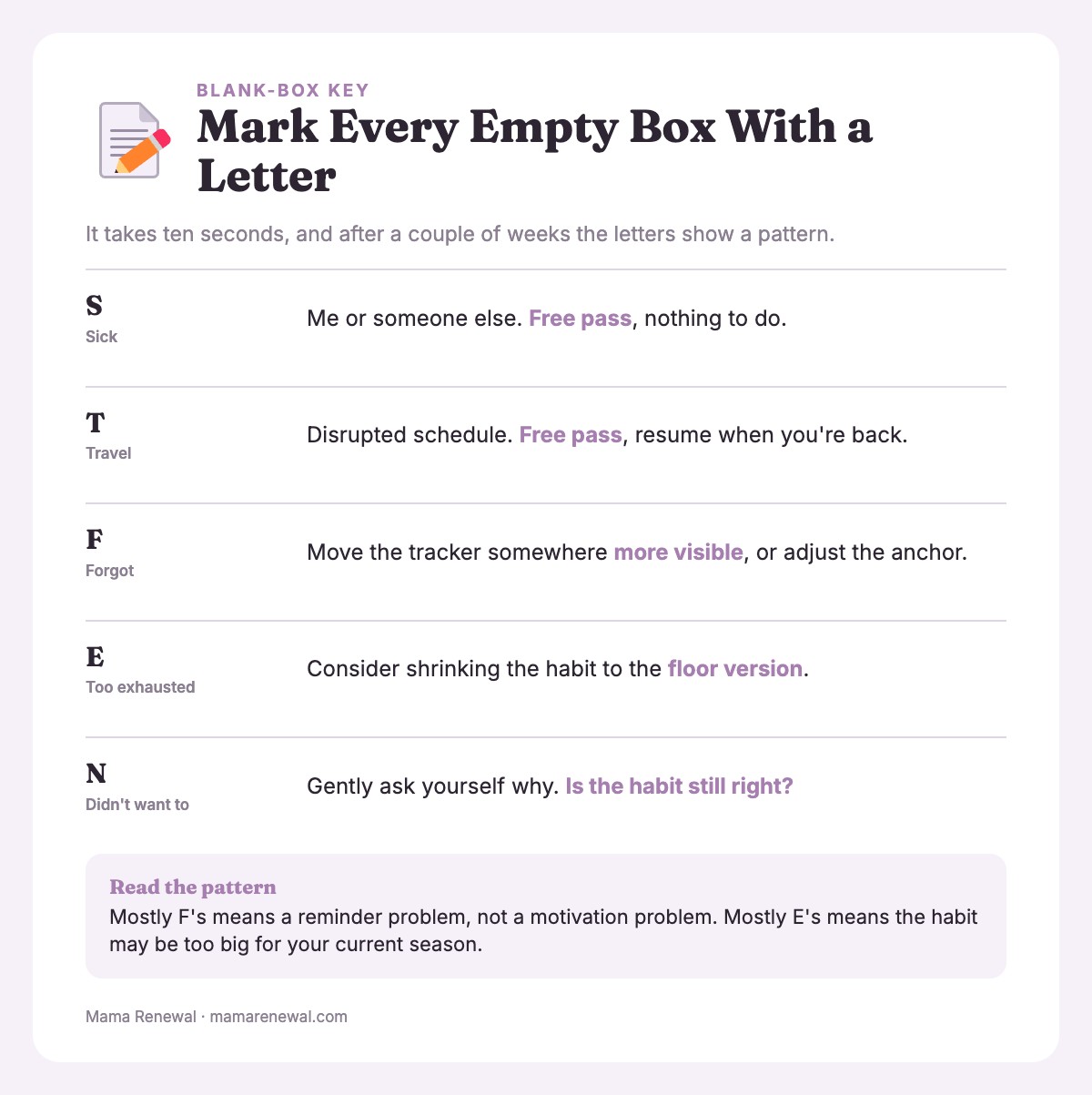
When a box is empty, take ten seconds and jot a single letter in it:
| Letter | Meaning | What to do about it |
|---|---|---|
| S | Sick (me or someone else) | Nothing. This is a free pass. |
| T | Travel or disrupted schedule | Nothing. Resume when you’re back. |
| F | Forgot | Move the tracker somewhere more visible, or adjust the anchor. |
| E | Too exhausted | Consider shrinking the habit to the floor version. |
| N | Didn’t want to | Gently ask yourself why. Is the habit still right? |
After a couple of weeks, glance at the letters. If you see mostly F’s, you have a reminder problem, not a motivation problem. If you see mostly E’s, the habit may be too big for your current season. And if you see a bunch of S’s, you’ve been in survival mode, and surviving counts too.
When “too exhausted” keeps showing up
If E is the most common letter in your grid, that deserves a kind look. Chronic exhaustion isn’t a habit failure. It can be a sign you need more sleep, more help, a medical check-in, or all three.
Safety firstIf you’re also feeling persistently low, irritable, anxious or numb, talk to your doctor or a mental health professional. A habit tracker is a gentle tool, not a substitute for support. If you have thoughts of harming yourself or your baby, call or text 988 (US) or your local emergency number right away. Postpartum Support International: 1-800-944-4773.
Gentle Self-Care Habit Ideas, Sorted by Energy Level
If you’re stuck on what to track, here’s a menu. Pick based on how much energy you honestly have right now, not how much you wish you had.
Under one minute (for the empty-tank season)
- Drink a glass of water before your first coffee
- Take three slow breaths before getting out of the car
- Say one kind thing to yourself in the mirror (or just don’t say a mean one)
- Put your hand on your chest for ten seconds
- Roll your shoulders back five times
- Step outside and feel the air on your face
- Close your eyes for 30 seconds while the microwave runs
- Open a window in the room you spend the most time in
Under five minutes
- Stretch your neck, shoulders and back
- Eat a protein-containing breakfast or snack
- Write one sentence about your day
- Text one friend something that isn’t about the kids
- Listen to one song you love, start to finish
- Put on lotion or a face cream slowly, as a tiny ritual
- Tidy one small surface just for the calm of it
- Read one page of a book
Five to fifteen minutes
- Take a short walk around the block
- Do a gentle stretching routine (see gentle morning stretches for moms for a ten-minute option)
- Journal with a single prompt
- Prep one ingredient for tomorrow’s meals so dinner feels easier
- Take a shower without rushing, even if it’s short
- Spend ten minutes on a hobby that’s only yours
- Call a friend or family member who feels easy to talk to
- Go to bed fifteen minutes earlier than usual
Habits that protect your sleep and mood
- Put your phone on a charger outside arm’s reach at a set time
- Dim the lights in your house one hour before bed
- Keep a “worry list” notepad by your bed to dump thoughts onto
- Get outside within an hour of waking
- Try a caffeine cutoff in the early afternoon and see whether your sleep improves (caffeine alternatives for moms can help)
- Wind down with something screen-free for ten minutes
Habits that protect your relationships and identity
- Ask for help with one specific task each day
- Say “no” to one thing that doesn’t matter to you
- Send one voice memo or message to a friend
- Do one thing that has nothing to do with being a mom
- Notice one moment you were a good enough parent today
- Take one photo of something that makes you smile, just for you
If you’re not sure which category fits you best, the self-care style quiz can help you find the kinds of habits that actually work with your personality instead of against it.
Sample Tracker Setups for Different Seasons of Motherhood
A habit that works with a newborn is not the same habit that works with a middle schooler. Here are a few sample setups to adapt.
The newborn or postpartum season
Sleep is broken, your body is healing, and everything is unpredictable. Keep the bar on the floor.
| Element | Example |
|---|---|
| Habit | Drink a full glass of water |
| Anchor | After every night feeding, or after the first morning feed |
| Floor version | Three sips |
| Free passes | Every bad night. All of them. |
Don’t pile on goals. Hydration, food and a few minutes of rest are the entire assignment.
Safety firstIf sadness, anxiety or overwhelm doesn’t ease up, tell your provider; for thoughts of harming yourself or your baby, use the crisis numbers in the safety note above right away.
The toddler and preschool season
You’re touched out, mentally scattered, and every plan gets interrupted. Choose habits that survive interruption.
| Element | Example |
|---|---|
| Habit | Five slow breaths |
| Anchor | After I buckle the kids into the car seats |
| Floor version | One slow breath |
| Free passes | Sick days, travel days, tantrum days |
The school-age season
Logistics take over. You may get small windows of quiet during the day, which is a gift and also a trap, because the window fills with chores. Use it on purpose. The post on school-age mom burnout and the invisible load of logistics explains why this season is more draining than it looks.
| Element | Example |
|---|---|
| Habit | Five minutes of something for me (walk, book, hobby) |
| Anchor | After I drop the kids off, before I open my laptop or the laundry basket |
| Floor version | Two minutes sitting in the car with no phone |
| Free passes | Weeks with school breaks or illnesses |
The “all stages at once” season
If you’ve got a baby, a kindergartener and a teenager, you don’t have a season. You have a weather system. Pick the habit most tied to your body (water, food, sleep) because those are what everything else rests on.
Where to Put Your Printable Habit Tracker
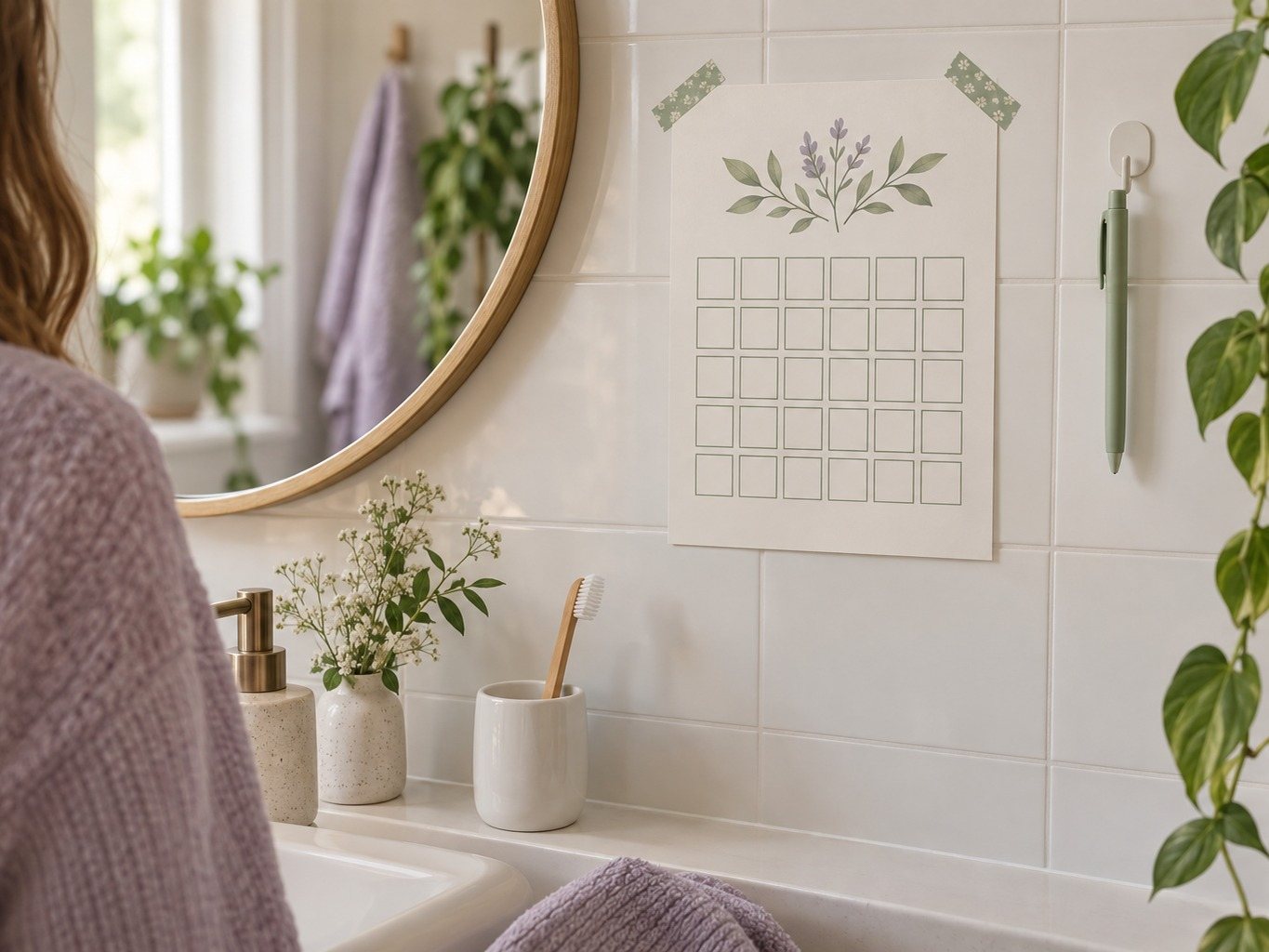
A tracker in a drawer is just paper. A few ways to put yours where you’ll see it:
- On the bathroom mirror. You go there every day, and it’s one of the few places you’re alone.
- Next to the coffee maker or kettle. Pair it with your most reliable morning ritual.
- As a photo on your phone’s lock screen. Take a picture of the printed grid and use it as your wallpaper.
- Next to the family calendar. If you share a household calendar, your habit sits beside everyone else’s obligations. That’s a quiet way of treating your needs as real.
Then keep a pen you like right next to it. If checking the box requires a hunt for a pen, you won’t check the box. Two small ways to make the check-off feel like a reward:
- Use a gel pen or highlighter in a color you love, or draw a tiny star instead of a check mark
- Let your kids put a sticker on your tracker (many love this, and it models self-care for them)
- Self-care bingo for days when a daily habit feels like too much
- A fall reset without overhauling your life, which pairs well with a four-week cycle
- Fall journal prompts for moms if your habit is one sentence a day
How to Talk to Your Family About It
Habits need protection, and sometimes that means telling the people you live with. This doesn’t have to be a big announcement. A few lines that work:
- “I’m trying a small habit for the next four weeks. It takes about two minutes. If you see me doing it, please don’t ask me for anything just yet.”
- “I’m working on drinking more water. Can you remind me if you see me skip it?”
- “Between 8:30 and 8:35 tonight, I’m taking five minutes. If it’s not an emergency, it can wait.”
If your partner is supportive, ask them to cover one specific moment so your habit can happen, like handling the last bedtime story while you step into the other room. If they’re not on board yet, that’s a conversation worth having, and the invisible labor checklist can give you language for it.
With kids, a simple explanation works: “Mom is taking care of herself so she can take better care of all of you.”
Common Mistakes (and Simple Fixes)
Even a gentle tracker has pitfalls. Here are the most common ones.
| Mistake | Why it backfires | Simple fix |
|---|---|---|
| Choosing two or three habits “since they’re all small” | Each one needs an anchor and attention; the total load adds up fast | Pick one. Add a second only after four weeks. |
| Picking a habit that depends on other people | Someone else’s schedule can derail you | Choose something you control entirely |
| Skipping the anchor | The habit floats without a trigger and gets forgotten | Write the “After I…” sentence at the top of the page |
| Setting the habit too big | You’ll feel like you failed on the first hard day | Shrink it until it feels almost silly |
| Counting blank boxes as failures | Shame kills motivation | Use the letter system and treat blanks as information |
| Starting on a chaotic week (holiday, travel, big deadline) | Setup is harder when everything is disrupted | Start the Monday after things settle, or use a floor-level habit |
If you’re planning to start during a high-pressure stretch like the holidays, go extra small. The holiday mental load checklist is a good companion for that season, because lightening the load first makes any new habit easier to carry.
A Realistic Look at What Four Weeks Can (and Can’t) Do
Four weeks of a small habit will not transform your life. It won’t fix burnout, replace sleep, or do the work that rest, support and shared responsibility have to do. Exhaustion in motherhood is partly structural, and a pretty tracker can’t fix an unequal division of labor.
What four weeks can do is quieter and still valuable:
- Give you a daily moment of attention on your own needs
- Show you what your real capacity looks like, without guessing
- Create a foundation you can build on slowly, one habit at a time
Two minutes a day doesn’t sound like much, but over four weeks that’s nearly an hour of tending to yourself that wouldn’t have happened otherwise.
Frequently Asked Questions
What is a self care tracker, and how is it different from a regular habit tracker?
A self care tracker is a habit tracker built around small acts of looking after your own body and mind, rather than productivity goals like finishing tasks or hitting numbers. This one is designed specifically for moms, so it uses one tiny habit, forgiving rules, a built-in floor version for bad days, and no streak-shaming. The goal is consistency and self-trust, not perfection.
How many habits should I track at once?
One. It sounds too simple, but one habit with a clear anchor is far more likely to stick than three habits competing for your attention. Once you’ve finished the four weeks and the first habit feels easy, you can start a second four-week cycle with a new habit.
What if I miss several days in a row?
Resume with the floor version of your habit as soon as you can, without restarting the grid or making up for lost days. A week of sickness, a family emergency or a rough patch isn’t a failed habit, it’s life. Mark the boxes with a letter (like S for sick) so you remember why, then pick up where you are. If missed days keep happening, shrink the habit or change the anchor, since that usually means the setup needs adjusting, not you.
Can I use this tracker with a baby or newborn at home?
Yes, with an extra-small habit and lots of grace. In the newborn and postpartum season, stick to basics like drinking water, eating something with protein, or taking one slow breath, and treat every rough night as a free pass. If you’re feeling persistently sad, anxious or overwhelmed, please reach out to your doctor or midwife, because postpartum mood changes are common and very treatable.
How long does it really take to form a self-care habit?
There’s no magic number. In the small University College London study mentioned above, the median was about 66 days, and individual times ranged from 18 to 254 days depending on the person and how complex the behavior was. Four weeks is long enough to learn whether a habit fits your life and to build real momentum, but not necessarily long enough for it to become fully automatic. If it still feels effortful at the end of week four, keep going or simplify it further.
Do I need to print the tracker, or can I use it digitally?
Either works. Print the printable card, copy the grid into a notes app or spreadsheet, or sketch it by hand on any piece of paper. Some moms find the physical act of ticking a box more satisfying, and others prefer a phone reminder. Choose whichever you’re most likely to see at your anchor moment.
What if my chosen habit just isn’t working after two weeks?
That’s useful information, not a failure. Check whether the habit is too big, whether the anchor is unreliable, or whether it just doesn’t match what you need right now. Shrink it, move it to a different time, or swap it for another habit entirely. Changing the plan mid-cycle is completely allowed, and adjusting early is smarter than pushing through something that feels like a chore.
Start Small, Start Messy, Start Today
You don’t need a perfect planner, a quiet house, or a fresh start on Monday. You need one tiny habit, one reliable anchor, and the willingness to count a one-breath day as a win. Fill in the habit sentence, print the card or copy the grid onto an envelope, and check the first box the next time your anchor shows up.
If you miss a day, you haven’t ruined anything. You’re a mother with a full life, doing something small and kind for yourself in the cracks of it. Four weeks from now, you may not feel like a new woman, but you’ll have proof that you can show up for yourself, even a little. That proof is worth more than any gold-foil planner.
Keep reading:
- Self-care bingo for the days a daily habit feels like too much
- A fall reset without overhauling your life, which pairs well with a four-week cycle
- Fall journal prompts for moms if your habit is one sentence a day