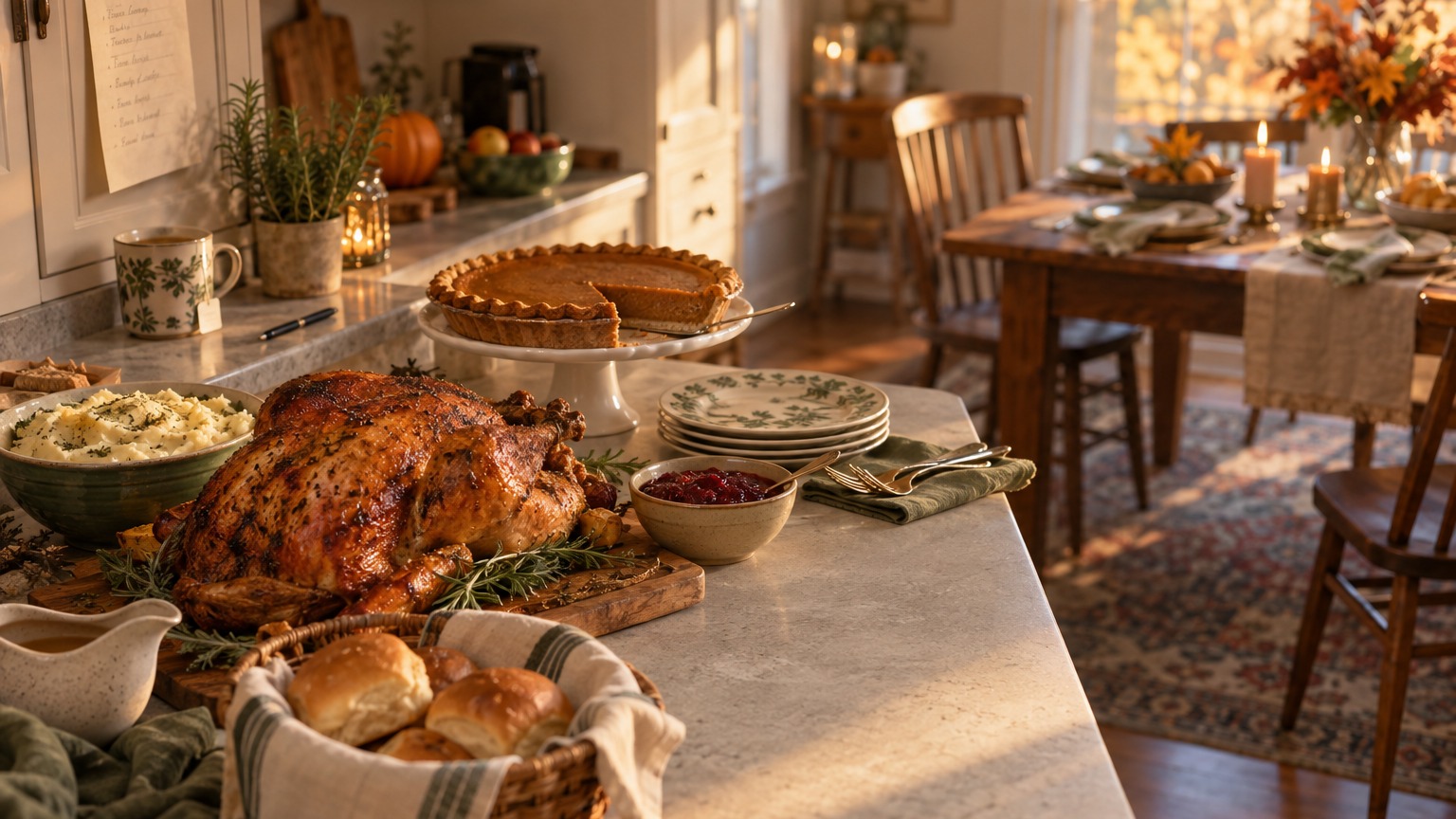
Thanksgiving Hosting Boundaries: Scripts for Moms Who Are Done
Discover actionable scripts and boundary-setting strategies so you can stop hiding in the pantry and enjoy hosting Thanksgiving on your own terms.
- Decide your boundaries and non-negotiables before guests arrive.
- Use clear, pre-planned scripts to decline extra demands calmly.
- Delegate tasks directly with tools like a fridge task board.
- Protect your post-holiday recovery time with scheduled downtime.
This post contains affiliate links. As an Amazon Associate I earn from qualifying purchases.
Last year, at 4:47 on Thanksgiving afternoon, I stood at my kitchen counter holding a gravy boat in one hand and a toddler’s sippy cup in the other. My brother-in-law had been on my couch since 11:15 a.m., asking “Anything I can do?” in the tone of a man who hopes the answer is no. A relative had just called the turkey “a little pale.” The dishwasher was still full from the first round of appetizers.
I said, “Sure, no problem!” and went into the pantry to stand in the dark for ninety seconds.
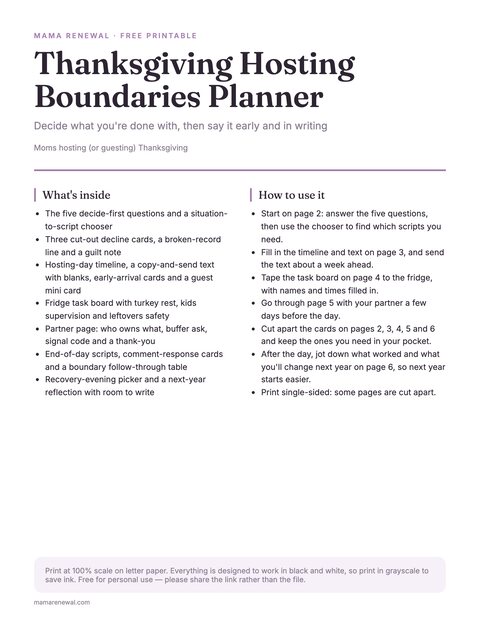
Free printable · 6 pages
Thanksgiving Hosting Boundaries Planner
A writable planner with the five decide-first questions, a situation-to-script chooser, three decline cards, a hosting-day timeline, a pre-Thanksgiving text with blanks, a fridge task board, a partner page, comment-response cards, a boundary follow-through table, a recovery-evening picker and a next-year reflection.
Free. Your download link appears right here. You'll also join the Mama Reset. Unsubscribe anytime. Privacy
If you’ve ever hidden in a pantry, a laundry room, or a running shower on a holiday you were hosting, this one is for you. Thanksgiving hosting boundaries aren’t about being difficult. They’re about the fact that one person (usually the mom) is quietly running a catering company, a hotel, a cleaning crew, and a children’s entertainment service for most of a day, unpaid, while being expected to smile.
This guide covers the hosting day itself: who shows up when, who does what in the kitchen, what your partner owns, who finally leaves, and what to say to rude comments. You’ll get six word-for-word scripts you can copy, adjust, and text before the day starts, because the best boundary is the one you set well before the day, not at 4:47 p.m. with a gravy boat in your hand.
In this article (14 sections)
- Why Thanksgiving Hosting Wears Moms Down So Hard
- Before You Write a Single Script: Decide What You’re Actually Done With
- Script 1: Declining to Host (When You’re Simply Done)
- Script 2: Setting Arrival Times (So Nobody Shows Up at 9 A.M.)
- Script 3: Asking for Kitchen Help (Specifically, Not Hopefully)
- Script 4: Asking Your Partner for the Real Help (Before Guests Arrive)
- Script 5: Ending the Day on Time (Without Throwing Anyone Out)
- Script 6: Handling the Comments (Food, Kids, House, and Everything Else)
- What to Do When Someone Doesn’t Respect the Boundary
- Thanksgiving Stress Without the Hosting: Boundaries for Guests and Moms Who Travel
- Small Things That Make the Day Gentler (Beyond the Scripts)
- A Sample Pre-Thanksgiving Message You Can Copy Today
- Frequently Asked Questions
- You’re Allowed to Enjoy Your Own Holiday
Why Thanksgiving Hosting Wears Moms Down So Hard
Thanksgiving is a strange holiday. It has none of the gift-buying of December. But it carries a uniquely heavy logistics load: one enormous meal, a hard deadline, a crowd with different dietary needs, and a house that has to look like you don’t live in it.
Most of what makes it exhausting is invisible:
- The planning. Menu, headcount, who’s bringing what, who’s allergic to what, who’s “not eating carbs this year.”
- The shopping. Often two or three trips, because someone always forgets the butter.
- The cleaning, twice. Once before guests arrive, and once after they leave.
- The emotional management. Seating arrangements, old tensions, a relative who always makes a comment.
- The kids. Yours need feeding, napping, and refereeing, and they’re also supposed to be “on their best behavior.”
If that list made your shoulders creep up toward your ears, you’re not dramatic. You’re doing the math correctly. The Holiday Mental Load Checklist is a good way to see all of this written down, and most moms are startled by how long the list gets.
Stress around Thanksgiving is also rarely about the food. It’s about the gap between how much you’re carrying and how much anyone has noticed. A boundary is just a way of narrowing that gap out loud.
What a Boundary Actually Is (and Isn’t)
A boundary is not a demand that other people change. It’s a statement about what you will do.
| Not a boundary | A boundary |
|---|---|
| “You need to stop showing up late.” | “Dinner is at 3:00. We’ll start eating at 3:00 whether everyone’s here or not.” |
| “Why doesn’t anyone ever help?” | “I’d like you to take over drinks and dishes after dinner.” |
| “Your kids are out of control.” | “I’m going to keep the upstairs closed so the house stays calm.” |
| “You should know I’m exhausted.” | “I’m wrapping up at 6:30, so I’ll say goodbyes at 6:00.” |
The left column hopes people will read your mind. The right column gives them something concrete to do or not do. If you want a deeper foundation, boundaries for moms covers the general skill, and this article applies it to one very specific, very loud day.
Before You Write a Single Script: Decide What You’re Actually Done With
Scripts only work if you know what you’re asking for. Take ten minutes with a pen and answer these honestly. Nobody’s grading them.
- If I could change one thing about last year’s hosting, what would it be? (Arrival chaos? Zero help in the kitchen? People lingering until 9 p.m.?)
- What part of hosting do I actually enjoy? Some moms love the table-setting and hate the cleanup. Some love the cooking and dread the crowd. Keep the part you like.
- What’s my hard stop? The time you want the house back.
- Who is my ally? A partner, sibling, or friend who can back you up in the moment.
- What’s my “no” and what’s my “yes, but”? You might be a full no on hosting, or a yes with conditions.
Here’s a quick way to sort your answers.
| Your situation | Likely best move |
|---|---|
| Hosting feels like dread, not just tiredness | Decline or hand it off (Script 1) |
| You like hosting, hate the timing chaos | Set an arrival and meal time (Script 2) |
| You cook alone while others watch TV | Assign kitchen jobs in advance (Script 3) |
| Your partner “helps” only when asked mid-crisis | Plan the division of labor together (Script 4) |
| Guests stay until you’re falling asleep | Announce an end time (Script 5) |
| Comments about food, kids, or the house sting | Prepare a calm redirect (Script 6) |
You may need only one or two of these. You may need all six. Either is fine.
Script 1: Declining to Host (When You’re Simply Done)
Knowing how to say no to hosting Thanksgiving is the hardest one, because the pressure is rarely spoken. It’s assumed. “Well, you have the biggest table.” “Your house is so cozy.” “We always do it at yours.” Those sentences are job offers you never applied for.
You are allowed to resign.
The principles
- Say it early. The longer you wait, the more it feels like backing out. Aim for at least three weeks ahead, though even a week out is fine if that’s where you are.
- Be kind and short. Long explanations invite debate. “No” with warmth is complete.
- Offer an alternative only if you want to. You do not owe a counteroffer.
- Don’t apologize for the decision. Apologize, if you like, for the inconvenience.
Script 1A: The clean decline
“I wanted to let you know early: I’m not going to be hosting Thanksgiving this year. I know we’ve done it here the last few years, and I appreciate everyone counting on me for it. I just don’t have it in me this time. I’d love to still celebrate together, so if someone else wants to host, I’ll gladly bring a dish.”
Script 1B: The “not this year, and maybe not again” decline
“I need to be honest, since I’d rather you hear it now than be surprised later. Hosting has become more than I can carry, and I’m going to step back from it. This isn’t about anyone in particular. I’m just done being the default. If we want to rotate houses, I’m happy to take a turn in a couple of years.”
Script 1C: The “I’ll do part of it” decline
“I can’t host the whole day this year. What I can do is make the pies and bring them wherever we land. Would you be willing to host the main meal?”
If they push back
Pushback is common, and it’s usually surprise, not malice. Have a “broken record” line ready:
“I understand it’s a change, and I’m not able to host this year.”
TipSay it again, same words, same tone. You don’t need new reasons. New reasons are new things to argue with.
What if there’s guilt? Expect some. Guilt is not proof you’re wrong. It’s what it feels like to change a pattern that other people were comfortable with. If you’re holding a lot of “shoulds” about being the family’s holiday anchor, boundaries with in-laws walks through how to hold a line when family is used to a different answer.
Script 2: Setting Arrival Times (So Nobody Shows Up at 9 A.M.)
If you’ve ever been in your robe, mid-turkey-wrestle, when the doorbell rang three hours early, this section is yours. Arrival times are the most overlooked hosting boundary, and they shape the entire day. An early arrival turns “hosting a dinner” into “hosting an all-day event.”
Give people a window, not a vibe
“Come whenever!” sounds generous and is a trap. It means someone arrives at 10, someone at 2, and you never get to sit down.
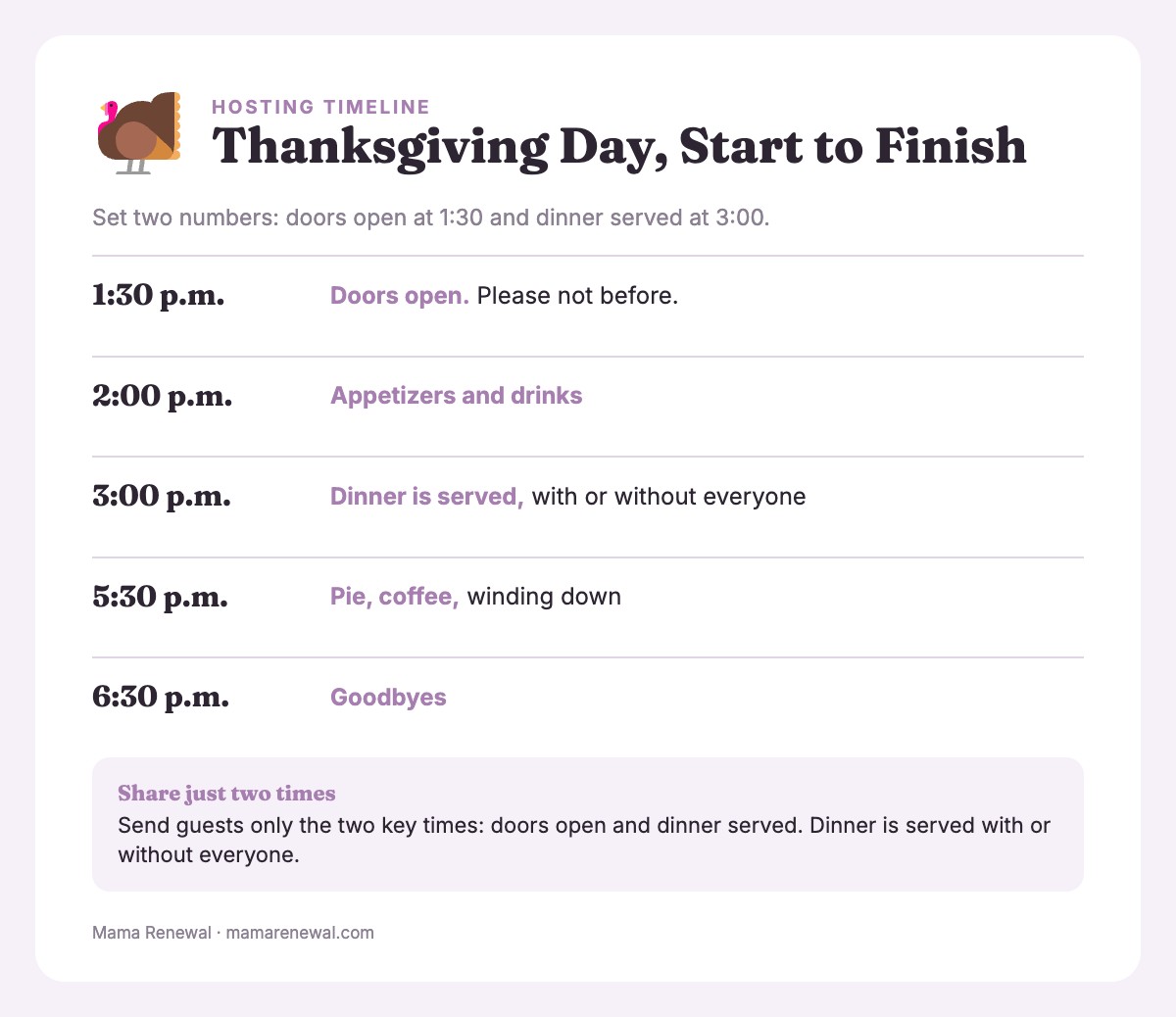
Instead, set two numbers: doors open and dinner served.
| Time | What’s happening |
|---|---|
| 1:30 p.m. | Doors open. Please not before. |
| 2:00 p.m. | Appetizers and drinks |
| 3:00 p.m. | Dinner is served, with or without everyone |
| 5:30 p.m. | Pie, coffee, winding down |
| 6:30 p.m. | Goodbyes |
Script 2A: The group text
“Hi everyone! Thanksgiving details: please plan to arrive between 1:30 and 2:00. We won’t be ready before then, so no early drop-ins, please. Dinner will be served at 3:00 sharp. If you’re running late, we’ll save you a plate, but we’ll start without you. Can’t wait to see you all!”
Notice the tone: cheerful, specific, no apology. “We’ll start without you” is the sentence that actually changes behavior, because it removes the pressure on you to hold dinner and keep everything warm.
Script 2B: The one person who always arrives absurdly early
Every family has one. It’s usually someone who means well and genuinely doesn’t realize.
“I love that you’re excited to come! Just a heads-up, I’m in full prep mode until 1:30, so please aim for 1:30 or after. If you want to be helpful earlier, I’d happily take a bag of ice dropped off at 1:30 on the dot.”
Giving them a task at the correct time channels the enthusiasm.
Script 2C: When someone shows up early anyway
You’re allowed to meet them at the door with a job and a boundary.
“Hey, you’re early! I’m not quite ready for company, so here’s what would help: can you take the kids’ table and set it up while I finish in the kitchen? I’ll come say a proper hello at 1:30.”
Or, if you’d rather not have them in at all:
“I’m so glad you’re here, but I’m not ready yet! Could you grab a coffee and come back at 1:30? I’ll have the door open then.”
It feels awkward for about eight seconds. Then it’s over, and next year they remember.
Script 3: Asking for Kitchen Help (Specifically, Not Hopefully)
“Let me know if you need anything!” is a kind sentence that puts the work of delegating back on you. To ask for help, you have to notice what needs doing, decide who’s capable, explain it, and then check it was done. That’s three jobs to avoid one.
The fix is to assign tasks before the day, by name, with a time.
Make a task board
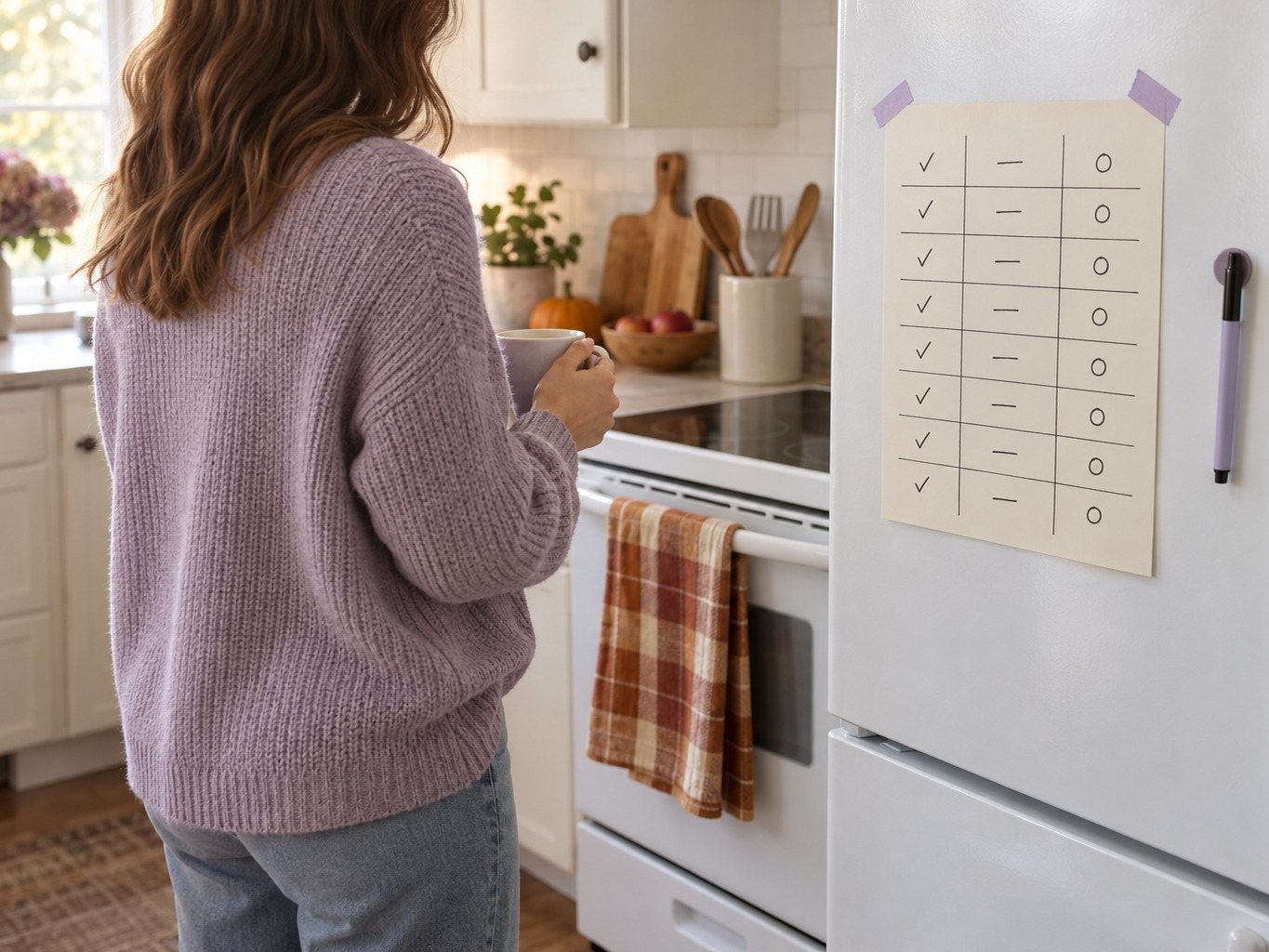
Print or write this up and tape it to the fridge, or text it ahead of time.
| Task | Who | When |
|---|---|---|
| Fill the ice bucket and drinks station | Uncle Dan | 1:30 |
| Set the kids’ table | Cousin Maya | 2:00 |
| Mash the potatoes | Dad | 2:30 |
| Turkey out of the oven to rest (20-30 minutes) | You or your partner | 2:15 |
| Carve the turkey | Brother-in-law | 2:45 |
| Load the dishwasher (round one) | Whoever’s closest to it | 3:45 |
| Wrap and refrigerate leftovers | Aunt Carol | 4:30 |
| Dish duty, start to finish | Everyone who ate, in teams | 6:00 |
A named task is nearly impossible to ignore. “Anything I can do?” gets “No, I’m fine!” out of an exhausted mom by reflex. A written assignment doesn’t give you that option.
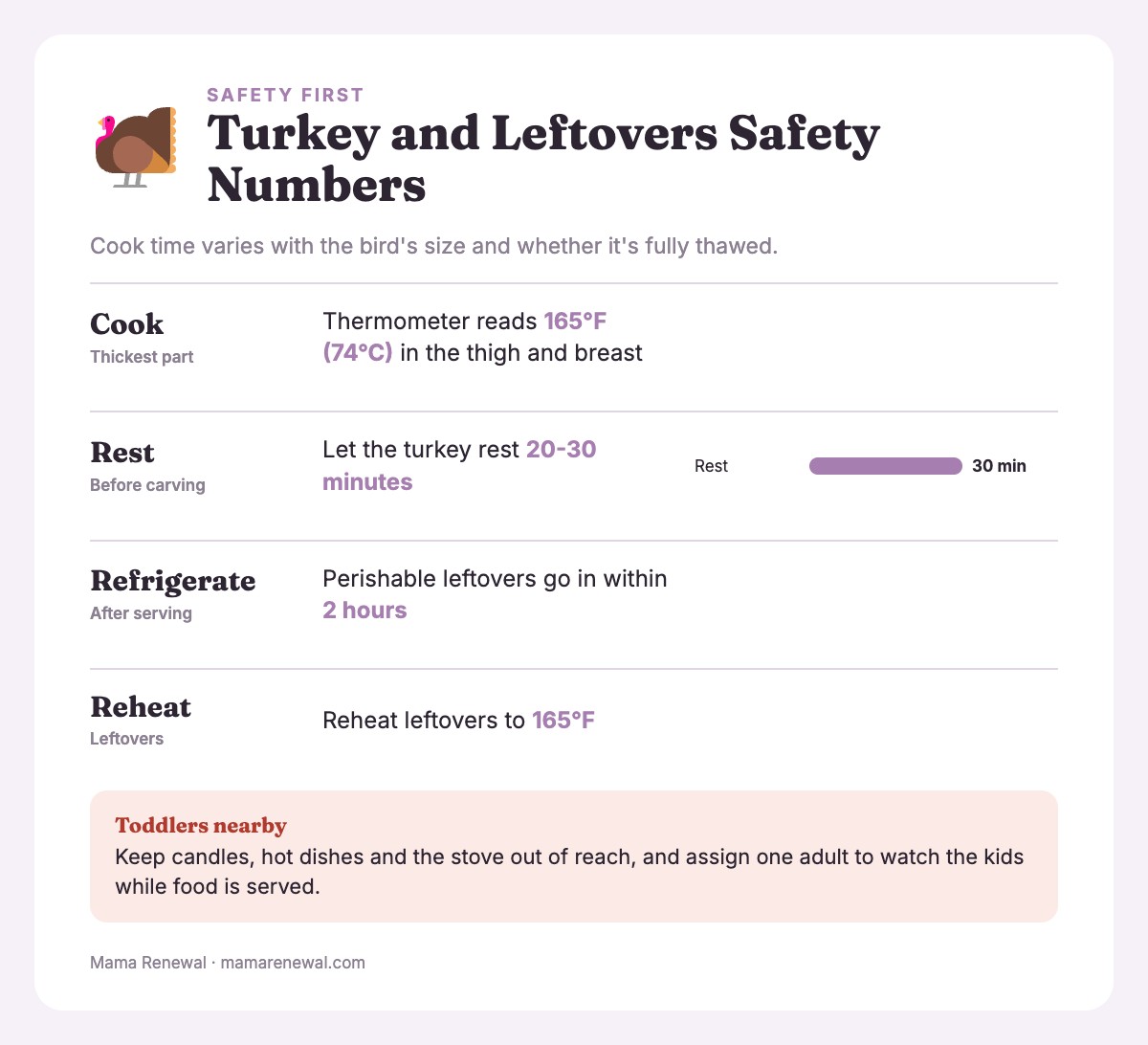
Safety firstCook the turkey until a thermometer reads 165°F (74°C) in the thickest part of the thigh and breast, then let it rest 20-30 minutes before carving. Cook time depends on the bird’s size and whether it’s fully thawed. Refrigerate perishable leftovers within 2 hours of serving and reheat them to 165°F. With toddlers around, keep candles, hot dishes and the stove out of reach, and assign one adult to watch the kids while food is served.
Script 3A: The pre-holiday ask
“Thanksgiving is going to run smoothly this year because everyone’s taking one small job. I’ve put together a list. You’re on potatoes at 2:30, and it’ll take about fifteen minutes. Can I count on you?”
Script 3B: In the moment, when someone offers
When a guest does say “What can I do?”, say a specific thing immediately.
“Yes! Could you fill the water glasses and set out the napkins? Thank you.”
Never say “Oh, nothing, I’ve got it.” If you say that, you’ve told them the truth about your preferences: you’ll do it all.
Script 3C: When someone is “helping” in a way that isn’t helpful
This is the person who rearranges your fridge or “fixes” the gravy.
“I appreciate that you want to jump in. I’ve got the gravy handled, but I’d love your help with the rolls. They need to come out in about ten minutes. Can you take those?”
You’re redirecting, not rejecting. People are far more willing to move toward a task than away from one.
Script 3D: The “I’m cooking, you’re cleaning” split
If you’re cooking the whole meal, you can reasonably say the cleanup belongs to everyone else.
“Since I made dinner, I’m going to sit down and have pie while the rest of you take care of the kitchen. Dishes are in the sink and the dishwasher’s empty. Thank you all.”
Then sit. Actually sit. This is the part that feels hardest, and it’s the part that makes the whole system work, because if you hover and re-do the dishes, you’re teaching everyone that your instructions were optional.
Script 4: Asking Your Partner for the Real Help (Before Guests Arrive)
Your partner is the most important person in this whole system, and also the one most likely to be treated as a guest in their own home. If you’re hosting your side of the family, they may feel like a bystander. If you’re hosting theirs, they may be playing son or daughter instead of co-host.
Either way, the conversation needs to happen privately and ahead of time. Not in the kitchen at 2:15 with a timer going off.
If this kind of conversation is hard in your house, communicating needs to your partner goes deeper into how to say what you need without it turning into a fight. For Thanksgiving specifically, here’s a short version.
Script 4A: The planning conversation (a few days before)
“Can we sit down for fifteen minutes about Thanksgiving? I’m not asking you to take over. I’m asking us to split it so I’m not running everything. Here’s what I’m thinking: I’ll handle the cooking, and I need you to own the house and the kids. Cleaning the bathrooms tonight, setting the table, entertaining the little ones, and handling the dishes afterward. Does that work, or do you want to swap any of it?”
Notice the final question. It gives your partner some control, and people take on tasks more willingly when they’ve had a hand in choosing them.
Script 4B: The “I need you to be my buffer” ask
If there’s a relative who tends to criticize or take over, you may want your partner to run interference.
“If your mom starts rearranging my kitchen, I need you to step in and redirect her. Something like, ‘Mom, can you come help me with the kids?’ I don’t want to have the argument, and I shouldn’t have to. Can you be on that?”
Script 4C: The mid-day signal
Agree on a code before the day. It can be a phrase, a look, or a text.
“If I say, ‘Can you help me find the serving spoons?’ it means I’m overwhelmed and I need you to come into the kitchen right now. Don’t ask questions. Just come.”
It sounds silly, but it gives you an exit ramp that doesn’t require an announcement.
Script 4D: The afterward check-in
“Thank you for taking the kids and the dishes today. It made a real difference. Next year I’d like us to do the same split from the start. Can we agree on that?”
Thanking someone for specific work is the best way to make sure it happens again. If you’re still unsure where your partner’s share of the load ends and yours begins, The Mental Load: Why Moms Feel Exhausted Even When Everyone “Helps” is worth reading. The quickest fix, though, is saying it out loud, in advance, with a list.
Script 5: Ending the Day on Time (Without Throwing Anyone Out)
It’s 7:45 p.m. The pie is gone. The kids are melting down. Your feet hurt. Three adults are on your couch discussing a movie none of them have seen. And you’re thinking, with growing intensity, about your bed.
The problem isn’t that they’re rude. It’s that nobody told them when the day ends. Most people will happily leave once they know there’s a time. They stay because the day has no edge.
Put the end time in the invitation
Do this from the first message. It’s much easier than introducing it at 6 p.m.
“Dinner’s at 3:00, and we’ll wrap up around 6:30. The kids have bedtime, and I’ll be done by then!”
That’s it. A time that’s announced early reads as a plan, not a rejection.
Script 5A: The soft 30-minute warning
At 6:00 or so, make a friendly announcement.
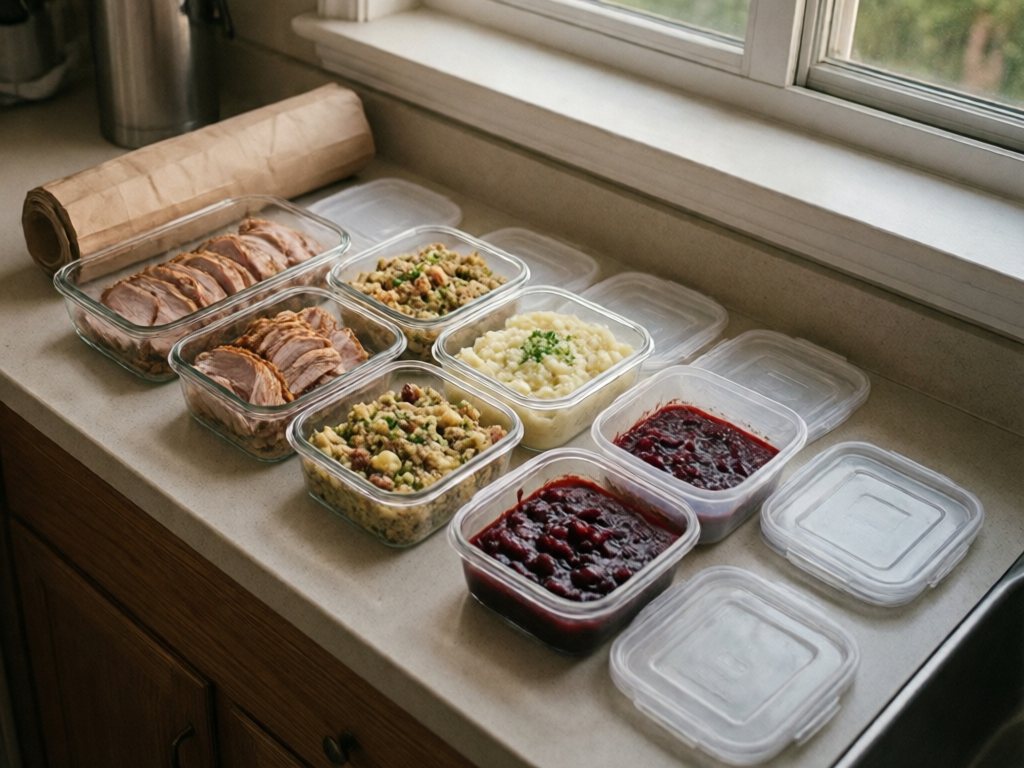
“Just so everyone knows, we’ll wrap things up around 6:30. The leftovers are already packed in the fridge, so grab a container on your way out. And if you’re doing dishes, now’s a great time!”
This does three things at once: signals the end, offers leftovers (a gentle nudge), and assigns the cleanup.
Script 5B: The gentle exit for a lingering guest
When it’s past the time and someone is still settled in:
“This has been such a lovely day. We’re going to start winding down so we can get the little ones to bed. Let me grab your coat, and I’ll walk you out.”
Standing up and moving toward the door is the most powerful move here. Words follow the body, and people follow the room.
Script 5C: For the guest who says, “Oh, we’re not in a hurry”
“I’m so glad you’re having fun. I’m at the end of my energy, so I’m going to call it for the night. Thank you so much for coming.”
You don’t need a reason beyond your own limit. “I’m at the end of my energy” is honest, short, and hard to argue with.
Script 5D: For houseguests who are staying over
Overnight guests need their own boundary, since “the day ending” doesn’t apply.
“Breakfast is at 8:30, and I’m going to take a quiet hour after dinner tonight, so I’ll say goodnight at 8:00. Towels are in the bathroom, and the coffee maker is yours to use in the morning.”
Quiet hours and a self-serve coffee station are two of the kindest things you can give yourself.
Build in your recovery

After the last guest leaves, the day is not actually over. There’s the post-event crash, and it’s real. Plan something small for the evening: tea, a show, a hot shower, silence. You can find ideas in 27 cozy fall self-care ideas if you need inspiration, though honestly, the best plan is “nobody talks to me for an hour.”
Script 6: Handling the Comments (Food, Kids, House, and Everything Else)
You’ve done everything right. The timing is set, the helpers are assigned, the day is ending on schedule. And then someone says something.
“Is the stuffing from a box?”
“Wow, she’s still not sleeping through the night?”
“You really should do something about the carpet.”
“When are you having another one?”
Comments sting more on holidays because you’re already depleted. A prepared response means you don’t have to build one from scratch with a hot pan in your hands.
Three tools: deflect, redirect, close
| Tool | What it sounds like | Best for |
|---|---|---|
| Deflect | “Hm.” / “Interesting!” / “Thanks for the thought.” | Low-stakes jabs |
| Redirect | “Speaking of food, did you try the cranberry sauce?” | Awkward but harmless |
| Close | “I’m not going to discuss that today.” | Repeated or personal comments |
Script 6A: The food critic
“I’m so glad you’re here to eat it. There’s plenty of pie if you’d like a different option.”
Light, warm, and a clear statement that you aren’t taking requests.
Script 6B: The parenting commentary
“We’ve got a system that works for us, and I’m happy with how it’s going. Can I get you some more potatoes?”
If the commentary is about discipline or rules, what to say when Grandma overrides your discipline rules covers more detailed language for that exact situation.
Script 6C: The personal question (body, baby plans, career)
“That’s not something I’m going to get into today. How’s the new job going?”
The “How’s the…” at the end is the redirect. It hands the conversation back to them, and most people are delighted to take it.
Script 6D: When it keeps happening
If the same person keeps coming back to the same topic, move from deflecting to closing.
“I’ve answered that already, and I’d like to move on. If you keep bringing it up, I’m going to step away for a minute.”
Then, if they do, step away. A boundary is only a boundary if something follows it.
Script 6E: When you’re about to snap
Sometimes the problem isn’t one comment. It’s the whole accumulated day, and you feel the heat coming up your neck. That’s your cue to leave the room, not to push through.
“Excuse me, I need a minute. I’ll be right back.”
Then go. Breathe. Run cold water over your wrists. Stand in the pantry if you must; you’ve earned it. If that rage feels frequent rather than occasional, what it really means when motherhood makes you snap is worth a read, and it’s more common than most moms admit.
Good to knowIf anger or overwhelm feels frequent or constant, or comes with low mood, anxiety, or thoughts of harming yourself, talk to your doctor or a mental health professional.
What to Do When Someone Doesn’t Respect the Boundary
You will, at some point, say the thing, calmly and clearly, and someone will ignore it. They’ll arrive at 11 a.m. They’ll “forget” the task. They’ll stay until 9:30.
This does not mean the boundary failed. It means you’ve reached the second half of a boundary, which is consequence.
A consequence is not a punishment. It’s simply what you will do next.
| The boundary | When it’s crossed | Your follow-through |
|---|---|---|
| “Dinner is at 3:00.” | Someone arrives at 3:40. | Eat without them. Save a plate. |
| “Please arrive after 1:30.” | Someone arrives at 11:00. | “I’m not ready; please come back at 1:30.” |
| “We’re wrapping up at 6:30.” | Guests are still seated at 7:15. | Stand up, start collecting coats. |
| “Dishes are a group job.” | Everyone drifts off. | Leave them. Go sit down. Deal with them in the morning. |
The hardest consequence for most moms is the last one. Leaving dishes feels like failing. But when you silently do all the cleanup, you confirm the old system. When you leave the sink full for one evening, you gently introduce a new one. The mess will survive until morning, and so will you.
A note on guilt
You will probably feel guilty after at least one of these. That feeling doesn’t mean you did something wrong. It means you did something different, and you’re used to the old pattern. Guilt often eases faster than resentment does, and resentment is what you were carrying before.
Thanksgiving Stress Without the Hosting: Boundaries for Guests and Moms Who Travel
Not every mom is hosting. If you’re a guest this year, a lot of the same boundaries apply in reverse.
- Set your own arrival and departure time. “We’ll be there from 2:00 to 5:30. The kids need to be home for bedtime.” You don’t need to ask permission to leave.
- Bring the thing you can manage. One dish that you enjoy making. Not three, not a recipe you’ve never tried.
- Offer help in a defined way. “I can take over drinks and cleanup for the kids’ table.” It saves the host from having to guess.
- Protect your kids’ routine where it matters. If naps or bedtime are non-negotiable, say so kindly and early. Sleep problems after a holiday can last days, and they stack on top of the recent clock change (the daylight saving time hangover is real).
- Have an exit plan. Drive separately if you can. Having your own car is the quiet superpower of the weary guest.
Quick Scripts for Guests
“We’ll plan to head out at 5:30 so the kids can wind down. Thank you so much for having us.”
“I’d love to bring the rolls and take care of the kids’ table. What else would be useful?”
“We’re going to skip the second round of dessert tonight. We’ve got a long drive.”
Small Things That Make the Day Gentler (Beyond the Scripts)
Words are only half of it. A few practical choices reduce the load before you open your mouth.
Simplify the menu without apology
You don’t need nine sides. Choose three that you genuinely like, buy the rest, and let the potluck do its job.
- Store-bought is fine. Rolls, pie crusts, cranberry sauce, even the whole pie.
- Make-ahead saves you. Casseroles, cranberry sauce, and pie dough can all be done two days early. Refrigerate casseroles promptly and reheat them to 165°F. Keep hot food hot and cold food cold, and refrigerate perishables within 2 hours of serving.
- Paper plates are a legitimate choice. If your dishwasher holds twelve place settings and you’re feeding twenty, you know what to do.
Delegate the grocery list
Send the list in advance with names beside items. “You’re on the rolls and the sparkling cider” is a fast text, and it spares you a third store run.
Protect one hour of the day
Pick a 45-60 minute stretch, maybe mid-afternoon before dinner or right after, when you are not “on.” Put it on the task board. “Mom’s quiet time, 4:30 to 5:15, please handle kids and drinks without me.” If you hate the idea of calling it self-care, you’re in good company. self-care ideas for moms who hate bubble-bath self-care is built for exactly that.
Eat something real
It sounds basic, and it matters. Hosting moms regularly realize at 8 p.m. that they’ve eaten two rolls and a handful of olives. Put a plate together before the rush and sit down for it. A well-fed host has more patience.
Lower the bar on the house
Your guests came for dinner and people, not a white-glove inspection. Tidy the main areas, close the doors to the rest, and put a basket in the bedroom for any clutter you want to hide. If they notice dust, that’s information about them.
A Sample Pre-Thanksgiving Message You Can Copy Today
If you want to set most of this in motion with one text, here’s a version you can adapt. Send it about a week ahead.
“Hi all! Thanksgiving is shaping up, and I’m excited to see everyone. A few details to keep the day smooth:
Timing: Doors open at 1:30. Dinner is at 3:00 sharp. We’ll start without latecomers and save plates. We’ll wrap up around 6:30 for little ones’ bedtimes.
Food: I’m making the turkey, stuffing, and gravy. Please bring the dish I’ve listed next to your name below.
Help: Everyone has one small job (see list). It’s what lets me actually enjoy the day with you.
Cleanup: Dishes are a team effort after dinner. I’ll be on pie duty and sitting down!
Can’t wait. Thank you for making this easy on me.”
It’s warm, specific, and sets every major boundary before anyone’s in your driveway. People tend to respond well to clarity. Most of them have been guessing too.
Frequently Asked Questions
How do I say no to hosting Thanksgiving without starting a family fight?
Say it early, keep it short, and skip the long justification. Something like, “I’m not going to host this year, but I’d love to bring a dish wherever we celebrate,” is complete. If someone pushes back, repeat the same sentence calmly rather than offering new reasons. Reasons invite debate; a calm repeat doesn’t. Any upset is usually surprise about the change, and it tends to settle once people adjust.
What if my family expects me to host because I have the biggest house or I always have?
Habit is not an obligation. “We’ve always done it here” describes the past, not a contract. You can acknowledge the pattern (“I know we’ve done it here for years”) and still change it. If you’d like to stay part of the tradition, offer a smaller role, like dessert or a specific side dish, or suggest rotating houses so the load is shared.
How do I get my partner to actually help instead of just “being there”?
Have a private planning conversation a few days before, not a stressed exchange mid-cooking. Offer specific tasks with a time attached (“you own the table setup at 2:00 and the dishes after dinner”), and ask whether the split works for them. Agreeing on a quick signal for “I need you in the kitchen now” also helps. Naming exactly what you need removes the guesswork, which is where most of the friction lives.
What do I do about guests who show up hours early or stay way too late?
Give guests a start and an end time in your invitation: “Doors open at 1:30, we’ll wrap around 6:30.” For an early arrival, greet them kindly and hand them a small task. Or ask them to return at the right time. For a late stayer, stand up, start collecting coats, and say something warm like, “This has been wonderful, and I’m at the end of my energy.” Body language usually gets you most of the way there.
Is it okay to leave the dishes and go sit down?
Yes. If you cooked the meal, it’s reasonable for the cleanup to belong to everyone else, and leaving a full sink for one evening does no harm. The point is that quietly redoing everyone’s work teaches them that your requests are optional. If dishes are left, they’ll still be there in the morning, and you’ll have had a real chance to sit.
How do I handle critical comments about my cooking, my kids, or my house?
Match the response to the comment. For light digs, deflect with “Thanks for the thought” or redirect to a different topic. For repeated or personal comments, calmly close it: “I’m not going to discuss that today.” And if you feel yourself about to snap, step out for a minute. Having a few phrases ready in advance means you don’t have to invent one while tired and cooking.
What if I set boundaries and the day still goes badly?
It happens, and it doesn’t mean you handled it wrong. Some people take a few holidays to adjust to a new pattern. Note what worked, what didn’t, and what you’d change, then adjust next year. You can also decide this is your last time hosting. A boundary is something you keep refining, not a one-time performance.
You’re Allowed to Enjoy Your Own Holiday
Here’s what I wish I’d known at 4:47 p.m. in the pantry: nobody was going to rescue me, not out of cruelty, but because nobody could see the problem. The people I loved were sitting comfortably in a day I had built and was quietly drowning in.
Boundaries are how you let people see it, kindly and clearly, and then give them something to do about it. You don’t need to be perfect at it. You can start with one script, one text, one “doors open at 1:30.”
This Thanksgiving, you’re allowed to do less, ask for more, and sit down for pie while it’s still warm. The turkey doesn’t need you to be a martyr. It needs a thermometer reading 165°F (74°C) in the thickest part of the thigh and breast, and the timing depends on the bird’s size. Everything else is optional, and the rest of the day belongs to you too.