Solo Time Ideas for Moms Who Get 20 Minutes and Nowhere to Go
Discover practical, free solo time ideas you can do at home in short bursts (2-20 minutes) to prioritize your well-being without a babysitter. You'll learn where to find these windows and how short breaks add up.
- Your short solo breaks (2-20 min) are valid self-care and add up significantly.
- Utilize free, at-home activities that don't require a babysitter.
- Hunt for hidden solo time windows like after drop-off or while cooking.
- Prioritize safety: ensure kids are safe or with another adult during your solo time.
This post contains affiliate links. As an Amazon Associate I earn from qualifying purchases.
Picture this: you’re sitting in your parked car in the driveway, engine off, for eleven minutes while another adult has the kids. For once you aren’t “mom” or “the person who knows where the permission slip is.” You’re just a woman listening to a song she liked in college. Then your youngest taps on the window to show you a “big bug.”
That counts. Below are free solo time ideas for moms, sorted into body, mind, creativity and reconnecting with yourself. You’ll also find where 20 minutes of real me time tends to hide in a full day, and a realistic weekly rhythm. Everything works at home, with no babysitter and nothing to buy.
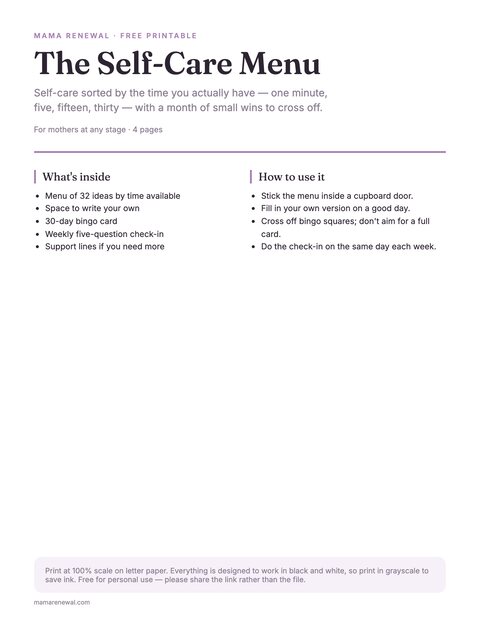
Free printable · 6 pages
The Self-Care Menu + 30-Day Bingo
Self-care sorted by the time you actually have — one minute, five, fifteen, thirty — with a month of small wins to cross off.
Free. Your download link appears right here. You'll also join the Mama Reset. Unsubscribe anytime. Privacy
Can you get out of the house? Try our solo date ideas for moms. This list is for the days you can’t.
In this article (12 sections)
- Why 20 Minutes Is Enough
- Solo Time Ideas for Moms at a Glance
- Where to Find 20 Minutes of Solo Time at Home
- Body: Stretches and Rest for Tired Muscles
- Mind: Ways to Quiet a Busy Head
- Creative Me Time Ideas at Home
- Reconnect With Yourself in 20 Minutes
- A Realistic Weekly Solo Time Rhythm (Not a Rigid Schedule)
- What to Do When Even 20 Minutes Feels Impossible
- How to Keep Solo Time From Becoming Another Chore
- Start With Today’s Twenty Minutes
- Frequently Asked Questions
Why 20 Minutes Is Enough
Mom culture has a quiet rule: anything short of a full afternoon doesn’t “really” count as self-care. I don’t buy it. Short breaks are easier to repeat, and a short break you actually take beats a long one you never get.
If you’ve read our guide to nervous system regulation for moms, you know this isn’t about grand gestures. Small, repeatable pauses do the work.
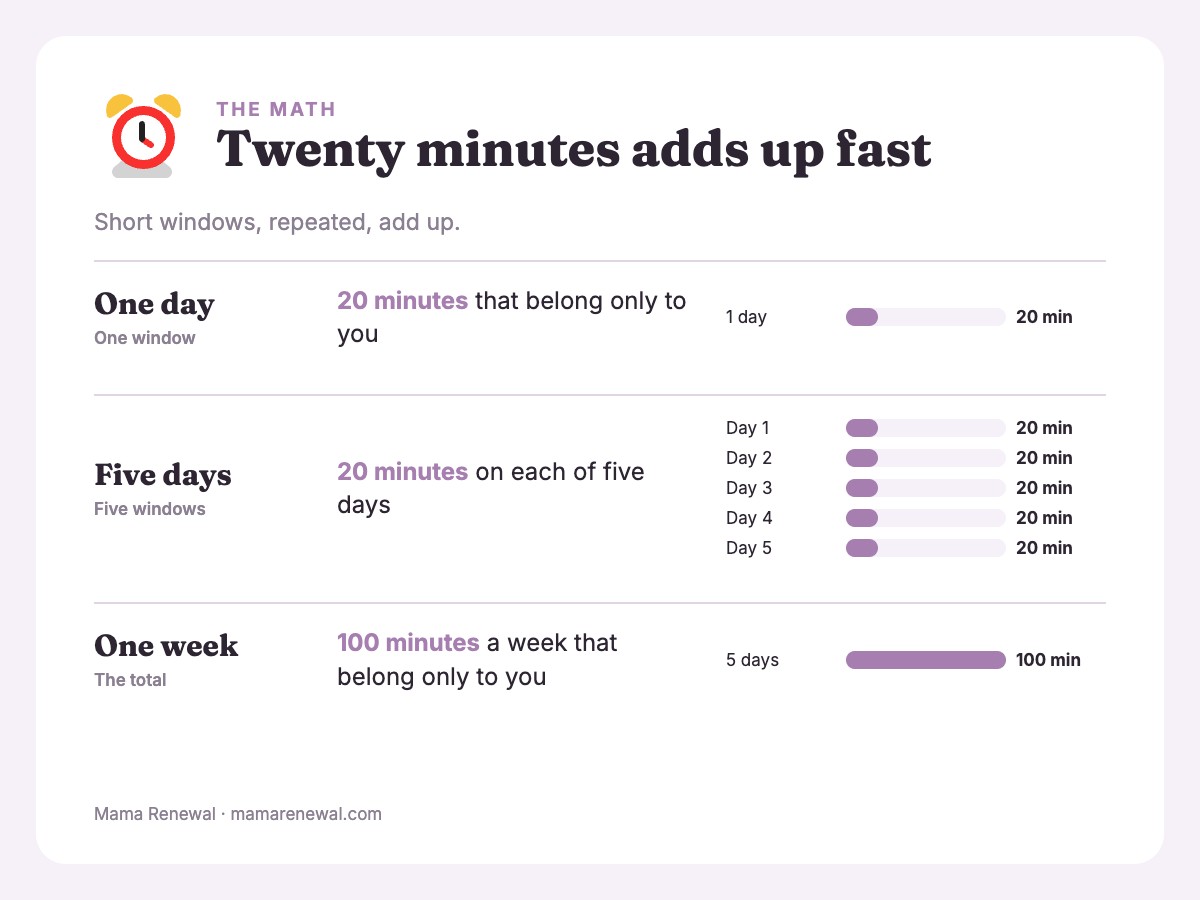
Twenty minutes on five days is 100 minutes a week that belong only to you. When you stop waiting for a free Saturday or a night at grandma’s, you stop putting yourself on hold.
Solo Time Ideas for Moms at a Glance
Pick by how many minutes you have. Each idea is explained in the sections further down.
| Idea | Time | You need | Best when |
|---|---|---|---|
| Hand-on-chest breathing | About 2 min | Nothing | Anytime, even in the bathroom. |
| Brain dump on paper | 5 min | Pen and paper | At the start of nap time. |
| Floor stretch, no goal | 5-10 min | A patch of floor | During nap time or after bedtime. |
| Free-writing or doodling | 10 min | Pen and paper | Early morning, before anyone’s up. |
| Legs up the wall | 10-15 min | A clear wall | After bedtime, lights low. Check the caution in the Body section first. |
| Hot drink, no phone | 10-20 min | A mug, lidded if kids are near | Early morning. |
| Puzzle or a trashy novel | 10-20 min | A book, crossword or sudoku | After bedtime. |
| Call or voice-text a non-mom friend | 15-20 min | Your phone | After bedtime or a quiet stretch. |
| A shower you actually finish | 5-20 min | Another adult with the kids (keep it to 5-10 min if you’re alone) | When another adult is home. |
Where to Find 20 Minutes of Solo Time at Home
Nobody hands you a twenty-minute block labeled “self-care.” You have to hunt for it inside a full day, and it’s usually disguised as something else. Read the safety basics first, then check these spots.
Safety firstTake a window only when everyone else is safe without you.
- Babies and toddlers should be asleep in a safe sleep space or with another adult, never awake and on their own. A monitor helps you listen, but it doesn’t replace supervision.
- Leave older kids on their own only if they’re ready and local rules allow it. Many guidelines suggest waiting until around 11 or 12.
- If something is cooking, stay in the kitchen with a timer set.
- Use a parked car only with no children in it, engine off, outside a garage, and in mild weather.
- The gap after drop-off. Once every child is handed off at school or childcare, sit in your parked car, engine off, for ten to twenty minutes before your day starts. Save it for mild weather.
- While something is cooking or baking. A simmer or a bake is a built-in window. Set a timer and stay in the kitchen, where you can see the stove.
- The first stretch after the last kid goes down. It’s often the longest window of the day, and the phone is right there. If the phone usually wins, try these ways to stop doom scrolling.
- While older kids are busy with each other. If they’re old enough to be on their own for that long (see the note above) and they’re occupied, even bickering, honestly, that’s a window.
- The bathroom, unapologetically. Not glamorous, but it’s a room with a door. The door and monitor rules are in the shower notes in the Body section below.
- Nap time, before the thirty things on your list. I know the instinct is to spend nap time on chores. Give yourself the first twenty minutes, once your little one is down in a safe sleep space (see the safety notes above).
- Early morning, before anyone else is up. Even fifteen minutes of being awake and alone, in silence, before the day’s demands start landing on you.
The trick is noticing the minutes already there and deciding they belong to you instead of the laundry pile or your phone. If mornings are where your window tends to live, our gentle morning stretch routine is built for exactly that ten-to-fifteen-minute slice before the house wakes up.
TipStart with one window: the one that shows up most reliably in your week. Pair it with one idea from the table above, and write both on the free Self-Care Menu printable on this page so the decision is already made.
Body: Stretches and Rest for Tired Muscles
These are for physical tiredness: tight shoulders, a back that’s carried a toddler for three years, legs that have forgotten how to move without a purpose.
Stretch on the floor, no goal in mind. Lie down and move however your body wants to. Roll your shoulders, hug your knees to your chest, twist side to side. Stop whenever it stops feeling good.
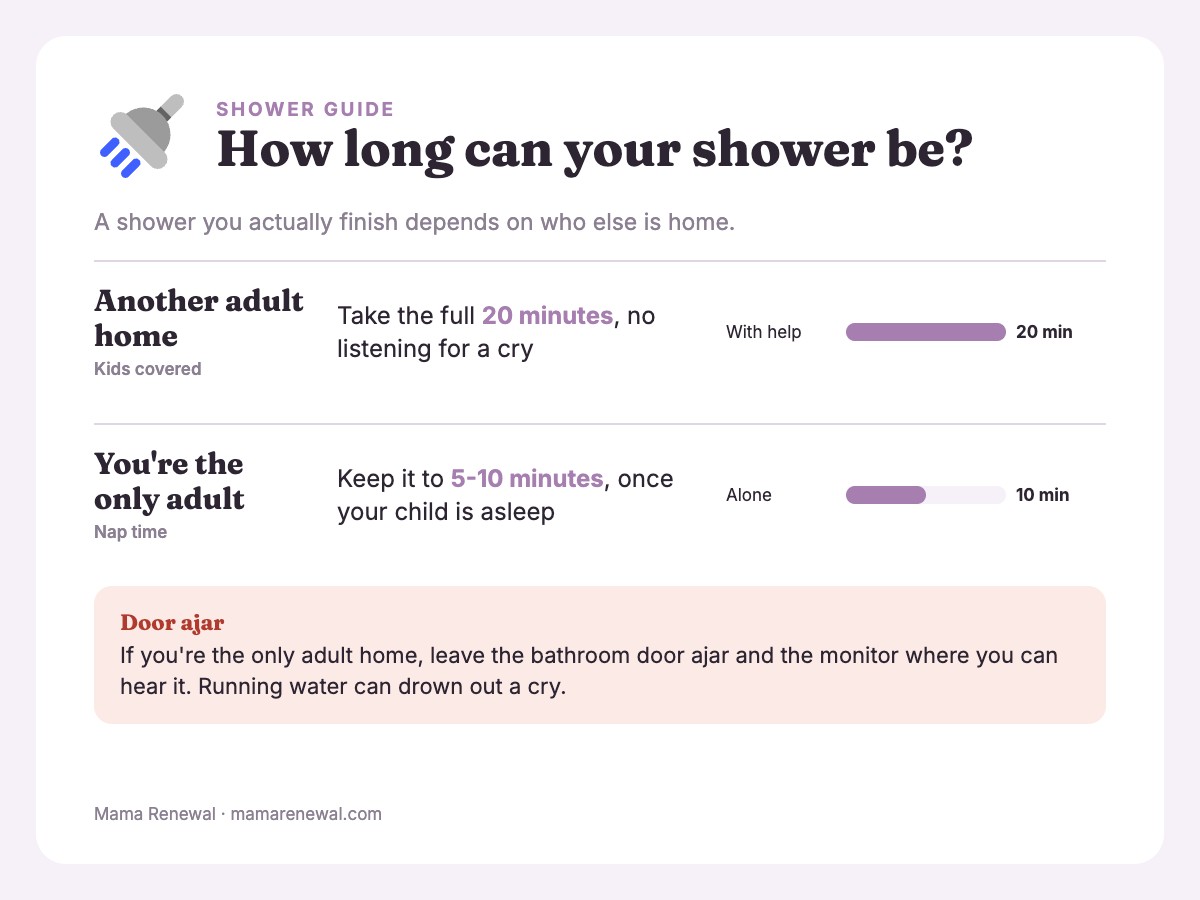
Take a shower and actually finish it. I mean one where you’re not listening for a cry or racing the clock. The full twenty-minute version is for when another adult is home with the kids.
If you’re the only adult home, keep a nap-time shower short, five to ten minutes. Start it only once your child is asleep in a safe sleep space. For a baby, that means on their back in a crib, bassinet or play yard with only a fitted sheet.
Never lock the bathroom door. Close it if another adult is home. If you’re alone, leave it ajar and keep the monitor where you can see and hear it, because running water can drown out a cry.
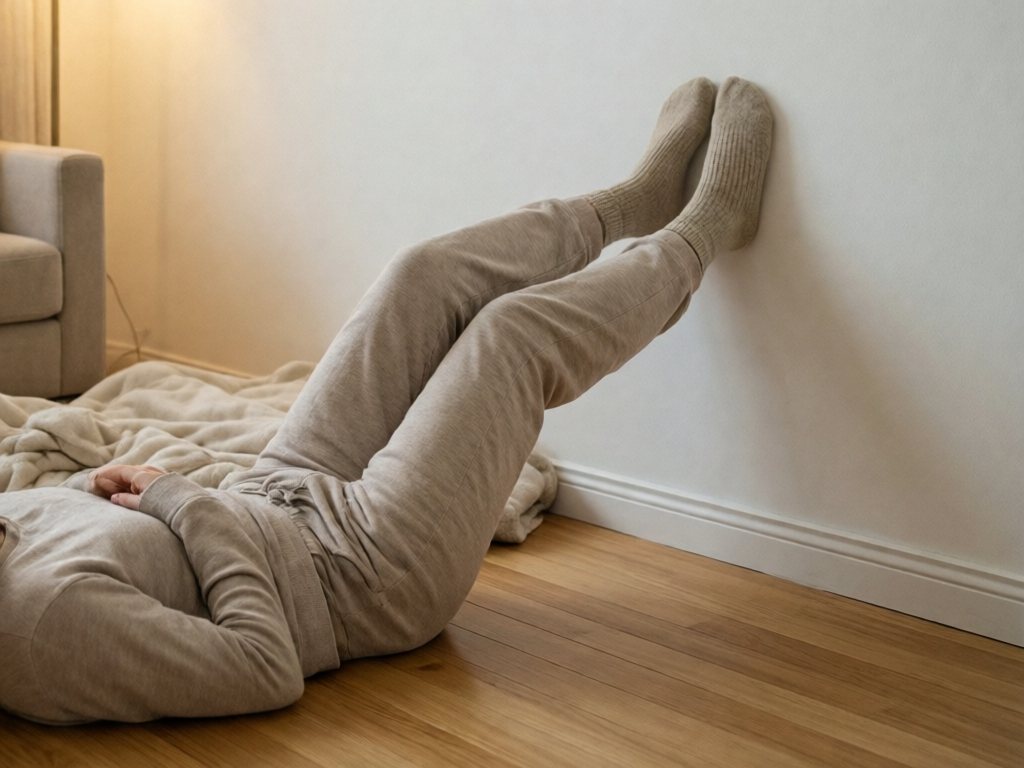
Lie on the floor with your legs up the wall. This restorative yoga pose (called viparita karani) is one many people find calming, and it feels good on tired legs.
Safety firstCheck with your doctor before trying legs-up-the-wall if you have glaucoma or another serious eye condition, high blood pressure, or a neck problem, or if you’re pregnant or newly postpartum.
- Get set. Sit sideways next to a wall with one hip touching it.
- Swing up. Lie back and swing your legs up the wall, hips as close as is comfortable.
- Breathe. Rest your arms out to the sides and breathe slowly for 10-15 minutes.
- Come down. Bend your knees, roll to one side, and sit up slowly. Stop if you feel dizzy or tingly.
Take a slow, quiet walk. Go slowly enough to notice your legs moving and your breathing settle. If another adult is home with the kids, go around the block or the yard. If you’re alone with babies or toddlers, stay indoors and walk slow laps of the living room.
Save solo trips outside for when your kids are old enough to be on their own for that long. The point is movement with no destination.
Foam roll or use a massage ball on your feet and shoulders. These are inexpensive and take up almost no space. They can ease muscle tightness for some people after all the carrying, bending and car-seat hauling.
Roll slowly for 1-2 minutes per area. Stand with the ball under one foot, then switch feet. For your upper back and shoulders, lean against the ball on a wall. Stop if you feel sharp pain, and see a clinician for pain or numbness that lingers.
Mind: Ways to Quiet a Busy Head
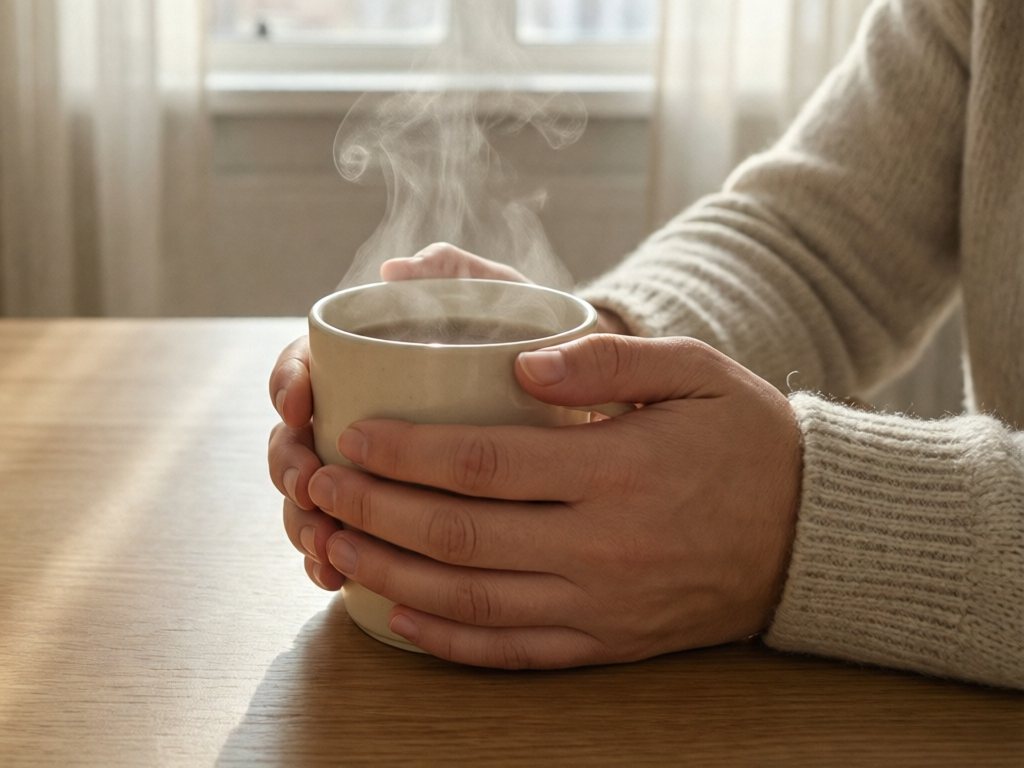
Some days your body isn’t the tired part — your brain is. It’s been holding a thousand small facts (permission slip due Thursday, we’re out of the good snacks, the dentist called back) and it needs somewhere to put them down.
Do a brain dump on paper. The point isn’t to solve anything. It’s to get it onto paper, where it can wait quietly.
- Set a timer. Five minutes.
- Write it all down. Appointments, worries, grocery items, the argument you’re still replaying. Don’t edit.
- Circle one thing. Pick the single item that needs action this week.
- Close the notebook. Spend the remaining fifteen minutes on anything else.
Read something with no redeeming value. Not the parenting book or the productivity book. A trashy novel, a gossip site, a magazine you’d be slightly embarrassed to be seen reading. Your brain needs input that isn’t asking anything of you.
Do a puzzle: crossword, sudoku, jigsaw corner. Puzzles are absorbing without being demanding. You don’t have to make a decision that matters. You just have to find where the piece goes. Keep a crossword book or a half-done jigsaw where you’ll see it, so you can start the moment a window opens. Ten to twenty minutes is plenty.
Sit with a cup of something hot and do nothing else. Leave the phone and the book in another room, hold the mug, and let your thoughts wander. It’s harder than it sounds, because most of us have lost the habit of sitting still. If kids are around, use a lidded cup and keep it out of their reach.
Listen to a podcast about something you care about, not parenting. If every input in your life is about kids, your identity can start to shrink to fit. Twenty minutes on true crime, home renovation or an old hobby reminds you what else you care about.
Download one episode ahead of time so you’re not scrolling for one when the window opens. Set a 20-minute timer if it runs long. If you need to hear the kids or the monitor, use one earbud or keep the volume low.
One honest aside: many moms find a guided meditation app just turns into a planning session for dinner. If that’s you, start with the brain dump above.
If your mind is more exhausted than your body most days, read our piece on mom sleep debt. Sometimes “I just need quiet” is really “I am chronically under-slept.” The fixes aren’t identical.
Creative Me Time Ideas at Home
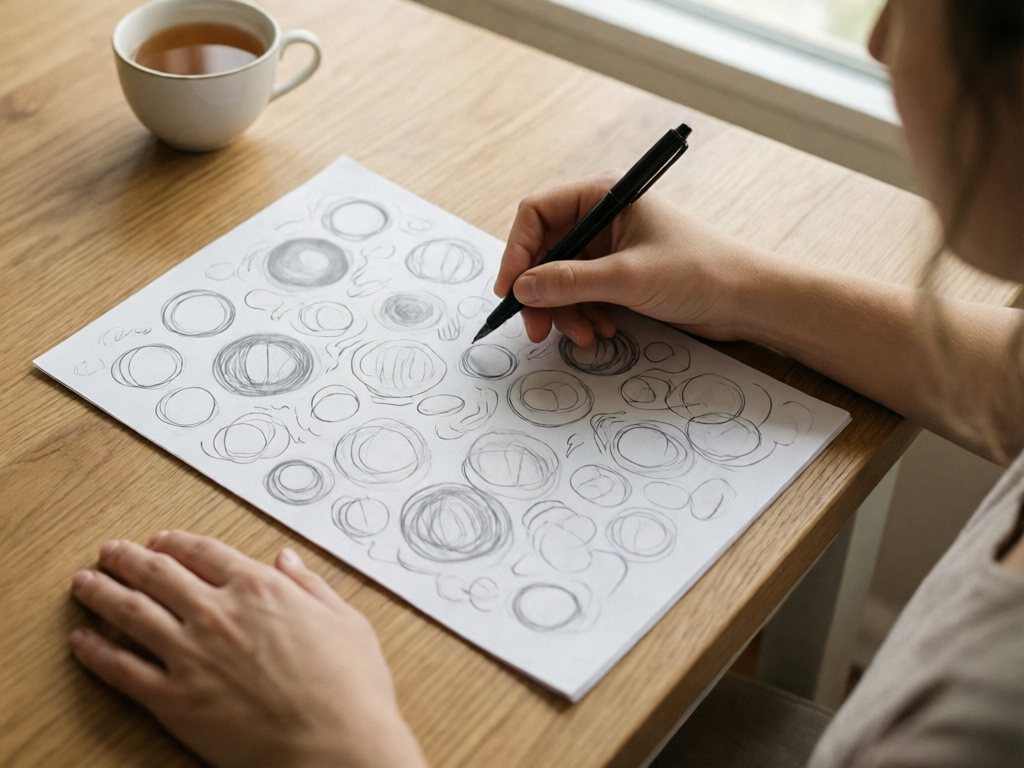
This category gets skipped a lot because moms assume creative time has to produce something — a finished painting, a publishable page, a Pinterest-worthy result. It doesn’t. The point is the act, not the output.
Doodle without a plan. Grab any pen and paper and make marks. Circles, lines, shading, whatever. Nobody has to see it. It gives your hands something to do besides scrolling or folding laundry.
Write for ten minutes with no structure. Skip the prompt. Start a sentence and see where it goes. Complain, dream, describe your coffee. If writing stirs up feelings that seem too big, reach out to a friend, your doctor or a therapist.
Play an instrument you haven’t touched in years. If a guitar or keyboard has been gathering dust since before kids, twenty minutes of badly playing old songs is a way to reconnect with the person you were before “Mom” became your main name.
Rearrange something small. A bookshelf, a windowsill, the photos on your fridge. Give it fifteen minutes and stop before it turns into a cleaning project. It scratches a creative itch without any skill, and it’s satisfying to have one small space entirely under your control.
Try a five-minute version of a hobby you’ve shelved. Maybe you used to knit, paint, garden or bake for fun before it became “one more thing.” A short session can matter more than it seems. Even setting out materials or knitting one row counts.
Our post on hobbies for busy moms has more on fitting a real hobby back into a schedule that currently has zero room for it.
Reconnect With Yourself in 20 Minutes
Some of the best twenty-minute windows aren’t about doing anything. They’re about checking in with yourself, the way you would with a friend you’d been neglecting.
Ask yourself how you’re actually doing, and answer honestly. Not the “fine, busy, you know how it is” answer you give other people. The real one. Five minutes with a pen is plenty, or just sit with it.
Look through old photos of yourself, from before kids or a season you loved. Ten minutes is enough. Use them to remember that you’re still that person, with the same interests and inside jokes.
If old photos or an honest check-in stir up heavy grief, it’s okay to stop. Talk it through with someone you trust, and our guide to finding a therapist as a busy mom can help if you want more support.
Call or voice-text a friend who isn’t a mom-friend. Pick someone who knew you before the diaper bag and can talk about something other than sleep regressions. It feels good to be talked to as yourself, not just as someone’s mom.
Sit with your hand on your own chest and just breathe. This is a short practice, about two minutes, to fit inside your twenty. Let your breathing slow on its own; there’s no count to get right. It’s the kind of physical soothing you’d offer a crying child, aimed at yourself. If focusing on your breath makes you feel more anxious, stop and try something else.
Light a candle and do nothing but notice it. The smell, the flicker, the fact that you lit it for no productive reason. Use a stable, heat-safe surface out of reach of children and pets, and blow it out before you leave the room or get sleepy.
If touch and closeness feel like too much by the end of the day, quiet, non-demanding time like this can matter even more. Our piece on being touched out covers why that happens and how solo time helps.
A Realistic Weekly Solo Time Rhythm (Not a Rigid Schedule)
I don’t think you should try a different, elaborate solo-time activity every day. That’s its own kind of pressure. A small rotating menu of go-to options is easier to live with, so on your most depleted days you’re not also deciding what self-care should look like.
Here’s a sample rhythm. Treat it as a menu, not a rule.
| Day | Where the 20 minutes lives | What you could do |
|---|---|---|
| Monday | After school or childcare drop-off, in the parked car (mild weather only) | Sit in silence, engine off. No podcast, no phone. |
| Tuesday | While dinner simmers | Sit at the kitchen table, timer on, stove in view. |
| Wednesday | First 20 min of nap time | Brain dump. No chores yet. |
| Thursday | After last kid’s bedtime | Read something trashy. |
| Friday | Early morning, before anyone’s up | Journal or doodle. |
| Saturday | While another adult has the kids, or older kids play nearby | Stretch or foam roll in the same room. |
| Sunday | Sunday evening, after bedtime | Legs up the wall for 10-15 minutes, lights low (check the caution in the Body section first). |
This schedule doesn’t need new time to appear. It’s the same day you’re already living, with twenty minutes reassigned to something chosen. Some weeks you’ll hit four of these seven, some weeks two. Both are fine. It’s a menu to return to, not a streak to protect.
Windows collapse, sometimes with a tap on the glass. When one disappears, move the activity to the next open slot or do the five-minute version.
Pick your three:
- One idea for a short window, like the parked car or the bathroom.
- One idea for nap time or quiet time.
- One idea for after bedtime.
Pull each one from the lists above and keep them on your Self-Care Menu printable, so the choice is already made when a window opens.
On days when you can leave the house, try these out-of-the-house ideas for moms instead.
What to Do When Even 20 Minutes Feels Impossible
Some seasons make even twenty minutes feel like someone else’s life: a new baby, a sick kid, a partner traveling. If that’s you, I won’t pretend this is simple. A few things can help:
- Lower the unit. If twenty minutes isn’t available, five is. Our guide to 5-minute self-care for busy moms is built for exactly these seasons. Five minutes a day keeps the habit alive. When twenty minutes comes back, you’ll still know how to take it.
- Combine it with something that has to happen anyway. A shower, a drive, a feeding session — these are already happening in your day. So ask a different question: can this time also be mine?
- Trade with your partner or a friend in small increments. You don’t need a full evening off. Ask them to take the kids for twenty minutes after dinner so you can sit outside. That’s easier to ask for, and easier to say yes to, than a night away. Small trades are more sustainable precisely because they’re small.
- Let go of the guilt about wanting it at all. A lot of what makes twenty minutes feel impossible isn’t logistics. It’s the quiet belief that wanting time for yourself is selfish, and our guide on how to stop mom guilt can help with that. Sometimes “I don’t have time” really means “I’m the default person everything routes through.” If that sounds familiar, read why the mental load makes rest feel impossible, because that’s a different problem with a different fix.
Good to knowShort breaks ease everyday stress, but they aren’t a treatment. If exhaustion, low mood, anxiety, rage or numbness lasts two weeks or more, talk to your doctor or a mental health professional. After any birth, postpartum depression and anxiety can start well beyond the first weeks, so contact your doctor or midwife. Postpartum Support International: 1-800-944-4773. In the US, call or text 988 if you have thoughts of harming yourself.
How to Keep Solo Time From Becoming Another Chore
The fastest way to kill a good habit is to turn it into one more thing you’re failing at. A few guardrails help keep solo time from becoming a guilt-generating chore:
- No streaks. Skip the checkmarks and the “I missed three days” score-keeping.
- No hidden chores. If solo time turns into folding laundry, notice it. The guilt about resting may be louder than the wish to rest.
- Tell someone the plan. “I’m taking twenty minutes on the porch, I’ll be back” protects the window and makes it normal in your house.
- Match your mood. Some days stretching sounds terrible and a trashy novel sounds perfect. Follow what you want.
Start With Today’s Twenty Minutes
Twenty minutes is real time, and it’s been hiding in your day all along: after drop-off, while the pasta boils, after the last light goes off down the hall. You don’t need a babysitter or a better week to take it.
Pick one window and one idea. If you want a list to choose from, start with the free Self-Care Menu printable on this page. That’s enough for today.
If you need support right now
Reaching out is not an overreaction. These lines are free and confidential.
- Emergency: if you are thinking about harming yourself or your baby, or you can’t keep yourself safe, call 911 or go to the nearest emergency room. This is a medical emergency, and it is treatable.
- 988 Suicide & Crisis Lifeline: call or text 988, 24/7, for anyone in crisis.
- National Maternal Mental Health Hotline: call or text 1-833-TLC-MAMA (1-833-852-6262), 24/7, in English and Spanish, for pregnancy and postpartum support.
- Postpartum Support International: call or text 1-800-944-4773 for help finding a provider who specializes in perinatal mental health. Not an emergency line.
US numbers. Elsewhere, ask your doctor, midwife or local crisis line. This article was written by a parent, not a clinician, and isn’t medical advice.
Frequently Asked Questions
What are the best me time ideas for moms with almost no free time?
Start with minutes that already exist, like the drive after drop-off, a simmering pot, or the first stretch after bedtime. Pick one low-effort option (sitting in silence, stretching on the floor, a cup of tea with no phone) and repeat it rather than searching for the “perfect” activity each time.
How can I get solo time for myself without leaving the house?
Solo time doesn’t require going anywhere. The bathroom, a bedroom during nap time, or the porch while another adult is inside all count. Don’t lock the door, and if you’re the only adult home, follow the shower notes in the Body section. The goal is a boundary, not a change of location. Stretching, journaling and podcasts work in any room.
What can I realistically do in just 20 minutes to myself?
Twenty minutes is enough for a brain dump on paper, a chapter of a book, a short doodle, or a hot drink with nothing else. It also fits 10-15 minutes of legs up the wall (check the caution in the Body section first), or a full shower when another adult has the kids. Choose one thing and stay with it. Cramming in several small tasks turns solo time into multitasking.
How do I find alone time as a mom when my schedule feels completely full?
Look for minutes already absorbed by defaults, like scrolling your phone or handling something a partner or older child could cover for twenty minutes. Alone time is often less about finding new hours and more about reassigning minutes you’re already living through. Jotting down your day for a few days can show windows you didn’t know you had.
Is 20 minutes of self-care actually enough to make a difference?
It can help. Many moms find that short, regular windows of genuine rest help them settle, and twenty minutes most days adds up to more rest than waiting for a rare longer block. Short breaks ease everyday stress, but they are not a treatment. If exhaustion, low mood, anxiety or numbness lasts two weeks or more, talk to your doctor or a mental health professional.
What should I avoid doing during my solo time?
Avoid hidden productivity, like folding laundry or answering emails while telling yourself it’s “me time.” Scrolling social media can also leave you more drained than restored. Protecting the time as genuinely unproductive, even for just twenty minutes, is what makes it restorative.
What if I feel guilty taking time for myself instead of doing chores?
Guilt is common, and it often comes from a belief that your needs come last. Start small and say it out loud, “I’m taking twenty minutes, I’ll be right back,” so the break becomes normal. Taking it regularly often eases the guilt faster than waiting until you feel you’ve earned it.