
How to Say No: Printable Scripts to Protect Self-Care Time
This article provides printable scripts and strategies to help you confidently say no to requests, protecting your vital self-care time. You'll learn why saying no is hard for moms and how to use specific phrases to set boundaries.
- Use printable scripts to confidently decline requests.
- Understand why saying no feels disproportionately hard for moms.
- Reframe your self-care as essential maintenance, not a luxury.
- Implement the '3-second rule' to buy time before you answer.
This post contains affiliate links. As an Amazon Associate I earn from qualifying purchases.
Last Tuesday, my phone buzzed at 8:52 p.m. It was a text from a mom in my son’s class: “Hey! We’re short a snack parent for Friday’s game — can you grab it? Also wondering if you could help chaperone the field trip next week since you’re ‘always so organized’ lol.” I had exactly one hour of quiet blocked off that night — the first one all week — and I felt my stomach do that familiar drop. Not because the ask was unreasonable. It wasn’t. It’s because I know myself. I was going to say yes, resent it by Thursday, and lose the one hour I’d been counting on to just breathe.
I didn’t say yes that night. I typed a script I’d used before — the same eleven words, basically — and I felt the tiny electric jolt of relief that comes from protecting something instead of giving it away.
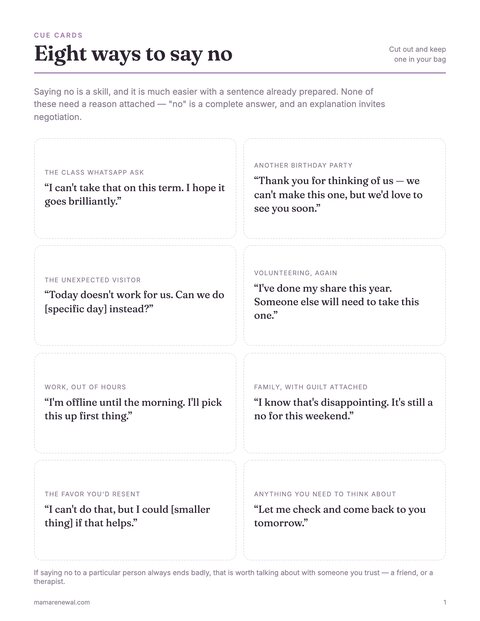
Free printable · 1 pages
Say-No Cue Cards
Eight ready-to-use scripts for the asks that are hardest to decline, sized to cut out and keep.
Free. Your download link appears right here. You'll also join the Mama Reset. Unsubscribe anytime. Privacy
If you’re a mom, you already know the theory. You’ve read that boundaries are healthy. You’ve nodded along to “you can’t pour from an empty cup.” What nobody hands you is the actual sentence to say when someone is standing in your kitchen, or texting you at 8:52 p.m., waiting for an answer. That gap — between knowing you should say no and knowing how — is where most of us lose our self-care time, week after week, one small yes at a time.
This article is the thing I wish someone had handed me years ago: word-for-word scripts, not theory. Print them, tape them inside a cabinet door, save them as a note on your phone — whatever gets them in front of your eyes in the three seconds before you answer. We’ve already covered the emotional groundwork of boundaries for moms and how to communicate your needs to your partner — this piece is the field manual. It’s meant to be used, not just read.
In this article (11 sections)
- Why Saying No Is So Much Harder for Moms
- The 3-Second Rule: Buy Yourself Time Before You Answer
- Printable Cue Cards: 8 Ready-to-Use Decline Scripts
- What to Say When They Push Back
- Guarding the Time After You Say No
- Building Boundaries Into Your Week, Not Just Your Answers
- When Saying Yes Is Actually the Right Call
- The Guilt Wave: What to Do After You Say No
- A Simple Weekly Boundary Check-In
- Frequently Asked Questions
- You Get to Decide What Your Time Is For
Why Saying No Is So Much Harder for Moms
Before the scripts, a quick word on why this feels so disproportionately hard, because understanding the mechanism makes the scripts easier to actually use.
Motherhood rewires your default answer to “yes” in a few specific ways:
- You’re the household’s shock absorber. When something needs covering — a shift, a carpool, a bake sale — you’re the name people think of first, because you’ve said yes before and you’re competent. Competence gets rewarded with more requests.
- Guilt is baked into the identity. Saying no to a school ask, a friend’s invite, or a family request can feel like saying “my kid/friend/family doesn’t matter,” even when the real trade is “my nervous system matters too.”
- You’ve lost the muscle from disuse. If you spent years in the newborn-to-toddler fog saying yes to survive (because refusing help or connection felt impossible), the “no” muscle atrophies. It has to be rebuilt like any other muscle — with reps.
- The requests are rarely dramatic. Nobody asks you to give up a kidney. They ask for twenty minutes here, an hour there, “just this once.” Each one is reasonable in isolation. The damage is cumulative, and cumulative damage is hard to justify saying no to in the moment.
This is closely related to what we call the mental load — the invisible tracking, anticipating, and managing that never shows up on anyone’s to-do list but yours. Every unprotected “yes” adds another line item to a load that’s already invisible and already heavy.
Here’s the reframe that actually changes behavior: your self-care time is not a luxury item competing with “real” obligations. It is the maintenance that keeps the rest of your obligations possible. You don’t skip the oil change and call it optional — the car stops running. Same math, different oil.
The 3-Second Rule: Buy Yourself Time Before You Answer
The single highest-leverage habit in this entire article is this: stop answering in real time.
Most of your unwanted yeses don’t happen because you weigh the request and decide it’s worth it. They happen because someone asks you a question and your mouth answers before your brain catches up — because “yes” is the path of least social friction, and friction feels bad in the moment even when it’s good for you long-term.
The fix is a stalling phrase. Say one of these, every time, before you commit to anything that touches your protected time:
- “Let me check and get back to you.”
- “I don’t want to overcommit — can I text you tonight?”
- “I need to look at my week before I answer.”
This isn’t a delay tactic to be polite while you secretly plan to say yes anyway. It’s a real pause that lets you consult your calendar, your energy level, and your actual priorities before your mouth commits you to something your body will resent by Thursday. Once you’re away from the asker, you can pick the actual decline script from the list below and send it calmly, without the pressure of someone waiting on your face for an answer.
Print this rule on a sticky note if nothing else in this article: no answer is required in the moment. Every “yes” you regret was rushed.
Printable Cue Cards: 8 Ready-to-Use Decline Scripts
These are the actual sentences. Copy them, print them, screenshot them — whatever gets them in front of you at 8:52 p.m. on a Tuesday. Each one is built to be short (so you can say it without over-explaining, which invites negotiation), warm (so it doesn’t damage the relationship), and specific to a common ask that eats into self-care time.
A note on structure: notice that almost none of these include a lengthy justification. The more you explain, the more you invite debate. A short, warm, firm sentence closes the loop. A paragraph of reasons opens it back up.
1. The Volunteer/PTA Ask
“I can’t take that on right now — I’m keeping my plate light this season. Thanks for thinking of me!”
This one covers snack duty, room parent, fundraiser committees, chaperoning — the entire category of school and activity asks that arrive constantly and always feel small individually. For a deeper dive specifically on this category, we have a full breakdown in How to Say No to the PTA (and Everything Else) Without the Mom Guilt.
2. The Social Invite You Don’t Have Energy For
“I’m going to pass this time — I need a quieter weekend. Let’s find another time to catch up soon.”
Notice this doesn’t require you to justify why you need a quieter weekend. “I need a quieter weekend” is a complete sentence. You don’t owe anyone your reasoning, only your honest answer.
3. The Extra Family Obligation (In-Laws, Extended Family Events)
“We’re not going to be able to make that one work. We’d love to see you [alternative — a shorter visit, a phone call, next time].”
Family asks are often the hardest because they come loaded with history and guilt. The move here is to decline the specific ask while offering a smaller, genuine alternative — it signals “I still love you” without signaling “I’m available for everything you propose.”
4. The “Can You Just Quickly…” Favor
“I can’t right now, but I can help with that on [specific day/time] if that still works.”
This script is useful because it’s not a flat no — it’s a boundary around when, not whether. It protects your current moment (the one you were about to give away) while still leaving room to help on your terms.
5. The Last-Minute Childcare Swap
“I’m not able to swap today — I’ve got something I can’t move. Can you try [another name] or a sitter this time?”
Moms often feel uniquely obligated to bail each other out on childcare because we know how it feels to be stuck. But “I’ve helped you before” doesn’t obligate you to help every time, especially when the ask lands on protected time. Redirecting to another resource (“try someone else”) keeps the door open without you being the fallback every time.
6. The Work Request That Bleeds Into Personal Time
“I’m not available after [time] — happy to pick this back up first thing tomorrow.”
For moms working outside the home, protecting self-care time often means protecting it from your job, not just from other people’s requests. This script sets a clean boundary on availability without apologizing for having a life outside work hours.
7. The “Can I Vent to You” Phone Call at a Bad Time
“I really want to be present for this — can I call you back at [specific time] when I can actually focus?”
This protects both the relationship and your bandwidth. It says “you matter to me” while being honest that right now isn’t the moment you can give your full self. Naming a specific callback time (not a vague “later”) makes it land as a promise, not a brush-off.
8. The Recurring Commitment That’s Quietly Draining You
“I’ve loved being part of this, but I need to step back for now. Thank you for [something genuine and specific].”
This is the hardest one, because it’s not declining a single ask — it’s exiting something you already said yes to. Committees, standing playdates, a rotating meal train you signed up for a year ago and never left. Give yourself permission: an old yes doesn’t obligate you to a lifetime yes.
Print-and-post tip: Pick the two or three scripts that match the asks you get most often, write them on an index card, and tape it inside a kitchen cabinet or your phone case. The goal isn’t memorizing all eight — it’s having your two or three most-used ones so automatic you don’t have to think in the moment.
What to Say When They Push Back
You will occasionally get pushback — a “come on, it’s just this once” or a guilt-tinged “I guess I’ll figure it out myself.” This is where most boundary attempts collapse, because the decline script works but the follow-up to pushback catches people off guard.
The fix is the same move every time: repeat your answer without adding new justification. This is sometimes called the “broken record” technique, and it works because most pushback is testing whether your no was firm or negotiable. If you add a new reason every time they push, you signal that the boundary is up for debate. If you calmly repeat the same short answer, you signal that it’s settled.
| They say… | You say… |
|---|---|
| “Come on, it’s just this once.” | “I hear you, but I’m still not able to.” |
| “I really thought I could count on you.” | “I understand it’s disappointing — my answer’s still no this time.” |
| “Everyone else already said yes.” | “That’s great that they can! I can’t right now.” |
| “You always seem to have time for everything else.” | “I’m making some changes to protect my time better these days.” |
| (silence / guilt face) | “I know it’s not the answer you wanted. I hope it works out.” |
Notice none of these responses attack, over-explain, or apologize excessively. They acknowledge the other person’s feelings (“I hear you,” “I understand it’s disappointing”) without letting that acknowledgment turn into a reversal. You can hold space for someone’s disappointment and still hold your boundary — those aren’t in conflict.
Guarding the Time After You Say No
Here’s the part that trips people up: saying no protects the time slot, but it doesn’t automatically protect what you do with it. I’ve said no to a commitment, freed up an hour, and then spent it scrolling, doing laundry, or answering emails I’d been avoiding — because I never actually decided what the hour was for.
Treat your reclaimed time like a real appointment, not empty space that defaults to whatever’s loudest. A few ways to do that:
- Name it before you decline, not after. When you say no to the ask, mentally (or literally) label the freed time: “This is my reading hour,” not just “this is now open.”
- Put it on the calendar like anything else. A block labeled “self-care” is easier to protect from yourself (and from future requests) than an unmarked gap.
- Decide on the activity in advance. Decision fatigue is real — if you have to figure out what to do with your time the moment you get it, you’ll often default to the phone. Pre-decide the day before.
- Tell one person what the time is for. Saying “that’s my walk time” out loud to your partner or a friend adds a small layer of social accountability that makes it easier to protect.
If you’re short on ideas for what to actually do with reclaimed pockets of time, Solo Time Ideas for Moms Who Get 20 Minutes and Nowhere to Go has a full list built specifically for small windows. And if you’re not sure what kind of self-care actually recharges you specifically (rather than what recharges your friend or your Pinterest board), our free self-care style quiz is a fast way to find out.
Building Boundaries Into Your Week, Not Just Your Answers
Scripts handle the moment-to-moment asks, but the deeper fix is designing your week so fewer requests land on protected time in the first place. A few structural habits that reduce how often you need to say no at all:
Set recurring “unavailable” windows. If Tuesday and Thursday evenings from 8–9 p.m. are always yours, people learn that over time — not because you announce it, but because you consistently aren’t available then. Predictability reduces the number of asks you have to decline in real time.
Batch your yeses. Instead of saying yes to requests as they trickle in throughout the week, designate one day to review and respond to non-urgent asks (school emails, group texts, favor requests). This reduces the “answer under pressure” moments where you’re most likely to over-commit.
Communicate the boundary to your household, not just outsiders. A lot of self-care time gets eaten not by outside requests but by the assumption inside your own home that you’re always interruptible. If your partner or older kids don’t know a certain hour is protected, they’ll ask for things during it — not out of disrespect, just lack of information. We go deeper on this specific conversation in Communicating Needs to Your Partner.
Notice your energy patterns before you commit. If you’re someone whose capacity for saying yes genuinely shifts across the month, cycle syncing can help you predict which weeks you’ll need to protect harder — and plan your “no” defaults accordingly instead of being caught off guard by low capacity.
When Saying Yes Is Actually the Right Call
This isn’t a philosophy of saying no to everything — that’s not boundaries, that’s isolation, and it tends to backfire by burning bridges you’ll want later. The goal is intentional yeses instead of reflexive ones. A quick gut-check before you answer:
- Does this genuinely energize me, or am I saying yes to avoid discomfort? Some requests — a friend’s birthday dinner, a spontaneous coffee — are worth saying yes to even when you’re tired, because connection is part of your self-care, not opposed to it.
- Can I actually afford this without borrowing from something else? If saying yes means skipping sleep, missing a workout, or canceling something you already committed to for yourself, it’s usually a sign the yes is costing more than it’s giving.
- Would I be upset if a friend said yes to this in my situation? If you’d tell a friend “don’t do that to yourself,” that’s useful data about your own answer.
- Am I the only person who can actually do this? Often we say yes assuming we’re uniquely necessary when we’re not. Check that assumption before you commit.
A yes that’s chosen deliberately feels completely different in your body than a yes that’s given because saying no felt too hard. Learning to tell the two apart is most of the skill.
The Guilt Wave: What to Do After You Say No
You will say no correctly, calmly, kindly — and still feel a wave of guilt afterward. This is normal and it doesn’t mean you did something wrong. It means you’re breaking a pattern, and pattern-breaking produces discomfort even when the new pattern is healthier.
A few things that help the guilt pass faster instead of spiraling:
- Name it as a withdrawal symptom, not a signal. “This guilt is my old habit talking, not evidence that I made the wrong choice” is a genuinely useful reframe.
- Resist the urge to over-explain after the fact. Sending a follow-up text with three more reasons why you said no re-opens the negotiation and usually makes the guilt worse, not better.
- Remind yourself of what the no protected. If you said no to chaperone duty to protect your one quiet hour, actually use that hour — the payoff makes the guilt feel worth it in real time instead of abstractly.
- Talk back to the guilt with facts, not feelings. “I’ve helped this group four times this year already” is a fact that can quiet a feeling that isn’t based on facts.
If the guilt after boundary-setting feels disproportionate or constant — not just an occasional wave but a near-daily undertow — that’s worth paying attention to, because it’s often connected to broader burnout patterns. If that’s resonating, School-Age Mom Burnout: The Invisible Load of Logistics and Depleted Mother Syndrome: What It Is and How to Start Recovering both dig into what’s underneath that pattern and how to start recovering from it, not just manage it week to week.
A Simple Weekly Boundary Check-In
Here’s a five-minute habit that makes all of this stick: once a week — Sunday night works well for a lot of families — ask yourself three questions and jot down quick answers.
| Question | Why it matters |
|---|---|
| What did I say yes to this week that I regret? | Identifies the specific ask-types you need a script for |
| What protected time did I actually keep? | Reinforces the wins so the habit feels rewarding, not just corrective |
| What’s coming next week that I should pre-decide on? | Lets you decide before you’re caught off guard mid-week |
This turns boundary-setting from a reactive scramble into a proactive, five-minute planning habit — the same way you’d plan meals or a calendar, except you’re planning your capacity.
Frequently Asked Questions
How do I say no to a mom without sounding rude?
Keep it short, warm, and specific — a brief “thanks for thinking of me, I can’t take that on right now” lands as considerate, not rude. Rudeness usually comes from tone and abruptness, not from the act of declining itself. Adding a genuine warm phrase (“thanks for asking,” “I appreciate you thinking of me”) before your no softens it without undermining it. Over-explaining, on the other hand, often reads as more awkward than a clean, kind decline.
What’s a polite way to say no to plans without a real excuse?
You don’t need a real excuse — “I need a quieter weekend” or “I’m not able to make that work this time” are complete, honest answers on their own. You’re allowed to decline because you don’t have the capacity, not just because something else is scheduled. Practicing this without fabricating a more “acceptable” reason is actually part of rebuilding the no muscle — fake excuses just create more things to track and defend later.
How do I stop feeling guilty every time I say no?
The guilt usually fades with repetition — the first few times you say no on purpose feel the worst, and it gets easier as your nervous system learns the sky doesn’t fall. In the short term, reframe the guilt as a normal side effect of breaking an old pattern rather than proof you made a mistake, and actively use the time you protected so the trade-off feels tangible rather than abstract.
What if my kids’ school or teacher guilt-trips me into volunteering?
Use the broken-record technique: acknowledge their disappointment without reversing your answer — “I understand you’re short on volunteers, and I’m still not able to take this on right now.” Schools rely heavily on a small pool of repeat volunteers, so a firm, kind no from you often just prompts them to widen the ask to other families, which is a healthy outcome, not a harmful one.
How do I set boundaries with family members who don’t respect “no”?
With repeat pushback, keep the script identical every time instead of escalating your explanation — consistency, not intensity, is what eventually teaches people the boundary is real. If a family member continues to disregard a clearly stated no, it’s reasonable to shorten your response further (“that doesn’t work for us”) or limit how much time you give the conversation, without owing a lengthy justification for why the boundary exists.
Is it selfish to protect time for myself instead of helping others?
No — protecting your capacity is what allows you to keep showing up well for the people who actually depend on you, rather than running on empty and showing up resentful or depleted. Selfishness is taking from others to serve yourself; a boundary is simply declining to give something you don’t have to spare. The two aren’t the same, even though guilt often tries to convince you otherwise.
How many self-care boundaries should I set at once?
Start with one or two — the ask-types that drain you most often — rather than overhauling every relationship and commitment simultaneously. Trying to enforce five new boundaries in one week is a fast route to burnout on the boundary-setting itself. Master one script until it’s automatic, then add the next.
You Get to Decide What Your Time Is For
Every “no” you say on purpose is a “yes” to something that matters to you — even when that something is just an hour of quiet with your coffee still hot. You don’t need a perfect reason, a long explanation, or anyone else’s approval to protect it. You just need the words ready before the ask arrives. Print the cards, keep them close, and start with just one. The rest gets easier from there.