Self-Care Ideas for Moms Who Hate Bubble-Bath Self-Care
If traditional bubble-bath self-care leaves you more stressed, this article explains why it doesn't work for everyone. You'll learn to identify what resources you're truly missing and find a different toolkit with time-boxed ideas.
- Your self-care needs to restore what you're actually running low on.
- Stillness can amplify mental noise if you're already overstimulated.
- Pinpoint if you lack agency, competence, connection, or physical release.
- Explore time-boxed self-care ideas (5, 10, 20 minutes) that fit your schedule.
- You're not broken; you just need a different self-care toolkit.
This post contains affiliate links. As an Amazon Associate I earn from qualifying purchases.
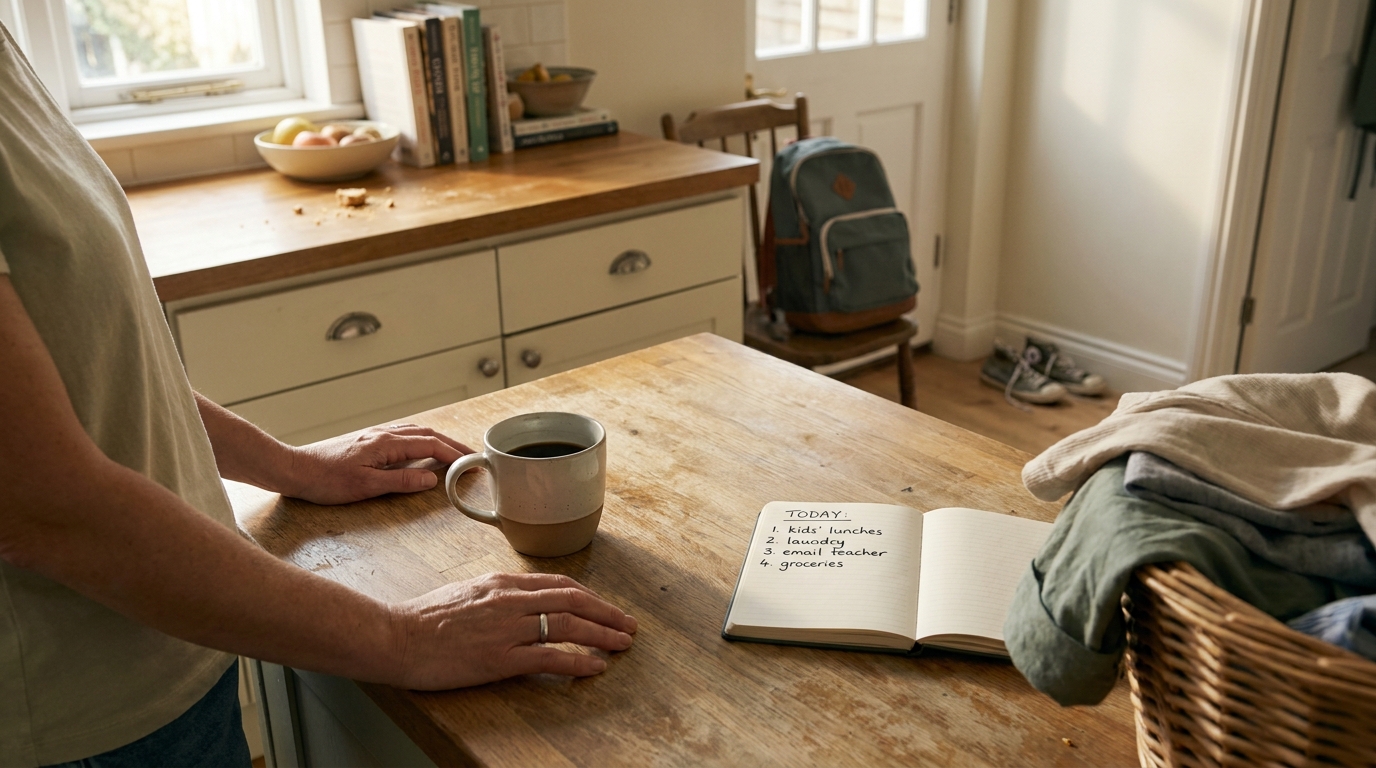
A few Septembers ago I got a “Mom Spa Day” gift card and lasted forty minutes in a lukewarm tub. Then I climbed out, dripping, to text my husband about our son’s dentist appointment.
If bubble baths and candles leave you more wound up, you’re not broken or ungrateful. You need a different toolkit. This page gives you a swap table, ideas sorted into 5-, 10-, and 20-minute slots, and a way to match the refill to what’s actually draining you.
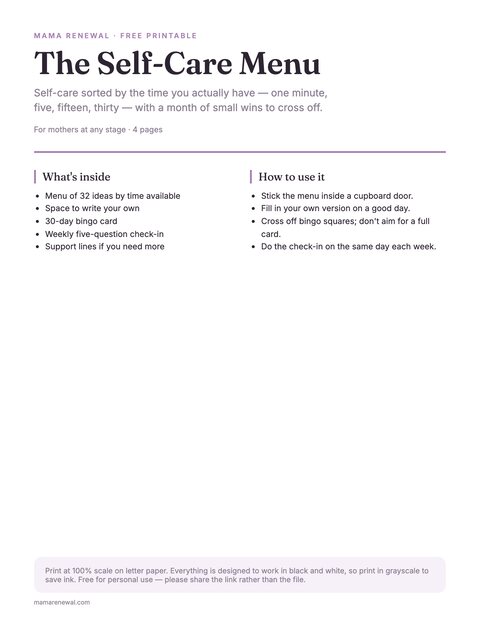
Free printable · 6 pages
The Self-Care Menu + 30-Day Bingo
Self-care sorted by the time you actually have — one minute, five, fifteen, thirty — with a month of small wins to cross off.
Free. Your download link appears right here. You'll also join the Mama Reset. Unsubscribe anytime. Privacy
TipStart here: pick one swap from the table below and try it this week. The Self-Care Menu + 30-Day Bingo above keeps your picks in one place.
In this article (13 sections)
- Why the Bubble Bath Version of Self-Care Doesn’t Work for Everyone
- What Self-Care Is Actually For
- Self-Care Ideas for Moms Who Hate Bubble Baths: The Swap Table
- Self-Care Ideas for Moms by Time: 5, 10 and 20 Minutes
- Self-Care for Moms Who Hate Sitting Still
- Self-Care That Actually Addresses What’s Draining You
- Basic Body Care That Counts as Self-Care
- Boundaries as Self-Care: The Version Nobody Puts on a Candle Label
- Building a Realistic Self-Care Routine (Not a Fantasy One)
- What to Do When Even the Realistic Version Feels Impossible
- The Bottom Line
- Frequently Asked Questions
- You Get to Define What Counts
Why the Bubble Bath Version of Self-Care Doesn’t Work for Everyone
The wellness industry sells one image of self-care almost exclusively: soft lighting, a robe, silence, stillness. It’s a beautiful image. It’s also a very specific personality type’s version of recovery — often someone who is understimulated and needs calm, quiet, and slowness to recharge.
But plenty of moms are the opposite. If you’re depleted from decision fatigue, invisible logistics, and mental noise, sitting still in a quiet bathroom doesn’t unload anything. It just removes the distractions that were keeping you from noticing how loud your own brain is. That kind of exhaustion is described well in The Mental Load: Why Moms Feel Exhausted Even When Everyone ‘Helps’.
There’s also a mismatch between what bubble-bath self-care assumes about your life and what your life actually looks like. It assumes:
- You have thirty uninterrupted minutes, reliably, on a regular basis.
- Silence feels good to you rather than eerie or anxiety-provoking.
- Physical stillness translates to mental rest.
- Someone else is handling the kids, the dog, the doorbell, and the group chat blowing up about the school fundraiser.
For a lot of moms, none of those assumptions hold. School-age logistics can rule them out (see School-Age Mom Burnout: The Invisible Load of Logistics). So can sensory overload from touch and noise (see Touched Out: What It Means When You Can’t Stand to Be Touched Anymore).
If you feel constantly on edge, a bath won’t change that. It just pauses it for twenty minutes. Persistent high alert or anxiety is worth discussing with a doctor or therapist.
This doesn’t mean self-care doesn’t work for you. It means you’ve been handed the wrong instructions.
What Self-Care Is Actually For
Strip away the marketing, and self-care has one job: it restores a resource you’re running low on. That’s it. Sleep restores energy. A hard conversation you finally have restores emotional bandwidth. A workout restores physical resilience. A closed door restores your sense of autonomy.
The bubble-bath version of self-care restores calm — which is great, if calm is what’s missing. But for a lot of moms, what’s missing isn’t calm. It’s:
- Agency — the feeling that you get to choose something, anything, today.
- Competence — the feeling that you’re good at something besides keeping everyone alive.
- Connection — actual conversation, not just proximity to people who need things from you.
- Physical release — a body that’s been braced and hyperaware all day needs to move, not sit.
- Silence from decisions, not silence from noise.
If you’ve ever taken the Discover Your Self-Care Style Quiz, you’ve probably already seen this in action. Some people are “restorative” types who need quiet and stillness. Others are “active” or “connective” types who need movement, novelty, or people. Neither is more evolved than the other. Think of it as a helpful way to look at your own patterns, not a scientific classification.
The practical self-care question isn’t “what’s relaxing?” It’s: what resource is actually low right now, and what’s the fastest legitimate way to refill it?
Self-Care Ideas for Moms Who Hate Bubble Baths: The Swap Table
Below are the most common self-care recommendations aimed at moms, with a practical alternative next to each one. The alternatives are for moms who find the original unhelpful, unrealistic, or actively irritating.
| Instead of… | Try… | Why it works better for practical moms |
|---|---|---|
| A candlelit bubble bath | A 10-minute walk around the block, alone, phone on silent | A short walk can ease tension and lift mood for many people. You also get privacy and a change of scene. |
| A spa day | A solo grocery run with the radio on, no kids, no cart negotiations | Same “alone in public” feeling, but it accomplishes something and costs nothing extra. |
| Journaling your feelings for 20 minutes | A 2-minute voice memo to yourself on a walk, while doing dishes, or in the parked car before you head inside | Many people find talking it out helps too, without requiring stillness or a blank page you’ll stare at. |
| Face masks and skincare rituals | A 5-minute “closed door, no interruptions” rule enforced with a lock or a sign, while another adult has the kids | The resource you’re missing is autonomy, not hydrated skin. Buy the boundary, not the product. |
| Meditation apps | Folding laundry or washing dishes with a podcast in your ears, phone-scroll-free | Some people find repetitive tasks calming, while brief guided meditation helps others. Keep the app if it works for you. |
| A “treat yourself” shopping trip | A one-item “no” list — pick one thing to decline this week and actually decline it | Overconsumption self-care adds more stuff and more decisions. Removing an obligation restores bandwidth directly. |
| A weekend girls’ retreat | One 30-minute phone call with one friend, scheduled like an appointment | Big-event connection sounds nice but rarely gets booked. A recurring small version actually happens. |
| A gratitude journal | A “three things that annoyed me and what I did about it” brain-dump list | If gratitude lists feel hollow, try naming what frustrated you and what you did about it. Gratitude practice helps plenty of people, so keep it if it works. |
| Yoga retreats or 60-minute workout classes | 7 minutes of stretching on the bedroom floor before anyone wakes up | Consistency beats intensity. A short daily reset (see Gentle Morning Stretches for Moms) does more for your body over a month than one long class you attend twice. |
| A “no-phone digital detox weekend” | A 30-minute phone curfew each night, same time, every night | Total detoxes rarely survive contact with a mom’s actual schedule. A nightly boundary is small enough to keep. Calls from key contacts or emergencies stay on. See How to Stop Doom Scrolling. |
| Sipping tea in silence | Sitting in the car in the driveway for 5 minutes before walking inside | You don’t need a special ritual for a decompression buffer. You need permission to not walk in the door the second you park. |
Safety firstThe solo swaps (the walk, the grocery run, the closed door) only work when another adult has the kids, or your kids are old enough to play safely on their own. Never leave a baby or toddler alone while you shut yourself in.
Notice the pattern: every “instead of” column swaps aesthetic self-care for functional self-care. Nothing on the right requires a Pinterest board, a purchase, or a Saturday morning to yourself that doesn’t exist. Everything on the right can be done in the cracks of a real week.
Self-Care Ideas for Moms by Time: 5, 10 and 20 Minutes
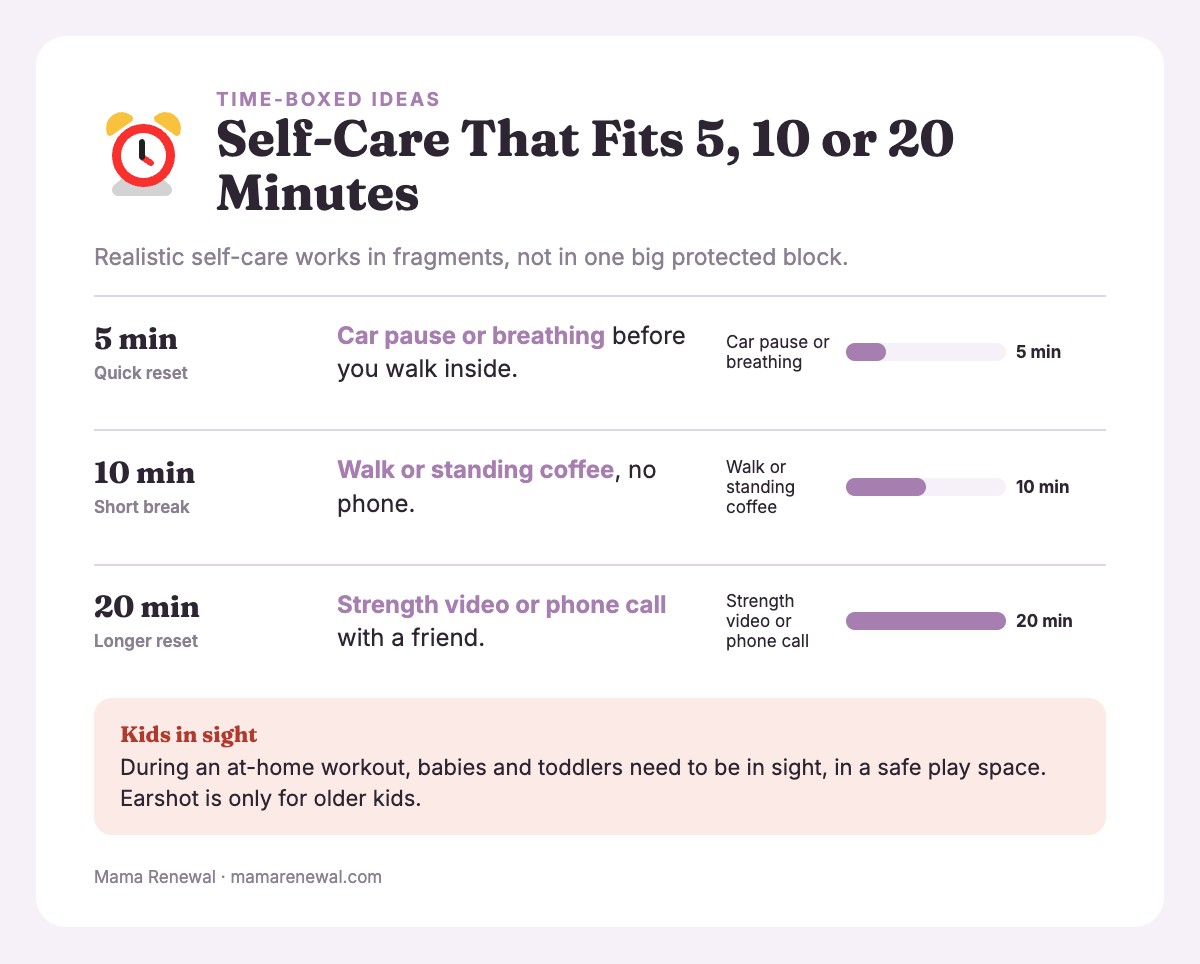
The biggest lie the bubble-bath model tells is that self-care requires a block of time you have to protect and schedule. Realistic self-care for practical moms works in fragments. Here’s what fits into the scraps of time most moms genuinely have. For more like this, see Solo Time Ideas for Moms Who Get 20 Minutes and Nowhere to Go. The Self-Care Menu + 30-Day Bingo printable above is a handy place to save your favorites.
5 minutes
- Sit in your car before going inside. Don’t check your phone. Just breathe and let your shoulders drop.
- Step outside for a minute and feel the air on your face. Go barefoot only on grass you know is clean and free of glass.
- Do one round of box breathing (4 counts in, 4 hold, 4 out, 4 hold). Stop if you feel dizzy or lightheaded, and shorten or skip the holds if they feel uncomfortable or make you anxious. If you have a heart, lung, or pregnancy-related concern, ask your clinician. For more techniques, see Nervous System Regulation for Moms.
- Text one friend something real, not logistical. “Thinking of you” counts.
10 minutes
- A brisk walk to the end of the driveway and back, twice.
- Make a cup of coffee or tea and drink it standing at the counter, no phone, before anyone else is up. If you’re pregnant or nursing, check your caffeine limit with your doctor, or go decaf.
- Do the dishes with earbuds in and a podcast that has nothing to do with parenting.
- Write down three things bothering you and one small action for each. Not a gratitude list — a triage list.
20 minutes
- A YouTube strength or mobility video while the kids watch one show or play where you can see them. Read the safety note under this list first.
- While another adult has the kids, read a chapter of a book you actually chose after a grocery run.
- Call one friend and talk about anything other than your kids.
- Lie on the floor with your legs up the wall. It sounds silly, but many people find it calming.
Safety firstDuring an at-home workout, babies and toddlers need to be in sight, in a safe play space. Earshot is only for older kids. Screen time is not recommended for children under 18 months except video chat, so plan around a play mat or nap time for the littlest ones. If you’re postpartum, get clearance from your clinician and pick a vetted program rather than a random video.
The point of listing durations this specific is to kill the idea that anything under thirty minutes is too short to count. It counts. Five honest minutes of decompression beats a fantasy ninety minutes that never happens.
Self-Care for Moms Who Hate Sitting Still
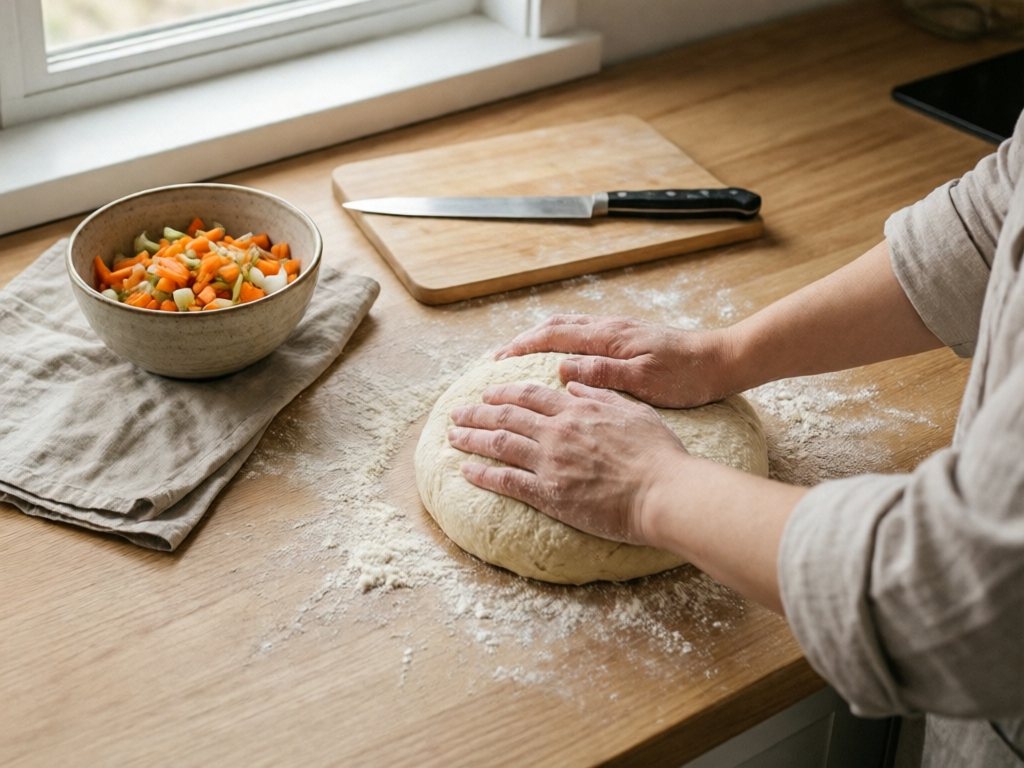
If stillness makes your brain louder instead of quieter, you’re not doing self-care wrong — you just need the moving kind.
Physical, not passive
- Exercise, even 15 minutes of it, can help many people feel less tense and lift their mood. If you’re postpartum or have a health concern, check with a clinician before intense workouts. If your gym window is nonexistent, Beyond the Gym: Ways to Move Your Body Outside has options that don’t require childcare.
- Cleaning out one drawer, one closet shelf, one junk pile. Weird as it sounds, physical decluttering gives a lot of practical-minded moms the same “I did something and now I feel lighter” payoff that other people get from meditation.
- Cooking something with your hands — kneading dough, chopping vegetables for a big batch of something — is repetitive, productive, and occupies your hands enough to quiet your head.
Productive, not indulgent
Some moms feel guilty resting unless something got accomplished. That guilt is worth examining eventually, but you don’t have to solve it before you take care of yourself — you can just lean into it for now.
Batch-prepping lunches for the week (see Back-to-School Meal Prep for Moms) can double as self-care if it removes a daily decision that was draining you. Doing one dreaded errand can feel more restorative than a nap: the return you’ve been putting off, the appointment you keep rescheduling. It removes a low-grade hum of guilt you’d been carrying for weeks.
Social, not solitary
If you recharge around people rather than away from them, forcing yourself into “alone time” self-care can backfire. Try a loud dinner with a friend, a shared errand run, or a phone call while you both fold laundry in your separate houses. Connection can be the self-care, not the interruption of it. If your friend circle has thinned out since becoming a mom, Making Mom Friends as an Adult has realistic starting points.
Self-Care That Actually Addresses What’s Draining You
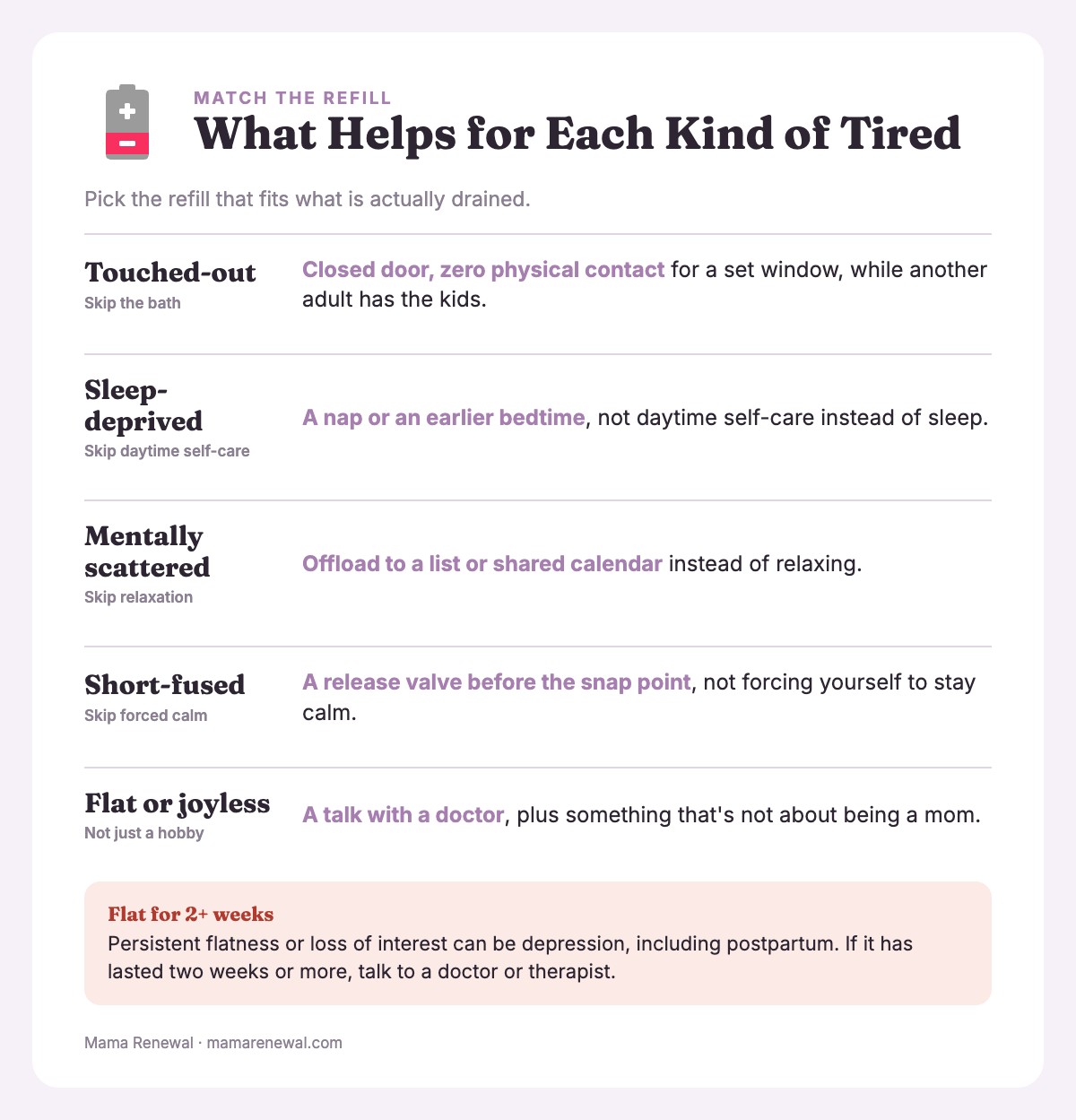
Generic self-care treats every kind of tired the same way. Realistic self-care matches the refill to the specific depletion. Here is a quick diagnostic, with detail below.
| If you feel… | What helps | Skip for now |
|---|---|---|
| Touched-out | A closed door and zero physical contact for a set window, while another adult has the kids | A bath, which adds more sensory input |
| Sleep-deprived | A nap or an earlier bedtime | Daytime self-care instead of sleep |
| Mentally scattered | Offloading to a list or shared calendar | Relaxation instead of offloading |
| Short-fused | A release valve before the snap point | Forcing yourself to stay calm |
| Flat or joyless | A talk with a doctor, plus something that’s not about being a mom | A new hobby as the only fix |
If you’re touched-out and sensory-overloaded
These are the days when a hand on your arm makes you want to scream. The fix isn’t a bubble bath, which adds more sensory input on already-overloaded skin.
It’s the opposite. Hand the kids to another adult, then take a closed door, loose clothing, silence, and zero physical contact for a defined window. Read Touched Out for scripts to ask for this without a fight.
Safety firstBabies and toddlers can’t be left unsupervised behind a closed door. If you’re on your own with little ones, skip the door and take no-touch time in the same room: they play in a safe space where you can see them, and you sit a few feet away.
If you’re sleep-deprived
If you’re running on fragments instead of full nights, protecting sleep itself usually helps more than daytime self-care. Try a 20-minute nap, an earlier bedtime, or fixing the actual disruption. See Mom Sleep Debt and, if the kids’ schedule is dragging yours down, Resetting Your Kids’ Sleep Schedule Before School Starts.
Safety firstNap when another adult is watching the baby, or once the baby is on their back in their own crib or bassinet (flat, firm surface, nothing else in it). If you feel yourself getting drowsy while feeding or holding your baby, put them down there before you rest. Never fall asleep with an infant on a sofa or armchair. Don’t drive when you’re drowsy. If sleep problems persist, talk to a doctor.
If you’re mentally scattered
Maybe you’re forgetting appointments, losing track of forms, and carrying every logistic in your head. The self-care that helps is offloading, not relaxing. Try a shared calendar, a written list, or a five-minute Sunday planning session. The relief of “I don’t have to remember this anymore” is a form of self-care nobody puts on a candle label.
If you’re touchy and short-fused
If you’re snapping at things that shouldn’t warrant snapping, you may be dealing with something closer to what’s described in Mom Rage: What It Really Means When Motherhood Makes You Snap. Start by noticing the pattern: when it happens and what the trigger is.
Then add a release valve before the snap point. Leave the room, take slow breaths, go for a walk, or get five minutes alone before you’re required to respond to anyone.
If the anger is frequent or intense, or you fear you might hurt someone, talk to a doctor or therapist. Postpartum depression, anxiety, perimenopause, and ADHD can all be behind it.
If you feel flat, joyless, or like you’ve disappeared into the role
Safety firstPersistent flatness or loss of interest can be depression, including postpartum depression. If this has lasted two weeks or more, please talk to a doctor or therapist before trying to fix it with a hobby.
If it’s more about identity, see Depleted Mother Syndrome (a popular term, not a clinical diagnosis) and the shift covered in Matrescence. Self-care here isn’t a task. It’s reconnecting with something that has nothing to do with being a mother: a hobby, an old friend, a piece of your pre-kid identity. See Hobbies for Busy Moms for a starting list that doesn’t take much time.
Matching the refill to the depletion is one of the biggest upgrades you can make to a generic self-care routine.
Basic Body Care That Counts as Self-Care
A lot of “practical mom” self-care isn’t a ritual at all. It’s basic maintenance that gets skipped in survival mode and can quietly drag down your mood and energy.
- Eating enough protein. Under-eating overall, protein included, can contribute to tiredness and irritability that no amount of candlelight fixes. Persistent fatigue or fog is worth raising with a doctor. Protein for Moms breaks down realistic targets and easy ways to hit them without meal-prepping like a bodybuilder.
- Gut health. Digestion and mood can influence each other. Persistent bloating, low energy, or low mood should be checked with a doctor. Gut Health for Moms covers simple fixes.
- Actually eating meals, period, not just feeding everyone else. Nutrition as Self-Care makes the case that skipping your own meals to keep the household running is a common, invisible way moms deplete themselves. It’s also one of the easiest to fix once you see it.
- Vitamin D and seasonal light exposure, especially as days shorten. Dips in energy and mood are common then. Vitamin D and the Fall Slump is a useful read, but check with your doctor before supplementing. Low mood that returns every fall or winter is worth discussing with them too.
- Cycle awareness, if that applies to you. Energy, appetite, and tolerance for stimulation can shift across the month, though the evidence for cycle syncing is limited. Severe premenstrual mood changes, or heavy periods with fatigue, deserve a doctor’s visit. Planning around your energy is covered in Cycle Syncing for Moms.
Fatigue, brain fog, low mood, or bloating that sticks around can have medical causes like thyroid problems, anemia, or postpartum conditions, so mention them to your doctor. None of this is glamorous. For many moms it makes a bigger difference than a face mask, because it addresses the basics of exhaustion instead of the look of relaxation.
Boundaries as Self-Care: The Version Nobody Puts on a Candle Label
For a lot of practical-minded moms, the highest-leverage self-care isn’t an activity at all. It’s a “no.”
Every hour you don’t spend on an obligation you resented saying yes to is an hour you get back — no bath required. This is self-care that pays for itself, because it doesn’t just feel good, it removes a drain instead of adding a patch on top of it.
Concrete places to start:
- The PTA ask, the class-parent volunteer sign-up, the friend group commitment you keep RSVPing “yes” to out of guilt. How to Say No to the PTA (and Everything Else) Without the Mom Guilt has scripts for exactly this.
- The general reflex to say yes before you’ve thought it through. How to Say No: Printable Scripts to Protect Self-Care Time gives you literal wording. That matters, because a lot of moms know what they want to decline but freeze on how to say it without a paragraph of apology.
- The comparison spiral that eats your evening before you’ve decided to opt out of anything. If the drain isn’t your actual to-do list but scrolling other moms’ highlight reels, Mom Comparison and Social Media is worth a look. Closing the app is its own form of boundary-setting.
Saying no to one thing this week can be more effective than a spa gift card for many moms, especially when the drain is overcommitment. It addresses the source instead of numbing it for an afternoon.
Building a Realistic Self-Care Routine (Not a Fantasy One)
The bubble-bath model fails most moms not just because of the content (baths, candles) but because of the structure — it assumes one big block of protected time. A more durable structure looks like small, frequent, low-friction deposits.
A framework that tends to hold up under a real schedule:
- One daily 5-to-10-minute non-negotiable. Coffee alone before the house wakes up. A driveway pause. A stretch on the floor. Small enough that skipping it feels like a genuine loss, not a relief.
- One weekly 20-to-30-minute appointment with yourself. Put it on the calendar the same way you’d put in a dentist appointment. A phone call with a friend. A solo errand. A workout class. Treat cancellations the way you’d treat canceling on someone else — with actual reluctance, not immediate resignation.
- One monthly boundary review. Once a month, ask: what am I doing right now out of guilt rather than choice? Pick one thing to say no to. This is where How to Say No earns its keep.
- One seasonal check-in. Life changes — school starts, clocks change, energy dips in fall and winter. A World Mental Health Day check-in or a Mother’s Day self-care plan can act as a natural prompt a few times a year. Use it to reassess what’s working instead of assuming your March routine still fits your September life.
If you haven’t already, taking the Self-Care Style Quiz is a useful first step here. It points to whether you refill through stillness, movement, connection, or novelty, which changes what goes in each of these four slots.
The Self-Care Menu + 30-Day Bingo printable is a good place to collect your picks. If the idea of building any of this from scratch feels overwhelming, A Realistic Self-Care Routine for Busy Moms walks through the setup in more depth.
What to Do When Even the Realistic Version Feels Impossible
Some weeks, none of this lands: not the walk, not the phone call, not the five minutes in the car. That’s usually a sign the depletion has gone past needing a small refill and now needs real support.
A few honest signs it’s time to look past self-care tactics:
- You feel resentful of everyone around you most of the time, not just on hard days.
- Nothing sounds appealing, including things you used to enjoy.
- You’re relying on scrolling, snapping, or shutting down as your primary coping tools.
- You’ve stopped being able to picture what you’d even want if you had a free hour.
Safety firstIf these feelings last two weeks or more, or get in the way of daily life, see a doctor or therapist. Changes in sleep or appetite, overwhelming anxiety, or flatness can be signs of depression or anxiety, including postpartum. If you have thoughts of harming yourself or your child, call or text 988 (US) or your local emergency number right away. Postpartum Support International: 1-800-944-4773.
If that’s where you are, this isn’t a “try harder at self-care” problem. Depleted Mother Syndrome is worth reading, but it isn’t a clinical diagnosis, so please talk to a doctor or therapist rather than only adjusting your routine. Self-care tactics are maintenance, not treatment. There’s no shame in needing more than a checklist, and getting support is itself one of the most practical forms of self-care there is.
The Bottom Line
Self-care doesn’t have to look like anything specific. It doesn’t need a candle, a robe, or a door you get to close for an hour that never actually materializes. It needs to match what’s actually depleted in you. It needs to fit inside the time you genuinely have. And it should feel like relief, not one more performance of wellness.
For a lot of practical moms, that means trading stillness for movement and aesthetics for function. It also means swapping big fantasy blocks of time for small, repeatable ones that survive real life.
If you need support right now
Reaching out is not an overreaction. These lines are free and confidential.
- Emergency: if you are thinking about harming yourself or your baby, or you can’t keep yourself safe, call 911 or go to the nearest emergency room. This is a medical emergency, and it is treatable.
- 988 Suicide & Crisis Lifeline: call or text 988, 24/7, for anyone in crisis.
- National Maternal Mental Health Hotline: call or text 1-833-TLC-MAMA (1-833-852-6262), 24/7, in English and Spanish, for pregnancy and postpartum support.
- Postpartum Support International: call or text 1-800-944-4773 for help finding a provider who specializes in perinatal mental health. Not an emergency line.
US numbers. Elsewhere, ask your doctor, midwife or local crisis line. This article was written by a parent, not a clinician, and isn’t medical advice.
Frequently Asked Questions
What if I’ve tried “realistic” self-care and I still don’t have time for any of it?
Start smaller than feels reasonable — one thing, five minutes, one time a week. The goal isn’t a full routine overnight; it’s proving to yourself that a tiny deposit is possible, then building from there. If literally nothing fits, the problem may not be your self-care plan — it may be your load. Look for one obligation you can say no to before adding anything new.
Is it normal to hate the “typical” mom self-care recommendations?
Very normal. Bubble baths, spa days, and candlelit journaling sessions are built around one personality type — someone who recharges through stillness and quiet. If you recharge through movement, productivity, or connection instead, those recommendations were never going to work for you. It’s a mismatch, not a personal failure.
What’s the fastest way to figure out what kind of self-care actually works for me?
Think back to the last time you felt genuinely lighter after doing something for yourself — not what you were “supposed” to feel, but what actually shifted your mood. Was it moving your body, talking to someone, finishing a task, or having quiet alone time? That’s your signal. The Self-Care Style Quiz is built to shortcut this process if you want a faster answer.
Can self-care be productive, or does it have to be “doing nothing” to count?
It absolutely can be productive. If crossing something off your list gives you more relief than a nap would, that’s real self-care for you — the “doing nothing” requirement is a cultural assumption, not a rule. The only requirement is that it actually restores something you’re low on, whether that’s energy, calm, competence, or a sense of control.
How do I fit self-care in when I genuinely don’t have a spare 30 minutes?
Look for 5-to-10 minute windows you’re already living through but not using intentionally — the drive home, the time between parking and walking inside, the first few minutes after the kids are down. Attaching a tiny deliberate act to an existing moment is far more sustainable than trying to carve out a new block of time that doesn’t exist in your schedule.
What if my partner or family thinks I’m being dramatic about needing this?
Frame it in terms of function, not indulgence. Saying “I’m short-tempered by 4pm without a break” lands differently than saying you need self-care. Practical framing tends to get more buy-in than wellness language, especially from skeptics. Scripts for these conversations are covered in How to Say No: Printable Scripts to Protect Self-Care Time.
Is it bad that I don’t enjoy being alone or in silence?
Not at all. Some people recharge through connection and stimulation, not solitude and quiet — there’s nothing wrong with your wiring. Forcing yourself into “alone time” self-care when you’re actually a connection-recharger will leave you feeling more depleted, not less. Build your routine around what actually works for your brain, not around what’s marketed as universal.
You Get to Define What Counts
You don’t owe anyone a bubble bath. If a hard walk, a closed door, a five-minute phone call, or crossing an errand off your list makes you feel more like yourself, that’s not a lesser version of self-care. It’s the version that fits you. Start with one small, honest swap from the table above this week, and let it be enough.