Anger Management for Moms: A Gentle, No-Shame Plan
This article offers a gentle, no-shame 4-part plan to manage mom anger, helping you understand anger as information and develop skills to respond effectively. You'll learn practical steps to track triggers, build pause habits, and repair with your kids.
- Your anger is information, not a sign you're a bad mom.
- Learn a 4-part plan: track triggers, build a pause habit, repair, seek help.
- Understand anger often hides underlying feelings like overwhelm or exhaustion.
- This plan helps you build skills to respond, not eliminate anger entirely.
The milk was the third spill of the day, and it wasn’t even a big one. Maybe half a cup, creeping toward the edge of the counter while I stood there with a wooden spoon in one hand and my phone buzzing with a school email in the other. I didn’t so much yell as detonate. Something came out of my mouth in a voice I didn’t recognize, my kid flinched, and the dog got up and left the kitchen.
Nobody said anything for what felt like a full minute. Then my kid quietly reached for the paper towels and started wiping up the milk. That was the part that got me. I was the one who had made the mess, and they were the one cleaning it.
At 9:47 that night, after everyone was asleep, I opened a private browser tab and typed “anger management for moms,” like I was looking up something illegal.
If that’s how you got here, hello. Sit down. You are not a bad mother, and you are not alone in that tab. Millions of us have searched some version of mom anger help at an hour when nobody could see the screen. I’m not going to tell you to “just breathe” or take a bubble bath. What I have is a plan with four parts, built for real days with real children: track your triggers, build a pause habit, repair with your kids, and know when it’s time to get more help than a blog post can give you.
One note before we start: I’m a mom, not a clinician, and this is educational, not therapy or medical advice. Part 4 is about exactly where the line falls and how to cross it if you need to. If you’re scared of what you might do right now, skip straight to Part 4. Everything else will still be here when you get back.
In this article (12 sections)
- Why “Anger Management” Is a Clunky Phrase (and Why We’re Using It Anyway)
- What’s Usually Underneath Mom Anger
- The 4-Part Plan at a Glance
- Part 1: Track Your Triggers
- Part 2: Build a Pause Habit
- Part 3: Repair With Your Kids
- Part 4: Know When to Get Help
- How to Find a Therapist (When You Don’t Have Time, Money, or Energy)
- Wet the Tinder: The Unglamorous Fixes That Shrink the Flame
- What a Hard Evening Looks Like With the Plan
- Frequently Asked Questions
- You’re Not Failing. You’re Learning a Hard Skill.
Why “Anger Management” Is a Clunky Phrase (and Why We’re Using It Anyway)
“Anger management” sounds like something a court orders. It implies that you are a problem, and the goal is to keep the problem under control. That’s not what’s going on with most moms, and it’s not what this plan is for.
I use the phrase because it’s what people type into search bars, and I want you to find something kind when you do. The way I think about it:
- Anger is information. It’s an alarm that something matters, something is unfair, something crossed a line, or something ran out. Usually more than one thing at once.
- What you do with it is a skill. Skills can be learned, even at 41, even on four hours of sleep, even if you grew up in a house where nobody modeled it.
- Explanation is not excuse, and responsibility is not shame. You can hold both: “there are real reasons I’m this stretched” and “how I treat my kids when I’m stretched is still mine to work on.” Most of the pain comes from believing you can only hold one.
If you want the deeper “what does it mean that I feel this way” conversation, I wrote about that in dealing with mom rage, and I’d read it alongside this one. That post is about understanding the feeling. This one is the practical how-to: a structure you can follow when the feeling shows up at 5:40 on a Tuesday.
What this plan is not
- It’s not a way to become a mother who never gets angry. That mother doesn’t exist, and if she did, her kids would miss out on seeing what a healthy human does with big feelings.
- It’s not a replacement for therapy, medical care, or a safety plan if anyone is at risk.
- It’s not a scorecard. You can’t fail it. You can only collect information and try again.
What’s Usually Underneath Mom Anger
Before the plan, a quick tour of what tends to be feeding the fire. This matters because a plan that only targets the outburst is like mopping while the tap runs.
Anger is often the last and loudest feeling in a line of quieter ones. By the time it shows up, it may have been preceded by tired, touched out, overwhelmed, invisible, lonely, rushed, or scared. Those feelings don’t yell. They just pile up until something does.
| What it looks like | What’s often underneath |
|---|---|
| Blowing up over a spilled drink | The third spill today, no break since 6 a.m., a brain with zero spare capacity |
| Snapping at the 47th “Mommmm?” | Sensory overload, no quiet anywhere, even in your own head |
| Fury at your partner’s “help” | The mental load carried alone; resentment that never got said out loud |
| Rage at a slow morning | Time pressure, fear of being late or judged, no margin in the schedule |
| Irritability the week before your period | Hormone shifts, sometimes a condition like PMDD that deserves a real look |
| Anger that seems to come from nowhere | Sleep debt, low blood sugar, a thyroid issue, postpartum mood changes, perimenopause |
| Overreacting to a specific behavior (backtalk, whining, defiance) | An old wound: something that echoes how you were treated or what you were never allowed to do |
Look at that table and notice that only one row mentions your kids as the actual source. That isn’t because kids aren’t hard. It’s because in most of these situations, what the child did is the spark, not the fuel.
That idea is where Part 1 starts.
The 4-Part Plan at a Glance
| Part | The question it answers | What you actually do | When |
|---|---|---|---|
| 1. Track triggers | When and why does this happen? | Two weeks of quick notes on your anger spikes | Start today, review in 14 days |
| 2. Build a pause habit | What do I do in the ten seconds before I blow? | Pick three pause moves and rehearse them when you’re calm | Practice daily, use as needed |
| 3. Repair with kids | What do I do after I snap? | A short, honest repair conversation, in age-appropriate words | Same day, once you’re calm |
| 4. Know when to get help | When is this bigger than a DIY plan? | Check the criteria; use crisis lines or find a therapist | Read now; act as soon as any criterion fits |
You’ll notice Part 4 is not a last resort or a failure condition. It’s part of the plan from day one. Plenty of mothers do Parts 1 through 3 alongside therapy, and it works better that way.
Part 1: Track Your Triggers
When you’re the one blowing up, it feels random. It feels like some defect in your personality that shows up unannounced. Two weeks of notes usually changes that story, because anger is far more patterned than it feels from the inside.
The two-week tracker
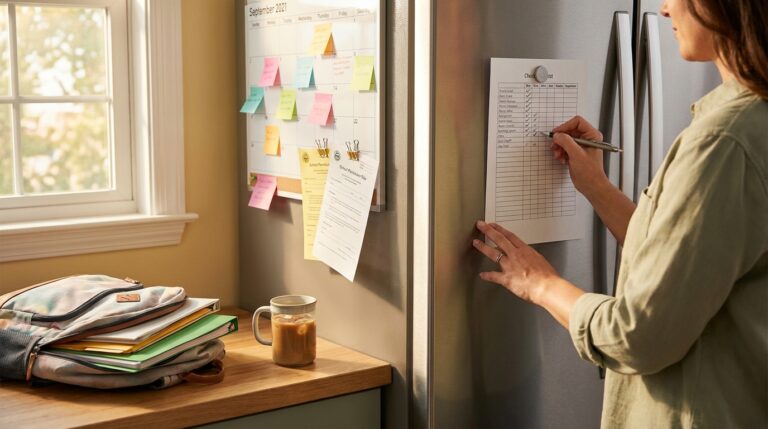
You don’t need a fancy app. Use the notes app on your phone or an index card on the fridge. Whenever your anger hits a 5 out of 10 or higher (or any time you yelled and regretted it), jot down:
| Time | What happened | Body signals | Intensity (1-10) | What I actually needed |
|---|---|---|---|---|
| 5:40 pm | Milk spill, third of the day | Hot face, clenched jaw, shaky hands | 8 | Food, five minutes, to not be the only adult in the house |
| 7:15 am | Shoes not on, bus in 8 minutes | Tight chest, voice rising | 6 | A less rigid morning; a shoes-by-the-door system |
| 9:30 pm | Partner asks “what’s for lunch tomorrow?” | Sharp heat, wanted to throw something soft | 7 | For somebody else to own lunches. Permanently. |
| 2:10 pm | Toddler refusing nap, screaming for an hour | Buzzing skin, wanting to leave the house | 7 | Sensory relief; a second pair of arms |
The last column is the important one. It feels awkward at first, because your first answer is “I needed the kid to stop.” Push one layer deeper. What did you need? Food? Silence? Help? To not be touched? To be thanked? Just to sit down?
Rules for the tracker:
- Write it down within a few hours, while the details are fresh. Voice memos count.
- Keep it to one line. This is not a journal assignment.
- Don’t grade yourself. Nothing here is a confession. It’s data.
- If you skip days, carry on. A patchy log is still useful.
What to look for after two weeks
Read the log back like a detective, not a judge. Look for patterns in:
| Pattern type | Examples | What it usually points to |
|---|---|---|
| Time of day | 4-6 pm every day; the 20 minutes before school | Hunger, fatigue, decision fatigue, transitions with no buffer |
| Sensory triggers | Noise, mess, being climbed on, multiple people talking | Sensory overload; needing regular downshifts; feeling “touched out” |
| Repetition | Being asked the same thing over and over; whining; ignored instructions | Depleted patience; feeling unheard |
| Fairness and load | Partner scenarios, chores, planning everything | Mental load and unspoken resentment |
| Disrespect or defiance | Backtalk, eye-rolls, “no!” | Old stories about authority, safety, or being disrespected as a child |
| Your body | After bad sleep, before your period, when skipping lunch | Physical fuel and hormones; possibly something worth a doctor visit |
| Big transitions | Leaving the house, bedtime, coming home from work | Not enough runway; too many demands at the pinch points |
Sparks and tinder
Here’s the framing that changed things for me. Every blow-up has a spark (the specific thing that happened: the milk, the shoes, the whine) and tinder (the dry conditions that made the spark catch: no sleep, no food, no help, no break).
You can’t remove every spark. Kids spill things. Kids also take twelve minutes to put on socks. But you can absolutely wet the tinder. For most moms, when they read their log, the tinder is more fixable than the sparks:
- The 5 pm blowups are actually 4:30 hunger. That’s a snack for you, not a lecture for anyone else.
- The morning rage is a missing buffer. Setting out clothes the night before might save more anger than any breathing technique.
- The 9 pm partner resentment is really about an invisible task list. That’s a conversation, not a mood.
Pick one pattern. Not five. Choose the trigger that shows up most often or costs you the most, and make it your focus for the next month. Everything else can wait.
Part 2: Build a Pause Habit
This is the part most “anger management for moms” advice jumps to first, and it’s the hardest to do without Part 1. Now that you know when you’re most likely to blow, you can plan the pause in advance instead of trying to invent one at a 9 out of 10.
Learn your early warning signs
Anger doesn’t arrive all at once. It has a ramp. The earlier you catch it, the easier it is to redirect. Most people notice the body first:
- Jaw tightening or teeth clenching
- Heat in your face or chest
- Voice getting sharper, faster, or louder
- Shallow breathing or holding your breath
- Fists or shoulders tightening
- An urge to grab, slam, or throw
- Tunnel vision: you can only see the thing that’s wrong
- A thought like “I can’t do this anymore” or “why does no one listen?”
Check your tracker’s “body signals” column. Those are your early warnings. Circle the two or three that show up most often. Those become your cue: when I notice this, I pause.
Build your pause menu
You need pauses you can do in front of children, in a kitchen, in a car, with a toddler on your hip. Pick three from this list and rehearse them until they feel a little boring:
| Situation | Pause move |
|---|---|
| Kid is safe and in the room | Longer exhale: breathe in for 4, out for 6-8, five times. The long exhale is the point; it nudges your body toward calm. |
| Anywhere with water | Cold water on your wrists, face, or the back of your neck. Or hold an ice cube in your fist. |
| Standing anywhere | Push against something: press both palms into the counter or wall for ten seconds, or press your feet hard into the floor. It gives the adrenaline somewhere to go. |
| Mid-argument | Lower your voice on purpose. Slower and quieter, even a whisper. It’s hard to stay at a 9 while whispering. |
| Kid old enough to be alone safely | Leave the room: “I’m getting too angry. I’m going to the bathroom for two minutes, and then I’m coming back.” Then come back. |
| Baby or toddler, and you’re at your limit | Set them down somewhere safe (crib on their back, playpen), step out of the room, and take a few minutes. A crying baby who is safe will be okay for five minutes. You are safer than you are while shaking with rage. |
| Any moment | Name it out loud: “I’m at a seven.” It sounds silly. It works, because naming an emotion engages the thinking part of your brain. |
| Any moment | Sit down. Changing your body position interrupts the “fight” posture. |
If you want more body-based options than I can fit here, nervous system regulation for moms has twelve simple techniques. Pick the ones that take under a minute. When you’re angry, nobody is doing a ten-minute meditation.
The phrase that saves you
You need one sentence ready, because your language skills drop when you’re flooded. Mine is:
> “I’m too angry to talk about this right now. I need a few minutes, and then we’ll figure it out.”
Other options:
- “I’m getting overwhelmed. I need a pause.”
- “I’m not okay to parent this second. I’m taking five breaths.”
- “My body is telling me I’m too upset. Give me a minute.”
Say it out loud a few times when you’re calm. Literally rehearse it in the shower. It’s much easier to reach for a rehearsed sentence than to build one from scratch.
Make if-then plans
This is the technique with the strongest research behind it, and it’s just a sentence: “If [cue], then I will [pause move].”
- If I feel my jaw clench, then I will exhale slowly and lower my voice.
- If I hear myself say “How many times do I have to tell you,” then I will stop and say my phrase.
- If it’s 4:30 pm, then I eat something before I start dinner.
- If I’m at a 7 or higher, then I leave the room for two minutes (or set the baby down safely and step away).
Write three of these on a sticky note and put it somewhere you’ll see it. The kitchen cabinet you open forty times a day is ideal.
Shrink the sparks ahead of time
Some pauses are better done at 4:15 than at 5:40:
- Eat something with protein before the witching hour, not after.
- Turn off the extra noise (the TV and the music and the podcast, all at once).
- Do the transition warnings (“five more minutes, then shoes”) so nobody is surprised.
- Cut one non-essential task from the evening. It’s allowed.
- Dim the lights, or step outside for two minutes with the kids.
What to expect (honestly)
You will not use the pause every time. Early on, you might catch it one in five. That’s not failure. That’s a new habit forming. Success looks like:
- Your outbursts are a notch shorter or a notch quieter.
- You notice sooner, even if you can’t stop it yet.
- Your repair comes faster (Part 3 is where that gets built).
And a warning about a common trap: a pause is not suppression. If you swallow your anger with a tight smile, then dump it on the dishes or your partner or yourself two hours later, you haven’t managed anything. The pause is a bridge to a calmer response, not a lid. After the pause, come back and say what needs saying, at a volume your kids can hear without flinching.
Part 3: Repair With Your Kids
You’re going to snap sometimes anyway. Everyone does. Part 3 is the part that most anger advice skips entirely, and it’s the part that matters most to your kids.
Researchers who study parents and babies have found something that should be printed on every diaper bag: even close, attuned pairs are out of sync a lot of the time. What builds a secure relationship isn’t the absence of ruptures. It’s the repairing. A child who learns that mistakes get named, apologized for, and fixed is learning that relationships can survive conflict. That’s a skill they’ll use for the rest of their lives.
The repair steps
- Get calm first. Don’t repair at a 7. A rushed, tearful, still-angry apology can make things worse. Take your pause, then go find them.
- Get on their level. Sit down. Lower your voice. Make it small and physical, not a formal announcement.
- Name what happened, plainly. “I yelled at you when the milk spilled.”
- Own your part, with no “but.” “That wasn’t okay. Spilling milk is an accident. It wasn’t your fault that I got so upset.”
- Reassure. “I love you. You’re not in trouble. You’re safe.”
- Invite their experience. “How did that feel for you?” Then really listen, even if the answer stings.
- Say what you’ll do next time. “Next time I feel that mad, I’m going to take a break and breathe.”
Scripts by age
| Age | What repair sounds like |
|---|---|
| Baby / toddler (0-3) | Very few words, lots of closeness. “Mama got loud. That was scary. I’m sorry. I love you.” Offer a cuddle if they want one. Toddlers repair through your calm, warm presence more than your words. |
| Preschool / early elementary (4-8) | “I yelled when you spilled your drink. That was not okay. Spilling is an accident. Yelling was my job to handle better, and I’m working on it. Can I have a hug?” |
| Older kids (9-12) | “I owe you an apology for how I spoke to you earlier. I was overwhelmed and I took it out on you. It’s my job to handle my feelings, not yours. Is there anything you want to tell me about how that felt?” |
| Teens | “I’ve been thinking about how I spoke to you earlier. The issue we were talking about still matters, but the way I handled it was not okay. I’m sorry.” Then give them room to be annoyed. A teen who doesn’t warm up right away is not rejecting your repair. They’re processing it. |
Repair traps to avoid
- The “sorry, but.” “I’m sorry I yelled, but you never listen!” cancels the apology. Save the boundary conversation for after.
- The guilt spiral. “I’m the worst mom ever, I’m so sorry, I don’t know why I do this.” Now your child has to comfort you. Keep the apology short and about them.
- Repairing with gifts. Ice cream is lovely. Ice cream instead of words teaches the wrong lesson.
- Demanding forgiveness. “Say you forgive me.” Let them take their time.
- Pretending it didn’t happen. Kids notice. Silence teaches them that these moments are shameful and shouldn’t be discussed.
Repair doesn’t mean the original issue disappears. If your child broke a rule, the rule still stands, and you can address it later, calmly. “I’m sorry I yelled. And I still need you to put your plate in the sink.” Both can be true.
About the shame
If you spent last night replaying every terrible thing you said, I want you to hear this: shame doesn’t make anyone calmer or kinder. It tends to push people toward hiding, defensiveness, or numbing out, not toward change. What helps is what you’re doing right now, which is looking at the pattern honestly and making a plan. Guilt says, “I did something I want to fix.” Shame says, “I’m broken.” Only the first one leads to repair.
And repair isn’t only for your kids. If your partner or another adult was on the receiving end, they deserve the same short, honest, no-“but” apology.
Part 4: Know When to Get Help
This is the part where I want to be very clear, because it’s the part that matters most. Everything above works for ordinary, human, overwhelmed-mom anger. But some anger is a signal that you need more support than tracking and breathing can give you. Getting that support is not a failure. It’s the same thing you’d do for a fever that won’t break.
Call someone today if:
- You’ve scared yourself. You’ve felt like you might hurt your child or someone else, or you’ve had an urge that frightened you.
- You’ve hurt or nearly hurt your child. Hitting, shaking, grabbing hard, throwing things at them, or anything that left a mark or injury.
- You’re having thoughts of harming yourself, or of not wanting to be here.
If any of these fit, please don’t wait to feel “bad enough.” Here are places to start (US numbers; outside the US, search for a crisis line in your country or contact local emergency services):
| Resource | Contact | Good for |
|---|---|---|
| 988 Suicide & Crisis Lifeline | Call or text 988 | Any emotional crisis, including thoughts of self-harm or fear of what you might do |
| Postpartum Support International HelpLine | Call or text 1-800-944-4773 | Moms in pregnancy or the first year (and beyond) who are struggling with rage, anxiety, or depression. They can connect you with local help. |
| Childhelp National Child Abuse Hotline | Call or text 1-800-422-4453 | Parents who are worried about their own behavior toward a child, or who feel out of control. It’s not only for reporting; you can call for support. |
| Crisis Text Line | Text HOME to 741741 | If talking on the phone feels impossible |
| Emergency services | 911 (US) | If you or anyone is in immediate danger |
If you’re about to lose control physically: put your child somewhere safe (a crib on their back, a playpen, a room with the door open), and go outside or into another room. Call someone. A baby who is crying and safe is far better off than a baby held by a parent at the end of their rope. Never shake a baby, ever.
Book an appointment soon if:
- Your kids seem afraid of you: they flinch, go quiet, hide, or walk on eggshells when you’re upset.
- The rage happens most days for two weeks or more, even after you’ve tried the plan.
- Your anger comes with sadness, hopelessness, numbness, panic, intrusive thoughts, or trouble sleeping even when you could.
- It started or got much worse after having a baby, a loss, a move, or another big change.
- It follows your cycle in a pattern (the week or two before your period is the classic one).
- You’ve noticed you’re using alcohol or other substances to cope.
- Your partner, family, or your kids’ school has expressed concern.
- It’s damaging your relationships or your work.
- You keep making the same regretful choices and nothing you try sticks.
Any single item on that list is enough. You don’t need to match five of them.
Consider a medical check-in, too
Anger can have physical contributors, and a doctor can rule them in or out. It’s worth mentioning your irritability and rage to a primary care provider or OB-GYN, especially since some causes are very treatable:
- Postpartum depression or anxiety (rage is a common, under-recognized way these show up)
- PMDD or other cycle-related mood changes
- Thyroid problems
- Low iron or other deficiencies
- Perimenopause, which can start earlier than most people expect
- ADHD, which is often missed in women until their kids are diagnosed
- Sleep problems, including sleep apnea
- Side effects from medications
I’m not a doctor and I can’t tell you which of these might apply. I can tell you that “my anger has changed and I don’t know why” is a completely legitimate reason to make an appointment.
How to Find a Therapist (When You Don’t Have Time, Money, or Energy)
Knowing you need a therapist and finding one are two different problems. The second is genuinely hard when you’re tired. Here’s how to make it smaller.
Step 1: Know what to search for
Look for a licensed therapist (LCSW, LMFT, LPC, psychologist) who lists any of these:
- Anger, irritability, or emotion regulation
- Parenting stress or perinatal/postpartum mental health (even if your baby is now five)
- Approaches like CBT (cognitive behavioral therapy) or DBT skills (dialectical behavior therapy, which is very good for intense emotions)
- Trauma-informed care or EMDR, if your anger has roots in your own childhood
- ADHD, if that’s a question mark for you
Step 2: Know where to look
| Where | What it offers |
|---|---|
| Psychology Today therapist directory | Search by location, insurance, telehealth, and issues. Filter for “anger,” “parenting,” or “postpartum.” |
| Postpartum Support International’s provider directory | Therapists who specialize in perinatal mental health |
| Your insurance provider’s directory | Covered in-network options, usually with the least paperwork |
| Employee Assistance Program (EAP) | Many employers offer a handful of free sessions. Check your benefits portal. |
| Open Path Collective | Reduced-fee sessions for people without adequate insurance |
| Community mental health centers and university training clinics | Lower-cost options, often with sliding scales |
| Your OB, midwife, or pediatrician | They often know local therapists who work with moms and can make a referral |
Step 3: Send the low-effort first message
Most people stall at “I don’t know what to say.” Copy this:
> “Hi, I’m looking for therapy for anger and irritability as a parent. I’ve been yelling at my kids more than I want to, and I’d like help learning to manage it. Do you have openings, and do you take [your insurance] or offer a sliding scale? I’m available [days/times].”
Send it to three therapists at once. Someone will respond.
Step 4: Ask a few questions in the first session or consult call
- How do you work with anger, specifically?
- Have you worked with moms or parents in the same stage I’m in?
- What would the first month look like?
- How do you feel about me bringing my tracker or notes?
Step 5: Give it a fair shot, and permission to switch
Give it about three sessions. If it doesn’t feel right, you’re allowed to try someone else. A good fit matters more than the credentials on the wall. You should feel like you can say the ugly thing out loud and not be judged.
Making it logistically possible
- Telehealth removes the drive. Many moms do sessions from a parked car, a closet, or the bathroom during nap time.
- Ask about evening or early-morning appointments.
- If cost is the barrier, ask about sliding scale. Many therapists have unadvertised reduced-fee slots.
- Medication is a legitimate option worth discussing with a doctor or psychiatric provider. Needing it says nothing about your character. It’s a tool.
Wet the Tinder: The Unglamorous Fixes That Shrink the Flame
Going back to sparks and tinder: these are the upstream changes that make the pause easier to reach. None of them are glamorous, and all of them work better than willpower.
- Sleep. Anger and sleep debt are close relatives. Even 30 more minutes, protected fiercely, can shift your baseline.
- Fuel. Eat something with protein before the 4-6 pm stretch. Hungry brains are angry brains.
- Load. If your log is full of “partner asked X” or “nobody remembers anything,” you’re carrying a mental load that’s not sustainable. That’s not a mood problem. It’s a distribution problem.
- Touch and noise breaks. Five minutes with the door closed, headphones on, and no one touching you is not a luxury when you’re touched out. It’s maintenance.
- Cycle awareness. If your log shows a monthly pattern, track it against your cycle and bring it to your doctor.
- Connection. Isolation makes everything sharper. One friend who can hear “I lost it today” without flinching is worth more than a dozen wellness hacks.
If your partner is part of the equation, try a specific, non-accusatory script:
> “I want to talk about something that’s important to me. I’m working on how I handle my anger with the kids, and I’m making changes. I also need some things to change so I can do it. Can we talk about how we split the evening routine?”
Specific asks (“you own lunches and bedtime on Tuesdays and Thursdays”) land far better than general ones (“I need more help”).
What a Hard Evening Looks Like With the Plan
Here’s a realistic walkthrough, because the plan sounds tidier on paper than it feels in the kitchen.
Two weeks in: My tracker shows that almost every serious blow-up falls between 4:30 and 6:00 pm. The “what I needed” column says the same thing over and over: food, quiet, and another adult. My chosen pattern is the 5 pm spiral.
The change: I start eating a real snack at 4:15 (cheese and crackers, standing at the counter). I put on a podcast instead of the TV noise. I made an if-then plan: If I feel my jaw clench, I lower my voice and say my phrase.
The Thursday it worked: A cup of juice hits the floor at 5:35. I feel the heat rising. I notice my jaw. I exhale, long and slow. I say, quietly, “That’s a mess. I’m feeling frustrated, so I’m going to breathe for a second.” I do, and we clean it up together. Nobody’s afraid. It’s a spill again, not a crisis.
The Saturday it didn’t: Twenty minutes before we were supposed to leave, I hit a wall and yelled. It was loud. My kid went quiet.
The repair: After I took five minutes in the bathroom, I sat on the edge of their bed. “I yelled at you earlier, and that wasn’t okay. You weren’t in trouble, and I was just overwhelmed. I’m sorry. Next time I’ll take a break instead.” They shrugged, then climbed into my lap. Twenty minutes later we were building a marble run.
That’s the plan working. Not a perfect run, but a shorter, quieter, more repairable one. Notice that the Saturday counts as progress too. I repaired within the hour instead of stewing in silence for days.
If you need support right now
Reaching out is not an overreaction. These lines are free and confidential.
- Emergency: if you are thinking about harming yourself or your baby, or you can’t keep yourself safe, call 911 or go to the nearest emergency room. This is a medical emergency, and it is treatable.
- 988 Suicide & Crisis Lifeline: call or text 988, 24/7, for anyone in crisis.
- National Maternal Mental Health Hotline: call or text 1-833-TLC-MAMA (1-833-852-6262), 24/7, in English and Spanish, for pregnancy and postpartum support.
- Postpartum Support International: call or text 1-800-944-4773 for help finding a provider who specializes in perinatal mental health. Not an emergency line.
US numbers. Elsewhere, ask your doctor, midwife or local crisis line. This article was written by a parent, not a clinician, and isn’t medical advice.
Frequently Asked Questions
Is it normal to feel this angry as a mom?
Feeling angry as a mother is extremely common, and it’s rarely talked about because it feels so shameful. Chronic sleep loss, an endless mental load, sensory overload, hormone shifts, and little time alone create ideal conditions for anger. Being angry sometimes is normal. What deserves attention is how often it happens, how intense it gets, and whether it’s frightening you or your children. If it’s frequent, intense, or scary, that’s not a character flaw. It’s a sign to look at the load you’re carrying and to get support, and Part 4 above lays out how.
Does yelling at my kids damage them?
An occasional raised voice followed by a real repair is part of ordinary family life and is not likely to harm a child. Research on parenting is more concerning about frequent, harsh verbal aggression, such as name-calling, humiliation, or threats, and about physical discipline. The good news is that a consistent pattern of repair (naming what happened, apologizing, reassuring) is protective. If you’re yelling more than you’d like, the goal is fewer blow-ups, shorter ones, and fast repairs. And if your kids seem afraid of you, that’s a clear sign to reach out to a therapist or one of the resources in Part 4.
How do I handle mom rage in the moment when I can’t leave the room?
If you can’t step out (a nursing baby, a toddler who follows you everywhere, a car ride), use pauses that happen in your body: a long exhale (in for 4, out for 6-8), pressing your palms hard against a surface, dropping your voice to a whisper, or naming it out loud (“I’m at a seven”). If your child is a baby or toddler and you’re truly at your limit, set them down somewhere safe, such as a crib, and take a few minutes in another room. A safe, crying baby is okay for a few minutes. A parent who is about to lose control is not. If you feel you could hurt your child, call 988 or the Childhelp hotline at 1-800-422-4453.
Could my anger be postpartum depression, hormones, or something medical?
It very well could be, and it’s worth checking. Rage is a common but often overlooked symptom of postpartum depression and anxiety, and irritability can also come from PMDD, thyroid changes, low iron, perimenopause, untreated ADHD, poor sleep, or medication side effects. A good clue is timing: did it start or worsen after a baby, a loss, or a major change, or does it follow your cycle? Bring your tracker to a doctor and say plainly, “My anger has changed, and I’d like to rule out medical causes.” You’re not overreacting by asking.
How long until I see a change?
Most moms notice something small within two to three weeks of tracking triggers and practicing a pause, often just catching the early warning signs sooner or repairing faster. Bigger changes usually take a couple of months of consistent practice, and they come faster with therapy or medical support if either is part of your situation. The goal is not zero anger, but shorter, quieter outbursts, faster repairs, and feeling more in control. If nothing shifts after a month or two, that’s information, and it’s a good reason to move to Part 4.
What if my partner or family is part of the problem?
Sometimes they are. If your tracker keeps showing that the trigger is doing everything alone, being ignored, or being criticized, then no breathing exercise will fix it, because the tinder is structural. Have a specific conversation about splitting tasks, using “I need” statements and concrete requests. If the relationship itself feels unsafe (you’re afraid of your partner, or they belittle or control you), that’s a different situation, and a therapist or the National Domestic Violence Hotline (1-800-799-7233) can help you think it through.
What if I’ve already said or done things I’m deeply ashamed of?
You can still repair, even if it’s been days, weeks, or years. Kids can accept a late apology: “I’ve been thinking about the time I yelled at you at the park, and I’m sorry. It wasn’t your fault.” If what happened involved hitting, injury, or fear, please talk to a therapist about it. It’s exactly what they’re there for, and they’ve heard it before. Shame will tell you to hide. The most useful thing you can do with it is turn it into a phone call.
You’re Not Failing. You’re Learning a Hard Skill.
The mother who typed “anger management for moms” into a private tab at 9:47 pm is not a monster. She’s someone who cares enough about her kids to be horrified by her own worst moments. That caring is the most important ingredient in every part of this plan. Track the patterns, build a pause, repair when you slip, and reach for real help when you need it, because reaching out is part of the plan, not a sign that the plan failed. You get to be a work in progress and a good mother at the same time.