
20 Journal Prompts for Processing Your Birth Story
This article offers 20 journal prompts to help you process your birth story, guiding you to organize fragmented memories into a coherent narrative for personal reflection.
- Use 20 prompts across four stages: facts, feelings, needs, and letters.
- Utilize journaling for reflection, not as a substitute for professional therapy.
- Organize fragmented birth memories into a coherent story with these prompts.
- Stop journaling if you experience flashbacks and seek professional help.
It’s 2:40 in the afternoon, the baby is finally asleep on your chest, and a friend texts: “Omg how was the birth?? Tell me everything!” You type “Long story, but we’re both fine!” and hit send. Then you stare at the ceiling, because the long story is still running on a loop. The moment the room got quiet. The word someone said that you can’t unhear. The part where you felt like a bystander in your own body.
“We’re both fine” is true. It’s also not the whole truth, and these birth story journal prompts are a place to put the rest. A lot of us carry it around for months with nowhere to set it down.
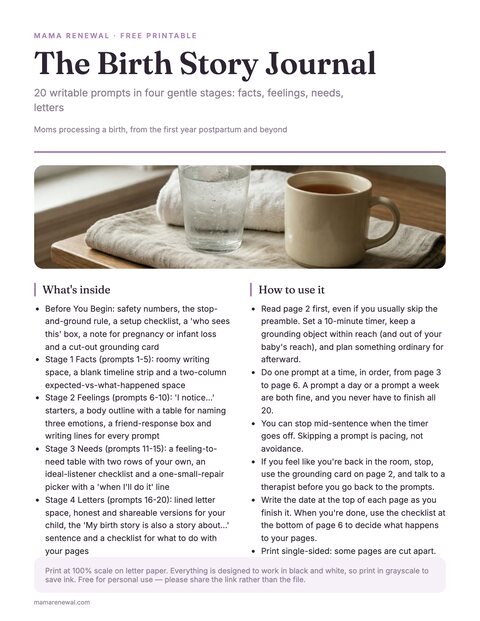
Free printable · 6 pages
The Birth Story Journal
A writable journal with all 20 birth story prompts in four stages, plus safety numbers, a setup checklist, a cut-out grounding card, a timeline strip, an expected-vs-happened table, a body outline, a feeling-to-need table, an ideal-listener checklist, a one-small-repair picker and lined letter space.
Free. Your download link appears right here. You'll also join the Mama Reset. Unsubscribe anytime. Privacy
There are 20 of them, organized into four stages: facts, feelings, needs, and letters (to another mom, to yourself, and to your child). All 20 are on this page, so you can read them here, copy them into your notes app, or write them out in whatever notebook is closest.
Want to go straight to the prompts? Jump to the full list. Please read the safety note just below first, though.
In this article (15 sections)
- A Note Before You Begin
- Why Journaling About Your Birth Story Can Help
- Who These Prompts Are For (Postpartum, 0-12 Months and Beyond)
- How to Set Yourself Up (So It Doesn’t Backfire)
- The Four-Stage Method
- The 20 Birth Story Journal Prompts
- Stage 1: Facts (Prompts 1-5)
- Stage 2: Feelings (Prompts 6-10)
- Stage 3: Needs (Prompts 11-15)
- Stage 4: Letters (Prompts 16-20)
- When the Writing Gets Hard
- What to Do With Your Pages Afterward
- Small Practices to Pair With Your Journaling
- Frequently Asked Questions
- You Get to Tell It Your Way
A Note Before You Begin
Please read this part first, even if you usually skip the preamble.
These prompts are for reflection. They are not therapy, they are not treatment, and they are not a replacement for care from a qualified professional. Writing can help you make sense of what happened. It can’t diagnose anything, and it can’t do the work a trained person does.
Here’s the one line I most want you to remember: if you have a flashback or feel like you’re back in the room while you write, stop and ground yourself. Talk to a therapist before you return to the prompts. It doesn’t mean you’re doing the journaling wrong. It means the story is carrying more weight than a notebook should hold alone. If finding someone feels impossible with a baby on your hip, this guide to finding a therapist when you’re a busy mom walks through it practically.
Safety firstIf you or your baby are in immediate danger, call 911. For thoughts of harming yourself or your baby, call or text 988, or call or text the National Maternal Mental Health Hotline at 1-833-852-6262 (free, 24/7). Don’t journal about it; reach out now.
Low mood, anxiety, or numbness that lasts beyond about two weeks deserves a call to your provider. These can start at any time in the first year. Hallucinations, severe confusion, paranoia, or not sleeping even when the baby sleeps are emergencies: call 911 or go to the ER.
A few other things worth knowing before you start:
- Postpartum Support International runs a helpline at 1-800-944-4773 (call or text) for moms who are struggling after birth. You don’t need to be in crisis to use it. It is not an emergency service; messages are returned within a day or so (Spanish text: 971-203-7773). In a crisis, use 988 or 911.
- You get to stop at any point. Skipping a prompt isn’t avoidance, it’s pacing.
With that said, let’s talk about why writing is worth trying at all.
Why Journaling About Your Birth Story Can Help
I want to be careful here, because the internet loves to promise that journaling “heals trauma.” It doesn’t, not by itself. What it can do is smaller and still real.
For many people, writing can turn a loop into a line. A birth that replays in your head tends to come in fragments: a sound, a face, a sentence. Writing puts them in order, and a story with an ending is easier to live next to than a scene that never finishes.
It can separate what happened from what you made it mean. Most of us fuse these together. “The nurse didn’t look at me” (a fact) becomes “nobody cared about me” (a meaning). On the page, you can see the seam between them.
It gives your feelings a place that isn’t your partner, your mother, or your group chat. Sometimes you don’t want advice, a comparison, or a “but you have a healthy baby!” You want to say the thing and have it simply be said.
It can help you figure out what you need. Many moms find, mid-sentence, that the thing bothering them isn’t the outcome at all. It’s that nobody explained what was happening, or that they never got to say what they wanted. That points toward something you can actually do.
One caution: research on expressive writing is mixed, and it doesn’t help everyone. For some people it stirs up distress. That’s why the stop signals later in this post matter.
For everyday journaling beyond birth, the journaling prompts for moms post covers the in-between seasons. This one is narrower: one story, told carefully.
Who These Prompts Are For (Postpartum, 0-12 Months and Beyond)
These prompts are written for the first year postpartum, when the details are still vivid or the numbness is finally wearing off. But there’s no expiration date. Plenty of moms come back to a birth story years later, set off by a second pregnancy, a friend’s labor, or a medical appointment that smells like the hospital.
They work whether your birth was:
- A vaginal birth that went mostly to plan
- A planned or unplanned C-section
- An induction that took three days
- A fast, scary, “I didn’t make it to the hospital” birth
- A NICU start, where the first days were about machines and monitors
- A birth that ended differently than you hoped (go especially gently)
- Pregnancy or infant loss (see the note below)
- Something you can’t quite categorize, where nothing was “wrong” but something still feels unfinished
Good to knowIf you are grieving a pregnancy or infant loss, work with a grief-informed counselor and skip or adapt prompts 9 and 19, which assume a living baby. Go at your own pace, and stop whenever you need to.
You don’t need a dramatic story to deserve a place to process it. “It was fine, but I keep thinking about it” is a perfectly good reason to pick up a pen.
How to Set Yourself Up (So It Doesn’t Backfire)
A rough setup can leave you raw at 11 p.m. with nowhere to go. A little structure helps.
Pick your timing
- Choose a time when you have a buffer afterward. Not right before a work call or the school pickup line. Ideally, something soothing or ordinary comes next: a snack, a shower, a walk, a TV show.
- Don’t do this at 2 a.m. while exhausted. Sleep debt makes everything feel heavier and less true. If you’re running on fumes, the mom sleep debt conversation is relevant here: your brain processes things differently when it’s this tired.
- Try one prompt at a time. You do not need to finish all 20. A prompt a day, or even a prompt a week, is a perfectly good pace.
Set a timer
Ten minutes is plenty. Set a timer and write until it goes off. When it does, you’re allowed to stop mid-sentence. A time limit makes it feel safer to start, because you know there’s an exit.
Keep a grounding object nearby

Have something within reach that pulls you back into the present: a cold glass of water, a damp cloth, a mug of tea, a soft blanket. Keep any small object, like a stone, well out of your baby’s reach. If you feel yourself drifting back into the room, hold it and name five things you can see.
Decide in advance who sees it
Nobody has to. These pages can be private, shredded, or kept in a locked notes app. If you do want to share them, decide who and why before you write, not after. Writing differently because you’re imagining an audience defeats the purpose.
Use whatever format works
Paper, notes app, voice memo transcribed later, a Google Doc named “Taxes 2019” so nobody opens it. Messy, bulleted, run-on, and misspelled all count. This isn’t writing for a grade.
The Four-Stage Method
The prompts are organized into four stages, and the order matters. It goes from the most concrete (what happened) to the most tender (what you’d write to someone else, or to yourself), so you build up to the hard parts rather than starting there.
| Stage | What you’re doing | Why it comes in this order |
|---|---|---|
| 1. Facts | Writing down what happened, in sequence, as plainly as possible | Gives the story a spine before the emotions arrive |
| 2. Feelings | Naming what you felt then and what you feel now | Easier once the facts are on the page and not swirling |
| 3. Needs | Identifying what you needed, what was missing, and what you need now | Turns feelings into something you can act on |
| 4. Letters | Writing to a mom who’s where you were, to yourself, and to your child | Moves you from carrying the story to making meaning from it |
You can go through them in order across a few weeks, or jump to the stage that calls to you. If you only do one stage, make it the first. Many moms never wrote down the actual sequence of events, and just having it on paper is a relief.
If even Stage 1 feels like too much, write only prompt 3 (the timeline) and stop there. Or start with prompt 13 in Stage 3, which asks what you need right now, and leave the rest for later.
The 20 Birth Story Journal Prompts
Before you write:
- Timer set for 10 minutes
- Grounding object within reach (and out of the baby’s reach)
- Something ordinary planned for afterward
- Baby safe and settled, or someone else watching
Here’s the full set, five prompts per stage.
Good to knowPrefer paper? The printable Birth Story Journal has all 20 prompts with space to write. On paper or on screen, the rule is the same: if you feel like you’re back in the room, stop and ground yourself, then talk to a therapist before you continue.
| # | Stage | Prompt |
|---|---|---|
| 1 | Facts | Start at the beginning. Where were you, and what was happening, when you first knew the birth was starting (or that the plan was changing)? Write it like a reporter would: plain, in order, no adjectives. |
| 2 | Facts | List every person who was in the room at any point. Next to each name or role, write one thing they did. |
| 3 | Facts | Build a rough timeline of the turning points: when things sped up, slowed down, or changed direction. Times are optional, an order is enough. |
| 4 | Facts | Draw two columns. On the left, write what you expected or planned. On the right, write what actually happened. Leave judgment out. |
| 5 | Facts | What do you know now that you didn’t know then? What questions do you still have that someone (a provider, your records) could answer? |
| 6 | Feelings | Which moment do you replay most? Describe it using your senses: what you saw, heard, smelled, and felt in your body. Stop whenever you need to. |
| 7 | Feelings | Name the three strongest emotions you remember from that day. Where in your body did each one live? |
| 8 | Feelings | What are you carrying that feels like it was your fault? Write it down. Then write what you’d say if a friend told you the same thing. |
| 9 | Feelings | What did you feel the first time you saw or held your baby? What did you think you were supposed to feel? Is there a gap? |
| 10 | Feelings | What’s the hardest feeling about this birth to say out loud? Write it here, where nobody has to react to it. |
| 11 | Needs | What did you need most during the birth that you didn’t get? (Information, a voice, a hand to hold, privacy, time, being believed.) |
| 12 | Needs | What did you need in the first 24 hours afterward? What was it like to go without it, or to have it? |
| 13 | Needs | What do you need right now, this week, in relation to this story? Rest, answers, a listener, a professional, to stop thinking about it for a while? |
| 14 | Needs | Who would you want to tell this story to? What kind of listener do they need to be (quiet, curious, not fixing, not comparing)? |
| 15 | Needs | What would feel like even a tiny bit of repair? Pick one small, doable action and write when you might do it. |
| 16 | Letters | Write a letter to a mom who just had a birth like yours. What do you want her to hear first? |
| 17 | Letters | What did nobody tell you that you wish someone had? Write it for her. |
| 18 | Letters | Write a note to the version of you in that room. What would you say to her, standing next to the bed? |
| 19 | Letters | When your child is old enough, what would you want to tell them about the day they arrived? Write the honest version, then the version you’d actually share. |
| 20 | Letters | Finish this sentence as many ways as you can: “My birth story is also a story about…” |
Now let’s walk through each stage, with notes on how to approach the prompts and some examples of what a response can look like.
Stage 1: Facts (Prompts 1-5)
This stage can feel almost boring, and that’s the point. You’re not analyzing, you’re recording.
Why start with facts
When a birth was frightening or confusing, your memory often holds it as a handful of vivid, out-of-order flashes. The rest is a blur. Putting the sequence in order gives you ground to stand on.
You’re also practicing a skill you’ll need later: describing something hard without being swept away by it.
Tips for the facts prompts
- Write in the past tense, third person if it helps. “She arrived at the hospital around 6 p.m.” can feel safer than “I was terrified.”
- Leave blanks. If you don’t remember something, write “I don’t remember this part.” That’s real information, too.
- Skip the adjectives. “The doctor came in and said we needed to move to surgery” is a fact. “The doctor rushed in and coldly announced” is already interpretation. You’ll get to interpretation in Stage 2.
What a response might look like
Prompt 3 (timeline):
4:30 a.m. Water breaks at home. Not sure if it’s labor.
7:00 Arrive at hospital. Triage for a long time.
11:00 Admitted. Told it will probably be a while.
3:15 p.m. Baby’s heart rate drops. Several people come in.
3:40 Decision to do a C-section.
4:22 Baby born. I don’t remember the next ten minutes.
That’s it. No feelings, no judgment, and it still tells a story.
The “expected versus actual” prompt
Prompt 4, the two-column exercise, tends to surface the quiet grief that doesn’t have a name. Moms sometimes discover that part of the hurt is about a specific loss. “I wanted to be awake for the first cry.” “I wanted my husband to cut the cord.” “I wanted skin-to-skin right away.” Seeing it in a column helps. You can grieve something real instead of vaguely feeling “off.”
| What I expected | What happened |
|---|---|
| A calm room, low lights | Bright lights, many people, loud |
| To labor at home as long as possible | Sent in right away |
| Skin-to-skin immediately | Baby taken for evaluation; I held her an hour later |
| To feel in charge of decisions | Felt like things were happening to me |
The “what do I still not know” prompt
Prompt 5 is more practical than emotional. If you have unanswered medical questions (“Why did it become an emergency?” “What was that medication?”), you’re allowed to request your records or ask for a follow-up conversation with your provider. Many hospitals offer a birth debrief. Writing down your questions first makes that appointment far less overwhelming.
Stage 2: Feelings (Prompts 6-10)
Once the facts are down, the emotions usually become easier to name. This stage is where the writing can get intense, so go slowly and keep your grounding object close.
Naming without drowning
You’re not trying to relive the day. You’re trying to label what you felt with some distance, the way you’d describe weather you watched from a window. A useful trick: write “I notice…” sentences. “I notice my chest tightens when I think about the monitor beeping.” It keeps you slightly outside the experience.
Prompt 6: the moment you replay
Almost every mom has one. It’s rarely the most medically significant moment. It’s the one that touched a nerve: a comment, a look, a feeling of being invisible. If writing the full scene feels like too much, try this: write only the first sentence, then stop. Sometimes naming it is enough for one day.
If you notice flashbacks, a racing heart, or a sense of being back in the moment, stop journaling and ground yourself. Name five things you can see, four you can touch, three you can hear. Then do something ordinary, and talk with a therapist before you return to the prompts rather than pushing through on your own.
Prompt 8: the “it was my fault” thought
This one deserves extra attention, because so many of us carry it. Common versions:
- “I should have pushed harder.”
- “If I hadn’t asked for the epidural…”
- “I should have advocated for myself.”
- “My body failed.”
- “I should have gone in sooner (or later).”
The second half of the prompt, “what would you say to a friend,” is where the shift happens. We’re usually far kinder to other people. Read your friend-response back to yourself out loud. It may feel awkward, and it may also be the first compassionate thing you’ve said about that day.
Prompt 9: the gap between what you felt and what you thought you should
Plenty of moms don’t feel an instant rush of love, and plenty feel it but also feel fear, numbness, or relief mixed in. If you felt flat, scared, or like you were watching from far away, you’re far from alone, and it doesn’t say anything about the kind of mother you are. This prompt gives you room to write the true version. If the flatness or distance lasts beyond about two weeks, or gets heavier, mention it to your provider. Postpartum mood changes are common and treatable.
Prompt 10: the thing you can’t say out loud
This page never has to be shared, so write the sentence you’d never say at a baby shower or in a mom group. For some moms it’s “I was terrified I’d die” or “I didn’t want to do it again.” For others it’s “I resented my partner,” or relief that it was over, followed by guilt about feeling relieved. All of those are human, and none of them cancel out your love for your baby.
Some moms find that feelings of anger arrive here, sometimes strongly. If that resonates, the post on mom rage might help you understand where that intensity can come from.
Stage 3: Needs (Prompts 11-15)
Feelings tell you something mattered. Needs tell you what to do about it. In this stage you’ll name what was missing then, what’s missing now, and one small step you can take.
Why needs are different from feelings
“I felt scared” is a feeling. “I needed someone to explain what was happening” is a need. Once you can name the need, you can ask whether it’s still unmet today, and whether anyone can meet it now.
Here’s a quick translation table to help you move from feeling to need:
| What you might write | The need underneath |
|---|---|
| “I felt invisible.” | To be seen, acknowledged, spoken to directly |
| “Everything happened so fast.” | Information, time, a chance to say yes or no |
| “I felt so alone.” | A steady person beside me, company, reassurance |
| “I felt like a body, not a person.” | Respect, privacy, dignity |
| “Nobody believed me.” | To be heard and taken seriously |
| “I wasn’t allowed to hold her.” | Connection, closeness, being with my baby |
| “I didn’t know what was normal.” | Education, reassurance, someone to ask |
Prompt 11 and 12: during, and just after
Many moms find that the unmet need during the birth is one thing, and the unmet need in the hours afterward is another. In the first 24 hours you might have needed sleep, food, privacy, a nurse to take the baby for an hour, a partner who noticed you were shaking. That first day is often skipped over in birth stories, even though it shapes so much of how the early weeks feel.
Prompt 13: what you need now
Keep this one concrete and small. The answer might be a therapist who understands birth trauma, your records, or a night of uninterrupted sleep. Maybe it’s for your mom to stop saying “at least the baby is healthy.” Write whatever’s honest, even if it’s something you can’t have yet. If your need is a night’s sleep, that counts as legitimate. The nervous system regulation techniques for moms can also help when you’re feeling keyed-up or on edge between the heavy journaling sessions.
Prompt 14: your ideal listener
Not everyone is a good audience for a birth story, and some of the hurt comes from telling it to the wrong person. This prompt helps you describe the listener you need, so you can look for them on purpose. Think about what you’d want:
- Someone who lets you finish without interrupting
- Someone who doesn’t rush to fix it or find the silver lining
- Someone who won’t compare it to their own birth
- Someone who can hear the hard parts without flinching
Then ask whether that person exists in your life. If not, that’s a clue that a support group, a postpartum doula, a counselor, or a trained peer supporter might be a better fit than your usual circle.
Prompt 15: one small repair
Repair doesn’t have to be dramatic. It can be:
- Requesting your hospital records
- Scheduling a birth debrief with your provider
- Writing a thank-you note to the nurse who was kind
- Writing a letter you don’t send to the one who wasn’t
- Telling your partner one specific thing you needed
- Booking one therapy consultation
Pick one. Write down when you might do it. Then go easy on yourself if “when” turns out to be next month.
Stage 4: Letters (Prompts 16-20)
By now you’ve told the story, named the feelings, and identified the needs. This last stage turns outward. You’ll write to a mom going through what you went through, to yourself in that room, and to your child, then finish with one sentence that widens the lens. For many moms it’s the most tender stage.
Why writing to another mom works
It’s hard to be gentle with yourself. It’s easier to be gentle with someone else. When you write to an imagined mom who just went through something similar, you often find yourself saying things you would never allow yourself to hear directly. Then you realize those words apply to you.
Prompt 16: the letter
Imagine a specific mom: she’s in a hospital bed or at her kitchen table, three days postpartum, replaying her own version of the story. What do you want her to hear first? Many moms begin with something like:
You did not fail. Whatever happened, you got through it, and you’re still here, and so is your baby. It’s okay if you don’t feel okay yet.
You don’t need to write it well. You just need to mean it.
Prompt 17: what nobody told you
Think of this as your own mini-guide for the next person. Examples of what you might write:
- “Your milk might not come in right away, and that’s not a verdict on you.”
- “You can ask what every medication is before you take it.”
- “It’s okay to cry for no reason on day four.”
- “Recovery from a C-section is major surgery recovery, not a lazy break.”
- “You’re allowed to ask for a different nurse.”
- “You might feel more grief than joy at first. That’s common.”
Prompt 18: a note to the woman in the room
This one is often the emotional peak, so save it for a day when you have energy and a soft landing. Picture yourself standing next to the bed. What would you say to her? Often it’s simple: “I’m here. You’re doing it. You’re not alone.” Some moms find it helps to write it in second person, directly to “you.”
Prompt 19: what you’d tell your child
Write the honest version first, without editing for age-appropriateness. “The day you were born was frightening, and I didn’t know if we were going to be okay. When they put you on my chest I couldn’t stop shaking.” Then write the version you’d share with them as a kid: shorter, warmer, without the parts that belong to you.
Having both is helpful. One holds your truth; the other holds your love.
Prompt 20: “My birth story is also a story about…”
Finish this sentence as many ways as you can. It’s a way of widening the lens so that the story isn’t only about what went wrong. Some ways you might finish it:
- “…how strong I turned out to be.”
- “…how much I wanted to be heard.”
- “…the nurse who held my hand when no one else did.”
- “…how fast love can arrive and how slowly feelings can catch up.”
- “…learning to ask for what I need.”
- “…a partner who stayed steady when I couldn’t.”
- “…how scared I was and how I did it anyway.”
None of these cancel out the hard parts. They sit beside them. A story can hold both.
When the Writing Gets Hard
Sometimes the notebook stirs up more than you expected. That doesn’t mean you’re fragile. It means this mattered. Here’s a quick guide for what to do in the moment, and when to reach for more support.
A quick check-in table
| What you notice while writing | What to try | When to reach out for more help |
|---|---|---|
| Teary, tired, a bit raw | Take a break, drink water, do something ordinary | If it lingers for days |
| Heart racing, shaky, tight chest | Stop writing, ground yourself (5-4-3-2-1), slow your exhale | If it happens most times you write |
| Feeling like you’re back in the room, flashbacks, or strong physical reactions | Stop journaling. Open your eyes, look around, touch something real, move your body, then do something ordinary | Talk to a therapist before you return to the prompts. This is a sign to bring the story to someone trained |
| Numb, blank, unable to feel anything | Skip the prompt, return to a lighter one | If numbness is ongoing or paired with low mood |
| Thoughts of harming yourself or your baby | Do not keep writing. Reach out now | If you or your baby are in immediate danger, call 911. Otherwise call or text 988, or call or text the National Maternal Mental Health Hotline at 1-833-852-6262 (free, 24/7) |
| Overwhelming guilt or hopelessness that won’t lift | Share with a trusted person | Tell your provider about it. Postpartum mood changes are common and treatable |
Grounding in a minute
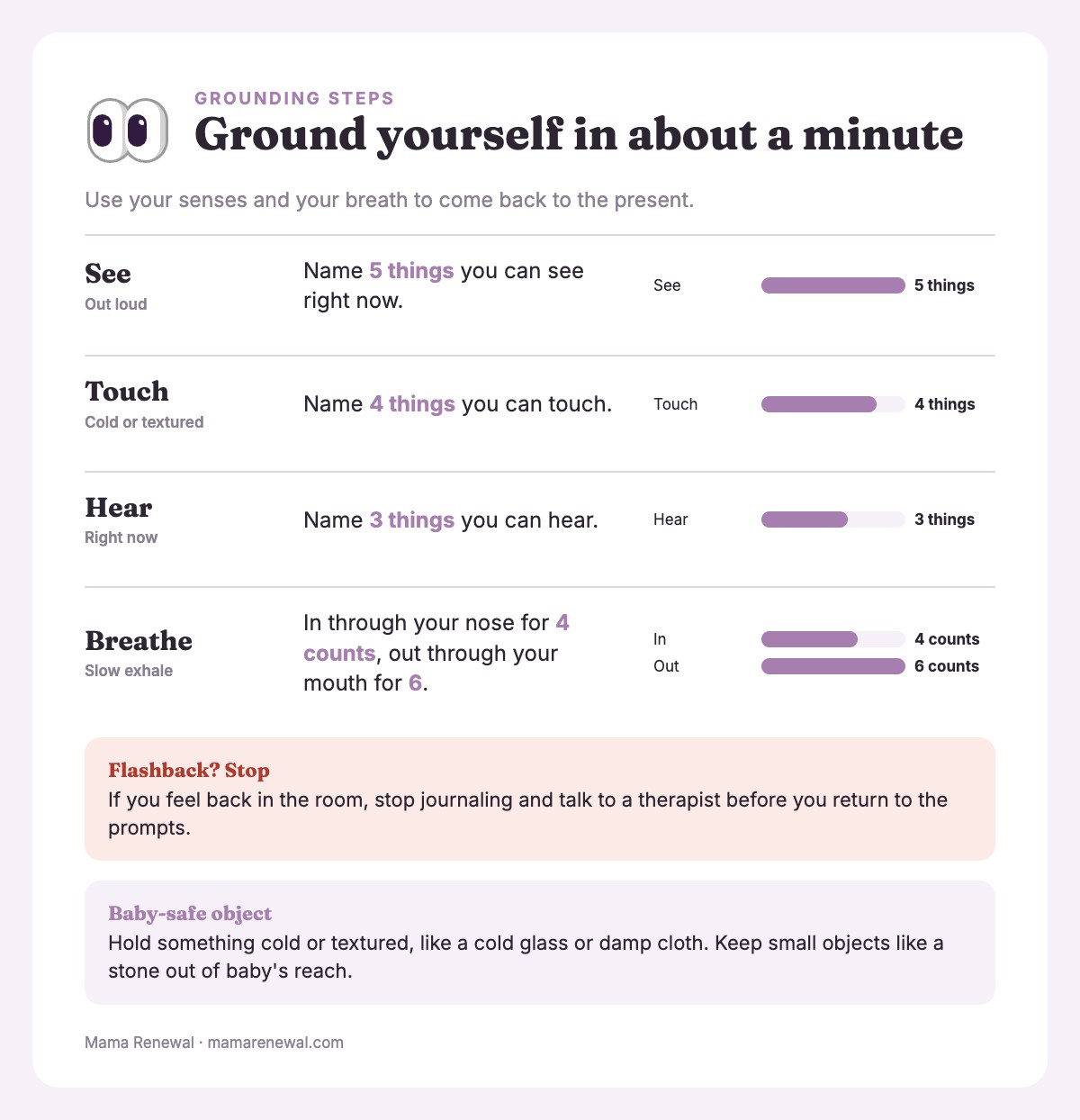
If you feel yourself being pulled back, try this:
- Put both feet flat on the floor and press down.
- Name five things you can see right now, out loud.
- Take a slow breath in through your nose for four counts and out through your mouth for six.
- Hold something cold or textured, like a cold glass or a damp cloth. Keep any small object, like a stone, well out of your baby’s reach.
- Say your name, today’s date, and where you are.
Then do something ordinary for a few minutes. Make toast. Fold a towel. Text a friend about nothing. If it was a flashback or a feeling of being back in the room, stop journaling and contact a therapist before you resume.
Some stories are better told with help
Birth experiences involving emergencies, loss, feeling unsafe, being dismissed, or feeling stripped of control can leave a mark that journaling alone isn’t designed to heal. If your story falls anywhere near that territory, it’s not a failure to want a professional in the room. Many therapists specialize in perinatal mental health. Finding one as a busy mom takes some legwork, but you can make it manageable, and you can bring your journal pages with you. They often make the first session far easier, since you won’t have to start from scratch.
What to Do With Your Pages Afterward
You wrote something. Now what? You have more options than “keep it forever” or “burn it.”
- Keep it, privately. Many moms like having a record, especially for medical details they’ll want later.
- Reread it in a month. You may notice your feelings have shifted, or that a thing that felt enormous has shrunk, or vice versa. Either is useful.
- Pull out the facts and questions to bring to a provider or a debrief appointment.
- Share a piece of it with someone you chose in Prompt 14, if you want to. Start with one paragraph, not the whole thing.
- Bring it to therapy. Your writing can be a shortcut to the real work.
- Let it go. Some moms shred, bury, or recycle their pages as a way of closing the chapter. That’s a valid choice, too.
There’s no right outcome. If the pages sit in a drawer and you feel a little lighter, that counts.
Small Practices to Pair With Your Journaling
Heavy writing sits better when the rest of your day has some softness in it. Pair your sessions with something gentle:
- Before you write: a few slow breaths, a warm drink, a blanket.
- After you write: a short walk, a shower, a snack. A snack can help if you haven’t eaten. If shakiness keeps happening, mention it to your provider. (If you’ve been skipping meals, the post on nutrition as self-care has easy ideas.)
- Anchoring ritual: turn on a flameless LED candle while you write and switch it off when you’re done, as a signal that the session is over and you’re back in the present. (If you use a real candle, never leave it lit and unattended or near the baby.)
- Protect your sleep. Try not to write within an hour of bedtime, especially at first.
- Lower your phone time. Late-night scrolling through other people’s birth stories, or comparing yours, tends to stir things up rather than settle them.
None of this needs to be elaborate. The goal is to give your nervous system a soft place to land.
If you need support right now
Reaching out is not an overreaction. These lines are free and confidential.
- Emergency: if you are thinking about harming yourself or your baby, or you can’t keep yourself safe, call 911 or go to the nearest emergency room. This is a medical emergency, and it is treatable.
- 988 Suicide & Crisis Lifeline: call or text 988, 24/7, for anyone in crisis.
- National Maternal Mental Health Hotline: call or text 1-833-TLC-MAMA (1-833-852-6262), 24/7, in English and Spanish, for pregnancy and postpartum support.
- Postpartum Support International: call or text 1-800-944-4773 for help finding a provider who specializes in perinatal mental health. Not an emergency line.
US numbers. Elsewhere, ask your doctor, midwife or local crisis line. This article was written by a parent, not a clinician, and isn’t medical advice.
Frequently Asked Questions
How often should I do these journal prompts?
There’s no right schedule. Many moms do one prompt a day for a couple of weeks, others do one a week, and some only come back when something stirs up. If you notice that writing leaves you more unsettled than relieved, slow down or take a longer break between prompts. You never have to complete all 20, and you can start with whichever stage feels most approachable.
What if I can’t remember parts of my birth?
That’s very common, especially after emergencies, long labors, anesthesia, or intense fear. Write “I don’t remember this part” and move on. If gaps bother you, you can ask your provider for a debrief appointment or request your hospital records to fill in the timeline. Some moms also find it helpful to ask a partner or support person what they remember, though be aware their version may differ from yours, and that’s okay.
Is it normal to cry or feel worse while journaling?
Some tears or a heavy feeling afterward is common, and often a sign that you’re touching something real. But if you experience panic, flashbacks, feeling like you’re back in the room, or distress that doesn’t ease after you stop and ground yourself, that’s a signal to bring this to a therapist rather than continuing alone. These prompts are for reflection and are not a replacement for professional care.
My birth went “fine” on paper. Is it okay that I still want to process it?
Absolutely. A birth can be medically uncomplicated and still leave you with feelings you didn’t expect: disappointment, fear, a sense of being unseen, or simply intensity you hadn’t prepared for. You don’t need a dramatic story or a diagnosis to justify writing about it. If it’s on your mind, it’s worth some attention.
Can my partner use these prompts too?
Yes. Partners often have their own experience of the birth, including fear, helplessness, or witnessing things they didn’t expect. Stages 1 through 3 can work well for them with small tweaks, like swapping “my body” for “what I saw.” Encourage them to write separately first, then decide together whether to share. Comparing notes can be powerful, but only when both people feel ready.
How do I know if I need a therapist instead of a journal?
Consider reaching out to a professional if you notice recurring panic or flashbacks, nightmares about the birth, or avoidance of anything that reminds you of it. The same goes for persistent low mood, intense anxiety, or trouble bonding or functioning. Postpartum Support International (1-800-944-4773) can help you find perinatal-informed support, and your provider can point you toward local options. It is not an emergency service; messages are returned within a day or so.
If you or your baby are in immediate danger, call 911. For thoughts of harming yourself or your baby, call or text 988, or call or text the National Maternal Mental Health Hotline at 1-833-852-6262 (free, 24/7).
How do I write my birth story?
Start with a plain timeline: what happened, in order, with no adjectives. Do facts before feelings, because the sequence gives you ground to stand on. Then move through feelings, needs, and letters (to another mom, to yourself, and to your child) at your own pace, stopping any time.
Should I write by hand or type it?
Whichever you will actually do. Handwriting slows you down, which some moms find calming. Typing is faster and easier to keep private on a locked device. Voice-to-text can be a good option if you only have one hand free while holding a baby. The best format is the one that makes it easy to start and easy to stop.
You Get to Tell It Your Way
Your birth story belongs to you. You don’t have to make it neat, grateful, or inspiring, and you don’t have to keep it to the “at least the baby’s healthy” version everyone else prefers. Whether you write one prompt or all twenty, whether you keep the pages or toss them, you’ve made room for something that deserves room.
Go at your pace, take breaks, and call in help if the story feels bigger than a notebook. You lived through it, and you’re allowed to tell it truthfully.