
What to Say When Grandma Overrides Your Discipline Rules
Learn how to uphold your toddler discipline rules with grandparents using a clear four-part communication formula and escalation plan.
- Sort your boundaries into non-negotiable and flexible rules.
- Use the Warmth + Fact + Ask + Backup formula to address overrides.
- Follow word-for-word scripts for common issues like treats and screens.
- Deploy an escalation plan when gentle reminders are ignored.
This post contains affiliate links. As an Amazon Associate I earn from qualifying purchases.
Picture a mom I’ll call Dana, a composite of the moms I hear from. Her two-year-old threw his crackers on the car floor, and she calmly said, “We don’t throw food. If you throw it again, snack is all done.” Grandma sighed, said, “Oh, he’s just hungry,” and handed him a cookie from her purse.
Nobody yelled. But in three seconds the consequence was gone, and so was Dana’s authority.
This post is for the toddler years. You’ll get a way to sort your rules, a four-part formula, and an escalation plan for when gentle isn’t enough. In between are six word-for-word scripts: candy, screens, “in my day” comments, public undermining, rescued consequences, and going around you.
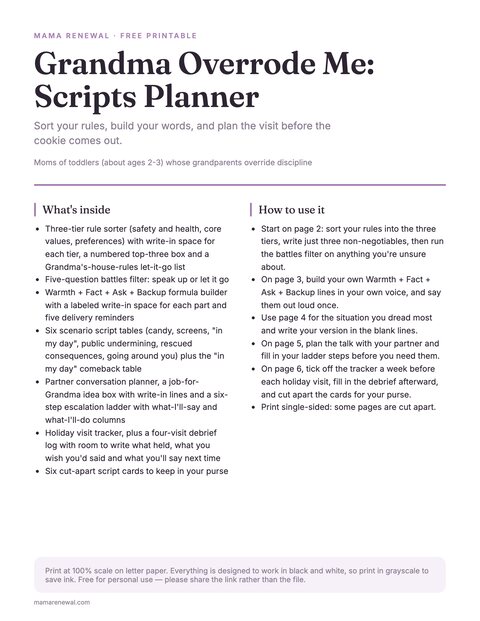
Free printable · 6 pages
Grandma Overrode Me: Scripts Planner
A fill-in planner with a three-tier rule sorter, a battles filter, the Warmth + Fact + Ask + Backup formula builder, six word-for-word scenario script tables, a partner conversation planner, an escalation ladder, a holiday visit tracker with debrief log, and six cut-apart purse cards.
Free. Your download link appears right here. You'll also join the Mama Reset. Unsubscribe anytime. Privacy
In this article (13 sections)
- Why Discipline Is the Flashpoint
- Before You Say a Word: Pick Your Non-Negotiables
- The Formula Behind Every Script
- What to Say When Grandma Overrides Your Discipline: 6 Scripts
- Boundaries With a Mother-in-Law (and Getting Your Partner to Step Up)
- When Gentle Isn’t Working: The Escalation Ladder
- What Your Toddler Can (and Can’t) Handle About Different Rules
- The Feelings Underneath: Why This Gets So Heated
- Choosing Your Battles Without Giving Up
- Holiday Season: Where Discipline Fights Peak
- A Quick Reference Card
- Frequently Asked Questions
- You’re Allowed to Be Both Kind and Clear
Why Discipline Is the Flashpoint
If you’ve ever driven home from a visit rehearsing what you should have said, this is for you. Grandparents undermining discipline rarely looks like a fight. It looks like a cookie, a “just this once,” a small sigh. Because it’s wrapped in love, it’s hard to name without feeling like the bad guy.
The complaints cluster around food, gifts, sleep, and discipline. Discipline hits hardest, and you can jump straight to the six scripts if you need words right now. Here’s why it stings so much.
Discipline is where your parenting philosophy lives. Snacks and gifts are things. Discipline is how you raise a person, so an override can feel like a verdict on your whole approach, even when that’s not what they intend.
It happens in real time, in front of your child. You can sort out gift limits over text. You can’t text your way out of “Grandma, can I have another cookie?” happening in the next room.
It touches an old wound. Many grandparents raised kids when spanking was common and “because I said so” was a complete sentence. When you parent differently, some hear, “What you did was wrong,” and get defensive.
Toddlers test every adult, and Grandma usually isn’t the villain. A two- or three-year-old quickly learns that Grandma’s house has a different rulebook. If whining at Grandma works and whining at you doesn’t, the whine goes to whoever says yes. Most grandparents who override you aren’t trying to sabotage you, though. They’re trying to be the fun, safe place, running on instinct and nostalgia.
None of that means you have to tolerate it. It means this is an inconsistency problem, not a character problem: a problem to solve rather than a betrayal to survive. Keeping that in mind will make every script below land softer.
If your kitchen-table conversations keep circling back to a bigger pattern, our guide to boundaries with in-laws covers the broader relationship, including how to talk to your partner about it. This post zooms in on the flashpoint that stings most: what to say when discipline gets overridden.
Before You Say a Word: Pick Your Non-Negotiables

Here’s the mistake almost every mom makes first: she tries to hold every rule with equal force. Then every visit becomes a negotiation, the grandparent feels micromanaged, and the one rule that truly matters gets lost in the noise.
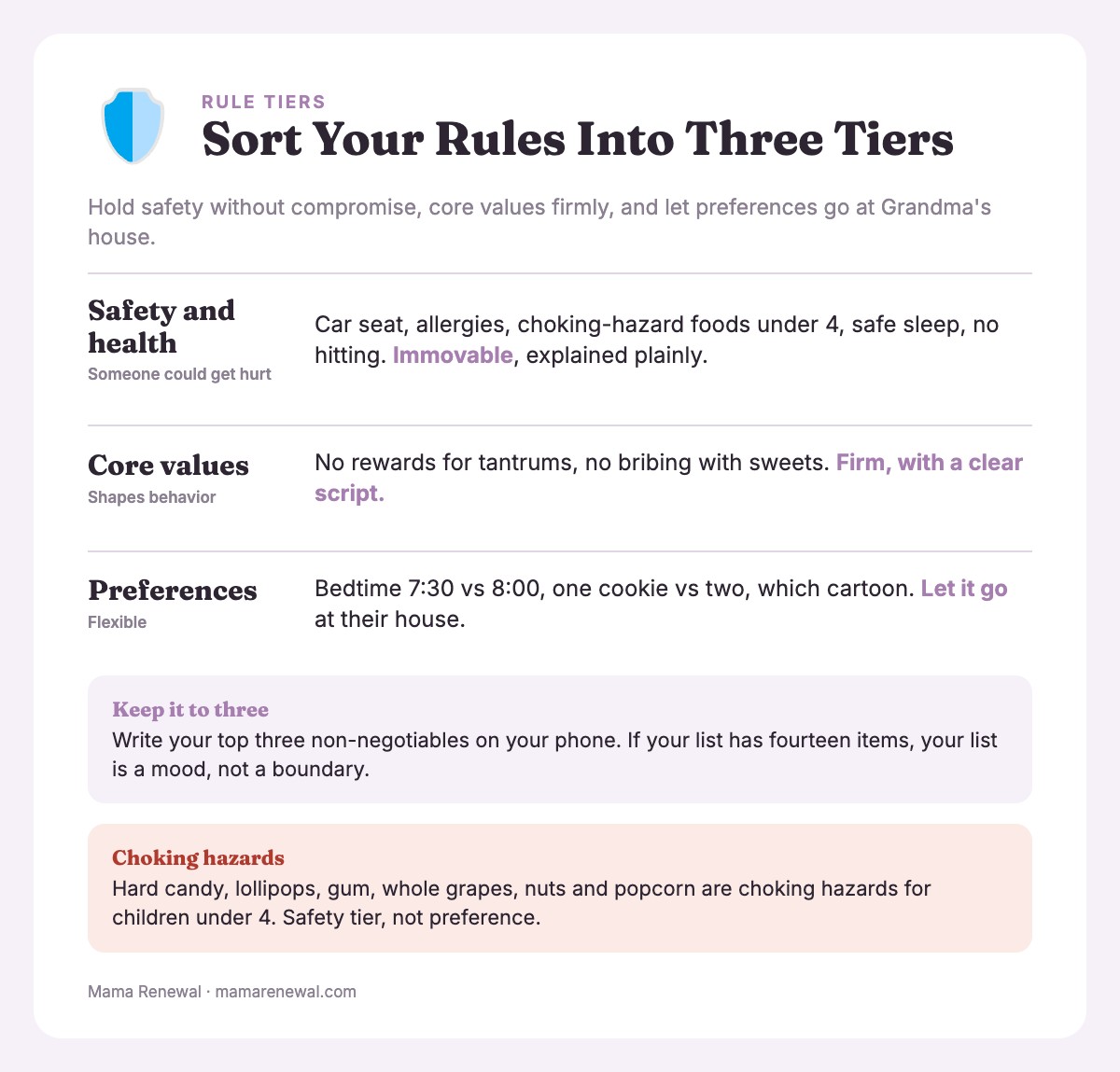
Before any conversation, sort your rules into three tiers.
| Tier | What it means | Examples (toddler years) | How firm to be |
|---|---|---|---|
| Safety and health | Non-negotiable; someone could get hurt | Car seat every ride, allergies, choking-hazard foods under 4, safe sleep (back, flat, empty crib), medications and firearms locked away, no unsupervised water, no hitting | Immovable, explained plainly |
| Core values | Matters deeply to your parenting, shapes behavior | No rewards for tantrums, no bribing with sweets, respecting “no” from a sibling | Firm, with clear script |
| Preferences | You’d like it, but it’s flexible | Bedtime 7:30 vs 8:00, one cookie vs two, which cartoon | Let it go at their house |
Safety firstHard candy, lollipops, gum, whole grapes, nuts and popcorn are choking hazards for children under 4. Safe sleep (baby on their back, flat, in an empty crib, per the AAP) and medications and firearms locked away belong here too. These go in the safety tier, not the preference tier, and grandparents may not know the current guidance.
Try this: grab a note on your phone and write down your top three non-negotiables for when your toddler is with grandparents. Just three. If your list has fourteen items, your list is a mood, not a boundary. Three is something a grandparent can actually remember and honor.
Here’s what a sample list might look like for a strong-willed two-and-a-half-year-old:
- If he hits or throws, he gets a calm break, and the break isn’t cancelled by a snack or a cuddle until it’s finished.
- No sweets as a reward for stopping a tantrum.
- Screens only for the car or a sick day, not as a fix for a meltdown.
Everything else (the extra cookie after dinner, a later bedtime, a toy you wouldn’t have bought) goes into the “Grandma’s house, Grandma’s rules” bucket. That one shift can take a lot of the tension out of visits, because you stop spending credibility on things that don’t matter.
If you struggle with guilt when you set limits, you’re not alone, and it’s worth reading How to Say No: Printable Scripts to Protect Self-Care Time before your next visit. The same muscle you use to protect your time is the one you’ll use here.
The Formula Behind Every Script
You don’t need to memorize six scripts. You need one formula you can adapt on the fly, because real life will not give you the exact scenario you rehearsed.
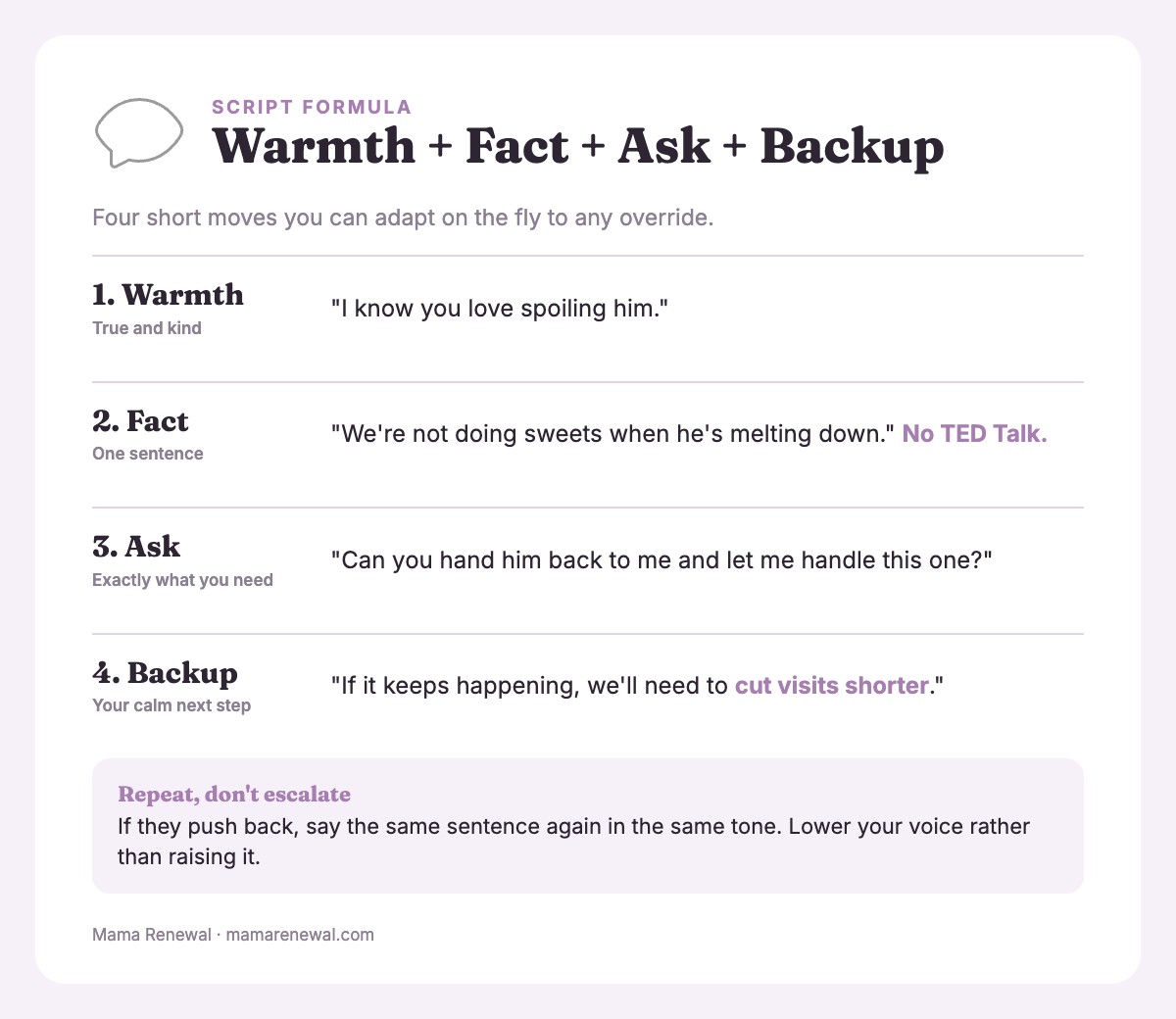
The formula: Warmth + Fact + Ask + Backup.
- Warmth. Start with something true and kind. (“I know you love spoiling him.” “I can tell you want her to have a good time.”)
- Fact. State the rule in one short sentence, without justification or a TED Talk. (“We’re not doing sweets when he’s melting down.”)
- Ask. Say exactly what you need them to do. (“Can you hand him back to me and let me handle this one?”)
- Backup. Have a calm next step ready if they don’t. (“If it keeps happening, we’ll need to cut visits shorter, and I really don’t want to do that.”)
A few rules of delivery that make the formula work:
- Lower your voice, don’t raise it. A slower, quieter tone sounds more confident than a sharper one.
- Use “we” and “I,” not “you.” “We’re doing it this way” lands softer than “You’re undermining me.”
- Don’t over-explain. Every extra reason you give is another thing for them to argue with. “Because this is what works for our family” is a complete answer.
- Say it away from your toddler when you can. Private first, public only if you must.
- Repeat, don’t escalate. If they push back, say the same sentence again in the same tone. Staying calm and repeating yourself works.
Now the scripts.
What to Say When Grandma Overrides Your Discipline: 6 Scripts
Each scenario below includes what’s really going on, the exact words to try, and a backup line for when the first attempt doesn’t stick. Edit them until they sound like you. A script you can’t say out loud with a straight face won’t help.
Script 1: The Candy Override
The moment: You’ve said no to more sweets, or said “after dinner.” Grandma slips your toddler a cookie “because she was so good,” or quietly hands over more sweets the second you leave the room.
What’s going on: For many grandparents, food is love. Handing over a treat is the fastest way to say, “I adore you.”
When you limit sweets, some of them hear, “Your love isn’t welcome here.”
Say this (private, before the visit)“I love how much you love spoiling her. Here’s the one thing I need help with: sweets only with meals at our house, and no sweets when she’s upset. At your house, an age-appropriate treat eaten sitting down is totally fine. Can you help me hold that line when she’s with me?”
Say this (in the moment)“Mom, thank you, that’s so sweet of you. Let’s save that for after dinner. Can I hold it for her?”
Say it cheerfully, hold your hand out, and keep moving. You are rescuing the gift, not rejecting the gesture.
Backup if it keeps happening“I’ve noticed the cookies keep showing up before dinner, and it’s making bedtime a lot harder for us. I need you to check with me first. If that’s not going to work, I’ll bring our own snack for visits.”
Give them something to do instead. Grandparents who override on food are often looking for a way to connect. Hand them a job: “She’d love it if you baked together on Saturday, and you get to be in charge of the sprinkles.”
Redirecting the love works better than simply restricting it.
Script 2: The Screen Time Override

The moment: You’ve said no screens before lunch. Your toddler asks Grandpa for “show,” and within thirty seconds the tablet is propped on the couch and she’s glassy-eyed.
What’s going on: For a tired grandparent, a screen is a peaceful babysitter. It isn’t malicious, it’s easy. Toddlers can be a lot, and those cartoons buy twenty quiet minutes.
Say this (private, in advance)“I know the tablet makes things easier when she’s wound up. For us, I’m trying to keep screens for the car and sick days. When she asks, can you try a book, a snack, or going outside first? I’ll pack a bag of activities so you’re not stuck.”
Say this (in the moment)“Hey Dad, we’re skipping the show today. She loves when you do the puzzle with her, want me to get it out?”
Notice that you’re not just taking something away. You’re replacing it with something concrete and easy. A rule without an alternative puts the burden on the grandparent. A rule with an alternative makes compliance easier than rebellion.
Backup“I know it feels like such a small thing, and I’m not saying you’re wrong. But screens make her meltdowns much worse for us afterward, and I’m the one handling those. Can we stick with no screens on your watch for now?”
Good to knowThe AAP advises avoiding screens other than video chat before 18 months, and for ages 2 to 5, limiting high-quality content to about an hour a day and watching together when possible. Your family’s rules can be stricter than that, and that’s your call to make.
Make it easy to say yes. Leave a “Grandma bag” with three or four low-effort activities: sticky-note art, stickers, a bin of scoop-and-pour things, a book stack.
Grandparents override discipline most when they feel helpless. Hand them tools.
Script 3: The “In My Day” Comment
The moment: Your toddler is mid-meltdown and you’re calmly sitting with her feelings. Grandma mutters, “In my day, we just gave a swat and that was the end of it,” or “You’re making a rod for your own back.”
What’s going on: This comment is rarely about your toddler. It’s a defense of their own parenting. Underneath it is often a worry that if your approach works, theirs was wrong, or a genuine (if clumsy) concern that you’re being too soft.
You do not have to argue the history of discipline in the middle of a meltdown. You do not have to win. You just have to not accept the premise.
Say this (in the moment, calmly)“I know things were different then, and you did a great job raising your kids. This is what’s working for us right now.”
That’s the whole thing. Warmth, fact, done.
If they push“I hear you. I’m not asking you to parent the way I do, I’m asking you to let me handle this the way we’ve decided.”
Later, privately“When you said that earlier, it stung a little. I know you’re trying to help. I’d love it if you’d trust that I’m thinking hard about this, even when it looks different from how you did it.”
A few more lines you can keep in your back pocket:
| When they say… | You can say… |
|---|---|
| “You’re spoiling her.” | “She’s two. She’s not spoiled, she’s learning. This is how we’re teaching her.” |
| “He’s just manipulating you.” | “He’s two, he’s not strategizing, he’s overwhelmed. I’ve got it.” |
| “We never had all these rules.” | “I’m sure it felt simpler. This is how we’re doing it.” |
| “A little smack never hurt anyone.” | “We don’t hit our kids. That’s firm for us, and I need you to follow it.” (See “On physical discipline” below.) |
| “You’re too soft.” | “I’m okay being the softie. It’s working for us.” |
On physical discipline: If a grandparent has physically punished, or threatens to, treat it as a safety-tier issue, not a preference. Be clear and unambiguous: “No one hits our kids. If that happens, the visit ends and we leave.” Then follow through.
The AAP advises against all physical punishment, and research links it to worse behavior and mental health outcomes. If a grandparent has hit your child, unsupervised care ends right away, with no ladder. You don’t need to soften this one.
Script 4: Public Undermining
The moment: You’re at a family dinner, the park, or a restaurant. You’ve told your toddler, “We’re leaving the playground now.” Grandma says loudly, “Oh, five more minutes won’t hurt, let her play!”
Your toddler looks back and forth between you, deciding who’s in charge.
What’s going on: Public undermining is the hardest to handle because you have an audience, a crying kid, and no time to think. It’s also the most confusing for toddlers, who need to know that the adults are a team.
The goal in public isn’t to win the exchange. It’s to not lose it in front of your child and handle the real conversation later.
Say this (in the moment, calm and brief)“Mom, I’ve got this one. We’ll talk later.”
Say it with a smile, a steady voice, and then immediately turn your full attention to your toddler and complete what you said you’d do. Do not look back for approval.
Softer version“Thanks, but we’re heading out. Love you, see you Sunday!”
Later, privately (the real conversation)“When I tell her it’s time to go and you say five more minutes, she learns that she can go to you instead of listening to me. I’m not upset at you, but I need us to look like a team. Can we agree that when I make a call, you back me up in front of her, and if you disagree, we talk after?”
That last sentence is the heart of it: “back me up in front of her, disagree with me afterward.” Most grandparents can agree to that. It acknowledges that they’re allowed to have opinions, just not in front of the toddler.
A note on timing: Don’t try to have the full conversation while your toddler is melting down and relatives are watching. A quick “we’ll talk later” buys you time and keeps your dignity.
The real work happens when everyone is calm.
Script 5: The Rescue From a Consequence

The moment: Your toddler threw a toy at the dog. You’ve calmly said, “Toys are not for throwing. You’re going to take a break.”
She starts to wail, and Grandma scoops her up. “Oh, poor baby, she didn’t mean it, come here.”
What’s going on: Hearing a small child cry is hard, especially for someone who adores that child. Rescuing is a reflex.
The grandparent usually isn’t thinking, “I’ll undo her consequence.” They’re thinking, “Make the crying stop.”
The problem, of course, is that the toddler learns two lessons: crying works, and Grandma overrides Mommy.
Say this (in the moment)“I know it’s hard to watch. I’ve got her. She needs a minute, and then she’ll be ready for a hug.”
If Grandma has already scooped her up, you can gently say:
If she’s already been scooped up“Mom, can you set her down? She’s learning something right now. I promise she’ll be okay, and I’ll bring her right back.”
Private conversation“I know it’s really hard to hear her cry, and I’m not asking you to be okay with it. When she’s in a break, she’s working through something. If you pick her up before she’s done, she gets confused about what happened. Can you take a walk to the kitchen when you hear it? I’ll come get you when she’s ready for you.”
That last move, giving them a place to go, is the most useful part. A grandparent who wants to rescue needs somewhere to put their feelings. Offering them a job (“go start the tea, I’ll bring her in”) makes it easier to step back.
A word on gentleness: Holding a consequence doesn’t mean being harsh. You can sit with your toddler, stay calm, and offer comfort after the limit is held.
The sequence is: limit, feelings, connection. Grandma is welcome to join at the connection step. It’s the first two she needs to stay out of.
Script 6: Going Around You
The moment: Your toddler asks you for a snack before dinner. You say no. She immediately runs to Grandpa, who says, “Well, sure, let’s see what we’ve got,” and you hear the pantry door.
What’s going on: This is the “ask the other parent” move, and many toddlers discover it around age two. It becomes a problem when the grandparent plays along, usually without realizing they’re being used.
Say this (preventive, before the visit)“One thing I’m working on is making sure she doesn’t shop around for a yes. If she asks you for something and I’ve already said no, can you say, ‘Let’s check with Mom’? Then even if you disagree, she sees we’re on the same team.”
Say this (in the moment)“Hey Dad, quick thing: I already said no snack before dinner. Can you tell her you agree with Mom? I’ll handle the rest.”
Or, if you’re across the house and hear it happening:
From across the house“Before you answer, I want to check that. I already talked to her about snack.”
The family-wide script: Some families adopt one phrase that everyone uses: “What did Mom/Dad say?”
When the toddler asks Grandma for something, Grandma asks, “What did Mommy say?” It teaches the child that all the adults talk to each other. It also takes the pressure off Grandma to be the bad guy.
Backup“I’ve noticed that when she asks one of us and gets a no, she goes to the next adult. It’s making things harder at home. I need all of us to say the same thing, even when we’d do it differently.”
Boundaries With a Mother-in-Law (and Getting Your Partner to Step Up)
If the person overriding you is your own mother, you have a head start: you know her, you know her language, and you know exactly which buttons she’ll push. If it’s your mother-in-law, the dynamics are trickier. When moms ask about boundaries with a mother-in-law about the kids, the real question is often, “How do I say this without starting a war with my spouse’s family?”
The honest answer: you shouldn’t be the one delivering the hard message.
A rule of thumb that works for many couples: each partner handles their own parents. When your partner talks to their mother, it sounds like family loyalty. When you talk to their mother, it can sound like an outsider criticizing. Same words, very different reception.
Here’s how to bring your partner in without turning it into a fight:
- Choose a calm moment, not right after a visit. Say, “I need to talk about something that’s been weighing on me. Can we do it tonight after the kids are in bed?”
- Describe the pattern, not the person. “When we say no and then Grandma says yes, our daughter learns to go to whoever will say yes. It’s making things harder for both of us.”
- Make a specific request. “Can you talk to your mom before Sunday and ask her to check with us before giving sweets or screens?”
- Offer a script. If your partner freezes, give them words: “Mom, we’re working on consistent rules at home. Can you help us by following them when you’re with the kids?”
- Agree on what happens if it continues. Decide together, in advance, what the next step is (shorter visits, no unsupervised time, a more direct conversation) so you’re not negotiating in the moment.
Our post on the holiday mental load is a useful companion here. Managing relatives’ expectations is an enormous piece of invisible work, and it often falls on moms by default. If you’re doing 100% of the “family diplomacy,” that’s something to put on the table.
A partner who won’t back you up is a different and bigger conversation. If you say, “This matters to me,” and the answer is a shrug or “that’s just how my mom is,” that’s worth a calm, direct talk, or a session with a counselor. A united front at home is what makes every boundary outside of it possible.
When Gentle Isn’t Working: The Escalation Ladder
Most grandparents will adjust after one or two honest conversations. Some won’t, usually because they don’t believe you’re serious, or because the pattern is deeply ingrained. If you’ve been clear and kind and the behavior continues, it’s time to move up the ladder, not skip to nuclear.
Safety firstHitting, deliberately unsafe sleep, and knowingly ignoring allergy or choking-food rules skip the ladder. Step in right away and end unsupervised care. For a first honest mistake about current guidance, correct it clearly and tell them exactly what to do instead.
| Step | What it looks like | What you say |
|---|---|---|
| 1. Gentle reminder | In-the-moment, light | “Quick reminder, we’re skipping that today.” |
| 2. Private conversation | A calm talk away from the kids | “This keeps happening, and I need it to stop. Here’s what I’m asking.” |
| 3. Clear consequence, stated kindly | Lay out the next step | “If we can’t get on the same page, I’ll need to stay in the room during visits.” |
| 4. Follow through | Do exactly what you said | Stay in the room. Shorten the visit. Leave early. |
| 5. Reduce unsupervised time | Visits happen only with you present | “For now, visits will be with us there. I’d love to go back to alone-time when we’re aligned.” |
| 6. Pause or limit contact | Last resort, after the earlier steps haven’t worked | “I’m not comfortable with this. Until we can agree, we’re going to take a break.” |
A few important notes on using the ladder:
- Follow-through is everything. A boundary you state but don’t enforce teaches everyone to ignore you. Say only what you’re prepared to do.
- Give one clear chance at each step. You don’t need to jump from “gentle reminder” to “no visits.” Escalate in proportion.
- Be warm but unmoving. “I love you, and this is how it’s going to be” is a complete boundary.
- Don’t punish; protect. The goal isn’t to hurt them. It’s to protect your child and your parenting.
If you’ve hit step 5 or 6 over non-safety issues like candy, it might be a sign to revisit your tiers. Pause and ask: is this a core value or a preference? Sometimes the best boundary is a shift in what you’re holding.
What Your Toddler Can (and Can’t) Handle About Different Rules
One question that often sits under all the others: Will my child be confused or harmed by having different rules at Grandma’s?
Here’s the reassuring truth: toddlers are remarkably good at learning “different places, different rules.” That holds as long as the core expectations at home stay consistent and the adults aren’t fighting about it in front of them.
Think of it like school. Your child learns that the rules at preschool are different from the rules at home, and she adapts. She knows she can run in the yard but not in the hallway. Grandma’s house can be the same: “At Grandma’s we have a treat after lunch. At our house we have fruit.”
What toddlers do struggle with:
- Adults contradicting each other in real time. “Mom said no, Grandma said yes” in the same room creates confusion and testing.
- Inconsistent consequences for the same behavior. Hitting is okay with Grandma but not with Mom? That’s genuinely confusing.
- Being the rope in a tug-of-war. Toddlers sense tension. If adults are visibly upset with each other, the toddler absorbs it.
What toddlers handle just fine:
- Different snacks, bedtimes, or treats at different houses
- Different routines for different places
- A grandparent who is more relaxed on small stuff
You can lean into this framing with your toddler directly, in simple words:
Say this to your toddler“At Grandma’s house, she makes pancakes with chocolate chips. At our house, we do plain pancakes. Both are okay! But hitting is never okay anywhere.”
This gives your child a clear, consistent message about the big rules and permission to enjoy the small differences. It also takes some pressure off you. You don’t need to control every detail of Grandma’s house to raise a kid with good values.
The Feelings Underneath: Why This Gets So Heated
If you’re reading this because a visit left you shaking with rage, tearful in the car, or snapping at your partner afterward, that deserves to be named. The intensity isn’t an overreaction. There are real reasons why this particular conflict lights you up.
You’re defending your role. When a grandparent overrides you, it can feel like a message that you’re not the real parent, or not a competent one.
That hits at the deepest part of your identity as a mom.
You’re running on empty. Toddler years are physically and emotionally exhausting. When you’re already depleted, small violations feel enormous.
If you recognize yourself in that, Depleted Mother Syndrome: What It Is and How to Start Recovering may help explain why your fuse is shorter than you’d like.
It’s tangled up with your own childhood. Maybe you’re trying to parent differently from how you were raised, and this feels like being pulled back into old dynamics. That’s a tender spot, and it’s normal for it to sting.
You can’t just leave. Most work conflicts you can walk away from. Family doesn’t work that way.
You’ll see these people at holidays, birthday parties, and every school play for years. The stakes of the relationship raise the cost of every awkward moment.
Give yourself some grace in the aftermath. A few things that help:
- Debrief with someone safe. A friend, a partner, a counselor. Say the unfiltered version out loud so it doesn’t ferment.
- Write it out. Ten minutes of messy journaling about what you wanted to say can drain a lot of the heat.
- Move your body. A walk around the block after a hard visit can help you settle.
- Don’t send the text in the car. Draft it, save it, and look at it tomorrow.
- Notice if it’s becoming bigger than this. If you find yourself snapping at your kids or feeling constant rage, our guides on mom rage and anger management can help you tell the difference between a rough week and something that needs more support.
Good to knowIf rage, hopelessness or tearfulness last more than two weeks or get in the way of daily life, talk to a doctor or mental health professional. In the US, you can call or text 988 in a crisis.
Choosing Your Battles Without Giving Up
There’s a quiet fear many moms carry: If I let one thing go, I’ll lose all my authority. In practice, the opposite is true. In many families, choosing your battles makes the important boundaries easier to hold, because grandparents take them more seriously.
Here’s a quick filter to run when you’re not sure whether to speak up or let it slide:
- Is it safety or health? If yes, speak up, every time.
- Does it contradict a core value I’ve told them about? If yes, speak up kindly but clearly.
- Is it a one-off or a pattern? One extra cookie at a birthday is a one-off. Cookies before every dinner is a pattern. Patterns deserve a conversation.
- Is this about my toddler, or about my own stress? Sometimes we push back harder because we’re tired, not because the issue is that big. Be honest with yourself.
- Would I be upset if my child’s other caregiver did this? If a teacher did it, would it bother you? If yes, it matters. If not, maybe it’s fine at Grandma’s.
Letting things go is not the same as losing. It’s allocating your limited energy to where it counts. You are allowed to say, “That’s not how I’d do it, but it’s their house, and she’ll be fine.”
And on the flip side, if you notice you’re letting everything go to avoid conflict, that’s a signal to check in with yourself. Peace-keeping at your own expense isn’t sustainable. If unsolicited advice from relatives is a wider theme, our guide to unsolicited parenting advice can help. The goal is a family system where your voice counts, not one where you’ve gone silent.
Holiday Season: Where Discipline Fights Peak
If you’re reading this in November, you already know what’s coming. Holidays compress everything that causes friction into a few intense weeks: late bedtimes, sugar, gifts, overstimulation, long stretches with extended family, and a tired toddler who hasn’t napped in the right place.
A few ways to get ahead of it:
- Have the conversation before the visit, not during. A quick text or call a week out: “Just a heads-up, we’re keeping naps and bedtime pretty steady, and we’re going light on sweets before dinner. Thanks for helping us out!”
- Pre-negotiate the big stuff. Gifts, in particular, are a frequent flashpoint. If that’s your sticking point, Grandparents Buying Too Many Christmas Gifts? What to Say has scripts designed for exactly that.
- Protect nap and bedtime where you can. An overtired toddler makes every boundary harder to hold, and every grandparent override more catastrophic.
- Plan an exit. Drive separately if possible, or agree on a signal with your partner. Knowing you can leave makes you more patient.
- Build in downtime. Even fifteen minutes in a quiet room can help you both settle.
- Lower the bar. A messy, imperfect holiday where your toddler had two extra cookies and watched one show is not a parenting failure.
And if the season is starting to feel like too much generally, our post on scripts to say no to fall activity overload has more language you can borrow for the broader pile of invitations and expectations.
A Quick Reference Card
When your brain goes blank in the moment, here’s a cheat sheet. Screenshot it, save it, or write it on a sticky note inside your purse.
| Situation | One-line response |
|---|---|
| Candy before dinner | “Thank you! Let’s save that for after dinner. I’ll hold it.” |
| Screen time | “We’re skipping the show today. Want to do the puzzle with her?” |
| “In my day…” | “I know things were different, and this is what’s working for us.” |
| Public undermining | “I’ve got this one. We’ll talk later.” |
| Rescuing from a break | “She needs a minute. I’ll bring her to you when she’s ready.” |
| Going around you | “What did Mommy say?” |
| Pushback on any boundary | “I hear you, and this is how we’re doing it.” |
| Needing to end the conversation | “I love you, and I’m not going to debate this right now.” |
The most powerful phrase on this list, honestly, is the last one. You are allowed to stop a conversation. You do not owe anyone a debate on how you parent your own child.
Frequently Asked Questions
What do I do when grandparents undermine my discipline and my partner won’t back me up?
Start with a private, calm conversation with your partner away from the kids, and focus on the pattern rather than their parent’s character. Say something like, “When your mom overrides us, our daughter learns to go to whoever says yes, and it makes everything harder.” Then ask for one specific action, such as talking to their parent before the next visit. If your partner dismisses it repeatedly, that’s worth raising directly or with a counselor, because a united front at home is what makes every other boundary possible.
Is it okay for grandparents to have different rules at their house?
Yes, within limits. Toddlers handle “different places, different rules” well when the core expectations stay consistent and the adults aren’t contradicting each other in real time. Small differences like an extra treat, a different bedtime, or a different snack are usually fine. Safety rules, no hitting, and the way consequences are handled should stay the same everywhere. Use the three-tier approach in this post to decide what’s flexible and what isn’t.
How do I set boundaries with my mother-in-law about the kids without causing a family fight?
Ideally, your partner delivers the message, since feedback from their own child lands as family loyalty rather than outside criticism. Keep it specific and warm: “Mom, we’re working on consistent rules, and we’d love your help.” Focus on one or two non-negotiables rather than a long list. Offer her something she can do, like a special activity or tradition. Most mothers-in-law respond far better to a clear, kind request than to a vague sense of being criticized.
What should I say when a grandparent says “in my day we just spanked”?
Stay calm and don’t debate the history. A simple, “I know things were different then, and this is what works for our family,” is enough for a casual remark. If a grandparent actually uses or threatens physical punishment, treat it as a safety issue and be unambiguous: “No one hits our kids. If it happens, we leave.” This is one boundary where you don’t need to soften your language or offer compromises.
How do I correct a grandparent in front of my toddler without embarrassing them?
Keep it short, smiling, and neutral: “I’ve got this one, we’ll talk later,” or “Thanks, but we’re skipping that today.” Then turn your attention fully to your toddler and follow through on what you said. Save the real conversation for later. In private, say, “When I make a call, can you back me up in front of her and tell me afterward if you disagree?” Most grandparents accept this because it respects their opinion without undermining you.
What if the grandparent keeps overriding me even after I’ve asked nicely?
Move up the escalation ladder in proportion to the issue. Start with a more direct private conversation, then state a clear consequence, such as staying in the room during visits or shortening them, and follow through exactly as you said. Consistency matters more than intensity. For serious safety violations, skip the ladder and end unsupervised care right away. Pausing contact is a last resort, but it’s legitimate if the behavior puts your child at risk or you’ve been clear and nothing has changed.
Will my toddler be confused if Grandma and I handle discipline differently?
Not if the big messages stay consistent. Toddlers adapt to differences between homes and caregivers very well, much like they adapt to daycare or preschool rules. What confuses them is when two adults contradict each other in the same moment, or when the same behavior, like hitting, gets different responses. You can help by naming the difference simply (“At Grandma’s we have chocolate pancakes, at home we have plain ones”) while keeping your key rules steady everywhere.
Can grandparents discipline my child?
That’s your call as the parent. Many families agree that grandparents can give a calm redirect or enforce the house rules while you’re not there, but consequences and anything physical stay with you. Say so plainly before the visit.
What if grandma gives my toddler food I’ve said no to?
If it’s a safety issue, like an allergy or a choking-hazard food, take it away calmly and say so directly. If it’s sweets, use the in-the-moment script: thank her, hold it for later, and give her a job to do instead.
You’re Allowed to Be Both Kind and Clear
For a mom like Dana, what usually changes things isn’t a big confrontation. It’s a short text the next morning, something like: “Mom, I know you love spoiling him, and I love that you do. The one thing I need help with is no sweets when he’s melting down. Can I count on you for that?”
Some grandparents answer a message like that with something like, “Of course, I didn’t realize it was making it harder.” Not all of them will. The escalation ladder above is there for the ones who don’t.
A clear sentence, said kindly, usually does more than a showdown. You can love the people in your child’s life and still hold the line on how your child is raised. Warmth and firmness aren’t in conflict, and you can practice both in the same breath.
You won’t get it perfect. Some days you’ll swallow it, some days you’ll snap, and some days you’ll nail the script and feel like a boundary-setting genius. All of it counts. Keep picking your three non-negotiables, keep using the formula, and keep trusting that you’re the one who knows your child best.