
Holiday Travel Sleep Reset for Your Whole Family
Learn how to reset your family's sleep schedule in three days after holiday travel by targeting key disruption levers like light and timing.
- Identify which travel disruption levers affected your family's body clocks
- Match your trip type to the right timeline and reset strategy
- Anchor recovery with fixed wake times, morning light, and normal bedtimes
- Prioritize sleep recovery for yourself alongside your children
This post contains affiliate links. As an Amazon Associate I earn from qualifying purchases.
It was 3:40 a.m. on the Monday after Thanksgiving, and my three-year-old was standing at my bedside, whispering, “Mama, is it breakfast?” We had been home for nine hours, and we hadn’t even crossed a time zone. We’d just spent four days with a travel bed wedged between a dresser and a treadmill, plus late dinners, skipped naps and too many late nights.
This post is a 3-day sleep reset for your kids and for you, plus a prevention kit for before you travel and a clear note on when to see a doctor.
If you need a sleep schedule reset after travel, you may be living some version of that scene right now. You have a body clock too, and you probably slept the worst, so this plan resets the kids and you.
In this article (14 sections)
- Why Travel Wrecks Sleep (Even When You Barely Went Anywhere)
- First, Figure Out Which Kind of Disruption You Had
- The 3-Day Reset Timeline for Kids and Mom
- How to Reset Your Kids’ Sleep After Holiday Travel
- Jet Lag With a Toddler: What’s Different
- Your Own Recovery (Because You Count Too)
- Mistakes That Prolong Post-Travel Sleep Chaos (Starting With the Unpacking Trap)
- Before You Go: Prevent the Crash
- When Things Don’t Bounce Back as Expected
- When Your Own Sleep Doesn’t Bounce Back
- The Gentle Reset Checklist
- A Note on the Holidays Themselves
- Frequently Asked Questions
- You Don’t Have to Reset Everything at Once
Why Travel Wrecks Sleep (Even When You Barely Went Anywhere)
It helps to know what you’re actually fixing. Travel disrupts sleep through several levers at once, and only one of them is the time zone.
TipYou only need to fix the one or two levers that apply to your trip, not all six.
The light lever
Your internal clock (your circadian rhythm) takes its cues mostly from light. Different morning light, late-night screens, a dark car at 5 p.m., a bright airport at midnight: all of it nudges the clock in directions it didn’t ask to go.
The timing lever
Meals, naps, and bedtimes are also clock cues. When they all shift by an hour or two, or vanish entirely, the body loses its reliable signals.
The environment lever
A new room smells different, sounds different, and has different light leaks. Kids sleep lighter in unfamiliar places, and many adults sleep worse on the first night somewhere new (sleep researchers call it the first-night effect).
The stimulation lever
Cousins, grandparents, new toys, sugar, noise, and excitement. A wound-up nervous system doesn’t power down on schedule.
The sleep-debt lever
Short or broken nights stack up. A kid who missed two naps and went to bed an hour late three nights running isn’t “off schedule.” They’re tired in a way that makes bedtime harder, not easier.
The adult lever
Add a mom who was up cooking, wrapping, driving, soothing, and managing everyone’s feelings. She may have had a glass of wine, or three cups of coffee past 2 p.m. to stay upright. Your sleep took a hit from all directions.
The good news is that every one of those levers can be pulled back the other way in a few days.
First, Figure Out Which Kind of Disruption You Had
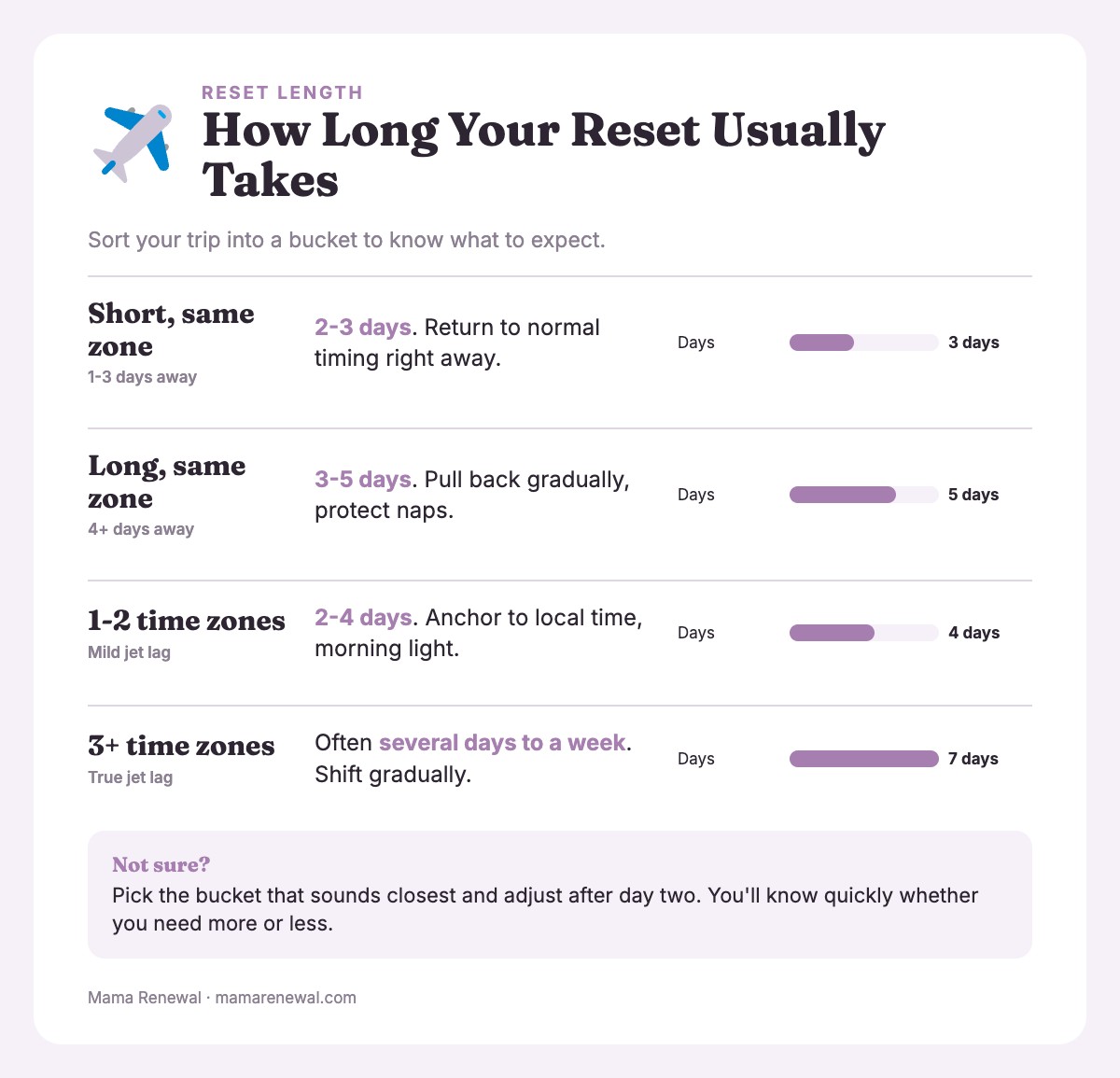
Not every trip needs the same reset. Before you build a plan, spend a minute sorting yours into one of these buckets.
| Type of trip | What happened | How long a reset usually takes | Main strategy |
|---|---|---|---|
| Same time zone, short (1-3 days) | Late nights, skipped naps, new bed | 2-3 days | Return to normal timing right away |
| Same time zone, long (4+ days) | Habits drifted, bedtime crept later | 3-5 days | Gradual pull-back, protect naps |
| 1-2 time zones | Mild jet lag | 2-4 days | Anchor to local time, morning light |
| 3+ time zones or overseas | True jet lag | Often several days to a week (see the jet lag section) | Shift gradually, lean on light and meals |
| Road trip with night driving | Fragmented sleep, car naps | 2-4 days | Rebuild nap and bedtime anchors |
| Houseful of relatives | Noise, stimulation, late nights | 3-5 days | Calm, low-stimulation days at home |
If you aren’t sure which bucket you’re in, pick the one that sounds closest and adjust after day two. You’ll know quickly whether you need more or less.
The 3-Day Reset Timeline for Kids and Mom
This is the heart of the post. I recommend printing it or screenshotting it, because at 6 a.m. in a suitcase-strewn house, you will not remember any of it.
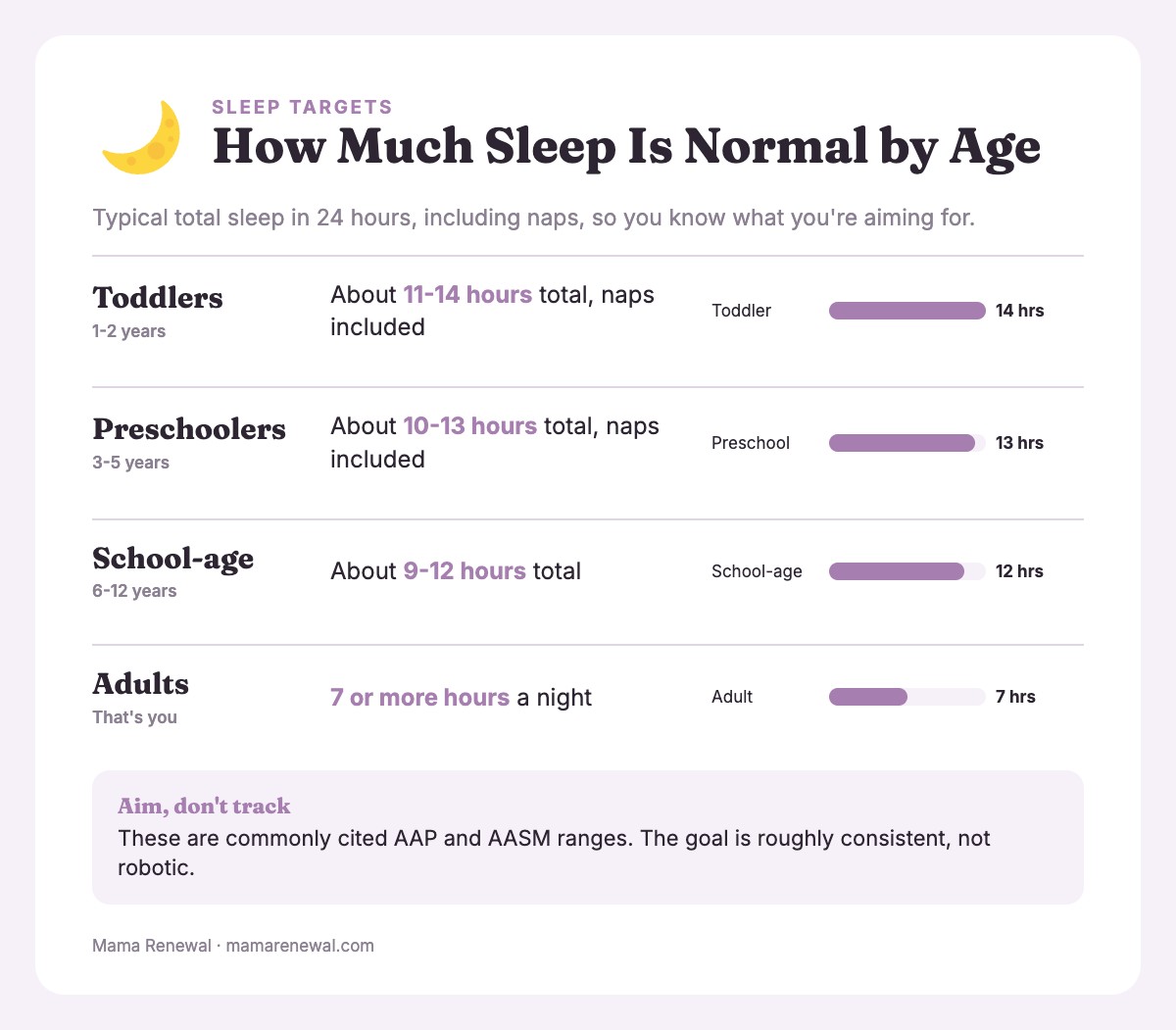
“Normal” depends on age. These are commonly cited AAP and AASM ranges for total sleep in 24 hours, so you know what you’re aiming for.
| Who | Typical total sleep (including naps) |
|---|---|
| Toddlers (1-2 years) | About 11-14 hours |
| Preschoolers (3-5 years) | About 10-13 hours |
| School-age (6-12 years) | About 9-12 hours |
| Adults (you) | 7 or more hours |
The idea is simple: anchor the morning, protect the middle, and be boring at night. You are not trying to fix everything in 72 hours. You’re trying to get your family’s clocks pointed in roughly the right direction so that by day four the rhythm starts holding on its own.
| Day 1: Land and Anchor | Day 2: Rebuild the Middle | Day 3: Lock In Bedtime | |
|---|---|---|---|
| Kids: wake-up | Wake at the normal home time, or within about an hour of it. Open the curtains, go outside if you can. | Same wake time as Day 1. Don’t let them sleep in “to catch up.” | Same wake time. By now it should feel a little easier. |
| Kids: morning light | 15-30 minutes of daylight within the first hour awake. | Repeat. A walk or playground trip counts. | Repeat. Make it a habit. |
| Kids: meals | Breakfast, lunch, and dinner at normal home times, even if the food is simple. | Same. Add protein to breakfast. | Same. Dinner at the usual time, not a late snack-fest. |
| Kids: naps (toddlers) | Offer the normal nap at the normal time, even if short. Cap it so it doesn’t push bedtime late. | Normal nap, normal length. Quiet room, same routine. | Normal nap. If they refuse, do quiet time instead. |
| Kids: movement | Burn real energy. Park, run, stomp, dance in the kitchen. | Same. Outdoor time again if the weather allows. | Same. Don’t skimp. |
| Kids: bedtime | Aim for 30-60 minutes earlier than normal if they’re overtired, otherwise normal bedtime. Don’t push late. | Normal bedtime. Full routine: bath, book, song, lights out. | Normal bedtime, same routine. Expect protests to fade. |
| Kids: screens | Keep them light and early. None in the last hour. | Same. | Same. |
| Mom: wake-up | Get up at a consistent time, even if you slept poorly. Resist the sleep-in. | Same time. Pair it with morning light. | Same time. |
| Mom: light | Step outside for 10 minutes with coffee or tea. | Repeat. Skip sunglasses for the first few minutes if it’s comfortable, so your eyes get the daylight. | Repeat. |
| Mom: caffeine | Normal amount, with a cutoff around noon or early afternoon. | Same cutoff. | Same cutoff. |
| Mom: food | Eat a real breakfast with protein. Skip the “I’ll just have the kids’ leftovers” trap. | Regular meals, regular times. | Same. |
| Mom: evening | Dim lights an hour before bed. Skip the 10 p.m. unpacking spree. | Phone down 30 minutes before bed. Warm shower or tea. | Same wind-down, one more night. |
| Mom: bedtime | Go to bed 30-60 minutes earlier than usual if you can. Sleep debt is real. | Normal bedtime, maybe slightly earlier. | Normal bedtime. Notice how you feel. |
| Mom: expectations | Low. Survive. Laundry can wait. | Slightly higher. One small win. | Back to your regular pace, gently. |
A few things to notice about this table.
The wake-up time is the lever that does the most work. Many families let everyone sleep in after a rough night. It feels kind in the moment and pushes the reset out by days. A consistent wake time, paired with morning light, is the quickest way to tell the body what time it is.
Day 1 is deliberately boring. Not productive. Not fun. Boring. The less novelty, the faster the nervous system calms down.
The mom column matters as much as the kid column. If you reset the children but not yourself, the plan gets hard to follow by day three.
How to Reset Your Kids’ Sleep After Holiday Travel
Start With the Wake-Up, Not the Bedtime
When parents ask me how to start, they usually want to start at bedtime, because that’s where the pain is. But bedtime is the result of the day before, not the cause. If your toddler slept until 8:30 a.m. in a travel haze, no amount of bedtime wrangling will make them tired at 7 p.m.
Pick the wake-up time you want at home and begin there. If your child is waking earlier than normal, keep them in the room until a reasonable hour if you can. Early waking is very common after traveling west, or after a week of sunrise through unfamiliar curtains. Then start the day at the normal time. A toddler clock or a simple “wait until the light turns green” cue can help with this.
Use Morning Light Like a Free Tool

Natural morning light is the strongest cue for resetting the body clock, and it costs nothing. Aim for fifteen to thirty minutes outside, or at least by a bright window, within the first hour or so of waking. This is true for kids and adults. If it’s raining, turn on the brightest lights in the house.
On the evening end, do the opposite. Dim the lights an hour before bed. Bright overhead lights and screens in the evening tell the brain it’s still daytime.
Protect the Nap, but Cap It
For toddlers, naps are the trickiest piece of the puzzle. After travel, they swing wildly: a kid who skipped the nap for two days may crash for three hours, which wrecks bedtime, while a kid who is overtired may refuse to nap entirely.
The middle path:
- Offer the nap at the usual time in the usual place (their own bed, if they’ll go).
- Cap it at roughly their normal length, plus maybe thirty minutes on the first day. Wake them gently if needed.
- If they won’t sleep, swap in a quiet-time hour with books and blocks, and plan an earlier bedtime.
- Skip car naps late in the day. A 4:30 p.m. nap in the back seat is bedtime’s worst enemy.
If you want a deeper dive on adjusting naps and schedules gradually, the approach in resetting kids’ sleep schedule before school starts translates well here. The mechanics are the same, just with a different trigger.
Be Boring at Bedtime

For three nights, run the same bedtime routine with almost no variation. Same bath, same pajamas, same book, same song, same words. Kids who have spent a week in chaos find sameness deeply reassuring, even if they protest.
A few small things that help:
- Bring the sleep environment home. If you traveled with a sound machine, blackout curtains, or a specific lovey (for children over 12 months), make sure those are back in place immediately.
- Aim for earlier, not later. An overtired child is wired, not sleepy. If your kid is melting down at 6:30 p.m., an earlier bedtime might be exactly what they need for the first night or two.
- Keep the room cool, dark, and quiet. The same recipe that works at home works here.
- Skip the big feelings conversation at 8 p.m. Save the debrief about the trip for the morning.
Expect Some Protest (and Some Regression)
It’s completely normal for a toddler or older child to resist bedtime, wake at night, or ask to sleep in your bed for a few days after a trip. This is usually a temporary blip, not a permanent habit.
Safety firstBabies under 12 months should always sleep alone on their own flat, firm surface, including while traveling.
If you held firm to a sleep arrangement before you left, return to it calmly and consistently.
If you let things slide while traveling (a shared hotel room, a mattress on the floor), tell your child in simple words: “We’re home now, and you’re sleeping in your own bed again.”
For school-age kids, the dynamics are a little different. They can handle explanation (“We’re getting our bodies back on home time”), and they benefit from a say in the process: choosing the pajamas, picking the book, deciding which stuffed animal is on duty. Older kids often struggle with a later drift, like staying up until 10 p.m. because the holidays gave them permission. Pull their bedtime back by fifteen to thirty minutes a night if a sudden return to the old time feels too harsh.
Jet Lag With a Toddler: What’s Different
If your trip crossed several time zones, you’re dealing with real jet lag. The jet lag toddler mom experience is its own flavor: a three-year-old wide awake at 2 a.m. local time, thrilled to see you.
Which direction you flew changes what helps most:
| Direction | What the body clock needs to do | Best light timing | Typical trouble | Tip for kids |
|---|---|---|---|---|
| East | Shift earlier | Morning light | Hard to fall asleep at the new bedtime | Get outside early, keep evenings dim and calm |
| West | Shift later | Afternoon and evening light | Waking too early | Keep the room dark and hold them in bed until a reasonable hour |
Some practical principles:
Pick a clock and commit
Within the first day or so, switch to local time for meals, light, and sleep. Trying to straddle two time zones keeps everyone confused.
Use light strategically
After traveling east, morning light helps pull the body clock earlier. After traveling west, afternoon and evening light helps push it later. For small kids, the simplest rule is to get outside as much as possible during local daytime and keep nights dark and calm.
Expect night waking and be ready
A toddler who wakes at 2 a.m. wide awake needs a low-key response: dim lights, quiet voices, a drink of water, back to bed. Skip the toys if you can, so the body doesn’t learn that 2 a.m. is a party. If your child is genuinely hungry, offer something small and plain, then back to bed. You may still end up with a few hours of a wide-awake kid in a dark room. Staying calm and boring is the best strategy.
Let the first day be short on ambition
It’s tempting to power through and “get them on the schedule.” A flexible first day, with a short nap and an early bedtime, usually works better than a rigid fight.
Expect it to take a while
A common rule of thumb for adults is about a day per time zone crossed. Children vary, and eastward trips often take longer. If things still feel tough on day four after a big trip, that’s well within normal.
If your trip was mostly about driving, the dynamics differ: a dark late-night drive plus a car-seat doze can scramble things more than you’d expect, even without a time change. Treat it as a mini jet lag and use the same tools: morning light, normal meals, normal wake time.
Your Own Recovery (Because You Count Too)
Here’s the part that rarely makes it into travel sleep advice: the mom is usually the most depleted person in the car.
You packed the bags. You tracked the snacks. You smoothed over the meltdown in the airport. You kept the peace at a table with six opinions. You probably slept the least, because you were the one waking with the toddler in an unfamiliar room, and then you lay there awake in the dark running a mental to-do list. If you want a name for part of what’s draining you, the holiday mental load checklist lays out the invisible work that piles up around trips and celebrations.
So the holiday travel exhausted mom feeling is not weakness. It’s math.
Don’t Skip Your Own Light and Wake Time
Everything I said about morning light and consistent wake time for kids applies to you. In practice, the temptation after travel is to collapse. You sleep in when the kids finally do, nap on the couch for two hours, or stay up late to “have some time to myself.” That’s understandable, and sometimes you need it. But if you want your own body clock to reset, a steady wake time and morning light are the most reliable fix.
A gentle version: get up with the family, step outside for ten minutes with your drink, and let your eyes see actual daylight. It feels small, but it works.
Treat Sleep Debt Like a Debt (but a Friendly One)
If you slept five hours a night for four nights, you aren’t going to repay that in a single weekend. (Here’s more on why mom sleep debt leaves you so tired.) But you can pay it down:
- Go to bed earlier for a few nights, by 30-60 minutes if you can.
- Take a short nap if you need it, ideally before mid-afternoon and under about thirty minutes, so it doesn’t steal from nighttime sleep.
- Don’t try to compensate with a three-hour nap. It often makes the night worse.
- Lower the bar for the first few days. Dinner can be eggs. The suitcases can sit.
Watch the Caffeine, Sugar, and Alcohol Spiral
During travel, many of us lean on caffeine to function, sugar to cope, and wine to unwind. None of that is a moral failing, but all of it can make the following week’s sleep worse. A few easy swaps:
- Keep caffeine to the morning and early afternoon.
- Eat real protein at breakfast and lunch to keep your energy steady.
- If alcohol was a regular part of the trip, notice how you sleep without it for a few nights. Many people sleep more lightly after drinking.
- Drink water. It sounds boring. It helps.
Do a Small Evening Wind-Down
You don’t need a forty-step routine. You need a signal to your body that the day is ending. Try:
- Dimming the lights an hour before bed.
- A warm shower or a cup of caffeine-free tea.
- Phone out of the bedroom or at least face-down across the room.
- Five minutes of gentle stretching, or just lying on the floor with your legs up the wall.
- A “brain dump” on paper: everything on your to-do list, out of your head and onto a page.
That last one is surprisingly helpful after holiday travel, when your mental list includes thank-you notes, unpacking, laundry, returning gifts, and the work emails that piled up. If you want to make wind-down easier to actually do, habit stacking for moms is a useful way to attach a small routine to something you already do every night, like brushing your teeth.
Be Kind to Your Emotional Hangover
After holiday travel, many moms notice something besides tiredness: a flat or irritable feeling, a short fuse, a low mood that lingers. Some of that is sleep loss. Some of it is the emotional work of managing family dynamics, and some of it is the simple letdown after an intense stretch. Give it a few days. Drink water, get outside, go to bed early, and lower your expectations of yourself.
If a low mood lasts more than a couple of weeks, or is getting worse, it deserves a professional check. Postpartum depression and anxiety can show up at any point in the first year or longer, so don’t wait it out if something feels wrong.
Mistakes That Prolong Post-Travel Sleep Chaos (Starting With the Unpacking Trap)
Let’s talk about what makes the reset harder than it needs to be. I’ve fallen into all of these.
The 10 p.m. unpacking spree
You walk in the door and suddenly must sort the laundry, because the pile is bothering you. Resist. Pull out only what you need for tonight, including pajamas, toothbrushes, and the lovey (for kids over 12 months). Everything else can wait for tomorrow’s daylight.
The sleeping-in “treat”
It feels like a gift, but it delays the whole reset. Hold the wake-up time, then put a nap or an early bedtime on the calendar instead.
The all-day screen day
After a long trip, it’s tempting to put on movies and let everyone veg. A little is fine, but too much indoor time with no light and no movement makes sleep worse. Aim for a walk, a park, or even a lap around the block.
The empty-fridge dinner
Late, random meals are a sleep disruptor. Keep a few “landing meals” in the freezer or pantry so Day 1 dinner can be on time and simple. Scrambled eggs, buttered noodles, and frozen waffles with fruit all count.
The social calendar rebound
The week after Thanksgiving or Christmas is packed with events, school programs, and parties. If you can, keep the first two or three evenings quiet. Rhythm needs quiet evenings.
Trying to be the perfect sleep coach
You don’t need to track every minute or run a spreadsheet. The goal is “roughly consistent,” not “robotic.”
Before You Go: Prevent the Crash
If you’re reading this before a trip, a little preparation makes the reset much shorter.
Pack a Sleep Kit
Safety firstBabies under 12 months sleep on a firm, flat surface with no loose blankets, pillows or soft toys, including when traveling. Blanket and lovey items below are for children over 12 months only. Check the manufacturer’s weight and height limit on any portable crib: many 3-year-olds are over it, and a travel cot or a mattress on the floor may be safer.
| Item | Why it helps |
|---|---|
| Portable white noise machine or app | Masks unfamiliar sounds |
| Blackout curtain clips or a portable blackout cover | Controls light in a new room |
| Familiar blanket, lovey, or pillowcase (children over 12 months only) | Smells like home |
| Pajamas (and a spare set) | Keeps the bedtime cue consistent |
| Nightlight | Reduces fear in unfamiliar rooms |
| Travel-friendly book or two | Keeps the routine intact |
Protect the Anchor Points
You can’t control everything on a trip, but you can protect a few things:
- Bedtime routine, even if the bedtime itself shifts.
- A mid-day rest, even if it’s a quiet half hour of stroller walking or reading together. Never leave a child alone in a car, and move a sleeping infant to a flat surface once you arrive.
- Morning light, since a walk after breakfast fits into nearly any itinerary.
- One calm evening between big events.
Plan Your Return, Not Just Your Departure
Build a recovery buffer into your calendar. If you’re driving home on Sunday, avoid scheduling school, work, or big activities first thing Monday if you can help it. Even one buffer day makes the reset much smoother. Stock your fridge, clear the calendar, and tell yourself ahead of time that the first couple of days home will be slow.
Set Expectations With the Relatives
If you’re staying with family, it’s reasonable to ask for a quiet room, a consistent bedtime for the kids, or a short nap window. It’s also reasonable to leave early from an evening event. Some families find it easier to name this in advance: “We’ll do the evening dinner, but we’ll head out by 7 so the kids can sleep.” Most relatives understand once they hear the reason. If a relative is disappointed, that is a small cost for a rested family.
When Things Don’t Bounce Back as Expected
Most of the time, a few days of consistency does the trick. But sometimes the reset drags. Here’s how to troubleshoot without panicking.
Your child still wakes at night after a week
Look at the whole day. Are naps too long or too short? Is bedtime too late or too early? Is there something new in the room? Sometimes a lingering problem is a new habit picked up on the trip, like being rocked to sleep, sleeping in your bed (toddlers and older kids only), or having a snack at 2 a.m. Gently walk it back over a few nights.
Your child is suddenly afraid of the dark or their room
A change of scenery can stir up new fears. A nightlight, a short check-in routine, and a little extra reassurance usually help it pass.
Everyone is sick
Travel and holiday gatherings come with germs. If a kid has a cold or ear infection, sleep will be rough for a while regardless of what you do. Prioritize comfort now and return to the reset when everyone feels better.
Safety firstA fever of 100.4°F (38°C) or higher in a baby under 3 months, or any trouble breathing, needs immediate medical care. Call your pediatrician right away or go to the ER.
Call your pediatrician for ear pain or pulling, or for symptoms that get worse or last more than a few days.
A developmental change is happening at the same time
Toddlers drop naps, school-age kids hit growth spurts, and travel sometimes coincides with all of it. If the reset isn’t working and your child’s age is near a transition, it may be time to adjust the schedule rather than force the old one.
If your own sleep is the problem, see the next section.
When Your Own Sleep Doesn’t Bounce Back
Most moms I know recover from a trip’s sleep disruption within a week or so. A few rough nights, a few tired afternoons, and then the body settles. That’s the usual pattern.
But sometimes it doesn’t. If you notice that sleep problems have hung around for more than a couple of weeks after travel, it’s worth mentioning to your doctor. That might look like:
- Trouble falling asleep most nights, even when you’re exhausted.
- Waking in the night and being unable to get back to sleep.
- Waking much earlier than you want and not being able to return to sleep.
- Feeling unrefreshed no matter how many hours you spend in bed.
- Daytime sleepiness that interferes with driving, work, or parenting.
Safety firstDon’t wait two weeks if your mood is the problem. Hopelessness, panic, or thoughts of harming yourself or your baby mean you should contact a doctor, midwife or emergency services promptly. In the US, call or text 988. Postpartum depression and anxiety are common and treatable, and they can show up in the first year or longer.
Lingering sleep trouble isn’t cause for alarm, but a disrupted pattern can sometimes settle into a longer-lasting one. A doctor can help you work out whether something else is going on, like stress, a thyroid issue, anxiety, a medication effect, or a sleep disorder.
They’re also good at practical help. Mentioning it early is far easier than waiting until you’ve been exhausted for months.
You don’t have to be at rock bottom to bring it up. “My sleep hasn’t been right since our trip, and it’s been about three weeks” is a perfectly good opening line. This guide is general, supportive information, not medical advice, and it can’t replace a conversation with someone who knows your health history.
The Gentle Reset Checklist
When the brain is foggy, a checklist beats a paragraph. Here’s a version to keep on your phone.
Day 1
- Wake everyone at normal home time (or close to it)
- Outside in daylight within the first hour
- Meals at normal times, keep them simple
- Offer a capped nap, or quiet time
- Move your bodies: park, walk, dance
- Early-ish bedtime with the full routine
- Mom: only unpack what you need tonight
- Mom: caffeine cutoff, dim lights, phone down
Day 2
- Same wake time
- Morning light again
- Normal nap, normal length
- Protein at breakfast
- Normal bedtime and routine
- Mom: one small win (a shower, a walk, a hot meal)
Day 3
- Same wake time
- Notice what’s easier
- Normal bedtime, no negotiation
- Mom: reflect on how you feel, adjust if needed
- Optional: debrief the trip with your partner, then drop the guilt about anything that didn’t go to plan
Day 4 and beyond
- Keep wake time steady
- Keep light, meals, and bedtime as anchors
- If sleep problems linger (especially yours), take note and mention it to a doctor after a couple of weeks. Low mood or hopelessness shouldn’t wait.
A Note on the Holidays Themselves
The reason holiday travel is a tougher sleep disruptor than a summer vacation is that the holidays come with their own emotional weight. You may be navigating family tension, grief, financial stress, hosting duties, or simply the pressure to make everything magical. That stress doesn’t clock out at bedtime.
It’s okay to build your own limits. You can say you’ll arrive Thursday instead of Wednesday. You can book a separate place to stay. You can leave the party at 7:30 instead of 10. Treat your family’s sleep as a legitimate planning factor, not an inconvenience to everyone else.
And if you find yourself spiraling at 2 a.m. about a comment someone made at dinner or the cost of the gifts, you’re hardly alone. Write it down, put the list by the bed, and tell yourself you’ll deal with it in daylight. It almost always looks smaller by morning.
If you want a clear process for the fall clock shift, the guide on the daylight saving time sleep reset for moms covers a closely related set of tools. Many families hit DST and holiday travel back to back, so it’s worth knowing both.
Traveling with a baby this year? Read Christmas with a newborn for a gentler plan.
Frequently Asked Questions
How long does it take to reset a child’s sleep schedule after travel?
For a short trip within the same time zone, most kids settle back in about two to three days with a consistent wake-up time, morning light, and a normal bedtime routine. After a longer trip or a significant time change, it can take closer to a week (see the jet lag section for the rule of thumb). If things still feel rough after a week or so, look at naps, bedtime, and any new habits picked up on the trip.
Should I let my toddler sleep in after a late night of travel?
It’s tempting, but in most cases it’s better to keep the wake-up time close to normal, then offer an earlier nap or bedtime to make up for lost sleep. Sleeping in tends to push the whole reset back by a day or more. If your child is truly exhausted, a short grace period of thirty to sixty minutes is usually fine.
What’s the best way to handle jet lag with a toddler?
Switch to local time as quickly as you can, get lots of outdoor daylight during the day, keep nights dark and calm, and keep meals on the local schedule. Expect some wide-awake stretches in the night, and respond with low lights and quiet voices rather than play. Keep the first day light on activities and flexible on naps. Most kids adjust within several days to a week, depending on how many time zones you crossed.
Why am I so exhausted after holiday travel, even if I got some sleep?
Travel disrupts your body clock, and holiday trips add emotional labor, late nights, extra caffeine, irregular meals, and often a lot of invisible work like planning, packing, and managing everyone’s needs. All of that adds up to real fatigue, even when the hours in bed look okay on paper. Give yourself a few days of earlier bedtimes, steady wake times, morning light, regular meals, and lower expectations.
When should I talk to a doctor about my own sleep after traveling?
If sleep problems linger for more than a couple of weeks after your trip, mention it to your doctor. That includes trouble falling or staying asleep, waking too early, feeling unrefreshed, or daytime sleepiness. If you feel hopeless, panicked, or have thoughts of harming yourself or your baby, get help right away; in the US call or text 988. They can help rule out other causes and suggest next steps. You don’t need to wait until it’s severe. This article offers general, supportive information and isn’t a substitute for medical advice.
Is it okay to use melatonin to reset my child’s sleep after a trip?
Talk to your child’s pediatrician before giving any supplement, including melatonin, to a child. Many sleep disruptions after travel resolve with consistent light exposure, wake times, meals, and bedtime routines alone. A pediatrician can tell you whether a supplement makes sense for your child and what a safe approach would look like.
What if my kids bounce back quickly but I don’t?
That’s more common than you’d think. Moms often carry more of the mental and physical load on a trip, and many sleep less than their children do. Use the same tools you’re using for the kids: steady wake time, morning light, regular meals, a caffeine cutoff, and an earlier bedtime for a few nights. If you still feel off after a couple of weeks, it’s a good idea to mention it to your doctor.
You Don’t Have to Reset Everything at Once
If you take only one thing from all of this, let it be this: you’re not trying to undo the trip. You’re simply bringing your family’s rhythm home, one gentle anchor at a time. Morning light. A steady wake-up. A normal bedtime. A little extra rest for you.
Three days from now, the suitcases will probably still be in the hallway. But the 3:40 a.m. pancake requests will likely have faded, the afternoons will feel a little steadier, and you’ll have a better sense of what your family needs. That’s enough. You made it through the travel, the relatives, the car seat, and the layover snacks. Rest is allowed now.