
Mom Rage Trigger Log: Spot Your Patterns Before You Yell
Learn how to use a simple one-week trigger log to spot physical and emotional patterns upstream before you snap.
- Track your physical warning signs like clenched jaws to catch anger spikes early
- Shift your perspective from personal failure to objective data collection
- Identify recurring environmental and physical stacks, such as hunger or late-afternoon fatigue
- Use your logged patterns as concrete evidence when seeking professional or partner support
It was a Tuesday, and nothing special had happened. My daughter dropped a cup of water on the kitchen floor, the same kitchen floor I had mopped maybe forty minutes earlier. I heard myself say, in a voice I didn’t recognize, “Are you KIDDING me?” Then I stood there, shaking, with a dish towel in my fist, while a four-year-old looked at me like I was a weather event.
The cup wasn’t the problem, and I knew it even while I was yelling. This post gives you a simple one-week trigger log to spot what keeps lighting the fuse, how to read it, fixes for the most common patterns, and when to get real support.
A tracker shows patterns; it isn’t treatment. If your rage is frequent, intense, or scary, jump to the support section for when to get help and who to call.
In this article (14 sections)
- What a Mom Rage Trigger Log Actually Is (and Isn’t)
- Why Tracking Works When “Just Stay Calm” Doesn’t
- What Triggers Mom Rage: Common Triggers to Track
- The 1-Week Mom Rage Trigger Log
- How to Read Your Log After a Week
- Your Body Knows First: Learning Your Warning Signs
- Common Mom Rage Patterns (and Gentle Fixes)
- Making the Log Realistic (Because You’re Exhausted)
- What to Do With What You Learn
- Talking to Your Kids (and Repairing After a Blowup)
- When to Get Real Support (Please Read This Part)
- Your Anger Is Information, Not a Verdict
- Frequently Asked Questions
- You’re Learning Your Own Weather
What a Mom Rage Trigger Log Actually Is (and Isn’t)
A trigger log is a short record of the moments you feel a surge of anger, whether or not you act on it. You jot down when it happened, what set it off, what your body felt like right before, and what (if anything) helped. After a week or two, you read it back like a detective instead of a defendant.
That framing matters. Most of us treat our anger as a character flaw: I’m a bad mom, I have no patience, what’s wrong with me? A log moves you from judgment to data. The question stops being “why am I like this?” and becomes “what’s happening at 5:15 p.m. on weekdays?”
Here’s what it is:
- A pattern-finder. It shows you recurring triggers you can’t see in the moment.
- An early-warning system. It teaches you your body’s first signals so you catch the spike earlier.
- A reality check. It often reveals that the “random” explosions aren’t random at all.
- A way to collect evidence for a conversation, with your partner, your doctor, or a therapist.
And here’s what it isn’t:
- A punishment tool. You are not keeping score of your failures.
- A diagnosis. It can’t tell you whether something deeper is going on.
- A substitute for support. Patterns help, but they don’t replace a professional when you need one.
- A guarantee that you’ll never yell again. Fewer blowups, shorter blowups, and faster repair are the realistic wins.
If you want the bigger picture of why motherhood can bring out this kind of anger in the first place, Mom Rage: What It Really Means When Motherhood Makes You Snap is the companion read. This post is the practical, hands-on follow-up.
Why Tracking Works When “Just Stay Calm” Doesn’t
“Stay calm” is advice for the moment you’re already flooded, which is the hardest possible time to take it. By the time your heart is pounding and your jaw is tight, you’re usually too flooded to think clearly.
Tracking works upstream. It’s like noticing that your car makes a faint noise every time you turn left, long before the engine dies on the highway.
Three things happen when you start logging:
- You start noticing before you react. Writing down “jaw clenched, hot face” a few times can help you feel those signals in real time. That half-second of awareness is where choice lives.
- You observe instead of only reacting. Some moms find that noticing and writing down anger, even afterward, helps them step back from pure reaction over time.
- Patterns become visible. One blowup feels like a fluke. Ten entries on a page show you that six of them happened between 4:30 and 6:00 p.m., and four of those followed a skipped lunch.
That last one is where moms often have the biggest “oh.” The trigger wasn’t the kid. It was the clock and the empty stomach.
What Triggers Mom Rage: Common Triggers to Track
When moms ask what triggers mom rage, the honest answer is: it’s usually a stack, not a single thing. A kid’s behavior is the match, but the dry brush was already piled up. Here are the most common categories to watch for as you log.
Physical triggers
These are the least glamorous and the most overlooked.
- Hunger and blood sugar dips. Skipping breakfast, running on coffee, then hitting a wall at 3 p.m. Many moms feed everyone else first and never get around to themselves. If protein is part of that picture, Protein for Moms: Why You’re Not Eating Enough and How to Fix It goes into it.
- Sleep debt. Even one broken night lowers your tolerance noticeably. Several in a row can make small things feel enormous.
- Dehydration and caffeine swings. The jittery-then-crashed cycle is a classic.
- Hormonal shifts. Cycle timing, postpartum changes, perimenopause. Some moms see a clear monthly pattern once they track.
- Pain or illness. A migraine brewing, a bad back, a cold you’re pushing through.
Sensory triggers
- Noise. Overlapping voices, repeated sounds, the same song for the ninth time, a toddler screeching at pitch.
- Touch. Being climbed on, grabbed, or needed by little hands all day. If this one rings true, you may recognize it in Touched Out: What It Means When You Can’t Stand to Be Touched Anymore.
- Clutter and mess. Visual chaos can quietly raise your stress level even when you’re “not bothered by it.”
- Constant interruption. Being cut off mid-sentence, mid-thought, mid-task, over and over.
Time and transition triggers
- The after-school and pre-dinner window (the infamous “witching hour”).
- Morning rush. Shoes, backpacks, lost homework, the clock.
- Bedtime stalling, when you’re depleted and just want the day to be over.
- Transitions in general. Leaving the house, ending screen time, switching activities.
Mental load and emotional triggers
- Invisible logistics. The permission slips, the appointments, the “who’s out of wipes” tracking that lives only in your head.
- Feeling unseen or unhelped. Rage often has resentment underneath it.
- Guilt and shame spirals. For some moms, anger at the kids can sometimes be shame at themselves in disguise.
- Unmet needs. No alone time, no adult conversation, no real rest.
- Comparison. A scroll through other people’s tidy lives right before a messy afternoon.
If the “invisible logistics” category made you flinch, The Mental Load: Why Moms Feel Exhausted Even When Everyone ‘Helps’ is worth a read after this one.
Past-and-present triggers
Sometimes a kid’s behavior hits an old nerve: a tone that sounds like how you were spoken to, a defiance that echoes a family pattern, a feeling of being out of control that mirrors something from childhood. These are tender and worth exploring with a therapist rather than alone. A log can help you notice them, but you don’t have to untangle them by yourself.
The 1-Week Mom Rage Trigger Log

Here’s the tool itself. You can copy this table into a notes app, paste it into a doc, or print just this table. A week is enough to start seeing patterns. Two weeks is even better.
If you’d rather work on paper, The 1-Week Mom Rage Trigger Log printable puts the grid, the quick-check boxes, the reading questions, and the support numbers in one place. For calming tools to use alongside it, the Nervous System Reset Planner for Moms is a good second pick.
How to use it: Fill in a row any time you feel a real surge of anger or irritation, whether you yelled or not. You can also fill it in at the end of the day from memory. Keep it rough. Messy and honest beats neat and abandoned.
Good to knowWhen you can, jot the entry within an hour of the surge. The exact time and your body signals fade fast, though an end-of-day entry still beats none.
| Day | Time | Trigger (what set it off) | Physical warning sign | What helped (or what I wish I’d done) |
|---|---|---|---|---|
| Mon | ||||
| Mon | ||||
| Tue | ||||
| Tue | ||||
| Wed | ||||
| Wed | ||||
| Thu | ||||
| Thu | ||||
| Fri | ||||
| Fri | ||||
| Sat | ||||
| Sat | ||||
| Sun | ||||
| Sun |
Optional quick-check boxes (copy these under each day if you want more data):
- Had I eaten in the last 3 hours?
- Did I sleep 6+ hours last night?
- Was it loud, crowded, or cluttered?
- Had I had any time alone today?
- Was I rushing?
- Rate the intensity: 1 (annoyed) to 10 (explosive): ____
How to fill in each column
Time. Be specific: “5:20 p.m.,” not “evening.” Patterns hide in the details.
Trigger. Write what literally happened, in plain language. “Kid refused to put on shoes for the third time.” “Partner asked what’s for dinner.” “Spilled water on a clean floor.” Don’t analyze yet. Just record.
Physical warning sign. This is the most useful column, and the one people skip. What did your body do right before the spike? Examples: jaw tight, shoulders up by your ears, hot face, heart pounding, clenched fists, shallow breathing, buzzing in your chest, a sudden urge to leave the room, a flat “I can’t” feeling. You may not know at first, so write “not sure” and try to notice next time.
TipFill in the warning-sign column even if all you write is “not sure.” It pays off more than any other column once you start seeing repeats.
What helped. If you paused, walked away, drank water, or took a breath, write it down. If you didn’t and it went badly, write what you wish you’d done, with no self-punishment attached.
Either answer gives you something to work with. If nothing helped, “nothing, it just burned out” is a legitimate entry.
A sample filled-in week (so it doesn’t feel blank)
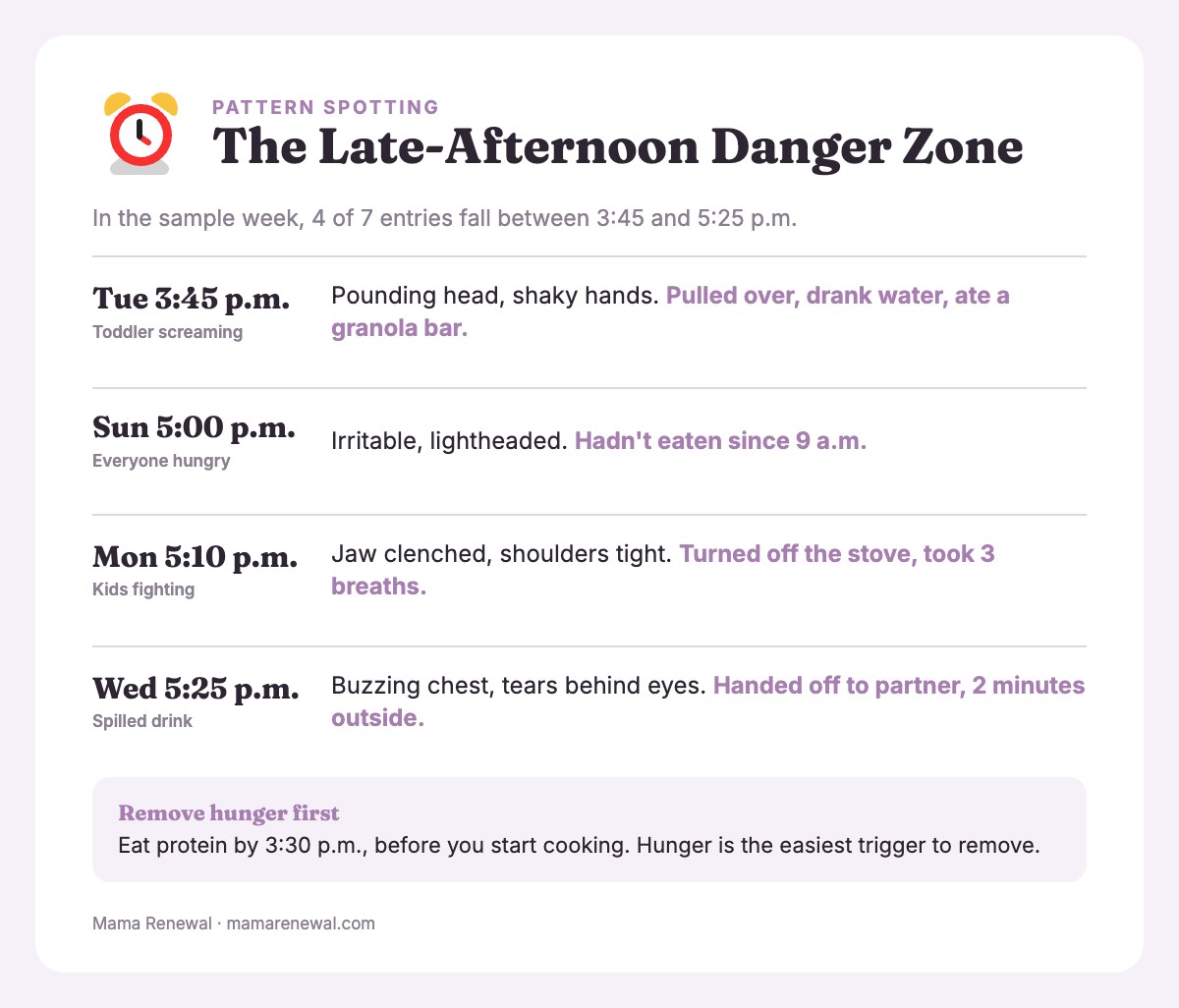
| Day | Time | Trigger | Physical warning sign | What helped |
|---|---|---|---|---|
| Mon | 7:40 a.m. | Lost shoe, late for drop-off | Hot face, fast breathing | Nothing; yelled. Wish: laid out shoes the night before |
| Mon | 5:10 p.m. | Kids fighting while I cooked | Jaw clenched, shoulders tight | Turned off the stove, took 3 breaths in the pantry |
| Tue | 3:45 p.m. | Toddler screaming in the car | Pounding head, shaky hands | Pulled over, drank water, ate a granola bar |
| Wed | 5:25 p.m. | Spilled drink, clean floor | Buzzing chest, tears behind eyes | Handed off to partner, went outside for 2 minutes |
| Thu | 8:15 p.m. | Bedtime stalling, 4th “one more thing” | Flat, numb, can’t think | Nothing; wished I’d had a bedtime script ready |
| Fri | 12:30 p.m. | Interrupted mid-call by sibling squabble | Heart racing | Told kids “I need 60 seconds,” stepped away |
| Sun | 5:00 p.m. | Everyone hungry, nothing planned | Irritable, lightheaded | Realized I hadn’t eaten since 9 a.m. |
Look at that week. Four of the seven entries (Mon, Tue, Wed, Sun) sit between 3:45 and 5:25 p.m. Hunger shows up on Tuesday and Sunday, and noise on Monday, Tuesday, and Friday. That’s not “I’m a terrible mother.” That’s “the late afternoon is my danger zone, and I’m running on empty when I walk into it.”
How to Read Your Log After a Week
Once you’ve got at least 7 to 10 entries, sit down with a cup of something warm and read them like someone else wrote them. You’re looking for repeats. Try these questions:
- When does it cluster? Morning, late afternoon, bedtime, weekends?
- What’s the common ingredient? Hunger, noise, time pressure, feeling unseen?
- What did my body say first? Is there a consistent early warning sign?
- What reliably helped, even a little?
- What’s the “stack”? Did several triggers pile up (tired + hungry + rushed + noisy)?
- Did anything surprise me? A trigger you hadn’t realized mattered?
Then, a quick way to sort what you find:
| Pattern you notice | What it might point to | A small experiment to try |
|---|---|---|
| Blowups cluster 4 to 6 p.m. | Low blood sugar, end-of-day depletion, transition chaos | Eat a real snack at 3:30; shift one task off that window |
| Mornings are explosive | Time pressure, too many steps | Prep the night before; cut one morning task |
| Noise is the repeat offender | Sensory overload | Quiet breaks; volume-limiting kids’ headphones with the volume kept low; earplugs for adults only when another adult is covering (see the safety note below) |
| Anger follows interruptions | Lack of uninterrupted time | Protect one 15-minute block; use a “knock twice” signal |
| Angriest on certain days of the month | Hormonal timing | Track cycle alongside; plan lighter days; mention to your doctor |
| Resentment before the yelling | Unshared mental load | Share a specific task, not a vague “help me”; see below |
| Worst after bad sleep | Sleep debt lowers tolerance | Prioritize one earlier night; trade a morning with your partner |
| Mostly at bedtime | Depletion plus unfinished needs | Simplify the routine; get your own wind-down before theirs |
The point isn’t to fix everything. Choose one pattern and one tiny experiment for the next week. That’s it.
Your Body Knows First: Learning Your Warning Signs
Anger usually isn’t instant. There’s a ramp, even if it’s only a few seconds long. Your body usually sends a signal before your mouth does.
Common early signals include:
- Tightening in the jaw, throat, or chest
- Heat in your face or neck
- A faster heartbeat
- Shallow, held breathing
- Clenched hands or toes
- A sudden sense of urgency to make it stop
- Tunnel vision or a “static” feeling
- A sudden flatness or numbness (some of us go cold instead of hot)
The goal of the “physical warning sign” column is to learn your version. After a week of logging, you’ll likely have two or three signals that show up reliably. Those become your cue.
Turn warning signs into a pause

Once you know your cue, you can attach a tiny action to it. Don’t aim for transformation. Aim for a few seconds of space.
- Cue: jaw clenches → Action: drop your shoulders and exhale slowly through your mouth.
- Cue: heart pounds → Action: press your feet into the floor and name three things you can see.
- Cue: “I can’t” feeling → Action: say out loud, “I need a minute,” and step into another room, even if it’s the hallway.
- Cue: hot face → Action: run cold water over your wrists.
This is the same territory as nervous system work. If you want more tools for settling your body, nervous system regulation for moms walks through gentle, realistic options that fit into a day with kids.
Common Mom Rage Patterns (and Gentle Fixes)
Once your log shows you what’s going on, here are practical ways to respond to the most common patterns. None of these are cures. They’re small shifts that give you more margin.
Pattern: The 5 p.m. meltdown (yours and theirs)

The late-afternoon window is brutal for a reason. Everyone’s tired, hungry, and transitioning from “out” to “home” or “day” to “dinner.”
TipEat protein by 3:30 p.m., before you start cooking. Hunger is the easiest trigger to remove.
- Put a snack tray out for kids at 3:30 too, so they’re not melting down while you cook.
- Make dinner the night before or on a low-effort rotation; this is not the hour for ambition.
- Give yourself a two-minute reset between “arriving home” and “starting dinner.”
- Lower the bar. Cereal for dinner is not a crisis.
Pattern: Noise overload
If your log is full of “loud,” “screaming,” and “everyone talking at once,” your nervous system may simply be maxed out.
Safety firstEarplugs can mask a child in distress, and they’re small enough for toddlers to grab or swallow. Use them only while another adult is watching the kids. Never wear them when you’re alone with a baby, or when kids are in or near the bath, a pool, or a hot stove. Keep kids’ headphones at a low volume.
- A “quiet 10” daily: ten minutes where everyone, including you, has a low-noise activity.
- Setting a house rule: one voice at a time at the dinner table, with a talking object.
- Turning off background noise (TV, podcasts) when you don’t need it.
- Earplugs for a brief break, only while another adult is watching the kids (see the safety note above).
Pattern: Interruptions and no uninterrupted time
Being cut off all day wears down patience faster than almost anything.
TipGive kids a specific wait (“two minutes”) instead of “wait.” A number is easier for them to accept.
- A visual signal for “I’m in the middle of something” (a specific hat, a card, a light).
- A short script: “I hear you. I’ll be with you in two minutes after I finish this sentence.”
- Protecting one non-negotiable 15-minute window when your kids are asleep, with another adult, or old enough to be safe alone. With a baby, put them down safely in the crib and step away for a minute instead.
- If you have a partner, trade 30 minutes of true solo time a few times a week.
Pattern: Resentment about the mental load
Sometimes the trigger log tells you that the rage shows up when you realize you’ve once again been the household’s project manager. That’s not a “you” problem. It’s a distribution problem.
TipHand over one whole task, thinking included, rather than asking for help with pieces of many.
- Writing down the invisible tasks (appointments, school forms, gift buying, meal planning) and showing them to your partner, so the labor is visible.
- Using a shared list or calendar so the information isn’t only in your head.
- The Holiday Mental Load Checklist is especially useful in the fall and winter, when the invisible work multiplies.
Pattern: Anger after poor sleep
If your worst entries follow rough nights, treat sleep like the trigger it is.
- Trading night duty or a morning with a partner or helper.
- Moving bedtime earlier by 20 minutes, which is more doable than “get 8 hours.”
- Lowering expectations on low-sleep days. Plan simple meals, fewer errands, and more screen time if needed. That’s a strategy, not a failure.
- Remembering that time changes can scramble things further; the daylight saving sleep chart for moms and toddlers helps if your pattern shows a spike around clock changes.
Pattern: Rage after you’ve been “nice” for too long
Some moms notice that blowups come after days of swallowing needs, saying yes to everything, and never asking for anything. Anger can be what’s left when boundaries erode.
- Practicing one small “no” a week, even over something tiny.
- Adding one thing you actually want (not something you “should” do) to the week.
- Naming your need earlier: “I’m getting overwhelmed. I need ten minutes.”
Pattern: Anger followed by crushing guilt
The yell, then the shame, then the promise to do better, then the next yell. It’s a loop, and the guilt often makes the next blowup more likely because you’re running on shame instead of rest.
- Repair quickly and simply: “I yelled, and that wasn’t okay. I’m sorry. I was overwhelmed, and it’s not your fault.”
- Letting the repair be enough. You don’t have to punish yourself afterward.
- Reading Mom Guilt: How to Stop if the guilt itself has become heavy.
Making the Log Realistic (Because You’re Exhausted)

The best tracker is the one you actually use. Here are ways to keep it from becoming one more thing you fail at.
Keep entries tiny. Five words per box is plenty. “5pm, hungry, noise, jaw” is a complete entry.
Use the notes app on your phone. Copy the table once, then add lines as you go. A voice memo works too: “5:20, spilled juice, hot face, took a breath.” Transcribe later or just listen back.
Fill it in at a consistent time. Many moms do a two-minute “end-of-day download” after the kids are in bed, jotting down what they remember.
Attach it to something you already do. Brush your teeth, then fill out the log. If you like that approach, Habit Stacking for Moms: Sneak Self-Care Into What You Already Do shows how to build it in without adding another chore.
Don’t aim for perfect. If you miss three days, pick it back up. Missing days is data, too. A hard week might be the week you didn’t have the energy to log.
Log the near-misses. The times you felt the surge and didn’t yell are some of the most valuable entries. They show you what works.
Make it private. If you share a phone, device, or kitchen counter with others and want honest entries, keep it somewhere safe. This is for you.
What to Do With What You Learn
Data without action is just a diary, and diaries are great, but here’s how to turn the log into relief.
1. Choose one trigger to address
Don’t try to fix the whole system. Pick the pattern that showed up most or hurt most. Write it at the top of a sticky note.
2. Run a one-week experiment
Examples:
- “I will eat a protein snack at 3:30 every day this week.”
- “I will take a 60-second quiet break before bath time starts.”
- “I will ask my partner to take over dinner on Tuesdays and Thursdays.”
- “I will lay out shoes and bags before bed.”
3. Keep logging, lightly
After the experiment week, compare. Did the afternoon spikes shrink? Did the intensity ratings drop even a point? Small changes count.
4. Build a “pre-trigger” plan
If you know that 5 p.m. is your danger zone, plan for it the way you’d plan for a storm. Eat first, lower expectations, put on a show, reduce the demands. You’re not weak for needing a plan. You’re smart.
5. Share patterns with someone
Show your partner, friend, or support person what you’ve found. “Here’s what I’m learning about me, and here’s what would help” is a much better conversation than “you never help.” Data is surprisingly persuasive.
Talking to Your Kids (and Repairing After a Blowup)
Even with a great log, you’re going to yell sometimes. You’re a human with a nervous system, not a machine. What matters most isn’t never snapping. It’s what happens next.
A simple repair has three parts:
- Name what happened. “I yelled, and that was scary.”
- Take responsibility. “That’s not okay, and it’s not your fault.”
- Reconnect. “I love you. Can I have a hug?”
For older kids, you can add: “I’m working on noticing when I’m getting overwhelmed so I can take a break before I yell.” Kids learn a lot from watching adults notice and manage their own feelings, even imperfectly.
A few things to avoid:
- Over-explaining or making your child responsible for your feelings.
- Long, self-flagellating apologies that leave your child comforting you.
- Waiting days to repair. Same-day is ideal, but late is better than never.
And if you’ve never repaired before, it’s okay. You can start today, with any age.
When to Get Real Support (Please Read This Part)
A trigger log is a gentle tool with limits. Here’s where it stops being enough.
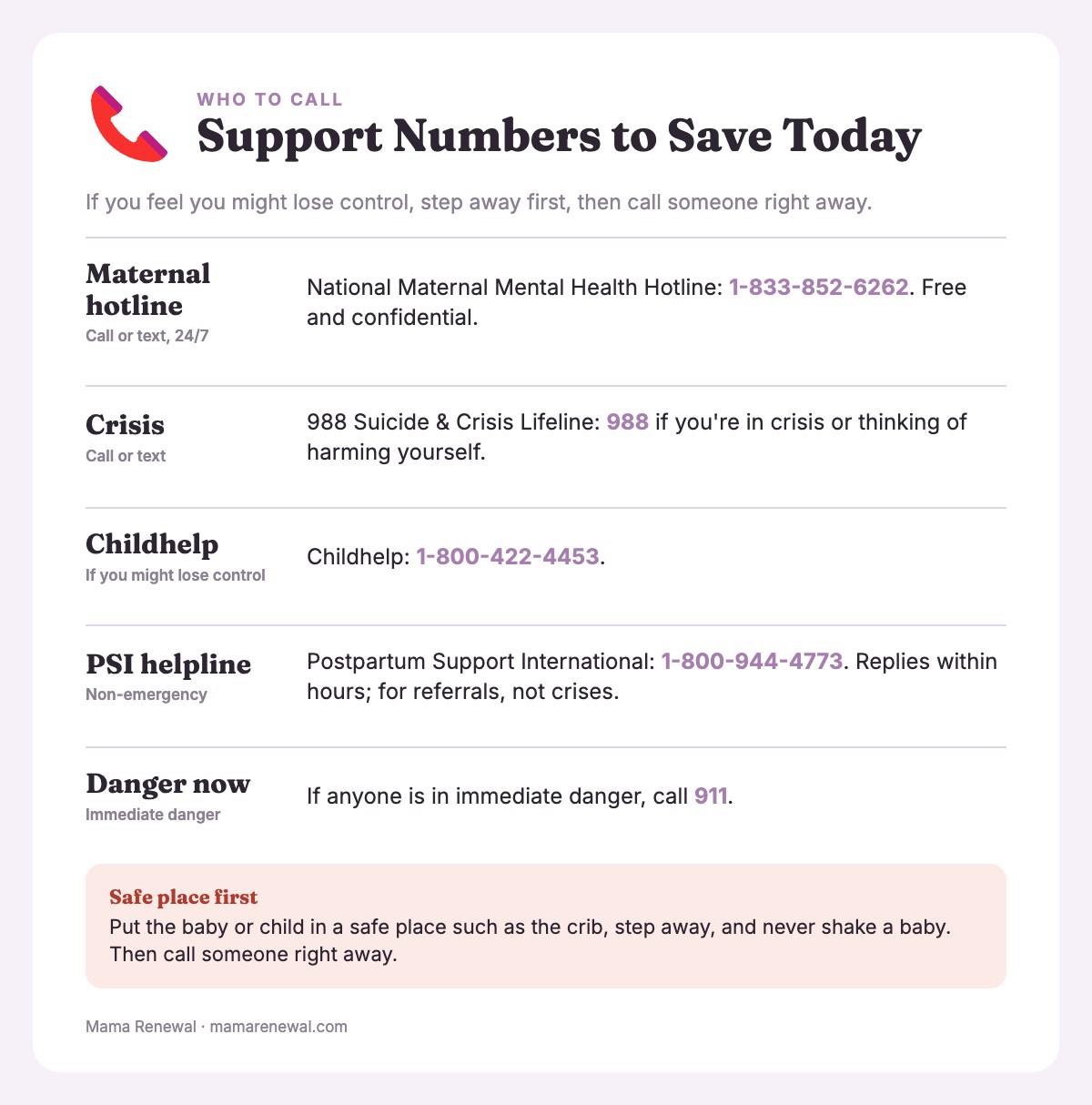
Safety firstIf you feel you might lose control, put the baby or child in a safe place such as the crib, step away, and never shake a baby. Then call someone right away: the National Maternal Mental Health Hotline at 1-833-852-6262 (call or text, 24/7), 988, Childhelp at 1-800-422-4453, or 911 if anyone is in immediate danger. Reaching out is the right move.
Please talk to a doctor or therapist if:
- Your anger is frequent, intense, or feels out of proportion to what’s happening.
- Your rage scares you, or scares your kids.
- You worry you might hurt someone, or you’ve had thoughts of harming yourself or your children.
- You feel out of control or like you’re “not yourself.”
- You also feel persistently sad, hopeless, numb, anxious, or unable to enjoy anything.
- Your rage started or got worse after having a baby, or it follows a clear hormonal pattern.
- You’re not sleeping, even when you have the chance.
- You’re using alcohol or other substances to cope.
- Your anger is affecting your relationships, your work, or your daily life.
Rage can be connected to a lot of things, including postpartum depression or anxiety, hormonal changes, and thyroid issues. ADHD, trauma, chronic sleep deprivation, and perimenopause can play a part too. A professional can help sort out what’s going on and offer real treatment: therapy, medication where appropriate, practical support. None of that makes you weak. It makes you a person who deserves help.
Your trigger log can be a great thing to bring to an appointment. “Here’s what I’ve noticed over two weeks” gives a provider a much clearer picture than “I’ve been really angry lately.”
If you’re in the US and need to talk to someone right now:
- National Maternal Mental Health Hotline: 1-833-852-6262 (call or text, 24/7). Free, confidential support for pregnant and postpartum moms.
- 988 Suicide & Crisis Lifeline: call or text 988 if you’re in crisis or having thoughts of harming yourself.
- Emergency: if you or anyone is in immediate danger, call 911.
- Postpartum Support International Helpline (non-emergency): 1-800-944-4773 (call or text). Messages are returned within hours, so use it for referrals and support rather than a crisis.
If your kids are older and you’re past the postpartum years, you still count. Call 988 in a crisis, and start with your own doctor for everything else.
If you’re outside the US, your doctor or local health service can point you to the right number. You don’t have to be “bad enough” to reach out. Wanting things to feel better is enough.
Your Anger Is Information, Not a Verdict
If there’s one thing I’d want you to take from this post, it’s that your anger is information. It isn’t a verdict on your character.
For some moms, rage can be the loudest signal of something under the surface: exhaustion, unmet needs, overwhelm, resentment, grief, too much for too long with too little support. It can also have medical or hormonal causes, which is why a professional is worth involving if it persists. When we only focus on controlling the behavior, we skip over the message. A trigger log lets you listen to the message, patiently, with a pen in hand.
You can be a loving, devoted mother and still have a day where you lose it. You can be doing your best and still be running on fumes. Both can be true. The work isn’t becoming a different person. It’s slowly building a life, and a body, with more margin in it.
Frequently Asked Questions
What triggers mom rage most often?
It’s usually a stack rather than one cause. The most common ones are hunger, sleep debt, noise, time pressure (mornings and the 4 to 6 p.m. window), and an unshared mental load. Use your log to find which ones are yours.
How do I track anger triggers without it feeling like homework?
Keep it tiny. Jot a few words in your phone’s notes app or a voice memo whenever you feel a surge: the time, what set it off, what your body felt like, and what helped. Two minutes at the end of the day is enough. You don’t need full sentences, and you don’t need to do it daily. Missing days is fine. If it starts to feel like another thing to fail at, simplify it further, or just track the one pattern you’re most curious about.
How long should I keep a mom rage trigger tracker?
One week gives you a first look, and two weeks is usually enough to see real patterns. After that, many moms pause and then log again during harder stretches, like a new school year, a sleep regression, or the holidays. You don’t have to track forever. The goal is to learn your patterns and warning signs so you can respond earlier, not to keep a permanent record of your worst moments.
What if I don’t notice any pattern in my log?
That’s useful information too. Try adding the quick-check questions (had you eaten, how did you sleep, were you alone at all today) and keep logging for another week or two. Some patterns only show up across a longer span, like a monthly hormonal cycle. If your anger feels random, intense, or out of proportion even after tracking, that’s a good reason to bring your log to a doctor or therapist, who can look at the bigger picture with you.
Is it normal to feel rage as a mom, or is something wrong with me?
Feeling intense anger sometimes is very common among mothers, and it doesn’t make you a bad mom. But if it’s frequent, feels out of control, scares you or your kids, or comes with sadness, anxiety, or numbness, talk to a doctor or therapist. Treatable issues can show up as anger, and help is available.
What should I do right after I’ve yelled at my kids?
Take a breath, get to a safe, calm spot, and then repair. Get down to your child’s level and keep it simple. Name what happened (“I yelled, and that was scary”). Take responsibility (“That’s not okay, and it’s not your fault”). Then reconnect (“I love you, can I have a hug?”). Skip the long, guilt-heavy apology that makes your child comfort you. Later, jot the moment in your log, including the time, trigger, and body signs, so you can learn from it without punishing yourself.
Can a trigger log replace therapy?
No. A log can show you patterns and warning signs, but it can’t diagnose or treat anything. If your anger is frequent, intense, or frightening, please see a doctor or therapist, and bring your log along as specific examples.
You’re Learning Your Own Weather
The next time the fuse gets short, you won’t have to wonder what’s wrong with you. You’ll have a page that says: it’s 5 p.m., you haven’t eaten, the house is loud, and your jaw is already tight. That’s not a flaw. That’s weather, and weather can be planned for.
Start with one week and a few honest lines each day. Be curious, not cruel. Notice what you notice. And if the weather is more storm than you can handle alone, reach out to a doctor or therapist. You don’t have to carry this by yourself, and asking for help is one of the strongest things a mother can do.