A Printable Sunday Self-Care Planner to Reset Your Week
Use this free printable Sunday Self-Care Planner to schedule one small self-care action for yourself each day. Spend just 15 minutes on Sunday to plan your week, ensuring your needs are met and preventing burnout.
- Download your free printable Sunday Self-Care Planner to reset your week.
- Dedicate 15 minutes each Sunday to plan your self-care for the upcoming week.
- Schedule one specific self-care action daily, with an exact time and place.
- Include a 5-minute backup plan for each action, and note potential obstacles.
- Make your self-care visible to others by writing it down in your schedule.
This post contains affiliate links. As an Amazon Associate I earn from qualifying purchases.
Last Sunday at 4:40 p.m., I stood in my kitchen holding a granola bar and a permission slip due Monday. I realized I hadn’t done one single thing for myself in nine days.
So I wrote seven days on the back of that slip and one small thing next to each. This page is that scrap of paper, cleaned up: a printable weekly planner, a 15-minute way to fill it in, a menu of ideas by time and energy, and three sample weeks. One small thing per day, written down with a time next to it, is small enough to survive a bad day.
Free printable · 6 pages
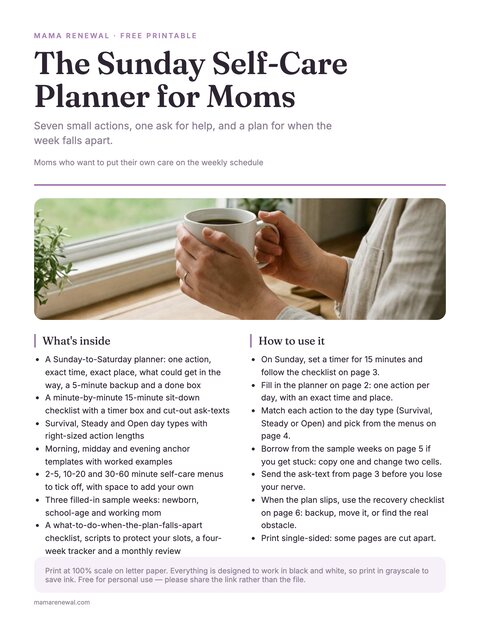
Sunday Self-Care Planner for Moms
A weekly planner with time, place, obstacle and 5-minute backup columns, a 15-minute Sunday sit-down guide, three day types, anchor templates, 2-5, 10-20 and 30-60 minute self-care menus, three filled-in sample weeks, recovery tools and a monthly review.
Free. Your download link appears right here. You'll also join the Mama Reset. Unsubscribe anytime. Privacy
In this article (11 sections)
- The Sunday Self-Care Planner (Print It or Copy It)
- Why Plan Your Self-Care Each Week
- How to Fill It Out in 15 Minutes (Without Overthinking)
- A Menu of Self-Care Actions, Sorted by Time and Energy
- Three Sample Weeks for Three Different Seasons
- Add One Daily Anchor (Optional)
- What to Do When the Plan Falls Apart
- Protecting Your Slots (Because Other People Will Fill Them)
- When Self-Care Isn’t Enough
- Frequently Asked Questions
- Your Weekly Self-Care Planner: Start This Sunday
The Sunday Self-Care Planner (Print It or Copy It)
Download the free PDF near the top of this page and print it. If you’d rather not print, copy the table below into your notes app, a shared calendar, or a notebook. The columns are kept few on purpose, so planning doesn’t become one more chore.
Good to knowThis short version fits a notes app; the PDF adds more columns and room to write.
Week of: ____________________
My energy this week (circle one): Running on fumes / Getting by / Pretty good / Actually okay
| Day | My one action (with when and where) | 5-min backup |
|---|---|---|
| Sunday | Example: plan the week with tea, 8:30 p.m., on the back step | Do it in bed |
| Monday | ||
| Tuesday | ||
| Wednesday | ||
| Thursday | ||
| Friday | ||
| Saturday |
One thing I’m letting go of this week: ______________________________
One person I’ll ask for help from, and what I’ll ask: ______________________________
How I want to feel by next Sunday: ______________________________
In the PDF, four ideas do the work:
- One action. Write three things on Tuesday and you’ve built a to-do list, which is what you’re trying to escape.
- An exact time and place. “8:15 p.m., after I start the dishwasher, on the back step” works; “evening” doesn’t.
- An obstacle for heavy days, so swim-practice Wednesday doesn’t blindside you.
- A 5-minute backup, like five minutes of fresh air if the 20-minute walk falls apart. The tiny version still counts.
Why Plan Your Self-Care Each Week
In a house with kids, free gaps don’t appear. Everyone else’s needs arrive loudly and with deadlines. Yours arrive quietly and can be postponed, so they are.
Writing it down on Sunday changes two things.
- It removes the daily decision. “What do I even want?” is a hard question at 8:45 p.m. when you’re touched out. If Sunday-you already decided, Thursday-you just follows the note.
- It makes your time visible. A partner or grandparent can plan around “Wednesday, 7:30 p.m., walk.” A vague “I need some time” is easy to forget.
Psychologist Peter Gollwitzer’s research on implementation intentions (“if-then” plans) suggests that people are more likely to follow through when they name when and where (Gollwitzer, 1999, American Psychologist). The format is simple: “I will do X at Y time in Z place.”
Why Sunday? You’re already thinking about the week ahead. For me, Sunday evenings felt heavier because I was holding everyone’s week, not just mine. So put yourself on the schedule, next to the dentist appointment and the soccer carpool. If you want the Sunday itself to feel restful too, I wrote about that in my self-care Sunday ideas and routine post.
How to Fill It Out in 15 Minutes (Without Overthinking)
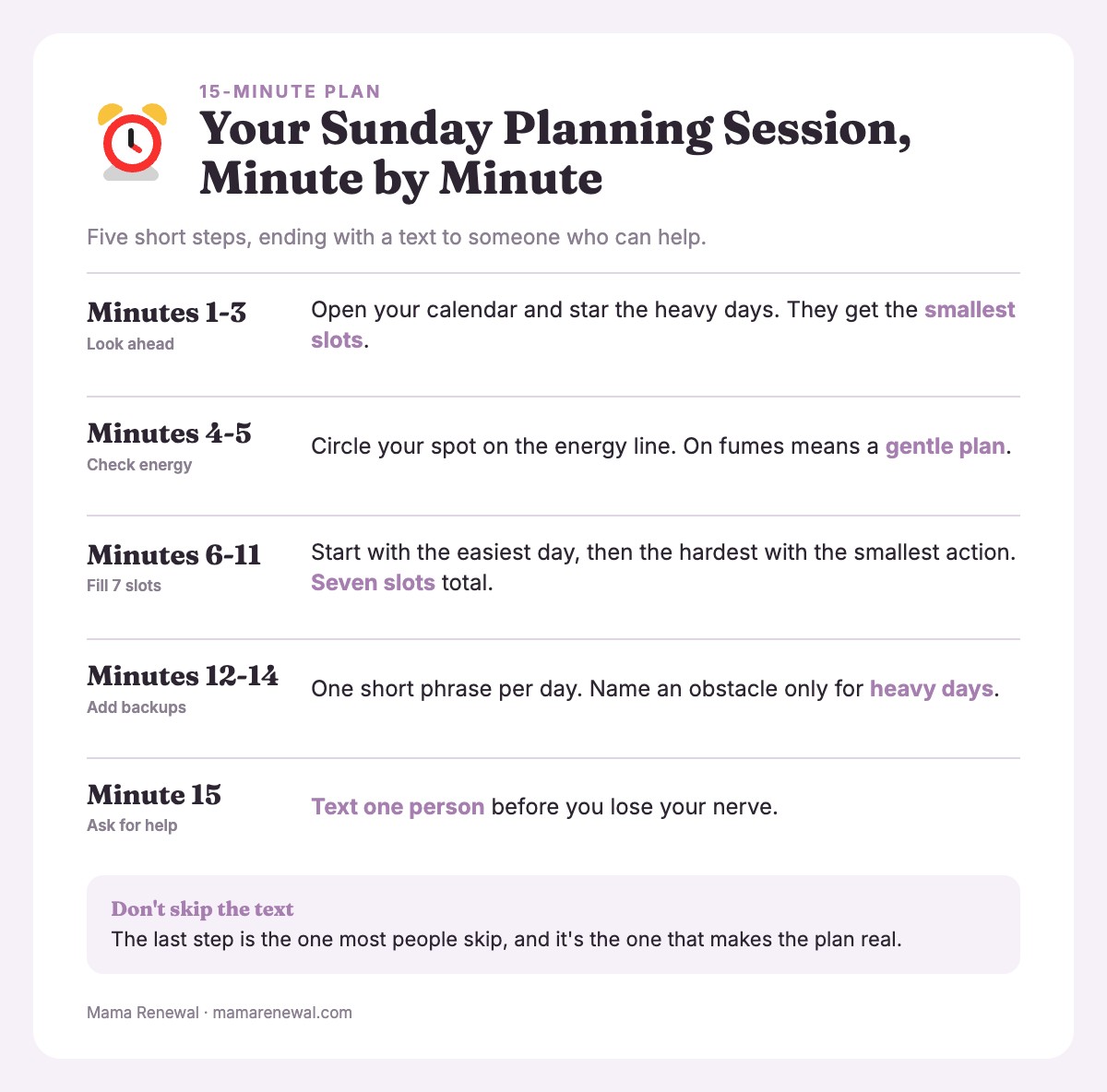
Set a timer for 15 minutes. If it takes longer, the planner is getting too complicated.
- Minutes 1-3: Look at the week ahead. Open your calendar and star the heavy days: late meetings, appointments, practice nights. Those days get the smallest slots, or a “survival” action (explained below).
- Minutes 4-5: Check your energy. Circle where you are on the energy line. On fumes means a gentle plan. Feeling decent means you can stretch a little.
- Minutes 6-11: Fill in the seven slots. Start with the easiest day, usually one with a nap-time window or a quiet morning. Then do your hardest day, with the smallest possible action. Then fill in the rest.
- Minutes 12-14: Add the backups. One short phrase per day. Name an obstacle only for your heavy days.
- Minute 15: Text one person. “Hey, can you take bedtime Thursday? I want to take a bath by myself.” Send it before you lose your nerve. This step makes the plan real.
Make the Planning Session Something You Look Forward To
- Pair it with a treat. Tea, a good coffee, the nice chocolate you hide from the kids.
- Change the spot. The car in the driveway, the tub edge or the back step all count. Away from the kitchen counter, you won’t start wiping things.
- Do a two-minute brain dump first. Write every swirling worry on a scrap of paper to make room to think about yourself. Plan after bedtime, when the house is quiet.
The Three Types of Days
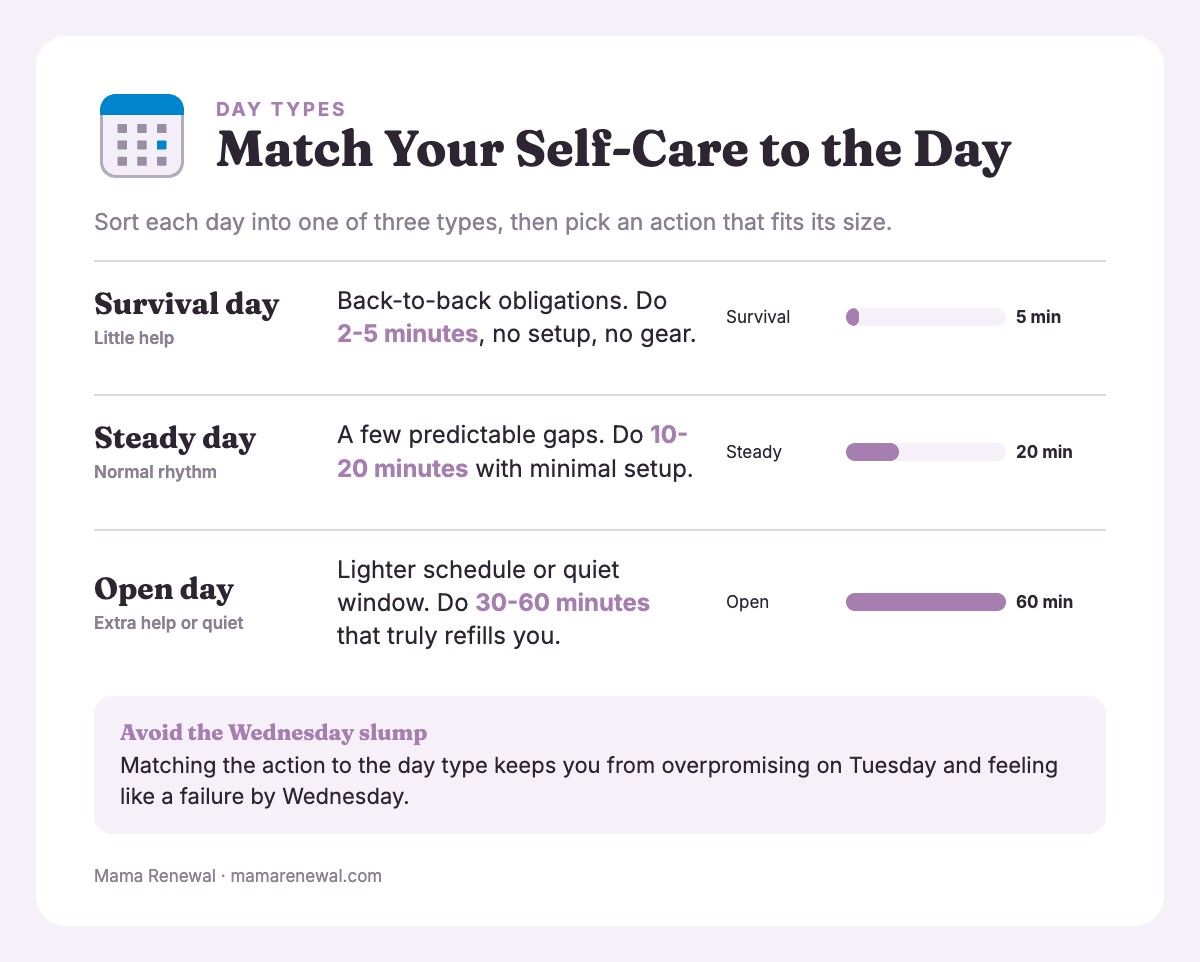
When you look at your week, sort each day into one of three types. This takes the guesswork out of choosing the right-sized action.
| Day type | What it looks like | Right-sized self-care |
|---|---|---|
| Survival day | Back-to-back obligations, little help, high chance of meltdowns (yours or theirs) | 2-5 minutes, no setup, no gear |
| Steady day | Normal rhythm, a few predictable gaps | 10-20 minutes, minimal setup |
| Open day | Extra help, a lighter schedule, or a naturally quiet window | 30-60 minutes, something that actually refills you |
In my house, a typical week has a few survival days, a few steady ones, and maybe one open day. Match the size of the action to the type of day. That’s how you avoid overpromising on Tuesday and feeling like a failure by Wednesday.

If you want more ideas for fitting small routines into a packed day, my post on a self-care routine for busy moms goes deeper on the daily rhythm side of things.
A Menu of Self-Care Actions, Sorted by Time and Energy
The most common reason a planner stalls is a blank page. You sit down and can’t think of a single thing you want to do. This menu is for that moment. Pick the menu that matches the day type, then pick any item in it.
The 2-5 Minute Menu (Survival Days)
| Action | Why it helps |
|---|---|
| Step outside and take five slow breaths | A change of scene that can help you feel calmer |
| Drink a full glass of water, sitting down | Hydration plus a built-in pause |
| Stretch your neck and shoulders against a wall | Can ease tension you’ve been carrying since morning |
| Put on lotion or lip balm slowly | Tiny sensory comfort, no setup |
| Text one friend a funny or honest line | Connection without a scheduled coffee date |
| Hide in the bathroom and do absolutely nothing | A real, legitimate break (see my post on bathroom self-care if you need ideas) |
| Listen to one song with headphones, eyes closed (only when another adult is watching the kids) | A short break in under four minutes |
Safety firstHeadphones and eyes-closed actions are only for times when another adult is watching the kids, and never while driving or walking. Breathing or resting in the car happens only when you’re parked, never behind the wheel with your eyes closed.
The 10-20 Minute Menu (Steady Days)
| Action | Why it helps |
|---|---|
| Walk around the block, phone on silent in your pocket | Movement plus quiet |
| Gentle stretching or yoga on the living room floor | Can ease muscle tension and help you unwind |
| Journal one page, unedited | Moves the mental clutter onto paper |
| Take a warm shower while another awake adult watches the kids | Warmth can help your body relax |
| Make a real cup of tea and drink it hot | Rare, and surprisingly restorative |
| Read ten pages of a book you chose | Reclaims your attention for yourself |
| Do a 10-minute tidy of one small spot, then enjoy it | A sense of control, for people who find order calming |
Safety firstWhen you walk alone, carry your phone, tell someone your route, and choose lit, familiar paths after dark. Don’t carry or sip hot drinks while holding a baby or toddler. Keep mugs out of small children’s reach.
The 30-60 Minute Menu (Open Days)
| Action | Why it helps |
|---|---|
| A bath while another awake adult watches the kids | A long soak many people find relaxing |
| A long walk, hike, or coffee alone | Space to think your own thoughts |
| A creative hour: draw, bake, knit, paint | Joy with no productivity attached |
| A nap, an actual one | Sleep is self-care, not laziness |
| A phone call with a friend who makes you feel like yourself | Time with a friend can lift your mood |
| Browsing a library or bookstore alone | Pleasure without a list |
| A workout you actually enjoy: a 30-minute class, a bike ride, or a dance session in the living room | Movement you like is easier to repeat |
Safety firstFor a bath, an awake adult stays in charge of the kids. Never leave a young child alone in or near bathwater.
With Kids Around (No Other Adult Needed)
Several menu items assume someone else is watching the kids. When no one is, try these instead.
- Step outside together and take five slow breaths
- Sit down with a glass of water while they eat their snack
- Stretch on the living room floor and let them copy you
- Read ten pages during quiet time or a show
- Play ten minutes of an audiobook or podcast on a speaker while they build blocks
If a candle and a soak aren’t restful for you, try these self-care ideas for moms who hate bubble-bath self-care, like organizing one drawer or walking the long way to the mailbox.
Three Sample Weeks for Three Different Seasons
Here are three filled-in weeks, each built for a different stage of motherhood. They show the action, the time, and the backup. Steal anything that helps and ignore the rest.
Sample Week 1: The Newborn or Baby Season
You’re sleeping in fragments. Your days have no shape. Anything over ten minutes feels impossible. Your planner’s job here is to protect tiny moments of rest and keep you connected to the world.
| Day | Action | When | Backup |
|---|---|---|---|
| Sunday | Ask for help: text one person for a 30-minute baby handoff this week | After the 3 p.m. feed | Add it to a group chat instead |
| Monday | Drink a full glass of water and eat a real snack sitting down | During first nap | Eat it standing, still counts |
| Tuesday | Step onto the porch with the baby for fresh air | 10 a.m. | Open a window |
| Wednesday | Warm shower while an awake adult watches the baby (see the safety note below) | Right after work handoff | Wash face slowly at the sink |
| Thursday | Text a friend one honest sentence about how it’s going | Any feed | Voice memo instead |
| Friday | Lie down 20 minutes, eyes closed, in your own bed (not a sofa) | Baby’s afternoon nap, or while a helper has the baby | Sit with your feet up, awake |
| Saturday | A slow walk with the stroller, no destination | Morning | Pace the living room |
Safety firstWhenever you rest or shower:
- The baby sleeps on their back on a flat, firm surface in an empty crib or bassinet. Never nap with the baby on a sofa, armchair or in bed.
- Anyone holding the baby must be awake and alert. If you’re too tired to stay awake, hand the baby to an awake adult.
- If you’re alone and can’t stay awake, put the baby on their back in their crib or bassinet, then rest nearby.
- For a shower, an awake adult watches the baby, or the baby sleeps in their crib or bassinet with a monitor on and another adult in the home.
- No one should carry hot drinks while holding a baby.
Sample Week 2: The School-Age Juggle
Your kids are in school, but your day is crammed with logistics: pickups, activities, forms, meals, homework. You’re not short on tasks. You’re short on any time that belongs to you. If this is you, the post on school-age mom burnout may feel uncomfortably familiar.
| Day | Action | When | Backup |
|---|---|---|---|
| Sunday | Plan the week (this planner) with tea | 8:30 p.m. | Do it in bed |
| Monday | Walk the block after drop-off | 8:45 a.m. | Stand at the window with coffee |
| Tuesday | Three deep breaths in the parked car before pickup, eyes open | 2:55 p.m. | Two breaths, still counts |
| Wednesday | Read 15 pages of a novel | During practice wait time | Audiobook in the car |
| Thursday | Music while cooking dinner | 5:30 p.m. | Hum a song |
| Friday | Coffee or a call with a friend | 9:30 a.m. | Voice memo exchange |
| Saturday | 45 minutes alone: a drive, a bookstore, anything | Late morning, partner on kid duty | 15 minutes in the garage |
Sample Week 3: The Work-From-Home or Working Mom Week
Your day has hard edges: meetings, deadlines, a commute or a fake commute. Self-care has to fit around a calendar that isn’t flexible. Your best friend is a “transition ritual” that separates work-mode from mom-mode.
| Day | Action | When | Backup |
|---|---|---|---|
| Sunday | Plan the week and pick one thing to let go of | After kids’ bedtime | Do it Monday at lunch |
| Monday | Walk for ten minutes at lunch, phone on silent | 12:15 p.m. | Stand outside for three minutes |
| Tuesday | Change clothes after work to mark the shift | 5:30 p.m. | Wash hands and face slowly |
| Wednesday | Stretch for 10 minutes after the kids are in bed | 8:30 p.m. | Five minutes on the floor |
| Thursday | Eat lunch away from the desk | Noon | Eat with the screen off |
| Friday | Treat: a favorite coffee or snack, on purpose | 3 p.m. | Fancy tea at home |
| Saturday | One unscheduled hour: nap, shop, or wander | Morning | Thirty unscheduled minutes |
TipCopy one of these weeks as-is, then change two cells to fit your life. That’s a finished plan.
Your energy shifts across the month and the year, so resize the plan when it stops fitting. Let the “energy this week” line at the top of the planner set the size of everything else: on fumes, the whole week is survival-size; feeling decent, add an open-day action. Your cycle changes this too, and my guide to cycle syncing for moms covers planning around it. If you’re on fumes week after week, mention it to your doctor; see the last section.
Add One Daily Anchor (Optional)
Skip this if the weekly planner is enough. If you want a small daily rhythm too, tie it to something that already happens, not to the clock. Pick one line and fill it in.
| Anchor | Fill in the blank |
|---|---|
| Morning (coffee, brushing teeth, getting dressed) | “After I ________, I will ________ for ___ minutes.” |
| Midday (lunch, school pickup, a work break) | “When I ________, I will ________ for ___ minutes.” |
| Evening (a bedtime step, like starting the dishwasher) | “Once ________, I will ________ for ___ minutes.” |
For example: After I pour my coffee, I will drink the first half standing at the window, no phone, for 3 minutes.
Add a second anchor only once the first has stuck for a couple of weeks.
What to Do When the Plan Falls Apart
It will. Probably by Tuesday. Someone will get sick, the car will need a tow, or you’ll fall asleep sitting up at 8 p.m. with the planner on your lap. The planner was built for weeks like that. To get back on track:
- Use the backup. If the 20-minute walk didn’t happen, do the five-minute porch version. It counts.
- Move it, don’t cancel it. If Wednesday’s slot is gone, slide it to Thursday. Cross out and rewrite.
- Find the real obstacle. If the same slot keeps failing, the time was unrealistic, the action was too big, or no one else knew to protect it. Fix that, not your willpower.
- Skip the guilt spiral. Guilt takes energy you’re already short on. Begin again tomorrow.
- Notice your unplanned days. If you scroll late at night when you’d rather rest, you may need a real break that never got scheduled. My guide to stopping late-night doom scrolling can help.
The goal is a week with more care in it than the last one, not a perfect seven-for-seven.
TipFour out of seven is a great week. Five is a spectacular one. If you hit two, look at what got in the way and adjust the plan, not yourself.
Protecting Your Slots (Because Other People Will Fill Them)
Other people’s requests land on whatever looks open. Here’s how to guard what you’ve written.
Tell Someone Specific and Put It on the Calendar
This is the text from minute 15 of your planning session. If you skipped it, send it now: “I’m taking a walk Wednesday at 7:30, can you do bedtime?” A time and a task are easy to say yes to.
If your household uses a shared calendar, add your slot as an appointment. Label it honestly: “Mom’s walk” or “Mom: quiet hour.” Your time deserves the same respect as a dentist visit.
Learn a Few Scripts for Saying No
The hardest part of protecting self-care is the pressure to give it up when someone else asks for a favor. A script helps. Something like: “I can’t this week. I’ve got a commitment on Wednesday evening.” You don’t owe a reason, and you don’t owe an apology. If you want more ready-made phrases, I wrote an entire post with printable scripts to protect your self-care time.
Ask for Trades, Not Favors
If you’re co-parenting, try a trade instead of a request. “I’ll take Saturday morning with the kids if you take Sunday.” Trades feel fairer and tend to hold up better than one-sided asks.
Make the First Five Minutes Easy
The hardest part of any self-care action is starting. Lay out the walking shoes. Put the book on your pillow. Set the tea mug next to the kettle. Removing one small obstacle can be the difference between doing it and meaning to.
When Self-Care Isn’t Enough
A planner helps, but it isn’t a cure for everything. Sometimes tired is just tired, and a walk will help. And sometimes what you’re feeling is bigger than a tired week.
Please talk to a doctor, therapist, or mental health professional if you notice any of these.
- You’re exhausted all the time despite resting
- You feel hopeless
- You snap more than feels like you
- You’re withdrawing from people and things you used to enjoy
- You’re having thoughts of harming yourself
These don’t mean you’re doing self-care wrong. They’re signals worth taking seriously, and help exists.
Safety firstIf you’re having thoughts of harming yourself, get help right away. In the U.S., call or text 988 (988 Suicide & Crisis Lifeline; chat at 988lifeline.org) any time. The National Maternal Mental Health Hotline (1-833-852-6262) is free and available 24/7. Postpartum Support International’s helpline is 1-800-944-4773. If you are in immediate danger, call 911. Outside the U.S., contact local emergency services or a local crisis line.
My post on World Mental Health Day and giving yourself permission to check in walks through some gentle questions to ask yourself if you’re not sure where you are.
Using a self-care planner and getting professional support are not either-or. Plenty of us do both.
If you need support right now
Reaching out is not an overreaction. These lines are free and confidential.
- Emergency: if you are thinking about harming yourself or your baby, or you can’t keep yourself safe, call 911 or go to the nearest emergency room. This is a medical emergency, and it is treatable.
- 988 Suicide & Crisis Lifeline: call or text 988, 24/7, for anyone in crisis.
- National Maternal Mental Health Hotline: call or text 1-833-TLC-MAMA (1-833-852-6262), 24/7, in English and Spanish, for pregnancy and postpartum support.
- Postpartum Support International: call or text 1-800-944-4773 for help finding a provider who specializes in perinatal mental health. Not an emergency line.
US numbers. Elsewhere, ask your doctor, midwife or local crisis line. This article was written by a parent, not a clinician, and isn’t medical advice.
Frequently Asked Questions
What should I put in a self-care planner?
One small action per day, the exact time and place, and a five-minute backup version. The planner on this page also has a quick energy check, one thing to let go of, and one person to ask for help.
How long should a weekly self-care planner session take?
About 15 minutes. Check your calendar and your energy, fill in the seven slots, add a backup for each, and text one person for help. If it regularly takes longer, plan only your three or four most important days.
What if I only have five minutes a day?
Five minutes is enough. Pick from the 2-5 minute menu above: step outside, drink a glass of water sitting down, or stretch your shoulders. A tiny action you do most days beats a big one you never get to.
What are some good self-care Sunday ideas if I have no childcare?
Choose things that work with kids nearby. Try a quiet-time hour where everyone has their own activity, a slow family walk, or a sit-down drink while the kids watch a show. Save the planning session itself for after bedtime, when the house is quiet.
How do I stick with a self-care routine when I keep forgetting?
Tie the action to something you already do every day, like pouring coffee or starting the dishwasher. Then put the plan where you’ll see it: the fridge, the bathroom mirror, or a recurring phone alert. Forgetting usually means the cue is too weak, not that you don’t care.
What if my partner or family doesn’t respect my self-care time?
Make the request specific and put it on a shared calendar. “I’m walking Wednesday from 7:30 to 8:00, can you handle bedtime?” is easy to say yes to. Offer a trade if it helps.
If you hit repeated resistance, have a calm conversation about the mental load and how it’s divided.
Is it okay to skip a day, or even a whole week?
Yes. Some weeks are survival weeks, and that’s allowed. If you miss a day, use the backup or move the action. If you miss a week, start fresh next Sunday. Four out of seven is a great week.
Your Weekly Self-Care Planner: Start This Sunday
You don’t need a perfect routine, a free weekend, or a village that shows up on cue. You need a pen, fifteen minutes on a Sunday, and the willingness to put yourself on the list alongside everyone else you take care of.
Print the PDF or copy the planner into your notes app. Fill in one small thing for each day. Pick the exact time. Name the obstacle. Text the person who can help. Then let the week be what it is, knowing you’ve already put yourself in it.
On the nights it falls apart, use the five-minute version. On the nights it works, notice how it feels. And next Sunday, sit down with a warm drink and start again.
You deserve to be on your own schedule. Start with Sunday.