
Boundaries at Work for Burned-Out Working Moms
This article helps burned-out working moms set effective work boundaries by teaching you how to decide your limits, state them clearly, offer alternatives, and close calmly, with practical scripts and a one-week plan.
- Decide your work limits in advance, not in the moment.
- State boundaries plainly, offer alternatives, and close calmly.
- Categorize limits into non-negotiables and flexible-with-notice.
- Recognize burnout signs like constant email checking or dread.
- Use scripts, a limits worksheet, and a one-week starter plan.
Picture a mom named Dana. It’s 5:10 on a Tuesday when her phone buzzes in the daycare pickup line. Her manager wants a “quick” call. It runs twenty-five minutes, past the 5:30 close, while a patient teacher walks her daughter to the curb.
That gap between what your job expects and what your family needs is what a work boundary is for. Here is how to set boundaries at work as a working mom: decide your limit in advance, state it plainly, offer an alternative, and close calmly. Below you’ll find a limits worksheet and word-for-word scripts for pickup times, after-hours messages, PTO and coworkers. You’ll also find what to do when burnout needs more than a boundary, plus a one-week starter plan to put it into practice.
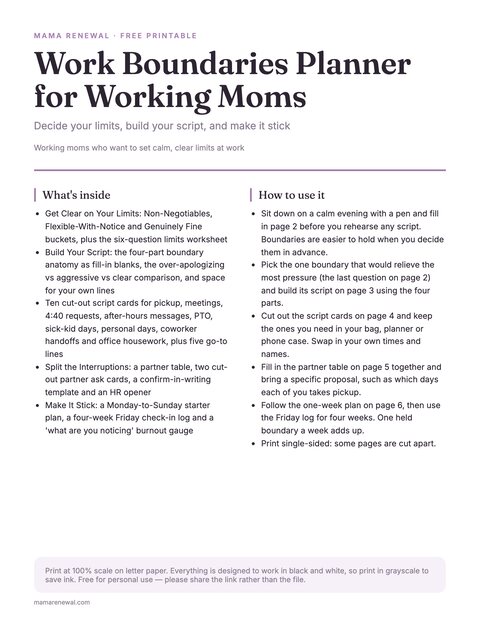
Free printable · 6 pages
Work Boundaries Planner for Working Moms
A limits worksheet with three buckets and six questions, a four-part script builder, ten cut-out script cards, a partner interruptions table, a one-week starter plan, a four-week Friday check-in log, a burnout gauge and a confirm-in-writing template.
Free. Your download link appears right here. You'll also join the Mama Reset. Unsubscribe anytime. Privacy
In this article (15 sections)
- Why Setting Boundaries at Work Is Harder for Working Moms
- Signs of Working Mom Burnout and Overwhelm
- First, Get Clear on Your Actual Limits
- The Anatomy of a Good Work Boundary
- Scripts for Setting Work Boundaries Around Pickup Times
- How to Set Boundaries Around After-Hours Emails and Messages
- How to Ask for PTO and Sick Days
- Scripts for Handling Coworkers Who Dump Work on You
- How to Split Work Interruptions With Your Partner
- When the Boundary Isn’t Enough: Burnout That Needs More Support
- How to Keep Your Work Boundaries Going Long-Term
- When You’re Worried About Retaliation or Judgment
- Your One-Week Starter Plan
- Frequently Asked Questions
- Your Next Step: Start With One Work Boundary
Why Setting Boundaries at Work Is Harder for Working Moms
Most boundary advice assumes work is neutral ground. For moms, it rarely is.
- You’re auditioning against a stereotype. Many moms feel pressure to prove that kids haven’t made them less committed. A boundary can feel like confirming the stereotype.
- Your time is spoken for on both ends. Daycare closes at 5:30 whether or not the project is done. Yet leaving at 4:45 can get treated as leaving early.
- You’re the default parent for logistics. The school nurse calls you, so interruptions come from both directions. More on that in school-age mom burnout.
- The paycheck matters. Many moms can’t afford to be seen as difficult. That’s why the scripts below are calm, specific, and solution-oriented.
Signs of Working Mom Burnout and Overwhelm
Working mom overwhelm rarely arrives as one dramatic breakdown. It shows up as small, repeated signs that are easy to explain away:
- You check work email in bed, in the bathroom, and in the pickup line, and never feel fully off.
- You feel a flash of dread when your phone buzzes after hours.
- Sunday afternoons feel like a countdown instead of a rest.
- You’re irritable with your kids in the evening, and then guilty about it, and then more tired.
- You daydream about being a little bit sick so that someone would give you permission to rest.
If you recognize several of these, that’s not a character flaw. It’s a signal. Your system is running with no margin.
If your body feels permanently braced, nervous system regulation can help alongside the boundary work here.
First, Get Clear on Your Actual Limits
Most of us try to set a boundary in the moment, with our heart pounding, in response to a request. That’s the hardest possible time to do it. Boundaries are much easier to hold when you’ve decided them in advance, on a calm evening, with a pen in your hand.
So before you rehearse any script, spend ten minutes sorting your reality into three buckets.
The Non-Negotiables
These are the hard limits where something real breaks if you cross them. Examples:
- You must sign off at 4:45 to make a 5:15 daycare pickup, before the 5:30 close.
- Or, if yours is a school pickup instead, you can’t be on calls from 3:00 to 3:30.
- You’re unavailable Wednesday mornings because of a recurring appointment.
- You don’t work on your child’s weekly activity night.
Keep this list short. Three to five items. If everything is non-negotiable, nothing is.
The Flexible-With-Notice Items
These are things you can do, but need a heads-up or a trade. For example:
- You can take an occasional late call if you know a day ahead, so you can arrange backup care.
- You can cover for a coworker’s deadline if you can flex your hours another day.
- You can attend an early meeting twice a month, but not every week.
The Genuinely Fine
Be honest here, too. There may be things that feel like obligations but actually don’t bother you much. Maybe you don’t mind a quick Slack reply at 8:00 pm if it’s rare and takes thirty seconds. Boundaries are not about rejecting everything. They’re about spending your limited energy on purpose.
The free Work Boundaries Planner (above) includes a printable version of this worksheet, with room to write.
| Question | Your answer |
|---|---|
| What time do I absolutely have to leave, and why? | |
| Which hours are completely off-limits for work contact? | |
| Which days or windows are fixed (pickups, appointments)? | |
| What can I flex, and what do I need in exchange? | |
| What am I currently doing “for free” that no one ever asked for? | |
| Which one boundary would relieve the most pressure right now? |
That last question matters most. You don’t need to overhaul your whole work life at once. Pick one.
The Anatomy of a Good Work Boundary
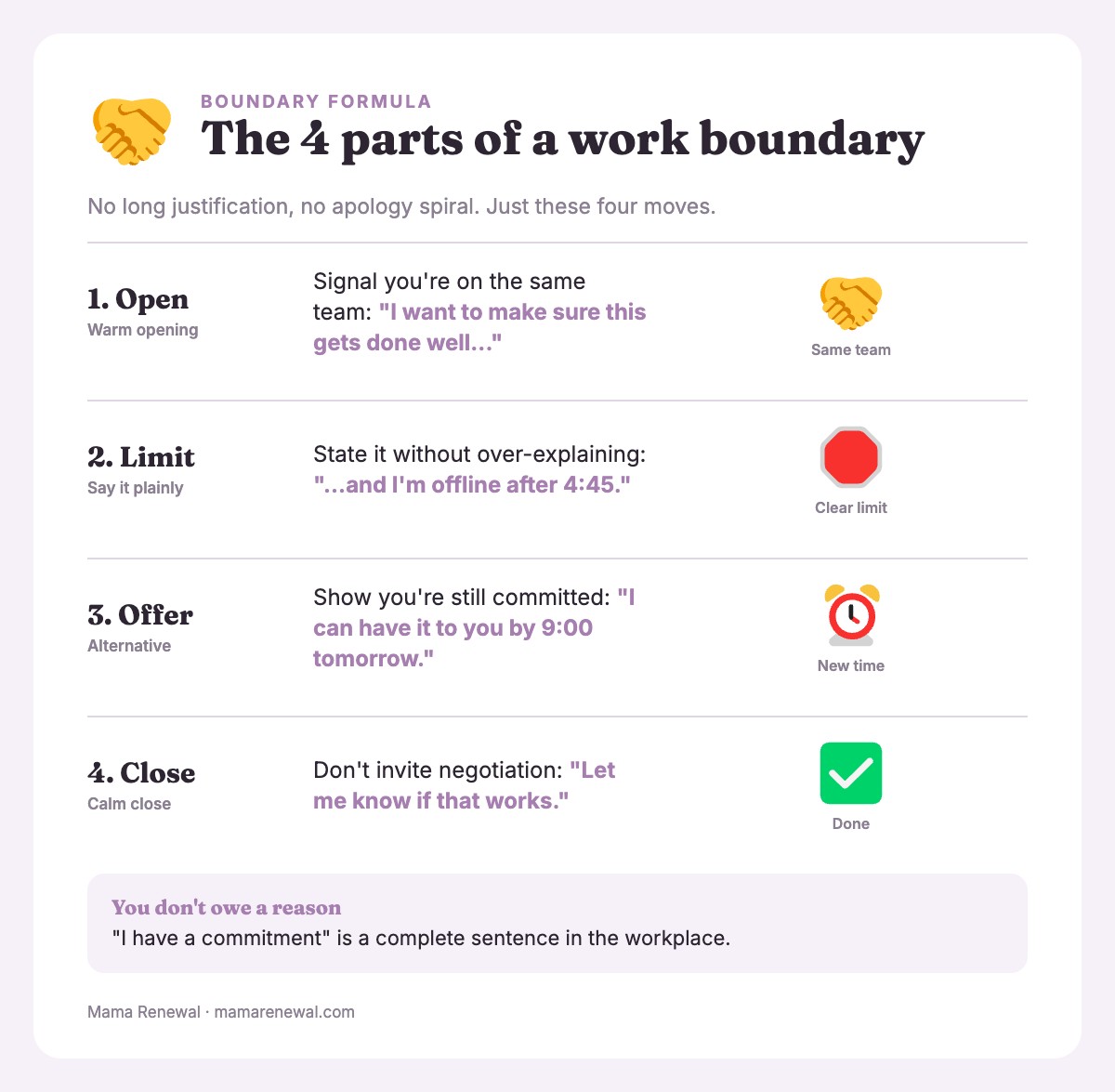
A workplace boundary that sticks tends to have four parts. Once you know them, you can build a script for nearly any situation.
- A warm opening. Signal you’re on the same team: “I want to make sure this gets done well…”
- The clear limit. State it plainly, without over-explaining: “…and I’m offline after 4:45.”
- An alternative. Show you’re still committed: “I can have it to you by 9:00 tomorrow.”
- A calm close. Don’t invite negotiation: “Let me know if that works.”
There is no long justification, no apology spiral, and no confession about your childcare situation. You can give a reason, but you don’t owe one. “I have a commitment” is a complete sentence in the workplace.
The same boundary can land very differently depending on the wording.
| Version | What it sounds like | What usually happens |
|---|---|---|
| Over-apologizing | “I’m so sorry. I hate to be a problem. I might possibly need to leave a bit early…” | Sounds like asking permission. Easy to push back on. |
| Aggressive | “I’m not answering messages after 4:45. Period.” | Can create defensiveness, even if the limit is fair. |
| Clear and collaborative | “I’m offline after 4:45. If it’s time-sensitive, I’ll handle it first thing at 8:30.” | Reads as professional. Gives them a path forward. |
You’re aiming for the third one every time.
Scripts for Setting Work Boundaries Around Pickup Times
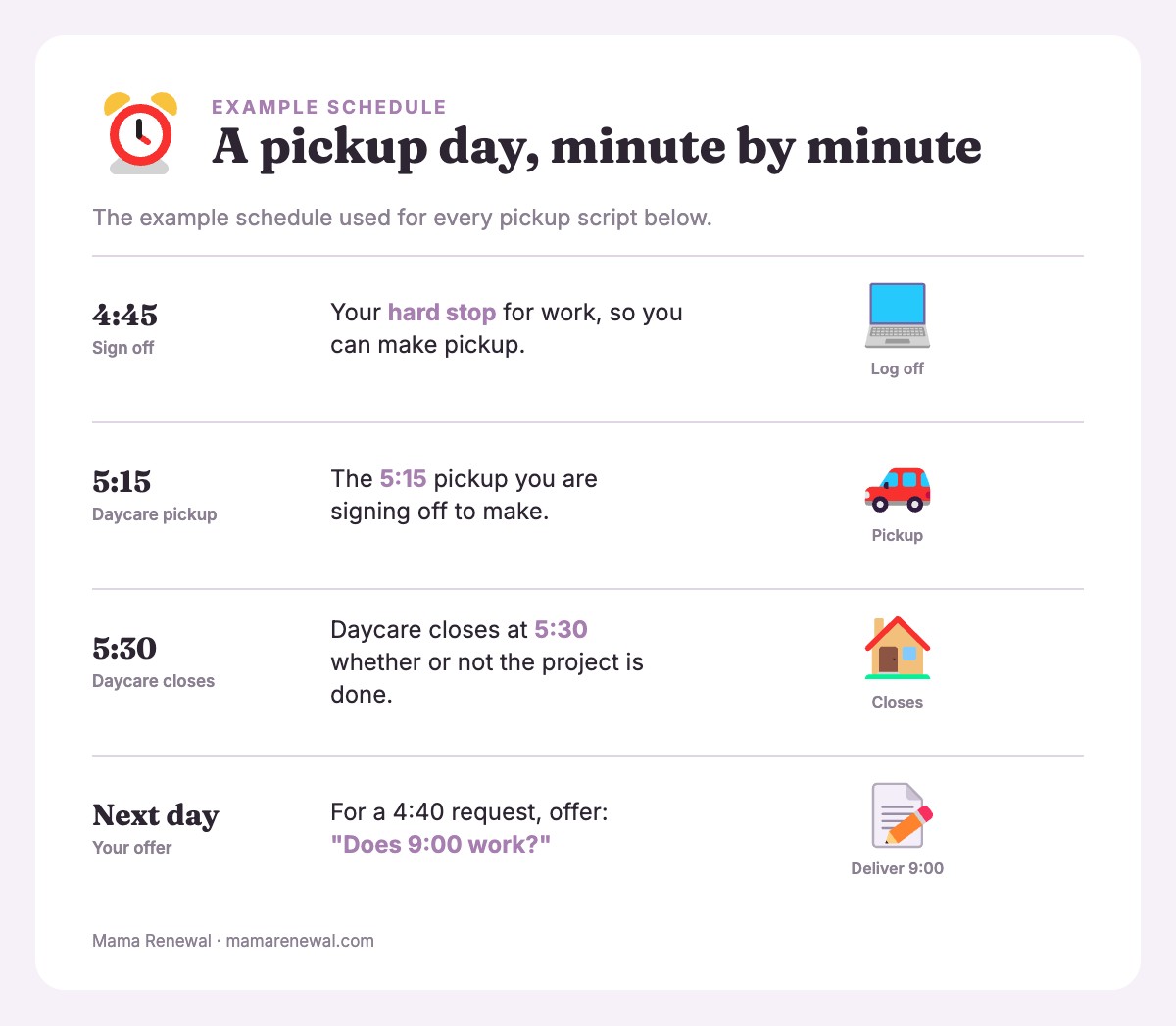
Pickup time is where so many working moms get cornered, because the constraint is real and a child is waiting on a curb.
These scripts use one example schedule: a 4:45 sign-off for a 5:15 daycare pickup, before a 5:30 close. Swap in your own times. The table gives short versions, and fuller scripts for most of them follow.
| Situation | Short script |
|---|---|
| Standing limit | “I sign off at 4:45 most days and I’m committed to my deliverables.” |
| Meeting at pickup | “I have a hard stop at 4:45. Could we move it earlier?” |
| Request at 4:40 | “I can have it first thing tomorrow. Does 9:00 work?” |
| Coworker schedules late | “I’m unavailable after 4:45. Could you send invites earlier?” |
| School emergency | “I need to pick up my child. I’ll check in at [time].” |
Telling your manager about a standing limit
If you haven’t formally set this expectation, don’t wait until a conflict forces it. Raise it proactively, in a calm one-on-one.
“I wanted to flag something about my schedule so there are no surprises. I have a fixed pickup at 5:15, so I’ll be signing off at 4:45 most days. I’m fully committed to my deliverables, and I’m happy to make up time in the early morning on occasion. Can we talk about how to make that work for the team?”
When a meeting is scheduled during pickup
“Thanks for setting this up. I have a hard stop at 4:45 on weekdays. Could we move it to 2:00 or 3:00? If this time is the only one that works for everyone, I’m glad to read the notes and send my input beforehand.”
Offering to contribute asynchronously can be a strong move. It shows you still care about the outcome while protecting the window.
When a request lands at 4:40
“I can’t take that on before I head out at 4:45, but I can get it done first thing tomorrow morning. Does 9:00 work, or does it need to land sooner?”
If the answer is “it needs to land tonight,” you now have real information to make a judgment call, rather than silently absorbing the urgency.
When you have a school emergency
Even with great boundaries, kids get sick. A short, calm message is better than a long, guilty one.
“I need to step away to pick up my child who isn’t feeling well. I’ll check in at [time] and will make sure [specific task] is covered or handed off. Thanks for understanding.”
You don’t need to narrate symptoms. You don’t need to over-promise. Just state what’s covered and when you’ll be back in touch.
A note on the guilt
Even with perfect words, your stomach may drop after you send these messages. The discomfort means the boundary is new, not that it’s wrong. For many moms, the first week feels worse than the second. If the guilt is loud, these scripts for saying no have more language for sitting with it.
If your inner voice says boundaries make you a worse employee or a worse mom, try two reframes.
- A boundary is information. It tells people how to work with you successfully.
- A boundary is modeling. Watching you protect your time teaches your kids it’s okay to protect theirs.
My broader post on boundaries for moms digs into the deeper roots of that guilt.
How to Set Boundaries Around After-Hours Emails and Messages
This is the boundary many working moms struggle to hold, because it’s so easy to erode. One quick reply at 9 pm becomes an expectation of replies at 9 pm.
Start by changing your own behavior
Before you ask others to respect your hours, make sure your own signals are consistent. If you reply at 10 pm on Monday and then ignore messages on Tuesday, people can’t tell what to expect.
- Remove work email from your personal phone, or at least turn off notifications after hours.
- Use scheduled send. If you do write something at night, schedule it for 8:30 the next morning so you’re not training people to expect night replies.
- Set your status. A simple “Offline 4:45 pm to 8:30 am, will respond next business day” in Slack or Teams does a lot of work for you.
- Add a line to your email signature if it fits your workplace: “I respond during business hours.”
Telling your manager about after-hours availability
“I want to be upfront about how I work best. I’m fully reachable between 8:30 and 4:45, and I’m offline in the evenings so I can be present with my family. For true emergencies, call me directly and I’ll pick up. For everything else, I’ll respond first thing the next morning.”
TipThe “call me directly for true emergencies” line is your pressure valve. It gives your manager a way to reach you when it matters, so they accept the rest of the boundary more easily. Many “urgent” messages turn out not to need a phone call.
When a manager routinely messages at night
Some managers send late messages simply because that’s when they work. They may not expect an immediate reply. It’s worth checking rather than assuming.
“I noticed you sometimes send messages in the evening. Just so I understand the expectation, do you need responses the same night, or is morning fine? I want to make sure I’m meeting your needs.”
That question turns a refusal into a clarification. Some managers are only clearing their own inbox and are happy with a morning reply.
When someone pushes back
“I understand it’s urgent for you. I’m not able to be reachable tonight, but I can prioritize it first thing at 8:30. If that timeline doesn’t work, can we talk about who else could cover?”
Repeat the limit calmly, offer the alternative, and stop. You don’t have to win the argument. You just have to stay consistent.
| Situation | Short script |
|---|---|
| Non-urgent message at 8 pm | No reply until morning. Or: “Got this. I’ll take care of it first thing.” |
| “Urgent” message, unclear | “Is this needed tonight, or can it wait until 8:30 tomorrow?” |
| Weekend request | “I’m offline this weekend. I’ll pick this up Monday morning.” |
| Manager expects constant availability | “Let’s agree on what counts as an emergency and how to reach me for those.” |
| Group chat spiraling at night | Mute notifications. Respond in the morning. |
How to Ask for PTO and Sick Days
Taking time off shouldn’t require a defense. Yet so many of us feel we need to justify every day. Working moms often burn PTO on school holidays, sick kids, and appointments. Then we never take a day for ourselves.
Requesting planned time off
“I’d like to take [dates] off. I’ll make sure [project] is on track before I go and will share a handoff doc with [coworker] by [date]. Let me know if you need anything else from me ahead of time.”
There’s no “if that’s okay” and no explanation of where you’re going. You’re giving notice and a plan, not asking for permission. (If your workplace requires approval, the structure still works: “I’d like to request…”)
Protecting your PTO from being interrupted
If you’re on vacation, the boundary needs to be set before you leave.
“I’ll be out [dates] and fully offline. [Coworker] is my backup for anything urgent. I’ll respond when I’m back on [date].”
Set an out-of-office that says the same thing. Then stay offline. One “just to peek” reply tells people the message is optional.
Taking a sick kid day
“My child is sick and I need to stay home today. I’ve handed off [task] to [coworker]. I’ll be reachable for anything critical, but I’ll be limited. I’ll catch up on the rest tomorrow.”
Taking a mental health day
This one is harder because it can feel like you have to be “sick enough.” You don’t. A simple message works:
“I’m taking a personal day today. I’ll be offline and back tomorrow.”
Good to knowCheck your employer’s policy and local leave laws. Some workplaces require documentation for sick leave, and not all offer personal days.
In the US, FMLA leave generally requires a qualifying reason such as a serious health condition, and ADA accommodations require a qualifying disability. Eligibility also depends on your employer’s size and how long you’ve worked there. Rules differ outside the US.
The WHO describes burnout as an occupational phenomenon, not a medical condition, so burnout alone may not qualify under some leave rules, though a diagnosed condition such as depression or anxiety might. HR can tell you which rules apply, and a doctor can assess your health.
Scripts for Handling Coworkers Who Dump Work on You
Not all boundary challenges come from managers. Sometimes it’s the peer who dumps tasks on you. Sometimes it’s the colleague who treats you like the office’s emotional support person, or the meeting that could have been an email.
When a coworker keeps handing off work to you
Moms often get stuck as the “reliable one,” which quietly becomes the “default one.”
“I can’t take that on right now. My plate is full with [X and Y]. Have you checked with [other person], or would it make sense to bring it to [manager] for prioritization?”
Naming what’s on your plate makes your limit concrete. Redirecting to the right person keeps you from being the dumping ground.
When you’re asked to do the “office housework”
Office housework includes things like planning the party, taking notes, ordering lunch, or organizing the baby shower. These tasks often end up with women by default, and you may have noticed.
“I’d rather not take notes this time. Can we rotate? I’ll take the next one after [name].”
If you’ve already covered it more than once:
“I’ve done the last two. Let’s make a sign-up so it’s shared.”
Rotation works because it doesn’t single anyone out. It just makes the load fair.
When coworkers comment on your schedule
“I’m on a fixed schedule so I can handle pickups. I’m always reachable during my work hours, and I’ll get my work done.”
For a “must be nice to leave early” comment, keep it shorter still: “It works for my team and my deadlines.” Say it once, evenly, and change the subject.
How to Split Work Interruptions With Your Partner
Work boundaries rarely hold if the home front is quietly sabotaging them. If you’re the only one who can leave work for a sick kid, you’ll keep hitting the same wall, however good your scripts are.
Take a hard look at how the “work interruptions” in your household are divided:
- Who is the first call from the school?
- Who handles the schedule changes?
- Who’s on the pickup rotation when you have a big meeting?
- Who covers the sick days, and is it ever truly 50/50?
If the answer is “me, me, me, and me,” your boundary at work will eventually crack under the weight of your boundary-less home. This is a conversation, not an ultimatum. The post on communicating your needs to your partner has language for opening that conversation without it becoming a fight.
“I want to make some changes at work so I’m not so depleted, and I need your help to make it work. Can we look at the week together and figure out which pickups and sick days you can take on? I’d like to split it more evenly.”
Bring a concrete proposal, such as “You take Tuesday and Thursday pickups,” instead of a vague “I need more help.” Specifics are easier to say yes to.
When the Boundary Isn’t Enough: Burnout That Needs More Support
Boundaries are powerful, but they are not a cure-all. Sometimes the problem isn’t that you haven’t communicated your limits. Your load has been too heavy for too long, and you need more than a script.
Signs you may need more than a script:
- Exhaustion that doesn’t lift with rest.
- Detachment or cynicism about work.
- Trouble concentrating.
- Feeling like nothing you do is enough.
The table below is a rough guide, not a diagnosis. If symptoms last more than a few weeks, see a doctor, whichever row sounds like you.
| What you’re noticing | What it might point to |
|---|---|
| Tired, but a long weekend helps. | Normal depletion. Boundaries and rest may be enough. |
| Tired most days, dreading work, snapping at home. | Strain that is building. Boundaries, recovery habits and honest conversations may help. |
| Struggling to function, physical symptoms, or slipping at work. | Talk to a doctor and explore HR options. |
| Feeling hopeless, numb, or unsafe. | Get help now: call or text 988 (US) or your local emergency number, or go to the nearest ER. See the Safety first box below. |
If this is affecting your health or your work, more support might look like:
- Talking to HR about accommodations. Depending on where you work, options may include adjusted hours, remote or hybrid work, a modified workload, or leave. HR can often explain what exists. HR also represents the employer, so keep written records. To open the conversation, try: “I’d like to talk about what flexibility or support might be available, because my current workload is affecting my health.”
- Seeing your doctor. Persistent exhaustion, trouble sleeping, changes in appetite, headaches, or anxiety can have physical and emotional causes. A doctor can help you rule things out and talk through options.
- Looking into your employer’s resources. Some workplaces offer employee assistance programs, counseling sessions, or wellness benefits that go unused simply because no one mentions them.
Good to knowI’m not a doctor, and nothing here is medical advice. What I can say is that asking for help is not a failure of boundaries. It’s the next step when boundaries alone aren’t enough.
Safety firstIf you feel hopeless, numb or unsafe, or have thoughts of harming yourself, get help now. Call or text 988 (US) or your local emergency number, or go to the nearest ER. If you’re postpartum or suspect depression or anxiety, tell your doctor.
If you’re curious about the deeper pattern of ongoing depletion, Depleted Mother Syndrome explores what it looks like and how recovery can begin.
How to Keep Your Work Boundaries Going Long-Term
Setting a boundary once is easy. Holding it for six months is where the real work lives.
Start small, then stay steady
Pick the lowest-risk boundary first, like silencing notifications after 7:00 pm. When nothing catastrophic happens, you gain confidence.
Then stay predictable, because people adapt to a steady signal. Someone will probably test the new limit at first, and that’s rarely malicious. Hold your line calmly, and the testing usually fades.
Have a go-to line
When you’re caught off guard, a short, reliable phrase saves you from over-explaining. A few to keep handy:
- “Let me check my schedule and get back to you.”
- “I can’t do that today, but I can do it tomorrow morning.”
- “That doesn’t work for me. Here’s what I can do.”
- “I’m not available then. What other times work?”
- “I’ll need to say no to that one so I can do [priority] well.”
Trade, don’t just refuse
Tie a no to a yes when you can. For example: “I can take this on if we can move that deadline.” That shows you are managing priorities, not avoiding work.
Protect recovery outside of work
Work boundaries don’t help much if the time you reclaim gets swallowed by a different set of demands. Use the time you reclaim to recover. The Sunday Self-Care Planner helps you build a little restoration into the week ahead.
Check in with yourself weekly
A five-minute Friday review can keep you honest:
| Weekly check-in question | Notes |
|---|---|
| Where did I hold a boundary this week? | |
| Where did one slip, and why? | |
| What request surprised me, and how could I script it next time? | |
| What did I do with the time I protected? | |
| What’s one boundary to adjust or add next week? |
When You’re Worried About Retaliation or Judgment
Not every workplace is supportive, and not every manager responds well. Some mothers do face real penalties for setting limits, such as being passed over after a schedule change.
- Document important agreements. If your manager agrees to a schedule or an arrangement, follow up with a short email: “Thanks for chatting today. To confirm, I’ll be signing off at 4:45 and will respond to anything urgent via phone.” A written record protects both of you.
- Frame boundaries around results. Whenever possible, connect your schedule to the quality of your work: “This structure helps me stay focused and deliver on time.”
- Know your rights. Depending on where you live and work, there may be legal protections around leave, accommodations, or discrimination. If you feel you’re being treated unfairly because of caregiving responsibilities, get guidance specific to your situation. HR, a workplace-rights organization, or an employment attorney can help.
- Weigh the long game. If your workplace consistently punishes reasonable limits, that’s useful information. It may not be a place you can sustain long-term. You don’t have to leave tomorrow, but it’s okay to quietly start exploring options that fit your life better.
Keeping your job and keeping your health are not opposing goals, even when a bad workplace acts as if they are.
Your One-Week Starter Plan
If you’re overwhelmed by the options, here is a gentle seven-day way in. You don’t have to do all of it. Pick what fits.
- Monday. Fill out the limits worksheet in the free Work Boundaries Planner. Name your 3 non-negotiables.
- Tuesday. Turn off work notifications after your sign-off time.
- Wednesday. Draft your script for your most pressing boundary (pickup, after-hours, or PTO).
- Thursday. Say it once, out loud, to a mirror or a friend. Notice where it feels shaky.
- Friday. Deliver one boundary to one person, using the four-part structure.
- Saturday. Notice how it felt. Write down what happened, not what you feared would happen.
- Sunday. Plan next week’s one new step. Use the time you’ve reclaimed for something restorative.
One held boundary a week adds up. You’re teaching your workplace, and yourself, a slightly better way to operate.
If you need support right now
Reaching out is not an overreaction. These lines are free and confidential.
- Emergency: if you are thinking about harming yourself or your baby, or you can’t keep yourself safe, call 911 or go to the nearest emergency room. This is a medical emergency, and it is treatable.
- 988 Suicide & Crisis Lifeline: call or text 988, 24/7, for anyone in crisis.
- National Maternal Mental Health Hotline: call or text 1-833-TLC-MAMA (1-833-852-6262), 24/7, in English and Spanish, for pregnancy and postpartum support.
- Postpartum Support International: call or text 1-800-944-4773 for help finding a provider who specializes in perinatal mental health. Not an emergency line.
US numbers. Elsewhere, ask your doctor, midwife or local crisis line. This article was written by a parent, not a clinician, and isn’t medical advice.
Frequently Asked Questions
How do I set boundaries at work without sounding like I’m not committed?
Say what you can do and by when, not just what you can’t. Pair the limit with a delivery time, as the scripts above do. Reliable results show commitment better than constant availability.
What if my manager doesn’t respect my after-hours boundary?
First, ask whether they expect a same-night reply; many don’t. If they do, restate your availability and offer a phone call for true emergencies. If it continues and affects your health, document it and talk to HR.
Do I have to explain why I’m leaving at a certain time?
No. “I have a commitment at 5:15” is a complete and professional statement. Some moms choose to share that it’s a childcare pickup because it builds understanding, and that’s fine too. The decision is yours, and you don’t owe anyone a detailed justification.
How do I handle guilt after setting a boundary?
Expect it, especially at first. Guilt is often a sign that you’re doing something new, not that you’re doing something wrong. Remind yourself why the boundary matters. Compare what actually happened with what you feared. Then give yourself a few weeks of consistency before judging how it’s going. Talking it through with a trusted friend, partner, or counselor can also help.
When should I talk to HR or a doctor about burnout?
If your exhaustion or stress is severe enough to affect your work performance or your health, it’s reasonable to seek more support. HR may be able to discuss accommodations like adjusted hours, workload changes, or leave. A doctor can help you look at physical and emotional contributors and discuss next steps. If you ever feel hopeless or unsafe, call or text 988 (US) or your local emergency number, or go to the nearest ER. This article is not medical advice.
What if I can’t afford to risk my job by setting boundaries?
That’s a real constraint, and it’s okay to be strategic. Start with the lowest-risk boundaries, like silencing notifications at night, and put key agreements in writing. If your workplace punishes reasonable limits, it’s valid to quietly explore other options over time.
How do I get my partner to share the work-related parenting interruptions?
Bring a concrete proposal rather than a general complaint. Look at the week together and assign specific days for pickups, sick-day coverage, and school calls.
Your Next Step: Start With One Work Boundary
If you’ve made it this far, you’re probably carrying more than anyone at your office sees. You’re doing two jobs with one set of hours. You’ve been quietly paying for the gap with your sleep, your patience, and your peace.
You don’t have to fix it all at once. Pick one boundary, one script, one conversation. Say it kindly, say it clearly, and let it hold. If it wobbles, adjust and try again. If the weight is bigger than boundaries can carry, reaching out to HR or a doctor is not giving up. It’s taking yourself seriously.
You’re allowed to be a committed professional and a person with limits. You always were.