Self-Care for Single Moms When There’s No One to Tag In
This guide offers self-care strategies specifically for solo parents who lack a partner for support. You'll learn how to manage self-care with kids present, build backup, and create a sick-day plan tailored to your unique reality.
- Learn self-care strategies designed for solo parents, without a partner to tag in.
- Discover how to find time pockets for self-care, even with kids in the room.
- Develop a robust backup plan and a sick-day strategy for when you're down.
- Establish a weekly rhythm using 'three anchors' to prioritize your well-being.
- Utilize the free Solo Mom Self-Care & Backup Planner for practical tools.
This post contains affiliate links. As an Amazon Associate I earn from qualifying purchases.
It was a Tuesday in February, and I had a fever of 101. I was lying on the bathroom floor because the tile was cool and nobody was in there asking me for anything.
Then I did the math every solo parent knows by heart. There was no one to call and no one to hand the kid off to. There was me, a thermometer, and a seven-year-old who needed breakfast at 6:45 whether I was dying or not.
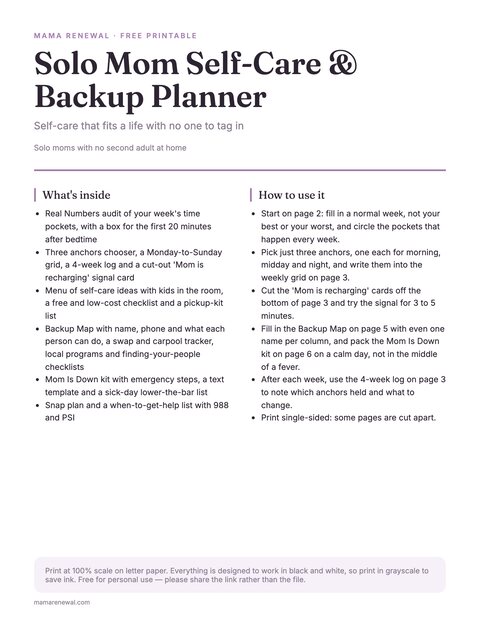
Free printable · 6 pages
Solo Mom Self-Care & Backup Planner
A time-pocket audit, a three-anchor weekly rhythm, a cut-out 'Mom is recharging' card, a Backup Map, a Mom Is Down kit and a snap plan with a 4-week check-in log.
Free. Your download link appears right here. You'll also join the Mama Reset. Unsubscribe anytime. Privacy
I’d read plenty of self-care articles by then, and nearly all of them hid the same step in the middle: ask your partner to watch the kids. This guide assumes there is no second adult. Maybe you’re divorced, widowed, solo by choice, or partnered on paper only. It covers self-care with kids in the room, finding time pockets, the body basics, building backup, the emotional side, a sick-day plan and a weekly rhythm. Start with the three anchors below.
In this article (13 sections)
- Why the Usual Self-Care Advice Falls Apart for Solo Moms
- Start With the Real Numbers, Not the Ideal Ones
- Self-Care With Kids in the Room: Ideas for Single Moms
- Self-Care in the Margins: The Pockets You Already Have
- The Body Basics (Sleep, Food, Movement) With No Backup
- Building Backup That Isn’t a Partner
- Self-Care on a Tight Budget
- The Emotional Side: Guilt, Loneliness, and the Snap
- Sick-Day Plan for Single Moms With No Backup
- A Realistic Weekly Rhythm
- What “Enough” Looks Like
- Frequently Asked Questions
- You Don’t Have to Do This Perfectly
Why the Usual Self-Care Advice Falls Apart for Solo Moms
Most mainstream self-care advice quietly depends on three things you may not have: a second adult, spare money, and spare time. Take any one of those away and the advice stops working. Take all three away and it starts to feel insulting.
Here’s where the standard tips break down:
| The usual advice | The hidden assumption | What actually happens when you’re solo |
|---|---|---|
| “Take a night off while your partner handles bedtime.” | A second adult is home and willing. | Nobody else can handle bedtime. |
| “Book a weekend getaway.” | Childcare for 48+ hours exists. | Not an option, and the guilt tax is huge. |
| “Hit the gym 4x a week.” | Someone can watch the kids, or you can afford a gym with childcare. | Costs money and logistics you don’t have spare. |
| “Just ask for help!” | A reliable helper exists. | You’ve asked, and the answer was “I wish I could.” |
| “Go to bed earlier.” | The house is quiet after you stop. | You stop at 9:30, and only because the dishes are finally done. |
| “Do a monthly spa day.” | Time and money and coverage. | See above. Three strikes. |
The problem here isn’t your effort. The advice was built for a different household structure, and you’re being graded on a curve that doesn’t fit you.
So the first reframe, and the one that matters most: solo-parent self-care is not a smaller version of two-parent self-care. It’s a different design problem. You can’t get time away from your kids reliably, so you have to get restoration inside your life as it already runs. You can’t count on a long block, so you build from small, repeatable pieces. You can’t rely on one person, so you slowly build a network of small supports instead.
That’s not a consolation prize. Done well, it’s more durable than a spa day, because it doesn’t collapse the first time a kid gets strep.
Start With the Real Numbers, Not the Ideal Ones
Before you add anything, look honestly at what you have. Most solo moms are running on a vague sense of “I have no time” that’s true but too blurry to act on. A rough audit turns the blur into something you can work with.
Take a normal week, not your best one and not your worst, and sketch it out like this:
| Time pocket | Typical length | How reliable is it? | Currently used for |
|---|---|---|---|
| Before kids wake | 0–30 min | Depends on your kids | Sleeping, or rushing |
| Commute / drop-off / pickup | 10–40 min | Very reliable | Logistics, podcasts, stress |
| Kid’s activity (practice, lessons) | 30–60 min | Reliable if you have activities | Phone, errands, hovering |
| Screen time / independent play | 20–60 min | Moderately reliable | Chores, catch-up work |
| Nap (little kids) | 60–120 min | Fading fast | Chores, panic |
| After bedtime | 30–120 min | Reliable, if you protect it | Chores, scrolling, collapsing |
| Weekends | Varies | Unpredictable | Everything |
Circle the pockets that happen every single week without fail. Those are your anchors. Self-care that lives in a reliable pocket gets done. Self-care that needs a new pocket usually doesn’t happen.
Then do one more thing, which is a bit uncomfortable. Note how much of your after-bedtime window goes to things that feel like rest but aren’t. For a lot of us, that’s scrolling.
If that sounds familiar, the piece on how to stop doom scrolling is worth a read. The late-night phone habit steals the one hour nobody else can claim. You may find you have more time than you thought, just badly spent.
The “Three Anchors” Rule
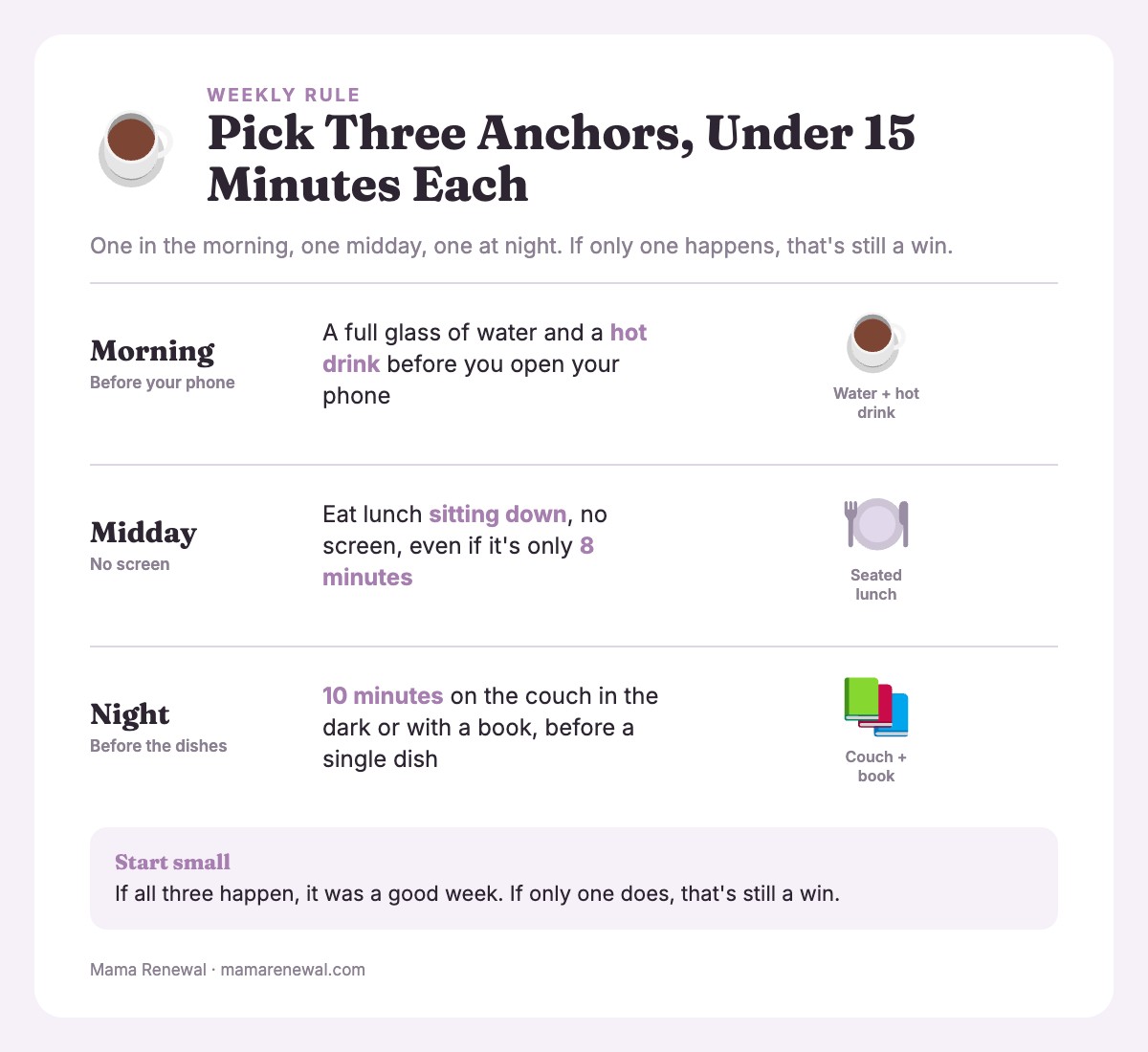
Here’s the planning rule that has kept me sane: pick three anchors a week, and only three. One in the morning, one in the middle of the day, one at night. Each is under fifteen minutes. If all three happen, it was a good week. If only one does, that’s still a win.
Examples of anchors:
- Morning: Drinking a full glass of water and a cup of something hot before you open your phone.
- Midday: Eating lunch sitting down, with no screen, even if it’s only eight minutes.
- Night: Ten minutes on the couch in the dark or with a book, before you do a single dish.
That’s it. You can build from there later. The point of starting small is that you need proof that self-care can survive your actual life.
Self-Care With Kids in the Room: Ideas for Single Moms
This is the part nobody writes about, and for solo moms it’s the biggest category. The time you spend with your kids is most of your time. If self-care only exists when they’re gone, you will get almost none of it.
So we make some of it happen with them present. That doesn’t mean ignoring them. It means choosing the activities where your needs and theirs overlap.
Parallel Play for Adults
Little kids are often happy to be near you while doing their own thing. You can use that.
- Sit on the floor with a cup of tea while they play with blocks. You’re not required to build anything. Being present and sitting is the whole task.
- Stretch while they watch a show. Ten minutes of floor stretching on the living room rug, narrated to a kid who doesn’t care, still counts. If your body is carrying the weight of carrying everyone, the gentle morning stretches routine is a good model, and nothing in it needs equipment or quiet.
- Read your own book next to their book. “Quiet reading time” is a real thing in plenty of households, and it works as soon as kids can sit with picture books.
- Do your hair or skincare at the table while they eat or color. It sounds silly, but it turns a “personal care” task you’d skip into something that fits.
Bring Them Into It (On Purpose)
Sometimes the best thing is to include them. Not as a distraction, but because it genuinely gives both of you something.
- A dance break in the kitchen. Two songs. Everybody moves. Many people find a short dance break lifts their mood and loosens tension. Nobody needs a gym.
- Walk the long way. Kids on scooters or in strollers, you walking. Daylight and movement can help lift mood for many people, and they cost nothing.
- Cook one meal together a week. You’re making dinner anyway. The difference is that you stop treating their help as an obstacle and let them stir, tear lettuce, or crack eggs. Wash hands with soap right after handling raw eggs, and don’t let kids eat raw batter or dough. It takes longer, but you also lose the resentment of doing it alone.
- Bedtime stories you actually like. If you have to read the same book for the 300th time, at least choose longer, better books when they’re old enough. You’re in the room anyway, so make it nourishing for you too.
Teach the “Mom Is Recharging” Signal
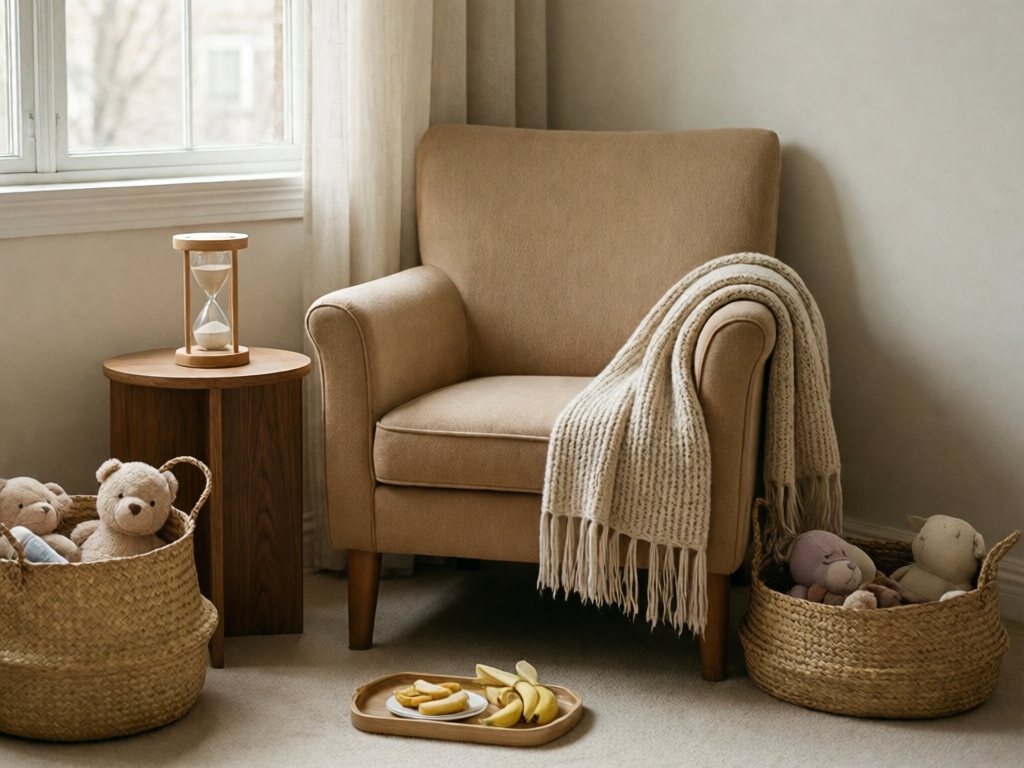
This one takes practice, but it pays off for years. Kids as young as three or four can learn a simple visual signal that means I need a short break; you can play nearby, but please don’t ask me for anything until the timer goes off.
You stay in the same room, or at least within sight and earshot. A three-year-old may manage only one or two minutes at first.
Some options that work:
- A specific scarf or hat you put on. When it’s on, you’re “off duty” for a short, timed stretch.
- A sand timer or kitchen timer they can see.
- A “calm corner” for you, such as a chair by the window.
Rules that make it work: start with just three to five minutes. Always end on time. Make sure they have something engaging to do (a snack tray, a special bin of quiet toys that only appears at this time, with age-appropriate toys and no small parts if anyone in the house is under 4). And do not use this for urgent things, which would train them to ignore it. Over several weeks, you extend it.
If this feels selfish, let me say it plainly: you are modeling that adults have needs and that needs can be met without a meltdown. That’s one of the most useful things a kid can learn.
Self-Care in the Margins: The Pockets You Already Have
If the middle of your day belongs to your kids, the edges of it belong to the in-between moments. This is where “ten-minute” ideas actually live.
The Naptime Question
If you have a napper, you know the temptation: use every minute of nap to do the dishes, the emails, the laundry. That’s understandable, and sometimes necessary. But if every nap goes to chores, you never rest. A rule that works for many solo moms is the half-and-half nap: first half is for you, second half is for chores. If you want ideas for what to do in that first half, how to use naptime for self-care breaks down options by energy level.
If your kids are past naps, the equivalent is “quiet time”: an hour in the afternoon when everyone is in their own space, reading or playing quietly. Even a five-year-old can learn to do this with a bin of books and a timer.
Commute and Waiting-Room Time
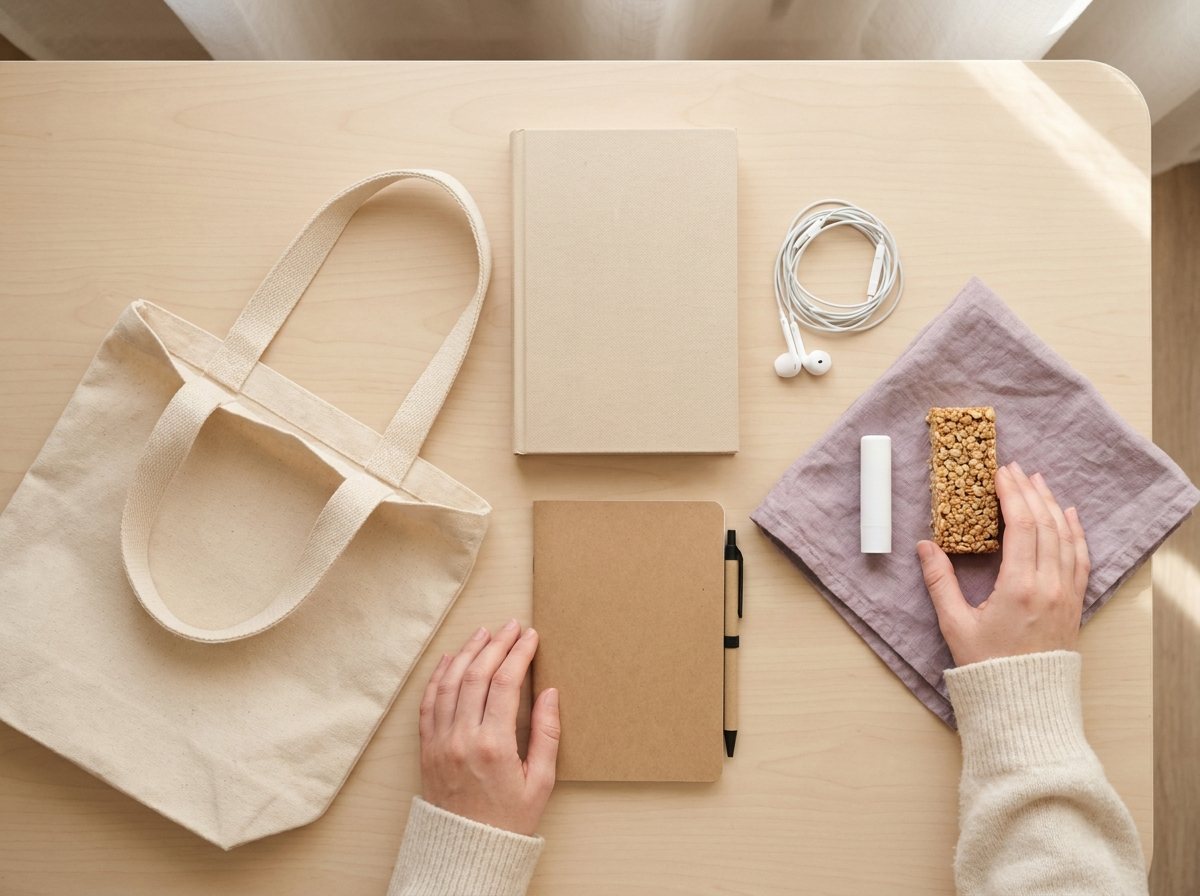
You might spend 30 to 90 minutes a week sitting in a car waiting for school, dance, or soccer to end. That time is not wasted, but it’s often spent on stress-scrolling. Replace some of it:
- Keep a small “pickup kit” in the glovebox or bag: a paperback, headphones, a snack that isn’t from a drive-thru, lip balm, a small notebook.
- Pick a single use per wait. Today it’s a podcast. Tomorrow it’s closing your eyes for six minutes, but only when you’re parked, the engine is off, and your children are not left in the vehicle. Choosing in advance prevents the default scroll.
- Practice a breathing pattern. Four counts in, six counts out, five or six times. It’s free and quiet. At a red light, keep it light and keep your eyes open.
Safety firstRest with your eyes closed only when the car is parked with the engine off, and never leave children alone in a vehicle. Never drowse behind the wheel.
The Bathroom Is Not Nothing
If the only door that locks is the bathroom, you know that room has been your one private space. That’s not pathetic. It’s resourceful. There are ways to make those few minutes count, which is exactly what bathroom self-care is about. A glass of water on the counter, a minute of slow breathing, a face mask on while you sit, a quick body scan: small changes that turn hiding into restoring.
After Bedtime: Protect It Like It’s Paid Work
For most solo moms, the hours after kids are asleep are the only truly solo time. They’re also the most contested, by dishes, work, laundry, and the pull of the phone. A few principles:
- Decide the first 20 minutes in advance. If you walk out of the bedroom without a plan, the chores will take everything. Pick one thing, any one thing, that’s yours, and do it before the first dish.
- Set a “kitchen closes” time. At 9:00, say, the kitchen is closed. Whatever isn’t done waits until morning. Done is not the goal. Rested is.
- Make a landing spot. A lamp, a blanket, a drink, a book or show queued up. The less you have to decide, the more likely you actually sit down.
- Have a hard stop for bed. A pattern often called revenge bedtime procrastination (staying up late because it’s the only time that feels like yours) is common. Choose your cutoff, and set an alarm for it.
The Body Basics (Sleep, Food, Movement) With No Backup
I wish I could tell you that the answer to burnout is bubble baths. It rarely is. For most solo moms, the real gaps are in the basics: sleep, regular food, and movement. These are also the places where having no backup is hardest, because you can’t “catch up on sleep” when you’re the only one who can wake up for a nightmare at 2 a.m.
Sleep: Defend What You Can
You can’t always control how much sleep you get, but you can control some of the conditions.
- Make the bedroom easy to fall asleep in. Dark, cool, phone out of arm’s reach. If you’re using your phone as an alarm, buy a cheap alarm clock. It’s a small thing that removes the “just checking” trap.
- Do a 10-minute “close the day” routine. Lay out tomorrow’s clothes, check the school bag, jot a quick to-do list. The point is to get tomorrow out of your head and onto paper so your brain stops rehearsing it.
- Share the nighttime load with older kids, within reason. Older kids (roughly 8+) can get their own water. Younger children still need you for illness, nightmares or fear. Teach them what counts as a reason to wake you. This is training, not neglect.
- Plan for time changes and disruptions. When the clocks shift, a solo parent has no one to take a bad-night shift. If this is a pain point, the daylight saving time sleep chart and the post on resetting your own sleep and energy afterward are made for exactly this.
If low mood, hopelessness or feeling unable to function lasts two weeks or more, whatever your sleep looks like, please talk to a doctor. Exhaustion and depression overlap in ways that are hard to sort out on your own, and you deserve actual care, not just tips.
Food: Lower the Bar and Raise the Floor
Solo moms often skip meals, eat standing up, or finish whatever’s left on a kid’s plate. You don’t need a perfect diet. You need a reliable floor.
A few approaches that don’t require cooking from scratch every day:
- Default meals. Pick three dinners you can make half-asleep, and let them repeat. Repetition is a feature, not a failure.
- Protein with every meal. Protein helps many people feel full longer and keeps energy steadier. If protein is a weak spot for you, the guide on protein for moms goes through easy options.
- A “mom snack drawer.” A place your kids don’t raid. Nuts, jerky, cheese sticks, dark chocolate, whatever you actually like.
- Batch once, eat several times. On Sunday, cook one big thing (a pot of chili, a tray of roasted vegetables, a batch of hard-boiled eggs). It’s less about fancy meal prep and more about having something in the fridge when you’re too tired to think.
- Eat when they eat. If you’re at the table anyway, put real food on your plate. It sounds obvious, but many of us skip it.
For a broader look at this, the post on nutrition as self-care is practical without being preachy.
Movement: Count What Counts
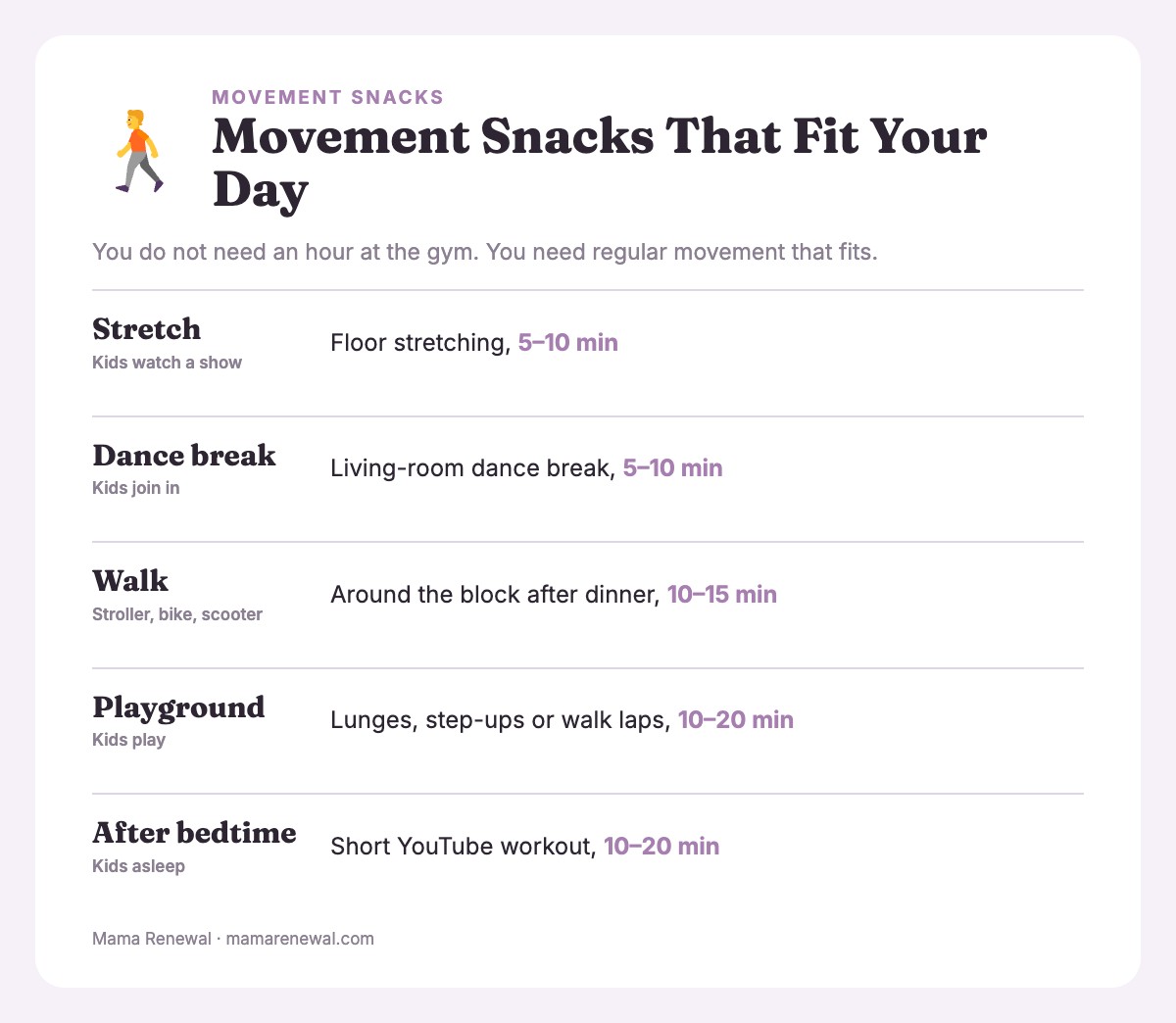
You do not need an hour at the gym. You need regular movement that fits. Think in terms of “movement snacks”:
| Movement snack | Time | Needs kids to be… |
|---|---|---|
| Walk around the block after dinner | 10–15 min | Along for the ride (stroller, bike, scooter) |
| Living-room dance break | 5–10 min | Participating |
| Stretching on the floor | 5–10 min | Nearby, watching a show |
| Calf raises or stretches while kids play on the living-room floor in sight | 3–5 min | Playing where you can see them |
| Playground circuit while they play | 10–20 min | Playing (you do lunges, step-ups, or just walk laps) |
| Short YouTube workout after bedtime | 10–20 min | Asleep |
Safety firstYoung children in the bath stay within arm’s reach with your full attention. Never exercise away from the tub.
If the weather’s turning cold, ideas for getting outside and moving in the colder months are in the 27 cozy fall self-care ideas. If you’re thinking about spring, the post on moving your body outside with kids in tow has plenty of options.
Building Backup That Isn’t a Partner
Here’s the truth that no one tells solo moms kindly: you can’t do this alone forever, and you aren’t meant to. But the kind of help you need may not look like a partner stepping in. It looks like a patchwork: many small supports, none of them heroic, that together keep you from going under.
This is where most solo moms stall, because asking is hard. If that’s you, the piece on asking for help without the mom guilt tackles the voice in your head that says you’re a burden. Read it if you notice yourself saying “I’m fine” when you aren’t.
The Backup Map
Start by mapping what you have, not what you wish you had. Draw four columns:
| Type of support | Examples | Who’s on my list? |
|---|---|---|
| Emergency (can show up within hours) | A neighbor with a spare key, a friend nearby, an on-call relative | |
| Regular, small (weekly or monthly) | A carpool partner, a standing coffee date, a friend who texts | |
| Paid or program-based | Aftercare, a sitter, a drop-in rec center, a cleaning service | |
| Community | School parents, faith community, library programs, online groups |
Fill in even one name in each column. A map with names on it is more useful than a vague sense of isolation.
Swaps, Co-ops, and “Trade Hours”
When you can’t pay for childcare, trade it. This is the most underrated tool in solo parenting.
- The two-family swap. You take their kids for two hours on Saturday morning; they take yours on a Sunday. Both of you get a window. Two solo parents trading is often the best match, because you both understand.
- Playdate rotation. Four families, one afternoon each month where one parent hosts everyone’s kids. You host once and get three free afternoons. Younger children may need a second adult, so keep the host group small.
- Carpool as support. Sharing school or activity runs saves time and builds a relationship that can grow into more.
- The “come over and we’ll both survive” evening. A friend arrives with takeout. The kids play. You both fold laundry or just sit. It’s not a break from the kids, but it’s a break from isolation, which is half the burnout.
Programs That Quietly Do the Job
Many communities have resources people don’t think of until they need them:
- School aftercare and extended-day programs (some with sliding scale or subsidies).
- Library programs that run story times, homework help, or teen drop-ins.
- Parks-and-rec classes and drop-in childcare at community centers.
- Faith community or community-organization childcare for events and groups, even if you only attend sometimes.
- Parent’s-night-out events at gyms, gymnastics studios, and churches, usually a few hours on a Friday for a modest cost.
- Respite care or family support programs through local agencies, particularly for single parents, military families, or families with a child with special needs.
Call your local 211 line (in the U.S.) or search “single parent support [your town].” You may be surprised.
If you are unsafe at home, the National Domestic Violence Hotline is 1-800-799-7233.
Finding Your People
Isolation is the hidden tax of solo parenting. You can lose hours of sleep and still do well, but a long stretch of no adult connection will wear you down faster than almost anything.
The honest part: making friends as an adult is hard, and doing it with no childcare is harder. If that’s where you are, making mom friends as an adult is a good place to start, because it doesn’t pretend it’s easy. A few approaches that work with kids in tow:
- Be a regular somewhere. Same park, same library story time, same Saturday market. Familiarity builds friendship slowly, with low stakes.
- Start with the other solo parents. At school pickup, at activities, in local groups. They’ll often understand your constraints without needing an explanation.
- Suggest kid-inclusive plans. “Want to meet at the playground Thursday?” is a lot easier to say yes to than “Let’s get dinner.”
- Lean on online groups for the late-night stuff. A group of other solo parents at midnight can be the difference between a lonely night and a survivable one. Just watch for the comparison trap. If a feed leaves you feeling worse, mute it.
Self-Care on a Tight Budget
For many solo moms, money is part of the equation, not just time. So here’s a list that costs nothing or very little.
| Free or nearly free | What it does | Cost |
|---|---|---|
| Library card (books, audiobooks, e-books, movies) | Entertainment and escape | $0 |
| Walking outside in daylight | Mood, sleep, energy | $0 |
| Free online yoga or stretch videos | Movement | $0 |
| Phone call with a friend while folding laundry | Connection | $0 |
| A cup of good tea or coffee made on purpose | A small ritual | ~$1 |
| Cheap journal and a pen | Processing | ~$3–5 |
| Face mask or bath salts from the dollar aisle | A small treat | ~$2–5 |
| Swapping a babysitting hour with a friend | Real break | $0 |
| Doing the “ugly” chore later and sitting down now | Permission | $0 |
| Planting something in a pot | Something that’s yours and grows | ~$5 |
And a note about spending: a lot of “self-care” is marketed as a purchase. A candle isn’t going to fix a depleted nervous system. When money is tight, protect your money and your sense of worth by focusing on what rebuilds you. Rest, food, connection, and a sense of capability often matter more than any product.
If you’re curious what actually works for your temperament, the self-care style quiz can narrow down whether you recharge through quiet, movement, creativity, or people, which saves you from wasting energy on the wrong things. And if bubble baths have never done a thing for you, self-care ideas for moms who hate bubble-bath self-care is a relief.
The Emotional Side: Guilt, Loneliness, and the Snap
The practical stuff is the easier half. The harder half is what’s happening inside. Solo parenting comes with its own emotional weather, and it’s worth naming.
Decision Fatigue and the Mental Load
When you’re the only adult, every decision is yours: what’s for dinner, which doctor, whether to say yes to the birthday party, what to do about the kid who’s falling behind in math. No one else is holding any of it. That’s a different kind of tiredness than physical exhaustion, and it doesn’t go away with a nap. If you want language for what’s going on, the mental load and the invisible labor checklist can help you see just how much you’re quietly carrying. Seeing it written down is oddly validating.
Some ways to lighten it:
- Decide once. Fixed meals on fixed days. A default answer for party invitations. A standing grocery order.
- Keep one master list. A single place for appointments, school forms, and to-dos, so your brain isn’t the filing cabinet.
- Automate what you can. Auto-refill prescriptions, auto-pay bills, recurring delivery for toilet paper and diapers.
- Drop the “shoulds.” Not everything needs to be done well. Some things just need to be done, or not done at all.
Learning to Say No
When you have no backup, every yes costs more. The PTA ask, the neighbor’s favor, the extra school event, the volunteer request. You’re allowed to protect your capacity. If saying no makes you sweat, the printable scripts for saying no give you actual words, so you’re not improvising while your heart pounds.
A rule of thumb that helps: if you wouldn’t do it for yourself on a normal Tuesday, don’t say yes in the moment. Say, “Let me check and get back to you.” Then you get 24 hours to answer from your values, not from guilt.
When You Snap
Every parent snaps sometimes. Solo parents tend to snap more often and feel worse about it, because there’s no one else to absorb the overflow and no one to hand the kids to when you feel the heat rising. If you’ve yelled and then lay awake hating yourself, you are not a bad mother. You’re a depleted one, and those aren’t the same thing.
There are gentler ways to understand it. The posts on mom rage and on anger management for moms go deeper, but here’s a short version of what helps in the moment:
- Spot your early signs. Jaw clenching, shallow breath, sharp tone. These show up before the blow-up.
- Say it out loud. “I’m getting really frustrated, and I need a minute.” Kids can hear this and learn from it.
- Make a physical change. Splash cold water, step onto the porch, put your hands on the wall and push. Anything that interrupts the escalation.
- Repair afterward. “I yelled, and I’m sorry. That wasn’t about you.” Repair is more powerful than perfection.
Safety firstIf you’ve had thoughts of harming yourself or your child and feel you might act on them, make sure your child is safe with someone else and call or text 988 or call 911 now. If rage feels constant or frightening, please reach out for help right away. Postpartum Support International’s helpline (1-800-944-4773) is non-emergency support for pregnancy and postpartum concerns.
Touched Out and Alone at the Same Time
Here’s a strange one that many solo moms recognize: being completely touched out and starved for adult contact. Your kids climb on you all day, and no adult has hugged you in weeks. If that rings true, this post on being touched out will make you feel less strange. The practical takeaway is to build in body-neutral comfort: a weighted blanket, a hot shower, a pet, a massage if you can swing it, a hug from a friend who knows you need one.
The Identity Piece
Somewhere in the middle of all this, you’re still a person. Perhaps you used to paint, hike, sing, write, or build things. Solo parenthood can swallow identity whole. Matrescence describes the identity shift every mother goes through, and for many solo moms, it’s compounded by a second shift: becoming the sole head of the household. Reclaiming even a sliver of the old you doesn’t betray your kids. It sustains you. And if you’re wondering where to start, hobbies for busy moms is full of ideas that work in small windows.
Sick-Day Plan for Single Moms With No Backup
The nightmare scenario for a solo parent is getting sick or hurt. You can’t plan away every emergency, but you can build a plan so that it doesn’t turn into a disaster. Do this on a calm day, not in the middle of a fever.
The “Mom Is Down” Kit
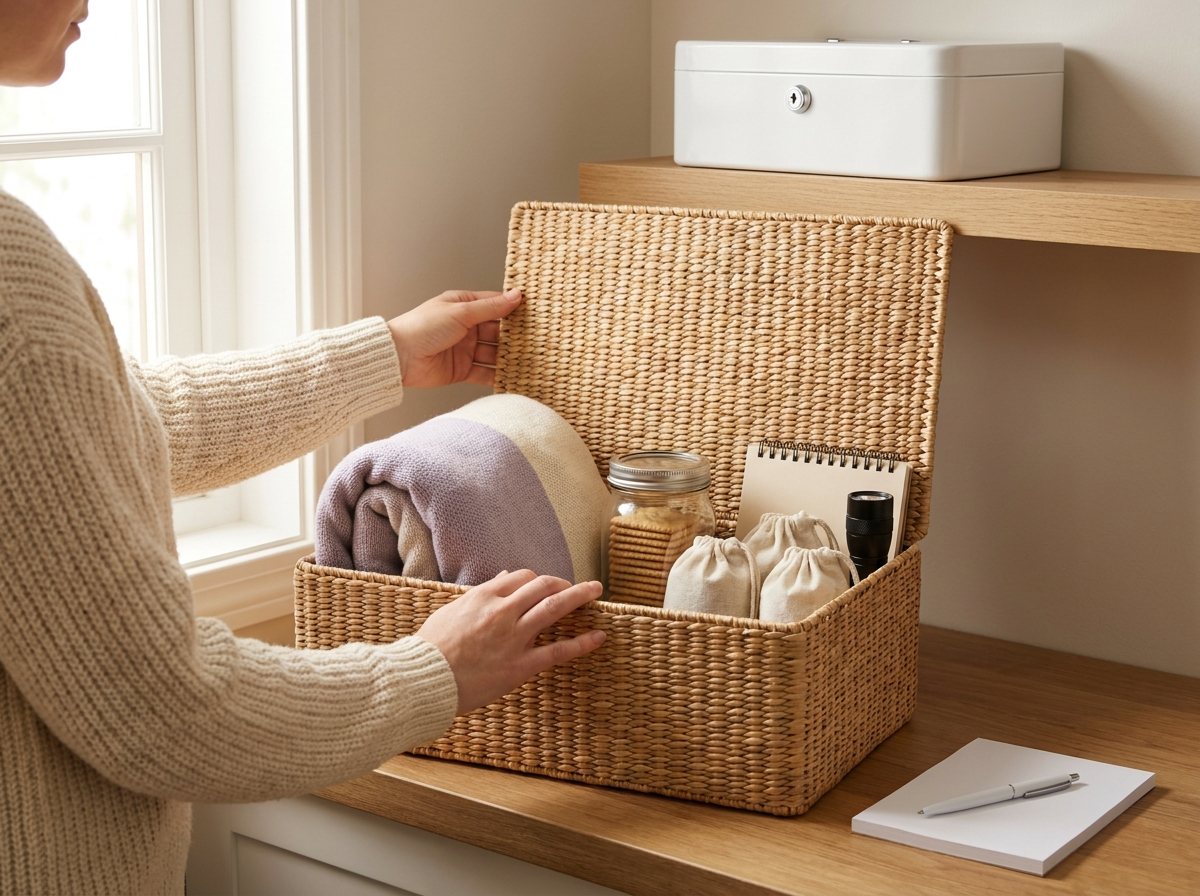
Pull together a small plan and keep it somewhere handy:
- A short list of emergency contacts, written down, with phone numbers: neighbor, friend, relative, school contact, pediatrician.
- Someone who has a key or knows where the spare is.
- A list of 3 low-effort meals you can make or order, and a few shelf-stable foods always in the pantry.
- A “sick day” box with a few special activities, movies, snacks, and books your kids only get when you’re down.
- Basic meds for you and the kids: fever reducers, rehydration, whatever your doctor recommends. Dose children by weight per the label or your pediatrician, never give aspirin to children, and store all medicine locked or out of reach.
- A “tell someone” habit: text a friend or neighbor, “I’m sick today, check on me tonight.” Even if they can’t do anything, someone knows.
Safety firstTrouble breathing, chest pain, confusion, fainting, or a fever that won’t break or leaves you unable to function are not things to wait out. Call 911 and ask a neighbor or relative to take the kids.
The Sick-Day Playbook
When it’s you who’s sick and there’s no backup:
- Lower the bar to survival. Everyone eats, everyone is safe, everyone is more or less clean. That’s the whole standard.
- Move to the couch or the floor and bring the kids with you. Movies, books, quiet games, a picnic on a blanket.
- Use screens without shame for kids old enough for them. The AAP advises avoiding screens for under-18-month-olds except video chats, and limiting them for under 2s. Keep little ones within sight or earshot.
- Order food. Delivery, a neighbor’s soup, a cereal dinner. Anything.
- Ask for something specific. “Can you drop off some groceries?” is easier to say yes to than “I need help.”
- Cancel what you can. Social obligations, school volunteering, errands. They can wait.
When the Whole System Is Fraying
Sometimes it isn’t one sick day. It’s weeks or months of too much and not enough. If you recognize that kind of exhaustion, depleted mother syndrome names what’s going on and offers a way back. If you’ve been running on empty for a long time, don’t just add more self-care tasks to your to-do list. Reduce load first, then build back up. That might mean dropping commitments, asking for money-based help if available, or talking to a professional.
A Realistic Weekly Rhythm
Here’s what putting this together might look like. It’s a template, not a rule book. Adjust to your kids’ ages, your work schedule, and your actual energy.
| Day | Morning anchor | Midday anchor | Evening anchor |
|---|---|---|---|
| Monday | Water + tea before phone | Lunch seated, 10 min | 10 min on couch before dishes |
| Tuesday | 5-min stretch while coffee brews | Walk during kid’s activity | Kitchen closes at 9 |
| Wednesday | Water + tea before phone | Call or text one friend | Face mask in bathroom |
| Thursday | 5-min stretch | Lunch seated | Read 15 min in bed |
| Friday | Water + tea before phone | Order or plan an easy dinner | Family movie night, snacks, no chores |
| Saturday | One slow hour: no agenda | Playground walk laps | Swap kids with another parent once a month |
| Sunday | Quick reset: plan the week | Batch-cook one meal | 20 min planning, 20 min rest |
For a deeper weekly framework, a printable Sunday self-care planner gives you a page to fill out, and the ultimate self-care checklist is a handy menu of options when you’re too tired to think of your own.
A note on seasons: the way you structure this will shift. In fall, with the days getting shorter, small changes like morning daylight and vitamin D can matter more than you expect (the post on vitamin D and the fall slump is a quick read). A gentle fall reset can help you reset routines without overhauling your life. In the holiday months, planning ahead protects your sanity. Holiday overwhelm hits solo parents hard, and having a plan matters whether it’s Halloween or later in the season.
What “Enough” Looks Like
Let me end the main part with the thing I wish someone had told me on the bathroom floor. That Tuesday, the dishes stayed in the machine and the permission slip waited until morning. My kid still got breakfast at 6:45, and that was enough.
You are probably not doing it wrong. You are doing something hard, with less than you need, and the fact that you’re still reading an article about taking care of yourself means you haven’t given up on yourself, even if you’re frayed.
“Enough” for a solo mom is not a spotless house, a perfect diet, a daily workout, and endless patience. Enough looks like this:
- Your kids are fed, safe, and know they’re loved.
- You eat something real most days.
- You get some sleep, and you’re defending more of it over time.
- You have at least one adult who knows how you’re really doing.
- Once in a while, you do something just because it brings you back to yourself.
- When you fall short, you repair and keep going.
That’s the bar. It’s lower and more humane than the one the internet sells you, and it’s also the one that gets you through the years.
If you need support right now
Reaching out is not an overreaction. These lines are free and confidential.
- Emergency: if you are thinking about harming yourself or your baby, or you can’t keep yourself safe, call 911 or go to the nearest emergency room. This is a medical emergency, and it is treatable.
- 988 Suicide & Crisis Lifeline: call or text 988, 24/7, for anyone in crisis.
- National Maternal Mental Health Hotline: call or text 1-833-TLC-MAMA (1-833-852-6262), 24/7, in English and Spanish, for pregnancy and postpartum support.
- Postpartum Support International: call or text 1-800-944-4773 for help finding a provider who specializes in perinatal mental health. Not an emergency line.
US numbers. Elsewhere, ask your doctor, midwife or local crisis line. This article was written by a parent, not a clinician, and isn’t medical advice.
Frequently Asked Questions
What is the best self-care for single moms with no free time?
The best self-care for single moms with no free time is the kind that fits inside time you already have. Think of small anchors tied to moments that happen every day: a hot drink before you touch your phone, eating lunch seated, ten minutes on the couch before you start the dishes. Pair self-care with existing routines instead of trying to carve out new blocks of time. Even five to ten minutes, done reliably, does more than an occasional big outing that never actually happens.
How do I do self-care when I have no help and no childcare?
Start with self-care you can do while your kids are present: stretching or reading while they play nearby, dancing in the kitchen, taking a walk together, or teaching them a “Mom is recharging” signal with a timer. Then protect the pockets you have, like naptime, quiet time, and the first twenty minutes after bedtime. Over time, build a small patchwork of support: a babysitting swap with another parent, a carpool, aftercare programs, or a neighbor who can handle an emergency. You rarely need one big source of help. Several small ones add up.
Is it selfish to take time for myself when I’m the only parent?
No. When you’re the only adult, your well-being is the foundation your whole household stands on. If you get sick, burned out, or depleted, there’s no one to step in. Taking care of yourself isn’t taking from your kids; it’s maintaining the person they depend on. It also shows them that adults have needs and that meeting them is healthy, not shameful. The guilt is common, but it’s not evidence that you’re doing something wrong.
What are some free self-care ideas for single moms on a budget?
Plenty of effective self-care costs nothing. Walk outside in daylight, borrow books and audiobooks from the library, or follow free stretch or yoga videos. Call a friend while you fold laundry, go to bed fifteen minutes earlier, or sit quietly with a cup of tea. Journaling and swapping kid-watching with another parent count too. Basics like regular meals, water, and sleep do more for your well-being than any product. If you want to spend a little, a notebook, a good tea, or a plant can add small comforts for a few dollars.
How can I make friends or build a support system as a single mom?
Start small and stay consistent. Be a regular at the same park, library program, or school event so familiar faces become friends. Look for other solo parents, who often understand your constraints without explanation. Suggest kid-friendly plans like playground meetups instead of dinners out. Use online groups for support at odd hours, and try low-pressure arrangements like carpools or babysitting swaps that build trust gradually. Friendship takes time, but even one reliable person changes how heavy everything feels.
What should I do if I get sick and have no one to help with my kids?
Plan ahead on a calm day. Keep a written list of emergency contacts, tell a neighbor or friend where your spare key is, stock a few shelf-stable foods and basic medications, and put together a “sick day” box of special activities and movies. When you’re sick, lower the standard to basic safety and feeding, set up on the couch with your kids, use screens without guilt, order food, and ask someone for one specific favor. If you have trouble breathing, chest pain, confusion, fainting, or a fever that won’t break or leaves you unable to function, call 911 and ask a neighbor or relative to take the kids rather than waiting it out. If you can’t safely care for your children, reach out to anyone on your emergency list right away.
When should I seek professional help for burnout or low mood as a single mom?
Reach out if you’ve felt persistently low, hopeless, numb, or anxious for two weeks or more. Reach out too if you can’t sleep even when you have the chance, you’re losing interest in things, or your anger or sadness feels out of your control. Exhaustion and depression can look alike, and a doctor or therapist can help sort out what’s going on. If you ever have thoughts of harming yourself or your child, contact emergency services or call or text 988 (in the U.S.) right away. Needing support doesn’t mean you’re failing. It means you’ve been carrying a lot.
You Don’t Have to Do This Perfectly
There may never be someone to tag in. But you can build a life that holds you up anyway, one small anchor, one swapped Saturday, one honest text to a friend at a time. Start with a single thing from this page, whichever one felt a little bit possible, and let that be enough for this week. You’ve been taking care of everyone else for a long time. You’re allowed to be on your own list.