
Scripts to Say No to Fall Activity Overload Without the Guilt
Feeling overwhelmed by fall activity requests? This article provides specific scripts to help you say no to common asks like sports, parties, and playdates, without feeling guilty, and offers strategies to talk to your kids.
- Use specific scripts to decline requests for sports, parties, and playdates.
- Prepare pushback replies for when your 'no' is challenged.
- Learn strategies to manage guilt after saying no to commitments.
- Get advice on how to discuss activity limits with your children.
This post contains affiliate links. As an Amazon Associate I earn from qualifying purchases.
One Tuesday in late September, I typed “Sure, happy to help!” to a near-stranger in the school pickup line. She needed snack sign-up covered for a soccer team my son wasn’t sure he wanted to join. I wasn’t happy to help. I was tired, and Thursday already held four things.
None of it was bad. That’s the trap of fall: every ask is reasonable, and the problem is the pile. If you’re working out how to say no to fall activities, here are the exact words I wish I’d had. You’ll get six decline scripts (sports, room parent, class parties, playdates, birthdays, and the “can you just…” ask), pushback replies, and how to handle the guilt and talk to your kids.
Free printable · 6 pages
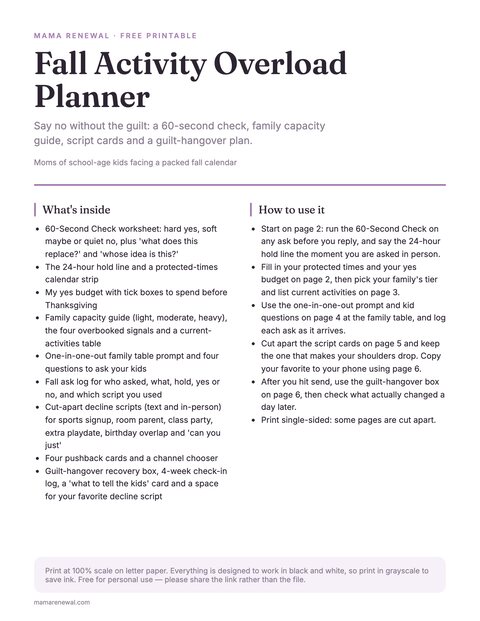
Fall Activity Overload Planner
A writable 60-second check with a 24-hour hold line, protected-times strip and yes budget, a family capacity guide with activity table and kid questions, a fall ask log, cut-apart decline and pushback script cards with a channel chooser, and a guilt-hangover recovery box with a 4-week check-in log.
Free. Your download link appears right here. You'll also join the Mama Reset. Unsubscribe anytime. Privacy
In this article (11 sections)
- Why Fall Schedule Overwhelm Hits Harder Than Any Other Season
- Before You Say Anything: The 60-Second Check
- Six Ready-to-Use Decline Scripts for Fall Overload
- Quick Reference: Scenario, Scripts, and the One Sentence to Remember
- When They Push Back (Because Sometimes They Do)
- What to Do With the Guilt After You Hit Send
- Too Many After-School Activities: How to Decide What Stays
- Building a Fall Schedule That Doesn’t Collapse
- What to Tell Your Kids About Your Own No
- Frequently Asked Questions
- You’re Allowed to Have a Quieter Fall
Why Fall Schedule Overwhelm Hits Harder Than Any Other Season
Fall is not just “busy.” It is busy in a specific, stacked way that catches even organized moms off guard.
In September, a lot starts at once. School, sports seasons, music lessons, scouts, religious education, church or community programs, and the PTA or parent organization often open registration in the same few weeks. Nobody coordinates with anybody else. Each group sends a perfectly polite email without knowing the other six exist.
Then the holidays are visible on the horizon. Halloween, Thanksgiving, and the lead-up to December are all lurking, and the invitations and asks start layering on top of the baseline schedule.
Add to that:
- Shorter daylight. Evenings get dark early, and many of us feel it in our energy, whether or not we name it. If low mood in the darker months is persistent or severe, talk with a healthcare provider.
- The back-to-school adrenaline crash. For many families the first few weeks run on novelty. By late October that fuel can be gone, but the commitments you made in August are still there.
- Class traditions with a sign-up sheet attached. Parties, fall festivals, book fairs, teacher gifts, harvest lunches, fundraiser nights.
- A social calendar that quietly doubles. Birthday parties, playdates, and team events multiply once kids have a full classroom of friends.
The people sending these asks are mostly not villains. They are other tired parents, volunteers, and coaches trying to make a thing happen. That’s why saying no feels so loaded. You are not refusing a bully. You are disappointing someone nice.
That is also why a script helps. When you’ve got exact wording ready, you don’t have to improvise warmth, firmness, and kindness at the same time while a hopeful face looks at you at drop-off.
What fall activity overwhelm actually looks like
It doesn’t always feel like “I’m overbooked.” Often it sounds like:
- “I’m so behind and I don’t even know on what.”
- Snapping at a kid over a lost shoe, then feeling awful.
- Checking the family calendar app with a sense of dread.
- Resenting activities your child actually enjoys.
- Saying yes to things reflexively, then spending the evening annoyed at yourself.
If that’s you, nothing is wrong with you. Ordinary overwhelm is common. Sometimes, though, it is more than that.
Safety firstIf you are thinking about harming yourself, call or text 988 (the Suicide & Crisis Lifeline in the US) or your local emergency number right away. If these feelings last more than a couple of weeks, get in the way of daily life, or come with hopelessness, please talk to a doctor or mental health professional. That is not overreacting.
If you want a deeper look at the cumulative weight of all this planning and remembering, the piece on Mom Mental Health 101 covers where ordinary stress ends and where it’s worth getting extra support.
Before You Say Anything: The 60-Second Check
Scripts work best when you know what you’re actually deciding. Before you reply to any ask, run through these three questions. They take a minute, and they make the “no” far less shaky.
- Sort it. Is this a hard yes, a soft maybe, or a quiet no? A hard yes is something you or your child truly want. A soft maybe is “it’d be nice, but.” A quiet no is what you’ve known since you read the message.
- Name the trade. What does this replace? Every yes takes the place of something else: rest, a meal at the table, an empty Saturday, an early bedtime. Name the thing it replaces. If you wouldn’t trade it, that’s your answer.
- Check the source. Whose idea is this, really? If your child is begging, that’s information. If you’re saying yes because you fear what other moms will think, that’s different information.
You don’t need to justify a no to anyone. But knowing your own reason keeps you from caving when the pushback comes.
The “24-hour hold” rule
This one habit has saved me more than any script. When someone asks you for something in person, say:
TipSay this the moment you’re asked:
“Let me check our calendar and get back to you tomorrow.”
Then actually do it. You are not stalling. You are creating the gap between the ask and the answer that guilt usually steamrolls. Most of my regrettable yeses happened in the exact moment of being asked.
If you struggle with the deeper pull to over-give, boundaries for moms goes into how to build this skill beyond the fall rush.
Six Ready-to-Use Decline Scripts for Fall Overload
These are written to be warm but clear. Each gives you ready-to-use wording, plus options for leaving the door open or closing it firmly. Adjust the names, keep the structure.
The structure underneath every one of them is the same: a kind opener, a clear no, and (optionally) a small alternative. You never need an excuse, a medical history, or a long explanation.
Script 1: The Sports Signup
The scenario: registration closes Friday. Your child’s friend is on the team. The coach has emailed twice. Your child said “maybe,” which, in kid language, could mean anything.
First, a question for your child (not a script for the coach):
“If we pick one activity this fall, which one would you choose? We can’t do all of them.”
Kids are often shockingly clear when the choice is framed as “one” instead of “everything.”
If you’re declining to the coach or team parent (text):
“Thanks so much for thinking of us! We’re going to sit this season out so we can keep our evenings open. Hope it’s a great season, and we’ll keep an eye out for spring.”
In person:
“We’re skipping this season. Our fall is already full. I really appreciate you running this, though.”
If your child wants to play but the schedule is the problem:
“[Child] would love to play, but the twice-a-week practices don’t fit with our schedule this fall. Is there a once-a-week or rec-level option? If not, we’ll pass for now.”
TipSkip “Maybe next year!” unless you mean it. A vague maybe invites a follow-up in August.
Good to knowMany moms worry that skipping a season means their child will “fall behind” or be left out socially. For many school-age kids in recreational leagues, a skipped season doesn’t change much, and friendships tend to survive it. Exhausted families burning through every weeknight can be the bigger cost.
Script 2: The Room Parent Ask
The scenario: the teacher or another parent asks if you’d be room parent, or “just help with a few things.” Everyone knows “a few things” is a job with a group chat.
Text or email:
“Thank you for asking, I really appreciate the confidence! I can’t take on room parent this year. If there’s a one-time thing that fits my schedule, like sending in supplies, I’m glad to look at that.”
In person:
“I’m flattered you thought of me, but I can’t take on a role like that this year. I’m happy to send in supplies when you need them.”
If you can do one small thing and want to name the boundary:
“I can do one thing this semester. I’ll sign up for [specific task]. I won’t be able to do more than that, so please don’t count me for the others.”
If someone says “it’s really not much work”:
“I believe you. It’s just that I’m at my limit this year, so it’s a no for me.”
Good to knowThis script offers a small, specific alternative instead of an open-ended “let me know if you need anything,” which is how you end up with a standing job. Specific is safer than vague.
For the wider PTA pressure that tends to arrive this time of year, more scripts to say no and protect your self-care make a good companion read.
Script 3: The Class Party or Fall Festival Volunteer Ask
The scenario: the sign-up sheet is circulating. Twelve slots, seven filled, and your name is conspicuously missing. The group chat has a gentle “we still need a few more hands!” message.
You don’t have to answer a group message addressed to everyone. Silence in a group chat is allowed. If someone messages you directly:
Direct message:
“Thanks for putting this together! I can’t volunteer at the party this time. I’ll send [napkins / cups / a donation] so it’s covered.”
Safety firstCheck the school’s allergy and food policy before sending any food. Many classrooms are nut-free or only allow labeled, commercially packaged items. Napkins, cups, or a donation are the safest default.
If you want to give nothing and still be kind:
“I won’t be able to help with this one, but I hope it’s a fun party!”
If the teacher asks:
“I’d love to, but my schedule won’t allow it this time. I’m happy to help in another way, like cutting things out at home, if that’s ever useful.”
Good to knowThe sign-up sheet always looks like everyone else is signing up. In my experience it was often the same few parents, and I doubt anyone noticed who was missing. If someone does notice, it’s a mild blip, not a character judgment.
If this invisible work wipes you out, school-age mom burnout and the invisible load of logistics may help you feel less alone.
Script 4: The Extra Playdate
The scenario: a kind mom texts, “The kids would love a playdate! Are you free Wednesday?” You like her. You like her kid. You have one empty afternoon a week and Wednesday is it.
This one is tricky because it isn’t hostile or demanding. It’s friendly. That’s what makes the guilt sneaky.
Text (decline, offer something later):
“That sounds so fun! Wednesdays are our slow day at home, so we’re keeping it free. How about a weekend afternoon in a couple of weeks? I’ll check in with you after the next few things pass.”
Text (decline with no counteroffer):
“Thanks for thinking of us! We’re not adding playdates during the week right now. Hope the kids get to catch up at school.”
Text (decline, but make a loose plan):
“We can’t do Wednesday, but I’d love to get the kids together sometime in November. I’ll text you when our calendar clears.”
Only use the last version if you will actually text her. A deferred plan you never follow up on can feel worse than a clean no.
If your child is the one asking:
“I know you want to see [friend]. This week is too full, but let’s find a time on the calendar for two weeks from now. Let’s pick it together.”
Putting it physically on the calendar teaches kids that a “not now” is real and not a brush-off.
Script 5: Birthday Party Overlap
The scenario: two invitations, same Saturday, 90 minutes apart. Or one invitation for a child your kid barely knows, on the weekend you finally have nothing planned.
Declining the party (text to the host):
“Thank you so much for inviting [child]! We can’t make it that day, but we hope it’s a wonderful party. Please tell [birthday kid] happy birthday from us.”
Skipping one of two overlapping parties:
“Thanks for the invite! We have another commitment at that time and can’t make it. Hope [birthday kid] has the best day!”
You do not need to specify what the other commitment is. “Another commitment” is true, and “nothing, I just want to stay home” also counts as a commitment to yourself.
Popping into both briefly:
“We have another event that day, but we’d love to pop in for the first hour to drop off a gift and say hi. Is that okay?”
If you’re skipping a party for a kid your child isn’t close with (what to tell your child):
“That party is on a day when our family has a plan. We’ll send a card.”
Kids rarely mind as much as we fear.
TipKeep a small stash of gifts at home (books, art supplies, a puzzle) so a “yes” never requires an emergency store run, and a “no” never has a gift-shopping errand attached. It takes the sting out of the whole category.
Script 6: The “Can You Just…” Ask
The scenario: a general catch-all. A fellow mom asks if you can drive the carpool, bring the dessert, handle the teacher gift collection, or cover the fundraiser table. The ask is small. There are four of them this week.
The universal decline:
“I wish I could, but I’m not able to take that on right now.”
With a slightly warmer tone:
“Thank you for asking me! I can’t do this one, and I hope it comes together.”
When it comes from someone you want to keep a good relationship with:
“I’m really trying to keep my plate from overflowing this fall, so I’m saying no to a lot. It’s nothing about you.”
That last line works because “It’s nothing about you” tells the other person it’s a policy, not a verdict.
If you want to make it a household policy:
“We’re keeping a one-yes-per-week rule this fall, and we’ve already used it. Ask me again in a few weeks.”
Having a “rule” makes the no impersonal and easier to hold.
Quick Reference: Scenario, Scripts, and the One Sentence to Remember
Here’s a cheat sheet to screenshot and keep on your phone. The Say-No Cue Cards printable on this site is a print-friendly companion.
| Scenario | Core Sentence | Optional Add-On |
|---|---|---|
| Sports signup | “We’re going to sit this season out so we can keep our evenings open.” | “We’ll look at spring.” (only if true) |
| Room parent ask | “I can’t take on room parent this year.” | “I can send supplies.” |
| Class party volunteer | “I can’t volunteer at the party this time. I’ll send [item].” | “Hope it’s a great one!” |
| Extra playdate | “We’re not adding playdates during the week right now.” | “Let’s plan a weekend in a few weeks.” |
| Birthday overlap | “We can’t make it that day, but we hope it’s a wonderful party.” | “We’ll drop off a gift.” |
| General “can you just” | “I wish I could, but I’m not able to take that on right now.” | “It’s nothing about you.” |
And here’s how to choose the right delivery method:
| Situation | Best Channel | Why |
|---|---|---|
| Someone you barely know | Text or email | Gives you time to write it well |
| Close friend | Text, or a quick voice message | Warmer tone, still gives you space |
| Teacher or coach | Leaves a record and feels respectful | |
| In-person ambush | “Let me check and get back to you.” | Buys time without lying |
| Group chat | Private reply, or silence | You don’t have to answer a mass ask publicly |
When They Push Back (Because Sometimes They Do)
Most people accept a polite no. A few don’t. Having a second sentence ready keeps you from folding.
The “Are you sure? It would really help” response
“I understand, and I’m sure. I just can’t do it this time.”
Repeat the same message with the same calm. You don’t need to add new reasons. New reasons are new things to argue with.
The “But everyone else is doing it” response
“I know. That’s what works for them, and this is what works for us.”
The guilt-laced response (“Oh… okay. I guess I’ll find someone else.”)
“Thank you for understanding. I hope it comes together.”
Then stop typing. Do not rescue the other person’s disappointment. They are allowed to be disappointed. You are allowed to not fix it.
The persistent asker
Some people have learned that your no can become a yes if they ask three times. Start gently:
“I know it’s hard to hear. My answer is still no, but I’m cheering for you.”
If they keep asking after that, it’s fair to be firmer:
“I’ve already given you my answer. I’d appreciate it if you didn’t ask again.”
Keep that one as a last resort. It feels harsh the first time you say it. It is also fair.
What to Do With the Guilt After You Hit Send
You can say the perfect script and still feel terrible for the next two hours. That doesn’t mean you did something wrong. It often means you changed a pattern, and it can take a little while to feel comfortable with the change.
This is the guilt hangover. Some ways to handle it:
- Name it as a feeling, not a fact. “I feel guilty” is true. “I was selfish” is a story.
- Do not reopen the conversation. The urge to text again with “but if you really need me…” is the guilt talking. Put the phone in another room.
- Do something small and restorative right away. A cup of tea, five minutes on the porch, a walk around the block. Let your body register that nothing bad happened.
- Check the actual consequences. A day later, what actually changed? Usually nothing. Someone else filled the slot. The party happened. The league ran.
If the guilt feels outsized and constant, it may be worth reading how to stop mom guilt and working through where it comes from. Often it isn’t really about this one decision. It’s about years of being the person who says yes. If guilt or anxiety stays overwhelming, talk with a therapist or doctor; finding a therapist as a busy mom walks through how to start.
And if part of the problem is that you can’t say no because you don’t feel you can ask anyone to share the load, asking for help without the mom guilt is the other half of this skill. Saying no and asking for help are the same muscle, really. Both are about believing your limits count.
A note for the people-pleasers
If you grew up being the “helpful” kid, the dependable one, the one who never made waves, saying no may feel like betraying your own identity. It isn’t. You can still be a generous, kind person with a calendar that has edges. In fact, you may be more generous because you’re not running on fumes.
Too Many After-School Activities: How to Decide What Stays
The scripts above handle one ask at a time. Sometimes, though, the problem isn’t one ask. It’s that your child already has a full roster, and every new ask lands on a family that was stretched before it began.
Before you build a calmer schedule, it helps to know what’s already too much. If you’ve searched “too many after school activities” late at night, here’s a framework for sorting what stays and what goes.
The four signals your family is overbooked
Look for patterns over a few weeks, not one rough day:
- Dinner is eaten in the car, standing up, or not at all more than twice a week.
- Homework happens late or under stress most nights.
- Your child is cranky, weepy, or melting down at the end of the day at rates that seem off.
- You dread the activities that used to be fun, or your child starts saying “I don’t want to go.”
Two or more of those signals suggest the schedule may be part of the problem.
Good to knowMeltdowns and dread can also come from anxiety, sleep problems, bullying, or learning differences. If the signs continue after you trim the schedule, check in with your child’s pediatrician or school counselor.
The “one in, one out” rule
When something new comes in, something old has to leave, or at least be reconsidered. This turns the vague “we can’t do everything” into a concrete choice. Try this at the family table:
“We have room for [number] activities this season. If we add this, which one are we dropping?”
Kids are often far more reasonable than we expect when the trade-offs are visible.
A simple weekly capacity guide
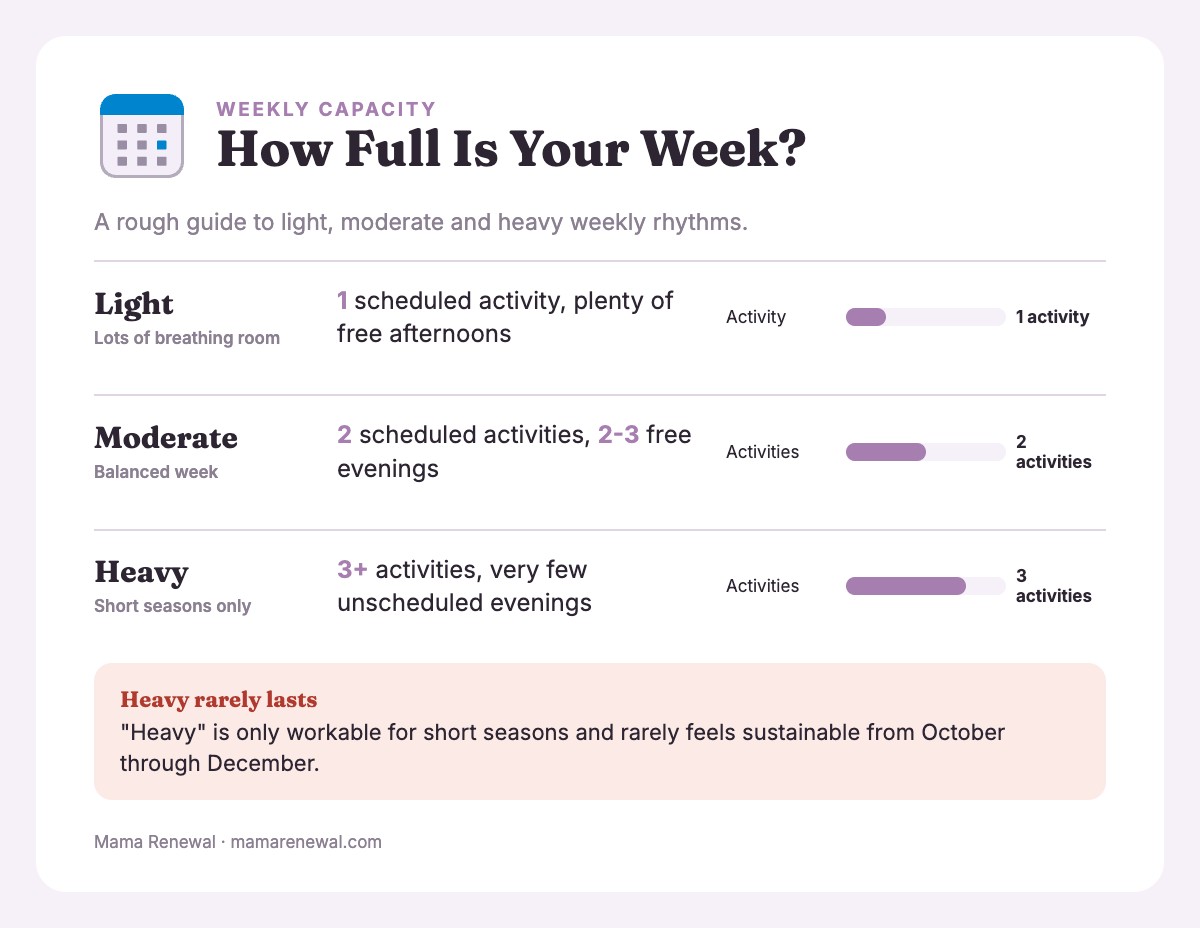
There is no magic number that applies to every family. Treat this as a rough guide only:
| Weekly rhythm | What it might look like |
|---|---|
| Light | 1 scheduled activity, plenty of free afternoons |
| Moderate | 2 scheduled activities, 2-3 free evenings |
| Heavy | 3+ activities, very few unscheduled evenings |
Most families discover that “heavy” is only workable for short seasons, and that it rarely feels sustainable from October through December. Pick the tier that fits your household’s actual energy, not the one that looks best on social media.
Questions to ask your child (for real)
- “Which activity do you look forward to the most?”
- “Which one do you wish you could skip?”
- “Is there anything you’d like more time at home for?”
- “If you could pick one thing to do every week, what would it be?”
Their answers may surprise you. Many kids are quietly begging for downtime.
Building a Fall Schedule That Doesn’t Collapse
Scripts handle the incoming asks. A few structural habits handle the baseline.
Pick your “protected” times
Choose one or two blocks per week that are off-limits to new commitments. For example:
- One weekend morning with no plans
- One weeknight that stays unscheduled
- Sunday evening reserved for prepping the week
Write them on the calendar like appointments. When someone asks about that time, you can truthfully say, “We have something then.” You do.
Do a Sunday calendar scan

Spend ten minutes each Sunday looking at the next two weeks. Ask: What’s coming? What’s stacked? What can I move, skip, or simplify? This one habit makes the 24-hour hold easier, because you already know what your week can bear.
Set a “yes budget”
Decide at the start of the season how many optional commitments you’ll take on. For instance: “Two optional volunteer things before Thanksgiving.” When the budget runs out, the answer is automatic: “I’ve hit my limit for the fall.”
Make a standard decline template
Save your favorite script as a text shortcut or note on your phone so you can paste it quickly. When saying no is easy, you do it more often, and the guilt has less time to build.
Lower the bar on the things you do say yes to
If you volunteer, buy the pre-made cookies (labeled and commercially packaged, and check the school’s food policy first). If you host, order the pizza. If you bring something, bring the store-bought version. A yes does not have to be a grand, homemade, Pinterest-ready yes. Nobody at the party will remember whether the cookies were homemade.
Give yourself something to look forward to

Overload feels worse when there is no relief on the horizon. If you need ideas for slow, nourishing moments, try the 30 fall journal prompts for moms craving a slower season. The prompts about what you want more of this fall are a good place to start.
What to Tell Your Kids About Your Own No
Kids are watching how you handle limits. When you say no gracefully, you teach them that:
- Their needs and your needs both matter.
- It’s okay to protect rest.
- Disappointment is survivable.
A few phrases that work at home:
- “We’re choosing quiet this weekend because our family needs rest.”
- “I said no to that so we can have time together.”
- “Everyone gets a turn to pick one thing we do this season.”
When a child is disappointed by a “no,” validate the feeling without reversing the decision:
“I know you’re sad. I get it. We’re still not doing it this time, and I’m here if you want to talk about it.”
That is a gift to a child, even though it doesn’t feel like one while they’re sulking in the back seat.
Frequently Asked Questions
How do I say no to fall activities without sounding rude?
Lead with thanks, give a clear no, and skip the long explanation. Something like “Thanks so much for thinking of us. We can’t take this on right now, but I hope it goes well” is polite and complete. Rudeness usually comes from being vague, dodging, or ghosting, not from a direct, kind decline. You are allowed to be brief.
Do I have to give a reason when I decline?
No. A reason is optional, and often a trap, because a reason can be argued with (“Oh, but we could do it on Thursday instead!”). “We can’t make it work this time” is a complete answer. If you want to offer context, keep it general: “Our fall schedule is full.”
What if my child wants to do the activity but I’m overwhelmed?
Treat it as a family decision with real trade-offs. Explain honestly what the activity would cost in time and energy, and ask what your child would be willing to give up to make room. Sometimes there is a lighter option, like a once-a-week program or a carpool with another family. If there isn’t, it’s okay to say, “I know you really want this, and it doesn’t fit this season. Let’s put it on the list for spring.” Your capacity as a parent is a legitimate factor.
How do I deal with mom guilt after saying no?
Expect it, and don’t treat it as proof you made the wrong call. Guilt is often just the discomfort of changing a habit. Name the feeling, avoid reopening the conversation, and do something calming. Over time, as you see that the world does not fall apart, the guilt shrinks. If it stays heavy, it can help to explore where the guilt originally comes from and talk with someone you trust or a professional.
How many after-school activities is too many for a school-age child?
There’s no universal number. The better measure is how your child and your household are actually doing. Warning signs include chronic exhaustion, rushed or skipped meals, homework stress, frequent meltdowns, and dreading activities that used to be enjoyable. If you’re seeing several of those, it’s a sign to trim, regardless of how many activities other families manage. Some families find one or two is plenty.
What if the other parent or a relative pressures me to say yes?
Align with your partner first, in private, so you can present a united answer. Then use the same calm, repeatable sentence: “We’ve decided to keep our fall lighter this year.” For relatives, a short boundary works best, repeated without escalation. You’re not required to win the argument. You only need to keep your answer steady.
Is it okay to say no to my child’s class events entirely?
Yes. Participation in school events is optional, and many families, especially those with working parents, multiple children, or limited energy, can’t attend everything. A no to volunteering does not make you a bad parent. If you can contribute in a small, low-effort way (sending supplies, a donation, or a short email of thanks), that’s a nice bonus, not a requirement.
You’re Allowed to Have a Quieter Fall
Nobody is going to hand you a medal for the fall you survived by saying yes to everything. But your kids will remember the dinners at the table, the lazy Saturday mornings, and the version of you that was patient because she had enough left in the tank.
Pick one script from this page, the one that made your shoulders drop when you read it. Save it to your phone. Use it this week. See what happens. Chances are the answer will be a quick “No worries, thanks for letting me know,” and you’ll have bought yourself an evening back.
You’re not letting anyone down by protecting your energy. You’re making sure there’s still a you to show up for the things that matter most.