
Second Baby Guilt: How to Stop Feeling Torn Between Your Kids
This post contains affiliate links. As an Amazon Associate I earn from qualifying purchases.
It was 6:50 p.m., and Dana had a plan: bath, two books, and the sleepy moon song her three-year-old, Theo, had asked for all day. Then her six-week-old woke up screaming for a feed. Through the monitor she heard her husband reading in the wrong voices, and Theo said, small and clear: “Mama does the moon song.”
She cried into the baby’s hair. Not because anything terrible had happened. Because everything was fine, and it still felt like she was failing someone no matter which room she was in.
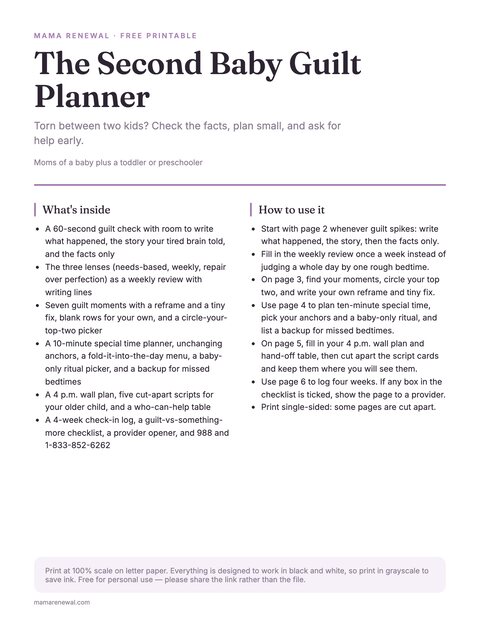
Free printable · 6 pages
The Second Baby Guilt Planner
A guilt-check worksheet with a weekly review, the seven guilt moments with a reframe and tiny fix, an older-child connection plan, a 4 p.m. wall plan, cut-apart scripts, a hand-off table, a 4-week check-in log, and a guilt-vs-something-more checklist with a provider opener and crisis numbers.
Free. Your download link appears right here. You'll also join the Mama Reset. Unsubscribe anytime. Privacy
If your chest just tightened, this is for you. Second baby guilt is common in the first year with two kids. Below you’ll find where it comes from, 7 specific guilt moments with a reframe and a tiny fix for each, scripts for your older child, and when to tell a provider.
In this article (11 sections)
- Why Second Baby Guilt Hits So Hard
- The Ledger Is Rigged (And What to Do Instead)
- 7 Second Baby Guilt Scenarios (and a Short Reframe for Each)
- A Quick Reference: Guilt Moment → Reframe → Tiny Fix
- What to Say to Your Older Child (Scripts You Can Steal)
- Small, Realistic Ways to Share Yourself
- How to Ease Mom Guilt: 5 Small Mental Resets
- Mom Guilt vs. Something More: When to Mention It to a Provider
- What Your Kids Learn From Having a Sibling
- Frequently Asked Questions
- You Are Not Failing Either of Them
Why Second Baby Guilt Hits So Hard
With your first baby, your attention was a single stream. You had one child, and when you were with them, you were with them. Even on exhausting days, the math was simple.
The second baby breaks the math. Now every minute you give one child is a minute you can’t give the other, and your brain, which is wired to notice that, keeps a running ledger. Feeding the baby? Ledger entry: toddler waited. Playing trains with the toddler? Ledger entry: baby fussed in the bouncer. You can’t win the ledger, because it’s designed to be unbalanceable.
A few things make it worse in the first year:
- You remember what the first child had. You gave your oldest your undivided, well-rested, Pinterest-board attention. The comparison is unfair, but your brain makes it anyway.
- Your oldest is visibly grieving a change. Regression, clinginess, big feelings, and sudden “I hate the baby” announcements are all normal, and they’re all very easy to read as evidence that you ruined something.
- The baby can’t tell you what they need. The toddler can protest loudly, so guilt toward the older one is loud. Guilt toward the baby is quieter: Am I holding them enough? Did I rush that feed?
- Hormones and sleep deprivation amplify everything. Postpartum is a neurological and hormonal upheaval. A feeling that would be a 4 out of 10 on a rested day registers as a 9 at 3 a.m.
- Identity is shifting again. Becoming a mother of two isn’t just “more of the same.” It’s a new role with new rules. If that sounds familiar, our piece on matrescence and the identity shift every mom goes through explains why this season feels so disorienting.
Here is the reframe underneath everything else in this article: guilt is not evidence that you’re doing something wrong. It’s evidence that you love two people and have a finite number of hours. The guilt is a measure of your love colliding with the math of being one person.
The Ledger Is Rigged (And What to Do Instead)
Let’s name the thing: you’re trying to run a fairness audit that no human can pass. Equal time, equal attention, equal patience, every day, for two children at different developmental stages with completely different needs. It’s not a standard anyone could meet, so you’ll never feel like you met it.
Instead of equal, try these three lenses:
- Needs-based, not time-based. A newborn needs frequent, urgent, physical care. A toddler needs connection, predictability, and proof that they still matter. These aren’t equal quantities, so they won’t look equal on a clock.
- Weekly, not hourly. Zoom out. Did your oldest get some real connection this week? Did your baby get fed, held, and loved this week? Judging a whole day by one rough bedtime is like judging a book by one page.
- Repair over perfection. Kids don’t need a parent who never misses. They need a parent who comes back. “I was feeding the baby and couldn’t come, and I missed you. Can we do the moon song tomorrow?” is a complete, healthy parenting move.
7 Second Baby Guilt Scenarios (and a Short Reframe for Each)
These are the specific moments moms describe over and over. Find yours, take the reframe, and leave the rest.
1. Missing Your Toddler’s Bedtime Because the Baby Needs a Feed
The guilt: You promised the moon song. The baby woke up hungry. Your toddler heard the baby win.
The reframe: Your toddler isn’t learning “the baby matters more than me.” They’re learning “Mama takes care of whoever needs feeding, and that will be me when I’m little, too.” A hungry baby is not a competition. Tonight’s bedtime can look different, such as a partner doing the book or a recorded song, and that’s okay.
What to try:
- Do the start of bedtime with your toddler (the bath or the first book) before the baby’s feed window, and hand off the rest.
- Record yourself reading a favorite book or singing the song on your phone. When you can’t be there, your voice can.
- Say the repair out loud the next day: “Last night I was feeding your brother and couldn’t come. I thought about you. Tonight I’m doing the moon song.”
2. Snapping at Your Older Child Because You’re Exhausted
The guilt: You raised your voice over spilled milk, and your toddler’s face crumpled. Now you feel like the worst person alive.
The reframe: A snap from a depleted parent, followed by a repair, is very unlikely to cause lasting harm. It’s a normal human moment, and the repair teaches your child that relationships survive conflict. What matters is the pattern, not the single moment.
What to try:
- Repair quickly and simply: “I yelled, and that wasn’t okay. I was tired and frustrated. I’m sorry. I love you.”
- Notice your triggers (hunger, noise overload, the 4 p.m. witching hour) so you can plan around them.
- If snapping feels frequent or scary rather than occasional, our guides on mom rage and anger management for moms offer gentle, no-shame places to start.
3. Less One-on-One Time With the Firstborn

The guilt: You used to spend whole afternoons on the floor with your oldest. Now you’re lucky to get ten uninterrupted minutes.
The reframe: Quality beats quantity, and small and predictable beats big and rare. Children measure connection by whether they feel seen, not by the clock. Ten minutes of your full attention often means more to a child than hours of distracted time nearby.
What to try:
- Ten-minute “special time”: Phone away, baby down (or with a partner), toddler picks the activity. Give it a name so they can look forward to it.
- Narrate the connection: “I love being with you right now.” Toddlers tend to take in what you say out loud.
- Include them, too: Let your oldest be the “helper” with diapers or the one who picks the baby’s outfit. Belonging counts as connection.
4. Your Toddler Is Regressing and You Feel Responsible
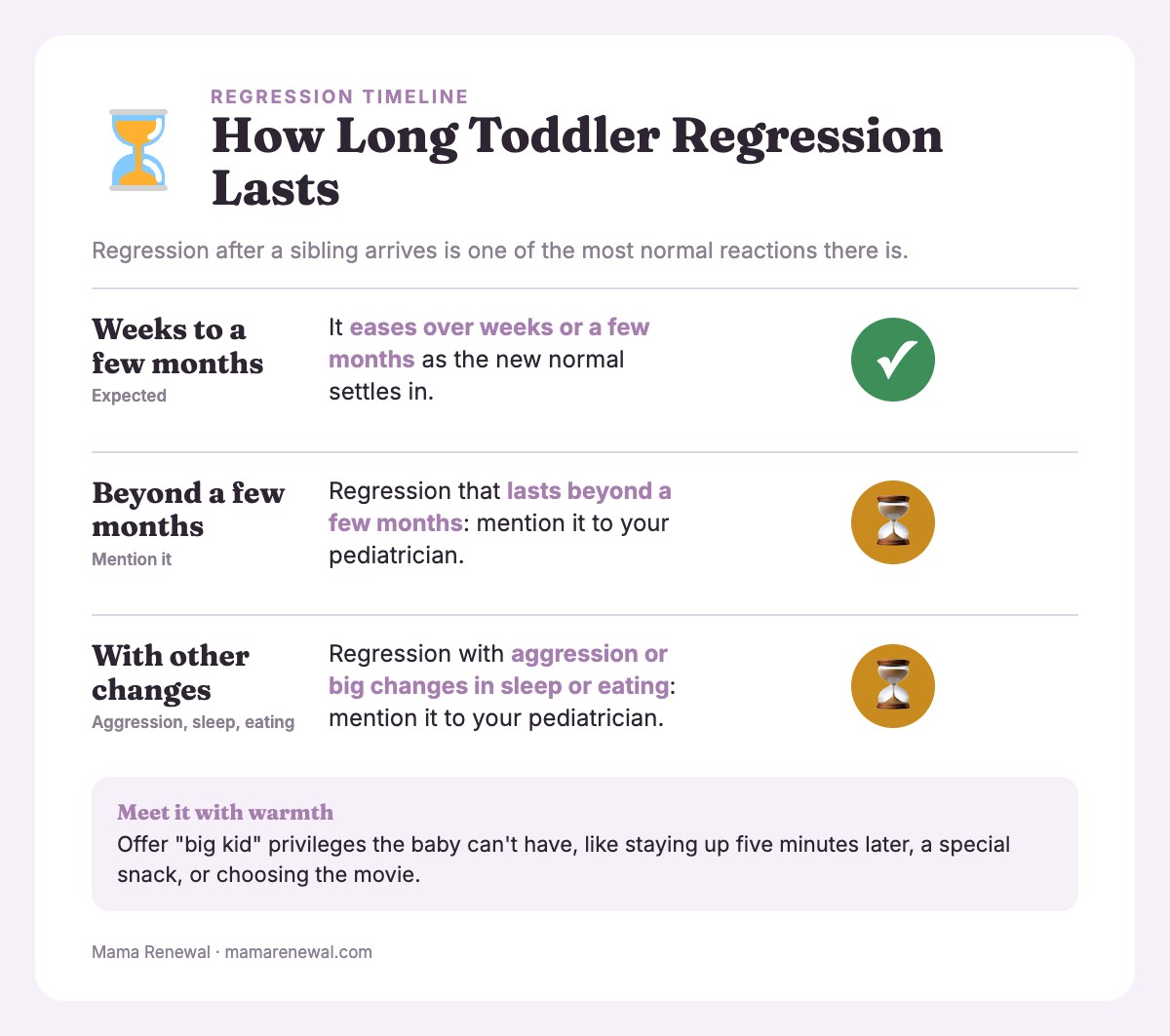
The guilt: Potty training reversed. The pacifier is back. Your formerly independent kid wants to be carried everywhere. You’re convinced the baby caused this and you caused the baby.
The reframe: Regression after a sibling arrives is one of the most normal reactions there is. It’s a sign your toddler is processing a seismic change, not a sign you broke them. They’re asking, in the only language they have, “Is there still room for me?”
What to try:
- Meet the regression with warmth, not shame. Let them have the pacifier or the baby-bottle pretend game for a while.
- Offer “big kid” privileges that the baby can’t have (staying up five minutes later, a special snack, choosing the movie).
- Expect it to ease over weeks or a few months as the new normal settles in. If regression lasts beyond a few months, or comes with aggression or big changes in sleep or eating, mention it to your pediatrician.
5. Feeling Bad for the Toddler Because the Baby Is “Taking Everything”
The guilt: Your toddler watches you give the baby your body, your lap, and your time. You feel like you stole their mother.
The reframe: You didn’t steal anything. You expanded the family, and the first weeks of that are lopsided by necessity. Your toddler is also gaining something: a sibling, a lifelong relationship, and the experience of learning that love can stretch.
What to try:
- Keep two or three tiny anchors that never change (the morning cuddle, the good-night routine, the Saturday pancakes). Predictability tells them the relationship is safe.
- Let them “help” in ways that feel important, not pretend.
- Resist narrating the baby as the reason for everything (“We can’t because of the baby”). Try “We can’t right now,” with no blame attached.
6. Not Bonding With the Baby the Way You Did With the First
The guilt: You’re so busy managing the toddler that the baby gets less cooing, less photographing, less you. You wonder if the baby is missing out.
The reframe: Second babies get a different kind of mothering, not a worse one. They get the calm of a mom who has done this before, they get a built-in best friend, and they get a family full of voices and faces. Plenty of mothers feel a slower bond with a second baby, and it can still deepen beautifully.
What to try:
- Create one baby-only ritual: the 3 a.m. feed, a morning skin-to-skin, a song only they get.
- Stop comparing the photo count. The first baby got 4,000 pictures; the second gets a real, lived-in childhood.
- Give yourself grace if the bond builds gradually. That is common, and it’s not a verdict on you.
7. Feeling Torn in the Same Moment: Both Kids Crying at Once
The guilt: The baby is screaming, the toddler is melting down, and you can only hold one. Whoever you pick, the other one loses.
The reframe: In that moment there is no right choice, only a good enough one. Triage is not failure. Safe, calm, and fed beats perfectly split every time.
What to try:
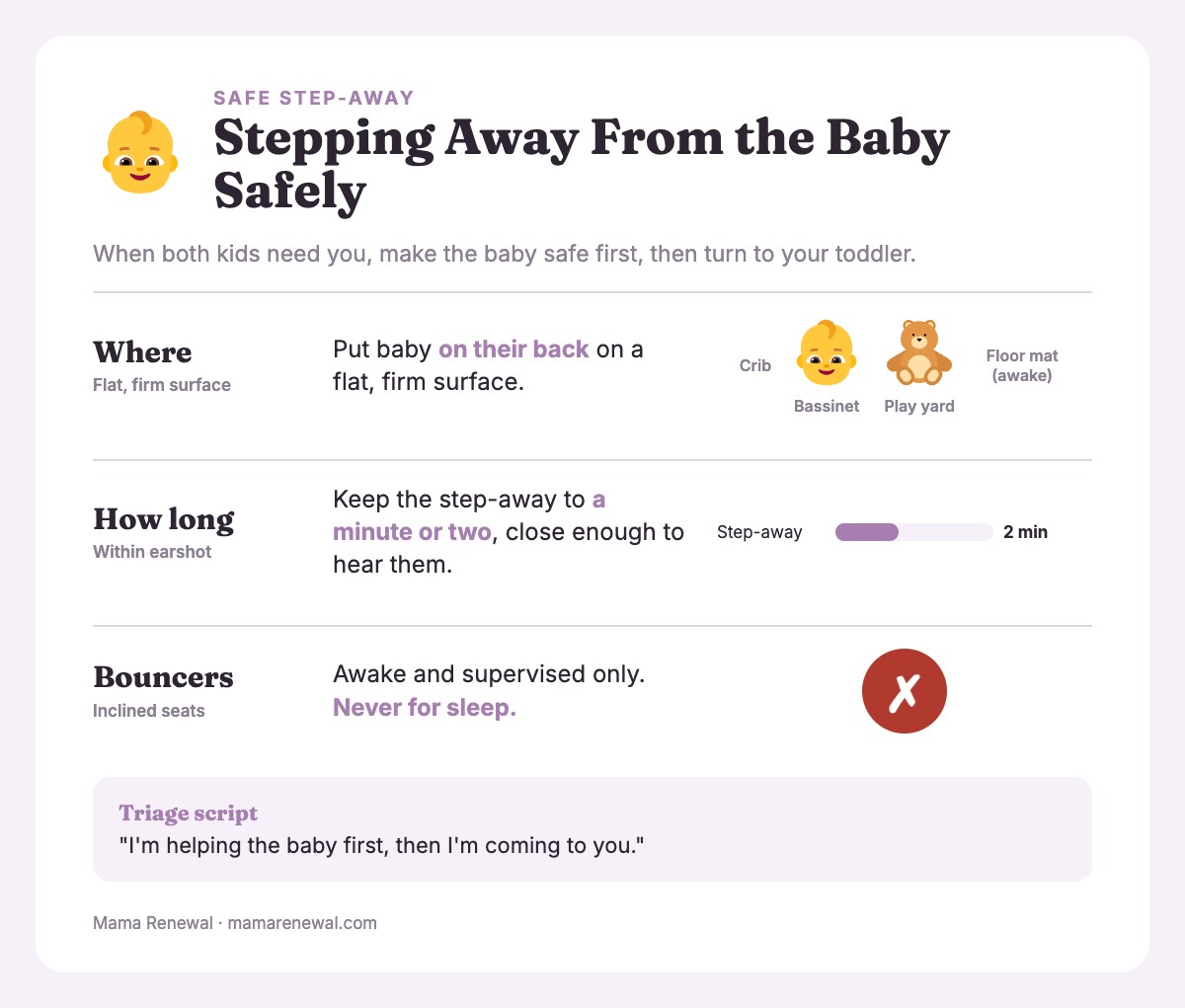
- Triage out loud: “I’m helping the baby first. Then I’m coming to you. You can do this, I’ll be there in two minutes.”
- Make the baby safe, then turn: If the baby is fed and changed, put them on their back in a crib, bassinet, or play yard, or on a flat floor mat while awake. Then you can step away for a minute or two, close enough to hear them. Bouncers and inclined seats are for awake, supervised use only. A baby who dozes off in one should be moved to a flat, firm sleep surface.
- Practice a “both-of-you” hold: Hold the baby securely in your arms (or lay them on a flat floor mat beside you), with your toddler snuggled next to you with a book or show. If your toddler has a snack, keep it soft and small-cut, and have them eat it seated with you watching. Never leave the baby alone on the couch. It’s not elegant, but it counts.
Safety firstBefore you step away from the baby, put them on their back on a flat, firm surface (crib, bassinet, play yard, or a floor mat while awake). Keep the step-away to a minute or two, within earshot. Bouncers and inclined seats are never for sleep.
TipYour one-line triage script: “I’m helping the baby first, then I’m coming to you.”
A Quick Reference: Guilt Moment → Reframe → Tiny Fix
| Guilt moment | The reframe | A tiny fix |
|---|---|---|
| Missed bedtime for a feed | Feeding the baby teaches trust, not rejection | Recorded song, repair talk next day |
| Snapped from exhaustion | Repair matters more than perfection | Short apology, name your trigger |
| Less one-on-one time | Small and predictable beats big and rare | 10-minute special time |
| Toddler regression | It’s processing, not damage | Offer comfort and big-kid perks |
| Baby “takes everything” | Love stretches; the first weeks are lopsided | Keep 2-3 unchanging anchors |
| Slower bond with baby | Different, not lesser | One baby-only ritual |
| Both kids crying | Triage is not failure | Say it out loud, then return |
What to Say to Your Older Child (Scripts You Can Steal)
Toddlers and preschoolers don’t need long explanations. They need short, honest, warm sentences they can hear over the noise. These name the feeling and offer a next step without making your child responsible for your guilt. Try:
- When the baby needs you: “The baby needs me right now. I’ll be with you as soon as I can, and I can’t wait.”
- When they act out for attention: “It’s hard when I’m busy with the baby. I miss you too. Come sit next to me.”
- When they say they don’t like the baby: “It’s okay to have big feelings about the baby. You can feel mad and I will still love you.”
- When you’ve snapped: “I’m sorry I yelled. You didn’t do anything wrong. I was frustrated. Can I have a hug?”
- When you promise a future moment: “After the baby’s nap, you and I are doing puzzles. Just us.”
TipKeep scripts to one or two sentences, say them at your toddler’s eye level, and name the feeling first.
Small, Realistic Ways to Share Yourself
When you’re running on fumes, “quality time” advice can feel like another item on a list you can’t finish. Here are the lowest-effort options that still count.
Fold connection into what you’re already doing

- Nursing or bottle-feeding time: Keep a basket of books and a small, soft, easy-to-eat snack within your eye line so your toddler can snuggle in next to you, seated. Everyone gets a piece of you at once.
- Car rides: When the baby drifts off in the car seat, use the drive for quiet chat or their favorite song with your older child. When you arrive, move the baby to a flat sleep surface.
- Diaper changes: Let your toddler narrate, hand you wipes, or sing to the baby. It’s connection disguised as logistics.
Safety firstDuring snuggle feeds, keep the baby’s face clear and keep your toddler from leaning on the baby. If you’re drowsy during a night feed, don’t fall asleep on a couch or glider with the baby.
Use the baby’s naps well
Naptime is the most valuable time in your day, and it pulls you in several directions: rest for you, connection with your oldest, a mile-long to-do list. You don’t have to pick the same one every day. Some days it’s ten minutes of floor time with your toddler; some days it’s lying down. Our post on how to use naptime for self-care, not just chores can help you decide what the day actually needs.
Let other people carry some of the split
You are not meant to be the only one who can comfort your children. If you have a partner, family member, or friend who can do the bedtime or the park trip, let them. Children who bond with several caring adults aren’t losing anything. They’re gaining a bigger net of love. And if the mental load of managing it all is the heaviest part, the mental load and why moms feel exhausted even when everyone “helps” is worth a read.
Plan the 4 p.m. wall

Most families have a daily pinch point when both kids are tired, hungry, and needy. Plan for it like weather. Not heroic, just prepared:
- Snacks ready
- A show or audiobook queued
- A simple dinner planned
- A hand-off to a partner or helper lined up
- Your own drink and snack within reach
How to Ease Mom Guilt: 5 Small Mental Resets
A few small things help the mental side of this:
- Name it without judgment. “I’m feeling torn, and that makes sense.” Naming a feeling often loosens its grip.
- Write the facts, not the verdict. On paper, list what actually happened today: Both kids fed. Both kids loved. One rough bedtime. Facts are less brutal than the story your tired brain tells.
- Talk to someone in the same stage. Other mothers of two will nod at everything on this page. If friendship feels hard to find right now, making mom friends as an adult is a good place to start.
- Protect one small thing for yourself. Five minutes of quiet, a warm drink, a short walk. Not as a reward, but as maintenance.
- Go back to the bigger guilt toolkit. Our guide on how to stop mom guilt goes deeper on the thought patterns that keep guilt looping, and pairs well with this one.
Mom Guilt vs. Something More: When to Mention It to a Provider
Most second baby guilt is a normal, if painful, part of a big transition. It tends to ease as routines form, sleep improves, and you gather evidence that your kids are okay. But guilt can also show up alongside something that deserves more support, and it helps to know the difference.
Consider telling your doctor, midwife, or another provider if you notice:
- Guilt that comes with persistent resentment toward either child. Occasional frustration is universal. A steady, heavy resentment that doesn’t lift is worth naming.
- Ongoing hopelessness. A feeling that things won’t get better, that you’re failing no matter what, or that your kids would be better off without you. If that last thought is present, see the urgent-help box below.
- Guilt that feels constant and out of proportion, not tied to specific moments but present nearly all day.
- Loss of interest or pleasure in things you usually enjoy, or in your children.
- Trouble sleeping even when the baby sleeps, appetite changes, or difficulty concentrating.
- Anxiety or intrusive thoughts that feel hard to control.
Safety firstIf you have thoughts of harming yourself or your children, or feel your kids would be better off without you, get help now. Call or text 988, call the National Maternal Mental Health Hotline at 1-833-852-6262, or call emergency services. Confusion, seeing or hearing things that aren’t there, or being unable to care for yourself or your children means same-day emergency care.
This isn’t a diagnosis, and it doesn’t mean something is “wrong” with you. Perinatal depression and anxiety are common, they can show up anytime in the first year (not just the first weeks), and they respond well to support. Our guides to postpartum depression signs and the postpartum anxiety guide can help you sort out what you’re feeling. Guilt paired with persistent resentment or ongoing hopelessness can be a symptom of depression rather than just a hard stretch, and a provider can help you tell the difference. Mentioning it is a sign you’re taking care of your family, not a sign you’re failing it.
If you’re not sure, a simple line works: “I’ve been feeling guilty and low for a while and I’d like to talk about it.”
What Your Kids Learn From Having a Sibling
This stretch is hard and, in ways you can’t see yet, good for your kids.
Your oldest is learning that love isn’t a limited resource, that other people have needs, that waiting is survivable, and that big feelings can be spoken and still be loved. Your baby is learning that someone comes, that the world is full of people, and that they have a sibling who will one day be their first friend.
Most importantly, both of them are watching a mother who shows up, repairs, and keeps trying. Not a perfect one. A real one. That’s the model of love they carry into their own lives.
Frequently Asked Questions
Is it normal to feel guilty about having a second baby?
Yes, it’s very common. Many mothers feel guilt about their older child’s changing world, about dividing their attention, or about not feeling the same instant bond with the second baby. This guilt usually reflects how much you care, and it typically softens as routines settle over the first several months. If it feels overwhelming or won’t lift, it’s worth mentioning to a provider.
How do I stop feeling torn between my two kids?
You probably won’t stop feeling it entirely, but you can loosen it. Shift from equal time to needs-based care, judge by the week instead of the hour, and focus on repair rather than perfection. Small rituals, like ten minutes of special time with your older child and one baby-only ritual, give both kids something steady to count on.
My toddler seems to resent the baby. Did I do something wrong?
No. Jealousy, regression, and acting out are typical responses to a new sibling. Your toddler is adjusting to a huge change. Name their feelings (“It’s hard to share Mama”), keep a few predictable one-on-one moments, and give them a sense of being a helpful big kid. Most children warm up to the baby over the first year, and the bond often becomes a favorite part of family life. If your toddler’s behavior toward the baby is aggressive, or you’re worried about the baby’s safety around them, never leave them alone together and talk with your pediatrician.
How much one-on-one time does my older child need?
There’s no magic number. Short, predictable, phone-free time, even ten minutes a day, tends to matter more than occasional big outings. Let your child choose the activity and tell them it’s their special time. Consistency and presence are what they’ll remember.
I don’t feel as bonded with my second baby. Is something wrong with me?
Not necessarily. Many mothers report a slower or different bond with a second baby because their attention is divided and they’re more tired. Bonding often builds through daily care, one-on-one rituals, and time. If the distance comes with persistent resentment, numbness, or hopelessness, tell your provider, since those can be signs of postpartum depression.
When is mom guilt a sign of postpartum depression?
Guilt alone is common and usually tied to specific situations. It’s worth speaking with a provider when guilt comes with ongoing hopelessness, persistent resentment toward either child, loss of interest in things you enjoy, big changes in sleep or appetite, or thoughts of harming yourself or others. This is not a diagnosis, just a guide for when to ask for support. Postpartum depression and anxiety are treatable, and they can appear anytime in the first year.
What should I do when both kids need me at the same time?
Triage and say it out loud. Make sure the baby is safe and as comfortable as you can, tell your toddler “I’m helping the baby first, then I’m coming to you,” and then follow through. If you can, bring both kids close together with a book, snack, or cuddle. Good enough, calmly done, is the goal.
You Are Not Failing Either of Them
The feeling of being torn doesn’t mean you’re getting it wrong. It means you have two small people you love fiercely and only one set of arms. Some nights you’ll miss the moon song. Some mornings you’ll snap, then repair. Some afternoons both kids will cry and you’ll sit on the floor between them and breathe.
That’s not failure. That’s what a first year with two looks like. Be as kind to yourself as you’re trying to be to them, ask for help early, and tell someone if the heaviness doesn’t lift. Your kids don’t need a perfect mother. They need you, tired and loving and coming back.