
Letting Go of Holiday Perfectionism: A Permission Slip for Moms
This post contains affiliate links. As an Amazon Associate I earn from qualifying purchases.
It was 11:40 p.m. on a Sunday in early December, and I was on the living room floor with a hot glue gun and a bag of felt scraps, making gnome ornaments for my daughter’s whole class. Nobody had asked me to. By gnome number six, one had a crooked hat, and I was crying a little over a felt triangle. Not because of the gnome, but because I was tired in a way sleep doesn’t fix.
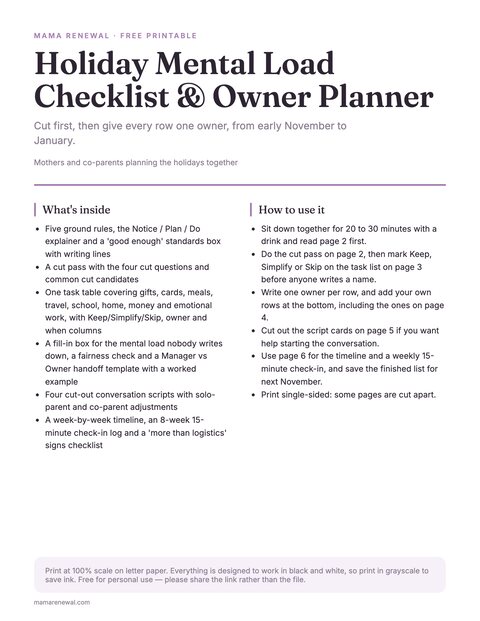
Free printable · 6 pages
Holiday Mental Load Checklist & Owner Planner
A ground-rules and cut-pass sheet with space to write your agreed standards, a Keep/Simplify/Skip task table with owner and timing columns across eight holiday categories, a 'mental load nobody writes down' box with a fairness check and owner handoff template, four cut-out conversation scripts, a Nov 3 to early January timeline, and an 8-week check-in log.
Free. Your download link appears right here. You'll also join the Mama Reset. Unsubscribe anytime. Privacy
If that scene feels familiar, you’re in good company. Holiday perfectionism in moms is incredibly common, and it rarely looks like a spotless house. More often it’s a long invisible to-do list and a feeling that you’ve failed if you don’t pull it all off.
This page covers the thoughts behind the overdoing, a 10-row “good enough” rewrite table, a 6-step plan to do less, scripts for pushback, and when to get help.
In this article (16 sections)
- Why the Holidays Bring Out the Perfectionist in So Many of Us
- What Holiday Perfectionism Looks Like
- What Perfectionism Costs You and Your Kids
- The Good Enough Mom, Holiday Edition
- 10 Perfectionist Holiday Thoughts and Their “Good Enough” Rewrites
- Where the Guilt Comes In (and Why It Won’t Be Reasoned With)
- Self-Compassion During the Holidays: What It Looks Like in Real Life
- How to Stop Overdoing the Holidays: A Practical Plan
- Scripts for When Other People’s Expectations Make It Harder
- Small Holiday Traditions That Count as Enough
- A Few Journaling Questions for the Perfectionist Season
- When It Might Be More Than Perfectionism
- What to Do on the Day Itself
- After the Holidays: The Landing
- Frequently Asked Questions
- One Last Permission Slip
Why the Holidays Bring Out the Perfectionist in So Many of Us
Perfectionism doesn’t show up in November out of nowhere. It’s usually been there all year, quietly managing the laundry and the lunchboxes. The holidays just turn up the volume, for a few predictable reasons.
The stakes feel higher. Ordinary Tuesdays are forgettable. The holidays feel like they’re supposed to be memorable, and many of us carry an unspoken belief that we’re the ones responsible for creating those memories. If the day is flat, we feel like we flattened it.
Everyone’s highlight reel is on full blast. From mid-November onward, your feed is a parade of coordinated pajamas, themed advent calendars, and cookie boards that look like they were assembled by a professional. You know, rationally, that you’re seeing a curated 1 percent of someone’s life. Your nervous system doesn’t always get the memo. If the scroll leaves you feeling behind, read up on mom comparison and social media before you open another app.
Our own childhoods are in the room. Whether you grew up with magical holidays you’re trying to recreate or hard ones you’re trying to make up for, you’re probably parenting against a memory. Both directions create pressure. “I want my kids to have what I had” and “I want my kids to have what I didn’t” both pile onto an already long list.
The work is invisible and lopsided. Gift tracking, card addresses, teacher presents, who’s hosting, what everyone’s allergic to, which relatives can’t sit near each other. In many households, one person holds all of it in their head. That person is often reading this article. If that’s you, the Holiday Mental Load Checklist can help you get the invisible work out of your head and onto paper, where other people can see it.
There’s a deadline that can’t move. Most stressors flex. A holiday doesn’t. December 25th arrives whether you’re ready or not, and that fixed date makes every small task feel heavier than it is.
None of this means you’re bad at the holidays. It means you’re a person with a finite amount of energy standing inside a season that asks for an infinite amount.
What Holiday Perfectionism Looks Like
When we hear “perfectionism,” we often imagine someone with color-coded binders and immaculate throw pillows. But the version that shows up in December is usually sneakier. See if any of these sound familiar:
- You say yes to things you already know you’ll resent.
- You do the task yourself because explaining it feels like more work than doing it, and also because nobody will do it right.
- You buy “one more thing” so the gift piles look even between siblings, even though your kids would never count.
- You feel a flash of irritation when your family doesn’t react enough to something you spent hours on.
- You can’t relax on the actual day because you’re scanning for what’s going wrong.
- You feel a heavy post-holiday crash, as though you ran a marathon nobody else knew you were running.
- You secretly judge yourself harshly for things you’d never judge another mom for.
That last one is the tell. Most of us extend far more grace to a friend with a store-bought pie than we do to ourselves.
The difference between high standards and perfectionism
Caring about your family’s holidays is not a flaw. Wanting a few traditions that feel special is lovely. The trouble starts when the standard becomes a measuring stick for your worth instead of a way to create something you love.
A rough test: high standards feel like energy; perfectionism feels like dread. If the thing you’re planning makes you a little excited, it’s probably a preference. If it makes you tense, or if you’re doing it to avoid someone’s disappointment (real or imagined), it’s probably perfectionism.
What Perfectionism Costs You and Your Kids
We tend to justify holiday overdoing because it’s “for the kids.” It’s worth asking, gently, what it actually costs them.
Children rarely remember the thread count of the tablecloth. Kids often pick up on how the adults around them feel, and that tends to color how a day feels to them. A mom who’s frazzled, snappy, and counting the minutes until everyone goes home creates a very different memory than a mom who is a little messy and actually in the room. You can host a gorgeous, flawless event and still send the message “this is stressful and I’m barely holding it together.”
Perfectionism also quietly takes things from you:
- Presence. You can’t savor your toddler’s first look at the tree if you’re mentally rearranging the dinner timeline.
- Rest. Sleep is usually the first thing to go, and a depleted brain makes everything harder, including the emotional regulation you’d like to have when the kids are overtired and overstimulated.
- Patience. If you’ve noticed your fuse getting shorter as the to-do list gets longer, you’re not imagining the connection. The Mom Rage Trigger Log can help you see your patterns before the yelling starts.
- Joy. The cruel irony is that the more effort we pour into creating a joyful holiday, the less capacity we have to feel any of it ourselves.
This isn’t meant to guilt you. (We’ll get to guilt in a moment, because it’s often the engine under all of this.) It’s meant to reframe the trade: you are not giving up magic by doing less. You may be making room for it.
The Good Enough Mom, Holiday Edition
The phrase “good enough” has a real history. The pediatrician and psychoanalyst Donald Winnicott introduced the idea of the “good enough mother” decades ago. Winnicott argued that a mother doesn’t need to be perfect. Small, manageable imperfections can help children learn that the world is survivable and that people can be loved when they make mistakes.
You don’t need a psychology degree to apply this. Good enough isn’t a consolation prize or a lowered bar. It’s a deliberate, loving decision about where your finite energy goes.
In practice, a good enough holiday might mean:
- The cookies are from the bakery section and the kids decorate them anyway.
- The photo card is a slightly blurry snapshot from your phone, or there is no photo card this year.
- Three family traditions happen, not eleven.
- You sit down for part of the main event.
- Someone else brings a side dish, and it’s not made the way you would have made it.
- Everyone gets to bed late, and nobody is permanently scarred.
If a voice in your head is already objecting, that’s okay. That’s the voice the next section is for.
10 Perfectionist Holiday Thoughts and Their “Good Enough” Rewrites
Telling yourself “don’t be a perfectionist” doesn’t work, because the thoughts don’t feel like perfectionism in the moment. They feel like facts, or like love, or like responsibility. A reframe only sticks if it’s believable, so each rewrite below is something you can actually say to yourself without rolling your eyes.
Try reading the left column out loud, then the right. Notice which ones hit a nerve. Those are the ones to practice.
| # | The perfectionist thought | The “good enough” rewrite |
|---|---|---|
| 1 | “If I don’t make this holiday magical, I’m failing my kids.” | “My kids need a present, loving parent more than a perfect production. Magic is mostly attention, and attention is free.” |
| 2 | “Everyone else seems to be pulling this off effortlessly.” | “I’m comparing my behind-the-scenes to their highlight reel. Most of them are tired, too.” |
| 3 | “It’s faster if I just do it myself, and it has to be done right.” | “Done by someone else, differently, is still done. I’m allowed to share the load even if it’s not up to my standard.” |
| 4 | “I have to keep every tradition going, or the kids will lose out.” | “Traditions are meant to serve us. I can keep the ones we love and let the rest quietly retire.” |
| 5 | “If I say no, I’ll disappoint someone.” | “Disappointing someone briefly is survivable. Burning out isn’t a better gift to anyone.” |
| 6 | “The gifts need to be equal, thoughtful, and perfectly timed.” | “Thoughtful doesn’t mean elaborate. A few meaningful gifts beat a mountain I resent buying.” |
| 7 | “I should be grateful and happy right now, so something must be wrong with me.” | “I can be grateful and exhausted at the same time. Mixed feelings are normal, not a malfunction.” |
| 8 | “My house has to look ready before anyone sees it.” | “People are coming to see us, not inspect the baseboards. A lived-in home is a welcoming one.” |
| 9 | “I’ll rest after the holidays.” | “Rest is part of how I get through the holidays. I can schedule small pieces of it now.” |
| 10 | “If something goes wrong, the whole day is ruined.” | “Some of our funniest, most memorable holidays had a disaster in them. Things going sideways is part of the story, not the end of it.” |
How to use the table (so it isn’t just pretty words)
A reframe only works if you practice it at the moment the old thought fires. A few ways to make that realistic:
- Pick your top two or three. You don’t need to overhaul all ten. Notice which thoughts show up the most in your head and start there.
- Write them on a sticky note and put it somewhere you’ll see it when the stress spikes: the bathroom mirror, the inside of the pantry door, the back of your phone.
- Say the rewrite in your own words. If “good enough” sounds too corporate, translate it. “It’s fine.” “That’ll do.” “Nobody’s grading this.” Whatever your inner voice would say if it were kind.
- Don’t expect to believe it right away. The goal isn’t to flip a switch. It’s to give your brain a second option next to the first one. Over time, the second option gets easier to find.
Let’s go through a few of these more closely, because some of them deserve more than a table cell.
“If I don’t make it magical, I’m failing my kids”
This is probably the most powerful thought on the list, and the most tender, because it comes from love. You want your children to feel safe, celebrated, and delighted.
Here’s what’s worth holding onto: kids experience holiday magic through small, sensory, repeatable moments, not big productions. The smell of a particular candle. A specific song. Staying up a little late in pajamas. A silly family inside joke that only happens in December. Many of these cost nothing and take almost no planning.
Your own favorite holiday memories are probably fragments too: a blanket, a laugh, a specific person’s voice. You can create those on very little energy.
“It’s faster if I just do it myself”
Sometimes this is true. For the next ten minutes, it’s faster. For the whole season, it’s an exhausting trap, because it makes you the permanent single point of failure for your family’s holidays.
A practical middle path: hand off the whole task, not a piece of it. “Can you handle the teacher gifts from start to finish?” works better than “can you grab one thing at the store?” The first respects the other person’s ownership. The second keeps you in charge of the plan and just recruits a helper.
And yes, they might do it differently. Let it be. The relief of not carrying it is usually worth more than the gap between your standard and theirs. If the imbalance runs deeper than the holidays, the piece on the mental load and why moms feel exhausted even when everyone “helps” goes further into why this happens and what to do about it.
“I should be happy right now”
This one is quietly brutal because it layers a second problem on top of the first. You’re tired or sad or overwhelmed, and you feel bad about feeling that way.
The holidays can bring up grief, old family wounds, financial strain, loneliness, or simple depletion, even in a season that is also genuinely lovely. You can hold both. If a wave of sadness shows up while you’re wrapping presents, it doesn’t mean you’re ruining the season or that you’re ungrateful. It means you’re a person with a full emotional life, which doesn’t take a December vacation.
Where the Guilt Comes In (and Why It Won’t Be Reasoned With)
Underneath most perfectionist holiday thoughts is a feeling that sounds like: “If I don’t do this, I’m a bad mom.” That is guilt, and guilt has a way of presenting itself as responsibility.
A helpful distinction: guilt says “I did something wrong.” Shame says “I am something wrong.” Perfectionism often runs on the second one. If the pressure around the holidays is less about specific tasks and more about proving your worth as a mother, you’re working with shame. That’s a different kind of problem than a too-long to-do list.
A few things that can help when the guilt arrives:
- Name it out loud. “This is guilt talking.” Naming creates a tiny bit of distance, and sometimes that’s all it takes to stop acting on it automatically.
- Ask what a friend would say. Picture a friend telling you she skipped the photo card. Would you think less of her? Almost never. Offer yourself the same response.
- Check the source. Whose voice is this? Your mother’s? A coworker’s? A stranger’s Instagram caption? A lot of “shoulds” turn out to be inherited, not chosen.
If you want a deeper walk through this one, How to Stop Mom Guilt breaks down the patterns and gives you language for talking back to it without dismissing it.
Self-Compassion During the Holidays: What It Looks Like in Real Life
“Be kind to yourself” is easy to type and hard to do when you’re juggling forty tasks. Self-compassion, as researchers like Kristin Neff describe it, means speaking to yourself kindly instead of harshly, remembering that struggle is shared, and noticing hard feelings without getting swallowed by them. Research by Neff and others links self-compassion with bouncing back from setbacks, which suggests being gentle with yourself can help keep you capable. For everyday ways to practice it with no spare time, see self-compassion for moms.
A 60-second self-compassion break for the middle of the chaos
When you feel the pressure spike (in a store aisle, at the stove, in the bathroom with the door locked), try this:
- Notice and name it. “This is a really stressful moment.”
- Normalize it. “A lot of moms feel this way during the holidays.”
- Offer yourself a kind phrase. “May I be gentle with myself right now.” Or, if that feels too soft, “I’m doing enough.”
- Take one slow breath with a longer exhale than inhale.
How to Stop Overdoing the Holidays: A Practical Plan
Mindset shifts are helpful, but they work best when paired with some structural changes. Here’s a step-by-step approach to scaling things back without feeling like you’re scrimping on joy. First the whole plan at a glance, then each step in more detail.
- Decide what you actually care about. Take five minutes to name the feeling you want, the traditions you’d miss, and the one you secretly dread.
- Sort your list into three buckets. Must-do, nice-to-have, and not this year.
- Use the “one less” rule. Do one fewer of each kind of holiday activity than last year.
- Lower the bar on purpose. Choose two or three things to do at about 70 percent, and decide that in advance.
- Build in the rest first. Put small breaks on the calendar now instead of promising yourself rest “after.”
- Get other people involved, specifically. Hand off whole tasks with clear names and dates attached.
Step 1: Decide what you actually care about
Before you add or subtract anything, get clear on your short list. Set a timer for five minutes and complete these sentences:
- “The one thing I want my family to feel this season is ______.”
- “The two or three traditions I’d genuinely miss are ______.”
- “Something I do every year that I secretly dread is ______.”
That last one is the gold. A tradition you dread, that nobody has explicitly asked for, is a strong candidate for retirement.
Step 2: Sort your list into three buckets
Take everything on your holiday to-do list and sort it:
| Bucket | What goes here | What to do with it |
|---|---|---|
| Must-do | Things with real consequences or things you truly love | Keep, and schedule them |
| Nice-to-have | Things that would be pleasant but aren’t essential | Do only if time and energy remain |
| Not this year | Things you’re doing out of pressure, habit, or comparison | Let go, without apology |
Most moms find the third bucket is bigger than they expected.
Step 3: Use the “one less” rule
If you’re not sure where to cut, try this: for each category of holiday activity, do one less than last year. One fewer party. One fewer homemade gift. One fewer decoration box. One fewer baking marathon. It’s a gentle way to scale back without feeling like you’re abandoning the season, and it’s easy to remember when your brain is fried.
Step 4: Lower the bar on purpose
Pick two or three things this season to do at about 70 percent of your usual effort, and decide in advance that 70 percent is the plan, not a failure. Examples:
- Buy the pre-made cookie dough.
- Wrap gifts in simple paper and skip the bows.
- Use paper plates on the busiest day.
- Send a text instead of cards.
- Order the main dish and make the sides.
When you decide ahead of time, you’re making a choice. When you cut corners in a panic, it feels like failure. Same action, very different emotional experience.
Step 5: Build in the rest first
Instead of promising yourself rest “after,” put it on the calendar now. This doesn’t need to be dramatic. It might be:
- Twenty minutes alone with a cup of tea after the kids are asleep.
- A walk around the block without a stroller or a phone.
- A morning where someone else handles breakfast.
- An early bedtime two nights a week, no negotiation.
If your sleep was thrown off by the November clock change and is now taking a beating from December chaos, the Daylight Saving Time Hangover guide has simple ways to reset your energy.
Step 6: Get other people involved, specifically
Vague requests (“I need more help”) tend to produce vague results. Specific ones work better:
- “Can you take charge of the grocery order for Thursday’s dinner?”
- “I need you to handle the kids’ bedtime on the 14th, 15th, and 16th so I can wrap gifts.”
- “Would you be willing to host this year, or should we skip it?”
You’re allowed to ask. You’re also allowed to ask more than once.
Scripts for When Other People’s Expectations Make It Harder
Sometimes the pressure isn’t just in your head. Relatives, in-laws, and friends can have real expectations about how the holidays should go. A few scripts that keep things warm but firm:
| Situation | What to say |
|---|---|
| You’re invited to something you can’t fit in | “Thank you so much for thinking of us. We’re keeping things simple this year, so we won’t be able to make it, but we’re thinking of you.” |
| A relative expects the usual elaborate meal | “We’re doing a simpler menu this year. I’d love for you to bring your famous [dish] if you’re up for it.” |
| Someone comments on your house or lack of decorations | “We’re keeping it low-key this year and it’s working for us.” |
| You need to step away from a group event | “I’m going to take a few minutes. I’ll be back soon.” |
| The gift situation is getting out of hand | “We’re trying to keep gifts small this year to keep things peaceful. Experiences or something handmade would mean a lot.” For more help, read what to say when grandparents buy too many Christmas gifts. |
You don’t owe anyone a lengthy justification. A short, kind, consistent answer usually goes a lot further than an apology spiral.
Small Holiday Traditions That Count as Enough
One reason we overdo the holidays is a fear that if we do less, there will be nothing left. Here’s a reassuring truth: a handful of simple, repeatable rituals does more for a family’s sense of connection than a packed calendar. A few that take almost no prep:
- The Friday-night lights. Turn off the overhead lights, put on one string of lights or flame-free LED candles, and eat dinner by the glow. Ten minutes of planning, huge atmosphere.
- The one-song tradition. Each family member picks one song to play while you decorate, bake, or wrap.
- The “best moment” jar. Each evening in December, everyone writes one good moment on a slip of paper. Read them on New Year’s Eve.
- The drive-around. Get everyone buckled in (car seats and seat belts) in their pajamas and drive around looking at lights, with warm, not hot, cocoa in lidded cups. No plan. No photos required.
- The holiday movie night. Blanket pile and a snack bowl, no expectation that anyone stays awake.
- The “nothing” day. Block off one full day in December where nothing is scheduled. Protect it fiercely.
TipYou don’t need all six. Pick the two that sound easiest this year and let the rest wait for another December, or never.
Safety firstUse flame-free LED candles or plug-in string lights around little ones. Many LED tea lights and candles run on coin or button batteries. Choose ones with a screw-secured battery compartment, and keep spare batteries out of reach. A swallowed button battery can cause serious internal burns within hours, so if a child may have swallowed one, go to the ER immediately.
Skip popcorn for kids under 4 (choking hazard); offer soft fruit instead, and have older kids sit up while they eat. Everyone should be buckled in for the drive, and hot drinks need lids and a cooler temperature.
If your reflective side craves a slower take on the season, try 30 Fall Journal Prompts for Moms Craving a Slower Season or journaling prompts for moms. They can help you sort your thoughts out on paper before they spiral in your head.
A Few Journaling Questions for the Perfectionist Season
Writing can untangle what thinking alone can’t. If you have ten quiet minutes, try one or two of these. No one will read them.
- What am I afraid will happen if I do less this year?
- Whose approval am I trying to earn with this task?
- What would I do differently if I knew nobody would judge me?
- What’s one thing I did last year that I’d happily never do again?
- What did my own mother or grandmother do for the holidays, and which parts do I actually want to carry forward?
- If my kids could describe this season in three words, which three would I hope for?
- What do I need that I haven’t asked for?
- What would “good enough” look like for each of the biggest items on my list?
Notice which question makes your chest tighten. That’s usually the one worth sitting with.
When It Might Be More Than Perfectionism
Most holiday stress, even intense holiday stress, is a normal response to a lot of demands. But sometimes the pressure is a signal of something that deserves more support than a blog post can offer.
It’s worth gently naming something to a therapist, doctor, or other trusted professional if you notice that:
- The perfectionist pressure comes with constant dread that doesn’t lift, even when nothing is going wrong.
- You feel panic: a racing heart, tightness in your chest, trouble catching your breath, or a sense of impending doom around holiday tasks.
- You’re unable to enjoy anything, including moments you’d normally love, and this has been going on for more than a couple of weeks.
- Perfectionism is interfering with your sleep, eating, relationships, or ability to function day to day.
- You’re having intrusive thoughts that scare you, or thoughts of harming yourself.
- The feelings were present before the holidays and are simply getting louder.
None of these signs mean something is “wrong” with you; they mean you’ve been carrying a lot. Perfectionism, anxiety, and low mood are common and very workable with support, and a therapist can help you understand why the pressure feels so intense. You don’t have to wait until you’re falling apart to ask, and needing help doesn’t make you weak or ungrateful. If you’re not sure where to start, see how to find a therapist as a busy mom.
Safety firstIf you ever feel you might be in danger of hurting yourself, please reach out to emergency services or a crisis line right away. In the United States, you can call or text 988 to reach the Suicide and Crisis Lifeline. If you’re postpartum and struggling, Postpartum Support International (postpartum.net) offers a helpline and resources too.
What to Do on the Day Itself
Even with the best planning, the day can get bumpy. A few ways to keep your footing:
- Start with a low bar. Before everyone wakes up, decide on your “minimum viable holiday”: the two or three things that, if they happen, make the day a success. Everything else is a bonus.
- Eat something real. Plenty of moms skip breakfast on the big day and then feel shaky and irritable by noon. Eating regularly steadies your energy and mood, which makes everything else easier. If food has fallen by the wayside lately, Protein for Moms is a practical place to start.
- Build in a reset button. Pick a moment, maybe after the gifts or the meal, to step away for ten minutes. No explanation needed.
- Let the kids be kids. They’ll be overstimulated, and they may cry over a broken toy or refuse the meal you made. None of that is a verdict on your effort.
- Plan for it going sideways. Something will. A loose backup plan (“we order pizza,” “we move dinner to tomorrow,” “we call it a pajama day”) turns a crisis into a story.
- Take one real moment. At some point, pause and look around. Take in a sound, a smell, a face. You don’t need a photo, just one breath of being there.
After the Holidays: The Landing
A lot of us hit a particular kind of crash in early January: exhaustion, flatness, and sometimes a sense of “was that it?” That’s not unusual. You’ve been running at a high pitch for weeks, and your body and mind need to come down.
Plan a soft landing:
- Block off a low-demand week if you possibly can. No big projects, no heavy social calendar.
- Do a quick, kind debrief. What worked? What would you skip next year? Write it down while it’s fresh so next year’s version of you doesn’t repeat the same overdoing.
- Notice what you’re proud of. Not what went wrong. What went right, however small.
- Return to a simple routine. The small-changes approach in the fall reset for moms translates nicely to winter too.
- Be extra gentle with your body and your calendar. Not a time for a harsh new-year overhaul.
If January feels heavier than just tired, and the low mood sticks around, it’s a good moment to check in with your doctor or a therapist.
Frequently Asked Questions
Is it normal for moms to feel so much pressure during the holidays?
Yes, very. Holiday perfectionism in moms is extremely common, partly because of cultural expectations, partly because the invisible planning work often falls on one person, and partly because social media makes everyone else’s season look effortless. Feeling the pressure doesn’t mean you’re doing anything wrong. If the pressure ever tips into constant dread or panic, though, it’s worth mentioning to a therapist or doctor rather than powering through alone.
What does “good enough” actually mean for the holidays?
It means choosing, on purpose, where your limited energy goes, and being at peace with the rest. A good enough holiday might include a few traditions you truly love, a store-bought dessert, simple gifts, and a parent who’s relaxed enough to enjoy the day. The idea comes from the “good enough mother” concept, which suggests that children thrive with caring, present parents who are imperfect, not with flawless ones. It’s not lowering the bar. It’s aiming the bar at what matters.
How do I stop overdoing the holidays when everyone expects the usual?
Start small and be specific. Try the “one less” rule: do one fewer party, one fewer homemade item, or one fewer tradition than last year. Tell people ahead of time rather than springing a change on them (“We’re keeping it simple this year”). Most people adjust faster than you’d expect, and some will quietly be relieved. If a particular person is resistant, a short, warm, consistent answer works better than a long explanation. You can be kind and still hold your ground.
What if my family or partner doesn’t help, no matter what I ask?
That’s genuinely hard, and it’s worth treating as its own conversation rather than something to absorb silently. Try asking for ownership of a whole task instead of small favors, put the full list in writing so the invisible work becomes visible, and choose a calm moment rather than the middle of a stressful evening. If you’ve tried and nothing shifts, consider deciding which tasks you’ll simply let go of rather than doing them resentfully. A couples counselor or therapist can also help if this pattern runs through more than the holidays.
How can I tell if it’s perfectionism or something I should talk to a therapist about?
Perfectionism that makes you tense, busy, and a little worn out is common and often manageable with the strategies above. It’s worth talking to a therapist if the pressure comes with constant dread, panic attacks, or an inability to enjoy anything. The same goes for sleep or appetite changes and intrusive or frightening thoughts. Also reach out if it’s been going on for weeks and getting in the way of daily life. You don’t need to hit a certain level of “bad enough” to ask for support. Wanting support early is reason enough.
What can I do about holiday guilt when I say no or do less?
Expect it, and don’t treat it as proof you made the wrong choice. Guilt often shows up whenever we break an old pattern, even a pattern that wasn’t serving us. Name it (“this is guilt”), ask what you’d say to a friend in your situation, and remind yourself of why you made the decision. Over time, as you see that the holiday survives and your family still loves you, the guilt tends to quiet down. Our guide on how to stop mom guilt goes deeper on this.
Will my kids be disappointed if I simplify the holidays?
Usually much less than we fear. Children tend to remember how the season felt (the warmth, the silliness, the time together) far more than the number of decorations or the complexity of the menu. A calmer, more present parent is often the better gift. If there’s one tradition your kids truly love, keep it. Let the rest be flexible.
One Last Permission Slip
Here is the slip I wish someone had handed me over that glue gun, written out plainly so you can keep it:
Your permission slipYou have permission to do the holidays imperfectly. You have permission to skip the thing you dread. You have permission to buy the cookies, to say no to the party, to sit down, to cry in the pantry, to laugh at the burnt rolls, and to let someone else do it differently. You are already a good mom, and December doesn’t get to revoke that.
I ended up giving my daughter’s class a sticker and a handwritten note each. Nobody remembers. Nobody seemed to mind. And the part I do remember from that December is a quiet Tuesday night when we ate cereal for dinner and watched a silly movie in a blanket pile, laughing so hard the dog left the room.
That’s the good stuff. It was never going to fit on a felt gnome.