Nervous System Regulation for Moms: 12 Simple Techniques to Stop Living in Survival Mode
If motherhood leaves your nervous system stuck in survival mode, you'll learn why chronic stressors trigger fight, flight, freeze, or fawn responses. Discover 12 simple techniques to regulate your nervous system.
- Your nervous system can get stuck in fight, flight, freeze, or fawn due to motherhood stressors.
- Chronic sleep loss, sensory overload, and mental load keep your stress response active.
- Learn 12 simple techniques to regulate your nervous system and move out of survival mode.
- Understand your autonomic nervous system's sympathetic and parasympathetic branches.
- Utilize the free Nervous System Reset Planner to track and apply regulation techniques.
This post contains affiliate links. As an Amazon Associate I earn from qualifying purchases.
It’s 2:47 PM. Your toddler is screaming because you cut her sandwich wrong, the baby needs to nurse, and something is burning on the stove. Your chest tightens, your jaw clenches, and you yell or go numb.
If that sounds familiar, your nervous system may be stuck in survival mode. This post explains what that means and why motherhood triggers it. Then it gives you 12 techniques sorted by time and says when to get professional help. In a hurry? Jump to the 12 techniques. The free Nervous System Reset Planner below lets you track which technique you used.
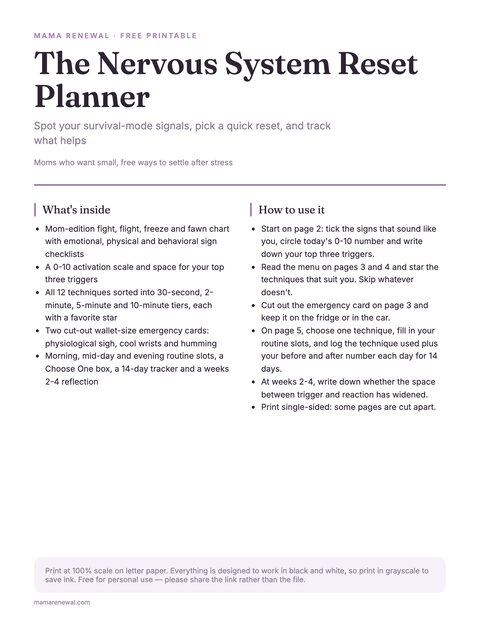
Free printable · 5 pages
Nervous System Reset Planner for Moms
Includes a fight/flight/freeze/fawn signal checklist with a 0-10 activation scale, all 12 techniques sorted by time with a cut-out emergency card, and a daily routine with a 14-day tracker.
Free. Your download link appears right here. You'll also join the Mama Reset. Unsubscribe anytime. Privacy
In this article (10 sections)
- Nervous System Regulation for Moms: What It Means
- Why Moms Are Stuck in Survival Mode
- Signs You’re Stuck in Survival Mode
- A Quick Look at the Science (and Its Limits)
- Nervous System Regulation Techniques for Moms (12 Quick Ways)
- Co-Regulation: Calming Down With Your Child
- Building a Nervous System Care Routine
- When to Get Professional Help
- Frequently Asked Questions
- Start With One Technique
Nervous System Regulation for Moms: What It Means
Your Built-In Alarm System
Your autonomic nervous system (ANS) runs on autopilot. It controls your heart rate, breathing, digestion and stress responses. Roughly speaking, it has two main branches that work together.
The sympathetic nervous system works roughly like an accelerator. When you sense danger, it drives fight-or-flight. Your heart rate rises, your muscles tense and digestion slows.
The parasympathetic nervous system works roughly like a brake. When you feel safe, it supports rest-and-digest. Your heart rate slows, your muscles relax and your body recovers.
Nervous system regulation means your body can move between these states. It ramps up for a real threat and settles when the threat passes.
Nervous system dysregulation means you feel stuck in the “on” position. Your body can respond to a tantrum in the cereal aisle much as it would to a real emergency.
Fight, Flight, Freeze, and Fawn: The Mom Edition
You’ve probably heard of fight or flight. The stress response is often described in four modes, and all four show up in motherhood. The last column points to a technique below.
| Response | What it looks like for a mom | Example moment | Try first |
|---|---|---|---|
| Fight | Mom rage, and anger bigger than the trigger. See dealing with mom rage. | The milk spills for the third time and you want to scream or slam a door. | Technique 1 or 2 |
| Flight | The urge to escape or check out. | You picture driving away, or you scroll your phone to leave the room in your head. | Technique 5 or 9 |
| Freeze | Shutdown, numbness and going blank. | You sit on the couch unable to move while the dishes pile up. | Technique 8 or 9 |
| Fawn | People-pleasing overdrive. See boundaries for moms. | You say yes to everything because conflict feels unbearable. | Technique 1 or 7 |
None of these responses make you a bad mother. They are ordinary stress responses, and most of us lean on one or two.
Why Moms Are Stuck in Survival Mode
Your stress response suits short emergencies followed by rest. Motherhood tends to be the opposite: steady demands with little recovery. Four things pile up.
Chronic sleep loss is a real physiological stressor. It is associated with lower heart rate variability (more on this shortly) and a stronger stress response. Yet we treat months or years of fragmented sleep as a normal part of motherhood.
Sensory overload is constant. The whining, the “MOMMY” on repeat, the toy that plays the same song all day. Someone is always climbing on you. By evening, many moms can’t stand one more touch. That isn’t a personality flaw. It’s a sign you’re maxed out. (More in feeling touched out.)
The mental load is a chronic stressor. You track appointments, the permission slip, the allergy medication and whether the milk is expired. This invisible work can keep your stress response switched on.
There is no recovery period. Bodies cope better with intense stress when rest follows. Motherhood has no weekend and no clocking out, so the “all clear” rarely comes.
Signs You’re Stuck in Survival Mode
Survival mode isn’t only panic attacks. Often it shows up in ways we write off as “just being a tired mom.” Tick the ones that sound like you.
Emotional Signs
- Rage bigger than the trigger. The spilled water, the wrong cup color, the loud chewing.
- Crying that comes out of nowhere. During a commercial, in the shower, while driving.
- Emotional numbness. You know you should feel something, but you don’t.
- Irritability that never fully lifts. You’re always slightly on edge.
Physical Signs
- Clenched jaw, tight shoulders, shallow breathing. Tension you don’t notice until someone points it out.
- Gut problems. Nausea, an unsettled stomach, loss of appetite or stress eating.
- The “wired and tired” pattern. Exhausted but unable to sleep.
- 3 AM wakeups even when your kids sleep through. Stress can play a part, though early waking has many causes.
- Heart racing or pounding for no apparent reason.
Behavioral Signs
- Doom scrolling as a way to numb out.
- Snapping at your kids or partner and then feeling crushing guilt.
- Avoiding social situations because they feel like too much.
- Trouble sitting still or relaxing. You always need to do, clean or check something.
- Saying yes to everything because saying no feels dangerous.
If you ticked several and thought, “Wait, this is just being a mom?”, that’s the point. We’ve normalized living this way. These signs are common, but they are not inevitable. Many people find that small, regular practices help them settle.
The guilt that arrives once the house is quiet (why can’t I handle this?) is part of the pattern too. This is not a character flaw or a willpower problem. Your body has been on high alert for a long time.
Good to knowMany of these signs also have medical causes, such as thyroid problems, anemia or poor sleep. If a racing heart, gut problems or constant exhaustion persist, see your doctor. If the list also sounds like burnout, see mom burnout recovery or the mental load.
A Quick Look at the Science (and Its Limits)
The Vagus Nerve: One Part of How Your Body Calms Down
The vagus nerve is the longest cranial nerve in your body. It runs from your brainstem down to your gut, with branches to your heart, lungs, throat, and facial muscles. It is one part of how your body calms down after stress.
Polyvagal theory, developed by Dr. Stephen Porges, is an influential but debated framework. Many physiologists dispute parts of it. I use it here as a rough map, not settled science: the body has ways to shift from “danger mode” toward “safety mode,” and slow breathing and gentle movement seem to help.
Chronic stress can make that shift harder, which is why it can feel like you’re stuck.
Heart Rate Variability: The Measure of Resilience
Heart rate variability (HRV) is the variation in time between heartbeats. Higher HRV is generally read as a sign that your body shifts gears easily. Lower HRV is associated with more difficulty settling after stress.
Some studies have linked lower maternal HRV with more symptoms of depression and anxiety. That is an association, not proof of cause. Genes and shared environment matter too.
What Helps: Slow, Regular Practice
Regular slow-breathing practice is associated with higher HRV, a marker researchers use for vagal activity. Every technique below is commonly used to help the body settle. Evidence is stronger for some (slow breathing) than others (shaking, gargling), and trying them costs nothing.
Nervous System Regulation Techniques for Moms (12 Quick Ways)
These techniques are organized by time, and the “Best for” column helps you pick. One 30-second reset in the middle of chaos beats waiting for the “perfect” 20-minute meditation that never comes.
Good to know“Nervous system dysregulation” is a popular term for stress overload, not a medical diagnosis. The evidence for some of these techniques is limited, but they are low-risk and free to try. Most work with kids in the room.
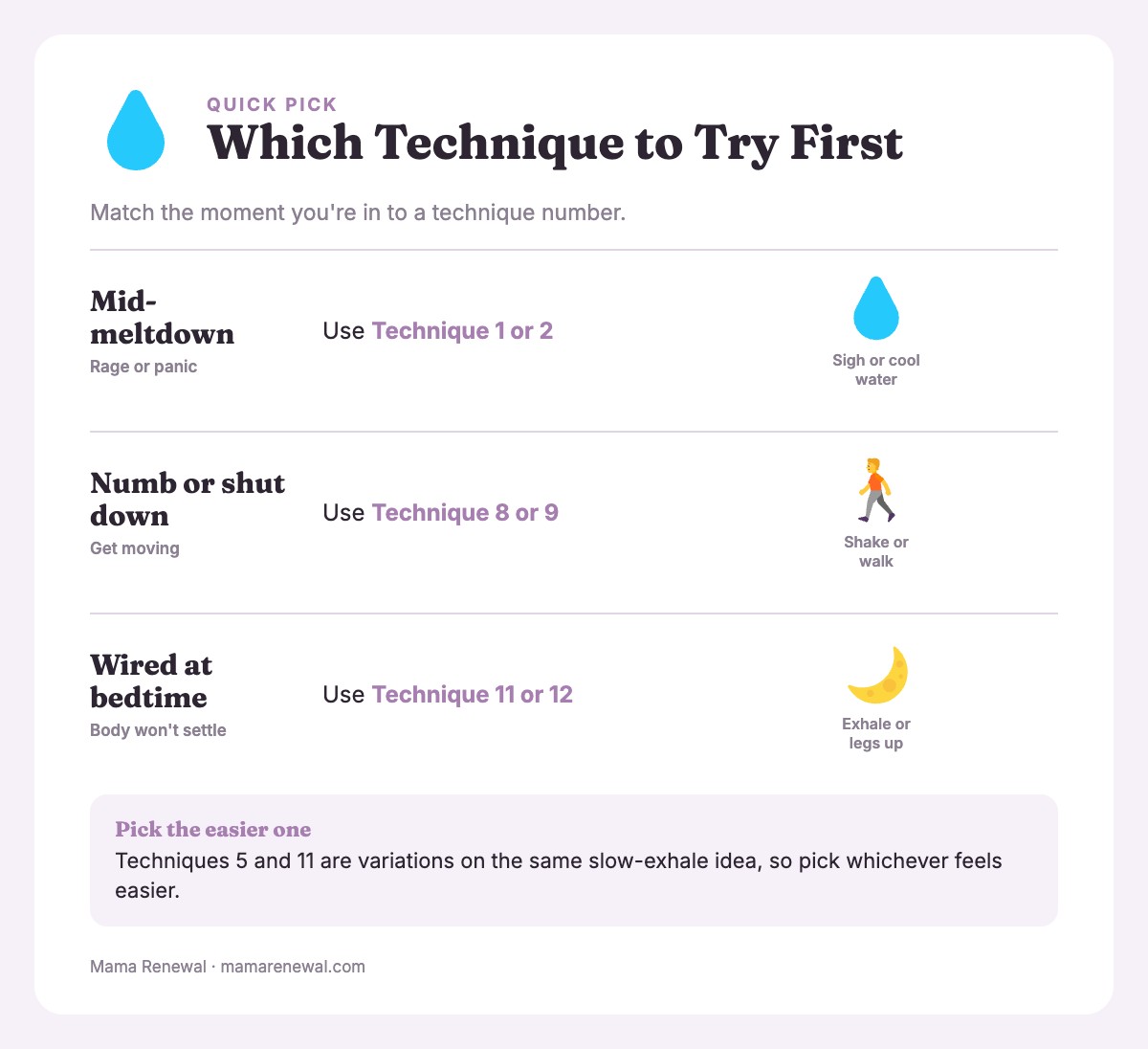
Which one first? Mid-meltdown, use Technique 1 or 2. For numbness or shutdown, get moving with Technique 8 or 9. For a wired body at bedtime, use Technique 11 or 12. Techniques 5 and 11 are variations on the same slow-exhale idea, so pick whichever feels easier.
The one I use most is the physiological sigh, usually at the kitchen counter. Gargling never stuck for me, and that’s fine. Skip whatever doesn’t suit you.
In the table, “Mostly” means it works with kids nearby once a baby is secure and you are wide awake.
| Technique | Time | Best for | Kids around? | Caution |
|---|---|---|---|---|
| 1. Physiological sigh | 30 sec | Rage, panic | Yes, invisible | Stop if dizzy |
| 2. Cool water on face, wrists or neck | 30 sec | Rage, panic | Mostly | Skip face cooling with heart conditions or fainting |
| 3. Humming | 30 sec | Irritability, overstimulation | Yes | None |
| 4. Gentle gargling | 2 min | Low-level tension | Mostly | Not for toddlers |
| 5. Paced breathing | 2 min | Panic, racing thoughts | Yes | Skip holds if uncomfortable |
| 6. Gentle rocking | 2 min | Overstimulation | Mostly | Stay awake with a baby |
| 7. Body scan | 5 min | Tension you can’t name | Needs another adult | Can surface hard feelings |
| 8. Somatic shaking | 5 min | Numbness, pent-up anger | Yes | Take care after birth or injury |
| 9. Rhythmic walk | 5 min | Numbness, restlessness | Yes | No tapping near traffic |
| 10. Yoga nidra | 10 min | Exhaustion | Needs another adult | You may fall asleep |
| 11. Extended exhale | 10 min | Can’t sleep | Mostly | Stop if dizzy |
| 12. Legs up the wall | 10 min | Wired and tired | Needs another adult | Check conditions first |
Safety firstDo these practices awake. Never bed-share with an infant (AAP advice). If you get drowsy while feeding or rocking, move the baby to a separate, firm, flat sleep surface. Avoid sofas, recliners and gliders when you’re sleepy. Stop any technique that makes you dizzy or more anxious.
30-Second Resets (For When You’re About to Lose It)
1. The Physiological Sigh
A 2023 Stanford trial (Balban et al.) found that five minutes a day of cyclic sighing over a month improved mood more than mindfulness meditation in adults. It was not studied in mothers specifically. You can do one in front of your kids and most people won’t notice.
How to do it:
- Inhale. Take a quick breath in through your nose.
- Top it up. Take a second, shorter inhale on top, like a double sniff.
- Exhale. Let out a long, slow breath through your mouth, longer than your inhale.
That’s one cycle. Repeat one to three times. Some people find it settles them.
Why it may work: The double inhale is thought to reinflate small air sacs in your lungs. The long exhale is thought to help your body shift toward calm.
When to use it: Before you respond to the tantrum. Before you send the text. In the car at the red light when everyone is screaming. This is your new first line of defense.
2. Cool Water on Your Face, Wrists or Neck
Splash cool water on your cheeks for 15-30 seconds. For a gentler option, run it over your wrists or the back of your neck.
Safety firstSkip face cooling if you have a heart condition, an arrhythmia or a history of fainting, and check with a clinician first. Use wrists or neck instead. Never use ice or immersion, and keep cold cloths off a baby’s skin.
Why it may work: The evidence is for face cooling. Cool water on the face, usually with a held breath, triggers the dive reflex, which slows heart rate. Cooling your wrists or neck is a comfort measure, not a proven one.
Mom-friendly version: Keep a damp washcloth in the fridge. When you feel rage or panic building, press it to your wrists or the back of your neck. With a baby, only do this when they’re secure (in a carrier or with another adult) and keep the cold cloth away from their skin.
3. Humming
Just hum. Any tune. “Twinkle Twinkle Little Star” works perfectly because you probably have it memorized and your kids will think you’re singing to them instead of regulating your nervous system.
Why it may work: The vagus nerve runs through your throat, and humming creates vibrations there. The long exhale that humming needs is also thought to help you calm down.
When to use it: During bedtime routines, where it can calm you and them. While doing dishes. While rocking a baby. This one hides in plain sight.
2-Minute Practices (For When You Have a Small Window)
4. Gentle Gargling
This one sounds strange, and the evidence is limited, but some people find it helpful. Fill a glass of water and gargle gently for 15-30 seconds, once or twice.
Why it may work: Gargling uses muscles in the back of your throat that the vagus nerve supplies. That is a theory, not a proven effect.
Mom-friendly version: Add it to your morning teeth-brushing. School-age children who gargle reliably can join you under supervision. Never give water to gargle to toddlers, who can inhale it.
5. Paced Breathing with Pauses
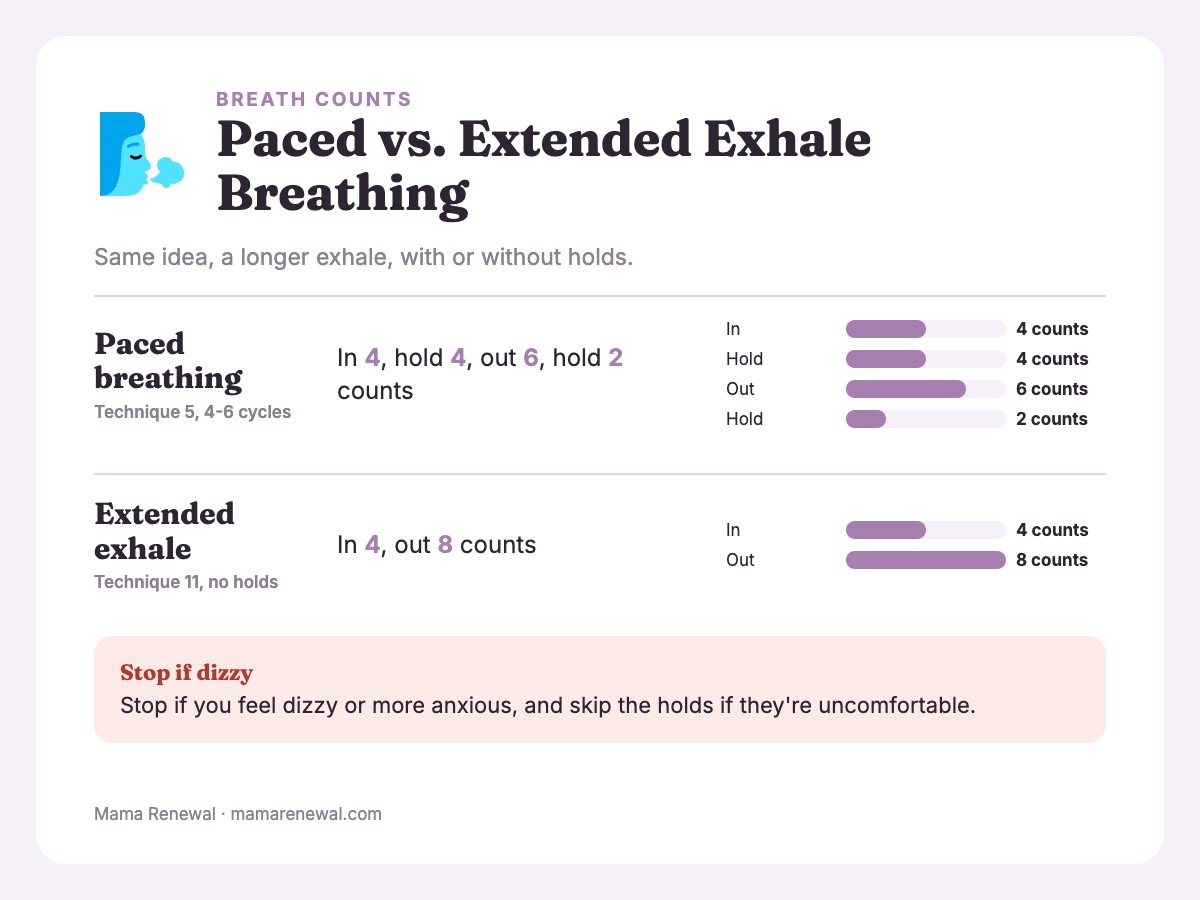
- Inhale. Breathe in through your nose for 4 counts, filling your belly, not your chest.
- Hold. Pause for 4 counts.
- Exhale. Breathe out through your mouth for 6 counts. The longer exhale is the key.
- Hold. Pause for 2 counts.
- Repeat. Do 4-6 cycles.
Why the longer exhale matters: Heart rate tends to rise slightly on the inhale and fall on the exhale. A longer exhale leans toward calm. Stop if you feel dizzy or more anxious, and skip the holds if they’re uncomfortable.
Mom-friendly version: Do it while reading bedtime stories (breathe between pages) or during floor play. Skip the holds while nursing. Stay awake when lying down near a baby (see the safety note above).
6. Gentle Rocking
Sit in a chair or on the floor and gently rock your body forward and back, or side to side. Slowly. Rhythmically. Like you’re rocking a baby — except you’re the baby.
Why it may work: Slow, rhythmic movement soothes babies, and many adults find it calming too.
Mom-friendly version: Rock on the floor while your child builds blocks. Rock in a chair while you’re wide awake. If you’re drowsy with a baby nearby, put the baby in a flat crib first.
5-Minute Rituals (For When the Kids Are Occupied)
7. Body Scan: Where Am I Holding This?
Sit or lie down. Close your eyes if you can. Starting at the top of your head, slowly scan down through your body, simply noticing where you’re holding tension. Don’t try to fix it. Just notice.
Forehead. Jaw. Throat. Shoulders. Chest. Stomach. Hips. Hands. Thighs. Feet.
Why it may help: Noticing tension often lets it ease a little. Naming the knot in your stomach as stress, not danger, can move you from reacting to choosing.
What you might discover: Your shoulders might be up by your ears and your hands in fists. This is tension your body has been carrying. Noticing it is a first step.
Good to knowBody scans can bring up hard feelings. If that happens, stop, open your eyes, look around the room, and talk to a professional if it keeps happening.
8. Somatic Shaking
Stand with your feet hip-width apart. Start to gently shake your body. Let your arms be loose, your knees slightly bent. Bounce or tremble — let whatever movement wants to happen, happen. Do this for 2-3 minutes, then stand still and notice the sensations in your body for another minute or two.
Why people try it: Shaking is a popular but under-researched practice, used in approaches like Tension and Trauma Release Exercises (TRE). Some people find it releasing.
Safety firstStop if shaking brings up distress, and work with a professional for trauma. Take care after a recent birth, an injury, or with pelvic floor problems.
Mom-friendly version: Put on a song and shake it out in the kitchen. Your kids will probably join you. Call it a dance party. Regulate together.
9. Bilateral Stimulation Walk
Walk at a comfortable pace, and as you do, pay attention to the alternating sensation of left foot, right foot, left foot, right foot. You can also alternate tapping your thighs as you walk — left, right, left, right.
Why it may help: Rhythmic walking is a grounding practice many people find calming. It is not a substitute for EMDR therapy.
Mom-friendly version: Try it with a stroller, or walk the hallway with your baby in a carrier (keep their face visible and chin off the chest). Walk during nap time only if another adult is home. Skip thigh tapping near traffic. Even 5 minutes counts.
10-Minute Practices (For When You Have a Pocket of Real Time)
10. Yoga Nidra (Non-Sleep Deep Rest)
Lie on your back in a comfortable position. Follow a guided yoga nidra recording (there are many free ones on YouTube and apps like Insight Timer, ranging from 10 to 45 minutes). You don’t have to do anything except lie there and listen.
Why it may help: Yoga nidra guides you into a state between waking and sleeping. Small studies suggest it may help with stress. Some people find it deeply restful, though it is not a replacement for sleep.
Mom-friendly version: Practice only when another adult is watching the children, or they’re safely asleep. Do it in bed before sleep. You may fall asleep, so set an alarm. Don’t do it alone in a vehicle.
11. Extended Exhale Breathing
This is the same idea as Technique 5, with no holds and a longer exhale. It suits a quieter moment. You don’t need both, so pick the one that feels easier.
- Inhale through your nose for 4 counts.
- Exhale through your mouth for 8 counts.
- Repeat for 3-5 minutes, or up to 10 if it feels good.
Why it may work: A longer exhale tends to slow your heart rate and is associated with feeling calmer. Stop if you feel dizzy or more anxious.
When to use it: This works well as an evening practice. Do it in bed before sleep instead of scrolling. Some people find it helps them fall asleep.
12. Restorative Yoga Pose: Legs Up the Wall
- Get close. Sit sideways with one hip near a wall, then lie back and swing your legs up it.
- Or go lower. Rest your calves on a couch seat or chair instead. Any elevation works.
- Let go. Rest your arms out to the sides, palms up, and stay for 10 minutes.
Why people like it: The fully supported position lets your body stop bracing. Many people find it calming.
Safety firstCheck with a clinician first if you have glaucoma, uncontrolled high blood pressure, a heart condition or reflux, or if you’re in late pregnancy. Keep children from pressing on your chest or neck, and keep infants off you.
Mom-friendly version: Do this while older kids watch a show and another adult is within earshot. You may doze off, so set an alarm.
Co-Regulation: Calming Down With Your Child
Children Learn to Regulate With a Calm Adult’s Help
Young children are still developing the skills to calm themselves. They lean on yours. Your tone of voice, breathing and facial expressions tell them whether things are safe.
Some research associates high maternal stress with changes in infant stress responses. That does not mean one bad afternoon harms your baby.
This is not meant to make you feel guilty. “Good enough” parenting, with repair after hard moments, is what matters. Each time you pause and come back to your body, you’re modeling that big feelings pass.
You don’t need to be calm all the time. Nobody is. When your kids see you get worked up and then settle, they see that there is a way through.
Co-Regulation Exercises You Can Do Together
- Buddy breathing. Lie on the floor together, each with a stuffed animal on your belly. Breathe slowly and watch them rise and fall.
- The “spaghetti test.” Tense your whole body like uncooked spaghetti, then go limp like cooked spaghetti. Giggle about it. It shows the contrast between tension and release.
- Humming or singing together. Pick a lullaby or any slow song. The long exhale may help calm both of you.
- Rocking together. Sway side to side while hugging, or rock in a chair while you’re wide awake.
Safety firstBuddy breathing is for awake, supervised children about 3 and up. Never put a stuffed animal on a baby, and keep soft toys out of any sleep space. If either of you gets drowsy while rocking, put the baby in a flat crib.
Building a Nervous System Care Routine
Knowing 12 techniques doesn’t help if you can’t remember them mid-meltdown. Attach a few to moments that already happen in your day. The Nervous System Reset Planner has space to note which ones you used.
Morning: The 60-Second Check-In
Before you get out of bed, take 60 seconds, even if a child is already yelling. Do three physiological sighs (Technique 1), then a quick body scan (Technique 7) of your jaw, shoulders and stomach. Finish with one intention, such as “Today I will pause before I react.”
Mid-Day: The Overstimulation Reset
Mid-afternoon is when many of us snap. When you feel the edge approaching, use cool water (Technique 2). Then rock for 2 minutes (Technique 6) during quiet play or screen time, or step outside for 30 seconds of fresh air.
Evening: The Wind-Down
Give your body a signal that the day is ending. Shake it out while dinner cooks (Technique 8). Put your legs up the wall for 10 minutes while your partner handles bedtime, or after the kids are in bed (Technique 12). Then do extended exhale breathing in bed instead of scrolling (Technique 11).
| When | Techniques | Time | Cue |
|---|---|---|---|
| Morning | 1 and 7 | 1 min | Before you get out of bed. |
| Mid-day | 2 and 6 | 2 min | When you feel the edge approaching. |
| Evening | 8, 11 and 12 | 10+ min | While dinner cooks, then in bed. |
For more ways to fit small breaks into your day, see solo time ideas for twenty minutes.
The Non-Negotiable: Choose One
TipIf this all feels like too much, just choose one technique. A new routine can feel like more demands. Do it once a day. That’s it.
One physiological sigh when you feel your chest tighten. One moment of cold water on your wrists before you yell. One round of humming while you make dinner.
Regulation isn’t about perfection. It’s about practice. Each time you consciously settle your body, you’re teaching it that it doesn’t have to stay in survival mode.
When to Get Professional Help
Sometimes nervous system dysregulation isn’t just about being an overstretched mom. Sometimes it’s a signal pointing to something that needs professional support.
When It Might Be More Than Stress
If you felt this way before motherhood, perhaps after childhood trauma or other hard experiences, having children can amplify what was already there. Loving a child can stir up old survival patterns. That isn’t failure. It is your body using the strategies it learned.
If specific triggers send you into disproportionate responses, such as your baby’s crying sparking rage or freeze, there may be a trauma response underneath. That deserves gentle, professional attention.
If you experienced birth trauma, pregnancy loss, NICU time, or postpartum complications, your nervous system may have encoded these experiences as ongoing threats. PTSD and post-traumatic stress are more common in mothers than most people realize.
Therapeutic Approaches That Work With the Nervous System
If you recognize yourself in the descriptions above, consider seeking out a therapist trained in body-based (somatic) approaches:
Somatic Experiencing (SE): Developed by Dr. Peter Levine, this approach focuses on the body’s stress responses. Some people find it helpful for trauma that shows up in the body. Research is still early.
EMDR (Eye Movement Desensitization and Reprocessing): A structured trauma therapy delivered by a trained clinician. It is not the same as a walk with tapping (Technique 9).
Polyvagal-informed therapy: Therapists trained in polyvagal theory understand the nervous system states we’ve discussed and can help you build regulation capacity with professional guidance.
Seeking help is not weakness. If finding someone feels like one more task, see finding a therapist as a busy mom.
Good to knowSee a doctor or therapist soon if you have low mood or anxiety lasting two weeks or more, panic attacks, intrusive thoughts, trouble functioning, or any thoughts of harming yourself or your baby. Contact them today, or call or text 988 in the US. Postpartum Support International: 1-800-944-4773. See also postpartum depression signs and the postpartum anxiety guide.
If you need support right now
Reaching out is not an overreaction. These lines are free and confidential.
- Emergency: if you are thinking about harming yourself or your baby, or you can’t keep yourself safe, call 911 or go to the nearest emergency room. This is a medical emergency, and it is treatable.
- 988 Suicide & Crisis Lifeline: call or text 988, 24/7, for anyone in crisis.
- National Maternal Mental Health Hotline: call or text 1-833-TLC-MAMA (1-833-852-6262), 24/7, in English and Spanish, for pregnancy and postpartum support.
- Postpartum Support International: call or text 1-800-944-4773 for help finding a provider who specializes in perinatal mental health. Not an emergency line.
US numbers. Elsewhere, ask your doctor, midwife or local crisis line. This article was written by a parent, not a clinician, and isn’t medical advice.
Mama in Chief
Mama in Chief is a wellness advocate and mother who learned the hard way that you can’t pour from an empty cup. After her own burnout journey, she now helps other moms prioritize their mental health, physical wellbeing, and personal identity alongside the beautiful chaos of motherhood.
Frequently Asked Questions
How long does it take to regulate a chronically dysregulated nervous system?
Timelines vary. Some people notice a small shift within a few weeks of doing something small most days. A common first sign is a slightly wider gap between trigger and reaction. It didn’t build up overnight, and it won’t ease overnight.
Can nervous system regulation replace medication or therapy for anxiety and depression?
No. These techniques can complement professional treatment, not replace it. If you’ve had low mood, constant anxiety, intrusive thoughts, or thoughts of harming yourself or the baby, contact your doctor or a crisis line today (US: 988; Postpartum Support International 1-800-944-4773). Never stop medication without your prescriber.
My kids are always around. How am I supposed to do any of this?
Most of these techniques were chosen because they work with children around. The physiological sigh is invisible. Cool water on your wrists takes 15 seconds at the kitchen sink. Humming happens during lullabies. Rocking works on the floor during block play. Shaking becomes a dance party. You don’t need to escape your children to do them, and letting them watch shows them one way to calm down.
I feel fine most of the time. It’s just certain moments that set me off. Do I still need this?
It can still help. “Fine most of the time with explosive moments” is a common pattern. It may mean your baseline stress is running high, so it doesn’t take much to push you over the edge. Practicing during calm moments can give you more buffer for the hard ones.
What about supplements, adaptogens, or devices marketed for nervous system regulation?
Evidence for supplements such as magnesium and omega-3s is limited and mixed. Check with a doctor or pharmacist first, especially if you’re pregnant, nursing or on medication. HRV wearables can be a useful feedback tool, but be wary of expensive gadgets with big promises. The techniques here are free and commonly used, so start there.
Can I do these while nursing or with my baby nearby?
Yes, with care. Slow breathing (without breath holds) works well while nursing, and see breathing exercises while nursing. Do practices awake and don’t bed-share with an infant (AAP). If you get drowsy while feeding, move the baby to a separate firm, flat sleep surface, and avoid sofas, recliners and gliders when sleepy.
Start With One Technique
Many of us have accepted that motherhood is supposed to feel like survival. We assume that being on edge, exhausted and one meltdown from coming undone is just what raising children means.
It doesn’t have to feel that way every day. Safety here doesn’t mean the absence of hard things. It means trusting that you can feel overwhelmed, touched out or impatient and still find your way back and repair.
Start small. Pick one technique: a physiological sigh, a splash of cool water, or a hum over the dishes. Use the Nervous System Reset Planner to note which one you tried and how it went.