
Invisible Labor Checklist: What’s Quietly Draining You
Discover what invisible labor is and how it quietly drains you. This article provides a 66-task checklist to help you identify, count, and hand off these unseen household responsibilities.
- Identify invisible labor: the unseen work of noticing, planning, and managing.
- Utilize a 66-task checklist to inventory your invisible household tasks.
- Access scripts to hand off or drop specific invisible tasks.
- Understand why your invisible labor often goes unnoticed by others.
This post contains affiliate links. As an Amazon Associate I earn from qualifying purchases.
It was 9:40 on a Tuesday night. I was standing in the kitchen holding a clementine I had no memory of picking up. Everyone was asleep.
But my brain was still going. Picture day is Thursday. The pediatrician’s office closes at five tomorrow, and I never called about the rash. We’re almost out of laundry soap.
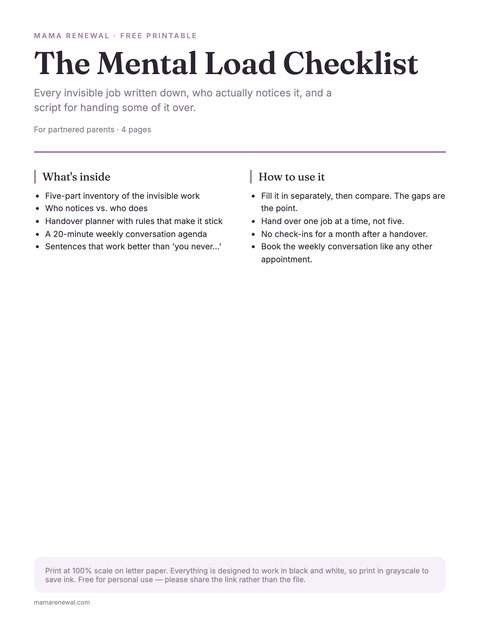
Free printable · 6 pages
The Mental Load Checklist
Every invisible job written down, who actually notices it, and a script for handing some of it over.
Free. Your download link appears right here. You'll also join the Mama Reset. Unsubscribe anytime. Privacy
None of it was on anyone’s list. A day with no disasters looks exactly like a day nobody worked.
That’s invisible labor. What helped me was getting it out of my head and onto a page. This post gives you a 66-task checklist in six areas, a simple way to count your load, and scripts for handing tasks off or dropping them.
Short on time? Start with the quick-start list for this week. Ready to mark boxes? Jump to the 66-task checklist.
In this article (11 sections)
- What Invisible Labor Actually Is (and Isn’t)
- Why It Stays Invisible (It’s Not Because You’re Bad at Communicating)
- How to Use This Checklist
- Invisible Labor Examples: The 66-Task Checklist for Moms
- What to Do With Your Checked Boxes: Hand Off, Share, Automate, Drop
- How to Hand Off a Task So It Actually Stays Handed Off
- If You’re Parenting Without a Partner at Home
- When Naming It Stirs Up More Than You Expected
- How to Lighten Your Mental Load This Week: Small Starting Points
- Frequently Asked Questions
- Invisible Labor Is Real: You Were Never Imagining It
What Invisible Labor Actually Is (and Isn’t)
Invisible labor is the unpaid work of noticing, remembering, planning, deciding, and emotionally managing that keeps a household running. Most of it goes unseen and unacknowledged.
It’s different from the visible chores, though the two are tangled together. Washing the dishes is visible. Knowing the dish soap is almost gone is invisible. So is deciding which brand your kid’s sensitive skin tolerates, adding it to the list, and remembering to order it in time.
The three layers of any task
Almost every household task has three parts, and most of the invisible work lives in the first two:
- Noticing and anticipating. Seeing that something needs to happen before it becomes a problem.
- Planning and deciding. Figuring out what, when, how, and who.
- Doing. The physical act of completing it.
When people say “I help out,” they usually mean layer three. They’ll do it when asked. But the person who notices and plans is still carrying the work. That’s true even if someone else swings by at the end to finish the last step.
Invisible labor vs. mental load vs. emotional labor
These terms get used interchangeably, and they overlap. It helps to separate them a little.
| Term | What it covers | Example |
|---|---|---|
| Invisible labor | The umbrella: any unseen, unpaid work that keeps life running | Tracking vaccines, managing the family calendar, smoothing over conflict |
| Mental load | The cognitive part: remembering, anticipating, planning, tracking | Keeping a running list in your head of what everyone needs |
| Emotional labor | Managing feelings: yours, your kids’, your partner’s, extended family’s | Calming a pre-bedtime meltdown, remembering to check in on a friend who’s grieving |
If you want a deeper look at the cognitive piece specifically, The Mental Load: Why Moms Feel Exhausted Even When Everyone “Helps” goes into it. This post is the companion: instead of explaining the weight, it hands you a way to inventory it.
Why It Stays Invisible (It’s Not Because You’re Bad at Communicating)
Before the checklist, one thing worth saying plainly. If the people you live with don’t see this work, it doesn’t automatically mean they don’t care. And it doesn’t mean you’ve failed to explain yourself. The work is hard to see, for a few reasons.
Success looks like nothing. When the permission slip gets signed, there’s no event. A task done well on time leaves no trace. A task missed makes noise. So the only time the work becomes visible is when it fails.
It happens in the gaps. Invisible labor gets done in the shower, in the car, at 2 a.m., in the checkout line. It doesn’t take place in a block of time anyone can watch you spend.
It scales quietly. Each child adds more than one more person to feed. There are more appointments, more sizes, more friendships, more school communications, more feelings. The workload tends to grow faster than the visible chores do.
It became “just how it is” by default. Often one person took over a task during a hard moment: maternity leave, a job change, a move. It never got renegotiated. A temporary arrangement quietly hardened into an identity: I’m the one who knows where everything is.
It’s hard to describe. Try saying out loud, “I’m tired from thinking about the birthday gift.” It sounds ridiculous. But the gift is one of forty open loops. Individually they sound trivial. Together they’re a second job.
So the goal isn’t to win an argument about who’s more tired. It’s to get the work written down so you can share it on purpose instead of by default.
How to Use This Checklist
You can use the lists below alone, with a partner, or even with a trusted friend who’s in the same season of life. Here’s a method that works better than just ticking boxes:
Pass 1: Mark what you carry. Go through each table and check the box for every task you currently own, meaning you’d be the one to notice if it didn’t get done. Don’t mark things you do under direction (“I’ll do it if you tell me to”). Mark the ones where you are the reminder system.
Pass 4: Pick your drops. Some tasks can simply stop. The standard doesn’t have to be what your mother, Pinterest, or the neighbor does. Mark anything you could let go of or downgrade without real consequences.
The ☐ boxes are for marking up a copy you print from this page. The free Mental Load Checklist printable is a shorter companion, not this full 66-task list. If you’d rather work on screen, select a table and paste it into a notes app, a spreadsheet, or a shared document. The point is just to see everything in one place.
TipCount the “I carry it” boxes one area at a time, then add the six subtotals. That total is the number you’ll use in the counting guide further down.
Invisible Labor Examples: The 66-Task Checklist for Moms
There are 66 tasks below, grouped into six areas. Every family has its own extras, so each table ends with a blank row for yours. The tasks you add are often the ones that weigh on you most.
Use this table to jump to an area, and come back to it to record your count for each one.
| Area | Task numbers | Tasks | Your “I carry it” count |
|---|---|---|---|
| 1. Household supplies and home management | 1-12 | 12 | __ of 12 |
| 2. Kids’ health, growth, and development | 13-23 | 11 | __ of 11 |
| 3. School, activities, and logistics | 24-35 | 12 | __ of 12 |
| 4. Calendar, social, and extended family | 36-46 | 11 | __ of 11 |
| 5. Emotional labor and family climate | 47-56 | 10 | __ of 10 |
| 6. Money, admin, and the seasonal stuff | 57-66 | 10 | __ of 10 |
| All six areas | 1-66 | 66 | __ of 66 |
Check I carry it if you’re the one who notices, plans, or remembers. Check Shared if the thinking is split too. Check Hand off / drop if you’d like to pass it on or let it go.
Area 1: Household Supplies and Home Management
This is the “running out of things” category. It’s the work of keeping a household stocked, working, and roughly in order.
| # | Task | I carry it | Shared | Hand off / drop |
|---|---|---|---|---|
| 1 | Noticing when household staples (soap, toilet paper, trash bags, foil) are running low | ☐ | ☐ | ☐ |
| 2 | Keeping the grocery list going and adding to it all week | ☐ | ☐ | ☐ |
| 3 | Planning the weekly meals and deciding what’s for dinner | ☐ | ☐ | ☐ |
| 4 | Remembering dietary needs, picky-eater rules, and allergies when shopping | ☐ | ☐ | ☐ |
| 5 | Deciding when it’s time to deep-clean something (fridge, oven, bathrooms) | ☐ | ☐ | ☐ |
| 6 | Tracking what’s in the pantry and freezer so food doesn’t get wasted | ☐ | ☐ | ☐ |
| 7 | Noticing when something in the house is broken and needs fixing | ☐ | ☐ | ☐ |
| 8 | Finding, vetting, and scheduling repair people or contractors | ☐ | ☐ | ☐ |
| 9 | Managing the laundry system (who needs what washed, when, and where it goes) | ☐ | ☐ | ☐ |
| 10 | Tidying the “drop zones” so surfaces don’t get buried | ☐ | ☐ | ☐ |
| 11 | Rotating, donating, and purging items that have been outgrown | ☐ | ☐ | ☐ |
| 12 | Remembering to replace things on a schedule (smoke detector batteries, water filters, air filters) | ☐ | ☐ | ☐ |
| Your own: | ☐ | ☐ | ☐ |
Area 2: Kids’ Health, Growth, and Development
This is often the heaviest category. It’s also the one where mistakes feel highest-stakes, which is part of why it’s so tiring.
Safety firstTrouble breathing or a severe allergic reaction needs emergency services (911 in the U.S.) right away. For a fever in a young infant, call your pediatrician or their after-hours line immediately. None of these should wait on a checklist.
| # | Task | I carry it | Shared | Hand off / drop |
|---|---|---|---|---|
| 13 | Scheduling well-visits, dental cleanings, and vision checks | ☐ | ☐ | ☐ |
| 14 | Tracking vaccines and knowing what’s due next | ☐ | ☐ | ☐ |
| 15 | Noticing symptoms and deciding whether it’s a call-the-doctor situation | ☐ | ☐ | ☐ |
| 16 | Being the one who stays home (or arranges coverage) when a kid is sick | ☐ | ☐ | ☐ |
| 17 | Keeping the medicine cabinet stocked and checking expiration dates | ☐ | ☐ | ☐ |
| 18 | Tracking milestones, growth, and “is this normal?” worries | ☐ | ☐ | ☐ |
| 19 | Researching products, programs, and advice when a new phase hits | ☐ | ☐ | ☐ |
| 20 | Handling insurance paperwork, referrals, and billing questions | ☐ | ☐ | ☐ |
| 21 | Managing the sleep schedule, routines, and transitions | ☐ | ☐ | ☐ |
| 22 | Staying on top of potty training, feeding, or other developmental “projects” | ☐ | ☐ | ☐ |
| 23 | Remembering and updating allergy plans, emergency contacts, and medical forms | ☐ | ☐ | ☐ |
| Your own: | ☐ | ☐ | ☐ |
Area 3: School, Activities, and Logistics
If your kids are in school, this category can quietly eat the whole week. (There’s more on this in School-Age Mom Burnout: The Invisible Load of Logistics.)
| # | Task | I carry it | Shared | Hand off / drop |
|---|---|---|---|---|
| 24 | Reading school emails, apps, and newsletters, and extracting what matters | ☐ | ☐ | ☐ |
| 25 | Signing and returning forms, permission slips, and order sheets | ☐ | ☐ | ☐ |
| 26 | Remembering spirit days, picture day, early-dismissal days, and holidays | ☐ | ☐ | ☐ |
| 27 | Managing school lunches (packing, ordering, tracking the account balance) | ☐ | ☐ | ☐ |
| 28 | Buying and replacing school supplies, uniforms, and gym clothes | ☐ | ☐ | ☐ |
| 29 | Coordinating drop-off, pick-up, carpools, and who’s where when | ☐ | ☐ | ☐ |
| 30 | Registering for activities, sports, and camps, and tracking deadlines | ☐ | ☐ | ☐ |
| 31 | Packing and tracking the gear each activity needs, week to week | ☐ | ☐ | ☐ |
| 32 | Managing homework, projects, and reading logs, including the “you have a diorama due” surprises | ☐ | ☐ | ☐ |
| 33 | Communicating with teachers, coaches, and other parents | ☐ | ☐ | ☐ |
| 34 | Organizing childcare for school breaks, half days, and summer | ☐ | ☐ | ☐ |
| 35 | Remembering teacher gifts, class-party contributions, and fundraisers | ☐ | ☐ | ☐ |
| Your own: | ☐ | ☐ | ☐ |
Area 4: Calendar, Social, and Extended Family
This is the “relationship maintenance” layer. It’s the work of keeping the family connected to everyone else.
| # | Task | I carry it | Shared | Hand off / drop |
|---|---|---|---|---|
| 36 | Keeping the master family calendar and spotting conflicts | ☐ | ☐ | ☐ |
| 37 | Buying and wrapping gifts for kids’ birthday parties | ☐ | ☐ | ☐ |
| 38 | Remembering birthdays, anniversaries, and milestones for extended family and friends | ☐ | ☐ | ☐ |
| 39 | Sending thank-you notes, cards, and RSVPs | ☐ | ☐ | ☐ |
| 40 | Planning and hosting holidays, or deciding who does | ☐ | ☐ | ☐ |
| 41 | Arranging playdates and maintaining your kids’ friendships | ☐ | ☐ | ☐ |
| 42 | Arranging babysitters, and training and briefing them | ☐ | ☐ | ☐ |
| 43 | Planning family outings, vacations, and weekends | ☐ | ☐ | ☐ |
| 44 | Keeping in touch with both sides of the family (calls, photos, updates) | ☐ | ☐ | ☐ |
| 45 | Managing the “family brand,” such as holiday cards, photos, and keepsakes | ☐ | ☐ | ☐ |
| 46 | Remembering your partner’s appointments, deadlines, and social obligations | ☐ | ☐ | ☐ |
| Your own: | ☐ | ☐ | ☐ |
Area 5: Emotional Labor and Family Climate
This is the least countable category and often the most exhausting. It’s the work of tracking and steadying everyone’s feelings. When I first went through it, #56 was the one I hadn’t realized I was carrying.
| # | Task | I carry it | Shared | Hand off / drop |
|---|---|---|---|---|
| 47 | Reading the room and noticing when a kid is struggling before they say anything | ☐ | ☐ | ☐ |
| 48 | Soothing meltdowns, big feelings, and bedtime anxieties | ☐ | ☐ | ☐ |
| 49 | Mediating sibling conflict and being the default referee | ☐ | ☐ | ☐ |
| 50 | Managing your partner’s moods, stress, and needs | ☐ | ☐ | ☐ |
| 51 | Initiating the hard conversations (money, chores, discipline, the relationship) | ☐ | ☐ | ☐ |
| 52 | Being the family historian: remembering stories, favorites, stages | ☐ | ☐ | ☐ |
| 53 | Staying the “fun” or “nice” parent to make up for someone else’s stress | ☐ | ☐ | ☐ |
| 54 | Making sure everyone else’s needs are met before checking in on your own | ☐ | ☐ | ☐ |
| 55 | Smoothing over awkward dynamics with in-laws, neighbors, or other parents | ☐ | ☐ | ☐ |
| 56 | Carrying worry on everyone’s behalf: the “what if” thinking | ☐ | ☐ | ☐ |
| Your own: | ☐ | ☐ | ☐ |
Area 6: Money, Admin, and the Seasonal Stuff
This category is easy to overlook because it comes in waves. It’s heavy when it hits and forgotten in between.
| # | Task | I carry it | Shared | Hand off / drop |
|---|---|---|---|---|
| 57 | Tracking bills, due dates, and subscriptions | ☐ | ☐ | ☐ |
| 58 | Managing the family budget and noticing overspending | ☐ | ☐ | ☐ |
| 59 | Handling taxes, receipts, and paperwork for the household | ☐ | ☐ | ☐ |
| 60 | Switching out seasonal wardrobes and tracking sizes for every kid | ☐ | ☐ | ☐ |
| 61 | Shopping for kids’ clothes, shoes, and gear before they’re needed | ☐ | ☐ | ☐ |
| 62 | Planning holiday gifts, stocking stuffers, and the “Santa” logistics | ☐ | ☐ | ☐ |
| 63 | Keeping documents (passports, birth certificates, school records) findable | ☐ | ☐ | ☐ |
| 64 | Updating wills, insurance, and emergency plans (or thinking about them guiltily) | ☐ | ☐ | ☐ |
| 65 | Researching and booking big-ticket items: car, summer camp, the next school | ☐ | ☐ | ☐ |
| 66 | Managing home systems: internet, phone plans, pet care | ☐ | ☐ | ☐ |
| Your own: | ☐ | ☐ | ☐ |
What to Do With Your Checked Boxes: Hand Off, Share, Automate, Drop
Some people feel relief at seeing the weight written out. Others feel a little queasy. I felt both. Either way, the next step is the same: count, sort, and pick a place to start.
Count, but don’t weaponize
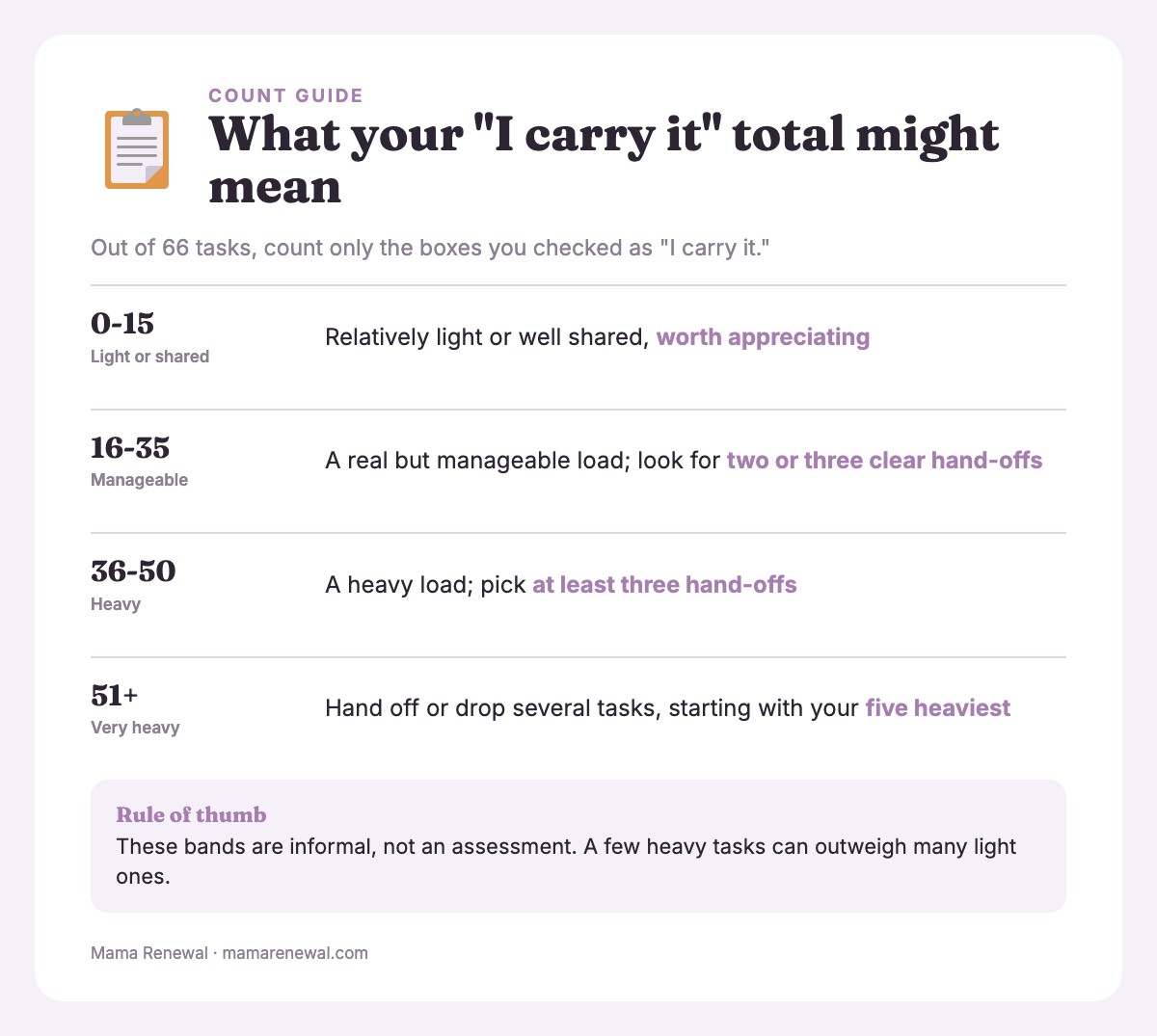
Add up the boxes you checked in the “I carry it” column. Here’s a rough way to read the total:
Good to knowThese bands are an informal rule of thumb, not an assessment. Tasks differ in size, so a few heavy ones can outweigh many light ones.
| Your count (out of 66) | What it might mean |
|---|---|
| 0-15 | Your load is relatively light or well shared, which is worth appreciating |
| 16-35 | A real but manageable load; look for two or three clear hand-offs |
| 36-50 | A heavy load; pick at least three hand-offs |
| 51+ | A very heavy load; hand off or drop several tasks, starting with your five heaviest |
If your number is high, that isn’t a verdict on you. It’s information. It tells you where the weight has been sitting, and it gives you a place to begin.
If counting doesn’t appeal, skip the total. Circle the five tasks that feel heaviest and work on those.
Sort the tasks into four buckets
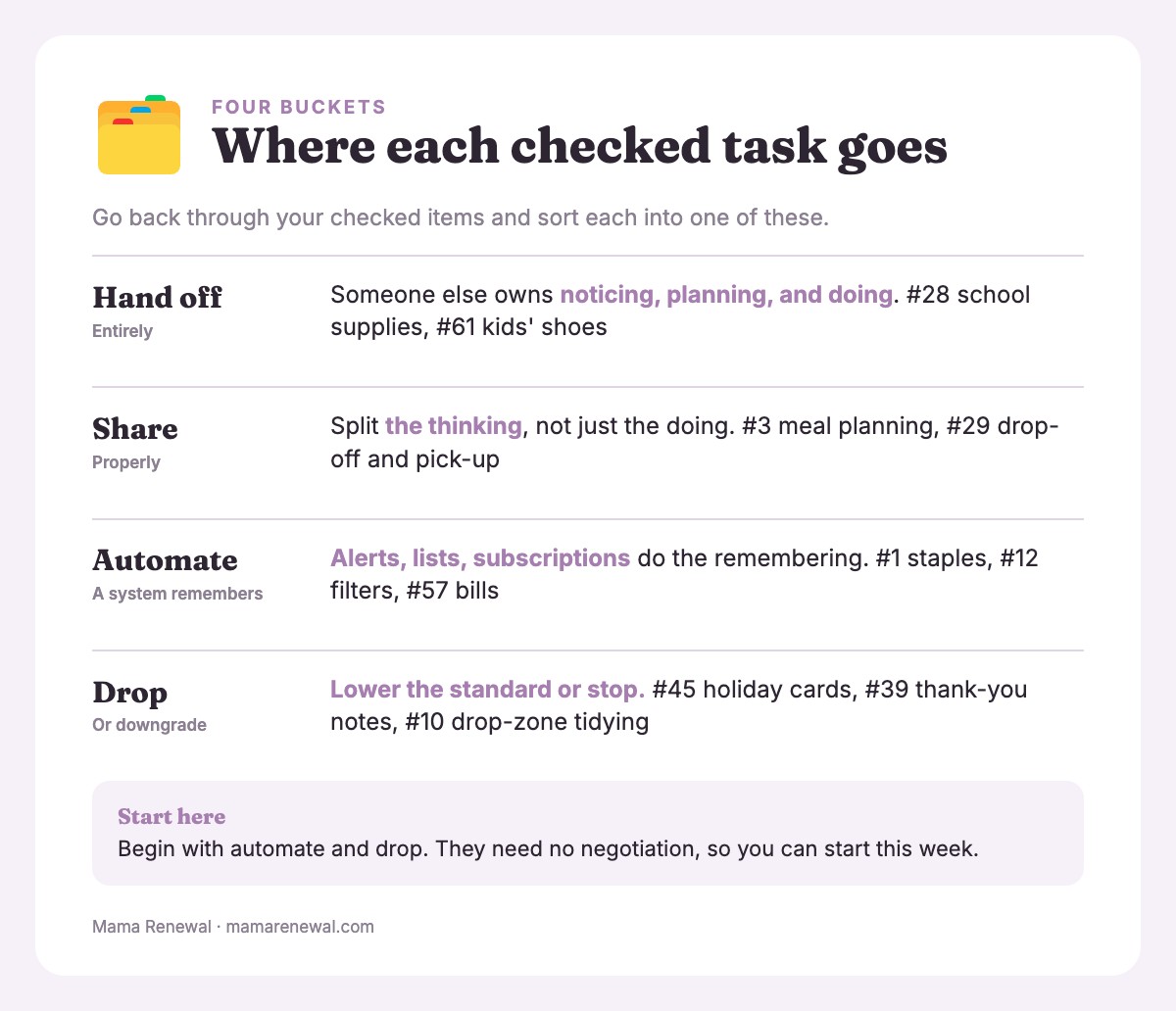
Go back through your checked items and sort each into one of these:
| Bucket | What it means | Example tasks from the list |
|---|---|---|
| Hand off entirely | Another person owns noticing, planning, and doing. You don’t remind. You don’t check. | #28 school supplies, #61 kids’ shoes and clothes |
| Share properly | Split the thinking, not just the doing. One person owns the planning and the other owns the follow-through, or you trade seasons. | #3 meal planning, #29 drop-off and pick-up |
| Automate | A system remembers so you don’t have to: subscribe-and-save, recurring calendar alerts, a shared grocery list app, a standing carpool schedule. | #1 staples, #12 filter replacement, #57 bills |
| Drop or downgrade | Lower the standard or stop. Store-bought treats count as class snacks (check the school’s allergy rules and the ingredient labels first). A birthday card can be a quick text. | #45 holiday cards (skip this year), #39 thank-you notes, #10 daily drop-zone tidying (make it a weekly reset) |
TipStart with the automate and drop buckets. They need no negotiation, so you can begin this week.
How to Hand Off a Task So It Actually Stays Handed Off
Here’s where many well-meaning attempts fall apart. You hand off a task, and someone does it differently than you would. Then you quietly take it back to save time.
Or you hand off the doing but keep the reminding. Now you’re managing someone else’s to-do list on top of your own.
A few things help.
Hand off the whole loop
A complete hand-off includes three things: the noticing, the deciding, and the doing. If the other person has to ask you “what do we need?” or “when is that due?”, the task is still half yours.
Instead of: “Can you pick up the kids’ shoes this weekend?”
Try: “You own shoes now: sizes, shopping, replacing them when they’re worn out. I’ll send you the current sizes once, and then it’s yours.”
Hand over standards along with the task
You don’t need to give up your values, but you do need to let go of method. If the goal is clean clothes that fit, it doesn’t matter whether the laundry is folded in thirds or tossed in a drawer.
TipAgree on the outcome. Let the person doing the task choose the method.
Expect a wobble
The first few weeks of a new handoff are bumpy. A deadline will get missed. A wrong size will arrive. Resist the urge to rescue.
The temporary mess is how the other person learns to notice what you already notice. Taking the task back teaches both of you that you’re the permanent default.
I’ll be honest: the first thing I handed off was shoe shopping, and the first pair that arrived was a size too small. Every part of me wanted to take it back. Letting the exchange happen without me was harder than doing the task myself.
Put it somewhere visible
A shared document, a whiteboard, or a family calendar app can hold the system so it doesn’t live in one person’s head. The checklist above can be the starting point: post it, mark initials next to each task, and revisit monthly.
Starting the conversation
Opening this conversation is its own piece of invisible labor, and it deserves some prep. A few openers that tend to land better than “You never help”:
- “I made a list of everything that happens in our house that nobody sees. I’d love to go through it together. I’m not blaming anyone. I want us to see the full picture.”
- “I realized I’m carrying a lot of the planning, not just the doing. Can we look at it and figure out a better split?”
- “I’m running low, and I think part of it is how much I’m tracking in my head. Can we try something different for a month?”
For more language to work with, see Communicating Your Needs to Your Partner. It covers how to name what you need without it sliding into a fight.
If You’re Parenting Without a Partner at Home
Everything above assumes a second adult in the picture, and many moms don’t have one. Others have a partner who’s part-time, deployed, or co-parenting from another household. The checklist is still useful, just in a different way.
Use it as a triage tool. If you carry most of these, you can’t do them all well. Choose the 10 that matter most this season and let the rest be “good enough” or dropped. This triage list is separate from the three to five hand-offs above.
Look for non-partner hand-offs. A grandparent can own the birthday-gift buying. A neighbor can swap carpool days. An older kid can own their own lunch-packing, permission slips, or laundry. Age-appropriate ownership is a gift to them, not a burden.
Outsource strategically. Grocery pickup, a cleaning service twice a year, or auto-pay for bills might feel indulgent. They can also be what keeps you from tipping into burnout.
Name the gap out loud. Being the sole manager of a household is a real load, and it’s worth saying: this is more than one person’s job. You’re not failing, and noticing that is not complaining.
When Naming It Stirs Up More Than You Expected
For some people, going through this list is clarifying and motivating. For others, it brings up something heavier. If you’ve been ticking boxes and feeling anger, grief, or deep tiredness, that’s not a sign you’re doing this wrong.
Sometimes redistributing the tasks helps, and the weight genuinely lifts. But sometimes the resentment or exhaustion stays, even after the chores are fairly split. If that sounds familiar, it may not be a chore problem at all. It may be burnout.
A few signs that point that direction:
- You feel resentful or numb even on days when nothing is going wrong.
- Rest doesn’t feel restful, and a weekend off doesn’t touch the tiredness.
- You’ve started to dread tasks you used to handle fine.
- You feel emotionally distant from the people you love, or irritable with them in a way that scares you.
- You find yourself thinking I can’t keep doing this more than occasionally.
Persistent exhaustion or low mood can also have medical causes, such as thyroid problems, anemia, depression, or postpartum conditions. Mention it to your doctor as well as a therapist. This list can’t tell you whether it’s burnout, depression, or something else. A clinician can.
If that’s where you are, a conversation with a therapist or counselor can help, especially one who works with parents or burnout. It isn’t a failure of your list-making or a sign you need to be more organized. It’s a way to get support for the weight itself, not just the logistics.
If the search feels like one more task on the list, here’s how to find a therapist as a busy mom.
If you want to read about a framework researchers use to describe burnout, Mom Burnout Explained: The 3 Signs Researchers Describe is a good place to start.
Safety firstIf you ever feel like you might hurt yourself, or like you can’t keep going, reach out right away. In the U.S., call or text 988. For postpartum support, Postpartum Support International’s helpline is 1-800-944-4773 (call or text). Outside the U.S., contact your local emergency number or crisis line. Thoughts of harming a baby or child need emergency help right away. You deserve support, and you don’t have to earn it by being at your limit first.
A list can show you where the weight is. It can’t always tell you how heavy it has become. If the answer is “very,” that’s worth taking seriously.
How to Lighten Your Mental Load This Week: Small Starting Points
You don’t have to overhaul everything at once. Here are some small starting points, drawn from the checklist.
This week (15 minutes)
- Set up a shared grocery list that anyone in the house can add to.
- Put all recurring appointments (dentist, pediatrician, vet) on a calendar with reminders.
- Pick one task from Area 1 and hand off the whole loop.
This month
- Sit down with your partner (or a friend) and walk through the checklist together.
- Choose one school-logistics task to automate or delegate.
- Drop one standard that no longer serves you: the homemade class treat, the extra holiday event, the perfect photo card.
This season
- Revisit the checklist and see what’s moved.
- Notice which hand-offs stuck and which need a second try.
- Ask what the next phase of your kids’ ages will add, and plan ahead for it.
If saying no is the hard part, How to Say No: Printable Scripts to Protect Self-Care Time has ready-made language. It’s for the moments when you want to protect your energy without a long explanation.
For a seasonal reset, try this fall reset checklist for moms who want to rebuild their routines. For ways to use the time you free up, see these solo time ideas you can fit into twenty minutes.
If you need support right now
Reaching out is not an overreaction. These lines are free and confidential.
- Emergency: if you are thinking about harming yourself or your baby, or you can’t keep yourself safe, call 911 or go to the nearest emergency room. This is a medical emergency, and it is treatable.
- 988 Suicide & Crisis Lifeline: call or text 988, 24/7, for anyone in crisis.
- National Maternal Mental Health Hotline: call or text 1-833-TLC-MAMA (1-833-852-6262), 24/7, in English and Spanish, for pregnancy and postpartum support.
- Postpartum Support International: call or text 1-800-944-4773 for help finding a provider who specializes in perinatal mental health. Not an emergency line.
US numbers. Elsewhere, ask your doctor, midwife or local crisis line. This article was written by a parent, not a clinician, and isn’t medical advice.
Frequently Asked Questions
What is invisible labor in motherhood?
Invisible labor in motherhood is the unpaid work of noticing, planning, remembering, and emotionally managing that keeps a family running. It includes tracking appointments, knowing each child’s shoe size, and soothing worries before bed. Because it’s mostly thinking and not visible chores, it often goes unrecognized.
What’s the difference between invisible labor and mental load?
Mental load is one part of invisible labor: the cognitive work of remembering, anticipating, and organizing. Invisible labor is the broader umbrella. It also covers emotional labor and the small unseen tasks that keep a household stocked, scheduled, and connected.
How do I get my partner to see unpaid mental labor without starting a fight?
Make the work concrete by going through a written checklist together at a calm time. That moves the conversation from “you never notice anything” to “here’s what exists.” Ask for ownership of whole tasks, and if it keeps turning into a fight, a couples counselor can help.
Is it still invisible labor if I enjoy some of these tasks?
Yes. Enjoying part of the work doesn’t make it any less real or any less tiring. What matters is whether the total load is fair, visible, and sustainable. Keep the tasks you enjoy and hand off the ones you don’t.
What if my partner says they’ll do tasks but I still end up reminding them?
That means only the doing was handed off, while the noticing and planning stayed with you. Agree on a shared system (a calendar, a list, a recurring alert) so the reminder comes from the system and not from you. Expect a messy adjustment period, and try not to step in and rescue.
When should I talk to a therapist about this?
Consider reaching out if resentment, exhaustion, or numbness doesn’t lift even after the workload is more fairly shared, or if rest doesn’t help. These can be signs of burnout and can have medical causes too, so mention them to your doctor as well as a therapist. If you ever feel unsafe or like you can’t go on, call or text 988 in the U.S.; the Safety first box above lists more crisis contacts.
Can kids take on some of this invisible labor?
Yes, at an age-appropriate level, and it’s good for them. Young children can put dirty clothes in a hamper or pack a backpack. Older kids can make a simple lunch or track their own activities. Keep supervision that fits their age, especially around knives, the stove, and allergens, and let the noticing transfer too.
Invisible Labor Is Real: You Were Never Imagining It
If you made it to the end of this list with a few more boxes checked than you expected, I hope you take away one thing. You weren’t being dramatic, ungrateful, or bad at coping. You were carrying real work that nobody could see, including, sometimes, you.
You don’t have to fix the whole list this week. Tonight, pick one task from Area 1 and tell the person taking it that the noticing, deciding, and doing are all theirs. Write their initials next to it, and let that be enough for today.