Habit Stacking for Moms: Sneak Self-Care Into What You Already Do
You can integrate self-care into your busy life using habit stacking, a method where you attach tiny new habits to existing routines. This approach helps you sneak self-care into your day without needing extra time or willpower.
- Attach tiny self-care habits to existing routines using an "anchor" method.
- Use the formula: "After I [existing habit], I will [new tiny habit]."
- Integrate self-care seamlessly without needing extra time or strong motivation.
- Access free resources like a planner and 18 two-minute stack ideas to get started.
This post contains affiliate links. As an Amazon Associate I earn from qualifying purchases.
Last winter I bought a beautiful gratitude journal and wrote in it twice. By February it held a coffee ring and a library-book receipt.
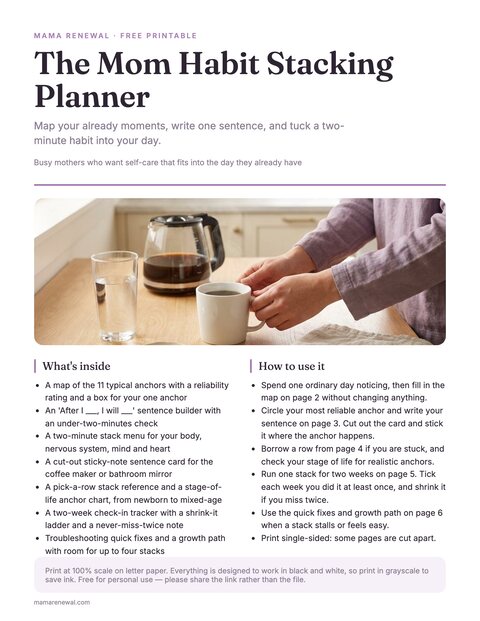
Free printable · 6 pages
The Mom Habit Stacking Planner
A habit stacking planner with an anchor-mapping worksheet, a fill-in sentence builder with a two-minute stack menu and a cut-out sticky-note card, a pick-a-row stack reference with a stage-of-life anchor chart, and a two-week check-in tracker with a shrink-it ladder, quick fixes and a step-by-step growth path.
Free. Your download link appears right here. You'll also join the Mama Reset. Unsubscribe anytime. Privacy
What finally worked was habit stacking: attaching one tiny self-care habit to something I already do, like the two minutes at the sink brushing my teeth, so the old habit becomes the reminder. No new calendar block, no willpower pep talk.
If you want self care habits for moms that don’t need a spare hour, here’s the formula, a five-step method, a table of 18 two-minute stacks, and ideas for morning, midday and evening. Write your sentences in the Mom Habit Stacking Planner.
In this article (14 sections)
- What Habit Stacking Actually Is (and Why It Works for Tired Brains)
- Why “Find Time for Yourself” Is Terrible Advice
- How to Build a Self Care Routine Out of Your Day (Step by Step)
- The Mom Habit Stacking Table: Pair What You Already Do With What You Need
- Morning Stacks: Small Wins Before the House Wakes Up (or Right After)
- Midday Stacks: The Drop-Off, the Pickup Line, and the Parked Car
- Evening Stacks: Landing the Day Instead of Collapsing Into It
- Gentle Habit Building: How to Keep Stacks From Becoming Another Source of Guilt
- Small Self Care Habits That Fit in Two Minutes (A Menu)
- What If You Have Different Seasons? Newborns, Toddlers, School-Age, and Beyond
- Troubleshooting: When Habit Stacking Doesn’t Seem to Work
- How to Add More Stacks Without Overwhelming Yourself
- Frequently Asked Questions
- You Don’t Need More Time, Mama
What Habit Stacking Actually Is (and Why It Works for Tired Brains)
Habit stacking is a simple formula:
TipAfter I [existing habit], I will [new tiny habit]. For example: after I pour my coffee, I will take three slow breaths.
That’s it. The existing habit is your “anchor.” The new habit is your “stack.” Because the anchor already happens without you thinking about it, it does the remembering for you.
The idea was popularized by habit writers like BJ Fogg and James Clear, building on research into implementation intentions, but moms have been doing a messy version of it forever. Taking a vitamin while the coffee brews. Singing in the car because it’s the only place nobody interrupts. You’ve already got some stacks. We’re just going to do it on purpose.
Why it works when nothing else does
Most self-care advice fails mothers for the same reason: it assumes you have unclaimed time and spare mental bandwidth. Neither is true on a Tuesday.
Habit stacking sidesteps both problems:
- It needs no extra time. The anchor is already on your schedule.
- It needs almost no memory. Finishing the anchor is the cue. You’re not relying on a 3 p.m. phone reminder you’ll swipe away while holding a toddler.
- It needs very little motivation. The new habit is so small that “I don’t feel like it” doesn’t get much of a foothold.
- It’s forgiving. Miss a day and the anchor is still there tomorrow, ready to try again.
If you’re running on fumes, this matters. Stress and poor sleep can make planning and decision-making harder. (If that sounds familiar, Depleted Mother Syndrome is worth a read.) Habit stacking works with that reality instead of fighting it.
Why “Find Time for Yourself” Is Terrible Advice
“Just carve out 30 minutes a day for you” is advice from someone who is not currently being climbed.
Many moms find a big self-care plan collapses within a week or two, and then read the collapse as proof that they’re bad at this. They’re not bad at this. The plan was built for a different life.
Common reasons big self-care plans collapse:
- They require a clear block of time that doesn’t exist.
- They depend on everyone else cooperating (nap schedules, partners, school pickups).
- They add a new task to an already overloaded mental list. Self-care becomes one more thing you’re failing at.
- They have all-or-nothing rules. Miss one morning and the whole routine feels ruined.
This is also where the mental load comes in. If you’re the one tracking appointments, snack supplies, and who needs new shoes, a self-care routine that requires more tracking is going to lose. For more on that weight, see The Mental Load: Why Moms Feel Exhausted Even When Everyone “Helps”.
Habit stacking flips it. Instead of asking “when will I have time?” you ask “what am I already doing that I could make 5% kinder?”
How to Build a Self Care Routine Out of Your Day (Step by Step)
You don’t need an app or a spreadsheet. You need a pencil and about ten minutes of honest noticing. Here’s a simple process.
- Map. List the things you do daily at about the same time.
- Pick one anchor. Choose the most reliable one.
- Keep it under two minutes. Make the new habit almost silly-small.
- Write the sentence. “After I…, I will…”
- Run it two weeks. Then adjust.
Step 1: Map your “already” moments
For one ordinary day (don’t change anything, just observe), jot down every thing you do at about the same time, in about the same way, every day. Don’t judge, just list.
Typical entries:
- Alarm goes off / feet hit the floor
- Bathroom first thing
- Making coffee or tea
- Brushing teeth (morning and night)
- Making school lunches
- School or daycare drop-off
- Sitting in the pickup line
- Starting the dishwasher
- Folding laundry
- Putting kids to bed
- Plugging in your phone at night
Aim for 8 to 12. You’ll be surprised how many “dead zones” are in there: pockets where your hands are busy but your mind is idle, or where you’re simply waiting.
Step 2: Pick ONE anchor
Choose the anchor that is the most reliable, not the most convenient-sounding. Reliable beats pretty. If your mornings are chaos but your nights are predictable, anchor at night. If the only thing you do every single day without fail is use the bathroom, that’s a perfectly respectable anchor. (See Bathroom Self-Care: What to Do With Your 5 Minutes of Hiding for ideas on that one.)
Step 3: Pick a stack that takes under two minutes
This is the part people skip, and it’s the part that decides whether this works. Your new habit should be so small it feels almost silly. Two minutes or less. Can be done standing up. Needs no special supplies.
Think “drink a glass of water,” not “meal prep for the week.” Think “three slow breaths,” not “meditate for twenty minutes.”
Step 4: Write it as a sentence
Say it out loud or write it on a sticky note:
Try itAfter I pour my coffee, I will take three slow breaths before I pick up my phone.
The specificity matters. “I’ll be calmer in the mornings” is a wish. The sentence above is a plan. Write yours in the Mom Habit Stacking Planner or on a sticky note.
Step 5: Run it for two weeks, then adjust
Don’t add a second stack yet. Let the first one become boring. When it feels easy, then add another. Slow is the point.
The Mom Habit Stacking Table: Pair What You Already Do With What You Need
Here’s the big one. Find a row that matches your day and borrow it. Every pairing is built to take two minutes or less.
| Existing routine (the anchor) | Self-care stack | What it gives you |
|---|---|---|
| Making your morning coffee or tea | Take three slow breaths while it brews or steeps, before you touch your phone | A small moment of calm before the day starts |
| Brushing your teeth (morning) | Roll your shoulders and stretch your neck side to side | Releases the tension you carry from carrying everything |
| Brushing your teeth (night) | Name one thing that went okay today, silently | A small counterweight to the “what I didn’t do” list |
| Feet hit the floor in the morning | Drink a full glass of water before anything else | Hydration, and you did one thing for yourself before anyone needed you |
| Making school lunches | Make your own lunch at the same time, even if it’s simple | You actually eat at midday |
| Drop-off at school or daycare | Once you’re parked with the engine off, sit for 60 seconds in quiet, or play one song you love | A bridge between “mom mode” and the rest of your day |
| Waiting in the pickup line | Unclench your jaw and drop your shoulders; save the slow body scan for when you’re parked | Interrupts the stress you’ve been holding |
| Loading the dishwasher | Put on one podcast episode or a playlist, just for you | Chores become a listening appointment |
| Folding laundry | Watch or listen to something you chose, not something for kids, while they play within sight | Time that already exists becomes yours |
| Standing at the stove | Eat a ready-to-eat protein bite (cheese, yogurt, a hard-boiled egg) while you cook, instead of waiting for the kids’ leftovers | Closes the “I forgot to eat” gap |
| Putting kids in the bath | Sit on the floor within arm’s reach of the tub, eyes on your child, and rest a hand in the warm water for a moment; never step away | A calm moment while you stay present |
| Bedtime story or song | Do three slow exhales after the last page | Slow exhales can help your body settle, too |
| After the kids’ lights go out | Wash your face with warm water and take a full deep breath | A boundary between the day’s work and your evening |
| Plugging your phone in at night | Put it across the room, then do one gentle stretch | Can help protect sleep from the late-night scroll |
| Using the bathroom | Close your eyes for five full breaths | The one door that locks, put to good use |
| Walking to the mailbox or trash cans | Look up at the sky for ten seconds | A little light and perspective |
| Turning on the car | Take one full breath before you shift into drive | Trains a pause into every trip |
| Starting a load of laundry | Do two minutes of stretching, or take a stroller walk with the kids; walk around the block only if another adult is home | Movement tied to a built-in timer |
Notice what’s not on the list: a bubble bath, a spa day, a yoga retreat. Those are lovely, but this is for ordinary Tuesdays.
Safety firstEyes-closed, breathing and body-scan stacks are for when you’re parked with the engine off, never while driving. While driving, keep your attention on the road and your audio low enough to hear the kids. Never leave a child alone in the car. At bath time, stay within arm’s reach and keep your eyes on your child; never use it to check your phone or step away. While cooking, stick to ready-to-eat foods and don’t taste raw meat, eggs or dough.
Morning Stacks: Small Wins Before the House Wakes Up (or Right After)
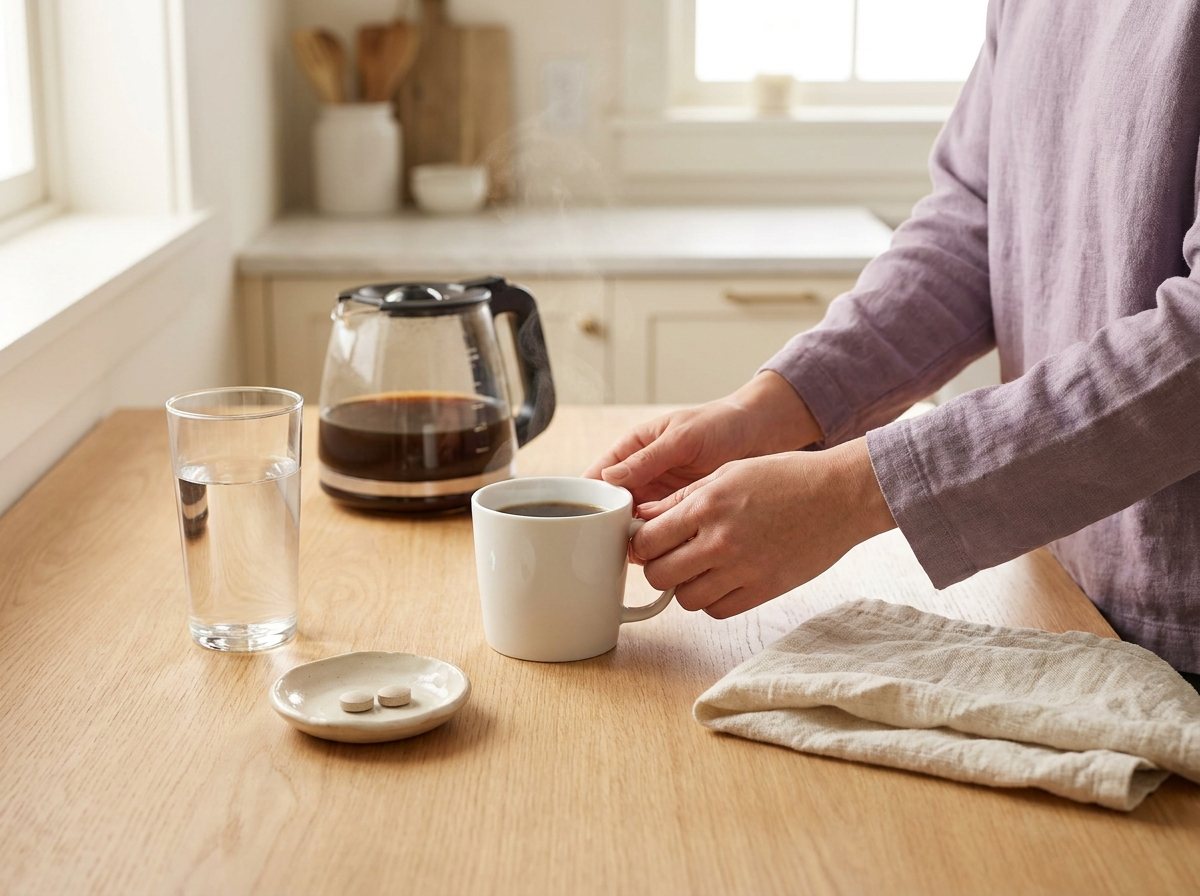
Mornings are the most contested real estate in a mom’s day. If you’re a “wake before the kids” mom, great. If you’re not, no shame, because plenty of us are woken by someone standing at the bedside whispering a very loud question about breakfast.
Think of the morning as a series of tiny doorways rather than one big block.
Good morning anchors
- The alarm or first wake-up. Before you reach for your phone, put one hand on your chest and take two slow breaths.
- The bathroom. Splash cool water on your face. Look in the mirror and say one neutral or kind thing. (Neutral counts. “I’m here” counts.)
- The coffee. Make it a ritual of three breaths, or pair it with your vitamins and a glass of water.
- The kitchen. Eat something with protein before you start serving everyone else.
If you want to build a fuller morning later, Morning Routine for Moms goes deeper. But start with one stack. A morning routine you actually do for 30 seconds beats a perfect one you do never.
Example: a morning stack in practice
Picture a mom who is determined to do a 20-minute workout at 6 a.m. and keeps falling short. Her actual mornings look like this: coffee at 6:40, toddler up at 6:45, a lot of chaos after that.
Her new stack could be: After I press start on the coffee maker, I’ll do ten slow squats while it brews. That takes about a minute and a half. She wouldn’t be “finding time.” She’d be noticing the time that was already in the machine.
Midday Stacks: The Drop-Off, the Pickup Line, and the Parked Car
The middle of the day is where a lot of moms hit the wall. Whether you work outside the home, work from home, or are home with little ones, there’s a stretch of hours that’s just logistics. (For school-age moms especially, School-Age Mom Burnout: The Invisible Load of Logistics puts words to what that feels like.)
Stacks for the gaps
- After the car door closes at drop-off: Sit for one full minute. No phone. Let your shoulders come down from your ears. Maybe play one song.
- While waiting in the pickup line: Do a quick jaw and shoulder check. Unclench. Stretch your neck. Drink water.
- After you hit “send” on a work email: Stand up and walk to the window.
- While the kids eat a snack: Sit and eat something yourself, rather than hovering.
- After you load the dishwasher: Take a full, slow breath with your hands on the counter.
On eating
Skipped meals are a very common “invisible” self-care gap. You feed everybody and then eat the crust off a sandwich standing over the sink at 2 p.m. Pairing your own eating with the moments you already feed others is a simple fix. It’s the same principle in Nutrition as Self-Care: Simple Eating Habits That Help Moms Thrive: make the easy thing the default thing.
Evening Stacks: Landing the Day Instead of Collapsing Into It

Evenings are where a lot of moms feel the sharpest tug-of-war: you’re exhausted, but this is also the only time that feels like “yours.” So we end up scrolling for two hours and feeling worse. (If that’s you, you’re in good company. How to Stop Doom Scrolling can help.)
Evening stacks work best when they signal transition: “the working day is over.”
Ideas for evening anchors
- After the last bedtime book or song: Three slow exhales, each one longer than the inhale. A longer exhale can help your body settle, too.
- After you close the kids’ door: Wash your face, brush your teeth, and change into comfortable clothes right away. Do this before you sit on the couch, not after.
- After you wipe down the counters: Turn off the overhead light and turn on a lamp. Light is a cue.
- When you plug in your phone: Leave it outside the bedroom or across the room. Add one stretch.
- When you get into bed: Name one thing your body did for you today. (It carried children. It got you through. It’s allowed to be thanked.)
If you’re not sleeping well
Sometimes the tiredness isn’t about habits; it’s a deeper sleep debt that doesn’t clear overnight. Mom Sleep Debt: Why You’re Still Exhausted Even When Kids Sleep Through the Night explains why. In the meantime, an evening stack that protects even 15 extra minutes of rest is worth more than most “productivity hacks.”
Gentle Habit Building: How to Keep Stacks From Becoming Another Source of Guilt
Here’s where a lot of well-meaning habit advice goes wrong: it turns self-care into a scoreboard. Streaks. Check marks. A red X when you miss. For a mom already carrying a lifetime supply of guilt, that’s not helpful.
Gentle habit building has different rules.
The gentle habit rules
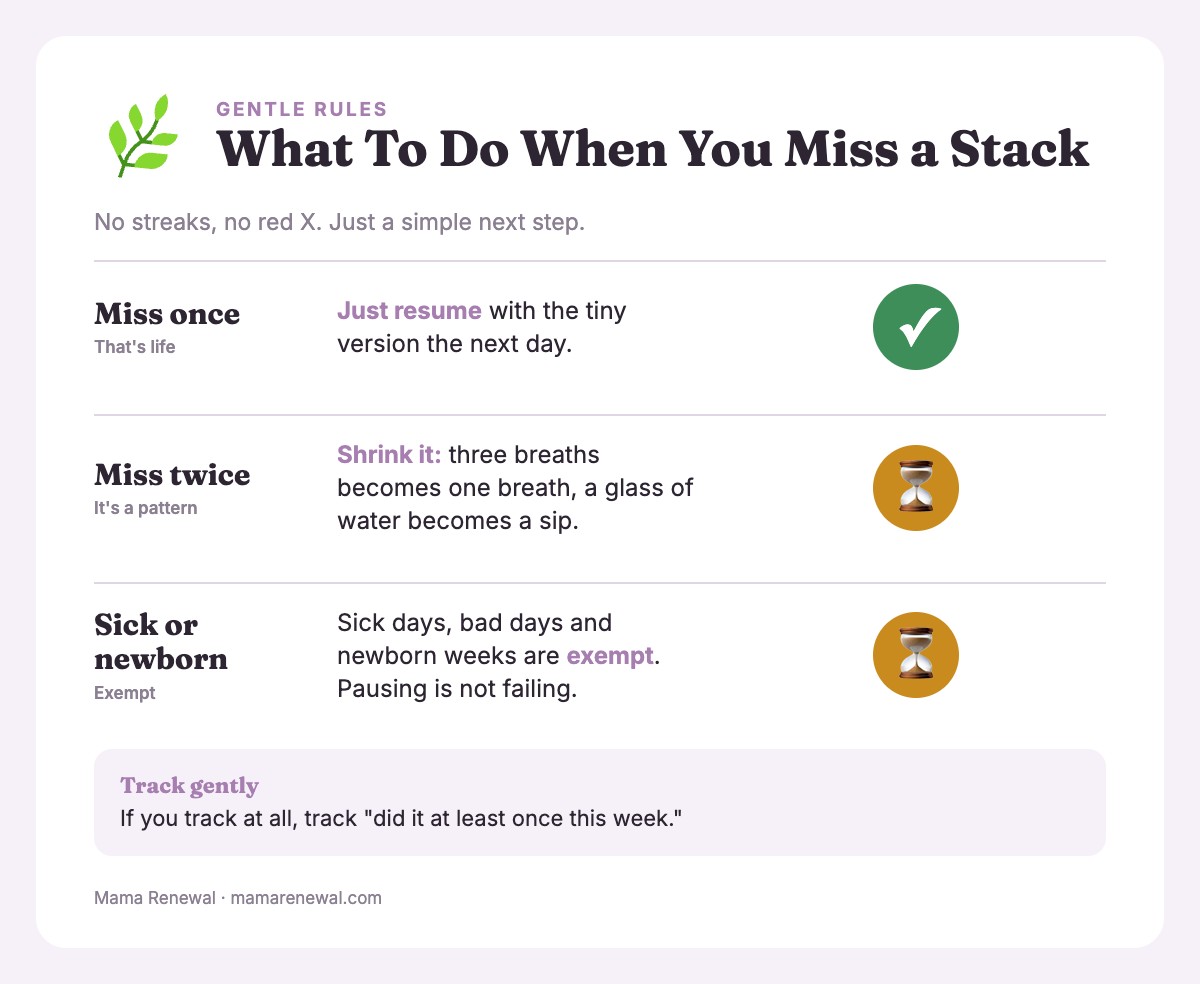
- Make it smaller than you think you need to. If you miss it twice, shrink it. Three breaths becomes one breath. A glass of water becomes a sip.
- If you miss once, just resume. The first miss is life. The second is a pattern, so shrink the habit. When you notice a miss, just do the tiny version the next day.
- Don’t track perfection. If you track at all, track “did it at least once this week.”
- Pair it with something pleasant. Good tea. A lotion you love. A song. The habit sticks if your body likes it.
- Let sick days, bad days, and newborn weeks be exempt. Pausing is not failing.
- Don’t stack on a stressful anchor. If drop-off is the most chaotic part of your day, don’t use it. Pick a calmer anchor.
What “success” looks like
It’ll feel like noticing, a few weeks in, that you’re standing at the sink with your shoulders down. Or that you drank water before 9 a.m. Or that you didn’t yell as quickly when the juice spilled.
Small Self Care Habits That Fit in Two Minutes (A Menu)
If you’re staring at the table wondering what to stack, here’s a menu. Pick whatever your body is asking for. Mix and match with any anchor.
For your body
- Drink a glass of water
- Stretch your neck, shoulders, or lower back
- Do five slow squats or wall push-ups
- Apply hand cream or lip balm slowly
- Eat a handful of nuts or a piece of cheese (protein helps; see Protein for Moms). Keep whole nuts away from children under 4, keep snack bowls out of toddlers’ reach, and follow your household’s allergy rules.
- Step outside for fresh air and daylight
For your nervous system
- Three slow breaths, with the exhale longer than the inhale
- Press your palms together firmly for ten seconds
- Feel your feet on the floor and name five things you can see
- Close your eyes for 30 seconds (only when you’re not driving and no child needs your eyes)
- Hum or sing one line of a song
If your system feels especially wired or fried, Nervous System Regulation for Moms has a longer list of techniques to explore.
For your mind
- Write one sentence in a notes app or on a sticky note
- Name one thing you’re looking forward to
- Say “this is hard and I’m doing it anyway”
- Listen to one song you love, start to finish
- Clear one tiny thing off your mental list: write it down so you can stop holding it
For your heart
- Send a one-line text to a friend (“thinking of you”)
- Look at one photo that makes you smile
- Give yourself the exact reassurance you’d give a friend
- Hug a child, a partner, or yourself, and really feel it for a few seconds
None of these will fix your life. All of them can make a hard hour a little softer. And repeated daily, they quietly change the baseline.
What If You Have Different Seasons? Newborns, Toddlers, School-Age, and Beyond
“Moms” is a big category, and the best stacks depend on your stage. The method stays the same; the anchors change.
| Stage | Reliable anchors | Realistic stacks |
|---|---|---|
| Newborn / postpartum | Feedings, diaper changes, burping | Sip water at every feed; three breaths with each diaper change; eat one snack at the night feed |
| Toddler | Snack time, nap start, bath time | Sit and eat with them; exhale slowly as nap starts; a hand-in-warm-water pause at bath while you stay within arm’s reach |
| Preschool / early school | Drop-off, car rides, meals | One song in the parked car; protein with breakfast; stretch while waiting |
| Big-kid / tween | Carpool, homework time, dinner prep | Podcast while driving; sit nearby with your own book while they do homework; stretch during dinner prep |
| Working mom | Commute, first coffee, closing the laptop | Breath before the first meeting; walk after the last one; shoes off and shoulders down at the door |
| Mixed-age chaos | Bathroom, bedtime, morning wake-up | Anything attached to the one routine that always happens |
Safety firstIf you might doze during a night feed, feed in your bed rather than on a sofa or armchair. Clear pillows and blankets away from the baby. As soon as you wake, move the baby back to their own flat, firm sleep surface. Falling asleep with a baby on a sofa or armchair is a serious risk. At toddler bath time, stay within arm’s reach with your eyes on your child the whole time.
If you’re in the newborn fog, the bar is on the floor and that’s fine. A sip of water at a feeding is a legitimate self-care practice. You’re not behind.
Good to knowIf low mood, anxiety, intrusive thoughts or hopelessness are severe, or last beyond about two weeks after birth, contact your provider. In the US, the National Maternal Mental Health Hotline is 1-833-852-6262 (call or text, 24/7). If you are thinking of harming yourself, call or text 988 or your local emergency number.
And if you’re in the season where you’re feeling like you’ve lost your identity in all of this, Matrescence: Understanding the Identity Shift Every Mom Goes Through might feel like a mirror.
Troubleshooting: When Habit Stacking Doesn’t Seem to Work
Sometimes a stack just won’t stick. That’s information, not failure. Here are the most common snags and what to try.
I forget to do it
Your anchor probably isn’t reliable enough, or the cue is too vague. Pick a more consistent anchor, or put a physical reminder where the anchor happens: a sticky note on the coffee maker, a hair tie on the bathroom faucet.
I do it for three days and then stop
The habit may be too big. Shrink it by half. Then half again, until it’s almost embarrassing.
My anchor keeps getting interrupted
Kids interrupt things. If you can’t finish the stack in the middle of the anchor, move it to the end: “After I pour the coffee and sit down, I’ll take three breaths.”
It feels pointless
Two minutes of breathing won’t change your life. It’s not meant to. It’s a toe in the water, and it can help you start to see yourself as someone worth looking after, which can make bigger choices easier later. If you want to dig into which kinds of self-care actually feel good to you, the free self-care style quiz can help you choose stacks you’ll want to keep.
I’m too tired to do anything extra
Then do less. Choose the single easiest stack in the table and ignore the rest for now. If exhaustion is constant and deep, or if you’re feeling hopeless, snappy all the time, or numb, it’s worth talking to your doctor or a mental health professional. In the US, you can call or text the National Maternal Mental Health Hotline at 1-833-852-6262 any time, and if you are thinking of harming yourself, call or text 988 or your local emergency number. Habit stacking is a helper, not a replacement for care.
My partner or kids make fun of it
Fair, they might. Try letting it be quiet. A deep breath at the sink doesn’t need an audience.
How to Add More Stacks Without Overwhelming Yourself
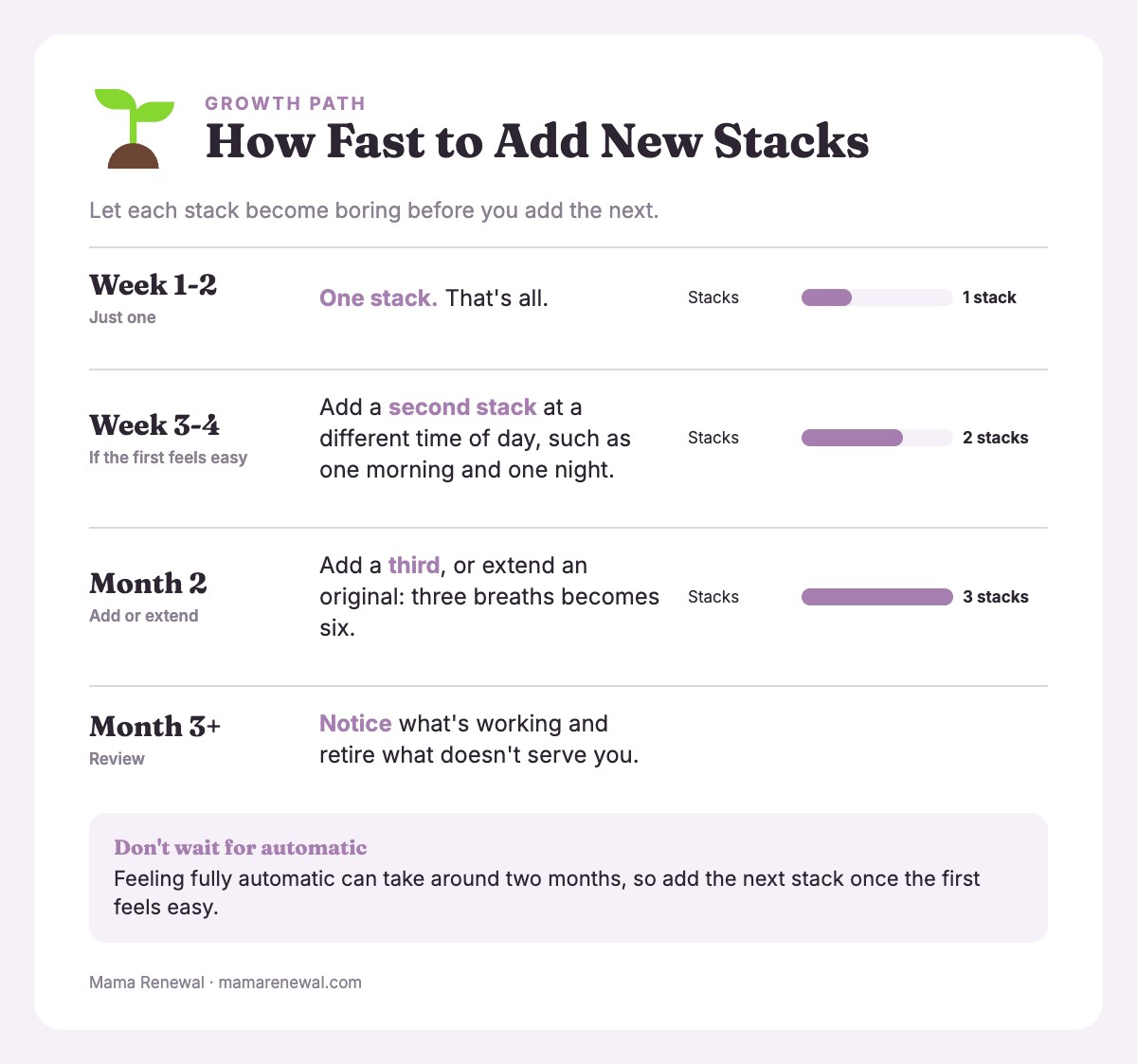
When your first stack feels easy, often after two to four weeks, you can add another. Feeling fully automatic can take around two months, so don’t wait for that. Here’s a simple growth path.
- Week 1 to 2: One stack. That’s all.
- Week 3 to 4, or when the first feels easy: Add a second stack at a different time of day (for example, one morning, one night).
- Month 2: Add a third, or slightly extend one of the originals (three breaths becomes six).
- Month 3 and beyond: Notice what’s working and what’s not. Retire what doesn’t serve you.
Over a few months you’ll have a “routine,” but you’ll never have had to build one in the intimidating sense. It will just be the shape your day already took.
When you’re ready for a bigger picture, The Ultimate Self-Care Checklist for Moms and A Printable Sunday Self-Care Planner pair nicely with this approach. The checklist helps you see all the categories, and the planner is a place to choose your next stack on a Sunday evening. And if you want the more structured approach, our guide to a self-care routine for busy moms is a natural next step.
If you need support right now
Reaching out is not an overreaction. These lines are free and confidential.
- Emergency: if you are thinking about harming yourself or your baby, or you can’t keep yourself safe, call 911 or go to the nearest emergency room. This is a medical emergency, and it is treatable.
- 988 Suicide & Crisis Lifeline: call or text 988, 24/7, for anyone in crisis.
- National Maternal Mental Health Hotline: call or text 1-833-TLC-MAMA (1-833-852-6262), 24/7, in English and Spanish, for pregnancy and postpartum support.
- Postpartum Support International: call or text 1-800-944-4773 for help finding a provider who specializes in perinatal mental health. Not an emergency line.
US numbers. Elsewhere, ask your doctor, midwife or local crisis line. This article was written by a parent, not a clinician, and isn’t medical advice.
Frequently Asked Questions
What is habit stacking, in plain English?
Habit stacking means attaching a new, tiny habit to something you already do every day. You use the existing habit as a reminder. For example, “After I brush my teeth, I’ll roll my shoulders.” Because you already brush your teeth without thinking, the new habit rides along with it instead of requiring its own spot on your schedule.
How long does it take to build a self-care habit as a busy mom?
It varies a lot from person to person and habit to habit. A tiny stack may feel natural within a few weeks, but one well-known study of everyday habits found that feeling automatic took about two months on average (roughly 18 to 254 days, depending on the person). Rather than watching the calendar, watch for the moment you notice you’re doing it without deciding to. Smaller habits are usually easier to repeat, which is why we keep them under two minutes.
What are good self care habits for moms who have almost no free time?
The best ones take under two minutes and ride along with something you already do. Drink a glass of water when you pour your coffee. Take three slow breaths in the parked car after drop-off. Stretch your neck while you brush your teeth, or eat a protein snack while you cook for the kids. You’re not adding time; you’re changing how you use time you already have.
What if I miss a day, or a whole week?
Nothing is ruined. Miss once, and just resume the next time your anchor happens. Miss twice, and shrink the habit. If you lose a few days or a week to sick kids, travel or a rough patch, come back to the tiny version. If you keep missing, switch to a more reliable anchor. It’s a design problem, not a character flaw.
Can habit stacking help with mom burnout?
It can help with the daily maintenance side of burnout, like hydration, eating, short breaks, and nervous system pauses. But it isn’t a cure for deep burnout, which often needs bigger changes: shared workload, more support, better sleep, or professional help. Think of habit stacking as a floor, not a ceiling. If you feel hopeless, numb, or constantly on edge, please reach out to your doctor or a mental health professional. In the US, you can call or text the National Maternal Mental Health Hotline at 1-833-852-6262 any time, and if you are thinking of harming yourself, call or text 988.
How many habits should I stack at once?
Start with one. When it feels easy, often after a few weeks, add a second. Most people do well with two to four total stacks spread across the day. More than that and it starts to feel like another to-do list, which defeats the purpose.
What if my day is too unpredictable to have reliable anchors?
Even the most chaotic days usually contain a few constants: waking up, using the bathroom, eating something, plugging in your phone, getting into bed. Pick the most reliable of those. If your anchors really do shift daily, try anchoring to something physical rather than a time, like “whenever I wash my hands” or “when I buckle my seatbelt.”
You Don’t Need More Time, Mama
You’ve probably been told, in a hundred small ways, that taking care of yourself requires a bigger commitment than you can give right now. It doesn’t. It can start at the sink tonight, with one slow breath and shoulders that drop half an inch.
Pick one row from the table. Say your sentence out loud. Let the rest wait. You’re not behind, and you don’t need to overhaul anything. You’re just making the life you already have a little kinder to the person living it.