30 Fall Journal Prompts for Moms Craving a Slower Season
Discover 30 fall journal prompts designed for moms to navigate school transitions, shorter days, and find a slower pace this season. Use these prompts to process overwhelm and cultivate a more mindful autumn.
- Utilize 30 fall journal prompts to navigate the season's unique challenges.
- Explore prompts categorized for school transitions, shorter days, and slowing down.
- Discover how journaling can help you process overwhelm and find a calmer pace.
- Download a free printable journal with prompts and tools for a slower season.
This post contains affiliate links. As an Amazon Associate I earn from qualifying purchases.
These 30 fall journal prompts for moms come in three sets of ten: school transition, shorter days, and slowing down. I wrote the first one in a school pickup line last October, twelve minutes early, with a latte I didn’t even want going cold in the cupholder. It was 3:40 and already felt like evening. My head was loud with a permission slip due Thursday, an undecided costume, and a Thanksgiving group text at 41 messages. Under all of it was a low hum of why am I so tired when nothing is technically wrong?
I had a notebook in the glovebox. I opened it, stared at the blank page, and wrote four words: “I don’t know what’s wrong.”
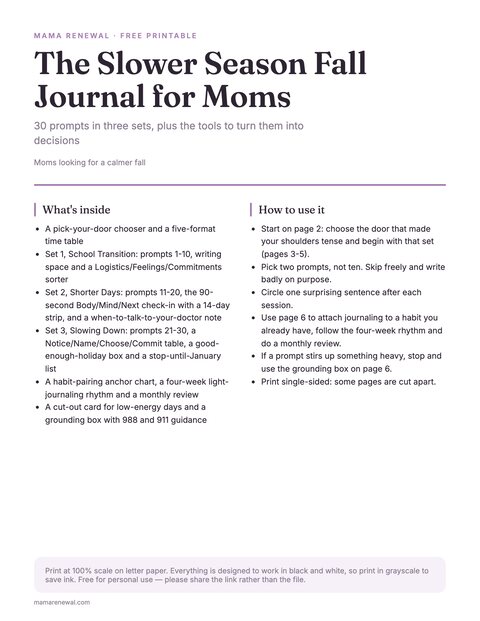
Free printable · 6 pages
The Slower Season Fall Journal for Moms
Thirty fall journal prompts in three sets (school transition, shorter days, slowing down) with writing space, a sorter, a 90-second check-in, a decision table, a good-enough-holiday box, a habit anchor chart, a four-week rhythm, a monthly review, a low-energy-day card and a grounding box.
Free. Your download link appears right here. You'll also join the Mama Reset. Unsubscribe anytime. Privacy
That was it. But it was the first honest sentence I’d written in weeks. By the time the bell rang, I had a short list of what was going on: the school-year grind, the disappearing light, and the holidays already looming.
Most fall prompts ask what you’re grateful for. Gratitude is lovely, but it doesn’t help when you can’t name why you’re overwhelmed. So these are grouped by what’s driving it: the school transition, the shorter days, and the slow-down you keep promising yourself. Start with whichever set made your shoulders tense when you read it.
In this article (10 sections)
- Fall Journal Prompts for Moms: Why Gratitude Lists Fall Short
- How to Use These Fall Reflection Prompts (Without Adding Another Chore)
- Set 1: School Transition Prompts (Prompts 1-10)
- Set 2: Shorter Days Prompts (Prompts 11-20)
- Set 3: Slowing Down Prompts (Prompts 21-30)
- Pairing Your Journaling With Habits You Already Have
- When a Prompt Stirs Up Something Heavy
- Making It Stick Without Making It Another Thing to Fail At
- Frequently Asked Questions
- You Don’t Have to Earn the Slower Season
Fall Journal Prompts for Moms: Why Gratitude Lists Fall Short
Search “autumn journal prompts” and you’ll find lists like “What is your favorite fall memory?” and “List five things you love about autumn.” They’re pleasant. They’re also mostly written for a person who has a spare hour, a candle, and no one asking her for a snack.
Real fall overwhelm has causes, and different causes need different questions:
- A routine that just got rebuilt. September and October bring new schedules, new teachers, new drop-off times, and new logistics. That’s a mental-load spike, and it needs sorting more than celebrating.
- Less daylight. The light shifts and your energy, mood, and motivation often shift with it. That calls for noticing and adjusting, not toxic positivity.
- Holiday pressure. The expectations arrive months before the actual holidays. Journaling here is about deciding what you will and won’t carry.
Gratitude can sit inside any of these, but it can’t be the whole plan. If you’re grieving the quiet of summer or dreading a family gathering, “list three things you’re thankful for” can feel like being told to smile. A good prompt meets you where you actually are.
You don’t need all three sets. Start with whichever fits.
How to Use These Fall Reflection Prompts (Without Adding Another Chore)
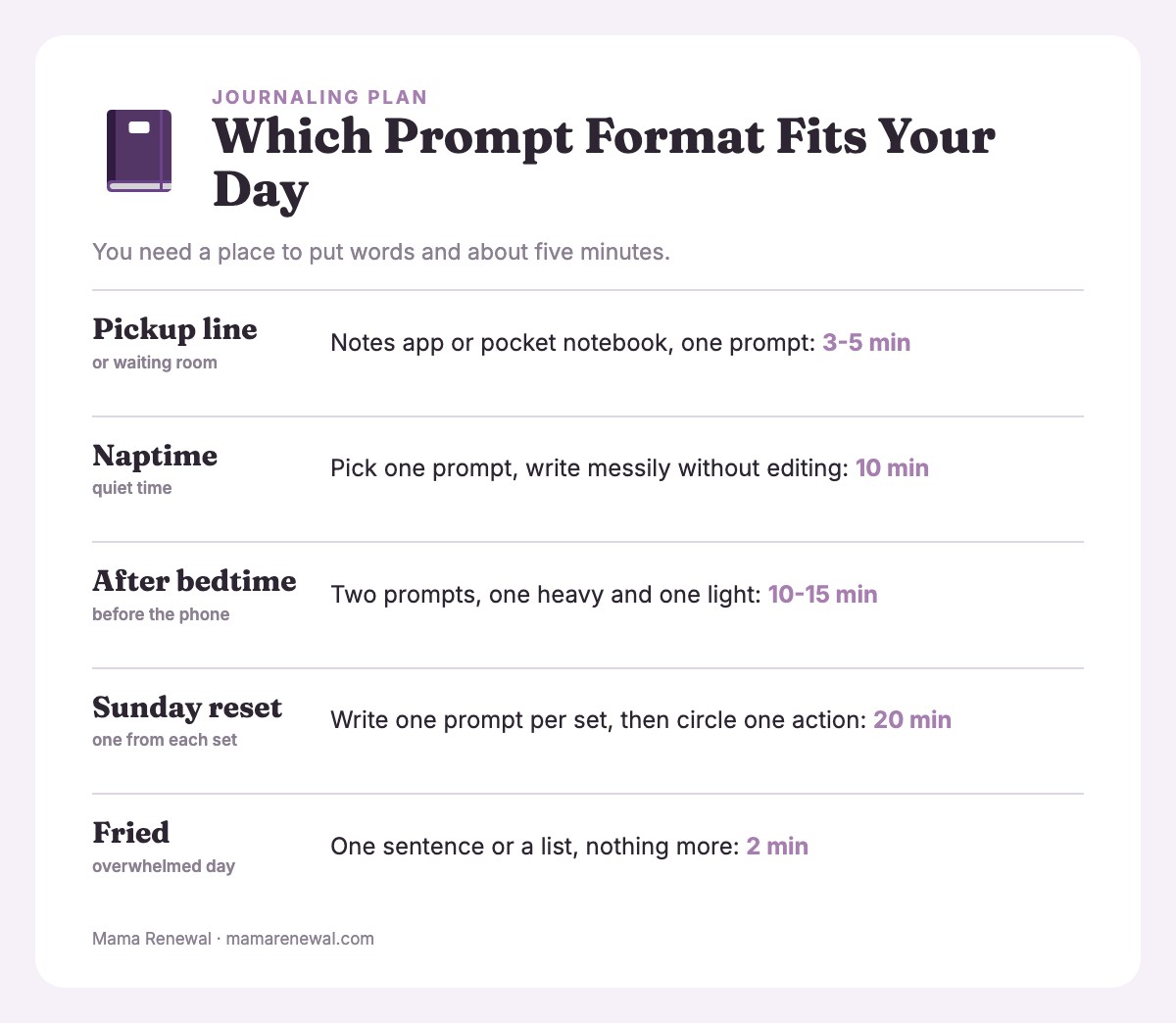
You do not need a gorgeous leather journal, a fancy pen, or a pot of tea. You need a place to put words and about five minutes. Here’s what tends to work:
| Situation | Format that works | Time |
|---|---|---|
| Pickup line or waiting room | Notes app or small pocket notebook, one prompt | 3-5 min |
| Naptime or quiet time | Pick one prompt, write messily without editing | 10 min |
| After bedtime (but before the phone) | Two prompts, one “heavy” and one “light” | 10-15 min |
| Sunday reset | Write one prompt from each set, then circle one action | 20 min |
| Overwhelmed and fried | Answer with one sentence or a list, nothing more | 2 min |
A few ground rules that keep this from becoming homework:
- Skip freely. If a prompt makes you roll your eyes, move on. That reaction is information, too.
- Write badly on purpose. Fragments, lists, run-on sentences, and angry scribbles all count.
- Don’t reread right away. Write first, judge never. If you want to look back, do it at the end of the month.
- Circle one thing. After a session, underline one sentence that surprised you. That’s your takeaway, and you don’t need more than that.
If you want even more options beyond fall, our everyday journaling prompts for moms and a second collection of journaling prompts are good places to keep going once you’ve found a rhythm.
Set 1: School Transition Prompts (Prompts 1-10)
TipPick two prompts, not ten. Start with the one that made your shoulders tense.
This set is for the mom whose September felt like running a small logistics company. Maybe your kid started kindergarten, or middle school, or just a new teacher who communicates exclusively through three different apps. Maybe the house got quiet in a way you didn’t expect. Maybe you got a lot louder in your own head.
The first weeks of school often mix relief, grief, and administrative overload. These prompts help you sort which one is on top today.
The Prompts
1. What did I think this school year would feel like, and how does it actually feel?
The gap between expectation and reality is where most disappointment hides. Naming it takes some of the sting away.
2. What is the one logistical task that drains me most, and who else could own part of it?
Be specific: the lunch packing, the form tracking, the pickup schedule. A vague “I’m overwhelmed” can’t be delegated, but “I hate the Sunday-night folder sort” can.
3. What am I grieving about this season of my kid’s life?
You’re allowed to miss the toddler who clung to your leg and be glad for the independent kid in front of you. Both are true. (If the first quiet morning hit you harder than you expected, you’re not alone. The First Quiet Morning explores exactly that.)
4. What am I relieved about, and do I feel guilty for being relieved?
Relief is not a character flaw. Write the relief down without a disclaimer attached.
5. What did I say yes to in August that I regret in October?
Fall is the season of over-committing. Look at the PTA role, the class snack rotation, the “sure, I can help” you said while distracted. Which one can be gracefully handed back?
6. Which parts of the school routine are mine, and which parts am I carrying because no one asked me to stop?
Many moms do invisible work simply because they’ve always done it. This question brings the work into the light.
7. What is my child showing me about who they are becoming this year?
It’s a good break from the stress. Write one small, specific thing you noticed: a new joke, a new fear, a new interest.
8. If a friend described my current schedule to me, what would I tell her?
We give other people grace we won’t give ourselves. Write the advice you’d offer, then notice whether you’re following it.
9. What part of my own identity got quieter when the school year started?
Back-to-school can shrink you into “driver, scheduler, snack provider.” Which parts of you are waiting for a turn?
10. What is one boundary around school stuff that would give me back 30 minutes a week?
Maybe it’s one app notification muted, one group chat left, or one “no” to a volunteer ask. If you need language for it, how to say no to the PTA has scripts that don’t require you to over-explain.
What to Notice After Set 1
Look back at your answers and sort them into three piles:
| Pile | What it means | What to do |
|---|---|---|
| Logistics | Fixable with a system or by sharing the load | Write one concrete change |
| Feelings | Needs space, not a solution | Give it a few more minutes on the page |
| Commitments | Something you agreed to that no longer fits | Draft a polite exit |
You may find that one pile is bigger than the others. That’s your starting point.
If the logistics pile is overflowing, that’s the mental load of school-age logistics. It’s a structural burden, not a personal failing, and it deserves recognition and, ideally, shared ownership.
Set 2: Shorter Days Prompts (Prompts 11-20)
This set is for the mom who notices that around 4:30 p.m. the sky goes gray, her energy drops through the floor, and dinner suddenly feels like climbing a mountain.
Shorter days change how a lot of us feel. Many people notice lower energy, a stronger pull toward carbs and the couch, and a shorter fuse in the evening. That doesn’t mean something is wrong with you. Shorter days affect many people’s sleep, appetite, and mood, and it’s a common, well-documented pattern.
Good to knowIf your low mood is heavy, lasts more than a couple of weeks, or interferes with daily life, please talk to your doctor or a mental health professional. Seasonal depression is real and treatable, and journaling is a supplement, not a substitute.
For many moms, the dark also lands right at the hardest time of day: the late-afternoon-to-bedtime stretch. These prompts help you notice what’s changing and plan around it rather than blaming yourself.
The Prompts
11. What time of day do I notice my energy dropping now, and what was I doing the last time it dipped?
Track patterns for a few days. You may find your slump is predictable, which means you can plan for it.
12. What does my body ask for as the days get shorter, and what do I do when it asks?
More sleep? Warm food? Quiet? Write the request and your usual response. Notice whether you ignore, override, or honor it.
13. Which part of the evening feels heaviest, and what would make it 10% lighter?
Not fixed, just 10% lighter. Maybe it’s a crockpot dinner, a family “quiet hour,” or turning on lamps instead of the overhead light.
14. When did I last feel truly rested, and what was different?
Describe it in sensory detail. The answer often reveals something simple, like a particular bedtime or a morning with no alarm.
15. How does the early dark change my mood, and what do I tell myself about it?
Watch for the harsh self-talk (“I’m lazy,” “I should be more productive”). Rewrite one sentence the way you’d say it to a friend. A longer look at kindness toward yourself lives in self-compassion for moms.
16. What small light, literal or figurative, could I add to my evenings?
String lights, a candle, a favorite show, a phone call with a friend. Pick something small enough that you’ll actually do it.
17. What did I do last winter that helped, and what did I do that made it worse?
You have data. Use it. If last year’s December collapse was predictable, this year’s can be softer.
18. What do I need to hear from myself on a low-energy day?
Write the actual sentence. Then put it somewhere you’ll see it: the bathroom mirror, a sticky note, your lock screen.
19. What am I trying to push through that I could, instead, adapt to?
Maybe it’s the 5 a.m. workout that no longer works in the dark, or the elaborate dinner at 6 p.m. Adapting is not quitting.
20. Who do I want to be around more when it’s dark and cold?
Winter isolation sneaks up on moms. Name a person or two you’d like to see, and write one specific plan, such as a Sunday walk or a Friday phone call. (If friendships feel hard to build, making mom friends as an adult takes on why it’s so tough and what actually helps.)
A Quick Fall Self-Care Journal Check-In for the Dark Months
If you want a short daily version of this set, try the “three-line check-in.” It takes about 90 seconds:
- Body. One word for how my body feels right now.
- Mind. One thing that’s taking up too much room in my head.
- Next. One tiny thing that would help in the next hour.
That’s it. After two weeks, flip back through and look for patterns. You might spot things like “my body is always ‘heavy’ by 3 p.m. on school-pickup days” and finally realize the problem isn’t willpower, it’s a missing snack and fifteen minutes of quiet.
It also pairs well with the practical side of seasonal energy. Our guide to vitamin D and the fall slump covers the basics. Persistent fatigue is worth raising with your doctor, who can check vitamin D and rule out other causes before you supplement. The daylight saving time sleep schedule chart is useful when the clock change in early November wrecks everyone’s sleep at once.
Set 3: Slowing Down Prompts (Prompts 21-30)
This set is for the mom who keeps telling herself, “When things calm down, I’ll rest.” Then things don’t calm down, because things never calm down. Then October rolls into November, and the calendar starts filling with Thanksgiving logistics, school concerts, gift lists, and the family expectations you haven’t yet decided how to handle.
These are the slow down journal prompts I wish I’d had years ago. They aren’t about doing less in some vague, aspirational way. They’re about choosing, on purpose, what gets your energy between now and January.
The Prompts
21. If I could protect one thing in my calendar this season, what would it be?
One thing. Maybe it’s Sunday mornings, a weekly walk, or an early bedtime. Write it, then block it before anything else gets scheduled.
22. What holiday task do I do mostly because “that’s what moms do”?
Cards, matching pajamas, the elf. No judgment if you love it, but if you secretly dread it, you’ve found something worth questioning.
23. What does a “good enough” holiday season look like for my family?
Define it before the pressure defines it for you. List three non-negotiables and three things that are fine to let slide.
24. Which family expectations am I dreading, and what is the actual fear underneath?
“I dread Thanksgiving” can mean a dozen things: a critical relative, the cost, the cooking, the travel with kids. Get specific, and the problem often shrinks. If gift overload from relatives is part of it, what to say when grandparents buy too many Christmas gifts offers scripts you can borrow.
25. What would I do this weekend if I gave myself full permission to rest?
Write the whole fantasy. Then circle the smallest piece of it you could do for real, even for twenty minutes.
26. What am I afraid will happen if I slow down?
This one is honest and sometimes uncomfortable. Many of us fear that if we stop, everything falls apart, or we’ll feel the exhaustion we’ve been outrunning. Write the fear plainly, then ask whether it’s actually true.
27. What small ritual makes a regular day feel a little more like fall?
A mug in your favorite color, the first fire of the season, a short walk where you crunch leaves. For a longer menu of ideas, see 27 cozy fall self-care ideas for moms running on empty.
28. What is something I can stop doing entirely until January?
Not “do better,” but actually stop. A volunteer role, a standing coffee date that drains you, a chore standard that nobody else notices.
29. How do I want to feel on December 31, and what is one decision I can make now to move toward that?
Pick a feeling, not a goal: calm, connected, rested, proud. Then work backward. That feeling is your compass for every “should” that shows up in the next ten weeks.
30. What would it look like to treat myself as someone worth taking care of, not just someone who takes care of everyone?
It’s a big question, so give yourself room. You don’t have to answer it in one sitting. Come back to it every few weeks.
Turning Prompts Into Decisions
The slowing-down set works best when your journaling ends in a choice, not just an insight. Try this simple structure after any prompt in Set 3:
| Step | Question | Example |
|---|---|---|
| Notice | What came up? | “I’m dreading hosting.” |
| Name | What’s underneath? | “I don’t want to cook for 14 people.” |
| Choose | What’s one option? | “Ask everyone to bring a dish.” |
| Commit | When will I act? | “Send the text Thursday morning.” |
A prompt that ends in a text message sent beats a prompt that ends in a feeling you’ll revisit in January.
Pairing Your Journaling With Habits You Already Have
The biggest reason journaling dies by mid-November isn’t lack of desire. It’s that it floats free of your day. The trick is to attach it to something you already do, which is the whole idea behind habit stacking for moms.
Some pairings that work well in fall:
- After you pour your coffee, write one sentence from any prompt.
- While dinner is in the oven, answer a single question at the counter.
- Right after you park at pickup, spend the early minutes with a prompt from Set 1.
- When you turn on the lamp at 5 p.m., do the three-line check-in from Set 2.
- Before you open the phone at night, finish with one Set 3 prompt instead of scrolling.
If you tend to journal with a pen and then never find the notebook again, try keeping it where you already end up. Many moms leave it in the car, by the bed, or in the bathroom, which is also a fine spot for a few minutes of hiding.
What a Month of Light Journaling Might Look Like

Here’s a sample rhythm that asks for very little:
| Week | Focus | Prompts to try | Time per session |
|---|---|---|---|
| 1 | School transition | 1, 2, 5, 6 | 5 min, 3 times |
| 2 | Shorter days | 11, 13, 14, 16 | 5 min, 3 times |
| 3 | Body and mood | 12, 15, 18, 20 | 5 min, 3 times |
| 4 | Slowing down | 21, 23, 25, 28 | 10 min, 2 times |
You’ll finish the month with a very clear picture of your own season, and with a few small decisions already made.
When a Prompt Stirs Up Something Heavy
Sometimes a gentle question opens a door you weren’t ready for. You start writing about the school routine and end up crying about something else entirely. That’s normal, and it doesn’t mean you did something wrong.
A few ways to take care of yourself when that happens:
- Set a timer. Ten minutes of writing, then stop. You can come back.
- Ground yourself afterward. Drink some water, step outside, or put your hands under warm water for a minute.
- End on something steadier. Finish with a line like “Right now I am safe and I have what I need for tonight,” or write a single thing that went okay today.
Safety firstIf what surfaces feels overwhelming, or you notice ongoing hopelessness, constant irritability, or thoughts of harming yourself or your baby or child, please contact your doctor, a therapist, or a crisis line right away. In the U.S. you can call or text 988 at any time. If you are in immediate danger, call 911. If you are pregnant or postpartum, the National Maternal Mental Health Hotline (1-833-852-6262) is free, 24/7, by call or text.
Journaling is a tool for noticing and processing. It is not a replacement for support, and needing support isn’t a failure. If your answers keep circling around anger that feels out of proportion, you may also find anger management for moms a useful, shame-free next read.
Making It Stick Without Making It Another Thing to Fail At
You will miss days. Everyone does. Here’s how to keep missing a day from turning into quitting:
- Lower the bar to the floor. One sentence counts. The word “tired” counts.
- Skip the catch-up. Never try to “make up” missed entries. Just start with today’s prompt.
- Keep it visible. Put the notebook where you’ll trip over it.
- Make it a little pleasant. A good pen, a mug of something warm, a lamp. The goal is a tiny signal to your brain that this is a soft moment.
- Review monthly, not daily. Once a month, flip through and highlight patterns. This is where journaling pays off.
And if you tried a prompt set and hated it? Good. Now you know. Swap it for another and keep what works.
Frequently Asked Questions
What are the best fall journal prompts for moms who are overwhelmed?
The most useful prompts are the ones that name what’s actually causing the overwhelm. If school logistics are weighing on you, start with the school transition set (prompts 1-10). If you’re dragging in the dark afternoons, try the shorter days set (11-20). If you’re already dreading the holidays, go straight to the slowing down set (21-30). Prompts that end in a concrete decision, like “what is one thing I can stop doing until January?”, tend to help more than purely reflective ones.
How long should I spend on each journal prompt?
Anywhere from two minutes to twenty. For most busy moms, five minutes is the sweet spot: long enough to get past the surface answer, short enough that it fits in a pickup line or a naptime. If you only have time for one sentence, that still counts. Consistency matters more than length, so aim for a few short sessions a week instead of one long, ambitious one.
Do I need a physical journal, or can I use my phone?
Either works. Paper is nice because it creates a little distance from screens, and some people find handwriting slows their thoughts in a helpful way. A notes app is great for catching a thought in the car or a waiting room. The best format is the one you’ll actually use. If your phone tends to pull you into scrolling, consider keeping a small notebook nearby for evening writing instead.
Can journaling help with the fall slump or seasonal low mood?
Journaling can help you notice patterns, like when your energy dips, what makes evenings harder, or what helped last year, so you can plan around them. It can also give you a place to process feelings instead of carrying them silently. It isn’t a treatment for seasonal depression, though. If your mood is persistently low, you’ve lost interest in things you usually enjoy, or your sleep and appetite have shifted significantly, please talk to your doctor or a mental health professional.
I feel guilty taking time to journal when I have so much to do. What should I do?
That guilt is incredibly common, and it’s worth writing about. Start small enough that guilt has nothing to grab onto: two minutes while your coffee cools, or one prompt in the car. Some moms find that a few minutes of sorting their thoughts actually saves time, because they stop circling the same worries all day. You’re also modeling something valuable for your kids: that taking care of your inner life is a normal, healthy part of being a person.
What if I don’t know what to write when I sit down?
Start with the plainest possible sentence, such as “I don’t know what to write” or “Today I feel…” and keep going until something real shows up. You can also use the three-line check-in (body, mind, next) from the shorter days section. Prompts exist precisely so you don’t have to invent a starting point. If one doesn’t work, skip it and try another. There’s no wrong order.
How often should I journal during the fall season?
Two to four times a week is realistic for most moms and enough to notice real shifts. If you want a rhythm, try one prompt from the school set early in the season, a short check-in during the darker weeks, and a weekly slowing down prompt as the holidays approach. Daily journaling is great if it works for you, but it’s not required. Missing days isn’t failing; it’s just life with kids.
You Don’t Have to Earn the Slower Season
If you take only one thing from these 30 prompts, let it be this: the overwhelm you feel in fall isn’t a personal flaw. It’s a real pile of real demands, and you’re allowed to sort through it gently, one honest sentence at a time. Pick a prompt tonight, even just one, and write whatever comes. The page can hold it, and so can you.